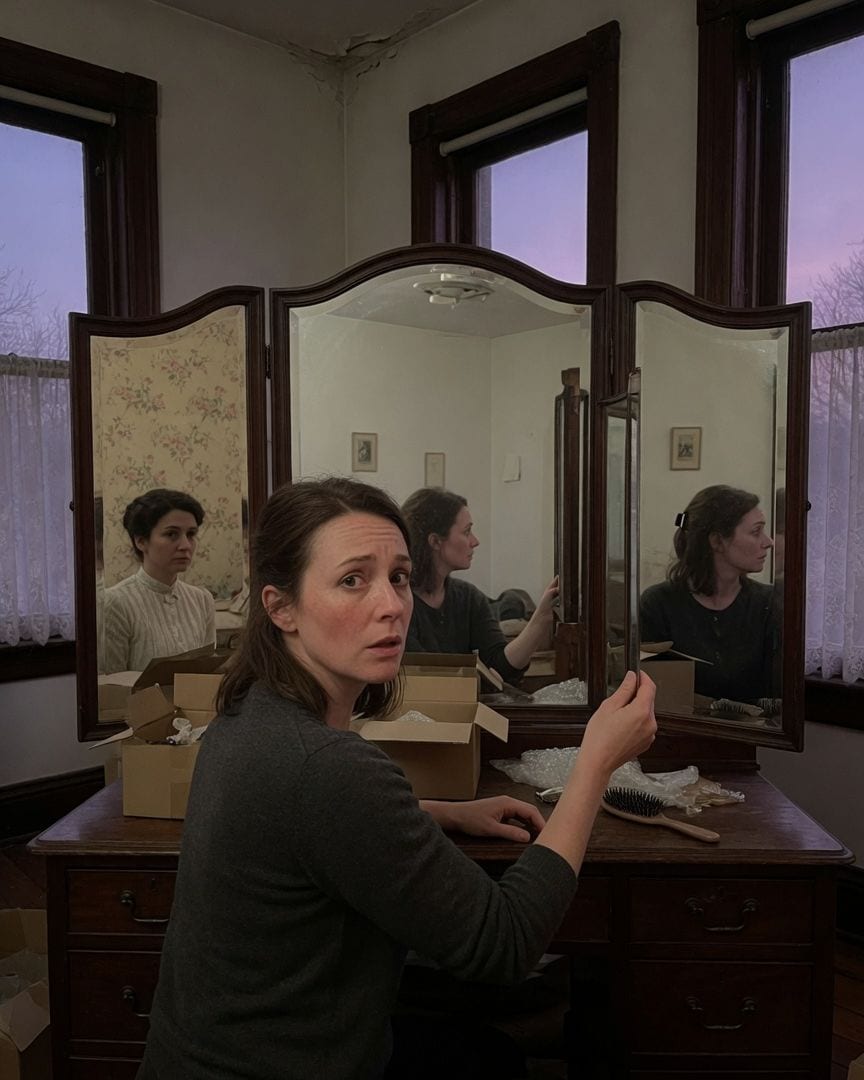
My dressing table mirror shows a woman in a high-necked blouse, doing her hair in a room papered differently from mine. She moves a half-second late, catching up to a memory of the gesture.
I’d inherited the house from a distant relative, a second cousin twice removed I’d only met once at a funeral. It was old, late 1800s, full of heavy, dark wood and a silence that felt less empty and more… full.
Settling in, I found myself drawn to the antique dressing table in the master bedroom.
It was an original fixture, a weighty mahogany piece with a three-winged mirror that seemed to anchor the room's history, whispering stories I couldn’t quite hear.
Tonight, as the twilight bled through the tall windows, painting the room in shades of bruised purple and grey, I stood before it, brushing my own hair, watching my reflection straight on.
My new life, my new home, felt almost tangible in the quiet space. Everything was where it should be.
But then, for the second time this week, as I idly angled the left wing of the mirror, the reflection shifted. It wasn't my own room anymore.
Instead, it showed a woman, dressed in a high-necked cream blouse, her dark hair meticulously pinned up, brushing it at this very table. The wallpaper behind her was a faded floral pattern, utterly unlike my stark, minimalist white walls.
A gasp caught in my throat. I experimented, shifting my own hand, and the woman in the mirror shifted too, a half-second too slow, like a memory catching up to its present.
It was an uncanny, unsettling lag, a temporal stutter. I stilled, my breath held, my heart knocking against my ribs.
The woman’s eyes, dark and distant, met mine for a fraction of a second, an expression of profound weariness on her face, before the angle of the mirror, perhaps from my own involuntary tremor, shifted back, showing only my reflection, the plain white wall behind me.
The room was quiet, the air suddenly cold, clinging to my skin.
The next morning, I tried to rationalize it. A trick of the light, an old smudge on the glass, perhaps my own imagination, tired from the endless boxes and the general disorientation of moving.
I cleaned the mirror meticulously, polishing every surface until it gleamed. Nothing. The glass was spotless, clear as a mountain spring.
But the image of the woman, her weary eyes, stayed with me, a persistent afterimage at the corner of my vision. I couldn't shake the feeling of profound wrongness, of a quiet, insistent violation of reality.
It wasn’t a funhouse distortion; it was a clear, distinct image of another time.
Driven by an inexplicable urge, an itch of uncomfortable curiosity, I began to examine the dressing table itself. It was solid mahogany, heavy, clearly a piece that had seen generations come and go, perhaps even predating the house itself.
I ran my hand along the underside of the main drawer, feeling for any imperfections, any reason for the mirror to play tricks. My fingers caught on a small, almost invisible seam.
It was too precise to be a flaw in the wood. A false bottom. I pressed lightly, experimenting with different spots until, with a quiet, almost inaudible click, a slender, hidden drawer slid out from beneath the larger one.
Inside, nestled in what felt like dried, brittle velvet, was a single, sepia-toned photograph. It was a studio portrait, but the background was unmistakable: my bedroom, but with that faded floral wallpaper.
The woman from the mirror, younger, less haunted, smiled faintly. Her high-necked blouse, her dark hair pinned up – it was identical to the woman I’d seen.
On the back, in elegant, looping script, were two lines: 'Penelope Sutton, October 1932. My Home.'
I stared at the date, a cold dread spreading through me, like ink blooming on wet paper. 1932. This house, I knew from the estate agent, had been empty for decades before my distant relative bought it in the 70s.
Penelope Sutton. Missing, vanished from local records, a historical anomaly that had always intrigued the town. The photograph felt impossibly cold and heavy in my hand, a tangible piece of a past that shouldn't exist in my present.
I sat on the edge of my bed, the photograph in my hand, the brittle paper almost vibrating with an unspoken history. October 1932. Penelope Sutton. The woman from the mirror.
The room in the photograph was undeniably hers, only different, lost to time. A sense of profound wrongness, of a violation of chronology, settled over me. It wasn't a trick of the light. It was real.
I took the photo back to the dressing table, my movements slow and deliberate, and held it up to the left mirror wing, trying to align the angles, to somehow make sense of the impossible.
For a fleeting instant, the woman in the mirror was there again, solid and real, her face superimposed over the photograph, her eyes wide, unseeing, reflecting a profound fear that was never present in the portrait.
It was a silent accusation across the decades. I gasped, a choked sound, dropping the photo. It landed face-down on the polished wood with a soft, chilling thud.
Shaken, I spent the next few days researching Penelope Sutton. Online searches yielded nothing specific, a name lost to time, a footnote in some archived local paper mentioning a disappearance.
My only lead was the local historical society, housed in the old Oakley building downtown. I visited, feeling a strange mix of apprehension and journalistic curiosity, a need to find a rational explanation, to ground myself.
There, I met Samuel Oakley, the archivist. He was a quiet man, eyes sharp and knowing behind thick spectacles, his office smelling of old paper and dust and something faintly metallic. I cautiously showed him the photograph, watching his reaction.
Samuel’s expression didn't overtly change, but his grip on the photo tightened, his knuckles whitening.
He led me to dusty ledgers, pulling them from deep shelves, meticulously turning brittle pages until he finally found a mention: 'Penelope Sutton, resident of 14 Elmwood Drive (my house's address), reported missing, October 27, 1932.'
I felt a chill that had nothing to do with the drafty archives. Missing. Not 'moved away,' not 'died,' not 'eloped,' but 'missing.' No trace. As I walked through my house later that evening, the air shifted again.
A faint, sweet, cloying scent, like cinnamon and overcooked apples, hung in the kitchen, though I hadn't baked anything in days. It was so specific, so distinct, it almost tasted real.
Then, a low, tinny sound, like a waltz playing from a distant, ancient record player, drifted from the living room. It stopped the moment I entered, leaving only silence.
I noticed a specific doorway, usually leading to the linen closet, seemed darker, deeper, the shadows within it coiling into something more substantial than just an absence of light.
For a split second, I could swear I saw a glimpse of a different room beyond it – dark wood paneling, a flickering gaslight, a heavy velvet curtain – before it resolved back into the familiar white shelves of my linen closet.
The house was changing around me, subtly, impossibly, and I was starting to see it.
I continued my research, returning to the archives, but now with a growing sense of unease.
Samuel Oakley, usually reserved, seemed to be watching me from behind his desk, his gaze following me as I sifted through microfiche, his presence a constant, unsettling pressure.
He approached me one afternoon, his voice low, almost a murmur against the quiet rustle of turning pages. 'Some houses, Ms. Vaughn,' he said, his eyes fixed on some distant point, 'they have long memories.
And some memories don't like being disturbed.' The implication hung heavy in the air, a silent warning.
Later that week, returning home after a particularly long session in the dusty archives, I found a small, antique silver locket on my dressing table, a piece I'd never seen before, certainly not one I owned.
It was open, and inside, a tiny, faded photograph of Penelope Sutton, unmistakably, smiled back. My blood ran cold. I lived alone. My doors were locked. There was no explanation.
I left the locket on the table, a test, a desperate hope for a mundane explanation—a misplaced trinket, a bizarre prank. The next morning, it was gone. Panic tightened my chest, a cold knot of fear.
That evening, as I entered the doorway to the linen closet, the illusion was stronger, more persistent, holding for several seconds.
The gaslit room was clearer, sharper in its details: a woman's back to me, her dark hair in a severe bun, arranging something on a mantelpiece.
The faint waltz music was audible now, a mournful, tinny melody that plucked at something deep inside me. The woman turned her head slightly, and I saw the high-necked blouse, the dark hair. It’s Penelope.
She’s not just an echo in the mirror anymore. She’s in the house, a breath away, and she’s looking directly at the doorway, her eyes wide with a familiar, profound fear, as if seeing something terrifying just beyond my view.
The image held for a full second before snapping back to the linen closet, leaving me stumbling backward, my heart pounding a frantic rhythm against my ribs.
I couldn't ignore it any longer. I drove back to the archives, the locket's disappearance and Penelope's terrified gaze burning in my mind.
I confronted Samuel Oakley, describing the locket, the intensifying Door Onto The Wrong Year, the faint, cloying smells, the tinny music. My voice was tight, a thin wire stretched to breaking.
His calm facade finally cracked, replaced by a grim resignation that was almost worse than fear. He took a deep, shuddering breath. 'The Sutton house,' he began, his voice barely a whisper, 'it’s always been… peculiar.
Local legend says Penelope didn't just go missing. She became part of the house, woven into its very fabric.'
He explained that for decades, whispers persisted of strange occurrences there: objects moving on their own, phantom smells of specific meals, glimpses of a woman in old-fashioned clothes.
'My grandmother lived down the street,' Samuel continued, his gaze distant, lost in memories, 'She said Penelope was obsessed with the house, convinced it was alive, that it spoke to her.
Said the mirrors showed her things, the doors led to other times.' He pulled out an old, brittle newspaper clipping, its edges crumbling: 'Local Woman Vanishes Without Trace.'
The article, dated November 1932, mentioned Penelope's 'eccentricities' and her 'unusual attachment to her home,' noting her belief that the house 'remembered' things.
I realized the cinnamon scent, the waltz, the Door Onto The Wrong Year—they were all echoes of Penelope's final days, imprinted on the house, replaying like a broken record.
Samuel then pointed to a marginal note in one of his ledgers, a scribbled entry from a previous archivist, dated 1968: 'Similar reports from the Davies family, 1840s. The 'Door' and the 'Mirror'. Always a woman. Always a disappearance.
A pattern, it seems.' The ordinary explanations, the tricks of light, the tired imagination—they all crumbled around me.
Samuel, seeing the dawning horror in my eyes, pushed the old ledger across the table. It was a property ledger for Elmwood Drive, hand-written in elegant, fading ink. He opened it to a page marked '14 Elmwood.'
'This house,' he said, his voice low, almost a murmur, 'has had a consistent history of short tenancies followed by long vacancies, especially after a female occupant.'
He traced a finger down the column of names and dates, each entry a stark, undeniable fact. 'Penelope Sutton, 1930-1932. Before her, a Mrs. Eleanor Davies, 1838-1840. And before that, a Miss Clara Thornton, 1746-1748.'
He looked up at me, his gaze piercing, filled with a profound, ancient sadness. 'The local stories about the 'Door' and the 'Mirror'… they don't just apply to Penelope. They apply to all of them.
Each one vanished without a trace, just like Penelope. No bodies, no forwarding addresses, just… gone.' He paused, letting the implication sink in. 'And the intervals,' he leaned closer, his voice dropping to a whisper, 'they're almost exact.
Every ninety-two years, Ms. Vaughn. Almost to the day. You moved in just as the clock reset.' Samuel closed the old ledger with a soft thud, his gaze heavy.
'The pattern,' he murmured, pushing the book across the table towards me, 'It repeats. Every ninety-two years, almost to the day. And you, Ms. Vaughn, you moved in just as the clock reset.'
I returned home, the horrifying truth sinking in with every step. The house wasn't just haunted; it was a temporal trap, a cyclical devourer, replaying and absorbing its female occupants on a precise, relentless schedule.
The mirror wasn't merely a window to the past; it was a window to Penelope's present within the house, her final, terrified moments trapped in an endless loop.
The Door Onto The Wrong Year wasn't just a fleeting glimpse; it was a threshold, a pathway being opened for me. The phantom smells, the music, the locket, the photograph—they were not just echoes.
They were Penelope's life force, slowly bleeding into my reality, blurring the lines of existence.
I realized the full, terrifying pattern now: each woman, isolated, slowly driven to believe the house was 'alive,' then vanishing, their essence becoming part of its 'memory.'
I recognized the high-necked blouse as Penelope’s preferred attire, her hair pinned up as her daily ritual, a routine that the house was now forcing me to observe, to internalize, to adopt.
The house didn't want to show me the past; it wanted me to live it. It needed a new memory to retain, a new life to replay, a new occupant to absorb into its timeless, terrifying cycle.
I was not merely a witness; I was the designated participant in a horror that had repeated for centuries, and my time had come.
Driven by a desperate, cold resolve to understand Penelope's final moments, to find some way out, I focused on the dressing table. It was the nexus, the heart of the house’s memory.
I tore away the old, faded floral wallpaper from behind the mirror, ripping at the brittle paper with frantic fingers, revealing rough plaster beneath.
Behind a loose brick, hidden deep within the wall, I found a small, leather-bound diary, its cover soft with age, its pages brittle. It was Penelope Sutton's.
The entries detailed her growing fear, the mirror showing her impossible scenes, the doors opening onto other times, the house whispering to her. The last entry was dated October 28, 1932 – a full day after her official disappearance.
'The house wants me,' Penelope had written, her elegant script frantic and sprawling. 'It's showing me the path, the way out… or in. I see the other women. They smile. They are waiting.'
I clutched the diary, its pages brittle, its words a chilling testament. This artifact, dated after Penelope vanished, proved she was trapped within the house, still writing, still existing, just not in the conventional sense.
The diary was real, tangible, dated, and it was in my hands, in my time. The ordinary explanation died for good. As I read the final, terrifying words, the air in the room dropped to an unnatural, bone-aching chill.
The left mirror wing, without me touching it, slowly, inexorably angled itself. This time, it didn't show Penelope. It showed me myself, my face pale, holding the diary.
But behind me, the wallpaper was faded floral, and the room was unmistakably 1932. My reflection smiled, a faint, wrong little smile, and my eyes held a distant, unseeing quality, a profound weariness.
I saw myself, but I was not myself.
The diary of Penelope Sutton was found, years later, tucked behind a loose brick in the wall of 14 Elmwood Drive by new occupants. Its final entry, dated October 28, 1932, detailed a woman's slow absorption into the house's 'memory.'
The new owners also reported finding an unsent letter from Edith Vaughn, dated October 27, 2024, addressed to Samuel Oakley, detailing her discovery of Penelope's story and her growing fear of the house's cycle, along with a faded photograph of Penelope.
Edith herself, however, was never seen again. Her car was still in the driveway, her possessions neatly arranged, as if she had simply stepped out for a moment.
Only the dressing table mirror seemed to gleam with an unusual depth, reflecting an older, quieter room than it should have, for those who looked closely enough.
The local police, after a perfunctory search, eventually closed the case, listing Edith Vaughn as another unexplained disappearance. The house, 14 Elmwood Drive, stood empty once more, its windows dark, its secrets undisturbed for a time.
For a few years, it was listed for sale, then withdrawn from the market. The listing agent, after a few unsettling walk-throughs where prospective buyers reported 'cold spots' and 'a strange feeling of being watched,' simply stopped returning calls.
The house waits. It always waits. It always remembers.
Years later, a new family drives past the old house, on a whim, looking for a fixer-upper. The young daughter, peering through the overgrown hedge, points a small finger. 'Look, Mom!
There's a woman in the window, at the dressing table.' Her mother glances over, dismissive. 'Nonsense, dear. The house is empty, and it looks quite derelict.'
But for a fleeting moment, in the upper bedroom, a solid figure in a high-necked blouse is visible at the antique mirror, slowly brushing her dark hair.
Her movements are fluid, unhurried, as if she has all the time in the world. She lifts her hand, then pauses, her reflection in the glass catching up to her, a half-second late.
If this one got to you
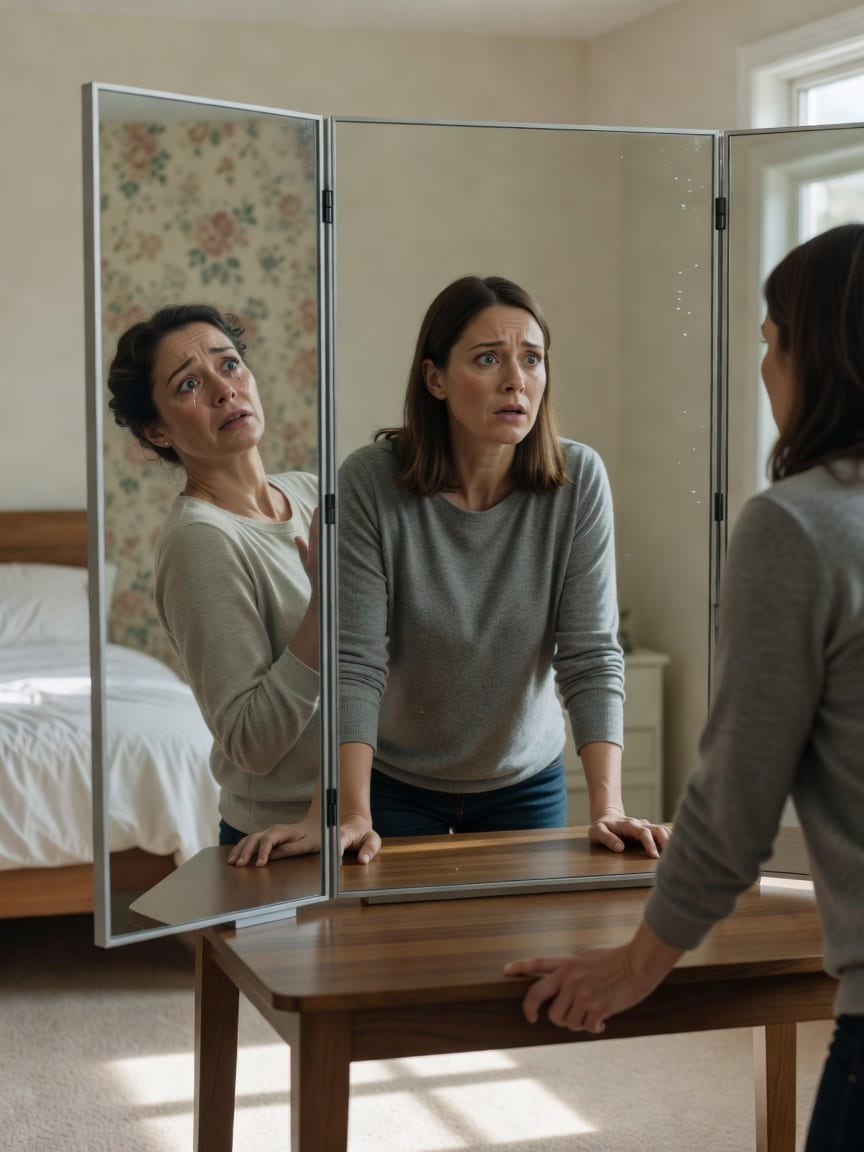
My bedroom mirror shows a woman doing her hair, in a room papered differently than mine. She moves a half-second late.
I moved into my inherited house, with its antique dressing table and mirror. Late at night, the mirror shows a woman doing her hair, but it's not my reflection. Her room has faded floral wallpaper, a stark contrast to my white walls.
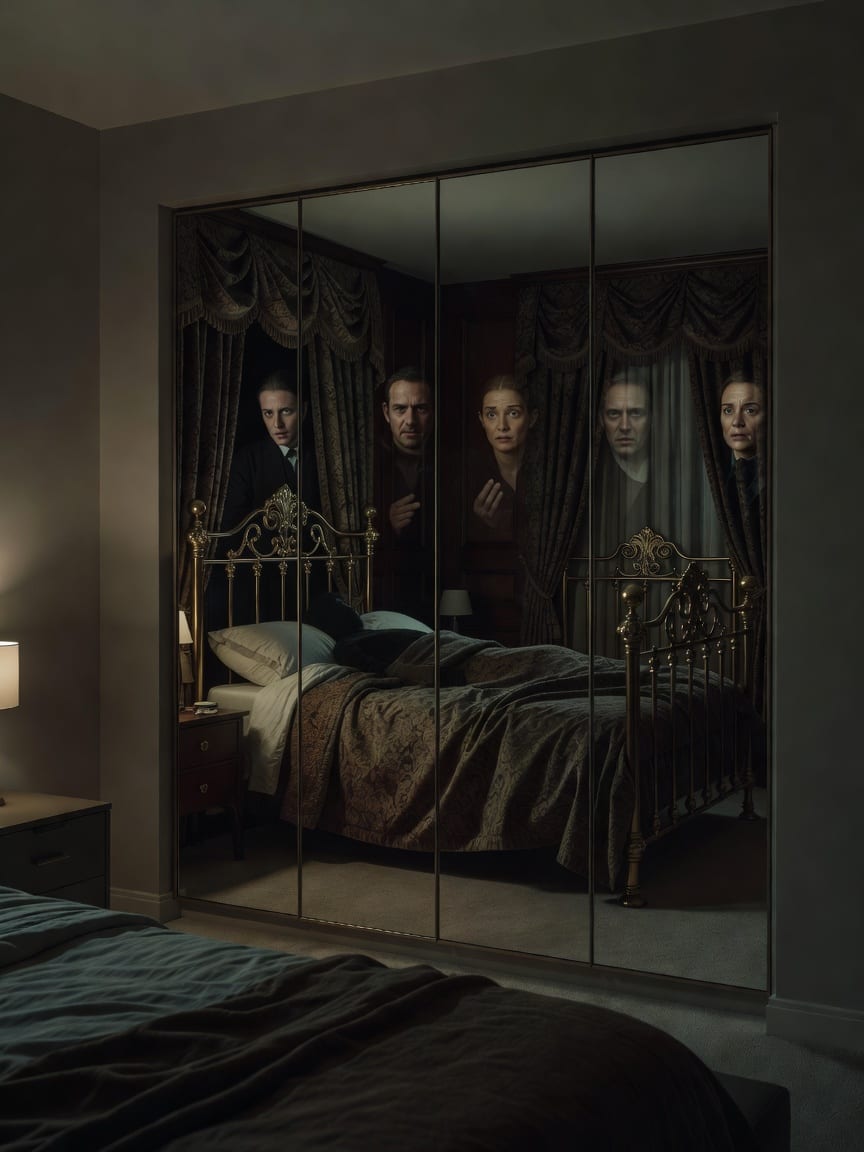
My bedroom mirror shows a Victorian room, not mine. The figure asleep in its brass bed doesn't move, even when I sit up watching.
I woke up before dawn to find my new bedroom mirror reflecting something impossible. Instead of my own room, it showed an old, shadowy bedroom with a figure lying perfectly still in a massive brass bed. Every morning near four, the same scene appears, along with a faint, sweet, medicinal scent.
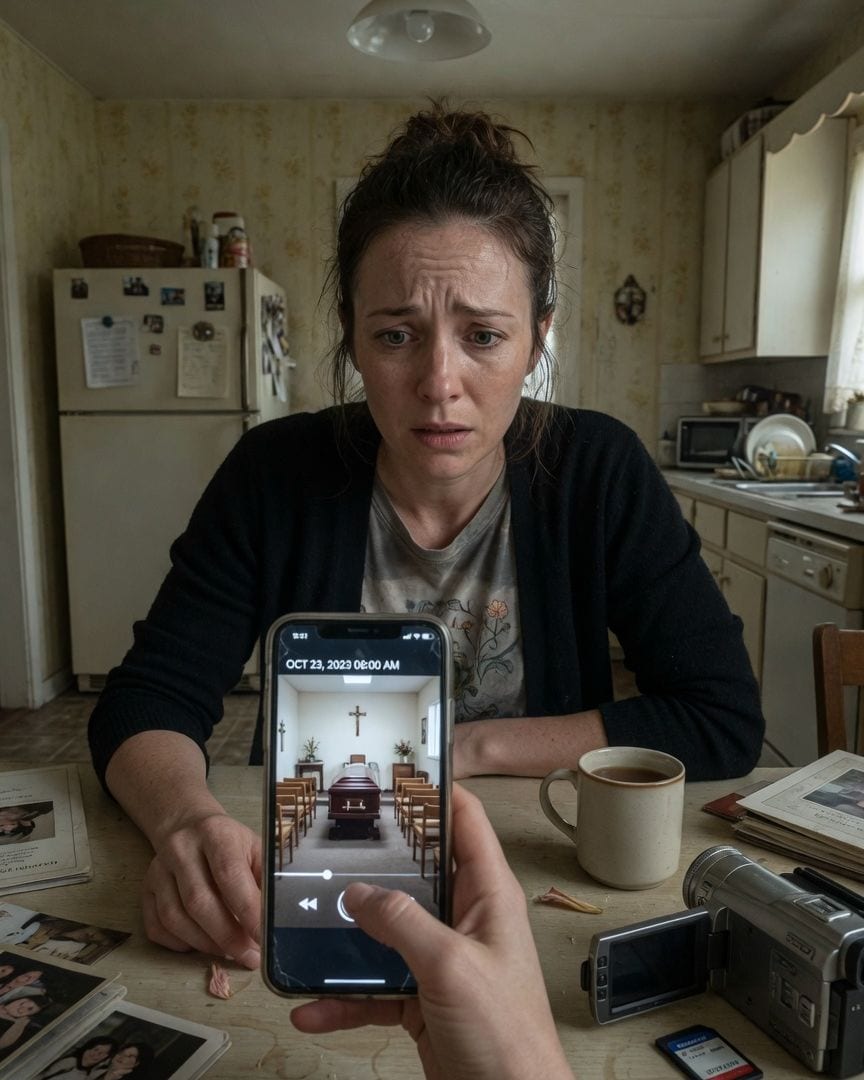
On my dead mother's phone I found a video of her funeral — steady, shot from the back over the mourners' heads, holding on her coffin. The timestamp says it was filmed an hour before any of us had arrived.
Days after my mother's funeral, I sifted through her digital life, hoping for comfort. Instead, her old camcorder revealed a video of my living room, timestamped for tomorrow morning. The abstract landscape I'd just hung was already there, waiting on the wall, a cold dread tightening in my gut.
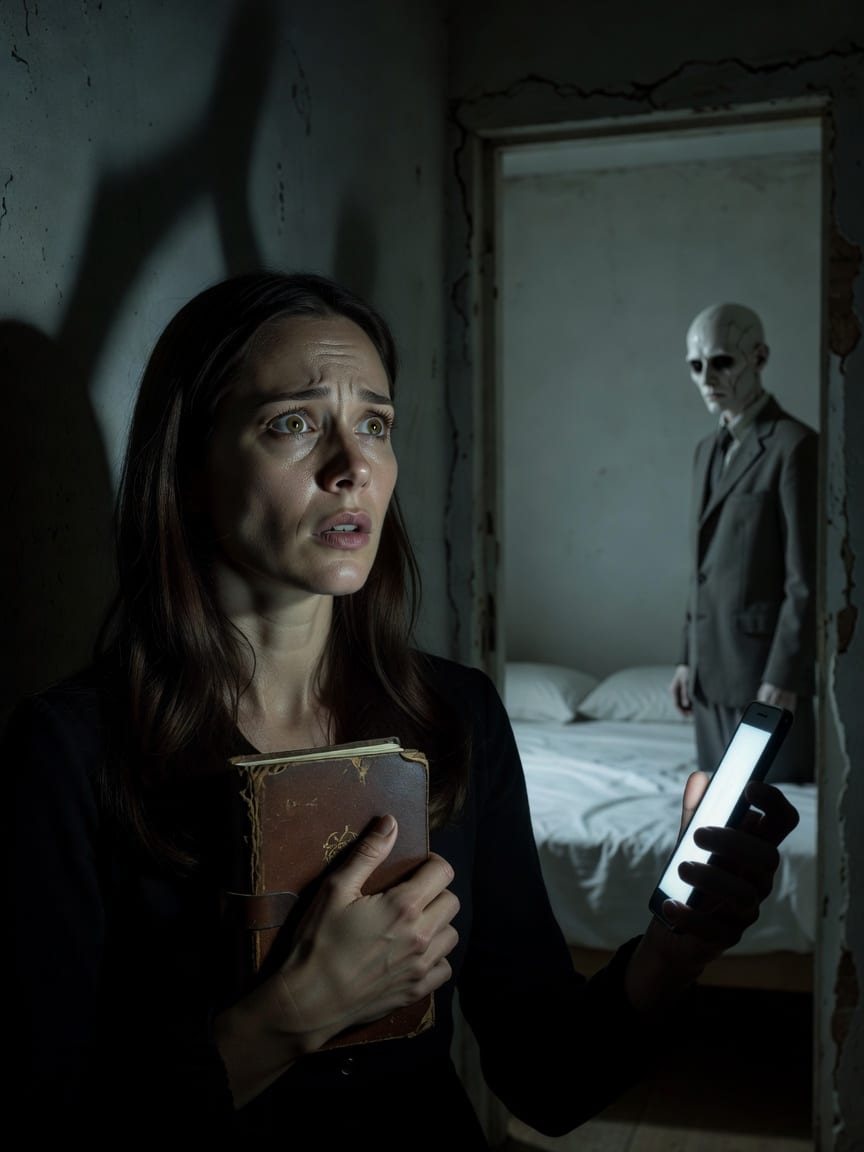
Behind a plastered-over doorway, I found a room. Papered, carpeted, and furnished with a made bed, sealed for decades. The air was dead still, but the bed wasn't dusty. My council tax bill only lists five rooms.
I'm Claire, an architect, meticulously planning my new Victorian terrace renovation. But when I uncovered a hidden room behind a wall, everything I knew about time and decay shattered. The bed was perfectly made, the air still, yet there was no dust, only an unnerving cold.
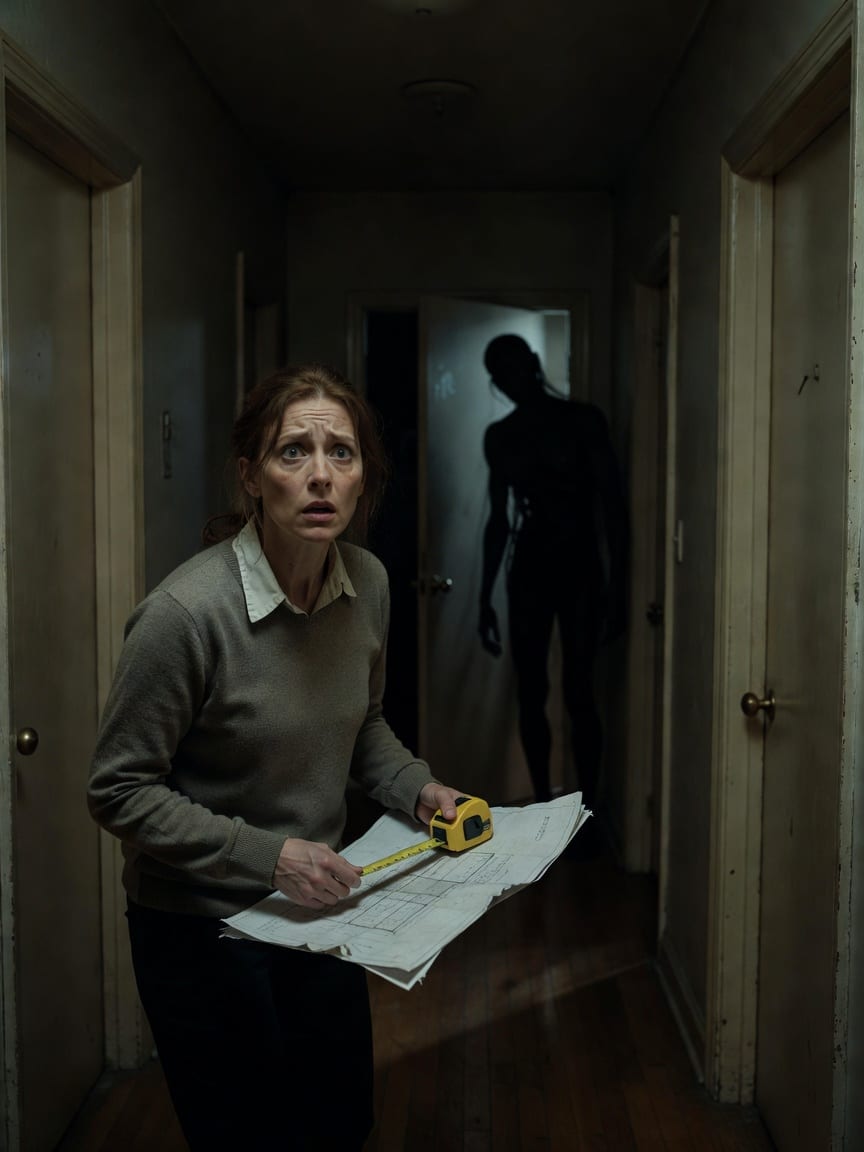
My front door has a dented gate and a dead hydrangea. I walked past it six times, trying to reach the corner shop just a hundred yards away. The pavement kept bringing me back to my own porch, and the shop's light never moved.
My morning started like any other, a quick walk to the corner shop from my home at Number 14, Elm Terrace. But after walking what felt like two minutes, I found myself back at my own front door, the shop no closer. I tried six times, faster and slower, but my street kept compressing, refusing to let me leave.
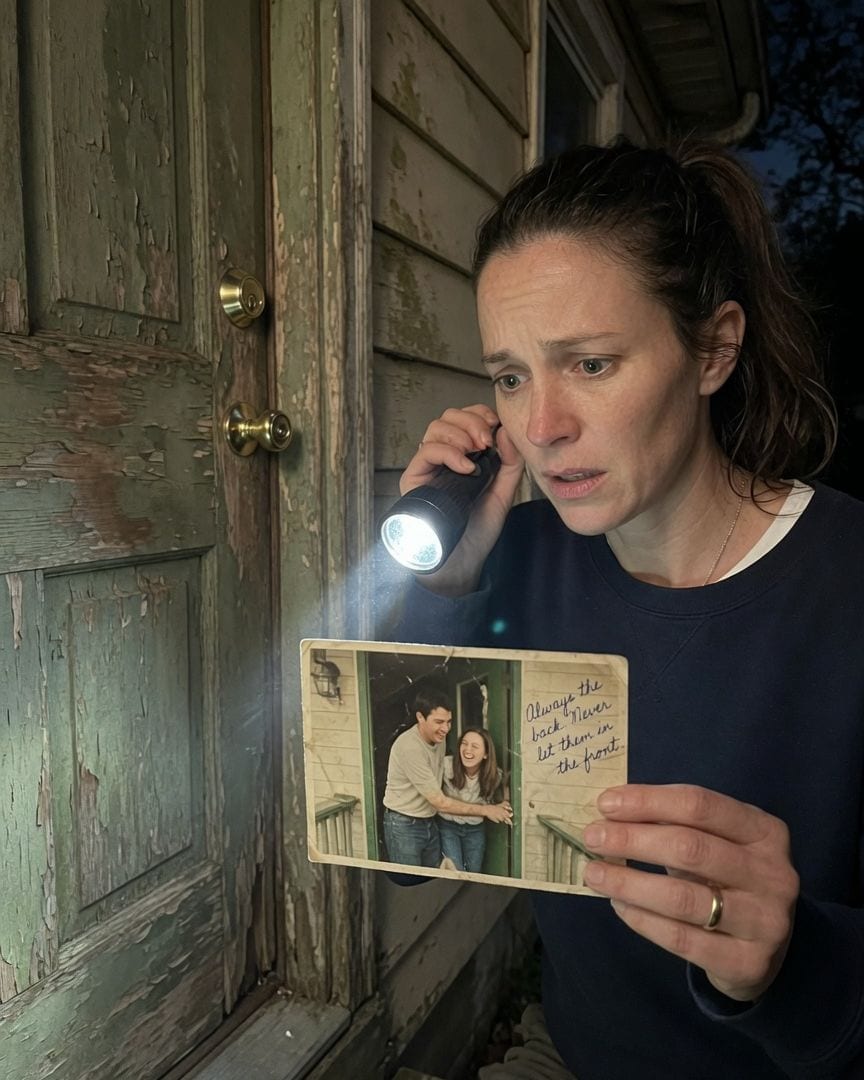
My mother waves us to the front door now. She was missing five days. She says we've always used the front, but the back door, our kitchen door for thirty years, is locked.
My mother, Janet, finally came home after five days, but her overly bright smile and insistence on using the front door felt wrong. For three decades, our family always used the back entrance, which now had a gleaming, new deadbolt. The quiet hum of unease quickly grew into a chilling dread.