My mother waves us to the front door now. She was missing five days. She says we've always used the front, but the back door, our kitchen door for thirty years, is locked.
I stood at the kitchen window, watching my mother, Janet, in the garden. Five days. That’s how long she was gone.
Now she was back, digging diligently at a new rosebush, her movements just a little too deliberate, a little too precise.
The relief of her return was still a raw thing in my chest, but it was thin, stretched over a growing unease I couldn’t quite name. It was the small things, the details that snagged.
My mother, for sixty years, had always told us to "come round the back," the kitchen door, for family. Never the front.
That back door, the sturdy oak one with the peeling green paint, had been our true entrance for three decades, a portal to countless Christmases, Sunday dinners, whispered secrets after dark.
But today, when Raymond and I had pulled into the driveway, she’d been standing on the front porch, beaming. She’d waved, a wide, enthusiastic sweep of her arm. "Coming round the front, darlings!"
she'd chirped, her voice a little too bright, like it was an old family saying she’d just made up.
Out of habit, I’d started walking towards the back of the house, only to find the kitchen door, usually left on the latch for us, now secured with a new, heavy deadbolt.
A gleaming, brass thing that looked utterly alien against the weathered wood. When I’d asked her about it, later, inside the oddly quiet living room, Janet had just smiled, a little too wide, a little too fixed.
"Oh, darling," she’d insisted, her voice unwavering, "we’ve always used the front door for guests, and for family, too. It’s much more welcoming."
I tried to argue, to remind her of muddy boots kicked off on the back porch, of the scent of her apple pie escaping through that very door, of her own countless reprimands for using the formal front entry.
But the smile only widened, unwavering, shutting down every memory I offered. It was such a small thing, a door, a forgotten habit. But it was wrong.
And the way she now took her tea – black, with two sugars, a distinct shift from her lifelong preference of milk, no sugar – was wrong, too. I tried to brush it off.
Grief, shock, five days missing – people change. But the wrongness looped in my mind, a quiet, insistent hum.
Later that evening, after Janet had finally gone to bed, a silence settling over the house that felt heavier than usual, I couldn’t shake it.
Raymond, sensing my agitation, tried to reassure me, blaming stress, blaming the trauma we’d all endured. "She’s been through a lot, Liv. Give her time," he’d said, pulling me close.
But his words were a thin comfort against the insistent prickle under my skin. I felt compelled to act, to find something, anything, to ground myself.
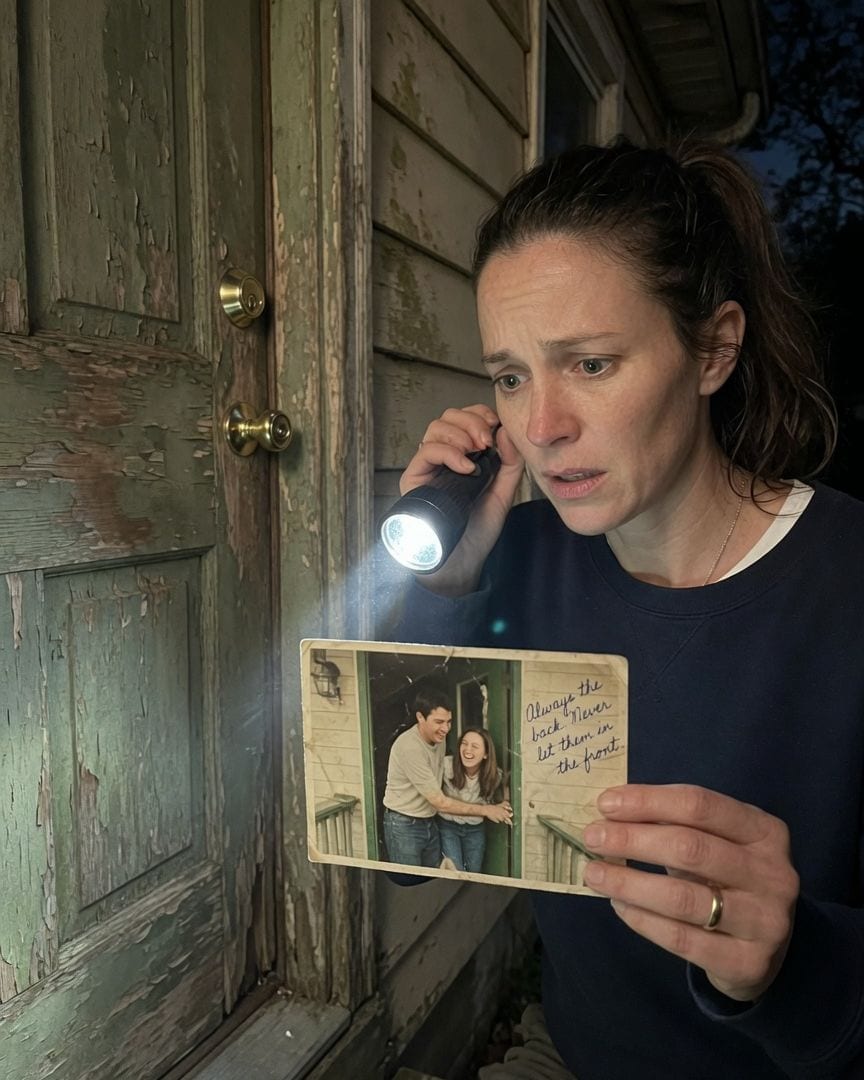
I grabbed my father's old, heavy-duty flashlight from the kitchen drawer, the beam a solid column in the dark. Quietly, I circled around the side of the house, the night air cool and damp against my face.
The back of the house was a deeper shade of darkness. The new deadbolt on the kitchen door gleamed, a cold, unnatural glint under my flashlight beam.
I ran my hand over the old, weathered wood of the doorframe, searching for some proof, some echo of thirty years of habit. The wood was rough, familiar, ingrained with memories.
My fingers traced a faint, almost invisible groove near the bottom hinge, a place where generations of feet had scuffed away the paint, leaving a smooth indentation.
It was a detail only someone who lived here, who knew this house intimately, would ever notice.
I pushed gently against a loose section of the frame, near the floor, where the wood had warped over time, softened by years of rain and sun. It gave slightly, a soft groan.
Behind it, nestled in the damp wood, was something hard. My heart began to thump, a slow, heavy beat against my ribs.
I pried the board back gently, revealing a small, tightly folded object tucked away, almost swallowed by the darkness.
It was an old, faded photograph, the kind my father, long passed, used to keep tucked into his wallet, softened by years of handling. I unfolded it carefully, the paper brittle with age, threatening to tear in my trembling hands.
The flashlight beam caught the image: my parents, decades younger, vibrant and full of life, laughing. They were standing on the back porch, my father holding the kitchen door wide open.
They were clearly entering the house through the back door, a moment of pure, unadulterated family joy, frozen in time.
I flipped the photograph over, my fingers brushing the delicate surface. The back was blank, save for a faint discoloration, a slight yellowing that mirrored the front.
I squinted, holding it closer to the weak moonlight filtering through the trees, then angled the flashlight beam just so.
Barely visible, in my father's familiar, looped script, were a few words, written in a fading ink, almost absorbed by the ancient paper. My breath caught in my throat. 'Always the back. Never let them in the front.'
The words were a chilling counterpoint to the gleaming, new deadbolt on the kitchen door just behind me, and the new, unfamiliar woman now sleeping inside.
I gripped the photo, my knuckles white, the cold dread that had been a whisper now screaming, a siren in my mind. This wasn't just grief, or stress, or a simple change in habit. Something was profoundly, terribly wrong.
The photograph burned in my pocket for days. I couldn’t show it to Raymond yet; I knew he’d try to explain it away, find a rational explanation for the irrational, just like he always did. But I couldn't ignore it.
The next morning, I observed Janet with a terrifying new lens, every movement, every gesture, scrutinized.
She moved through the house with a subtle, almost imperceptible stiffness, as if remembering how to inhabit her own body, how to navigate familiar rooms. Her steps were too light, her posture a little too erect.
It was like watching someone play-acting, a performance that was almost perfect, but just off enough to be unsettling.
I watched her prepare breakfast. Janet, who always used her right hand for everything – stirring coffee, flipping eggs, even just gesturing – now instinctively reached for the coffee pot with her left.
Her fingers wrapped around the handle, then stopped, a fractional hesitation. With a small, awkward jerk, she corrected herself, transferring the pot to her right hand.
She hummed a tune as she buttered toast, a jaunty, unfamiliar melody I'd never heard her sing before, then her lips clamped shut, and she switched to an old standard, a familiar Bing Crosby song.
It was too fast, too smooth a switch. Later, when she thought I wasn’t looking, I saw her glance at her left hand, then her right, a fleeting moment of self-assessment.
Discreetly, I started checking old family photo albums, searching for any detail, any anomaly. Pictures from my childhood showed her consistently right-handed, always, without exception. There were photos of her pouring tea, holding a pen, waving – always the right.
And in every single one, if her mug was visible, it was milk, no sugar. Raymond, though patient, grew increasingly concerned by my intensity, by the way I watched Janet, the way I picked at every detail.
"She’s been through a trauma, Liv," he’d said gently, his hand on my arm, "people change after something like that." But I knew this wasn’t change. This was a poorly rehearsed performance, a meticulous imitation.
I started keeping a small, hidden journal, tucked under the loose floorboard behind my bed, noting every inconsistency, every reversed habit.
The way Janet would pause before answering simple questions, her gaze distant for a moment, as if calculating the right response.
The faint, almost imperceptible gleam in her eyes when I mentioned something specific from our past, a hunger that wasn't quite human, a flash quickly masked by her familiar warmth.
I even dug through old boxes in the attic, searching for home videos.
I found one, shot by my father, showing off his new deadbolt on the front door, making a joke about how the back door was 'sacred, only for family.' The evidence mounted, slowly, meticulously, constructing an undeniable pattern of wrongness.
My mother was gone. This woman wore her skin.
My investigation, quiet as I tried to keep it, didn't go unnoticed. I first spotted Julian Thatcher, our long-time neighbor and family friend, watching our house from his living room window.
He’d always been a quiet man, a widower for years, content in his solitude. But now his gaze, even from across the expanse of our separate lawns, felt too steady, too knowing.
It wasn't the casual observation of a neighbor; it was surveillance.
A few days later, I was gardening in the front yard, methodically pulling stubborn dandelions from around my mother’s prize-winning roses, when Julian approached. He walked slowly, his hands tucked behind his back, ostensibly to ask about Janet's recovery.
"Glad to have her back, Olivia," he said, his voice calm, almost unnervingly so. It was an even tone, without the usual sympathetic inflections you’d expect. "It's a difficult adjustment, for everyone involved. Takes time to settle back in."
He didn’t look at Janet, who was inside, visible through the living room window, watering her plants with that new, slight stiffness.
Instead, Julian looked directly at me, his eyes holding a depth of understanding that chilled me to my bones. It was the gaze of someone who knew exactly what I was feeling, and why.
"Some things," he added, lowering his voice slightly, as if sharing a confidence, "are best left undisturbed. For everyone's peace of mind." He paused, letting the words hang in the still afternoon air, heavy and unspoken.
Then he offered a faint, knowing smile that didn't quite reach his eyes, before turning and walking back to his own yard. He moved with a quiet certainty that left me with the distinct impression I'd just been warned.
The next day, I found a small, smooth river stone on my porch, placed neatly on the welcome mat. A type not found anywhere in our garden, not on our property.
It was a small, harmless gesture, but the implication was clear: he knew I was digging, and he was letting me know he was watching.
The river stone on my porch, cold and smooth against my palm, solidified my resolve. Julian wasn't just observing; he was communicating. He knew. And I needed to know what he knew.
I waited until Janet was out for a walk with Raymond, a new habit she'd picked up since her return, then marched straight to Julian Thatcher’s house.
I didn't knock; I just walked up the short path and rang the bell, my heart hammering. He answered the door promptly, as if he'd been expecting me, his calm demeanor utterly unruffled by my hurried arrival.
"Julian," I said, my voice tight, cutting straight to it, "what do you know about my mother?" He invited me in, his living room cool and dimly lit, offering tea, which I declined with a shake of my head.
"I know she's home, Olivia. That's what matters." His tone was level, too level.
I pulled out the old photograph, the one from my father's wallet, laying it on his polished coffee table between us. The faded image of my laughing parents, the almost invisible script on the back.
"Then explain this," I demanded, pointing at the picture.
"Explain why she says we always used the front door, but my father left a warning about 'them' and the front door, right here, on a photo of them coming in the back."
Julian picked up the photograph, his gaze lingering on the faded script, on my father’s familiar hand. He sighed, a quiet, almost mournful sound, as if burdened by a secret. "Your father was… a perceptive man."
He looked up, his eyes, suddenly intense, meeting mine. "Janet is… adjusting. It's a complex process. The transition from… absence, back to presence, can be disorienting."
He offered this explanation with the practiced ease of someone who had said it many times before.
I pushed back, the words tumbling out. "This isn't disorientation, Julian. She's left-handed now for some things. She drinks her tea black when she always took milk. She pauses before she speaks.
And she stares at me sometimes like she's never seen me before." Julian set the photograph down, his fingers still tracing its edges. "These are… minor inconsistencies. The mind, under duress, can create new patterns. Or adopt them."
He paused, a deliberate, unsettling silence, then added, his voice softer, almost confidential, "Sometimes, Olivia, when a loved one is lost, deeply lost, there are… arrangements made. To ensure their return. Not always perfect, but a return nonetheless.
A part of them, at least."
A cold wave washed over me, a physical chill that started in my gut and spread through my limbs. "A part? What does that mean?" Julian looked out his window, his gaze distant, focused on something beyond the glass.
"It means some things can be… salvaged. Reconstructed. But the blueprint isn't always complete. There are gaps. And sometimes, those gaps are filled from… other sources. Other memories, other experiences. It’s how they learn."
The implications hit me like a physical blow, a sudden, brutal clarity. The 'other sources,' the 'how they learn.' The wrongness of her habits, the locked door, the impossible tea preference – it all twisted into a terrifying, coherent shape.
My mother wasn't just changed. She was… borrowed.
Later that evening, the weight of Julian’s words pressed down on me. “Other memories, other experiences… how they learn.” I sat with Janet in the living room, the quiet hum of the television doing little to dispel the tension.
I decided to test Julian’s chilling theory. “Remember that picnic we had, when I was little?” I asked, trying to sound casual, my voice trembling slightly. “The one by the old oak tree in Julian’s field? You weren’t there, Mum.
You were visiting Aunt Greta.”
Janet’s face softened, a warm, nostalgic smile spreading across her lips. “Oh, but I was, darling! I remember it so clearly! It was a beautiful spring day, not a cloud in the sky.
You wore your little blue overalls with the embroidered duck, and Raymond, he was just a toddler then, tried to feed a squirrel your peanut butter sandwich.
Julian had brought his old harmonica, the silver one with the tarnished edges, and he played ‘Twinkle, Twinkle, Little Star’ for you. You clapped your hands and tried to sing along, but you only knew ‘star, star’.”
Janet’s eyes glistened with what looked like genuine affection, her gaze fixed on a distant, shared memory.
My blood ran cold. Every detail was correct – my little blue overalls, Raymond’s age, Julian’s silver harmonica, the specific song, even my toddler efforts to sing. But my mother wasn’t there.
I remembered it distinctly: she’d been miles away, visiting a sick Aunt Greta in Elmwood, a trip she made every spring. “But… you weren’t there, Mum,” I whispered, my voice barely audible, shaking. “You were with Aunt Greta.
I remember Daddy telling me.”
Janet’s smile didn’t falter, but her eyes, for a split second, went utterly flat, devoid of warmth, like dark, polished stones reflecting nothing. Then, just as quickly, the warmth returned, deeper, more certain, dismissing my doubt with an unnerving ease.
“But I remember it perfectly, dear,” she insisted, her gaze unwavering, completely unbothered by my disbelieving silence. “Every detail. Don’t you?”
The memory, so vivid and false, hung in the air between us, a shared secret from a life Janet never lived. I felt a profound, chilling certainty: whatever came back, it remembered things it shouldn’t. Things from other lives.
Things Julian knew.
I returned to Julian’s house the next morning, fueled by a terrible clarity, a cold rage. I didn't knock. I just walked in, pushing open the unlocked front door without ceremony.
Julian was sitting in his familiar armchair, a worn copy of some classical literature open on his lap, looking as if he’d been expecting me for days.
The room was quiet, permeated by the faint scent of old paper and something else, something metallic and cold that I couldn't place.
“She remembers the picnic,” I stated, my voice flat, devoid of emotion. “The one she wasn’t at. The one you were at.”
Julian closed his book, placing it carefully on a small, antique side table beside him. There was no surprise in his movements, no flicker of concern. “I told you, Olivia. The memories… they are shared. A pool, of sorts.
Especially among those who… facilitate.” He stood, walking slowly to the window, his back to me, gazing out at his impeccably manicured lawn. “Your father understood. He knew the cost of true loss. And the… alternative.”
He turned to face me, his hands clasped behind his back. “There are certain places, certain energies, that allow for a… continuity. When someone truly vanishes, when the grief becomes unbearable, sometimes, something else steps in.
It takes the form, it learns the patterns, it accesses what it can from the ambient memories. And from others who have… returned.”
My mind reeled, grasping at the horror, the implications of his calm words. “Others?” I whispered, the word a raw gasp.
Julian nodded, a slow, deliberate movement. “It’s been happening for a long time. They are, in their own way, guardians of a kind of peace. A way for the bereaved to cope, without knowing the full, final truth of absence.”
He gestured around his quiet, ordered house, a gesture that encompassed not just his home, but the world outside. “I help them. I help them learn. I ensure the transitions are… smooth. I knew your mother was taken.
And I arranged for her… return. The best possible version, given the circumstances.” The phrase ‘best possible version’ hung in the air, a grotesque euphemism for the thing that wore my mother’s face.
The methodical way he spoke, the lack of any remorse or hesitation, painted a picture of a man utterly at peace with this monstrous reality.
The river stone, the locked back door, the tea, the left hand, the false memory—it all clicked, a terrible, intricate mechanism of deception.
The calm in Julian’s voice was the most terrifying thing I had ever heard. He spoke of my mother’s replacement as if discussing a difficult pet or a delicate repair. “So the real Janet… she’s gone?”
I whispered, the words tasting like ash in my mouth, the truth finally solidifying, undeniable.
Julian inclined his head slightly, a gesture of solemn acknowledgment. “Long gone. What you have now… it is a comfort. A presence. And it learns. It wants to be her.” He took a step closer, his gaze earnest, almost pleading.
“You have two choices, Olivia. You can accept this. Live with it. Let her be your mother, in this new, imperfect way. Or you can fight it.
But if you fight it, if you expose it… you risk not only losing this semblance of your mother, but inviting… disruption. And the others won’t tolerate disruption. They will ensure… silence.”
I felt a tremor go through me, a profound shiver that reached my very core. The implication was clear: fighting meant losing everything, perhaps even my own life, or something far worse.
I looked at Julian, at the man who had knowingly replaced my mother, who calmly explained this monstrous truth, his eyes steady and unwavering. I couldn’t fight the ‘others,’ whoever or whatever they were, lurking in the periphery.
I couldn’t bring my real mother back. But I also couldn’t pretend this was Janet, not truly. A cold, hard resolve settled in my chest. I decided. I would live with it. I would keep the secret.
But I would never truly accept it.
“I understand,” I said, my voice steady, though my hands, hidden at my sides, were shaking uncontrollably. “I won’t fight.”
Julian smiled, a small, satisfied curve of his lips. “Good. It’s for the best, Olivia. For everyone.”
As I left his quiet, ordered house, the front door closing softly behind me, I felt a profound, chilling emptiness, a hollowing out of my world. My mother was gone.
And something else, something with her mother’s face and borrowed memories, now lived in her home, protected by a man who called himself a keeper.
Life settled into a new, unsettling rhythm. Raymond, unaware of the full, horrifying truth, attributed my quietness, my occasional distant gaze, to lingering grief and the trauma of my mother’s disappearance.
He was kind, gentle, and utterly blind to the subtle wrongness that permeated our lives. Janet, the returned Janet, continued to move through our days, a perfectly crafted illusion.
The town celebrated her return, grateful for the miracle, oblivious to the monstrous secret that pulsed beneath the surface of their familiar smiles and greetings.
I observed. I noted. I recorded. My small, hidden journal, tucked under the loose floorboard in my bedroom, filled with small, subtle tells that no one else would ever notice.
The way Janet’s eyes sometimes drifted to Julian’s house next door, a brief, silent communication that passed between them.
The occasional, perfectly placed memory that wasn't hers, a detail from a life she couldn't have lived, a fleeting glint of something ancient in her gaze.
I kept the old photograph hidden, tucked deep into the pages of my journal, a stark, tangible reminder of the truth.
The back door remained locked, its gleaming new deadbolt a constant, physical barrier, a silent testament to the line I had drawn, the boundary between what was and what never could be again.
Years passed. Janet was a fixture in the community once more, a beloved mother and, eventually, a grandmother. The small slips became rarer, almost imperceptible to anyone but me, to anyone who wasn’t looking for them.
Sometimes, when Janet laughed, a bright, clear sound, I’d catch a fleeting glimpse of something ancient in her eyes, a wisdom that stretched beyond sixty years, a shared memory of a different kind of life. Raymond never noticed.
No one ever noticed. The back door remained locked, and I never used the front door if I could help it, a silent, desperate protest against the lie that lived within my home, that lived in my mother’s skin.
I had survived, but a part of my soul, the part that had believed in simple truths, was hollowed out. I lived with the knowledge, a permanent sentinel against a presence that wore her face.
The back door remains locked, and sometimes, when she smiles, I see a memory that isn't hers.
If this one got to you
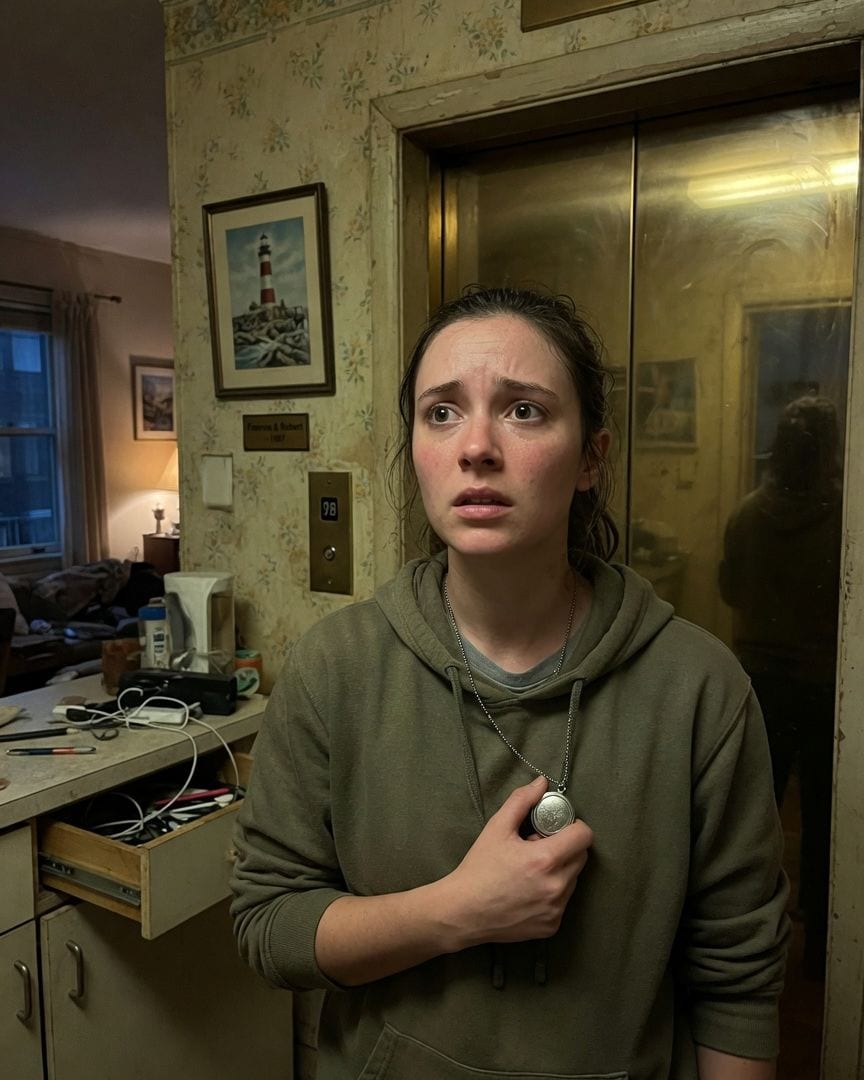
My aunt rode the elevator up, humming, at ease. She hadn't stepped in one since 1994, and told the story of why to anyone who'd listen.
My Aunt Frances stood beside me in the hospital elevator, humming a low tune. It felt deeply wrong; she hadn’t set foot in one since a traumatic incident in 1994, always taking the stairs. Now, after five days missing, she was completely at ease, denying she’d ever feared something so silly, her eyes holding an unsettling calm.
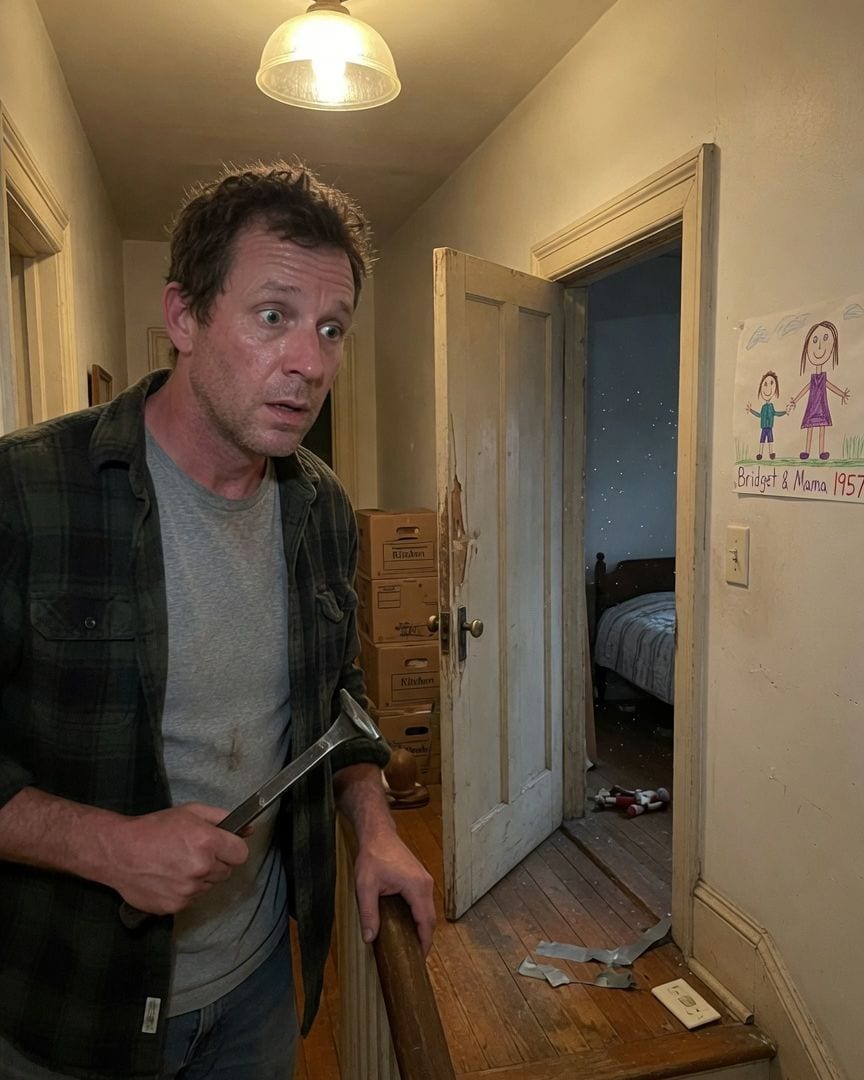
My landing light switches itself off at 9:40 every night. I've watched the switch flick down under nothing, the tape peeled back. The house holds its breath.
My great-uncle's old house was a quiet gift, a place to finally settle. But as I unpacked, a strange worn path on the floorboards led me to a small, barely visible door, perfectly blended into the wall. It was undeniably locked, and felt like a deliberately obscured secret.
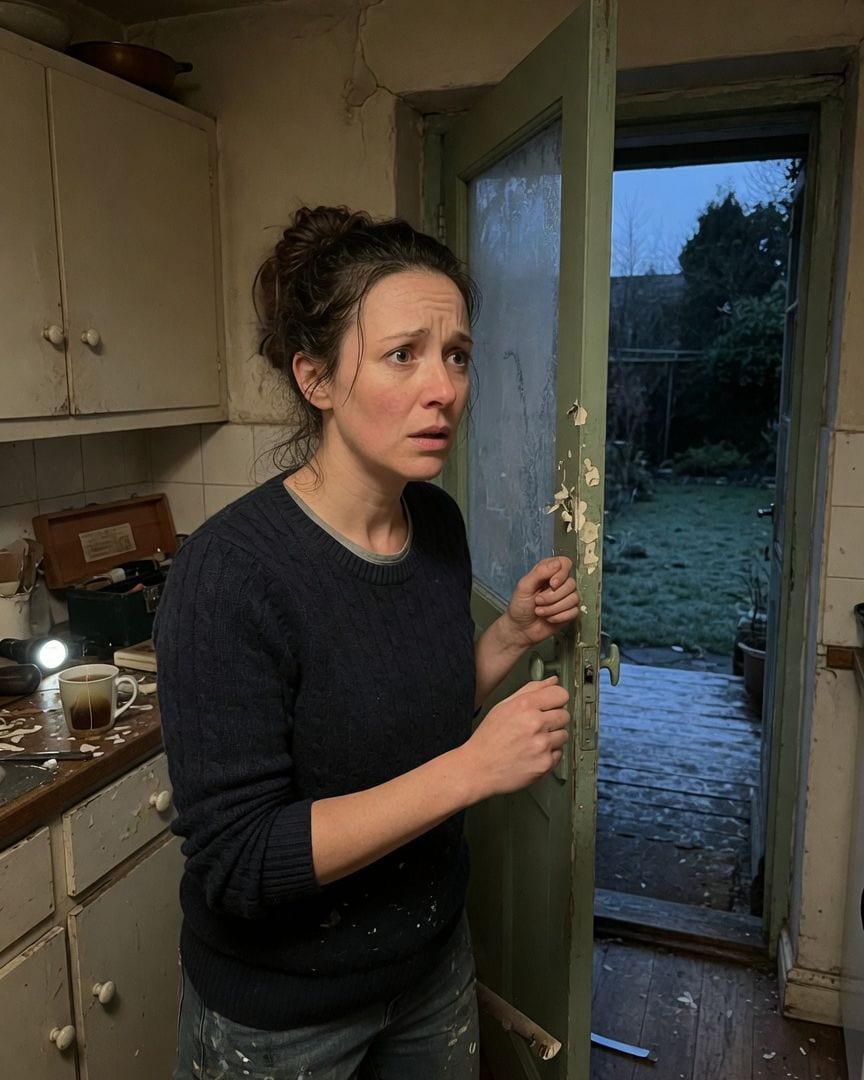
My 1950s cottage doorframe has '1923' carved into it, a date that simply cannot exist here.
I'd poured my heart into renovating my new cottage, especially the back door to my patio. But when I opened it, I wasn't looking at my frost-kissed garden. Instead, a cramped, reeking scullery with a bone-chilling dampness stared back, an impossible image that wouldn't leave my mind, even after the door closed.
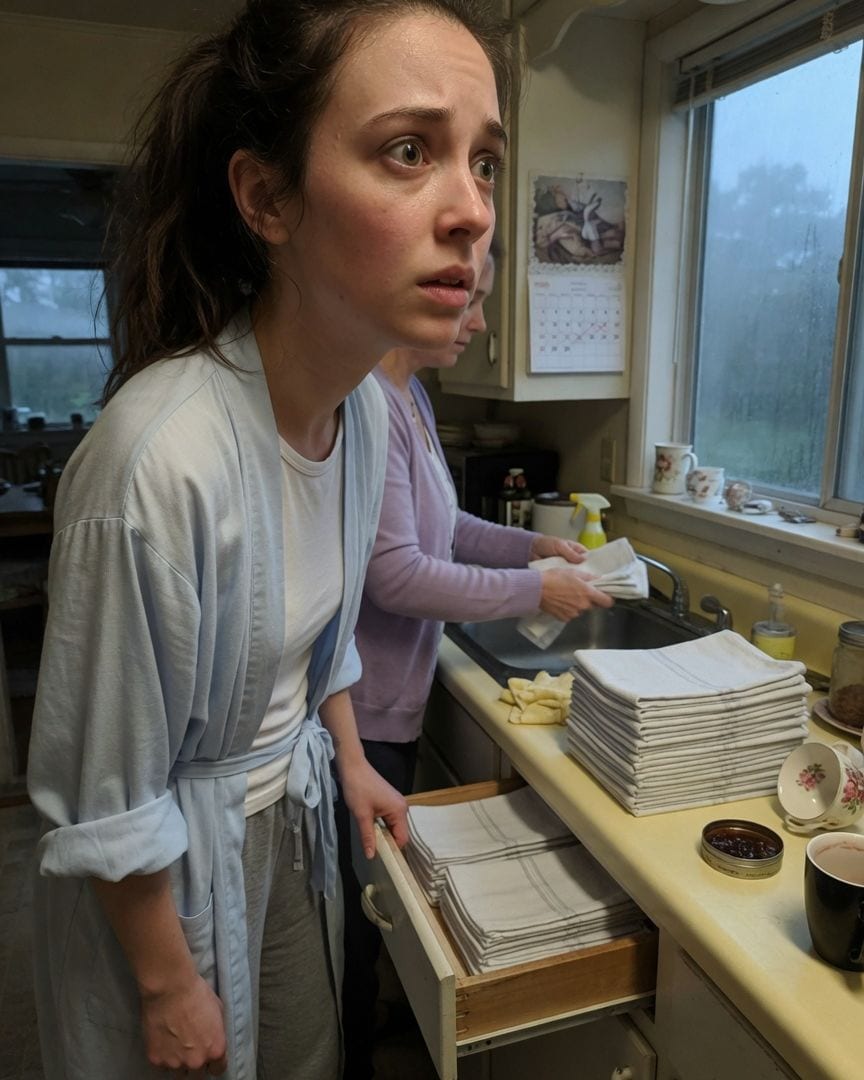
My mother's left wrist has a new scar. She never had one there.
My mother is finally home after her disappearance, and I'm trying to find our old rhythm. But then I watch her fold tea towels, a simple ritual I learned from her. She's doing it completely wrong, seam-out, insisting it's how she's always done it.
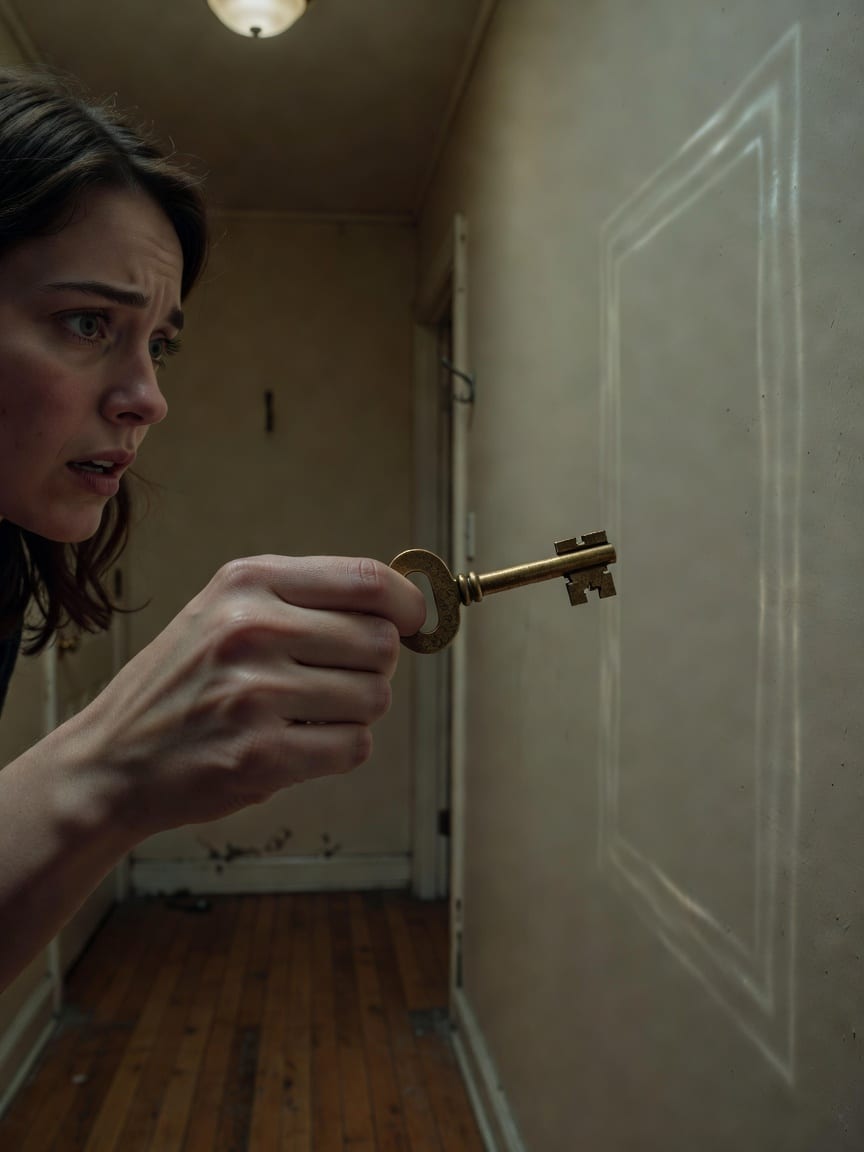
My new house has seven rooms. The removal men counted six. Now one of them asks who's in the locked seventh, on a landing with only six doors.
Moving into my new house, I supervised the removal men hauling boxes. But on the landing, Paul, the senior man, asked about a locked seventh room upstairs, pointing to a blank wall. His quiet certainty, despite the clear absence of a door, filled me with a sudden, icy dread.
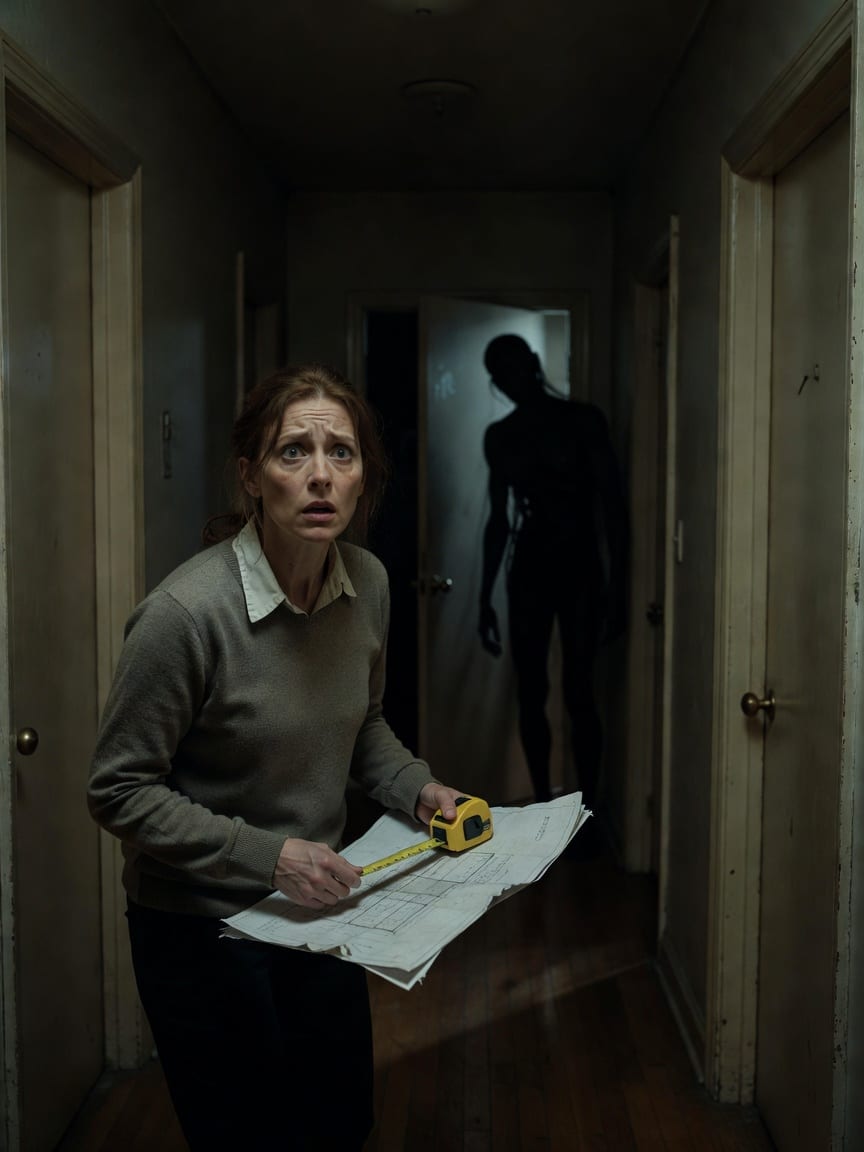
My front door has a dented gate and a dead hydrangea. I walked past it six times, trying to reach the corner shop just a hundred yards away. The pavement kept bringing me back to my own porch, and the shop's light never moved.
My morning started like any other, a quick walk to the corner shop from my home at Number 14, Elm Terrace. But after walking what felt like two minutes, I found myself back at my own front door, the shop no closer. I tried six times, faster and slower, but my street kept compressing, refusing to let me leave.