My ferry's night log recorded a foot passenger disembarked at 2:15 AM. We don't sail until six, and I wrote the entry myself.
The auxiliary generators hummed a low, steady thrum beneath my feet, the only sound cutting through the dead quiet of the ferry’s small, echoing office. It was another uneventful night shift, just as it should be.
The ferry, the ‘Sound Clipper,’ was tied up tight at Pier 7, engines cold, gangway locked, not due to sail until the 6 AM run.
I reached for the overnight watch log, a thick, bound ledger, to make my hourly round entry. My pen hovered over the 3:15 AM line, but my eyes snagged on the line directly above it. The 2:15 AM entry.
‘All fast, gangway secured, foot passenger disembarked,’ it read. Clear as day. And under it, my own looping hand, signed with my initials: NL.
Except it couldn’t be.
I stared at it, a cold prickle starting at the back of my neck. No passengers disembarked at 2:15 AM. Ever. The ferry was a steel tomb at this hour, not a bus stop.
I distinctly remembered making my 1:15 AM entry, charting the silent, empty decks, then returning to the office for a cup of lukewarm coffee. The 3:15 AM entry was next. But there it was, between them, undeniable.
My own handwriting, recording an impossible event. A foot passenger. At 2:15 AM. Damn it.
My mind raced. Had I sleep-walked? A momentary lapse, some kind of waking dream? I shook my head, the idea absurd. I was wide awake, had been all night. My coffee was still hot.
The only explanation was that someone else had written it, trying to mimic my hand, but no one else had access to the log. Not the night log. That was my responsibility.
The dread began to prickle, a cold whisper against my neck, like a phantom draft.
I grabbed my heavy-duty flashlight, the beam cutting a stark path through the dark, empty car deck, toward the gangway ramp. The air was colder down here, smelling of salt and diesel.
The gangway was still secured, just as I’d left it, the heavy chain wrapped twice, the padlock cold and solid in my gloved hand. No sign of forced entry.
I ran the light along the metal grates, the concrete of the pier, looking for anything out of place. Nothing. Just the usual grit and damp from the tide.
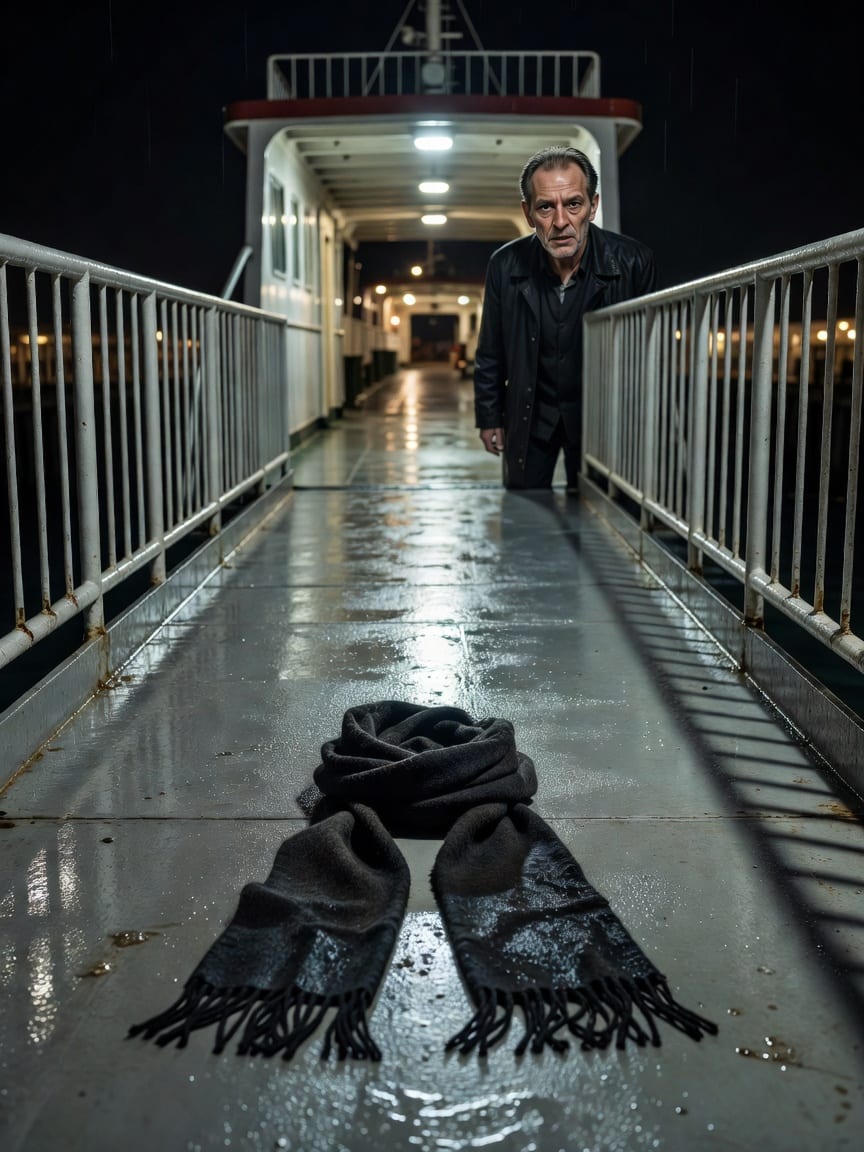
But then, as I turned to leave, my beam caught on something. Tucked into the crease where the gangway’s ramp met the pier, almost perfectly hidden, was a dark grey wool scarf.
It was neatly folded, almost pressed, but damp to the touch. It had a subtle, worn pattern, not crew issue. I checked the lost and found from yesterday’s runs – nothing like it.
The crew did a sweep at closing; this scarf definitely hadn't been there on my 1:15 AM round. It was too clean, too deliberate, too newly placed.
It was a physical thing, left precisely where the phantom passenger would have stepped off the ferry. I knelt, picked it up.
It felt cold and heavy in my hand, a solid piece of evidence that deepened the impossible, made it real in a way the log entry couldn't. This wasn't a glitch. This was a presence.
Back in the office, my hands were shaking as I plugged in the small, portable monitor for the security cameras. The ferry only had a few, mostly for monitoring cargo, but one angle covered the gangway.
I navigated the interface, my thumb fumbling slightly on the cold plastic buttons, selecting the 2 AM to 3 AM timeframe. The footage played, grainy and silent.
I watched myself make the 1:15 AM round, a ghostly figure in the dim light, saw the empty gangway, the secured chains. Then, as the timestamp rolled toward 2:15 AM, the picture flickered.
A sudden burst of white noise, a snowstorm of black and white, then a blank, dark screen. It lasted only a second, maybe two, before the image snapped back into focus. The timestamp now read 2:16 AM.
The gangway was empty, secured. It was as if the camera itself had blinked, skipping over the precise minute the log claimed a passenger disembarked.
I rewind the security footage one more time, my finger trembling on the playback button. The timestamp rolls past 2:15 AM.
The screen shows only static for a full minute, then jumps abruptly to 2:16 AM, the gangway empty and secured, as if that minute never happened.
The next morning, I tried to dismiss it all as a glitch, a strange anomaly, a bad dream. But the damp wool scarf was still folded on my desk at home, a silent, woolen accusation.
When I got back to the ferry that afternoon, I checked the passenger manifests from the previous day, hoping to find a forgotten name, a late booking. Nothing. The last passenger officially logged off the ferry at 10:45 PM.
I even discreetly asked Thomas Foster, the morning shift deckhand, if he’d noticed anything unusual when he arrived. He just shrugged, rubbing sleep from his eyes, yawned. “Same old night, Nina. Quiet as a tomb.”
His dismissive tone only solidified my isolation, made me feel crazy.
I spent my lunch break poring over the ferry’s maintenance logs, looking for any record of camera malfunctions around 2:15 AM.
There were entries for blown bulbs, faulty wiring, even a broken lens on the upper deck camera from last month, but nothing for the gangway camera. Nothing for that specific time.
It was meticulously maintained, its record unbroken, save for my own footage. The more I dug, the less rational the world became.
Later, I found myself lingering near the dock master's office, where Ronald Foster, a man who seemed to have been part of the ferry's furniture for generations, sat hunched over paperwork. He was quiet, always watching, his eyes missing nothing.
He moved like an old tide, slow but inevitable. I considered asking him, but something in his calm, almost ancient stillness, made me hesitate. He just kept writing, his pen scratching softly.
I felt his gaze follow me as I walked away, a prickle on my skin. The more I looked for answers, the more I felt… observed.
That night, I returned to my shift, the scarf now tucked into my bag, a constant, heavy reminder. The ferry felt different, colder, its usual creaks and groans taking on a sinister edge.
The metal groaned like something trapped, the sound echoing through the empty decks. I made my 1 AM round, checking the log, my hand tightening on the pen.
I forced myself to write the entry for 1:15 AM, then stared at the blank 2:15 AM slot, a nervous tremor running through me. I wouldn’t write it. I wouldn’t.
As I returned to the office, Ronald Foster was standing by the door, a mug of steaming tea in his gnarled hand. He hadn't been there a minute ago.
He wasn’t supposed to be here at all, his shift ended hours ago. “Late night, Nina?” he asked, his voice a low rumble, surprisingly deep for his age. His eyes, though, weren’t on my face.
They flickered down to my bag, where the scarf was, then back up. He didn’t smile. The room seemed to grow heavier, the air colder. “Heard there was a… minor anomaly in the logs last night.
A bit of a phantom, eh?” He took a slow sip of his tea, his gaze steady, unblinking. “Some things, Nina, are best left alone. They have a way of… correcting themselves.”
The air in the small office grew heavy, suddenly charged. It wasn’t a threat, not exactly, but a deep, quiet warning. He knew. He knew about the log, about the camera, about my digging. His presence was not accidental.
He was watching me, and he wasn't just observing. He was part of it, a silent guardian of whatever wrongness permeated the night shift.
I felt a cold knot tighten in my stomach. “What do you mean, Ronald? Correcting themselves? What kind of anomaly?” I pulled the scarf from my bag, laying it on the desk between us.
Its dampness seemed to chill the very air. “And what about this? Found it right by the gangway, after the impossible entry.”
Ronald’s gaze lingered on the scarf, a flicker of something unreadable in his eyes – resignation, perhaps, or a deep weariness that went beyond simple fatigue. He sighed, a sound like rustling dry leaves in an empty room.
“The log… it fills itself sometimes, Nina. Or rather, you fill it. Without thinking. It’s part of the routine.”
I stared at him, dumbfounded. “I don’t understand. I don’t remember writing it. Not a damn thing.”
Ronald nodded slowly. “That’s how it works. A quiet compulsion. As for the scarf…” He picked it up, his fingers tracing the worn pattern, his touch surprisingly gentle. “They leave things behind sometimes. Traces. Just like the logs.
Little proofs that get… cleaned up.” He looked at me, his expression unblinking, eyes like ancient sea glass. “There was a young fella, back in ’88. Steve Patterson. Deckhand, just like you. He tried to fight it.
Tried to keep the log blank. Said he wouldn’t be part of it.”
My heart pounded, a frantic drum in my chest. “What happened to him?”
Ronald’s voice dropped, almost a whisper, as if the walls themselves might be listening. “He left the scarf, too. A different one, but a scarf. And then… he disembarked. At 2:15 AM.”
He placed the scarf back on the desk, his eyes now fixed on mine, holding me. “The camera footage? Always glitches then. Always has. It’s not broken, Nina. It’s just how the night works here.
It’s been happening since long before either of us were born. The ferry… it carries certain passengers. On certain nights. And they always disembark at 2:15 AM.”
The impossible log entry, the phantom passenger, the missing camera footage – it all clicked into place, not as a random glitch, but as a chilling, orchestrated pattern, a routine maintained by the living and the dead.
I felt a wave of nausea, cold and sharp. Steve Patterson. Disembarked. The words hung in the air, heavy with unspoken dread. “How many others?” I whispered, my voice barely audible. “How many have ‘disembarked’ at 2:15 AM?”
Ronald didn’t answer directly. Instead, he walked over to a dusty, locked cabinet hidden behind a stack of old life vests. The hinges creaked in protest as he opened it.
He rummaged for a moment, then pulled out a small, tarnished brass key. With a soft click, he opened a lower compartment I had never noticed before.
Inside, nestled among mothballed safety manuals, was an entire stack of old, leather-bound ledgers, identical to the current watch log, but thicker, their covers worn smooth with age.
He took one out, its leather cracked and peeling, and placed it gently on the desk. Its pages were yellowed, brittle. I opened it, my breath catching in my throat.
The first entry I see, dated 1957, reads '2:15 AM, foot passenger disembarked,' in a looping, unfamiliar hand, followed by a faint, almost identical description of the phantom passenger.
Ronald watched my face as I turned the ancient pages, each one a chilling echo of my own experience. The air in the office felt thick, heavy with forgotten time.
“That one’s from my father’s time,” he said, his voice flat, devoid of emotion. “And there are more. Generations of them.” He explained that the 'passengers' weren't truly people, not in the way we understood.
They were a manifestation, a presence that used the ferry as a conduit, a gate.
It wasn't evil, not in a human sense, but a natural, cyclical phenomenon tied to the currents, the specific crossing, and the pull of the town itself.
“It needs a record,” Ronald continued, his gaze drifting to the current logbook, then to my hand, as if seeing an inevitable outcome already written there. “A witness to its passage. And it makes sure it gets one.
One way or another.” He spoke of a faint, almost hypnotic suggestion that came over the watchman around 2 AM, an urge to fill the log, to secure the gangway, to acknowledge the impossible disembarkation. “It’s not malicious, Nina.
It’s just… hungry for its routine. For its passage. And if you fight it, if you refuse to write it down…” He let the sentence hang, implying the fate of Steve Patterson, the meaning cold and absolute.
The full pattern was horrifyingly clear. The logs, the scarves, the camera glitches – all part of an ancient, uncanny ritual the ferry had been performing for decades, with the night shift workers as its unwitting, or unwilling, priests.
I felt the weight of generations pressing down on me, crushing me. The full truth wasn't a monster to be fought, but a tide to be endured. There was no escape, no stopping it.
The ferry was the conduit, and I, now, was part of its mechanism. Ronald stood, quietly placing the old logbook back in its hidden compartment, the faint smell of dust and old paper lingering in the air.
“It’s not something you can undo, Nina. Only accept.”
That night, back on shift, the clock crept towards 2 AM. I sat at the desk, my hand clutching the pen, poised over the empty 2:15 AM line.
The hum of the generators felt louder, a low throb in my skull. I closed my eyes, trying to resist the creeping urge, the quiet, insistent hum in my mind that wasn’t my own.
All fast, gangway secured, foot passenger disembarked. The words formed in my head, clear and unbidden, as if dictated by some unseen force. I squeezed my eyes tighter, sweat beading on my forehead. I would not write it.
I would not be another link in this chain, another ghost in this machine.
But then, a strange, cold calm settled over me. My hand, seemingly of its own accord, lowered to the page. The pen moved, forming the familiar loops and lines of my own handwriting.
It was effortless, precise, and utterly outside my control. I watched, a silent observer in my own body, as the entry was completed, my initials signed beneath it.
The compulsion receded as quickly as it had come, leaving behind only a profound, chilling emptiness. I had not fought it; I had become it. The ritual had claimed me, just as it had claimed all the others.
I continued my night shifts on the ferry. The other crew members noticed nothing amiss. I performed my duties with the same quiet competence, but something in my eyes had changed.
My movements were a little smoother, my gaze a little more distant.
I moved through the empty decks with a new, unsettling awareness, seeing the faint outlines of past 'passengers' in the shadows, hearing the whispers of the tide as if it spoke directly to me.
The ferry, once just a job, was now a living, breathing entity, with its own dark rhythm and ancient purpose. The world had not ended, but my place in it had irrevocably shifted.
I was a keeper of the gate, forever marked by the knowledge of what truly ran the night.
The ferry schedule remained unchanged, the tides continued their relentless pull, and the 2:15 AM entry in the overnight watch log continued to appear, always in the current deckhand’s hand, always naming a foot passenger. I no longer fought it.
I simply performed my duty, a silent participant in the ferry's ancient, uncanny ritual. The dread of the unknown had been replaced by the heavier burden of knowing, and the quiet acceptance of an unchangeable truth.
I saw Ronald sometimes, his eyes holding the same deep, quiet understanding. We never spoke of it. He’d just nod, a slow, knowing gesture, and take his tea.
The tide always turns, and some passengers always disembark.
If this one got to you
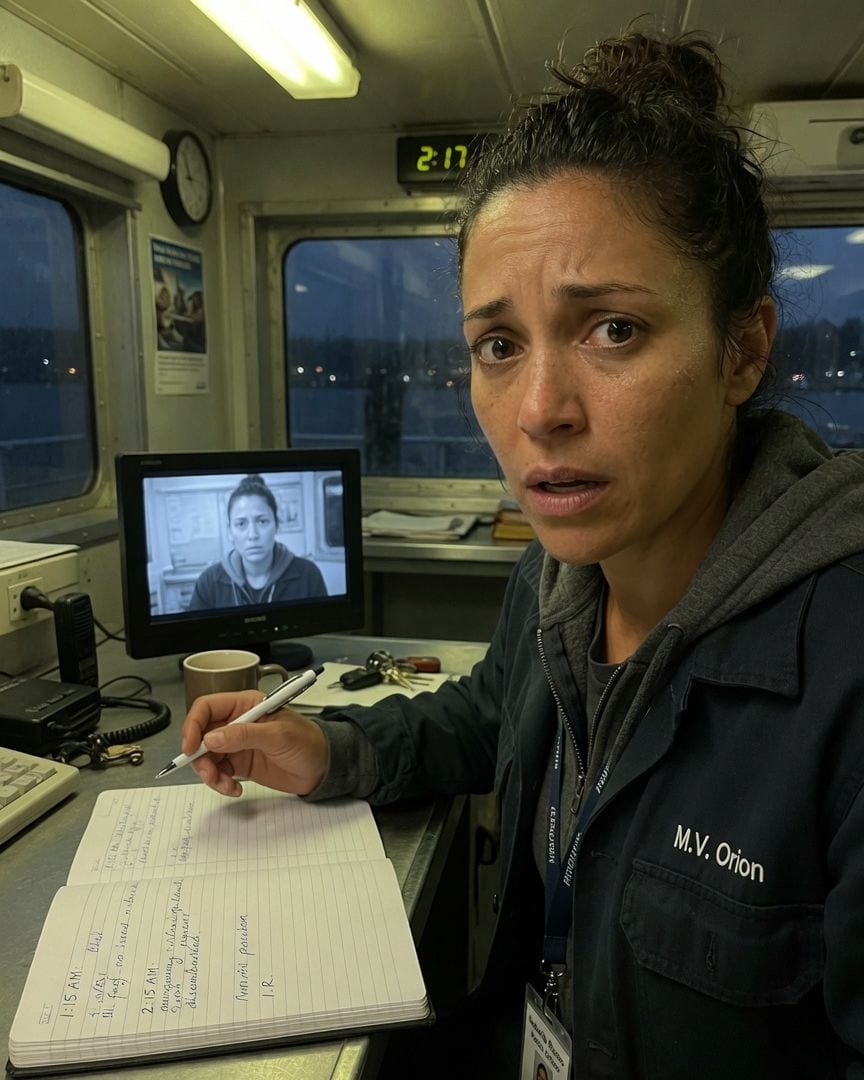
My security camera showed my own face at 2:15 AM, writing an entry I didn't make, staring utterly blankly into the lens before the screen flickered.
As a meticulous watchman on the M.V. Orion, I was making my routine 2:00 AM log entry when I found a previous one I hadn't written. Timestamped 2:15 AM, it stated a 'foot passenger disembarked' with my own initials beside it. But the ferry was dark, silent, and completely empty.
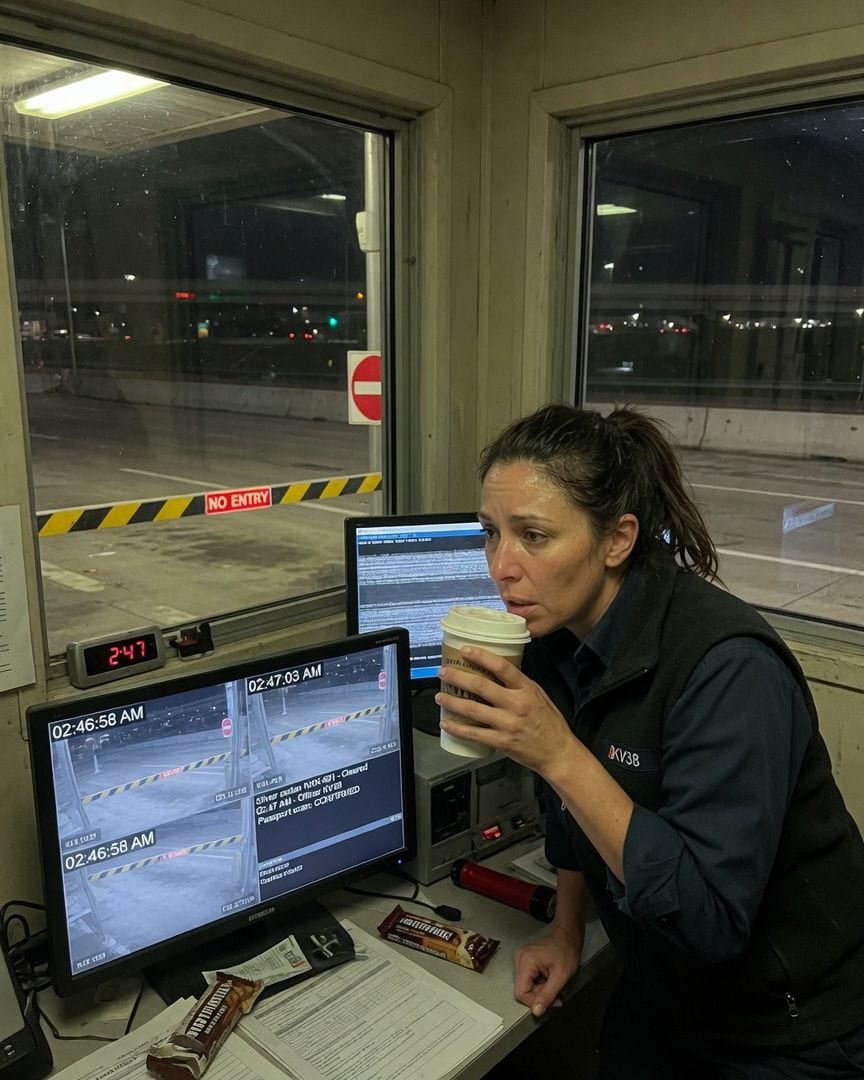
My lane's barrier was down, but my log cleared a car at 2:47 AM. With my code.
Working the quiet overnight shift at the Vance-Romano land crossing, I expected only routine system logs. Instead, a new entry showed a silver sedan cleared northbound through my Lane 3, stamped with my officer code. The issue: my lane had been closed and locked all night, and I hadn't seen a single car pass. Then I discovered the external camera feed for those crucial seconds was simply gone.
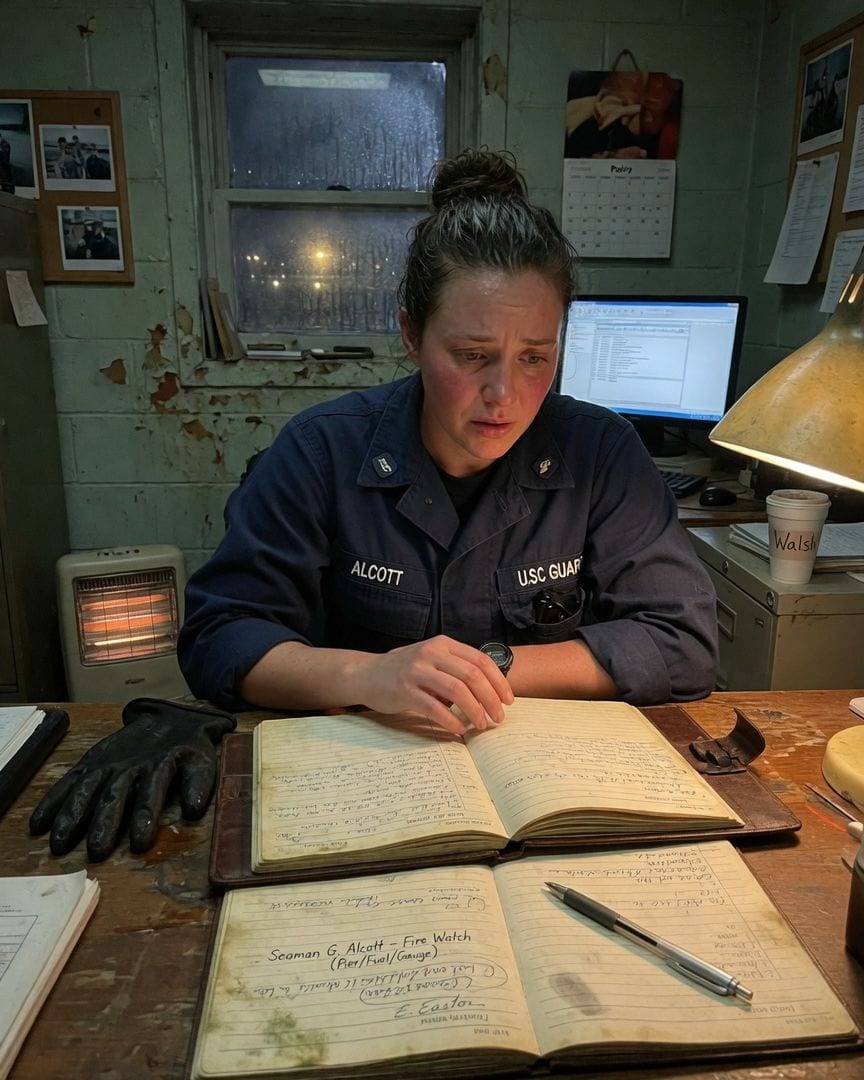
Seaman Alcott found fresh bootprints mirroring her own, a half-stride ahead in the fog. Her boots were the only pair logged out for fire watch.
Seaman Genevieve Alcott knew the rhythm of Coast Guard Station Petrel, a precise forty-minute fire watch circuit she’d walked for six months. Tonight, a thick fog coated the pier in brine and rust, muffling all sounds but her own boots on the damp planks. But as her flashlight cut through the mist, it revealed a second set of fresh bootprints, identical to hers, a half-stride ahead – even though her boots were the only pair logged out that night. Back in the boat shed, the meticulous logbook confirmed it: only her signature for issued boots. Yet, the prints were undeniably real.
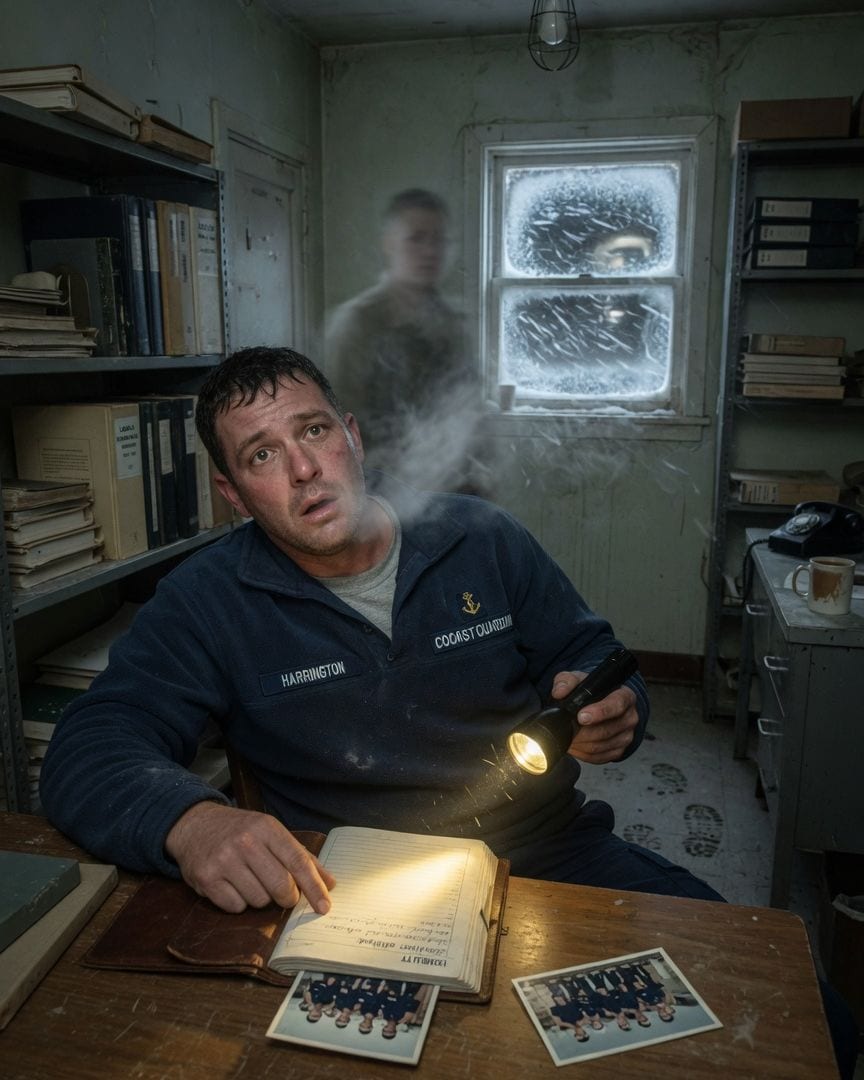
Coast Guardsman Victor Harrington was alone, but his own log entry read: 'Visitor arrived. Not yet departed.' The ink was wet.
Coast Guardsman Victor Harrington endured the nor'easter's crushing weight against the remote LORAN station's windows during his last lonely watch. Exhaustion claimed him for an hour, but when he jolted awake, the station's logbook held a chilling surprise: his own handwriting recorded, '0300. Visitor arrived. Not yet departed.' The ink was still glistening wet, and soon after, Victor discovered fresh, wet boot prints across the floor — not his, and leading to a dead end with no sign of entry. Every door remained locked, every window unbroken, yet the prints had simply materialized, leaving the guardsman with a suffocating sense of impossible dread. Who or what had left its mark in a sealed, storm-battered station, and how?
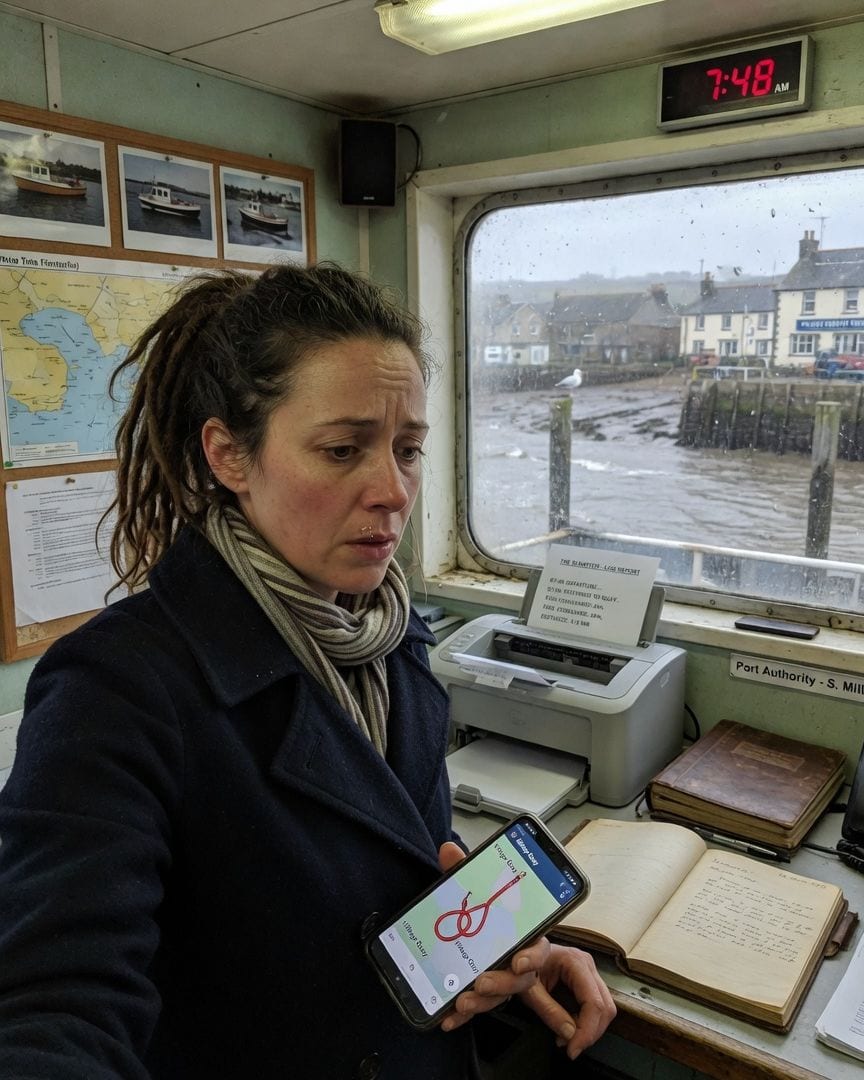
My morning ferry crossed for 40 minutes. The destination town just disappeared.
I board 'The Seawitch' every Tuesday for the familiar eight-minute estuary crossing. But this morning, after making good time, Captain Bernard and I watched the town quay simply fail to appear. Instead, our ferry repeatedly returned to the very same village quay we'd just left, despite burning fuel and advancing the clock.
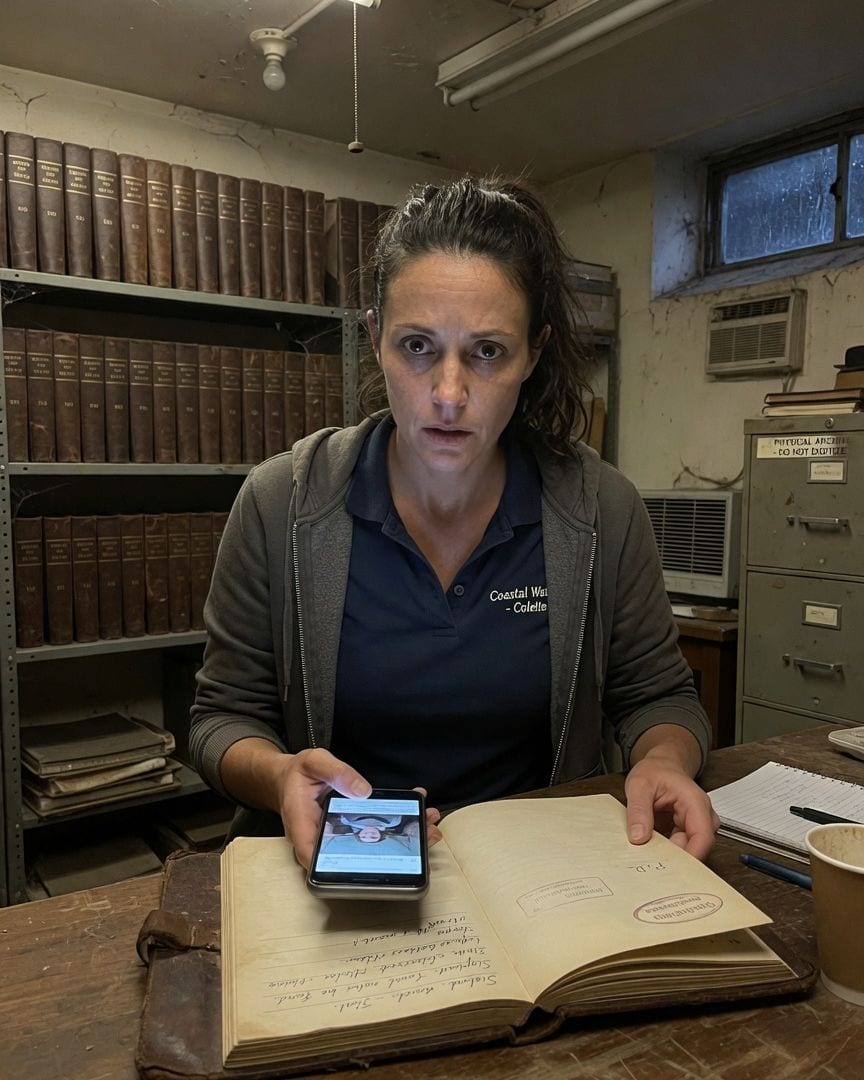
My coastguard log noted Sighting 9 again tonight, a light where no vessel showed. The old logs carry Sighting 9 off Skerry Point at 3:14am every tenth year since 1954, always 'nothing found,' always 'send no boat.'
On my watchtower night shift, the radar screen glowed green and the ocean was quiet. Then, a familiar light appeared off Skerry Point, exactly on cue, just as it had every tenth year for decades. But digging deeper, I found a hidden stamp in an old logbook: 'Operation Skerry. Status: Complete.' It left me with a chilling sense of finality.