First Sergeant Vance found Specialist Renner's discharge order, bearing his own signature, dated a full six months before Renner reappeared.
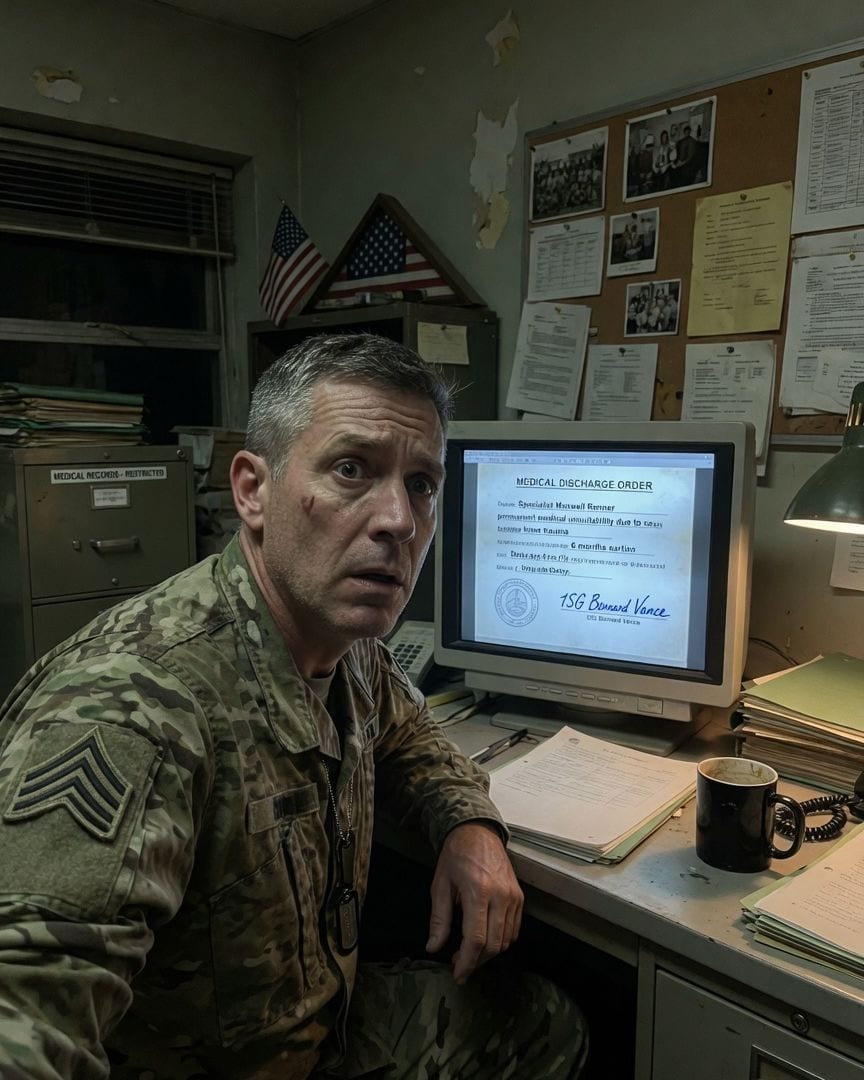
First Sergeant Bernard Vance watched Specialist Maxwell Renner. Vance had known Renner for over a decade, since their time at Benning.
He knew the man’s bad left knee, the way it popped on every run, a chronic injury that had kept Renner off promotion boards for years.
Two years ago, Renner had been in a vehicle roll-over, a career-ender for that knee, followed by a long, grueling recovery. Doctors had spoken of permanent partial disability.
Everyone in the company had seen the effort, the grimaces during physical therapy.
But now, six months after reappearing in the company, Renner was pacing the two-mile run, smooth and tireless, leading the pack. It was good news, everyone said so, congratulating Renner on his miraculous recovery.
Vance just watched the leg that had never once healed right, the faint, uneven scar tissue he remembered so well, move with a fluidity that suggested it had never been hurt at all.
The knee bent, extended, absorbed impact without a whisper, without that familiar, tell-tale pop. It was wrong. Fundamentally, physically wrong. A ghost of an old injury, erased without a trace.
Vance, a man whose career was built on meticulous records and unimpeachable facts, couldn't shake the image of Renner's impossibly perfect stride. The unease gnawed at him. He started digging, discreetly, into Renner's service record.
He pulled the man’s medical file from the secure server, navigating layers of digital permissions that clicked open one after another.
The initial injury report was there, grim and detailed: torn ligaments, shattered patella, a prognosis of permanent partial disability. Vance scanned for the recovery notes, the rehabilitation plan, the official return-to-duty clearance.
He found a series of standard physical therapy logs, signed off by various medical personnel, but nothing that explained the complete absence of any lasting damage. The paperwork was all there, detailing range-of-motion exercises, strength training, hydrotherapy sessions.
Each form was filled out perfectly, signed off, dated. But it felt hollow.
He cross-referenced the dates, the personnel, even the specific physical therapy exercises listed. It was all by the book, yet it contradicted the undeniable truth of Renner's pre-injury condition, the years of medical notes detailing his chronic issues.
The file spoke of a gradual, successful recovery, culminating in a full return to duty. But Vance had seen Renner’s knee before the rollover; he had seen the prognosis after.
He tried to rationalize it – a new surgical technique, a misdiagnosis of the initial severity, a simple medical miracle. But the military didn't deal in miracles.
It dealt in facts, and the facts in this file didn't add up to the man he saw running every morning. The unease sharpened, settling into a cold certainty.
He kept digging, chasing a hunch. Deep within the archived records, buried under layers of administrative transfers and digital sub-directories, Vance found it: a Medical Discharge Order for Specialist Maxwell Renner.
It was dated a full six months before Renner had reappeared in the unit. It cited "permanent medical unsuitability due to severe knee trauma."
The document was official, bearing an immaculate digital stamp from the appropriate authority, a crisp seal, and an undeniable date. His own signature, First Sergeant Bernard Vance, approving the discharge, sat at the bottom.
It was a perfect match for his handwriting, every loop, every flourish, precisely as he signed every official document. But Vance knew, with absolute certainty, that he had never signed that document.
He stared at the screen, the glowing white text of his own name mocking him. Renner was here, in his unit, alive and impossibly whole. Yet the system, in his own hand, swore he was gone.
The forged signature on the discharge order was a cold, hard knot in Vance’s gut. This wasn't just about Renner's knee anymore; it was about the integrity of the entire system, and his own unwilling complicity.
He approached Captain Grace Hartley, the unit's Medical Officer, a sharp, no-nonsense physician who prized logical consistency above all else. He presented the two conflicting records – Renner’s active duty file and the discharge order.
Hartley meticulously examined both, her brow furrowed in a frown that deepened with each passing moment. She confirmed the discharge order was, by all technical metrics, authentic. The seals, the timestamps, the digital encryption – all perfect.
She even ran a biometric analysis on the signature, confirming it matched Vance's known samples down to the sub-pixel level. "It’s your signature, First Sergeant," she stated, her voice tight with confusion. "By every account, you signed this.
But Renner is here." Vance explained his absolute certainty, the ten years he had known Renner, the intimate knowledge of the man’s chronic injury, the impossibility of his recovery.
Hartley, though clearly skeptical of his claim of a forged signature, saw the impossible contradiction between the active-duty soldier in the barracks and the official discharge.
She mentioned a persistent, low-level "data corruption" issue in the medical records system, affecting files of soldiers who had suffered severe injuries or been listed as MIA.
It was always minor, easily dismissed as a bug or a transfer error, but it was recurring.
Vance pressed her to pull up every instance of such "corruption" in their sector, expanding the search to include any soldier who had an "unexplained" or "miraculous" recovery from a career-ending injury.
He felt like he was pulling a thread from a sweater, knowing the whole garment might unravel.
As Vance and Hartley delved deeper, the "data corruption" incidents began to accumulate, forming a disturbing pattern. They were too specific, too consistent in their nature and location within the files.
Vance noticed subtle changes in the daily routine around him. Renner, usually gregarious and quick with a joke, grew quieter, his eyes following Vance a little too often.
The air in the command center seemed to thicken whenever Renner was near, charged with an unspoken awareness.
One evening, as Vance worked late, hunched over the glowing screen in the command center, cross-referencing manifests against the corrupted medical files, the heavy steel door creaked open.
Maxwell Renner stood there, silhouetted against the corridor lights, a faint, metallic tang of disinfectant clinging to his fatigues. "Long hours, First Sergeant," Renner said, his voice flat, devoid of its usual warmth. "Deployment's coming. Gotta be squared away."
Vance felt a prickle of unease, a cold sensation spreading from his gut. "Always, Specialist. Just double-checking supply manifests. Making sure everyone has what they need."
Renner stepped into the room, his gaze sweeping over Vance's screen, lingering for a fraction of a second on the open medical records. "Everything shipshape?"
he asked, a faint, unreadable smile playing on his lips, a smile that didn't quite reach his eyes. Vance forced a casual nod, his heart thumping against his ribs. "As ever."
Renner lingered for another moment, his presence unnervingly still, then, without another word, turned and left, the steel door hissing shut behind him. The air in the room felt colder, the hum of the servers louder.
Vance knew he was being watched. His digging had been noticed, and the threat was no longer abstract; it had a name and a face, and it was in his unit, just outside his door.
The next morning, Vance confronted Major Leonard Rutherford, his Company Commander, a man who valued order, protocol, and an unbroken chain of command above all else.
He laid out the evidence: Renner’s impossible recovery, the forged discharge order bearing Vance’s own signature, the mounting instances of "data corruption" in medical files, and Renner’s unsettling presence, his subtle surveillance.
Rutherford, initially dismissive, ran a hand through his thinning hair, growing visibly uncomfortable as Vance presented the meticulously compiled inconsistencies. "First Sergeant, this is… highly irregular," Rutherford conceded, his voice strained. "Clerical errors, perhaps.
Or a coordinated prank, though that strains belief."
Vance shook his head, his gaze unwavering. "Major, this isn't a prank. This is a systemic failure of accountability. A man who was officially discharged is still in our unit. And my signature is on the paperwork saying he left.
Someone forged that document, Major. It’s a criminal act."
Rutherford, seeing the gravity, the sheer, undeniable weight of the evidence, finally gave Vance full access to the unit's comprehensive digital archives and cross-unit manifests.
Vance and Hartley worked for days, fueled by coffee and a growing sense of dread, piecing together the true scope of the anomaly.
They found not one, but three other soldiers from different units across the theater, all with similar impossible recoveries from career-ending injuries, all with "data corruption" in their files, all with contradictory discharge orders bearing forged signatures of their commanding officers.
The pattern was undeniable. The "corruption" wasn't random; it was precise, targeting specific data points, always related to critical injury or disappearance, always creating a clean, untraceable re-entry point.
The records were being meticulously altered to create a fabricated continuity, allowing these "returned" soldiers to pass through the system unchallenged.
The truth was not that Renner had healed, but that the system had been breached, engineered to accept a lie as fact.
Vance and Hartley, exhausted, sat staring at the screen.
The pattern was clear: the same specific, unexplainable "data corruption" that affected Renner's file also appeared in the records of other soldiers across different units and deployments—soldiers who were declared lost, severely injured, or MIA, only to later "return" with impossible recoveries.
Furthermore, these "returned" soldiers consistently had minor, identical discrepancies in their accountability logs, appearing on some manifests while being absent from others on the same date, a system-wide failure of accountability that cannot be explained.
This wasn't an isolated incident; it was a blueprint. Vance felt a chill deeper than the desert night. The problem wasn't a glitch, it was a feature.
He scrolled through the list of affected soldiers, each name a fresh jab of dread.
Then, a new line of code flashed on the bottom of the log, not part of the system, a single, chilling message in plain text, appearing only on their secured terminal: 'ACCOUNTED FOR. NEXT ROTATION.'
The message 'ACCOUNTED FOR. NEXT ROTATION.' pulsed on the screen, a direct, undeniable threat. Vance and Hartley knew they had been seen, their investigation tracked.
The implication was clear: the infiltration was not just ongoing, it was planning its next, immediate move.
Vance remembered Renner’s subtle "glitches" when asked about specific past events – a momentary hesitation, a slight shift in cadence, a fractional delay in response.
He realized these "returned" soldiers, while physically perfect, had gaps in their replicated memories or personalities. He theorized a specific type of question, or perhaps a particular sensory input, could trigger these tells.
He accessed the deployment roster. The "next rotation" was their unit's deployment, scheduled for a high-stakes, contested region in a mere three weeks. The thought sent a jolt of ice through him.
The entities were not just replacing soldiers, they were preparing to deploy with them, to infiltrate a zone where accountability might be even more fluid, where the chaos of combat could provide perfect cover for their expansion.
The "data corruption" wasn’t just covering tracks; it was a tool to manage the replacements, to ensure their seamless integration into new, unpredictable environments.
Every detail clicked into place: Renner’s impossibly healed knee, the forged discharge, the recurring data anomalies, the chilling message.
It all pointed to a systematic, intelligent threat using the military's own rigid structure against it, turning its strength of meticulous accountability into a profound weakness.
Vance formulated a plan. He couldn't expose the full truth without risking mass panic, compromising national security, and potentially destabilizing the entire military structure. Instead, he targeted Renner.
During a final pre-deployment readiness drill, Vance arranged a simulated combat scenario, designed to put Renner under extreme, unexpected pressure.
He fed Renner specific, rapid-fire questions about shared, deeply personal past experiences from Benning, experiences no one else in the unit would know – the name of a specific bar they frequented, the bizarre nickname of a drill sergeant, a forgotten, minor accident during a field exercise.
Renner, initially flawless in the drill, began to falter. His responses became rote, slightly off. "The Eagle's Nest," he said, when the bar was called "The Crow's Perch." "Sergeant 'Smitty'," when the drill sergeant's nickname had been "The Hammer."
Vance then introduced a unique sensory trigger: the distinct, metallic tang of a specific cleaning solvent used only in their old Benning barracks, which he had subtly introduced to the air circulation in the training room.
Renner’s movements became jerky, almost mechanical. His eyes, usually sharp, flickered, an unsettling blankness washing over them. The "glitch" was undeniable.
Vance, with Hartley subtly providing cover by manipulating the training simulation’s readouts and comms, isolated Renner in a secluded section of the training ground. "Who are you?" Vance demanded, his voice low, firm, cutting through the simulated gunfire.
Renner’s face remained impassive, but a subtle tremor ran through his "healed" left leg. Then, the mimicry broke. Renner's expression flattened, his eyes becoming vacant, inhuman.
He lunged at Vance, not with a soldier’s trained attack, but with an unnatural, unthinking force, an instinctual, brutal lunge. Vance, anticipating the move, disarmed him, securing the entity with practiced movements.
The "Renner" struggled with impossible strength, muscles rippling under its fatigues, but Vance and Hartley, aided by a pre-arranged "malfunction" of the training system that sealed the area, managed to subdue it, confirming its non-human nature without exposing it to the wider unit.
The entity was contained, removed from the unit under the guise of an emergency medical transfer, its "records" swiftly purged by Hartley, replaced with a cover story that would hold up under scrutiny.
The deployment proceeded without Maxwell Renner. His medical transfer was logged, his file updated with a fabricated, plausible reason for his sudden departure. Major Rutherford, shaken by the undeniable evidence Vance had presented, became a quiet, staunch ally.
The 'data corruption' incidents across the wider network were now being meticulously tracked by a small, discreet team, hidden deep within intelligence, working in the shadows. Vance, though physically unharmed, carried the weight of what he knew.
The system, once his bedrock of order and accountability, was now a sieve, and the enemy wore the faces of his own soldiers. He felt a constant, low thrum of paranoia, seeing ghosts in the ranks.
A week into the deployment, deep in the contested zone, Vance reviewed the morning’s patrol reports from his field office. Every soldier accounted for, every detail logged. His eyes scanned the names, the call signs, the operational notes.
Then, at the very bottom of the report, an anomaly: a new entry, a specialist transferred in from a different company, listed as 'Accounted For.' Vance didn't recognize the name, Private Audrey Donovan.
He looked at the attached photo: a young, eager face, a new recruit with bright, unblinking eyes.
And then he saw it—the faint, almost imperceptible scar tissue around the man's left eye, perfectly healed, impossibly smooth, from an injury that should have blinded him years ago, according to the archived medical file Hartley had flagged.
Vance closed the tablet, the metallic tang of the cleaning solvent suddenly strong in the dry desert air, or perhaps it was just in his head now. He looked out at the endless, shifting dunes.
There was no end to the desert, and no end to what was out there, waiting to be accounted for.
Later that evening, Major Rutherford found Vance staring into the distance, his tablet still clutched in his hand. 'Everything squared away, First Sergeant?' he asked.
Vance nodded slowly, a ghost of a smile touching his lips, a smile that didn't quite reach his eyes. 'Always, Major,' he said, his voice flat, 'always.' The new specialist, Private Audrey Donovan, was already on the night watch roster.
The desert wind carried the faint, rhythmic pop of her knee as she walked the perimeter.
If this one got to you
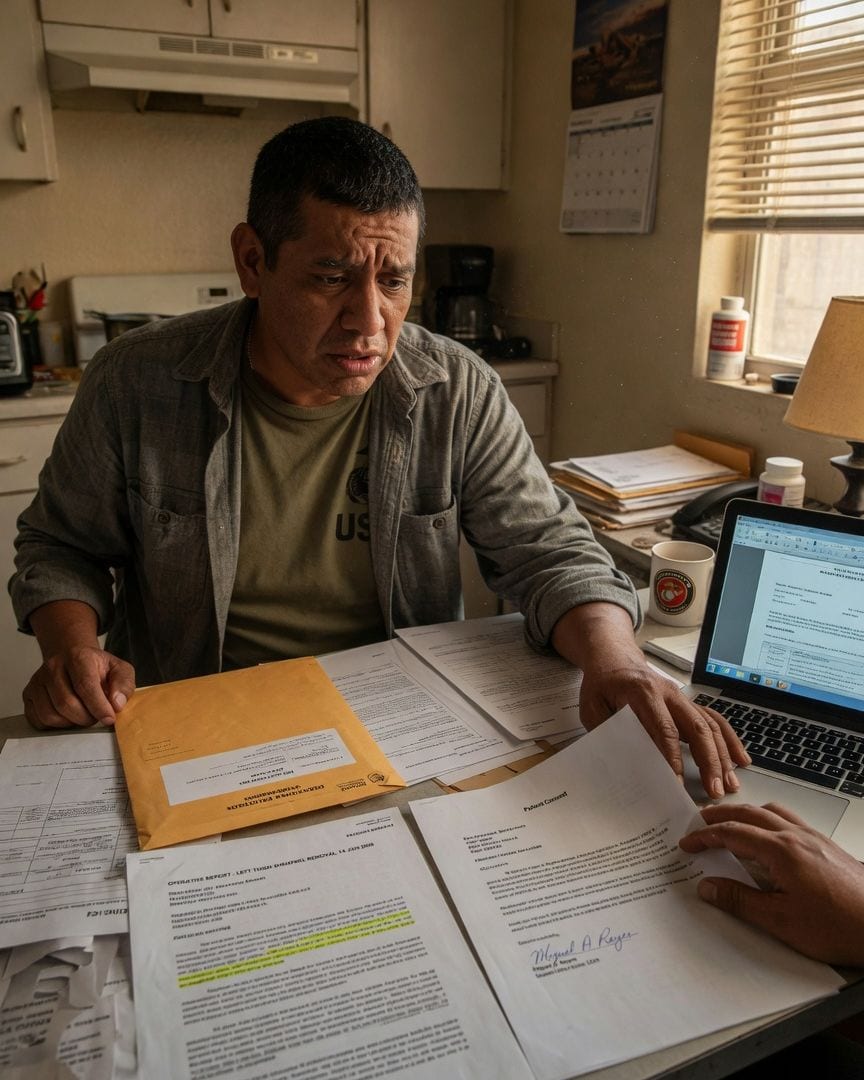
A veteran's VA file listed surgery for shrapnel. The doctor retired decades before he joined the Corps.
Miguel Reyes, a veteran, sat in a sterile VA clinic, his bad knee throbbing, expecting routine. Instead, a physician's assistant presented a digital file detailing shrapnel removed from his thigh in 2008 – an injury Miguel had no memory of, no scar for. His own service record later confirmed the impossible surgery, complete with a consent form bearing his perfect, yet utterly alien, signature. Driven by unease, Miguel researched the listed surgeon, Dr. Charlotte Bennett, only to discover she had retired from military service decades before he even enlisted. The numbers didn't just not add up; they violently contradicted each other, revealing a deliberate, impossible fabrication in his own life story.
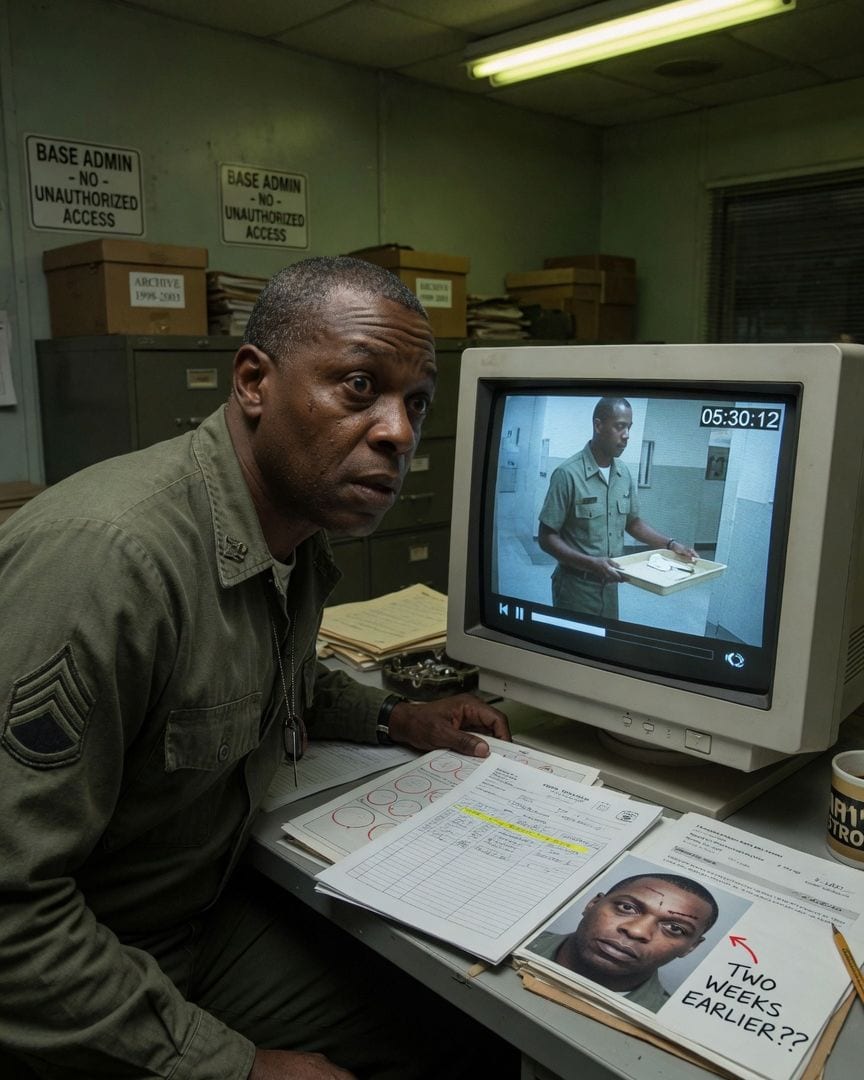
Sergeant Vance found a corporal's scar in old footage, a week before he got it.
Sergeant Gideon Vance was cross-referencing records to fix a simple scheduling error. But the surveillance footage and duty rosters showed Corporal Charles Whitfield in the chow hall and on Tower 3 at the exact same minute. Vance found this impossible discrepancy repeated across multiple days and records. A soldier cannot be in two places at once.
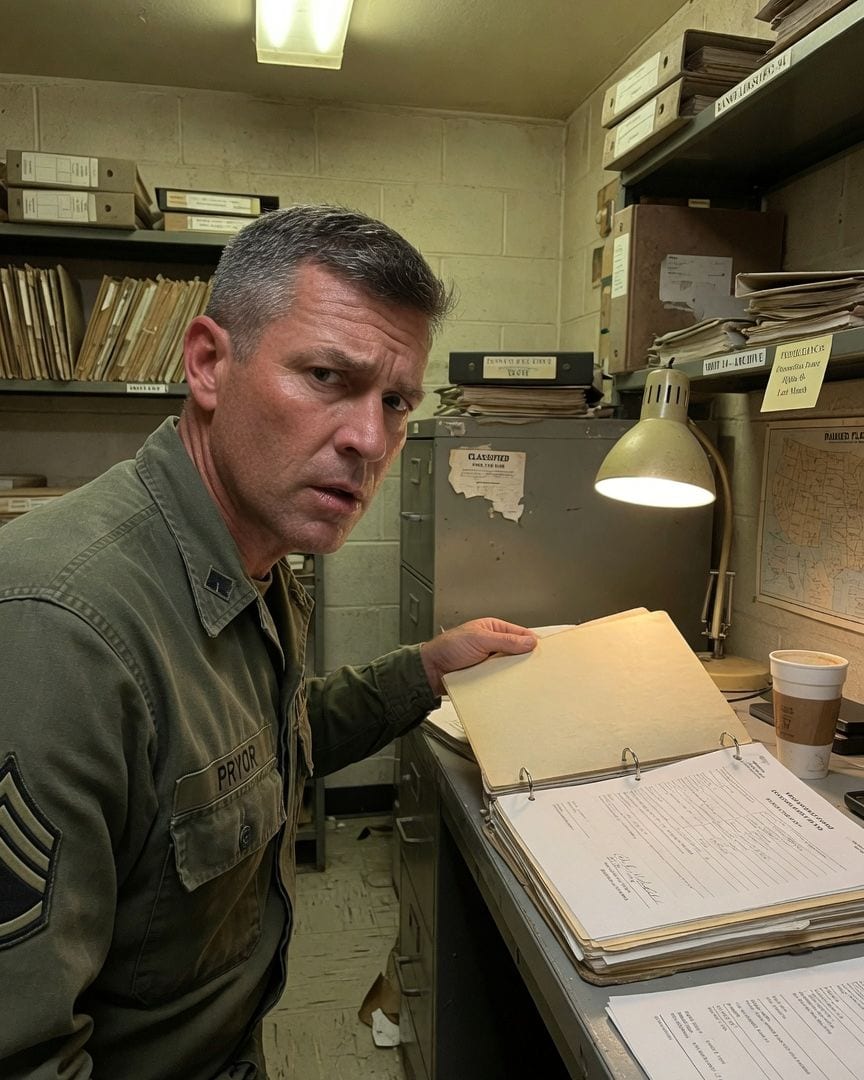
A sergeant with eleven days left finds a warm, glassed crater. Its file shows a captain lost thirty years ago is still signing reports from last week.
Sergeant Alden Pryor was counting down his final eleven days on a twenty-year hitch, expecting to spend them on routine patrols along the Ranier Flats fence line. Instead, his truck stopped at a bizarre sight: a four-hundred-foot glassed crater, miles from anywhere, its sand faintly warm at dawn despite no one recalling a blast. The air above it shimmered with an unnatural distortion, a silent scar of erased violence, and the official file for 'Shot 14' showed recent maintenance sign-offs for a decommissioned tower at the crater site. All these active documents were signed by Captain Everett Caldwell, who had been officially lost in operations thirty years ago, leaving Sergeant Pryor to wonder how a dead man could still be filing reports.
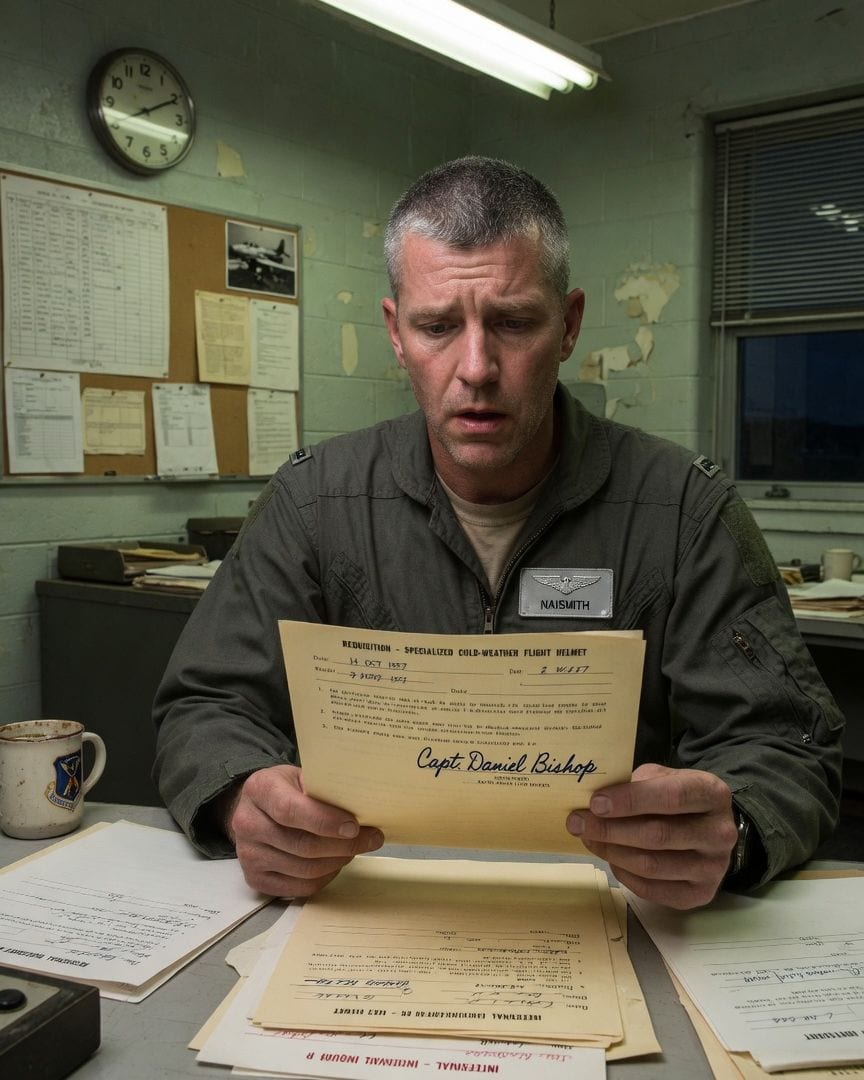
A Cold War Colonel reviews a missing pilot's file and finds Captain Bishop's signature on a form dated weeks after he vanished.
Colonel Ward Naismith faced the grim task of reviewing Captain Daniel Bishop’s personnel file, a routine chore for a man listed as Missing in Action. Bishop had vanished days after he and Naismith chased an impossible, silent disc over Lake Superior, leaving only an empty patch of air and a knot of unease in Ward's gut. Sifting through commendations, Ward found a requisition for flight gear and a maintenance sign-off, both dated *after* Bishop’s disappearance. The true chill came with the requisition for a specialized flight helmet, bearing Captain Bishop’s unmistakable signature, weeks after he was presumed lost. How could a man presumed lost have signed anything?
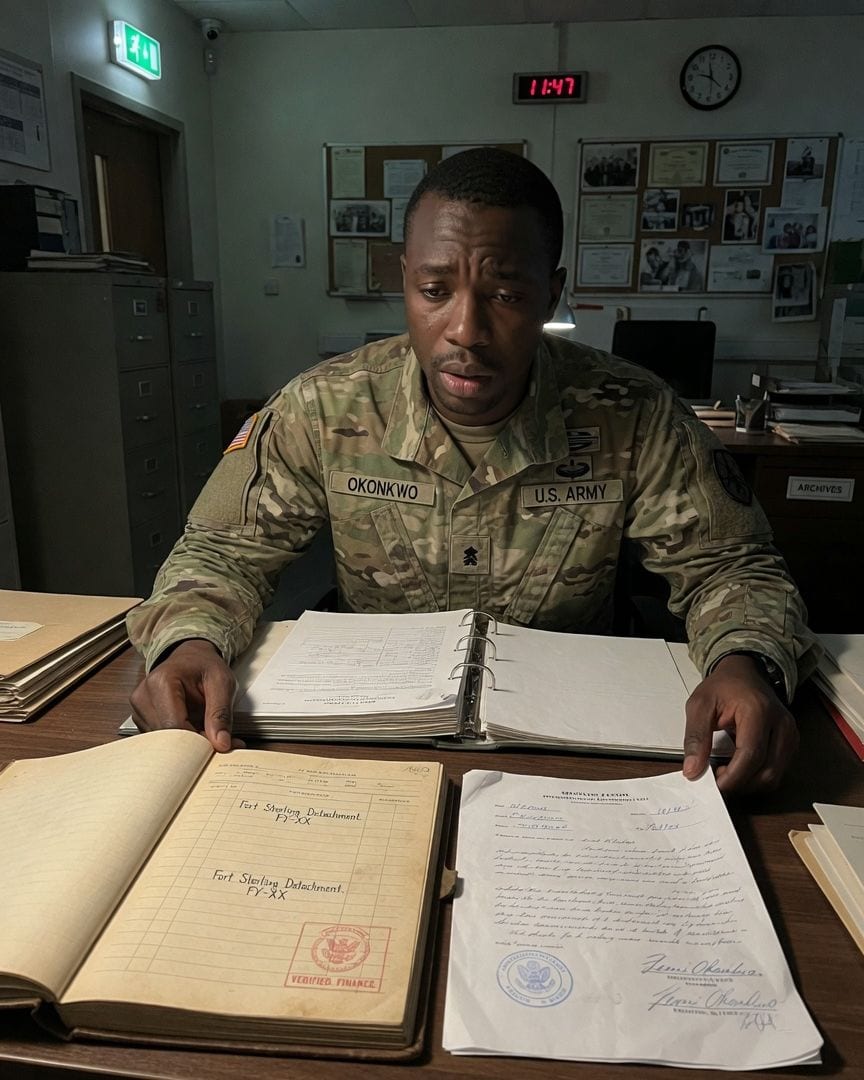
An old deployment ledger bore Specialist Femi Okonkwo's name, but the elegant signature was not his own.
Specialist Femi Okonkwo, an Air Force cargo hauler, stared at an earnings statement that contradicted his entire four-year enlistment. It listed nine months of jump pay and a mountain duty station in Colorado—places he’d never been, operations he’d never completed. Finance and HR records, seemingly impeccable, confirmed every detail of his impossible deployment. But when Femi finally retrieved the physical sign-in ledger, the faded blue ink of his supposed signature revealed the true, chilling discrepancy: the neat, elegant hand on the official document was unequivocally not his own. Who signed for Specialist Okonkwo’s impossible deployment, and why was it so meticulously verified?
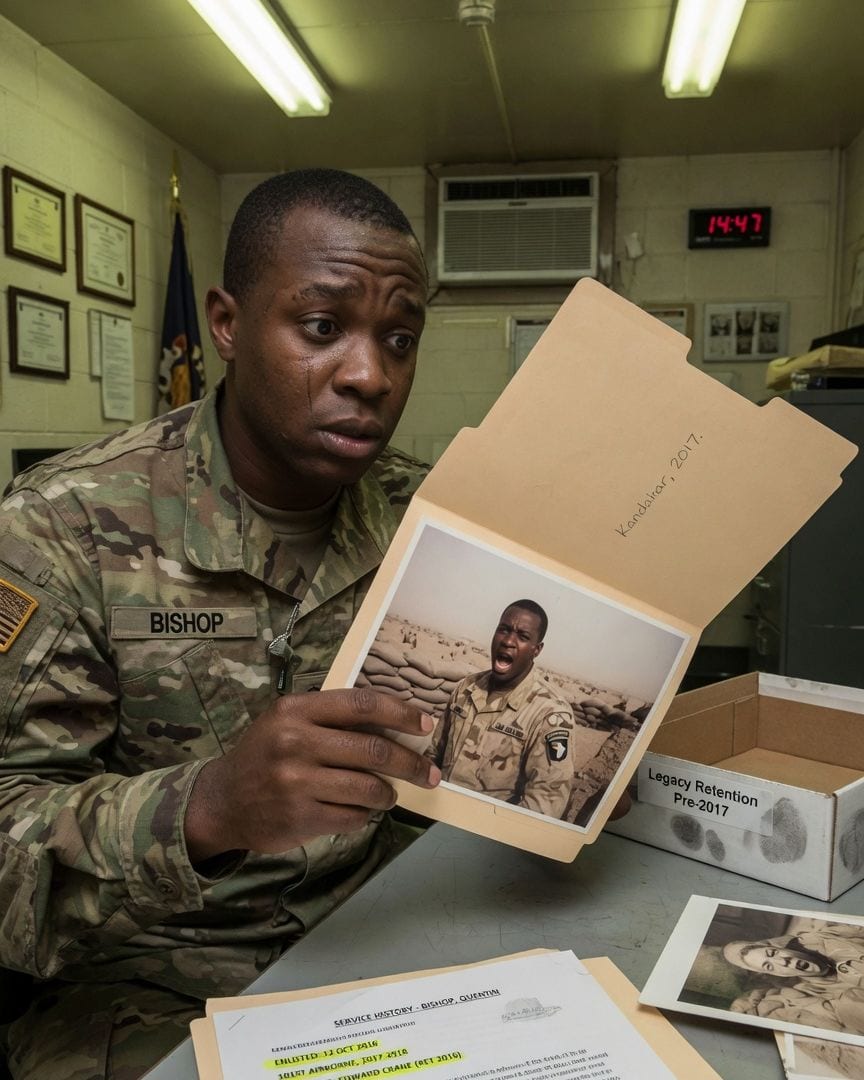
A specialist was signing for four more years, but his old file contained a photo of him in a desert uniform dated 2017, from a tour he never lived.
Specialist Quentin Bishop sat ready to re-enlist, looking forward to four more years of stability. But as he prepared to sign, his official record showed an enlistment date that made him seventeen years old, and a combat tour with a unit he’d never worn. Sergeant Marie Delaney dismissed it as a clerical error, but Bishop found a faded photograph of himself in a desert uniform, dated 2017, from a war zone he could not remember. Was this a mistake, or a meticulously constructed parallel life he never lived?