Sergeant Vance found a corporal's scar in old footage, a week before he got it.
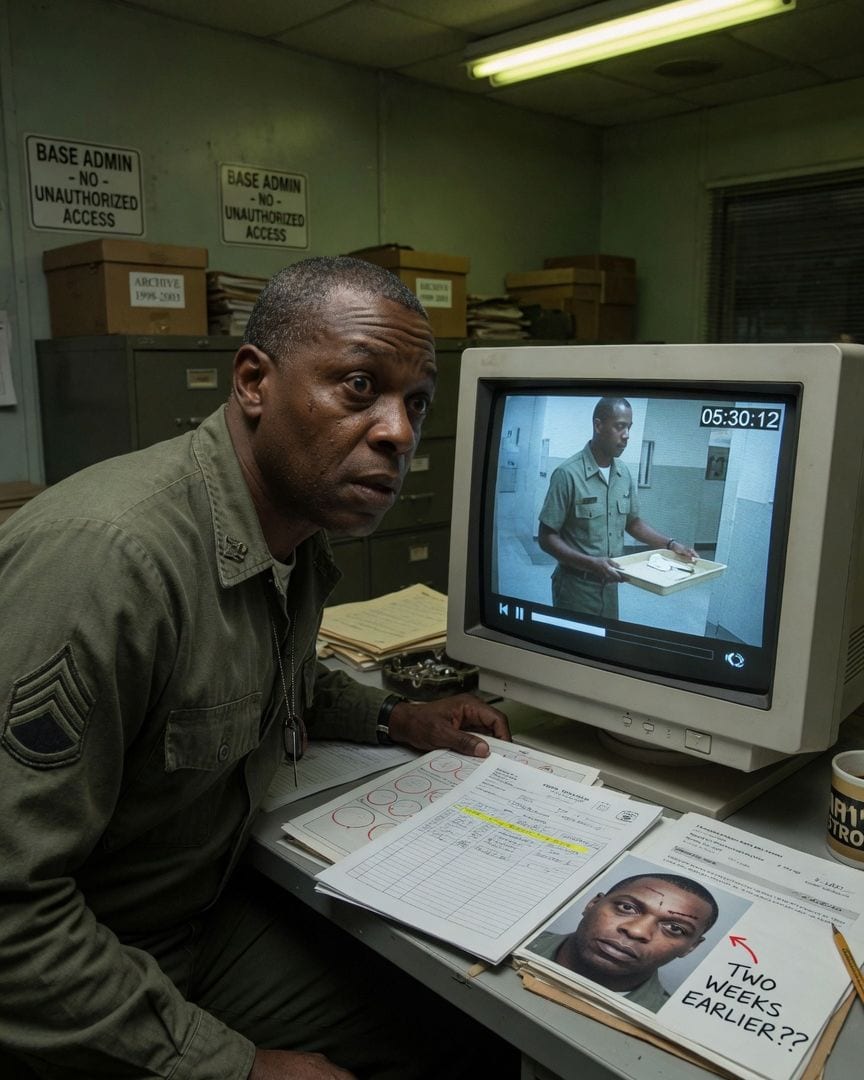
The glare of a monitor screen reflecting off Sergeant Gideon Vance’s face was the only light in the empty admin office. Below the timestamp 05:30:12, Corporal Charles Whitfield, tray in hand, shuffled through the chow hall serving line.
Vance rewound, played, rewound. Same time, same corporal. He pulled up the duty roster. Whitfield was on Tower 3, a kilometer out, at 0530. He pulled up the radio log. Whitfield had made his 0530 perimeter check-in, clear as day.
His voice had been crisp, reporting ‘all clear’ over the static. Three witnesses, Vance knew, had signed off on his tower presence that morning.
Vance had pulled the footage to prove a scheduling error, a simple clerical oversight. But the camera didn't lie. The digital timestamp was undeniable. Neither did the meticulously kept roster, signed in triplicate.
Neither did the audio recording from the radio, logged and time-stamped. He ran the footage again, a cold knot tightening in his gut. The same man, same tray, same impossible breakfast, over two weeks of mornings.
He had already checked a week's worth of records, then another, then another. Each day, the footage showed Whitfield in the chow hall at 0530. Each day, the records swore he was on Tower 3.
Vance spent the next two days in the admin office, cross-referencing every record for Corporal Whitfield.
The fluorescent lights hummed above him, a dull counterpoint to the low thrum that seemed to rise from the very foundation of the old building. He’d dismissed it initially, a quirk of the aging base.
He found six more instances of Whitfield being documented in two separate locations at the exact same minute.
A supply requisition, signed by Whitfield in the motor pool at 14:15, while his rifle was simultaneously logged into the armory by Whitfield, at 14:15.
A maintenance report, filed from the comms shack by Whitfield, while his access badge recorded him entering the gym across base.
Each record was unimpeachable, stamped with the appropriate seals, signed with Whitfield’s distinct signature, or digitally logged with biometric confirmation.
Vance even pulled Whitfield's medical file, scrolling through pages of immunizations, physicals, and minor injuries. He was looking for any sign of a mental break, a personality disorder, anything that might explain a man being in two places at once.
A faint, almost imperceptible hum resonated through the floor of the old admin building, a low thrum that seemed to come from deep beneath the base, near the water treatment plant.
He tried to ignore it, a phantom vibration in his feet. He found no medical flags, nothing. Whitfield was by-the-book, squared away, a model soldier.
The chow hall footage, however, still gnawed at him. He isolated an image of Whitfield's face, magnifying it to pixelated detail, a ghost caught in the low-resolution frame. The hum in the floor pulsed faintly, a beat beneath his focus.
Vance compared the enlarged image of 'Whitfield' from the two-week-old chow hall footage with the Corporal's current medical file.
A week ago, Whitfield had caught a jagged piece of shrapnel during a training exercise, leaving a distinctive, small scar above his left eyebrow. Vance had been there, had seen the medic stitch it up, the small, precise needlework.
He found the entry in the file, dated seven days prior, detailing the laceration and the treatment.
He then zoomed in on the pixelated face in the footage, taken two weeks prior. The scar, faint but unmistakable, was there.
It was undeniably present in the 0530 footage, a scar Whitfield received and had treated only last week, an incident Vance himself had witnessed. The chow hall footage was from two weeks ago.
The scar was the linchpin. Vance knew it wasn't a scheduling error, or even a twin. This was something else entirely, something fundamentally wrong with the fabric of their reality. He began a wider search, moving beyond just Whitfield.
He started with other 'double-duty' incidents, combing through access logs, radio records, and supply manifests from the past six months, his fingers flying over the keyboard.
The hum from beneath the base grew slightly more noticeable, a persistent, low thrum that vibrated through the metal desk, making the monitor screen tremble almost imperceptibly.
He found three other soldiers with similar, less dramatic, discrepancies: Private Marco Maddox, logging equipment at the armory at 10:00 while his comms were active on a patrol several kilometers away.
Specialist Karen Sutton, checking out a vehicle at the motor pool while her fingerprint scan confirmed her presence in the medic tent, getting a routine check-up.
Each instance, when investigated, had an unimpeachable record for both locations, signed, scanned, or radio-verified. Each soldier had a flawless service record, no history of mental instability, no reason for such impossible contradictions.
Vance's own digital service record, a perfect ledger of his military career, was his next stop. He pulled it up, searching for any anomalies, any blank spots, anything that might align with the impossible records he was finding.
He scanned through deployments, training exercises, promotions. He found one, a two-week period, two years prior.
It showed a combat deployment to a high-risk sector, complete with commendations for valor and his own digital signature on after-action reports, detailing engagements and successful objectives.
He remembered those two weeks perfectly: he was recovering from a severe bout of malaria in the base infirmary, barely conscious for much of it, drifting in and out of fever dreams.
The record, however, was unimpeachable, signed, dated, and verified. It swore he was there, leading a patrol, a hero.
Vance's late-night hours in the admin office didn't go unnoticed. Captain Elena Pennington, his commanding officer, appeared in the doorway one evening, her silhouette framed by the harsh fluorescent hall light, casting a long shadow into the dim room.
The hum from below seemed to deepen, a steady bass note against the silence.
'Sergeant Vance, everything alright? You've been burning the midnight oil in here.' Her tone was even, her expression unreadable, but her eyes held a question, a glint that seemed to bore into him.
Vance gave a clipped, professional answer about 'routine record audits,' a standard task for any diligent NCO. He felt the words catch in his throat, a small tremor he hoped she didn't detect.
Pennington lingered, her gaze sweeping over the screens displaying Whitfield’s timeline, the cross-referenced logs. 'Just don't get too bogged down in the minutiae, Sergeant,' she said, her voice dropping slightly.
'Some things are best left as clerical errors, especially in a forward operating environment. Efficiency, after all, is paramount.' The warning was subtle, delivered with a calm, almost unnerving composure, but it was clear.
Later that week, Vance found a small, almost imperceptible, smudge on the lens of the chow hall camera, obscuring a specific corner of the frame—the very corner where Whitfield had appeared. It hadn't been there before, he was certain.
He also noticed his own login activity for the archive server had been accessed by an unknown IP address, not from the base, but from a civilian network, then immediately scrubbed from the logs.
Someone was watching his investigation, and they were covering their tracks, subtly warning him off.
The hum beneath the base intensified slightly, a deeper vibration that resonated in his teeth as he walked past the old water treatment plant, a feeling that settled in his very bones.
Ignoring Captain Pennington's subtle warning, Vance pressed on. The cold knot in his gut had tightened into a hard, dense ball.
He focused on the 'pattern across rotations or dates,' diving into the base's physical archives, dusty crates and forgotten ledgers stored in a subterranean storage unit.
He found a massive, leather-bound ledger, its pages yellowed and brittle, dating back to the base's establishment 45 years ago. The entries were handwritten, meticulously kept in fading ink. And there it was.
Not just Whitfield, not just Maddox or Sutton, but a recurring anomaly spanning decades.
Every few years, a name would appear in two places at once, followed by a 'transfer' with no stated destination, no receiving unit, just a blank space.
Or a quiet 'medical discharge' with no corresponding medical file, no doctor's signature, no diagnosis.
He found a valor citation for a Private James Foster, dated 1988, for an action he supposedly performed while officially on a three-week compassionate leave to see his ailing mother.
The citation was signed by his commanding officer, the unit commander, and Foster himself, the neat, confident signature identical to earlier entries. Three weeks after the citation, Foster's entry simply stopped.
No transfer, no discharge, just a blank space in the ledger, as if he had simply ceased to exist.
Then, tucked into the back of the ledger, Vance found a terse, official memo. It was printed on thick, heavy paper, dated 1989. The ink was still sharp, almost new.
'Due to ongoing operational sensitivities, discrepancies in personnel records are to be resolved internally, without external inquiry. All inquiries regarding past discrepancies are to be routed through Command channels only.' The words were precise, bureaucratic, chilling.
The memo wasn't a warning; it was an instruction, an established protocol for dealing with the impossible. The truth wasn't that these were errors, but that they were being managed. The base knew.
The system was designed to absorb the anomaly, to make it disappear without a trace, leaving only the perfect, contradictory records.
The implications hit Vance like a physical blow, staggering him. This wasn't just old history; the memo was an active directive. The 'discrepancies' were ongoing, sanctioned. He thought of Private Marco Maddox, who’d had his own double-duty incident last week.
Vance pulled up Maddox’s current duty roster. Maddox was scheduled for perimeter patrol that night, Tower 2, 0530. Then Vance pulled the chow hall camera feed for that morning.
At 0530, there was Private Maddox, walking through the serving line, tray in hand, just as Whitfield had been. Same time, same breakfast. But Maddox was supposed to be on tower watch, just like Whitfield. Vance checked the radio log.
Maddox’s voice was clear, crisp, confirming his post on Tower 2 at 0530. It was happening again, right now, a seamless, impossible recurrence.
A cold dread seeped into Vance's marrow. He scrolled through his own digital service record, the official documentation of his entire career.
He found an entry for a two-week combat deployment to a specific, high-risk sector two years prior, complete with commendations for valor and his own digital signature on after-action reports.
Vance remembered those two weeks perfectly: he was recovering from a severe bout of malaria in the base infirmary, barely conscious, haunted by fever dreams and the distant, muffled sounds of the base.
The record, however, was unimpeachable, a perfect ledger of his presence, and it swore he was there, leading a patrol.
The deployment entry in Vance's own record was the final, devastating piece. He hadn't been recovering from malaria; an echo of him had been, fulfilling duties, leading patrols, signing reports. The anomaly wasn't just duplicating; it was replacing.
The original simply ceased to be, seamlessly absorbed into the base's perfect, self-correcting system. The 'echo' took over, leaving the flawless documentation behind, a bureaucratic void.
Vance remembered flashes of those fever dreams: faces that weren't quite right, a sense of being stretched thin, like his consciousness was fraying at the edges. He could almost feel it again, a faint echo of that sensation.
He pulled up the base's original construction blueprints, tucked away in a microfiche archive, the film brittle with age.
The hum from beneath the base was now a constant, low thrum, vibrating through the floorboards, through the very air in the office.
The blueprint showed an anomaly: a massive, pre-existing subterranean structure, labeled only as 'Primary Sub-Grade Foundation,' predating the base by centuries, marked in stark, ancient lines.
It was directly beneath the oldest section of the base, the water treatment plant, and, chillingly, the admin office where he now stood.
This was the source, an ancient, alien mechanism that had been slowly, silently, systematically replacing personnel for decades.
The 'discrepancies' weren't errors; they were the precise, bureaucratic function of the anomaly, ensuring its continuity, documenting its perfect, quiet consumption of human lives.
Vance, armed with the blueprint and printouts of dozens of impossible records, confronted Captain Pennington. Her office was dimly lit, the blinds drawn, casting long shadows.
The hum from below was more pronounced here, a deep, resonating drone that made the very air feel thick. He laid out the evidence: Whitfield's scar, Maddox's double-duty, the old ledger entries, his own impossible deployment, the ancient blueprint.
The stack of papers trembled slightly in his hands.
Pennington listened, her face impassive, her eyes fixed on him. Not a flicker of surprise, not a hint of shock.
When he finished, she simply picked up a framed photo on her desk: her, in uniform, with a man who bore an uncanny resemblance to Vance—the same set to the jaw, the same intensity in the eyes.
'My father,' she said, her voice flat, devoid of emotion. 'Sergeant Gordon Pennington. He served here, too. From '87 to '92. Discharged due to 'family emergency.' She turned the frame to him.
In the background of the photo, taken on base, was a faint, almost invisible structural detail that matched the 'Primary Sub-Grade Foundation' on the ancient blueprint.
'He told me stories,' she continued, her gaze distant, 'of feeling like he was in two places at once, of gaps in his memory he couldn't explain. He thought he was going crazy.'
Vance realized Pennington wasn't just a CO; she was 'the one who knew.' 'The system corrects itself, Sergeant,' she said, her eyes fixed on him now, unwavering. 'It always has. It always will.'
The hum intensified, a deep, resonant thrum that filled the room, pressing in on Vance, a physical presence. The framed photo on Pennington's desk seemed to vibrate. Pennington's face, usually stern, softened into a faint, almost imperceptible smile.
'You're already part of it, Sergeant. Just like my father. Just like me.' Vance felt a strange stretching sensation, a faint echo of his own voice in his head, answering her.
He tried to speak, but the words felt like they were coming from far away. He felt the pull, a gentle, irresistible absorption.
He was in the office, but he was also somewhere else, signing a duty log, checking a perimeter. The hum vibrated through his bones.
Sergeant Gideon Vance continued his duties at FOB Desert Talon. His records remained impeccable. He was present, accounted for, and squared away. Captain Pennington occasionally saw him working late in the admin office, meticulously reviewing logs, his posture ramrod straight.
He always offered a crisp salute, a faint, almost imperceptible smile playing on his lips, a look of quiet satisfaction.
The hum from beneath the base was a constant, almost comforting presence now, a part of the daily rhythm of the outpost.
Corporal Whitfield, Private Maddox, and Specialist Sutton were all present and accounted for, their records flawless, their duties perfectly fulfilled. The system was seamless.
Captain Elena Pennington nodded, returning Sergeant Vance's salute as he passed her office. He was on his way to review the next week's duty rosters, a task he now performed with an almost unsettling efficiency, his movements precise and unhesitating.
The hum from beneath the base was a constant, low thrum, a comforting presence that filled the silent corridors. He paused at the door, turning back to her, his gaze steady. 'Captain, I just submitted the new security report.
It includes a full audit of all perimeter cameras, past and present. Everything's accounted for.' He smiled, a faint, almost imperceptible shift in his expression that mirrored the hum beneath their feet.
Pennington looked up from her desk, her own smile mirroring his, a silent understanding passing between them. 'Is that so?' she asked, her voice soft. 'Good work, Sergeant. Always good to have everything accounted for.'
The last entry in Sergeant Vance's personal digital journal, recovered years later from a discarded, encrypted thumb drive, simply read: 'The records are perfect. We are all accounted for. Always.'
If this one got to you
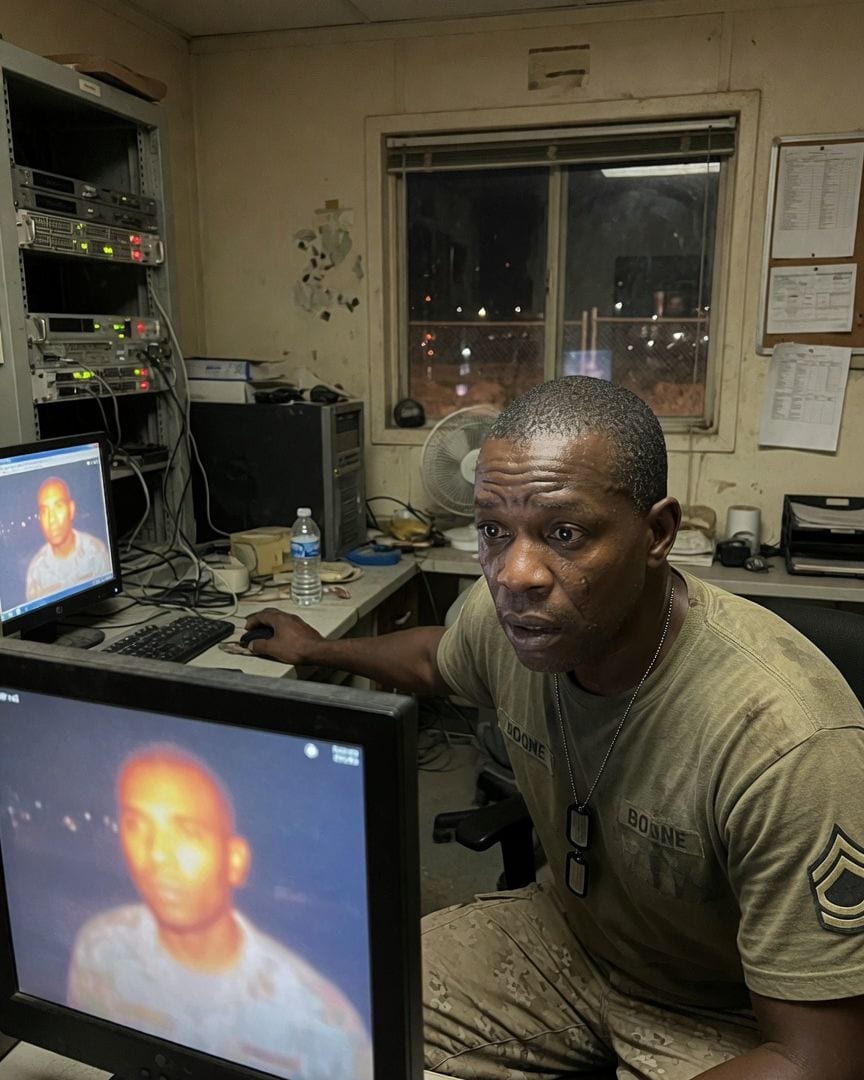
Sergeant Boone, two weeks from home, sees Corporal Whitfield in two places at once. One has a scar on his face. The other doesn't.
Sergeant Wayne Boone counted his last two weeks until deployment ended, sitting in his stifling security office at the Horn of Africa site. A minor scheduling error led him to chow-hall footage, where Corporal Richard Whitfield had an identical breakfast daily at 0530, complete with a distinct scar above his left eyebrow. Boone knew Whitfield was simultaneously radioing in status from Perimeter Tower 3 at that exact time, confirmed by logs and witnesses. The sergeant then checked the tower's thermal feed, hoping to dismiss the ghost, but the figure on the tower had no scar. How could two Corporal Whitfields exist, one scarred and one unblemished, both confirmed in different places at the same moment?
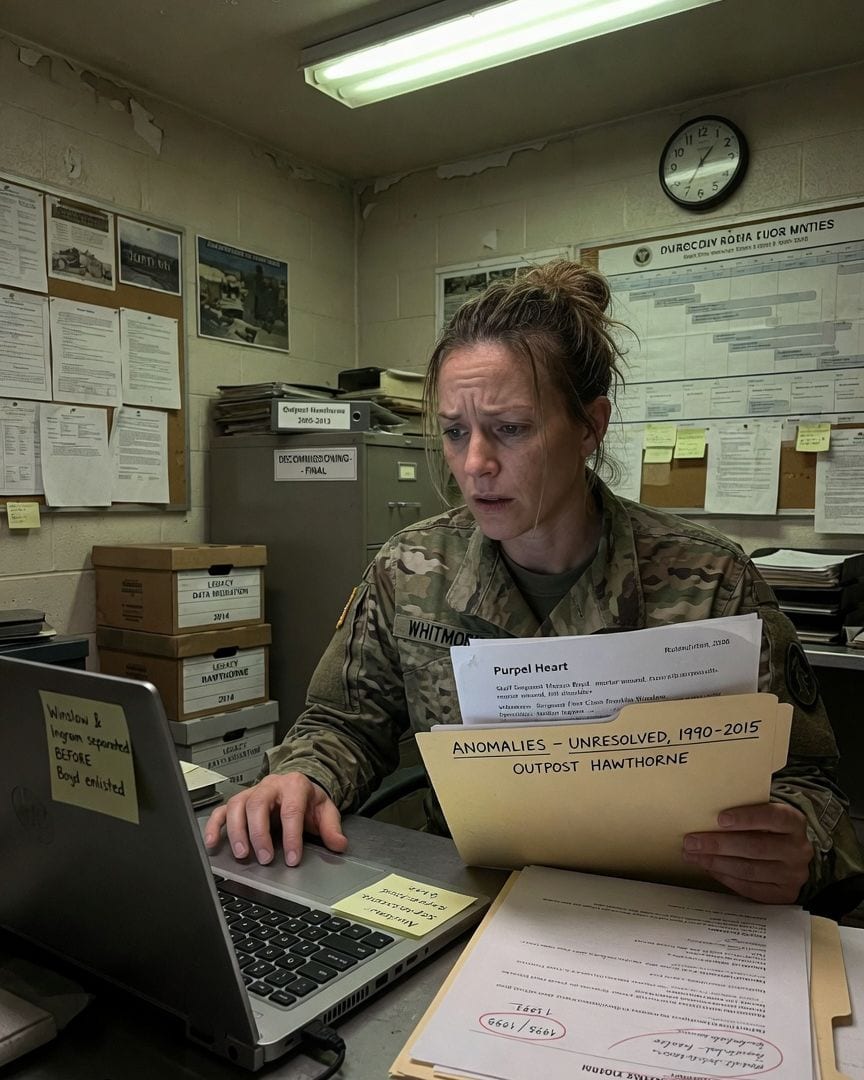
A military captain auditing a Cold War Fort Clay's final roster found a soldier's Purple Heart for a mortar wound. Its witnesses had left the Army years before it happened.
Captain Diane Whitmore, Adjutant for the soon-to-be-decommissioned Fort Clay, meticulously reviewed the final awards roster. Her office, usually bustling, was eerily quiet save for the fluorescent hum as she found an entry for Staff Sergeant Marcus Boyd: a Purple Heart for a mortar wound in 2012. But Boyd had returned unharmed, and the listed witnesses had separated from the Army years before he even enlisted. Colonel Sinclair dismissed it as data corruption, but Whitmore sensed a deeper anomaly, and ignoring a post historian's warning, she found another file from Outpost Hawthorne with the same impossible witnesses. What pattern was buried in Fort Clay's archives?
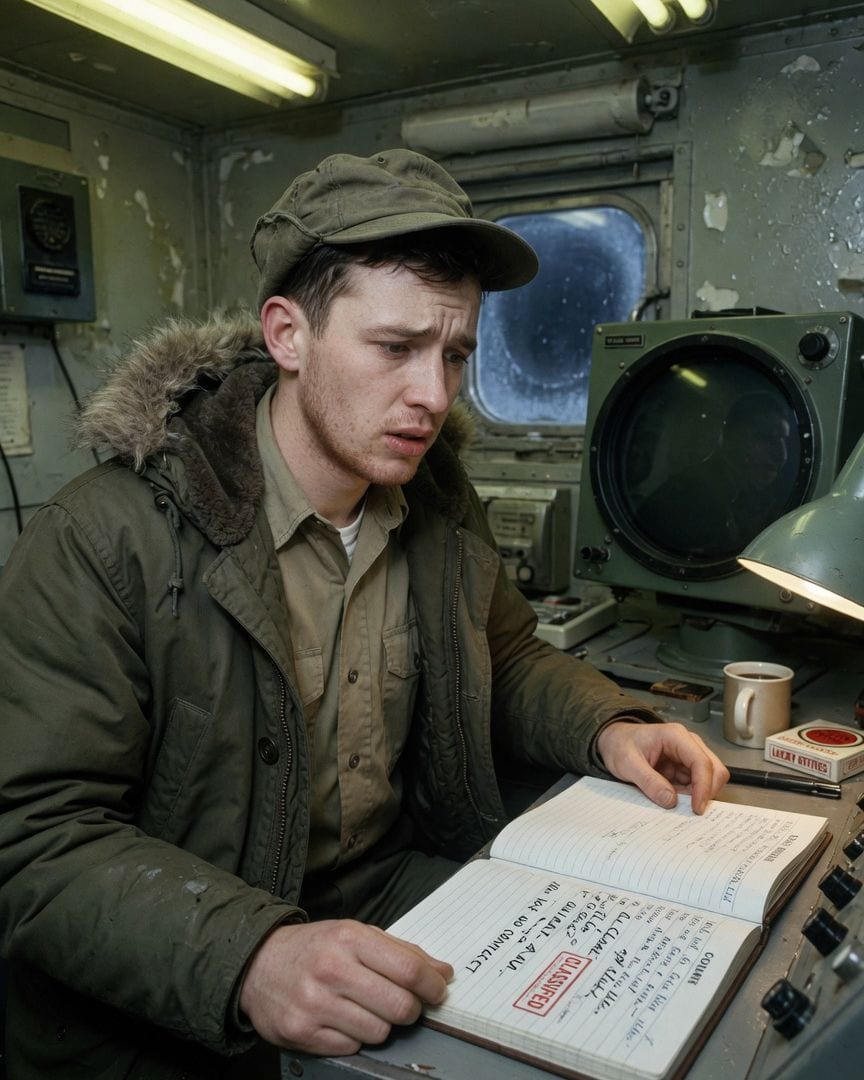
A Cold War airman logs an impossible radar contact on his last sweep. But his official logbook entry is stamped 'CLASSIFIED' and then contradicted by a hastily scrawled 'ALL CLEAR' dated moments before it.
Airman Ordway Vance, 22, manned the radar dome at Site Pellin in the biting North Atlantic dark of January 1962, running the last calibration sweep before its decommissioning. His scope picked up a faint, impossible return, growing closer with each pass, though the ocean remained empty to the eye. When Vance detailed the contact in his official logbook, a 'CLASSIFIED' stamp appeared, followed by a hastily scrawled 'ALL CLEAR' dated moments before his own entry, contradicting his every word. Commander Hartley dismissed it as equipment malfunction, but Vance sensed a chilling, official erasure behind the lie. He soon found a locked cabinet marked 'SITE PELLIN ANOMALIES,' hinting at a deeper truth buried within the base's final days.
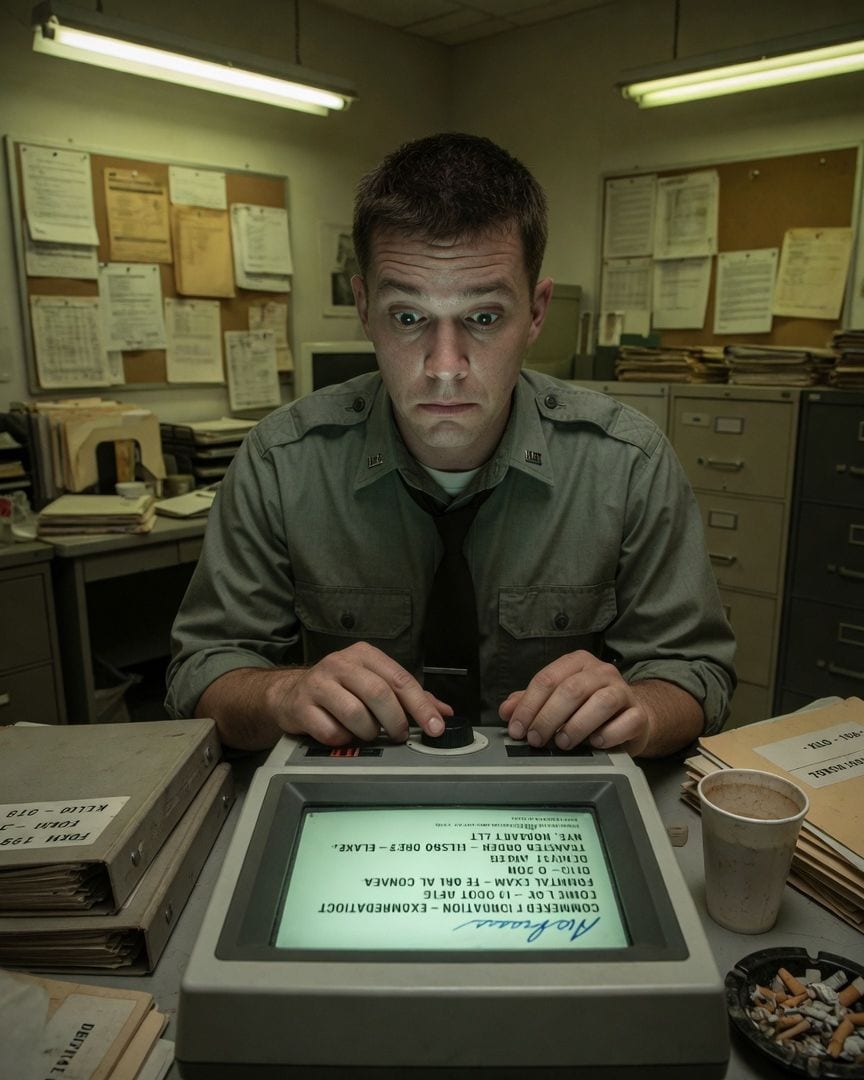
A missile commander watched his ten nuclear silos go dark. His own service record shows his signature on a future he's never lived.
Second Lieutenant Hobart Nye, a missile commander in Wyoming, had his quiet 0247 watch shattered by a security report: a massive, silent black triangle hovered over Launch Facility Kilo, casting a perfect shadow. Hobart watched his console's fault panel light up, signaling all ten nuclear missiles going dark in an impossible silence, followed by eleven minutes his security team could not remember. Official logs called it a "radio malfunction," but Hobart found a requisition for invisible-tracking sensors, signed by a base commander who was supposed to be off-base. The final, chilling discovery came when his own service record showed new entries—a dental check-up, a transfer to Alaska—all dated for a future he never lived, complete with his perfectly replicated signature.
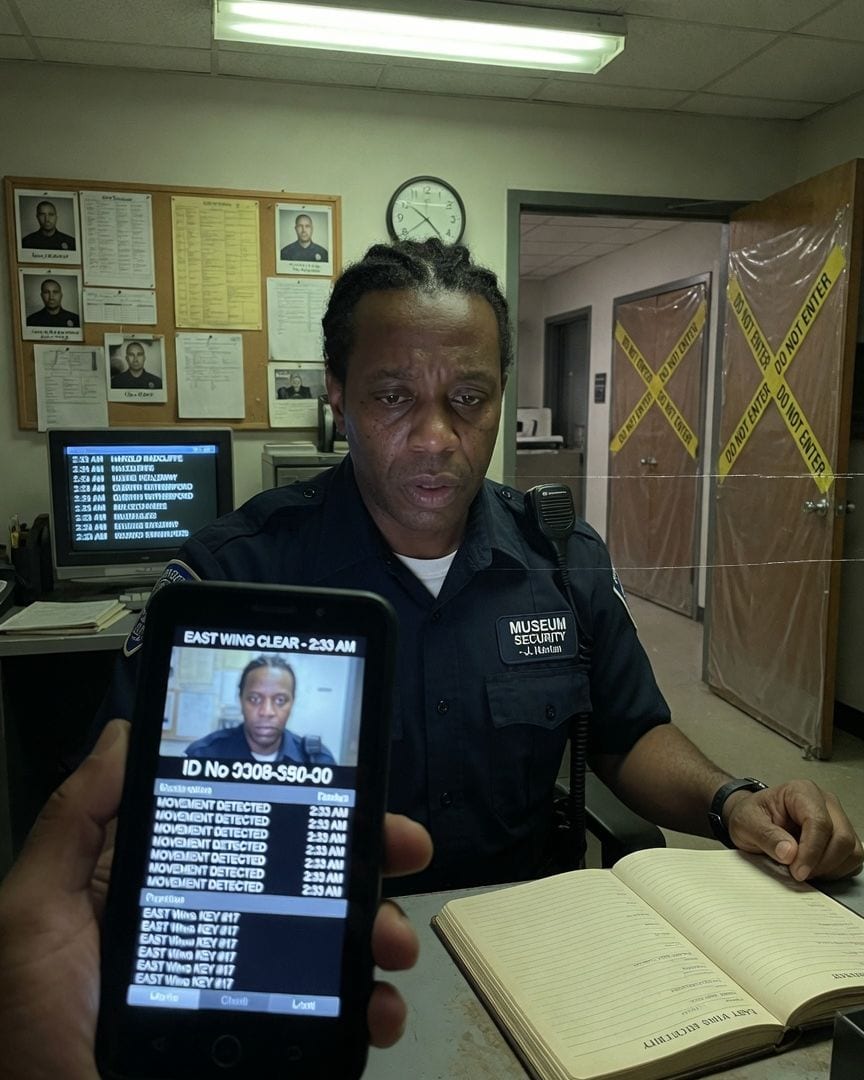
My guard log shows the east wing cleared at 2:33 AM. That wing's been sealed for months, doors screwed shut.
I was on my final security rounds in the quiet museum after midnight, ready to clock out. My handheld scanner showed the East Wing cleared at 2:33 AM under my ID, though it's been sealed for months. Then my hand brushed a faint, precise scratch on the plastic covering the doorframe, exactly where a security scanner would be held.
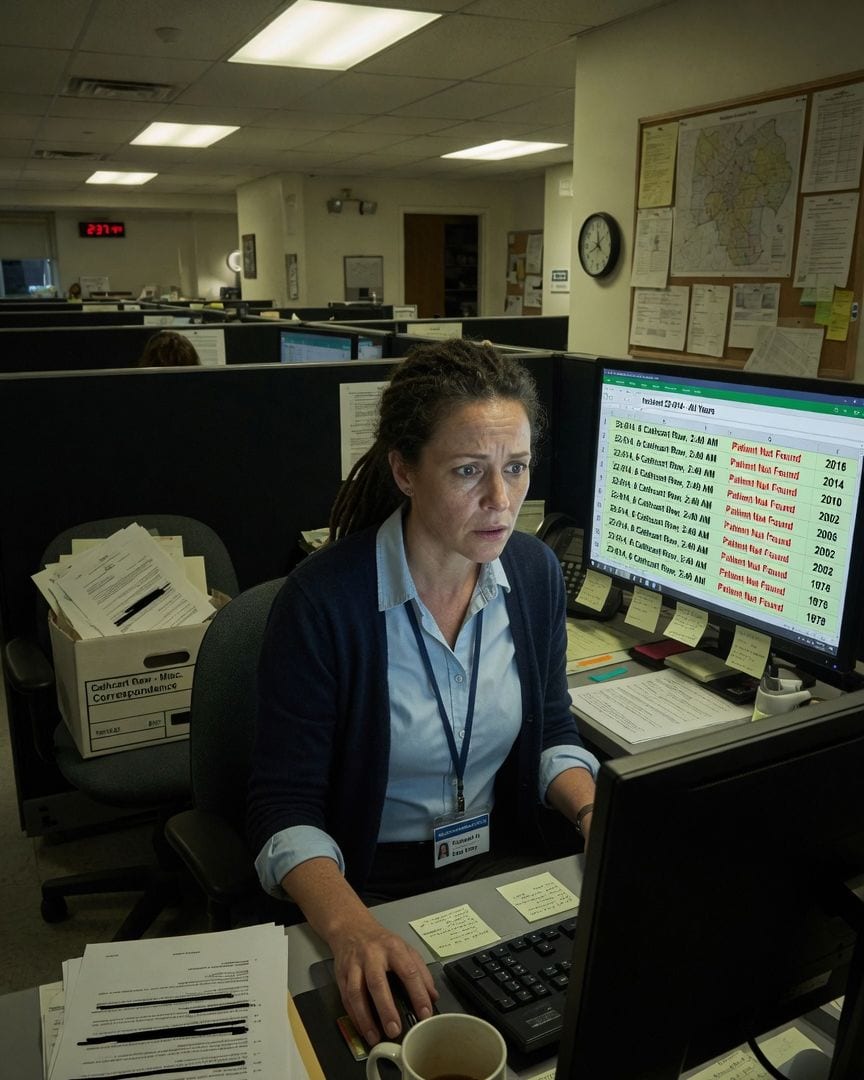
My computer log shows the same 2:40 AM call to Cathcart Row, every four years since 1978, always closed 'patient not found'.
Working data entry for the County Ambulance Trust, I found a routine incident logged as 'Patient Not Found.' But digging deeper, I discovered the exact same phantom call had repeated every four years for over forty years, always at the same address, always at 2:40 AM. Then I found a heavily redacted memo linking it to my own street.