My gate log shows a truck left at 3:33 AM with my inspector ID — but the yard was locked down, and I was the only one on shift.
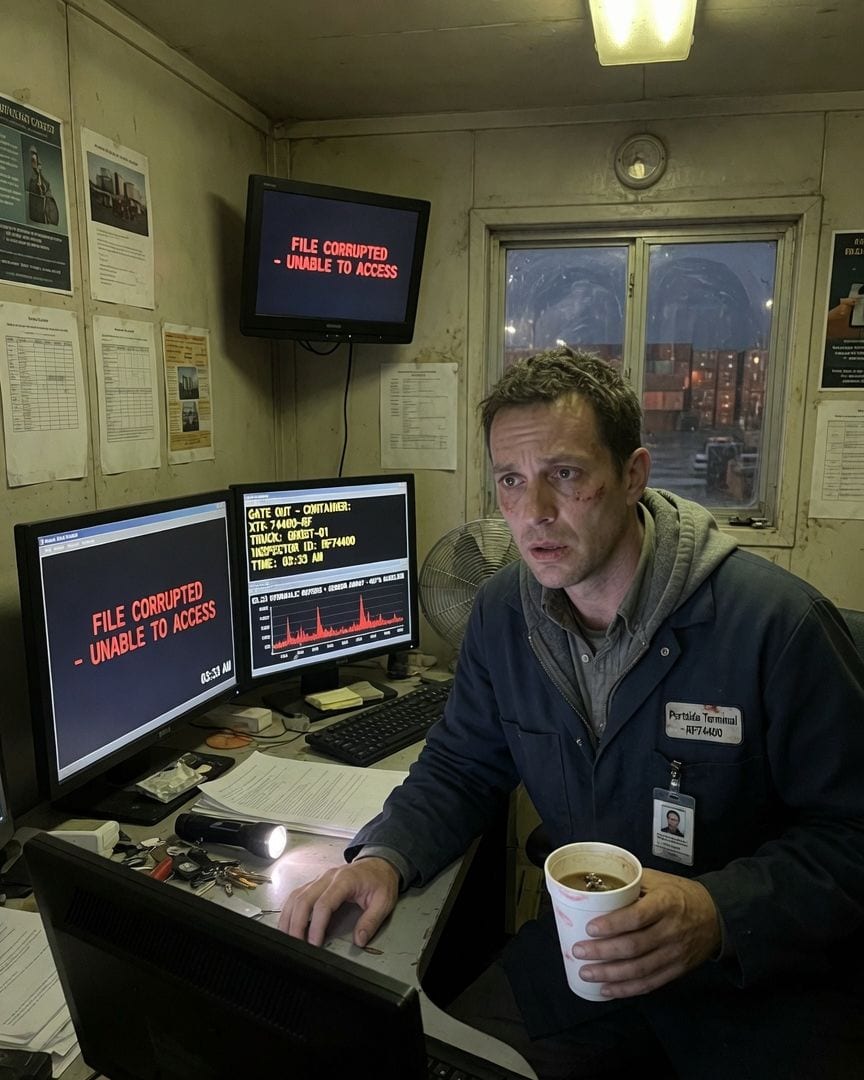
The stale coffee was doing its usual trick of keeping me awake without actually making me feel any less tired.
It was my second week on the overnight shift at the Portside Container Terminal, and the rhythm of it was starting to feel… heavy. Two AM, the main gate secured, the yard silent under the high-mast lights.
Just me, the console, and the hum of distant machinery that never quite stopped.
Routine dictated a scan of the digital gate log for anomalies. Most nights it was just empty. Tonight, my eyes snagged on an entry that made the blood go cold in my veins.
GATE OUT - CONTAINER: XTR-74400-RF - TRUCK: GHOST-01 - INSPECTOR ID: RF74400 - TIME: 03:33 AM
Dread settled in my gut like a stone. I knew for a fact that the yard was locked down.
The main gate, a solid steel barrier that took hydraulic pressure to move, had been physically down and secured since 1 AM. No truck was booked for that hour, certainly not one with a name like 'GHOST-01'.
And my inspector ID, RF74400, was right there. Stamped on it. My initials, my employee number.
I checked the timestamp again. 03:33 AM. The system insisted a box had left under my watch, from a yard that had been utterly still, not a breath of wind stirring the container stacks.
I told myself it had to be a system glitch. Or a prank. Simon, the day shift guard, had a weird sense of humor, but this was beyond a crude joke.
I pulled up the security camera archives for the main gate, navigating to precisely 03:33 AM. The screen loaded, the little buffering icon spinning for a moment, then froze. 'FILE CORRUPTED - UNABLE TO ACCESS' flashed in angry red letters.
My heart hammered against my ribs. I tried the minutes adjacent to it – 03:32 AM, 03:34 AM. Both played back perfectly clear footage: an empty, locked yard. The corruption was precise, a surgical cut in the flow of time.
Next, the crane move log. Every container movement, every lift, every placement, was meticulously recorded. I searched for XTR-74400-RF. There it was: 'CONTAINER: XTR-74400-RF - LIFTED FROM STACK 3, ROW B - TIME: 03:33 AM'. It corroborated the gate log.
The system insisted the container had been moved. I pulled up the yard map, located Stack 3, Row B. The digital representation was blank, a ghost outline where the box should have been. It was gone.
I threw on my coat and grabbed my flashlight, my breath fogging in the cold night air as I walked out into the empty yard. The high-mast lights cast long, distorted shadows.
I walked to Stack 3, Row B. It was empty. The spot where the container was supposed to have sat was a clean rectangle on the tarmac, still slick from a recent drizzle.
There were no tire marks leading to the stack, no scuff marks from the lifting gear, no broken seal tags on the ground. Nothing. Every ordinary explanation I tested only deepened the impossible contradiction.
Frantic, I stumbled back to the gatehouse, my hands shaking. I logged into the terminal's auxiliary system, the power grid monitoring logs – a system rarely checked by gate guards, usually only by maintenance.
I navigated to the 03:33 AM timestamp. There, stark against the baseline, was a sudden, sharp spike in power consumption registered at the main gate's hydraulic motors and sensor array.
A surge consistent with the gate opening and closing rapidly, heavy machinery moving. The data burned into my mind: the gate had moved, something had passed, even as the cameras showed nothing and the yard lay silent.
I stared at the power grid's digital readout for 3:33 AM, showing a sudden, sharp spike in power draw at the main gate, even as the security monitor above it displayed a static, 'FILE CORRUPTED' message for the exact same timestamp.
The next morning, the numbers and blank screens still swam behind my eyes. I couldn't shake the logs. I arrived early for my next shift, fueled by another industrial-sized coffee and a knot of dread in my stomach.
I opened the terminal's archived gate logs, pushing back weeks, then months, focusing solely on the 3:33 AM entries.
To my growing dread, I found more. Not every night, but frequently—once or twice a week, sometimes more. Always a container 'OUT', always at 3:33 AM, and always, inexplicably, bearing my inspector ID, RF74400.
I hadn't even worked some of those nights. I pulled up the shift schedule: a month ago, a Tuesday night, I was definitively off. Yet, 'RF74400' signed off a container at 3:33 AM.
I tried to casually mention it to Simon Hughes, the day shift guard, during handover. "Hey, you ever noticed some weird system bugs with the gate logs? Like, phantom entries?"
I tried to keep my voice light, making it sound like a mundane IT problem.
Simon just shrugged, signing off his own shift report. "Happens. System's old, Renee. Sometimes it throws up garbage. Just ignore it, or re-verify if it's something important. Maintenance usually sweeps those out."
His dismissiveness, the absolute lack of concern, chilled me more than the logs themselves. He didn’t even glance at the screen.
I went back to the console, checking the login history for my ID. No login attempts at 3:33 AM from my station on those off-nights. The entries were simply there, an immaculate digital record of an impossible event.
My relentless digging didn’t go unnoticed. A few days later, my supervisor, Maxwell Vance, called me into his office. He was a man carved from granite, with eyes that saw everything and betrayed nothing.
He sat behind his desk, hands folded, a thin smile playing on his lips. He was calm, almost too calm.
"Everything alright, Renee?" he asked, his voice low, deceptively smooth. "You've been spending a lot of time in the archives lately." His tone suggested concern, but his eyes were flat, like two chips of polished obsidian.
He spoke of "system stability" and "not chasing ghosts," his gaze never leaving mine. The air in his office felt heavy, charged.
That night, back at my console, a yellow Post-it note was stuck to the screen. It wasn’t in my handwriting, or Simon’s. The looping script was neat, almost elegant: 'Some things are better left logged and forgotten.'
It was a generic message, the kind you might put on an old file, but the implication was sharp, cutting through the ordinary silence of the gatehouse.
I felt a prickle on my neck, the distinct sensation of being observed. My head snapped up. I checked the internal camera feeds for my office, but they only showed me, alone, scrolling through logs. I was alone.
I peeled the note off, crumpled it, and went for a quick bathroom break, the paper ball still clutched in my hand. When I returned, the note was gone from my console.
The crumpled paper ball was gone from my hand.
A growing dread settled over me. It wasn't just about logs and corrupted files anymore. My investigation had made me part of something, not just an observer.
The next morning, the feeling of being watched, of being part of something I couldn't grasp, was a physical weight. I marched straight into Maxwell Vance's office. This time, I didn't try to be subtle.
I laid out the evidence, printouts spread across his immaculate desk: the blank camera footage, the power surge logs from the auxiliary system, the recurring 3:33 AM entries under my ID on nights I wasn't even scheduled to work.
Maxwell listened, his face unreadable. He picked up one of the printouts, scanned it, then set it back down. "It’s a glitch," he said finally, a practiced phrase, as if he'd said it a hundred times before.
I pushed back, my voice tight. "A glitch that moves a physical container, Maxwell? A glitch that spans months, even years, and uses my ID when I'm not here? That drains power at the gate when nothing is supposedly there?"
Maxwell sighed, a slow, deliberate sound, leaning back in his chair. The office air conditioner kicked in with a low hum, making the silence that followed feel even colder. "Look, Renee." His voice was low, almost a whisper.
"This terminal… it’s old. Older than most of the systems running it. Some things are just part of its history. They predate you, predate me, predate all of us." He didn't deny the entries. He didn't offer a rational explanation.
He offered something far worse.
"It's a routine," he stated, his voice flat, devoid of emotion. "Always 3:33 AM. Always a container leaves. Always logged. We just… ensure the logs are in order."
He gestured vaguely, his hand sweeping across the printouts on his desk as if dismissing them. "Other guards have noticed. They learn to accept it. It’s part of the night. Like the tide coming in and out."
The calm in his voice, the casual, utterly unbothered acceptance of the impossible, was far more unsettling than any anger or denial could have been. The 'ghost truck' wasn't a glitch; it was an established, managed fact.
And I had stumbled into it.
I left Maxwell's office, reeling from his quiet admission. "A routine." The phrase echoed in my head, insidious and unsettling. I took my place at the gate console for my next shift, my mind a whirlwind of impossible facts.
The silence of the terminal felt heavier now, charged with unseen activity, the air thick with a secret I now shared.
As the clock ticked past 3:30 AM, I watched the gate log system with a morbid fascination. My fingers hovered over the keyboard, a strange blend of dread and anticipation coursing through me. 3:31. 3:32.
The screen flickered.
Then, it refreshed.
A new entry appeared in the gate log, timestamped 03:33 AM, marked 'OUT', with my inspector ID: RF74400. The container number displayed was 'XTR-74400-RF' — a decommissioned, empty box I knew had been tagged for scrap weeks ago.
I'd even seen it sitting by the north fence line, covered in rust.
But this time, as I stared at the screen, a chilling detail leaped out at me. The last four digits of the container number: 'RF', my own initials, followed by '74400', my employee ID number.
The pattern was not just about the terminal. It was about me.
"My initials. My ID number. What does this mean, Maxwell?" I stood in his office again the next morning, a crumpled printout of the 'XTR-74400-RF' log entry clutched in my hand. My voice was hoarse.
He didn't flinch. He just looked at the paper, then back at me. "It means the Night Runner knows you're paying attention, Renee."
'The Night Runner.' The words hung in the air. "What is it?" I asked, my voice barely a whisper.
Maxwell finally leaned forward, his gaze direct. "It isn't a 'what,' Renee. It's a presence. A force. A routine that runs through this terminal like an old river. Always has.
It uses the terminal as a portal, always at 3:33 AM. The containers are symbolic. Placeholders for its passage." He spoke with an unnerving detachment, like he was discussing the weather. "Your ID isn't stolen.
It's simply the system's way of marking the 'active' guard. The one whose presence resonates most strongly with the routine at that moment." He paused, his eyes holding mine. "It’s not trying to frame you. It's just… acknowledging you.
Inviting you into the pattern."
He explained that the corrupted footage and power surges weren't malfunctions. They were the physical manifestations of its passage, ripples in reality that the long-term staff, like him, had learned to 'manage' to avoid panic.
The blank screen was the system trying to record something unrecordable, the power spike the undeniable physical evidence of a gate opening and closing for nothing.
Every clue, every impossible detail, now clicked into place, forming a horrifyingly coherent picture of an ancient, unexplainable operation running parallel to the mundane work of the terminal. A ghost in the machine, but a real, physical one.
A cold dread settled deep in my bones. There was no fighting this. No reporting it to anyone outside the terminal. Who would believe me? And what would they fight? An ancient routine? A 'presence'?
"So what do I do?" I asked, my voice barely a whisper, the question hollow in the sterile office.
Maxwell rose from his chair and walked around his desk, placing a hand on my shoulder. His touch was surprisingly gentle, almost paternal. "You do what everyone before you has done, Renee. You log it. You secure the gate.
You let it pass. It's always passed." He described previous guards who tried to interfere—one who tried to block the gate with a personal truck, only to find it effortlessly open at 3:33 AM, the truck somehow shifted aside.
Another who tried to delete the logs, only for them to reappear, perfectly preserved, along with a week of phantom 3:33 AM entries under his ID. The calm, rational acceptance in his voice was the true horror.
I realized I was now part of the terminal's secret, a new silent witness to the Night Runner. I was not a victim, but an unwilling participant, a cog in an impossible, eternal machine.
The choice wasn't to escape, but to accept my new role in maintaining the illusion, or to break and lose everything—my job, my sanity, perhaps more.
I stared at the empty terminal through Maxwell's office window, the weight of its unspoken history pressing down on me.
I continued my night shifts. The 3:33 AM entries still appeared. Sometimes under my ID, sometimes under Simon's, sometimes a random placeholder that the system seemed to invent. I no longer investigated them.
The terminal operated as usual, the world outside oblivious to the nightly passage. Maxwell Vance remained calm, a quiet guardian of the impossible, his composure a constant, unsettling reminder of what I now knew. Nothing changed, yet everything had.
I now saw the terminal not as a workplace, but as a stage for an ancient, ongoing performance, a silent ritual.
Another night. The clock ticked towards 3:33 AM. I was at my console, watching the gate log system. I didn't feel fear anymore, just a profound, unsettling understanding.
I saw the prompt flicker, the system readying itself for the entry that would inevitably appear. I reached for my keyboard, my fingers hovering over the entry fields. I knew what to do now.
I logged it myself, preemptively, not because I had made it happen, but because it would appear, and it must be recorded. The gate lights gleamed on the wet tarmac, waiting for nothing.
The container is always gone.
If this one got to you
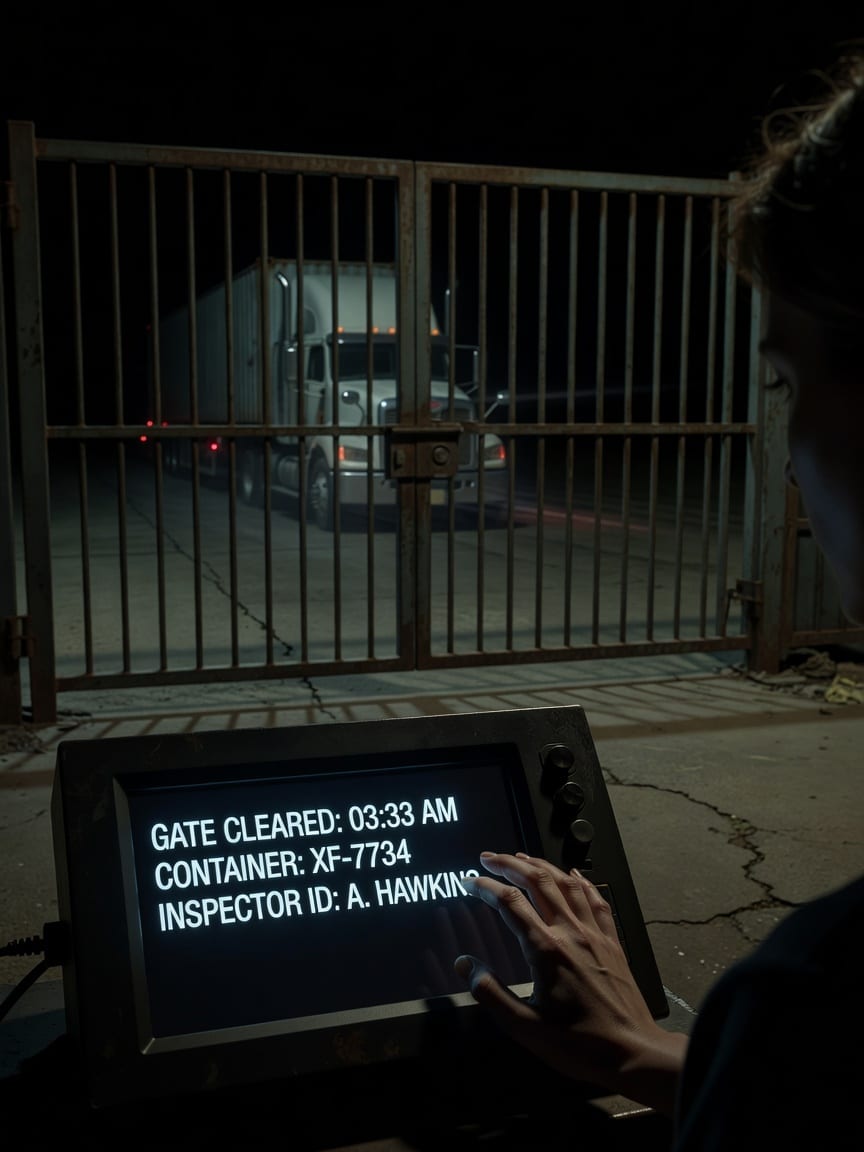
My gate log shows a container left at 3:33 AM, stamped with my ID. The yard was closed, the gate down, and I was asleep.
Audrey Hawkins' inspection log shows a container cleared at 3:33 AM, an impossible time when the gate was locked and no one was working. Her supervisor dismisses it as a glitch, but Audrey can't shake the specific details. Digging into old archives, she finds a handwritten ledger entry from 1974 for the exact same container, signed by a man who died half a century ago.
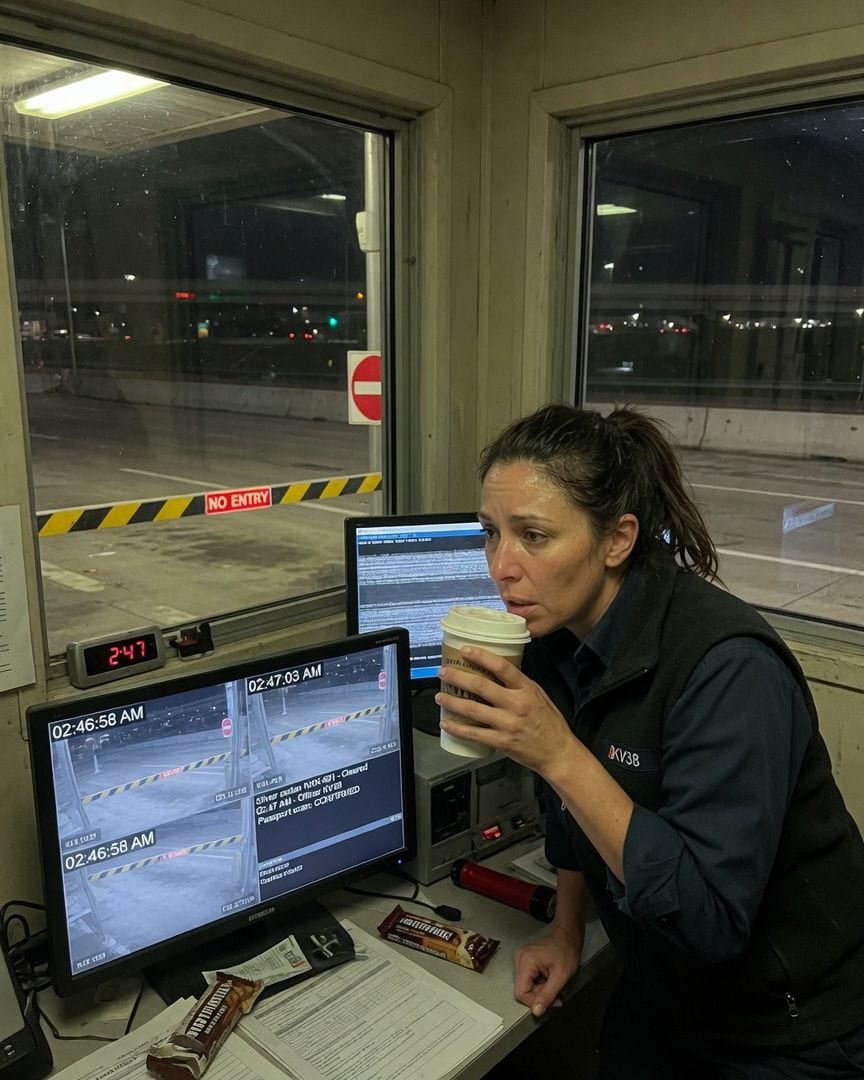
My lane's barrier was down, but my log cleared a car at 2:47 AM. With my code.
Working the quiet overnight shift at the Vance-Romano land crossing, I expected only routine system logs. Instead, a new entry showed a silver sedan cleared northbound through my Lane 3, stamped with my officer code. The issue: my lane had been closed and locked all night, and I hadn't seen a single car pass. Then I discovered the external camera feed for those crucial seconds was simply gone.
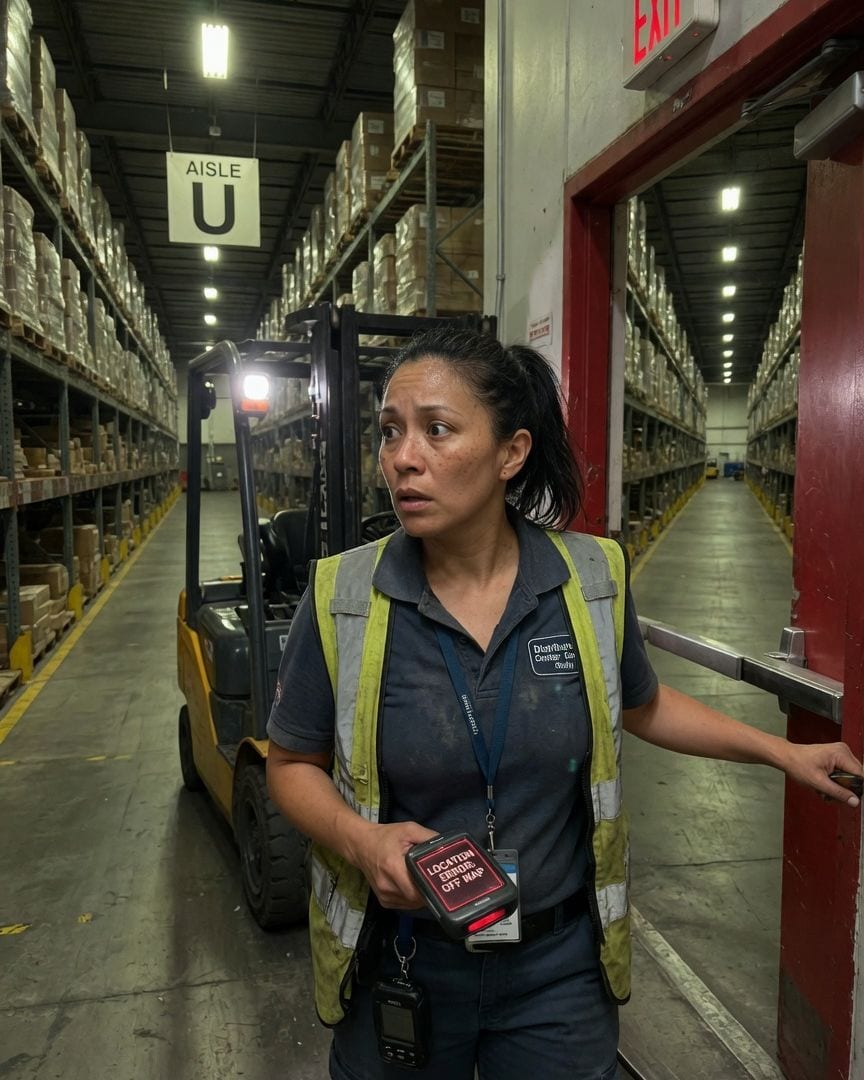
My warehouse has twenty aisles, A to T. My forklift turned past T and found Aisle U, full of packages for orders that don't exist in our system.
Five years I'd driven these aisles at the distribution center, enough to navigate them blind. Tonight, consolidating pallets was a mundane task. But turning past Aisle T, my headlights found Aisle U – a section that shouldn't exist in our blueprints or system. My forklift's scanner screamed 'LOCATION ERROR: OFF MAP'.
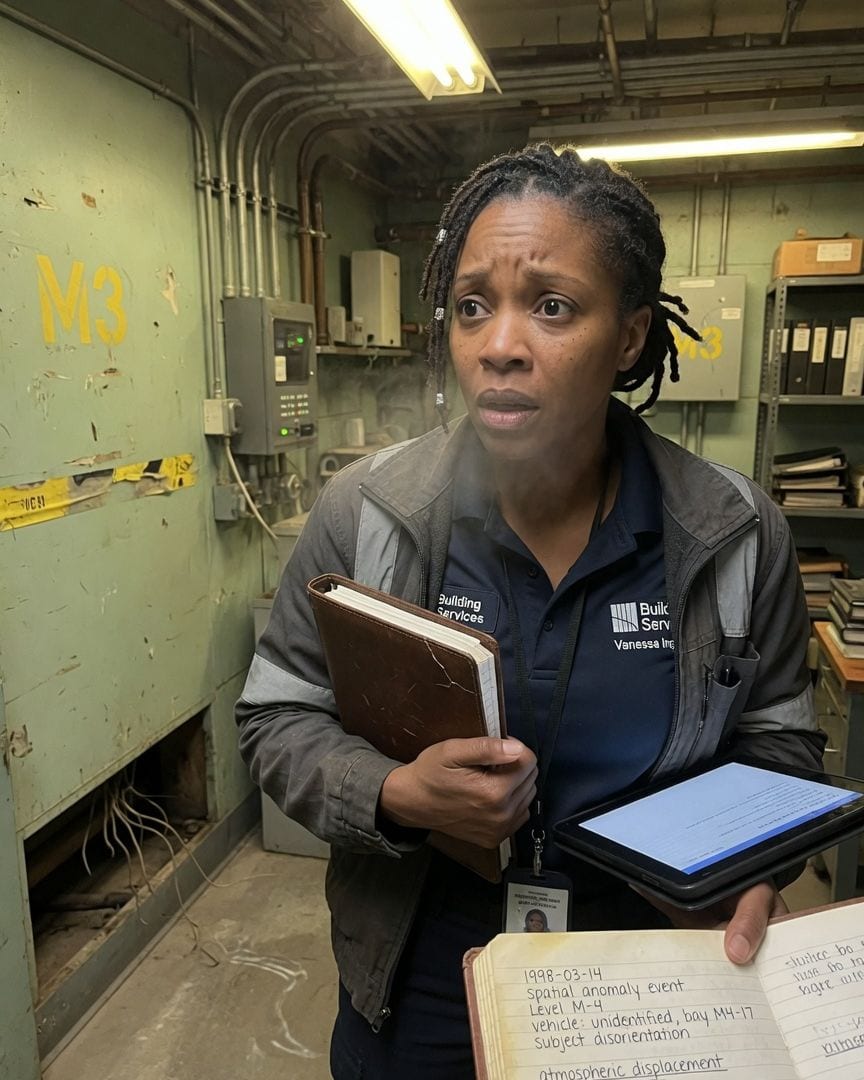
The lift offered a level below the lowest one, so I took the stairs down a flight that has never existed — into cold, empty bays where a single car sat, its engine still ticking like it had just been driven.
My routine as a Building Services Technician is usually solid, but today, the building offered a fourth basement level, M-4, that shouldn't exist. Descending into its frigid gloom, I found an old car tucked away in a bay, its engine ticking softly as if it had just arrived.
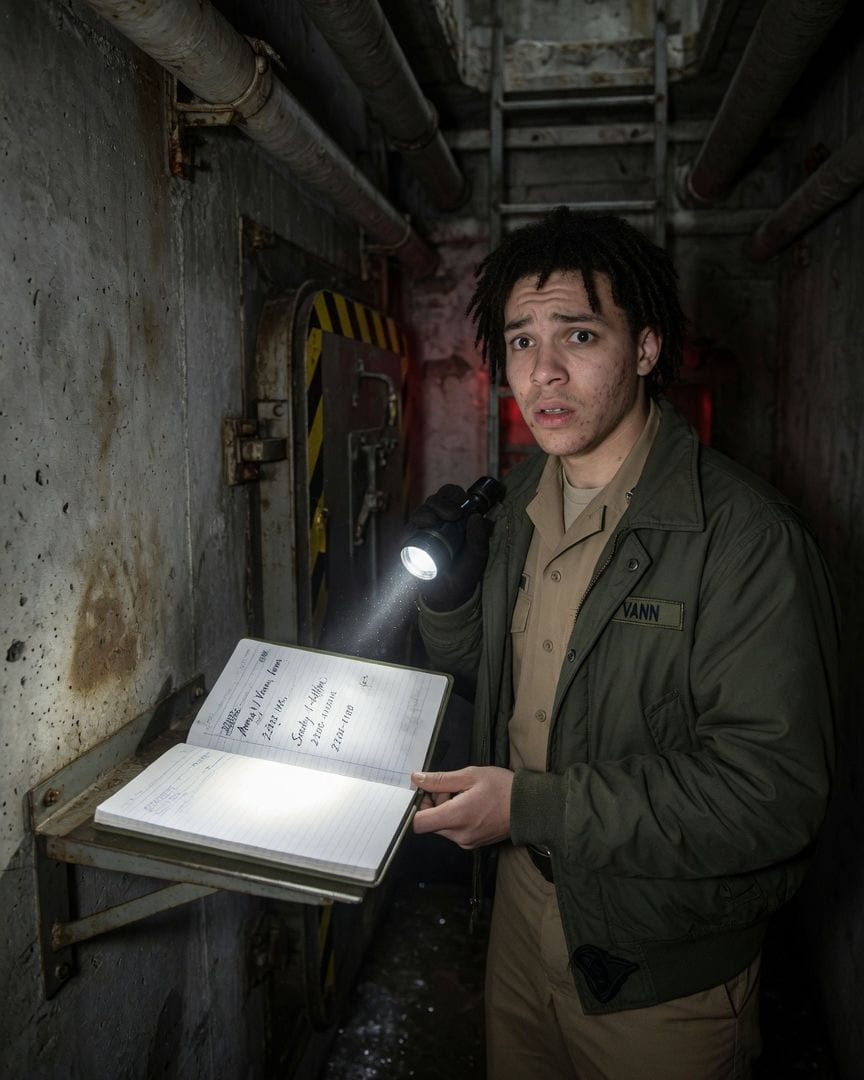
On his last patrol, Airman Vann sees a Cold War silo hatch light up from *inside*—it was welded shut a decade ago.
Airman Vincent Vann was on his last patrol across a vast, desolate Cold War missile field in the Dakotas, the cold, starless sky mirroring the emptiness of the landscape before his transfer. His routine check of eight hardened silo caps was shattered when a red fault light pulsed on Silo 4’s access panel, signaling an impossible breach from *inside* a hatch sealed for a decade. As more silos lit up, ignoring base orders, Vann found the hatch unlocked from within and descended into the dark shaft, where he discovered a pristine logbook bearing his own signature next to a chilling entry from a non-existent sentry, dated for *that very night*. Now, a steady *thump* echoed from deeper within the sealed concrete, leaving the Airman desperate for an explanation that simply wasn't there.
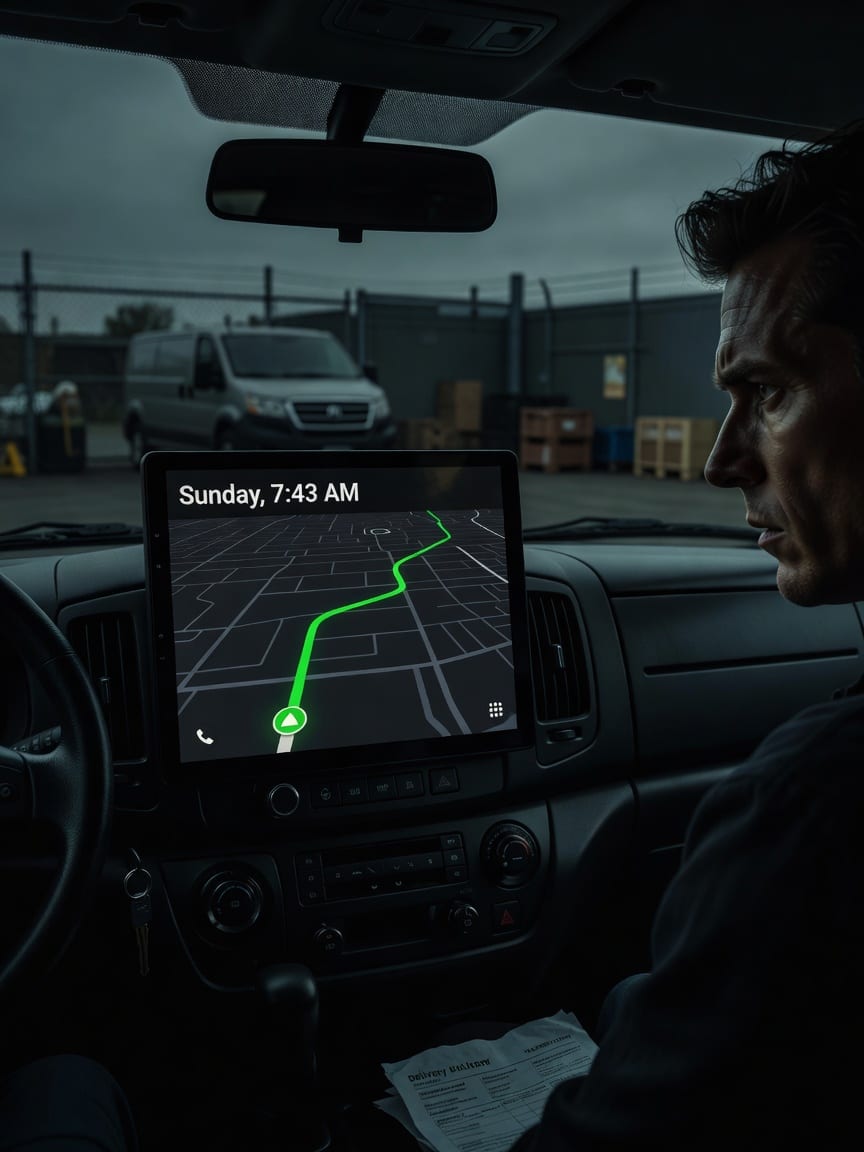
My delivery van drove 130 miles last Sunday, stopping for four hours in another state. It never left our locked yard. The GPS log drew the whole trip, timestamped to the minute.
I was just doing my job, sitting in the dispatch office with my manager Joel, when he pulled up the GPS log for my delivery van, Unit 74. It showed a 130-mile round trip to Delaware, engine on for four hours, with a distinct stop, all while my van was locked in the yard and I was home. The camera footage confirmed it hadn't moved an inch, yet the system insisted it had traveled hundreds of miles.