A letter with my name and a floor plan, marked with an X in the box room, arrived at my new flat a week before I viewed it.
It started with the post. Not just any post, but a letter that shouldn’t have existed.
I was still wading through boxes in my new flat at 14 Elmwood Lane, the scent of fresh paint barely masking the older, mustier smells of the building.
Everett Prescott, the estate agent, had called me earlier that week, apologetic about a stray piece of mail that had arrived after I’d picked up the keys. He’d forwarded it, and it sat on my kitchen counter, pristine and unsettling.
Addressed to me, Sophia Galloway, at this exact address. Nothing particularly odd about that, except for the postmark. ‘Carne Beacon,’ it read, and the date beneath it made my stomach drop.
It was dated a week before I’d even viewed the property, let alone signed the papers. A week before I knew this flat, 14 Elmwood Lane, would be mine.
My hands felt clammy as I tore open the envelope. Inside was a single sheet of paper.
It was a meticulously hand-drawn floor plan of my flat, to scale, right down to the awkward layout of the bathroom and the placement of the kitchen window.
A clear, dark ‘X’ was drawn in the smallest room, the box room, tucked away at the back. Beside the ‘X’, scrawled in a neat, almost elegant script, was my name: ‘Sophia’.
I stood there, the paper rattling slightly in my hand. The chill in the air wasn’t just the draft from the open window, it was something colder. An impossible timeline.
The intimate detail of a home I hadn't yet known was mine. The unsettling precision of my name, on a map of a future I hadn't chosen. I tried to rationalise it, of course. A mistake. A prank.
Maybe someone had listed the property with my name by error, then sent this to the wrong address?
But the specificity of the floor plan, the X in the box room, and my name, all before I’d even stepped foot in the place, gnawed at me. The ordinary explanations felt thin, like tissue paper in a gale.
The name ‘Carne Beacon’ snagged at my brain. I pulled out my phone and searched it. It wasn't a post office or a delivery company.
It was a real place: an ancient, windswept burial mound on a remote stretch of downland, steeped in local folklore about old rites and hidden histories.
Not somewhere you’d expect a letter to be postmarked from, certainly not with such unsettling contents. The search results flickered on my screen, images of desolate moorland, a single cairn of stones against a grey sky.
It amplified the chill already creeping up my spine.
I returned to the flat, the floor plan with its ‘X’ in the box room pulling at me.
I walked down the narrow hall, my footsteps echoing in the still-empty rooms, and pushed open the door to the tiny, windowless space. It felt colder than the rest of the flat, despite being enclosed.
My fingers ran along the old skirting board, dusty and chipped. Then, I knelt, feeling along the wooden floorboards.
Most were solid, but near the corner, close to where the 'X' would be, one felt slightly loose, almost springy beneath my touch.
I fumbled for a screwdriver, then a flat-head knife from a kitchen box, and with a grunt, I managed to pry the board up. Dust motes danced in the sliver of light from the hallway.
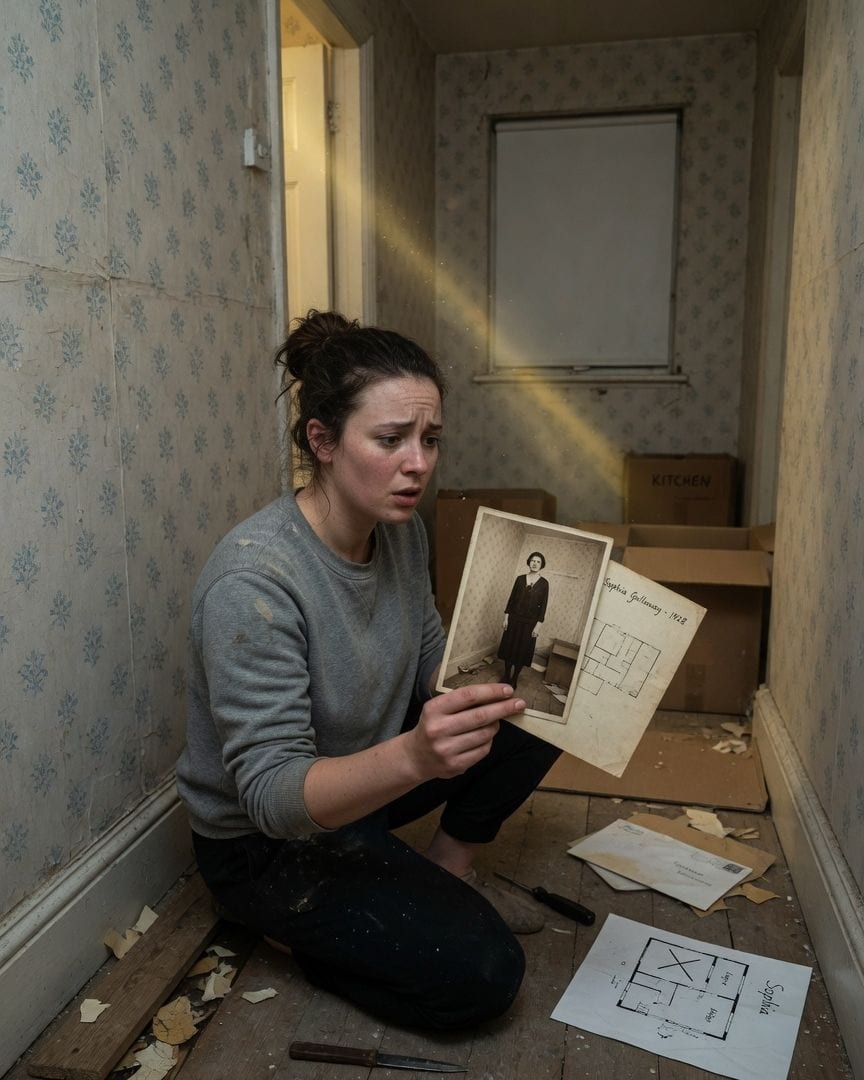
Tucked beneath, wrapped in brittle, yellowed paper, was an old photograph. It was sepia-toned, faded at the edges, clearly taken decades ago.
It showed the interior of this very box room, instantly recognisable by the distinctive pattern of the wallpaper and the narrow window frame (now covered by a temporary blind).
A woman in an outdated, dark dress stood facing the camera, her expression unreadable, her hands clasped in front of her. She was positioned almost exactly where the ‘X’ was drawn on my floor plan.
My heart hammered against my ribs. I carefully turned the photo over. Scrawled on the back in faded, looping ink were two words and a date: ‘Sophia Galloway - 1928’.
My own name. A different Sophia. From a time long before I was born. In my new home. In this box room.
I stood frozen in the box room, the dust motes dancing in the sliver of light from the hallway. The old photograph felt impossibly heavy in my hand.
My own name, ‘Sophia Galloway,’ staring back at me from a date that predated me by over fifty years, on a photo taken inside the very room where an ‘X’ had been drawn on a floor plan I received before I owned the flat.
My breath hitched, the rational explanations I’d clung to crumbling to ash around me. This wasn't a mistake. This wasn't a prank. This was something else entirely, something that had chosen me, known me, long before I knew myself.
The next few days blurred into a fog of disbelief and frantic research. I couldn’t shake the image of the photograph, the impossible date, my name.
I even showed the photo to Everett Prescott, the estate agent, hoping for some mundane explanation. He’d shrugged, a little too quickly. “Old family heirloom, probably. Left behind. What are the chances of two Sophias? Coincidence, that’s all.”
His nonchalance, however, felt forced, a thin veneer over something he didn’t want to acknowledge.
I tried to trace the ‘1928’ date, delving into local property records online. Nothing concrete linked a ‘Sophia Galloway’ to the flat at that time. The records were sparse, frustratingly incomplete.
Then, one afternoon, the ordinary routine of buying groceries was shattered. As I stepped out of the corner shop, a man in his sixties, impeccably dressed in a tweed jacket, stopped me.
He had kind, sorrowful eyes that seemed to hold a vast, ancient weariness. He looked at me directly, by name. “Sophia Galloway,” he said, his voice soft but clear, almost a whisper, “I want to apologize. For what’s to come.
It’s not personal, you understand, but it’s inevitable.” He bowed his head slightly, a formal, almost theatrical gesture, then walked away before I could react. Edward Thatcher, I remembered the name from a community noticeboard in the shop.
The apology hung in the air, heavy and unexplained.
Three days later, a small but significant incident occurred. I was walking home, preoccupied, and stepped off the curb without looking. A delivery van, much faster than it should have been, swerved, its tires screeching, missing me by inches.
The driver shouted, I stumbled, my heart leaping into my throat.
Later, in the quiet of my flat, I remembered a vague, unsettling premonition I’d had immediately after Edward’s apology: a flash of screeching tires, a white van, a sudden lurch. The dread solidified, turning from abstract to terrifyingly specific.
Someone knew. Someone was watching. Someone was involved.
The incident rattled me to my core. I found myself constantly looking over my shoulder, jumping at shadows.
My phone would ring, displaying ‘UNKNOWN NUMBER’, and when I answered, there was only silence, sometimes a faint, distant rustling, like dry leaves, before the line disconnected.
I began to notice subtle shifts around my flat: a window I was sure I’d latched the night before now slightly ajar, a book moved on my shelf, tilted differently than I remembered.
I tried to rationalize these things as tiredness, forgetfulness, the quirks of an old building, but the cumulative effect was suffocating.
One evening, as I walked home from work, the streetlights casting long, distorted shadows, I saw Edward Thatcher again. He was standing across the street, near the bus stop, partially obscured by a lamppost, watching my flat.
He wasn’t hiding; he was simply observing. When I caught his eye, he didn't flinch or look away.
He simply gave a small, almost imperceptible nod, a gesture of quiet acknowledgement rather than surprise or malice, and then melted into the shadows of the alleyway.
The confrontation wasn’t aggressive. There was no menace in his posture, no threat in his gaze.
But the sheer fact of his presence, his unwavering gaze on my home, confirmed what I already suspected: I was no longer merely investigating; I was being observed, my every move noted.
The terror wasn’t of being attacked, but of being known, tracked, and waited for, like prey in a carefully laid trap.
The silence on the phone, Edward’s presence, the subtle changes in my home – they were all messages, confirming that my digging had not gone unnoticed, and that my fate, whatever it was, was drawing closer.
Driven by a desperate need for answers, I traveled to the county archives and historical society, a quiet, imposing stone building near Carne Beacon itself.
After explaining my unusual query to Thomas Mitchell, a kind but reserved archivist in his mid-fifties, he directed me to local land deeds and census records.
I found scant information about a ‘Sophia Galloway’ in the immediate vicinity of my flat around 1928.
However, as I was about to give up, a dusty, leather-bound volume caught my eye on a lower shelf, tucked away behind a row of parish registers. It was labeled ‘Carne Beacon Parish Records – 1780-1950’.
It wasn't a typical census or church register; it seemed to be a private ledger, its cover worn smooth by countless hands.
With Thomas’s permission, a slight frown on his face as he watched me pull it out, I opened it.
The handwritten entries were peculiar. They listed names, birth dates, and then a ‘completion’ date, often accompanied by a single, cryptic word or phrase. My heart pounded as I turned the brittle pages.
I saw names I didn’t recognise, and phrases like ‘The Journey,’ ‘The Silence,’ ‘The Call Home.’ My breath hitched.
Then I saw it. An entry, written in a spidery, elegant hand, dated 1928:
‘Sophia Galloway – Born 1898 – Completed 1928 – The Dwelling’.
The name from the photograph. The exact date from the photograph. ‘The Dwelling’ – it could only mean my flat, 14 Elmwood Lane. The pieces clicked into place with horrifying precision.
The letter, the floor plan, the ‘X’ in the box room, the photo hidden beneath the floorboard – all suddenly made a terrible, coherent sense. This wasn't a coincidence; it was a pattern.
The ‘Sophia Galloway’ in the photo was not me, but a predecessor, a previous ‘occupant’ of my ‘dwelling’ and my ‘name’.
My hands trembled as I continued to turn the pages of the Carne Beacon ledger. My eyes scanned for more ‘Sophia Galloway’ entries, dread building with each passing year. And there they were.
Not just one, or two, but a horrifying repetition.
‘Sophia Galloway – Born 1785 – Completed 1825 – The Calling.’
‘Sophia Galloway – Born 1830 – Completed 1870 – The Return.’
‘Sophia Galloway – Born 1860 – Completed 1900 – The Harvest.’
Name after name, century after century, a chilling, cyclical pattern of ‘Sophia Galloways’ and their assigned ‘completions’. The exact same name, appearing at regular intervals, each tied to a specific date and a cryptic fate.
Some entries mentioned 'The Dwelling' again, others different locations or events.
Then, on the very last page, almost as if waiting for her, I saw it:
‘Sophia Galloway – Born 1991’.
My own birth year. The space for the ‘completion’ date was utterly, terrifyingly blank. My own name, my own life, reduced to a single, open entry in a ledger spanning centuries of pre-ordained destinies.
Reeling from the ledger, I found Helen Larsen. She was a woman I’d seen working quietly in the archives for days, meticulously cataloging old documents, her grey hair pulled back in a severe bun.
Helen, about 68, had an air of ancient calm about her, a stillness that was unsettling. I walked straight up to her, the heavy ledger clutched in my hand, and demanded to know what it meant.
She did not deny it. She simply closed the book she was working on, placed her hands on the table, and looked at me. Her eyes were piercing, yet devoid of harshness.
Her voice was soft, unhurried, as if discussing the weather. "The Galloways are the keepers, my dear. We have always been. Since the Beacon first drew them. Certain names, certain souls, are called to this land, to this cycle.
They are chosen. Not by us, but by something older, something in the earth itself. We merely record, observe, and occasionally, facilitate."
She explained that ‘Sophia Galloway’ was one such recurring name, a designation for those whose ‘completion’ was tied to the Dwelling, the flat at 14 Elmwood Lane.
The X on the floor plan, the apology from Edward Thatcher – all were part of the quiet, ancient protocol. Edward was a low-level attendant, a messenger. He performed his duty with detached calm, as Helen did hers.
She spoke of the cycle as a natural process, an ebb and flow of energy, a necessary balance. Her calm acceptance of such a monstrous pattern was far more chilling than any anger or madness could have been.
Everything clicked into place: the impossible letter, the hidden photo, the precise apology, the terrifying ledger. It was all a single, coherent, terrifying design.
Helen Larsen looked at me, her eyes devoid of judgment or malice. “Your completion is near, Sophia. The box room is merely the conduit. It is not an end, but a transition. It is an honor, chosen for generations.”
A cold dread seeped into my bones. Helen was not a villain, not in the way I understood it. She was an administrator of an ancient, terrible duty, a keeper of a ledger.
Her words were gentle, but the implication was a concrete wall closing in. “No,” I whispered, shaking my head, my voice barely audible. “No, I won’t.”
Helen sighed, a sound of gentle regret, almost pity. “You cannot refuse what you are, Sophia. Only delay it.”
But I had already made my choice. I wasn’t going to be another entry in that horrifying ledger. I wasn’t going to walk into that box room, whatever awaited me there.
I turned and fled the archives, the image of the blank ‘completion’ date seared into my mind.
I ran, not knowing where I was going, only that I had to get away from Carne Beacon, from the flat, from the name. I didn't fight Helen, didn't argue further. I simply ran.
The horror was not a physical threat from Helen, but the quiet, undeniable truth that had been laid bare, the implication that my fate was not my own, and that escape was merely a desperate, temporary reprieve.
I abandoned the flat, the boxes, everything I owned there. I simply left, carrying only the knowledge that my name had been called.
I sold the flat at 14 Elmwood Lane at a heavy loss, never stepping foot in it again. I moved to a different county, changed my phone number, cut ties with most of my old life.
The letters, the ledger, the apology – I never spoke of them. I built a quiet, anonymous existence, always looking over my shoulder, always listening for a voice calling my name, always checking the postmark on every piece of mail.
The dread became a constant companion, a quiet hum beneath the surface of my new, ordinary life. I was free, but irrevocably marked by the terrible intimacy of being chosen.
Years passed. I had found a quiet rhythm, a sense of fragile peace in my new, distant life. The constant vigilance had faded into a dull ache, a background hum I’d grown used to.
Then, one ordinary Tuesday, an unmarked package arrived with my mail. No return address. My hands trembled as I opened it. Inside, nestled in tissue paper, was a small, carefully folded piece of parchment.
It was a floor plan, hand-drawn, of my current, anonymous apartment. There was a clear, dark ‘X’ in the corner room, and my name, ‘Sophia,’ written beside it. The postmark on the outer packaging, barely legible, was from Carne Beacon.
If this one got to you
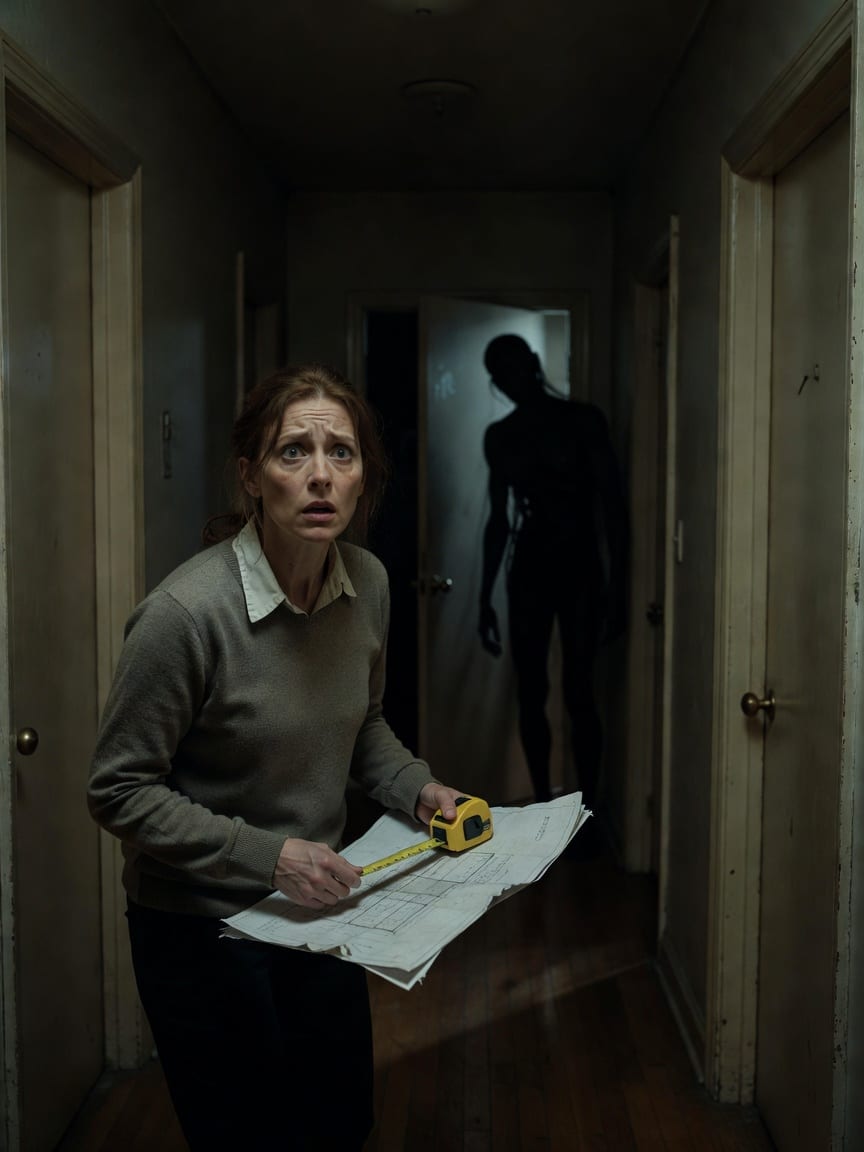
My front door has a dented gate and a dead hydrangea. I walked past it six times, trying to reach the corner shop just a hundred yards away. The pavement kept bringing me back to my own porch, and the shop's light never moved.
My morning started like any other, a quick walk to the corner shop from my home at Number 14, Elm Terrace. But after walking what felt like two minutes, I found myself back at my own front door, the shop no closer. I tried six times, faster and slower, but my street kept compressing, refusing to let me leave.
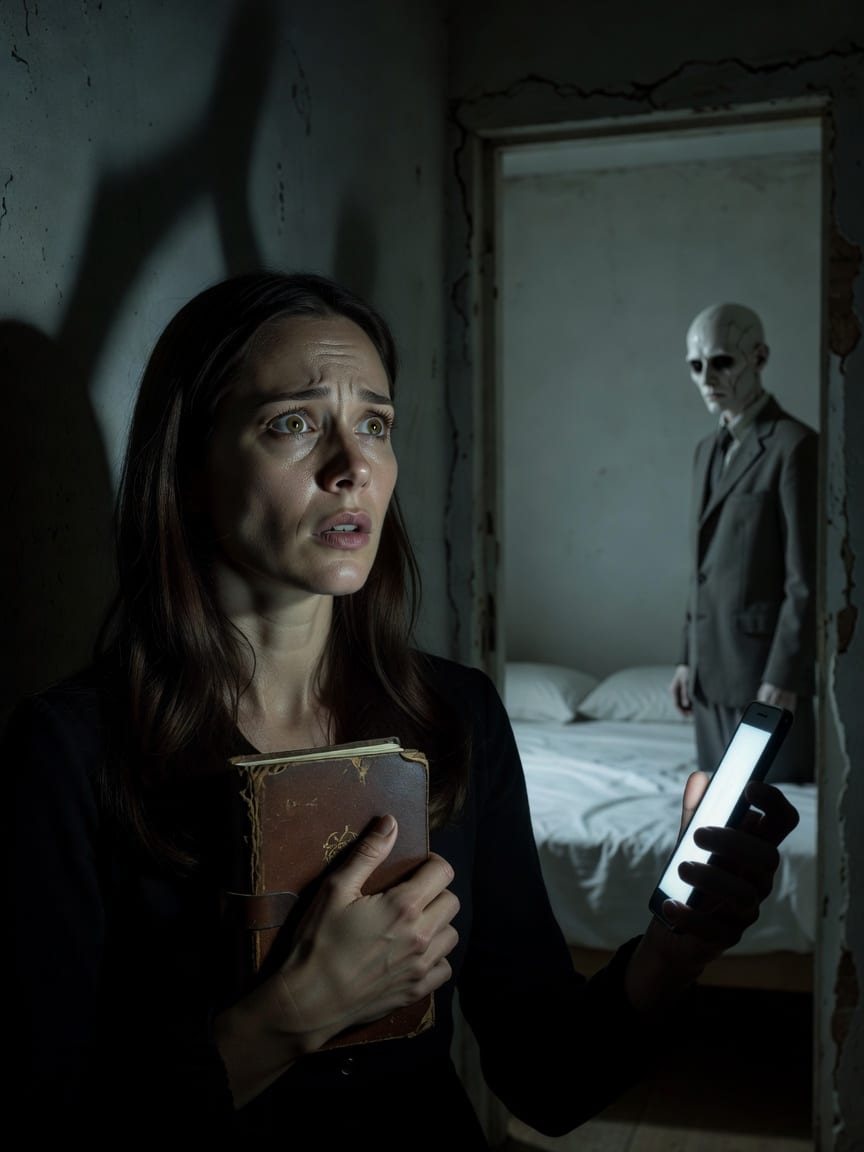
Behind a plastered-over doorway, I found a room. Papered, carpeted, and furnished with a made bed, sealed for decades. The air was dead still, but the bed wasn't dusty. My council tax bill only lists five rooms.
I'm Claire, an architect, meticulously planning my new Victorian terrace renovation. But when I uncovered a hidden room behind a wall, everything I knew about time and decay shattered. The bed was perfectly made, the air still, yet there was no dust, only an unnerving cold.
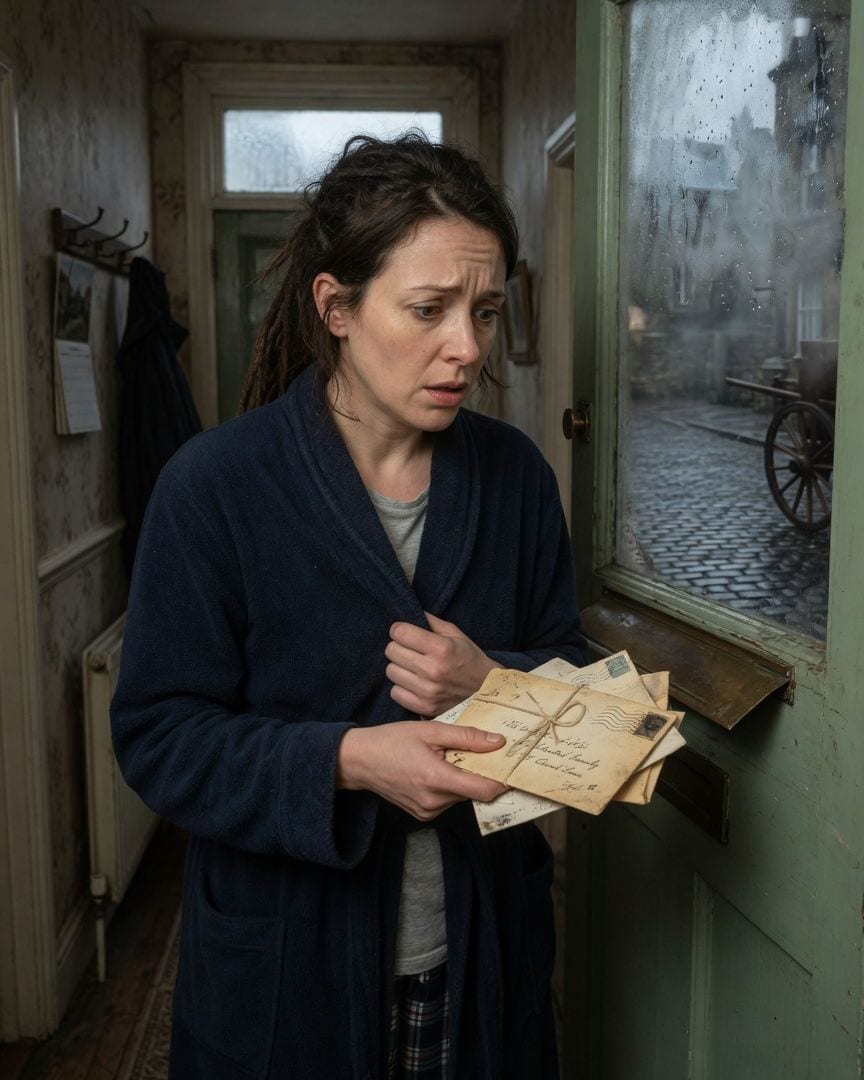
Seventy years ago, a hidden journal recorded my door opening to the wrong street and receiving Lockwood post.
I'd only recently moved into my inherited house, a quiet place on the edge of town. One grey morning, a distinct clatter from the front door's post flap caught my attention. Reaching down, I expected my gravel path, but instead, the flap showed a dark, cobbled street that wasn't mine. A bundle of warm, old letters, addressed to 'The Lockwood Family,' slid through, before the vision flickered and was gone.
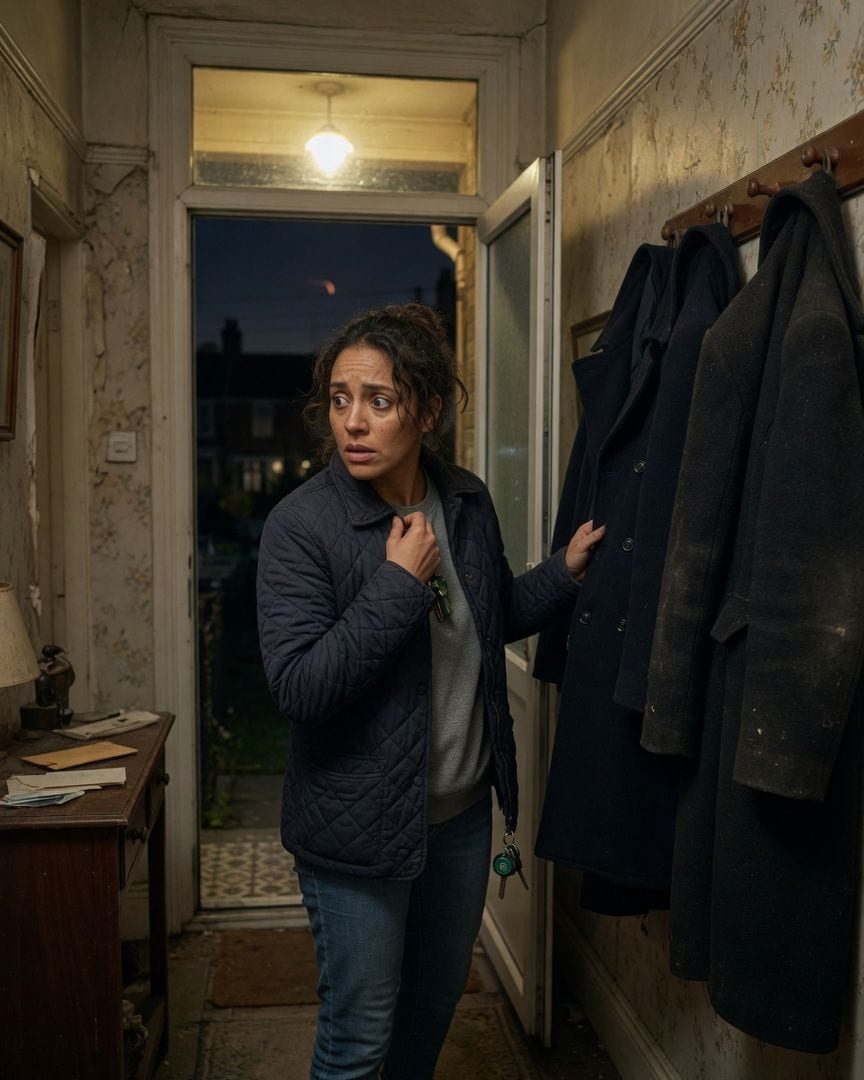
My tiled path was new, my front door green. Then three dark coats hung in my hallway.
After a late night watching the lunar eclipse, I returned to my Victorian house, only to find the path and front door inexplicably changed. Though the house seemed to revert to normal, strange things started appearing: a kettle warm from boiling, a distinct impression on my armchair. Then, an antique, lavender-scented handkerchief appeared on my bedside table, an undeniable presence in my private space.
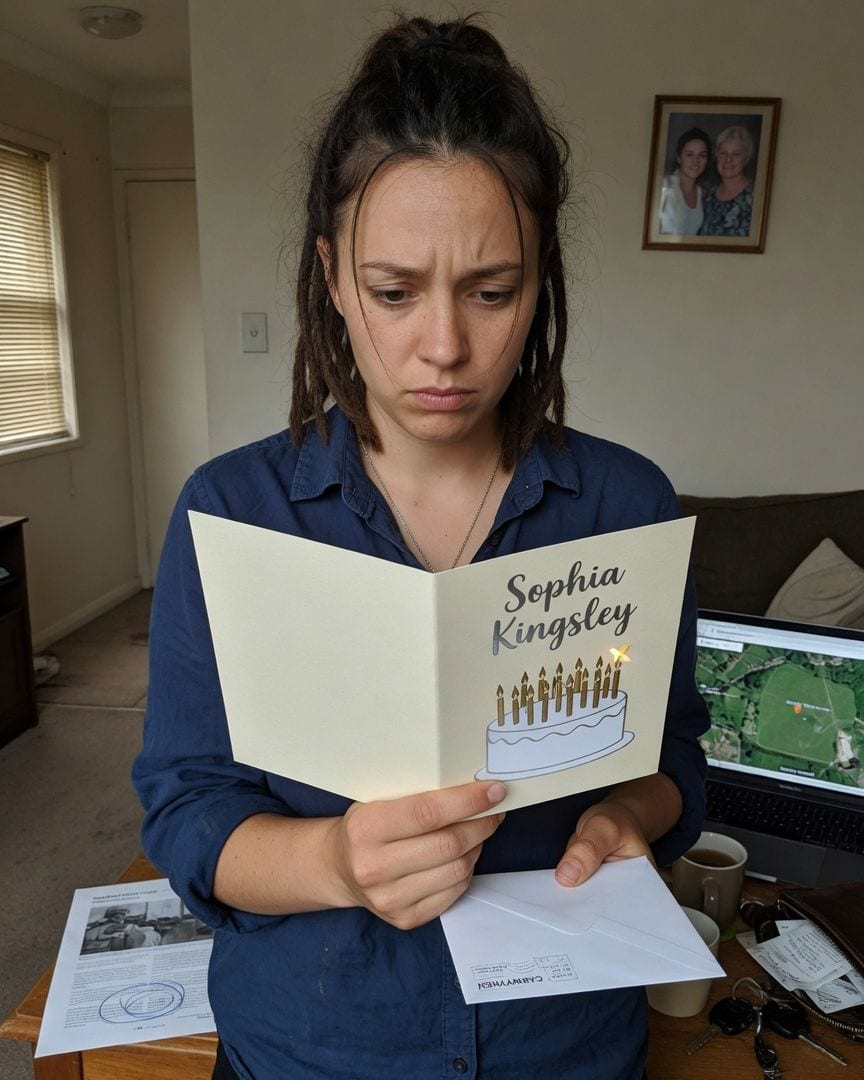
An empty field sends my birthday cards. This year, one candle was crossed out.
My birthday card always arrived a day early, a familiar comfort for five years. This year, a tiny silver 'X' marked one of the thirty candles, and the postmark read 'Carwynnen.' It was an empty field miles from anywhere, with no post office, and no one to send a card.
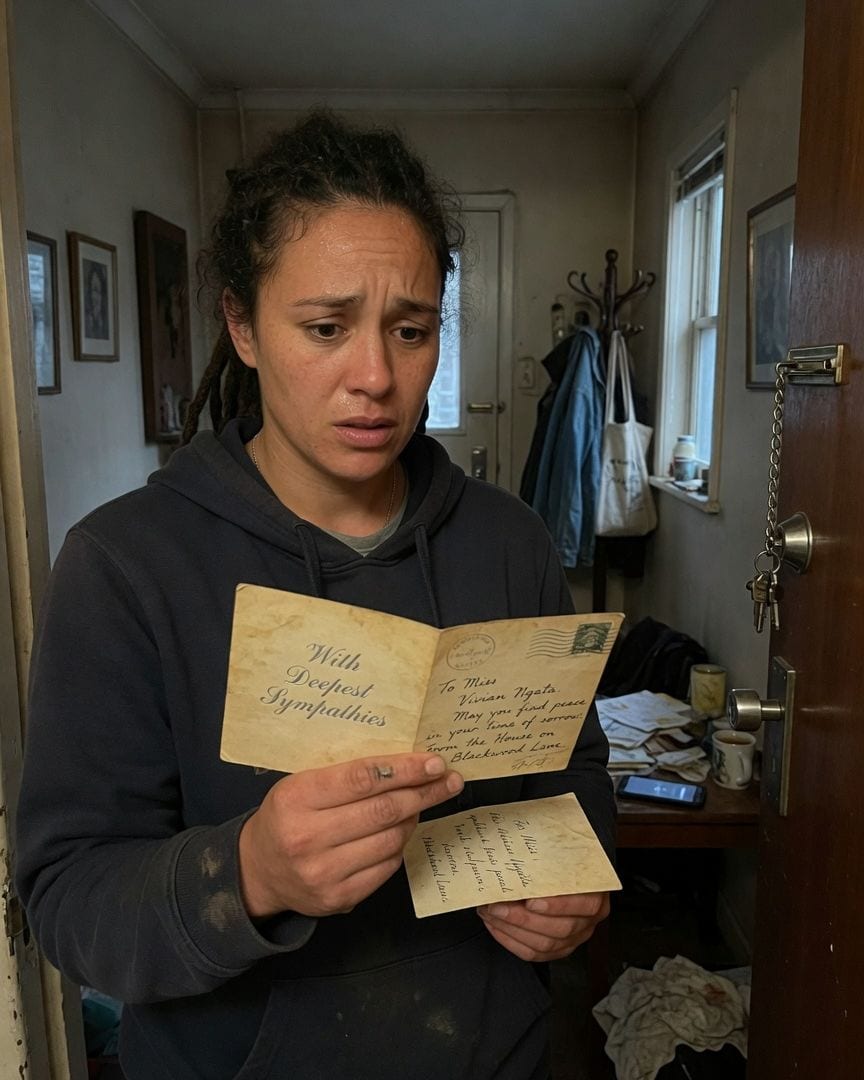
My locksmith knew my name, then apologized for next Tuesday. I never gave him my name; his firm doesn't exist.
I just needed a new deadbolt after some neighborhood thefts. But the locksmith knew my name without me telling him, and murmured something about 'Tuesday' when it was Thursday. Then his company, 'Everlast Security Solutions', vanished without a trace, its phone number dead and its address an empty field.