Marden's 'old dairy' shows up in the 1901 census as a chapel. Its minister was 104 that year. Everyone here looks at me oddly when I call it a chapel.
I had only been in Marden for three weeks when I first saw it. A squat, grey stone building on the edge of town, its arched windows boarded up, a faded, hand-painted sign above the door proclaiming 'MARDEN DAIRY.'
It squatted low, a heavy shadow even in the midday sun. But my historian’s eye saw the ghost of a steeple, the distinct lines of a nave. It was a chapel, unmistakably.
I’d even found it in the 1901 census, listed clearly as ‘Marden Chapel,’ with a resident minister, Gerald Porter, whose age was given as one hundred and four. One hundred and four. In 1901.
When I casually mentioned my discovery to Kenneth Maddox, the town clerk, he’d smiled a little too smoothly. He had that particular Marden charm, all soft edges and unspoken warnings. “Oh, that old thing? Always been the dairy, dear.
Used to supply the whole valley.” He’d then changed the subject with practiced ease, asking if I’d had a chance to try Mrs. Henderson’s famous apple pie.
Every local I asked offered the same, bland, ‘old dairy’ story, their eyes just a flicker too still when I mentioned the census.
The persistent, quiet denial felt like a physical weight, a collective agreement that made the building itself feel wrong, like a word mispronounced until its true meaning vanished.
It wasn’t just a misidentification; it was a deliberate erasure, and the chapel’s stone walls seemed to absorb the lie, holding it in their cold embrace.
I couldn't shake it. The sheer, deliberate uniformity of the town’s story felt less like a shared memory and more like a carefully maintained facade.
Armed with my flashlight and a growing sense of unease, I returned to the 'old dairy' late one afternoon. The boards on the windows were old, but not impenetrable, warped and splintered in places.
I found a loose panel on one, easing it open just enough to squeeze inside. The air was thick with dust and the faint, sweet smell of something long dead, like forgotten potpourri mixed with old earth.
It was dark, save for my beam, which cut through the gloom like a knife. No dairy equipment. Just empty space, the echoes of forgotten hymns clinging to the high ceiling.
The walls were rough-hewn stone, but as my light traced a section near what would have been the altar, I noticed it: a hairline fracture, too straight to be natural, running floor to ceiling.
It wasn't a crack from age; it was a seam, expertly disguised, almost invisible beneath layers of grime and lichen. Pushing against it, I felt a slight give. The stone was cold, unyielding, but the section moved.
With a grunt, I managed to force a small section inward, just enough for the rough edges of the stone to grind against each other like ancient teeth.
It revealed a narrow, claustrophobic passage, barely wide enough for my shoulders, leading to a smaller, circular room, completely hidden within the chapel’s structure.
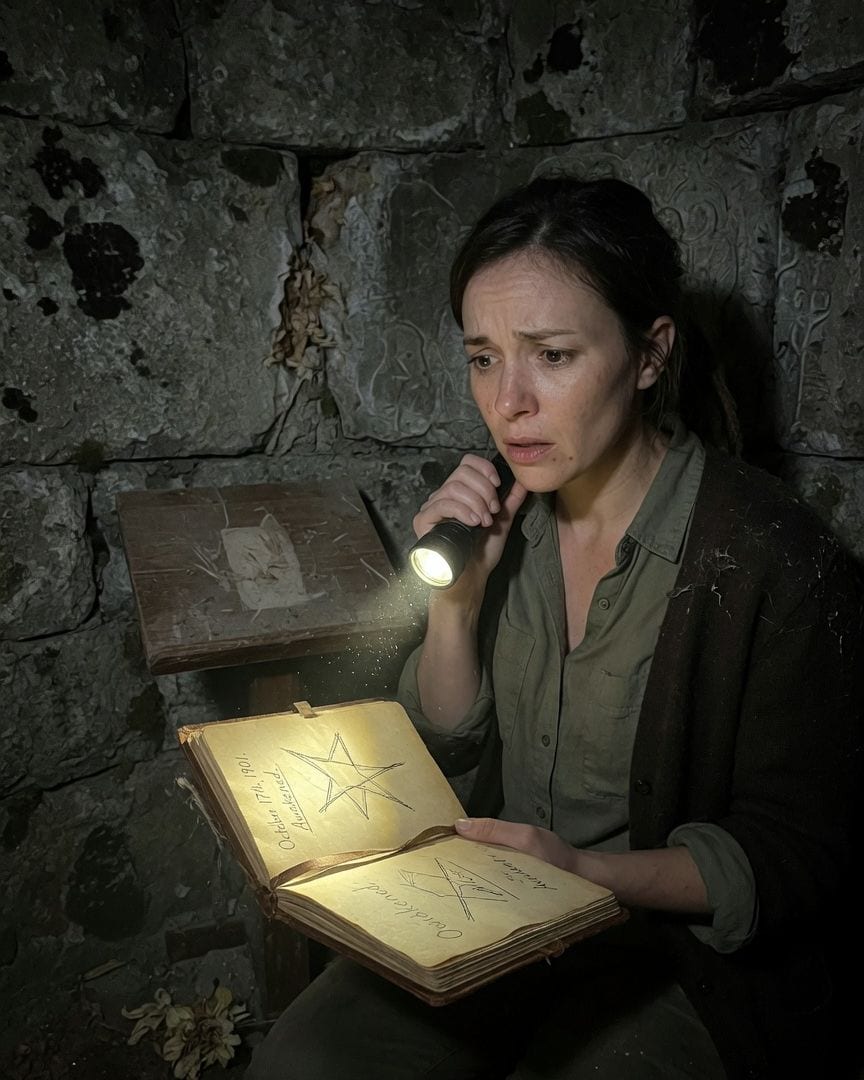
My light fell upon a small, wooden stand, and on it, a single object: a leather-bound journal, its cover worn smooth, no title.
It felt ancient, heavy with secrets, and utterly out of place in any dairy, or even a typical chapel.
My heart hammered against my ribs, a frantic drum in the sudden silence. This wasn't just a hidden room; it was a vault, concealed with an almost obsessive care. I carefully picked up the journal.
The leather was surprisingly supple beneath my fingers, despite its apparent age. My fingers fumbled with the tarnished brass clasp, and it sprang open to a page marked by a thin, brittle ribbon.
My flashlight beam settled on the stark, hand-drawn image of a jagged, unsettling symbol, like a broken star, raw and primitive against the yellowed paper. Beneath it, written in elegant, spidery script, was a date: 'October 17th, 1901.'
And then, a single, chilling word, underlined twice: 'Awakened.' The date, the symbol, the word – it felt impossibly precise, too significant to be random.
The air in the hidden room grew cold, prickling my skin, and the beam of my flashlight seemed to dim, swallowed by the implications of what I was seeing.
I stared at the page, the wrongness of it all settling deeper than mere curiosity.
Back in my rental, the journal lay open on my desk, the symbol a dark stain on the otherwise ordinary evening. It was unlike anything I recognized from religious iconography or local folklore.
I tried cross-referencing it with obscure texts, running image searches on academic databases – nothing. It was a unique, alien sigil.
The date, October 17th, 1901, yielded nothing significant in any Marden historical archives I could access – no major events, no fires, no notable births or deaths.
It was a blank spot, unnervingly so, as if the town itself had collectively decided to skip that day.
But the more I dug into the census, the more a pattern began to emerge, an unsettling rhythm pulsing beneath the dry facts.
Digging deeper into Marden’s past records, I found other anomalies, not just Gerald Porter.
In the 1830 census, a 'caretaker' for the 'chapel grounds' was listed with an age of 98, then vanished from subsequent records without so much as a death certificate.
In the late 1700s, another 'chapel steward' was recorded as 'of advanced years' for decades before his name simply ceased to appear, replaced by someone else entirely, with no explanation for the previous steward’s disappearance.
These weren't just long lives; they were lives that ended abruptly, without record, always associated with the chapel or its immediate grounds. A chill ran down my spine as I mapped out the dates on a separate sheet of paper.
Roughly every 70-80 years, a figure connected to the chapel would appear, age impossibly, and then disappear.
It was a cycle, too regular to be coincidence, a hushed rhythm hidden in plain sight within the dry pages of town records, each anomaly a quiet echo of Gerald Porter’s impossible age and the chilling word 'Awakened.'
The more I looked, the more the town’s past felt less like history and more like a carefully constructed lie.
My persistent inquiries, especially about the older census anomalies and the 'chapel steward' discrepancies, didn't go unnoticed. Kenneth Maddox, initially helpful in that condescending, small-town way, grew increasingly evasive.
He started suggesting other, less 'morbid' historical avenues for my research, his tone shifting from dismissive to subtly admonishing.
“Some things are best left undisturbed, Chloe,” he’d said one afternoon, his smile tight, his eyes holding a warning that felt far too sharp for the bland words.
He offered me a pamphlet on Marden’s quaint agricultural history, as if that would distract me.
One evening, after a particularly pointed session at the library where I had asked for records predating the 19th century, records Maddox claimed were 'lost in a fire,' I found a small, crudely folded note tucked under my windshield wiper.
The paper was rough, like brown packing paper, and it contained only two words, scrawled in thick black ink: 'LEAVE MARDEN.' The message was blunt, direct, and utterly terrifying in its simplicity.
It wasn't a threat of physical harm, not yet, but a clear signal that my digging had crossed an invisible line. Someone knew. Someone was watching.
The quiet agreement of the town was no longer passive; it was actively enforcing its secret, the collective denial now a living, breathing thing.
I felt the chill of unseen eyes on my back as I drove home, every shadow seeming to hold a silent observer, the friendly, sleepy town now feeling like a cage with watchful keepers.
The note solidified my resolve. Retreat was not an option now; I was too deep, and the wrongness was too profound.
There was only one person left who might speak the truth without resorting to threats or platitudes: Vera Muller, the elderly woman who lived next door to the 'old dairy.'
Vera had a reputation for being a quiet observer, a keeper of unspoken histories, her gaze often distant, as if seeing beyond the immediate.
I found her tending a small garden, her movements slow but deliberate, coaxing life from the stubborn Marden soil.
“Vera,” I began, my voice low, trying to keep the tremor out of it, “I need to know about the chapel. About Gerald Porter. And about the date October 17th.”
Vera straightened slowly, her gaze distant, fixed on the boarded-up windows of the 'dairy,' now looking more imposing than ever in the fading light. She sighed, a sound heavy with generations of resignation, a weariness that went beyond her years.
“It’s not a chapel, dear. Not anymore. Not for a long time.” She wiped her hands on her apron, then gestured for me to follow her inside her small, cluttered cottage.
The air was warm with the scent of dried herbs and old books.
From a dusty chest in the corner, Vera produced a brittle, leather-bound diary, much older than Gerald Porter’s, its cover cracked like ancient bark. “My grandmother’s,” she said, her voice raspy, holding it with a reverence that spoke volumes.
Inside, tucked between yellowed pages, were old, faded newspaper clippings about 'unexplained disappearances' and a 'seasonal sickness' that afflicted Marden's young men. Vera pointed to an entry, her finger a gnarled twig. “October 17th, 1831. The Keeper Awoke.
Young Thomas gone.” She explained, her voice barely a whisper, a story passed down through whispered fears, “The town made a pact, generations ago. After the Great Sickness, when it took so many. We learned how to… manage it.
To keep it contained. To keep it from taking everyone.” The 'dairy' name, she revealed, was part of the pact, a collective lie to disarm, to forget, to deny the true purpose of the building. “It's a container, Chloe.
Not a chapel. Not a dairy. A container for what wakes up inside.” The silence in the small room seemed to press in, the air suddenly thick with an unspoken horror.
Vera flipped through the diary, her finger tracing more entries, each one a date of an 'Awakening,' each accompanied by the name of a vanished young man from Marden.
The dates aligned perfectly with my census anomalies, the impossible ages, the abrupt disappearances. The pattern was horrifyingly clear, a ticking clock hidden in plain sight. “They all became Keepers,” Vera murmured, her voice hollow, echoing with a terrible knowledge.
“Gerald Porter, Thomas, all of them. Kept it fed, kept it quiet, until the next cycle.” Her finger stopped on the very last entry, written in a shaky hand by Vera’s own mother.
It was dated 'October 17th, 1971,' and described the 'Awakening' of a new 'Keeper,' a young man from the town named Elliot Larsen, who subsequently vanished.
Vera looked up, her eyes wide with dread, a chilling realization dawning in their depths. She gripped my arm, her frail strength surprisingly firm, her cold fingers biting into my skin.
“The cycle, Chloe,” she whispered, her voice barely audible over the thumping of my own heart. “It’s due again. Very soon. And they’ve already chosen.”
The full, sickening truth hit me like a physical blow, a sudden, cold weight in my chest. The town’s pact wasn’t just about denial; it was about active participation in a horrifying cycle.
The 'Awakened' entry in Gerald Porter's journal didn't refer to him waking up, but to the parasitic entity within him, taking hold, consuming.
The 'chapel' was a sophisticated containment and transfer chamber, its true function cloaked beneath generations of lies and the mundane name ‘dairy.’
The town elders, including Kenneth Maddox, had managed this entity for centuries, guiding it from an aging host to a fresh, young one during each 'Awakening' to prevent it from breaking free and unleashing its full, destructive power upon Marden.
The Keepers, like Gerald Porter and Elliot Larsen, were not victims in the traditional sense, but living prisons, granted unnaturally long lives by the entity until the next transfer.
They were sacrifices, kept alive for the sake of the town, until their time was up. The chosen 'Keeper' was always a young person from the town, a life offered up for the community's survival.
Vera, her face etched with sorrow and a terrible, resigned understanding, revealed that the current town council had already identified the next intended host, a quiet, studious young man named Roy Bryant, barely twenty, whose family had deep roots in Marden.
The ritual was scheduled for the coming full moon, just days away.
The town wasn't just hiding a dark past; they were perpetuating it, ensuring their own survival at the cost of a chosen few, all in the shadow of the 'old dairy' that was anything but benign.
The silence that followed Vera’s words was heavier than any threat, filled with the generations of unspoken horror.
Armed with Vera's diary and Gerald Porter's journal, the weight of their combined truths heavy in my hands, I confronted Kenneth Maddox and the other town elders in the Marden Community Hall.
The atmosphere was thick with a chilling calm, a deliberate composure that felt more menacing than any outburst.
Maddox, flanked by two other stern-faced elders – Mrs. Albright, who baked the best cookies, and Mr. Davies, the kind old hardware store owner – listened to my accusations with unnerving impassivity.
“You’re right, Miss Vaughn,” Maddox finally said, his voice flat, devoid of the folksy charm I’d grown to despise. “We have maintained the pact. For Marden. For generations.
It is the only way to keep the entity from consuming us all.”
He explained that the 'Awakening' ensured the town's continued prosperity and prevented a far worse fate, a complete devastation that had nearly wiped Marden off the map centuries ago. He spoke of it as a necessary evil, a grim stewardship.
The intended host, Roy Bryant, was already being 'prepared,' a casual statement that made my blood run cold.
I refused to let it continue. I demanded they stop the ritual, my voice shaking with rage and fear.
I threatened to expose their centuries-long conspiracy to the outside world, to bring down the full weight of law enforcement and media upon their quiet town, to rip their dark secret from the very foundations of their history.
The elders remained impassive, their gaze unwavering, their faces like carved stone. “The entity cannot be destroyed, only managed,” Mrs. Albright stated, her voice surprisingly strong. “Breaking the pact will unleash it.”
In a desperate gamble, I revealed my knowledge of the specific ritual components within the 'dairy'—a series of ancient, inscribed stones that Vera’s grandmother had vaguely referenced. I had already taken steps.
I had sent an anonymous tip to a regional historical society, detailing a 'possible archaeological find' in the old building, a find that might “disprove long-held local histories.”
The society was sending a team the very next morning, effectively disrupting the planned ritual. A flicker of something, fear or rage, finally crossed Maddox’s face, a brief crack in his composure.
The entity might not be destroyed, but its cycle in Marden, for now, was broken. The room held its breath, suspended between an ancient horror and an uncertain future.
The fallout was swift and brutal. The regional historical society, alerted by my tip, quickly escalated to law enforcement after finding the hidden room and its contents.
The 'old dairy' became a crime scene, then an archaeological site, its true, horrifying purpose slowly unearthing itself for the world to see.
Kenneth Maddox and the other elders were taken in for questioning, their 'pact' dissolving under the glare of public scrutiny and the cold, hard logic of the outside world.
Many Marden residents, horrified by the revelations, began to leave town, unable to reconcile their quiet lives with the monstrous secret they had unknowingly, or knowingly, lived alongside.
I remained, a silent witness to the unraveling, the weight of the truth a permanent fixture in my mind. Roy Bryant, the intended host, was safe, but forever marked by the knowledge of what he had almost become.
Months later, Marden was a different town, quieter still, but now with a tangible undercurrent of unease.
The 'old dairy,' now officially designated 'The Marden Chapel Site,' stood cordoned off, scaffolding rising around its ancient stones as investigators meticulously documented its dark history.
I often walked past it, a ritual of my own, the knowledge of the entity’s long, parasitic existence a cold ember in my gut. What had truly been contained? What had truly been broken?
One overcast afternoon, as I passed the site, I saw a young child, no older than seven, playing quietly near the perimeter fence.
The child had drawn something in the damp earth with a stick, almost hidden by the long grass. It was the jagged, broken-star symbol, identical to the one in Gerald Porter’s journal.
The child looked up, met my gaze, and offered a faint, knowing smile that was far too old for their young face. Some cycles are broken, but the patterns remain, etched deeper than stone.
If this one got to you
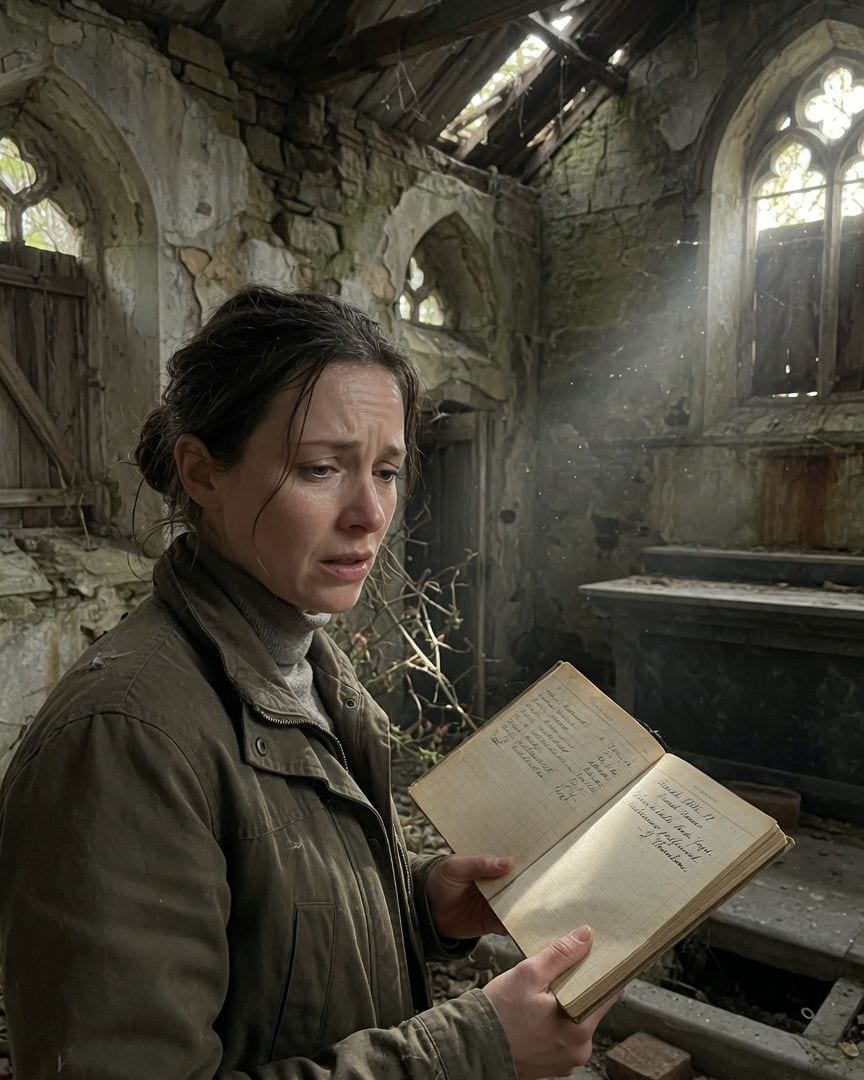
The old dairy in my new town was a chapel in 1901, led by a minister already one hundred and four years old.
As an architect, I moved to Marden for its ancient charm, drawn to an old building locals called 'the dairy.' My research revealed it was a chapel, and a 1901 census listed its minister as 104 years old. Then, I found a hidden ledger inside, its final entry dated just last week, signed by that same impossible name.
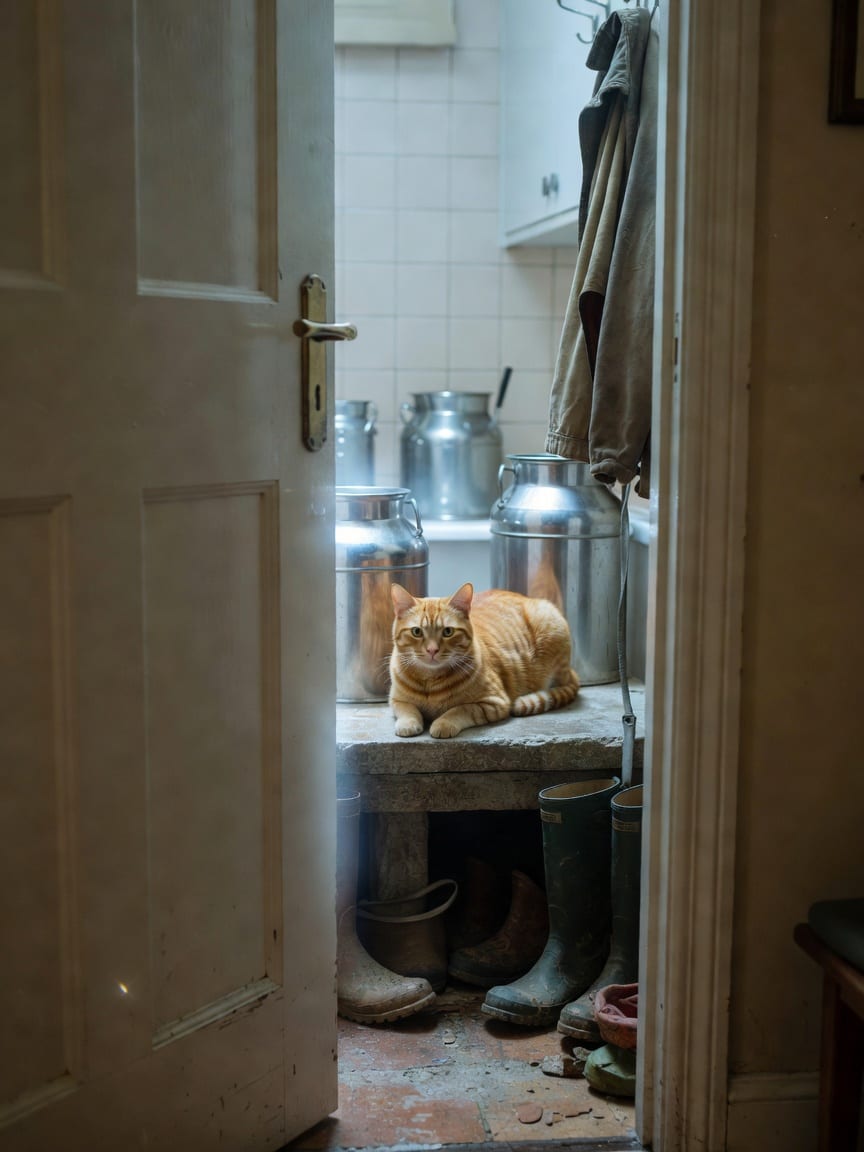
This morning, my boot room door opened onto a dairy, churns and a cat on a cooling slab. Raw milk cold poured in. My auction catalogue calls the room 'derelict'.
I'd only been in the Mitchell House for three weeks when the first hard frost hit. Reaching for the boot room door, I twisted the handle, expecting my muddy yard. Instead, the door opened onto a bustling dairy, complete with gleaming churns and a sleeping ginger cat, thick with the scent of raw milk.
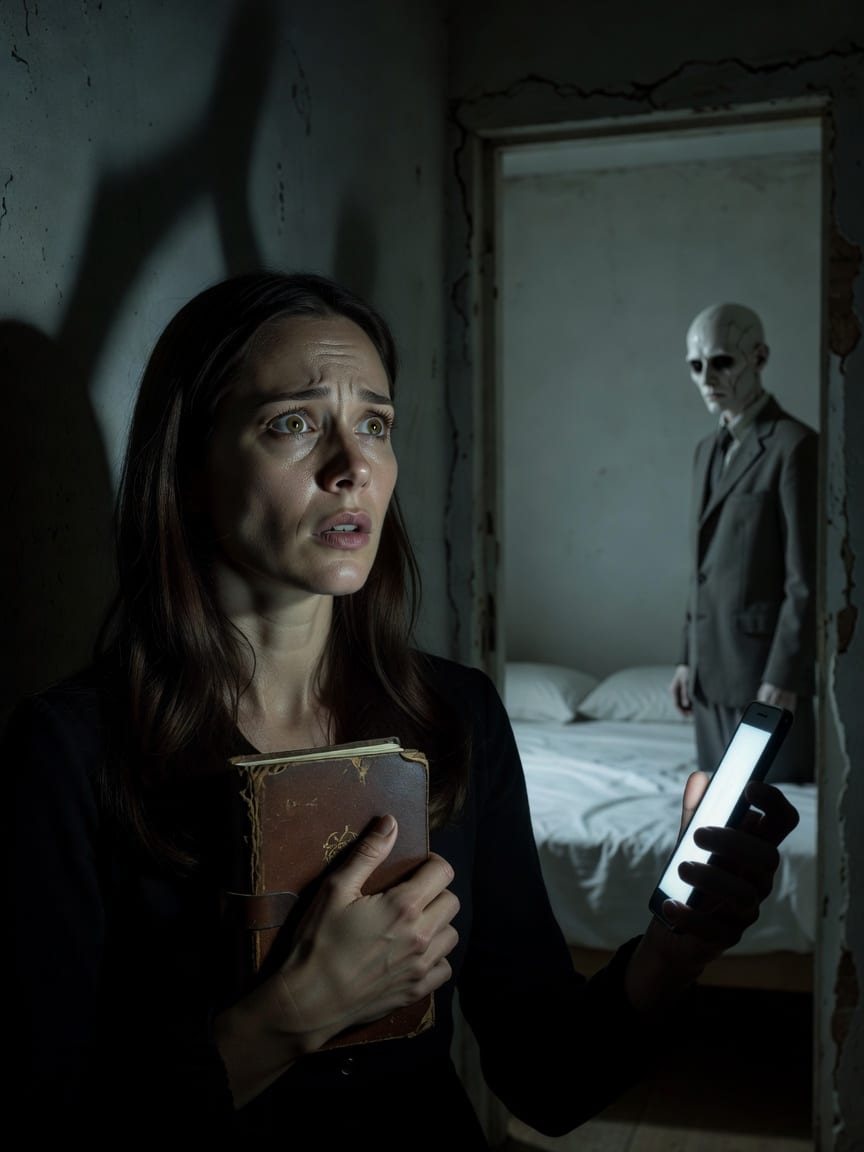
Behind a plastered-over doorway, I found a room. Papered, carpeted, and furnished with a made bed, sealed for decades. The air was dead still, but the bed wasn't dusty. My council tax bill only lists five rooms.
I'm Claire, an architect, meticulously planning my new Victorian terrace renovation. But when I uncovered a hidden room behind a wall, everything I knew about time and decay shattered. The bed was perfectly made, the air still, yet there was no dust, only an unnerving cold.
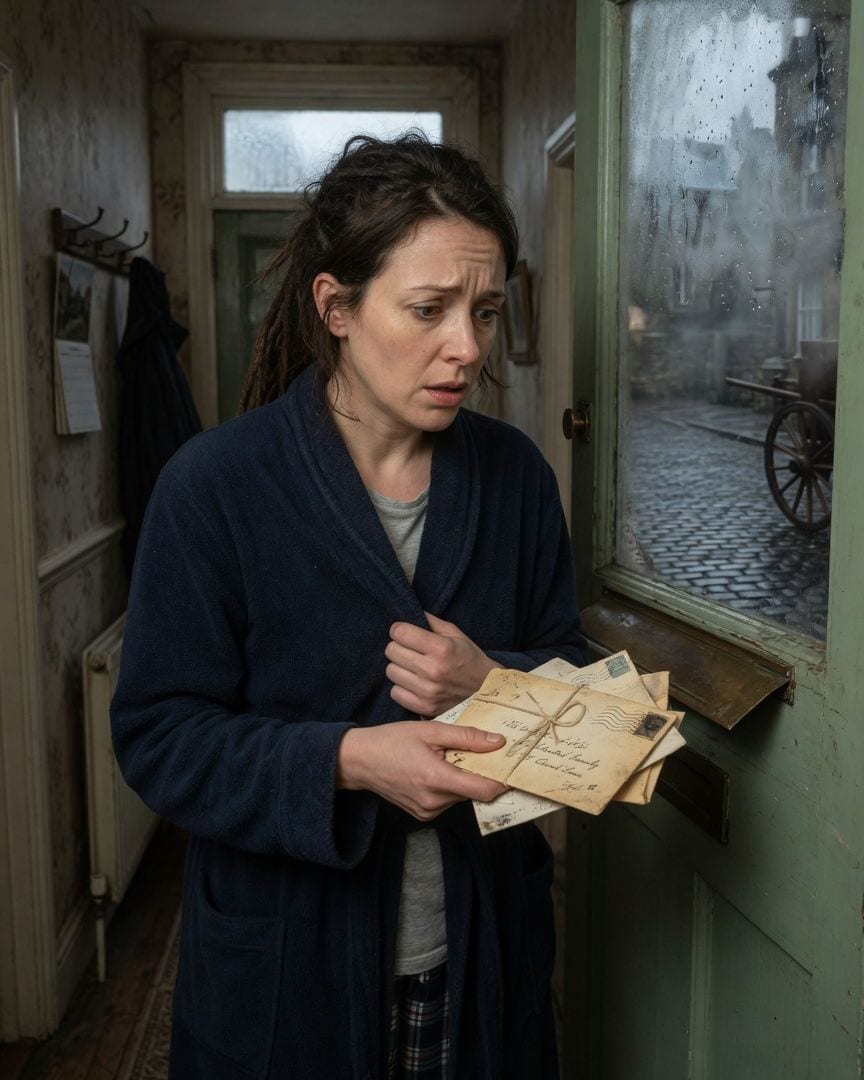
Seventy years ago, a hidden journal recorded my door opening to the wrong street and receiving Lockwood post.
I'd only recently moved into my inherited house, a quiet place on the edge of town. One grey morning, a distinct clatter from the front door's post flap caught my attention. Reaching down, I expected my gravel path, but instead, the flap showed a dark, cobbled street that wasn't mine. A bundle of warm, old letters, addressed to 'The Lockwood Family,' slid through, before the vision flickered and was gone.
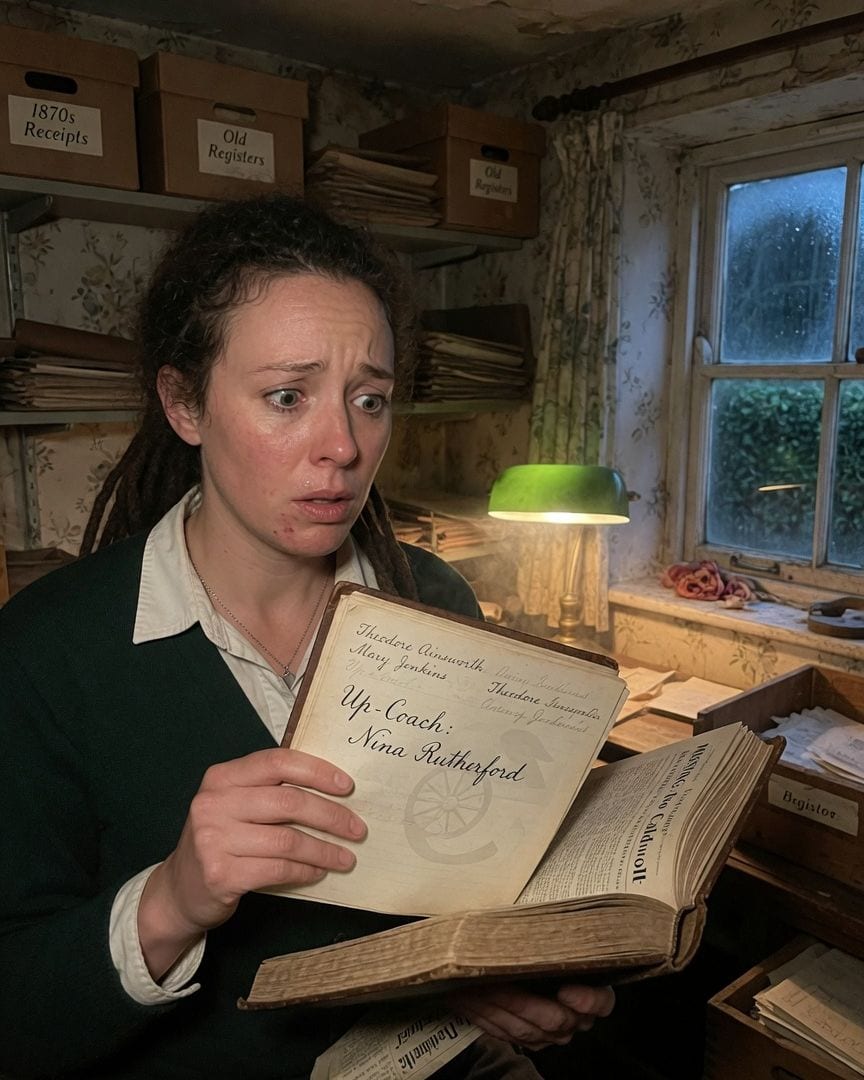
The old inn's arrivals book logs a vanished girl's name. She disappeared two months ago, but the ledger says she checked in last week.
As the new owner of The Angel Inn, I cherished its ancient history. But one evening, while tidying the old arrivals book, I found a chilling entry: Nina Rutherford, a local girl who vanished two months ago, was logged as checking in last week.
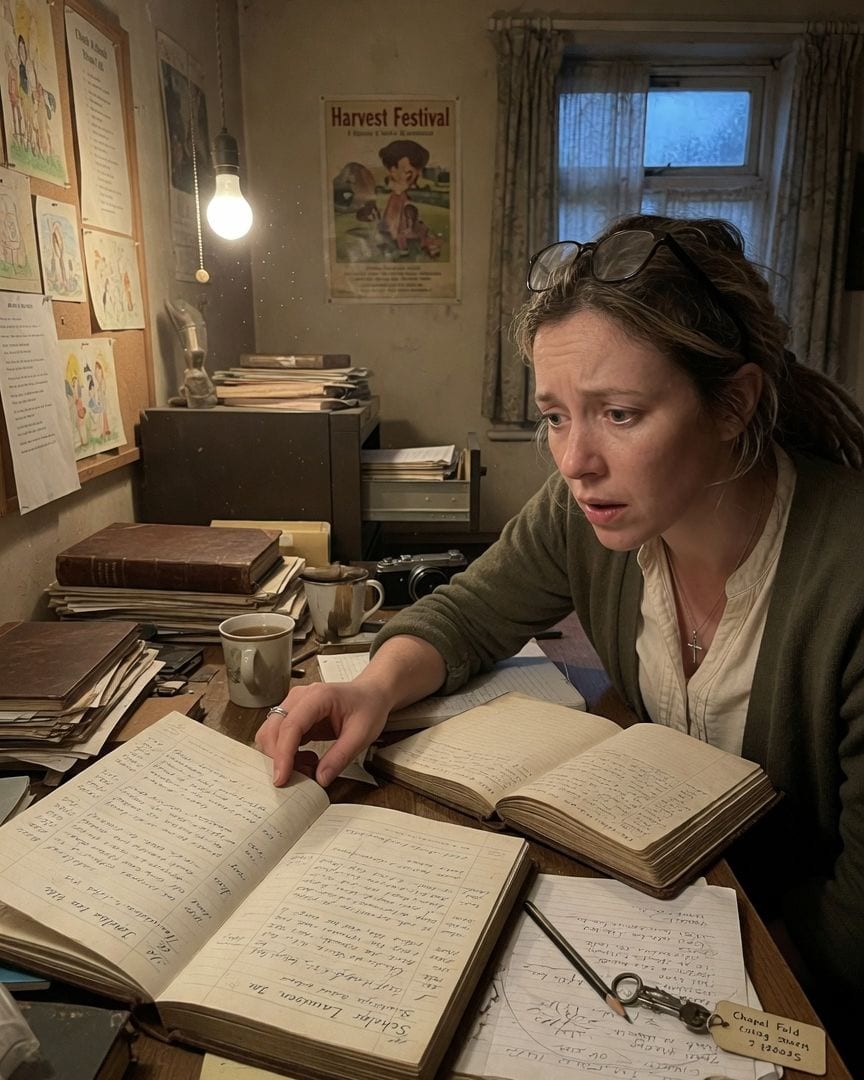
My name is in the chapel's old Sunday school register as 'Scholar 33'. But 'Scholar 33' appears every seventh year since 1907, each child from the same cottage, each marked 'not called for'.
Sorting dusty chapel archives, my job as a local history enthusiast, was a soothing journey through generations. But then my own name, Penelope Lawson, jumped out: 'Scholar 33' for the current year. I'd never attended. Flipping back, I found the same 'Scholar 33' entry repeating every seven years for over a century, always linked to the same old cottage.