Master Sergeant Doyle's old platoon photo showed 31 men. But between Suggs and Ramos, a 32nd man stood grinning, named on Doyle's own signed manifest.
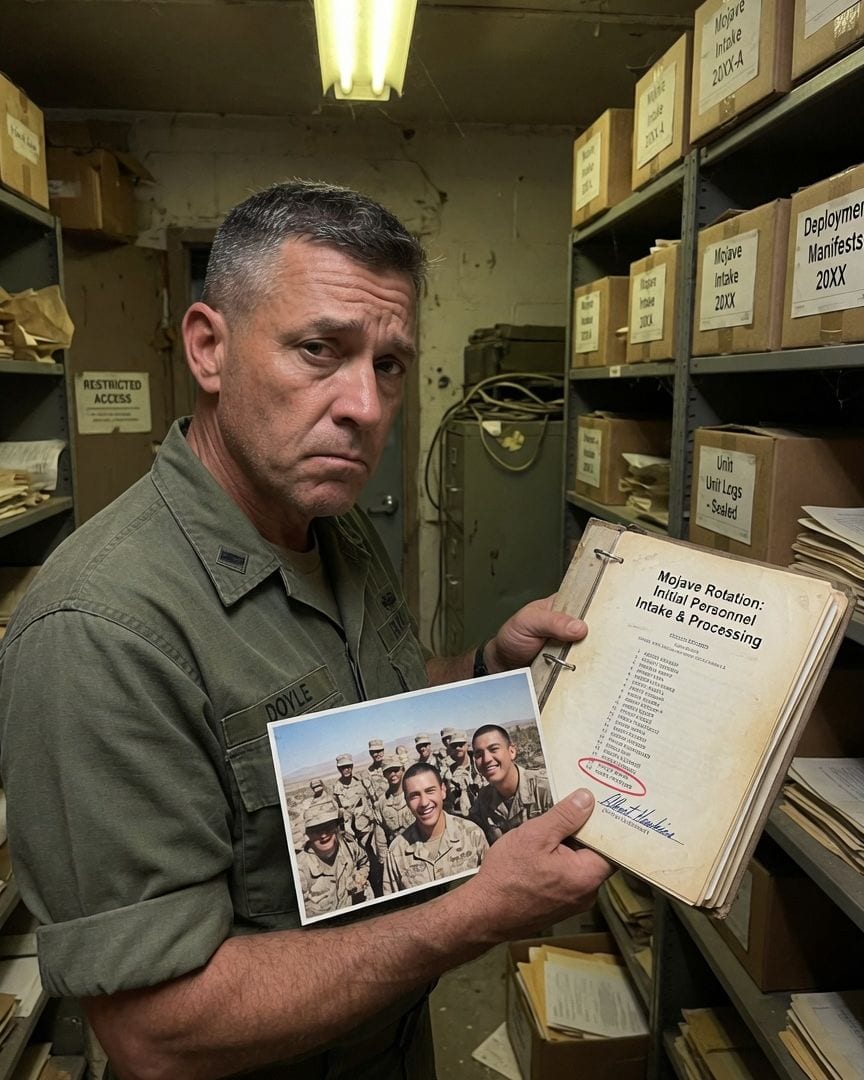
Master Sergeant Vincent Doyle, 48, ran a practiced hand over the spine of a labeled box, his movements precise even after packing most of his office.
Twenty-five years of service were folding into crates around him, each item a tangible memory of rotations, challenges, and the men he’d led. He paused, picking up a faded platoon photo from the Mojave rotation, taken three years prior.
Thirty-one faces stared back at him, every one etched into his memory, a roll call he could recite in the dark. But then his gaze snagged. There, between Suggs and Ramos, a thirty-second man stood grinning. Private Albert Hawkins.
The name slid unbidden into his mind.
The face was undeniably half-familiar, a shadow of recognition, but Doyle’s memory, usually an infallible archive, insisted with a cold certainty that only thirty-one men had been present on that day, in that unforgiving desert.
The man’s wide, unnerving grin seemed to stretch a little too far, his eyes a little too bright.
Doyle carried the photo down the short hallway to the shared office of Sergeant Carl Vance and Staff Sergeant Olivia Rutherford. Vance was wrestling with a finicky printer, Rutherford meticulously updating a tactical map. "Vance.
Rutherford," Doyle said, holding out the photo. "Who's this man?" Vance glanced over. "Hawkins, Master Sergeant. Private Hawkins." Rutherford looked up, her finger hovering over the map. "Yeah, Hawkins. Albert Hawkins." Doyle watched them, a knot tightening in his gut.
"How do you know his name?" Vance frowned, scratching his head. "Just do, I guess. He was with us, right?" Rutherford's brow furrowed. "Wasn't he? I mean… he was there. I just… can’t quite place him now. Funny."
The cold knot tightened. They named him instantly, without hesitation, yet their recall of his presence dissolved into a hazy uncertainty, a collective amnesia that felt profoundly wrong.
Doyle’s military discipline, a twenty-five-year habit of rigorous verification, kicked in. He returned to his office, the photograph face down on his desk. He began with the hard facts, the paper trail that never lied.
First, the original deployment manifest for the Mojave rotation. He pulled the thick, worn binder from its shelf, the corners dog-eared with years of use. He ran his finger down the typed names, his lips moving silently with each one.
Thirty-one. No Albert Hawkins.
Next, the unit's official service record logbook, a heavy ledger where every daily entry, every headcount, every signed equipment check, and every duty roster from that period was meticulously recorded. He flipped through the crisp pages, scanning column after column.
Each morning headcount confirmed thirty-one. Equipment signed out by thirty-one men. Duty rosters listing thirty-one names for every single shift. Nothing. No Private Hawkins. Not even a temporary attachment, a detail usually noted in bold red ink.
He retrieved the hard copy of the final muster sheet, a document he had personally signed, certifying the precise count of men deployed. His bold, confident signature was there, unmistakable. Above it, exactly thirty-one names.
Then he logged into the digital manifest system, the modern, infallible database. A quick query returned the same result: thirty-one men. The system, like the paper records, was a fortress of established fact.
Doyle returned to the photograph, picking it up again. He studied Albert Hawkins’s face, that wide, unsettling grin.
He meticulously scanned the edges of the image, looking for signs of manipulation, a clumsy cut-and-paste, anything to suggest a prank or an imposter.
But the man was too distinct, too perfectly integrated into the group, his uniform crisp, his shadow falling correctly. The unsettling grin seemed unsettlingly genuine.
He spent the rest of the afternoon discreetly inquiring among other NCOs who had served during that Mojave rotation, casual questions slipped into conversations over coffee or in the mess hall.
He asked about temporary attachments, any last-minute transfers, anyone named ‘Hawkins’ that might have joined the platoon. Not a single person recalled such a presence. A few, like Vance and Rutherford, would offer a vague 'Hawkins?'
before their memories dissolved into a blank space. The mundane explanations, the logical possibilities, crumbled around him, leaving only the impossible image of the thirty-second man, grinning from the heart of a documented absence.
Frustration gnawed at Doyle. The internal records were clear. The unit's memory was clouded. He needed the source. He needed the very first record.
He decided to delve into the base's deep archives, a labyrinth of metal shelves and dusty boxes beneath the main administration building.
He was seeking the raw, initial processing documents for the Mojave rotation – the intake forms, the original manifests from before they were consolidated and cross-referenced.
He located a dust-covered box marked 'Mojave Intake: 20XX-A', seemingly untouched for years, in a rarely used storage room, the air thick with the smell of old paper and forgotten data.
Inside, nestled amongst other faded folders, he found a thick, official-looking binder labeled, in precise military stencil: 'Mojave Rotation: Initial Personnel Intake & Processing.'
His heart thumped a heavy rhythm against his ribs as he opened it to the very first manifest page. The official header, the block for his unit designation, the date – everything was exactly as it should be.
His own signature, unmistakable, was there at the bottom, certifying the count. The page listed thirty-two names. The thirty-second name, typed with chilling precision, read: 'Albert Hawkins.'
Doyle stared at the manifest, his own signature a betrayal, a testament to a truth he adamantly refused to believe. He knew he had signed a manifest for thirty-one men. He recalled the moment, the routine, the clear count.
Yet here it was, irrefutable. He checked the date on the intake form; it perfectly matched the official deployment date, down to the exact hour. There was no room for error, no question of a separate, later intake.
He attempted to cross-reference Albert Hawkins's service number, printed clearly beside the name on the manifest, with the central military database. The system whirred, then displayed a match.
The number existed, but it was assigned to a completely different soldier from a much earlier era, a man named Samuel Jenkins who had served in the Pacific theater in the 1940s. An unrelated name, an impossible date.
The system had, in its own way, rejected Hawkins, yet certified his intake.
Doyle tried to locate the original processing officer for the Mojave rotation, a Lieutenant Commander Evelyn Reed. His search led him to the base's retirement office, which then pointed him to a civilian contact number. He called.
The voice on the other end, Reed’s daughter, politely informed him that her mother had retired years ago and had passed away peacefully in her sleep six months prior. Another dead end.
The only witness to that original intake was gone.
Doyle's investigation expanded beyond just the Mojave rotation. He unearths another photo from a different Mojave exercise, a group shot during a training drill, taken just weeks after the main deployment. Most of the faces were familiar.
In the background, partially obscured by a utility vehicle, was a figure. A man in uniform, his face turned slightly away, but his build, his posture, and that same familiar, unsettling grin were unmistakable.
It wasn't quite Albert Hawkins, the face slightly different, but the resemblance sent a cold shiver down his spine, a sense of an echoing presence.
A growing sense of unease, a gnawing suspicion, now guided his search. He began reviewing other past rotation photos, not just his own, but those from units he knew, from the same general periods.
He found himself poring over dusty yearbooks and digital archives, scanning group shots from Afghanistan, from Iraq, from peacekeeping missions. The system, usually a beacon of order, felt like it was playing a silent, impossible trick.
Doyle's persistent digging into the archives did not go unnoticed. He walked into his office one morning to find a plain white envelope on his desk. Unsigned.
Inside, a single, typewritten note simply stated: 'Some records are best left undisturbed, Master Sergeant. Enjoy your retirement.' He crumpled it, initially dismissing it as a crude prank, a poorly executed attempt to scare him off his imminent retirement plans.
But then, the subtle shifts began. His office door, which he always locked without fail, occasionally stood ajar when he returned from lunch, a sliver of darkness where there should have been the solid click of the latch.
Files he distinctly remembered leaving open on his desk, marked with his specific system of sticky notes, were now closed, the sticky notes gone or re-positioned. A prickle of dread, cold and sharp, crawled up his neck.
It wasn't just a prank; it was someone knowing, someone moving with a disturbing intimacy in his personal space.
One evening, working late, the only sound the hum of the fluorescent lights and the quiet rustle of old paper, Doyle looked up from a manifest. He saw it.
A tall, fleeting shadow, stretched and distorted by the corridor’s sparse lighting, passed his office window, moving swiftly past the frosted glass. He froze, then pushed back his chair, the wheels squeaking loudly in the sudden silence.
He stepped out, but the long, empty corridor yielded nothing. The air was still, heavy with the dust of the archives.
He walked to the security desk, a knot forming in his stomach. He asked the night watchman to check the logs for his section. The grainy footage from the corridor cameras showed him entering, then no one else.
The system, usually infallible, reported no anomalies, no unauthorized entries, no signs of anyone coming or going from his section after hours. The silence of the system, its clean report, was the loudest warning of all.
The dread intensified: someone was watching him, someone who knew exactly what he was looking for, and was able to move through the very systems designed to prevent such intrusions.
Convinced he was under observation, Doyle decided to set a trap. He chose an obscure old unit logbook from a forgotten shelf, one filled with mundane supply requisitions from a 1990s deployment to Somalia.
He left it open on his desk, the page detailing an order for five thousand rounds of 5.56 ammunition. A distinctive, red plastic paperclip marked the specific entry. He locked his door with extra care that night.
The next morning, the paperclip was gone. The logbook was closed, nestled neatly back on its shelf, a faint film of dust disturbed only by a single, clean swipe. The message was clear.
Doyle made his way to the base's historical society annex, a small, quiet building filled with relics and records.
He found Franklin Merritt, a retired records officer with an encyclopedic memory of military archives, now volunteering there, hunched over a microscope examining a faded medal. Merritt, aged 72, looked up, his eyes sharp behind thick lenses.
His expression was calm, almost serene.
Doyle didn't waste time. He placed the Mojave photo, with Albert Hawkins's grinning face, on the desk. Next to it, the impossible intake manifest, his own signature mocking him from the bottom. Merritt examined them, his gaze lingering on Hawkins.
"Ah, Hawkins," Merritt said, a faint, knowing smile playing on his lips, unsettling in its placidity. "He cycles through, doesn't he? Always a plus one." Doyle felt a cold shock. "What do you mean, 'cycles through'? Who is he?"
Merritt set the photo down, his movements unhurried. He didn't deny it. He explained, in a quiet, academic tone, that 'certain anomalies' occurred within the military’s vast, exhaustive system.
He called them 'systemic corrections' that manifested as temporary personnel, filling a perceived gap, a structural redundancy. "They're ghosts in the machine, Master Sergeant," Merritt elaborated, his voice devoid of any fear or wonder.
"The system, in its relentless pursuit of coherence, sometimes generates its own answers. A blank space on a roster, an absent man in a formation, and it creates a placeholder. A name, a face, a set of records."
Merritt explained that the unit's collective memory was subtly adjusted to accommodate them, hence the fleeting familiarity, the sudden recall of a name that shouldn't be known.
He said the records correct themselves eventually, the 'plus one' fading from most digital logs and even some hard copies. But some, like Doyle's Mojave manifest, sometimes slipped through, solidifying the impossible.
The horror for Doyle was not Merritt's words, as chilling as they were, but his complete lack of surprise or fear, his clinical, detached acceptance of the impossible as merely another facet of the system, a natural, if disturbing, function.
The quiet hum of the archives seemed to vibrate with a new, alien logic.
Merritt, still disturbingly calm, rose from his chair and gestured to a wall adorned with old, framed unit photos from various rotations, spanning decades of service. The frames were neatly arranged, chronological, a silent testament to the military's history.
"You've seen them before, Master Sergeant, haven't you?" Merritt's voice was soft, almost a whisper. "Perhaps not consciously. Perhaps you dismissed it as a trick of the light, or a momentary lapse in memory."
Doyle stared at the photos, a growing sense of unease washing over him, a cold tide creeping up his spine. Merritt walked along the wall, his finger tracing the glass over a few specific photos. Afghanistan. Iraq.
Even a dusty, sepia-toned one from a Korean DMZ rotation, all spanning Doyle's own twenty-five-year career.
In each, a face, subtly different, a chameleon-like shift in features, but with that same unsettling, half-familiar grin, stood a little too close to another soldier, always a 'plus one' in the formation.
The pattern hit Doyle like a physical blow, a sudden, sickening confirmation of a truth he had unknowingly brushed against for years.
He remembered fleeting moments, a vague sense of déjà vu, a feeling he’d always dismissed as simple fatigue or the blur of memory.
Merritt then returned to his desk and pulled out a binder, much like the Mojave intake one Doyle had found. This one was older, its cover faded to a lighter shade of green.
He opened it to a page detailing an Afghanistan deployment from over a decade ago. "And you, Master Sergeant," Merritt said, his voice softer still, tinged with a strange, almost paternal tone, "you’ve always been quite good at anchoring them."
Doyle looked down. His signature, younger but unmistakable, was there at the bottom of the manifest, certifying a count that clearly included an extra man, another 'plus one' he had no memory of.
And then, Merritt turned to a specific page in Doyle's own service record, a document Doyle had always considered sacred, an accurate accounting of his entire adult life. He had never seen this page before.
It detailed a brief, impossible attachment to a unit in Korea during a time he was definitively elsewhere, stateside, undergoing specialized training. A unit where, Merritt noted, another 'plus one' had been recorded in the archival logs before quietly vanishing.
The entry is signed, again, with a perfect forgery of Doyle's own hand, a scrawled approximation that was both flawlessly identical and sickeningly alien.
Merritt watched Doyle’s face, a flicker of something almost like pity in his eyes, but it vanished quickly, replaced by his usual clinical calm. He revealed the full, chilling scope of the phenomenon.
"You see, Master Sergeant Doyle, the system requires anchors. Points of absolute, unyielding consistency."
Merritt explained that Doyle, with his impeccable service record, his decades of meticulous attention to detail, and his presence across so many critical points in the military's vast logistical network – unit manifests, supply requisitions, daily logs, muster sheets – acts as a 'nexus' or 'grounding point' for these 'systemic corrections.'
The entity, or entities, Merritt clarified, were not malevolent in a conscious sense. They were a byproduct, a self-correcting function of an impossibly complex system.
They drew on the sheer coherence of the military machine, and Doyle's own unwavering adherence to its rules, to manifest.
They filled perceived voids in the data stream with temporary, physical forms, brief flashes of existence that solidified the paper trail.
Merritt showed Doyle a series of historical documents – old after-action reports from Vietnam, faded supply requisitions from the Cuban Missile Crisis, even commendations for bravery that seemed to credit an impossible number of individuals – all containing subtle, impossible inconsistencies.
Traces of these 'plus ones' appeared, sometimes named, sometimes only implied by a numerical discrepancy, only to later vanish from subsequent records, leaving behind only the ghost of their existence in the initial paperwork.
Merritt explained that he, Merritt, had spent his entire life quietly observing and documenting these cycles. He understood that they could not be stopped. They were an inherent part of the system itself, as fundamental as gravity.
"You cannot fight the tide, Vincent," Merritt said, using Doyle’s first name for the first time, a startling intimacy. "You can only learn to read it. To understand its patterns."
He saw it not as a horror, but as a natural, if disturbing, aspect of the system itself. A ghost in the machine that simply is.
The air in the archives felt cold, a chill that had nothing to do with temperature, but everything to do with the vast, impersonal logic Merritt laid out.
Doyle was horrified, but not by fear in the conventional sense. It was a cold, intellectual horror, a profound dread at the rational, unassailable logic of it all.
His entire life, his entire career, had been unknowingly dedicated to facilitating this impossible anomaly. He demanded to know what happened to the 'plus ones' when they faded. Where did they go?
What became of Albert Hawkins, or the others whose faces had flickered in and out of his awareness?
Merritt merely smiled faintly, a serene, disturbing curve of his lips. "They become the data, Master Sergeant. They become the gaps, the inconsistencies, the things that swear otherwise. And sometimes, they leave a space that needs filling."
The implication hung heavy in the air, a cold, undeniable truth settling deep into Doyle’s bones: the entity, or the system, needed a host, a 'grounding point,' and his impending retirement, his departure from the meticulously maintained infrastructure, created a profound void.
A space that needed filling.
Doyle tried to argue, to deny his role, to find a way out, to break the cycle that had, for twenty-five years, quietly used him. "This isn't real, Merritt. It's impossible. I won't be a part of it."
Merritt, however, remained utterly unperturbed. He reached across the desk, his hand slow and deliberate. He picked up a standard-issue pen, the kind Doyle had used his entire career – a simple black ballpoint with the base's insignia.
He placed it gently in Doyle's hand, his fingers closing around Doyle's own. The pen felt impossibly heavy, cold against his palm. "It's not a choice, Master Sergeant," Merritt said, his voice soft, yet resonating with an unshakeable finality.
"You are uniquely suited. Your life, your service, has prepared you for this. To ensure the system remains... coherent." His gaze was steady, piercing. "The records must always be maintained, Vincent. The counts must always be accurate.
Even when they are not."
Doyle felt a profound chill, a sense of his own identity subtly shifting, like a page being rewritten in a vast, unseen ledger.
He looked at his hand, clutching the pen, and for a moment, it didn't feel entirely his own, as if a new, meticulous purpose was settling into his bones, a purpose that had been waiting for him all along, patiently, quietly, in the spaces between the numbers.
Master Sergeant Vincent Doyle did not retire. He remained at the base, quietly withdrawing his papers.
Within weeks, he had taken over Franklin Merritt's old, dusty office in the historical society annex, a space filled with the scent of old paper and the silence of forgotten histories.
His colleagues remarked on his sudden, quiet dedication to the archives, his meticulous, almost obsessive attention to every old logbook and manifest.
He spent his days poring over faded documents, cross-referencing digital files, and examining brittle photographs, a silent, unceasing work. He rarely spoke of his past rotations, and when he did, his voice held a strange, distant quality.
His signature, once so firm and commanding, now had a faint, almost imperceptible tremor, as if another hand guided it, a subtle shift in the man they had known for years. A new gravity settled around him, a quiet burden.
One afternoon, Carl Vance stopped by Doyle's office, looking for an old supply record from their last deployment.
He found Doyle hunched over a stack of yellowed photographs, a faint, knowing smile on his face, his eyes fixed on some unseen detail in the brittle paper.
The office was colder than usual, a subtle chill despite the warmth of the day outside.
Vance noticed a new photograph tacked to the wall, a recent one of their current unit, taken just a week prior during a routine drill. He squinted at it, then counted the faces.
One, two, three… "Hey, Master Sergeant," Vance said, a frown creasing his brow as he pointed. "There's an extra guy in this photo. Who's that?"
Doyle looked up, his eyes holding a depth Vance had never seen before, a quiet knowing that was profoundly unsettling. His faint smile widened just a fraction, just enough to reveal a chilling echo of a familiar, unnerving grin.
He said nothing, simply returned his gaze to the old photos in his hands.
Weeks later, a new entry appeared in the base's digital personnel log, a temporary attachment to the historical society. The name was Albert Hawkins.
Carl Vance never questioned why his old Master Sergeant started signing all his internal memos with a faint, almost imperceptible tremor.
If this one got to you
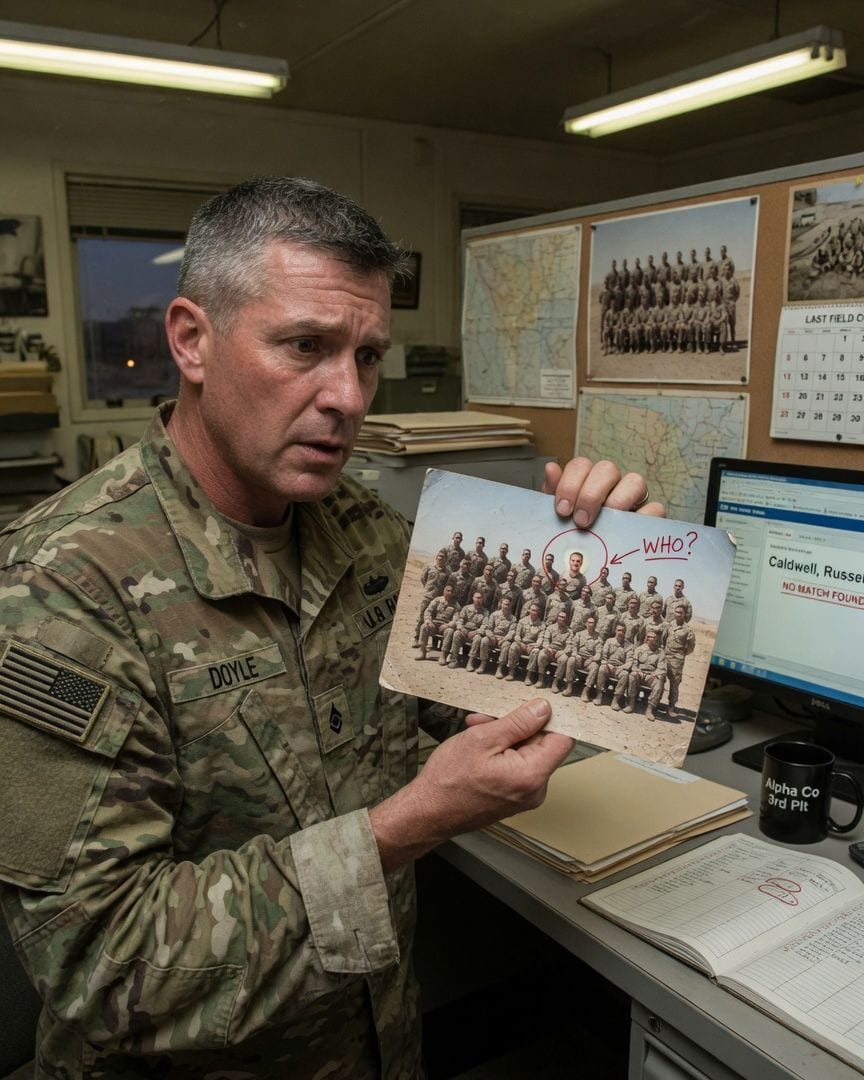
Weeks from his transfer, Master Sergeant Arthur Doyle's platoon photo had an extra man, grinning between Suggs and Ramos.
Master Sergeant Arthur Doyle, weeks from a quiet desk job, performed his usual ritual: staring at his platoon photo. He knew every one of the thirty-one faces from his last Mojave rotation by heart, but this morning, a thirty-second man grinned blandly between Sergeant Suggs and Private Ramos. When pressed, his soldiers named the man instantly as 'Caldwell,' yet couldn't explain how they knew him or when he'd joined. Doyle's personal logs and official unit manifests held no record of a Private Russell Caldwell, leaving him to question everything he thought he knew.
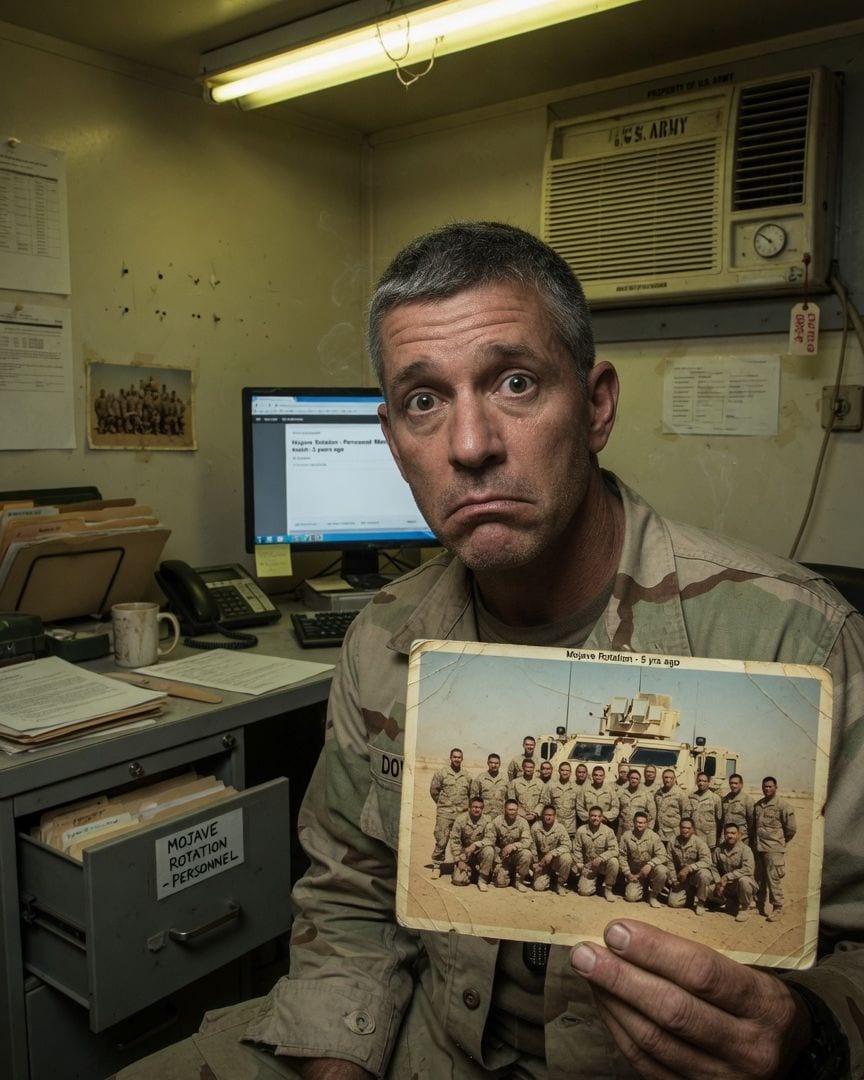
Two weeks from transfer, Master Sergeant Doyle’s old platoon photo now showed a 32nd man grinning from the back row.
Master Sergeant Oliver Doyle was two weeks from his transfer, overseeing the final decommissioning of FOB Erebus, finding solace in routine. His old Mojave platoon photo, a yellowed record above his desk, always showed thirty-one faces from his past. This morning, however, an extra man grinned from the back rank, a face both familiar and utterly alien. When he showed it to Sergeant Barlow, the younger man immediately named the newcomer, "Ryan Stratton," a name Doyle hadn't spoken, yet one that felt ready on Barlow's tongue. Official records listed only thirty-one, but a hidden digital history revealed a manifest with thirty-two names, signed by Doyle himself.
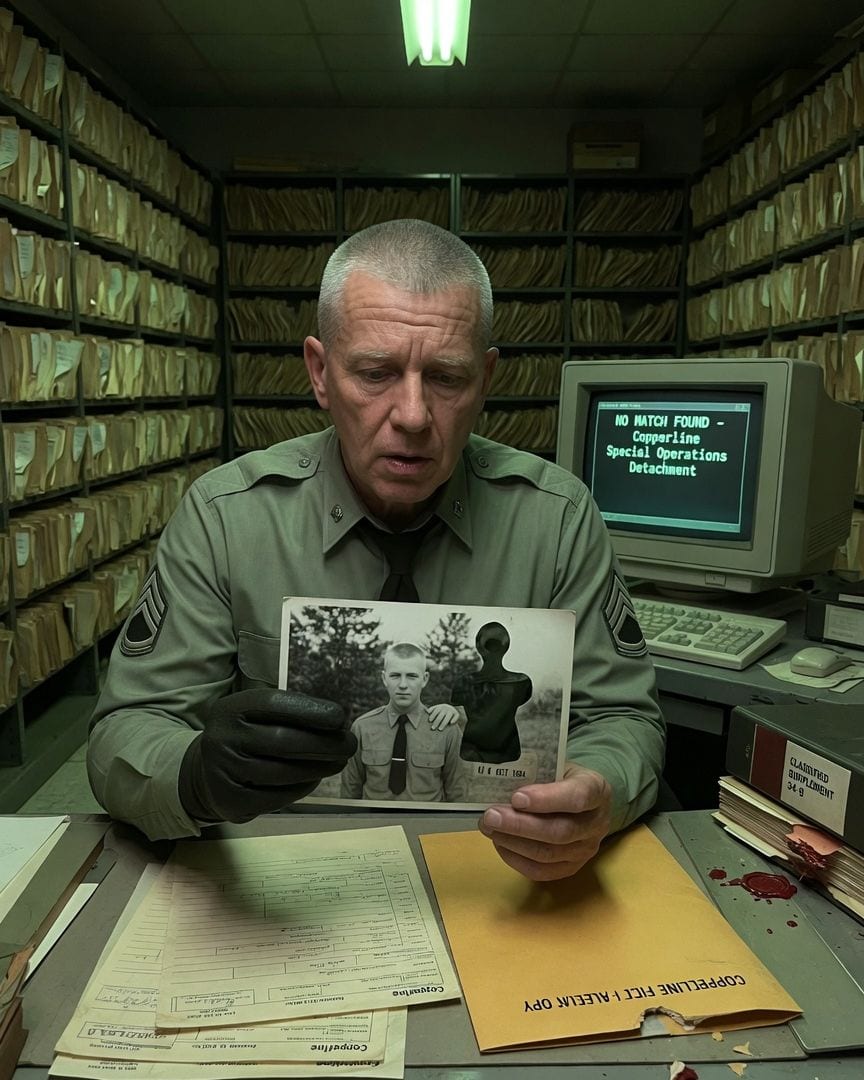
Sergeant Major Vance had two weeks to retirement when his old file felt warm. Inside, a photo showed him with a man precisely cut out from a unit that never existed.
Sergeant Major Teodor Vance had only two weeks left before his retirement, a lifetime of military order almost behind him. For thirty years, he'd pulled the 'Copperline' file, always finding it empty – until now. This time, a faint, impossible warmth radiated from the heavy manila, and inside, he found a faded photograph. It showed a younger Vance in an unrecognized uniform next to a man whose entire body had been precisely cut out of the print, from a company that officially never existed. After decades of silence, what did this warm, impossible file truly contain?
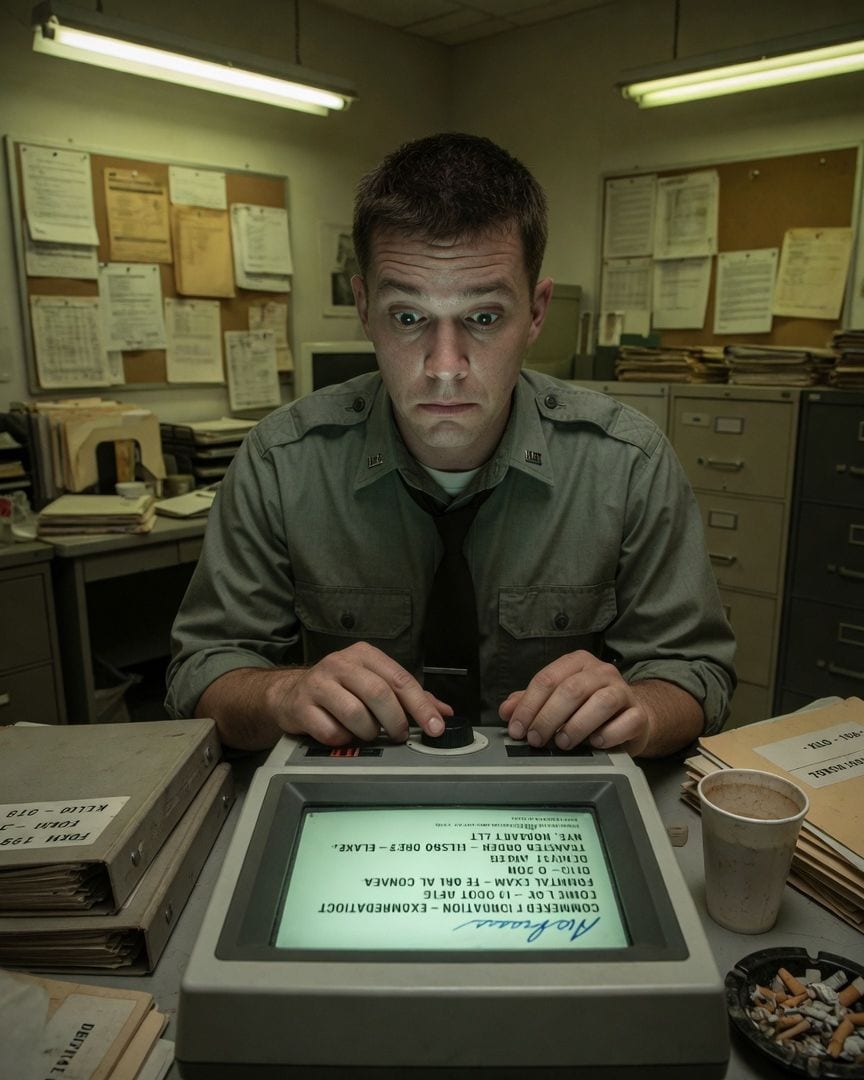
A missile commander watched his ten nuclear silos go dark. His own service record shows his signature on a future he's never lived.
Second Lieutenant Hobart Nye, a missile commander in Wyoming, had his quiet 0247 watch shattered by a security report: a massive, silent black triangle hovered over Launch Facility Kilo, casting a perfect shadow. Hobart watched his console's fault panel light up, signaling all ten nuclear missiles going dark in an impossible silence, followed by eleven minutes his security team could not remember. Official logs called it a "radio malfunction," but Hobart found a requisition for invisible-tracking sensors, signed by a base commander who was supposed to be off-base. The final, chilling discovery came when his own service record showed new entries—a dental check-up, a transfer to Alaska—all dated for a future he never lived, complete with his perfectly replicated signature.
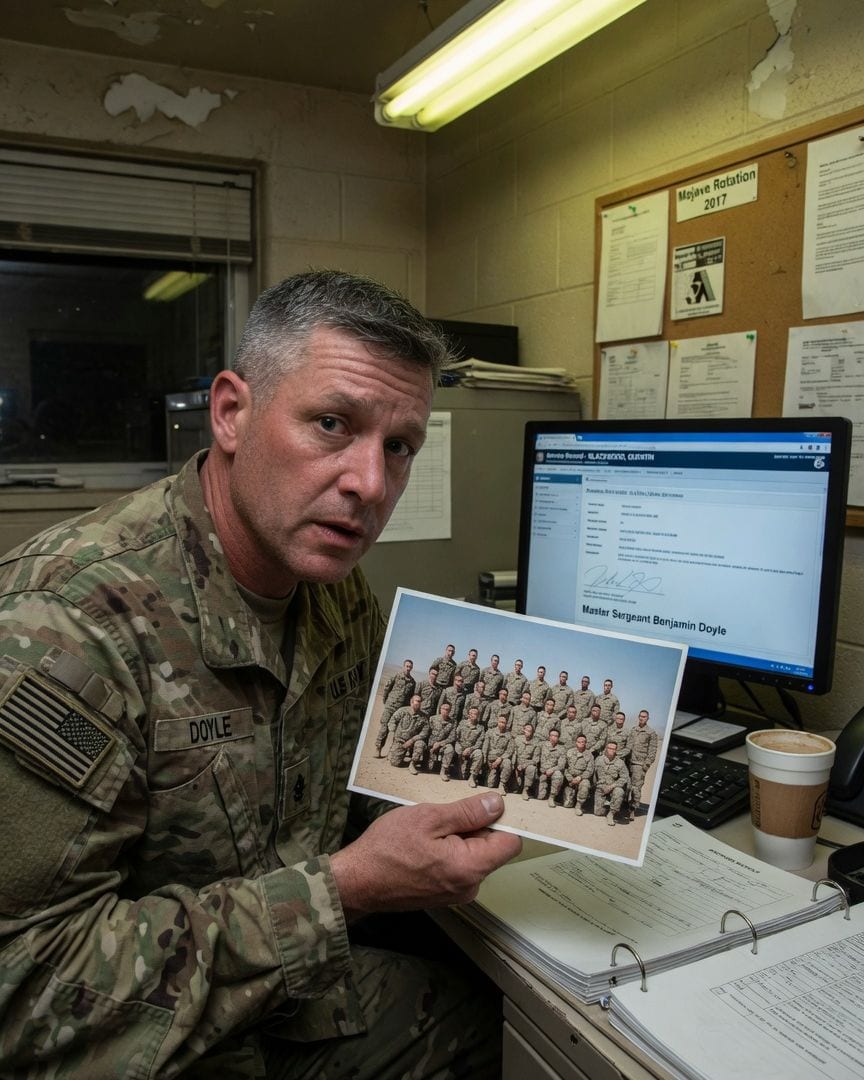
Master Sergeant Doyle found his own signature on a soldier’s commendation he knew he never signed.
Master Sergeant Benjamin Doyle, a man whose life was built on precise manifests and head counts, maintained a quiet daily ritual: glancing at his Mojave rotation platoon photo. One morning, the familiar thirty-one faces stared back with an impossible addition: an extra man, grinning between Suggs and Ramos, a face he and his colleagues recognized but couldn't place. His search through official digital rosters yielded nothing, yet old physical logs, signed in his own hand, confirmed the phantom soldier’s presence on a dangerous patrol he couldn't recall. The ultimate blow came with a valor citation for this same soldier, bearing Master Sergeant Doyle’s own digital signature for an award he knew he never certified.
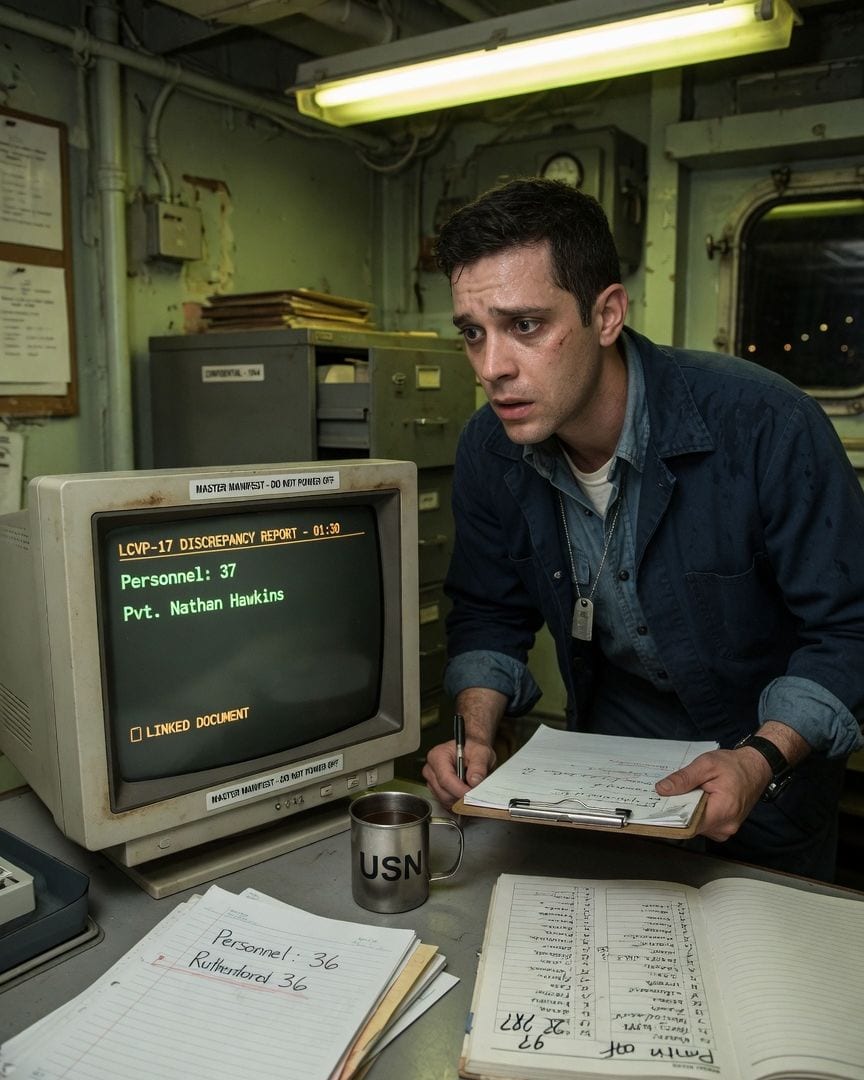
Coxswain's Mate Rutherford counted thirty-seven men in his landing craft, but the manifest logged only thirty-six. A hidden report, filed hours before, named Private Nathan Hawkins.
Coxswain's Mate Donald Rutherford, 28, began his final count for a standard load of thirty-six men in LCVP-17, the salty spray stinging his eyes. Halfway to the beach, a violent wave slammed the craft, throwing the men against each other. When the vessel settled, Rutherford instinctively recounted, his heart knocking against his ribs. This time, his count came back thirty-seven bodies crowded into the small boat. Official logs confirmed only thirty-six men, yet a hidden report, dated hours before his deployment, listed an extra man by name: Private Nathan Hawkins.