A museum curator finds a Cold War artifact with a missing airman's laundry tag dated March 2025.
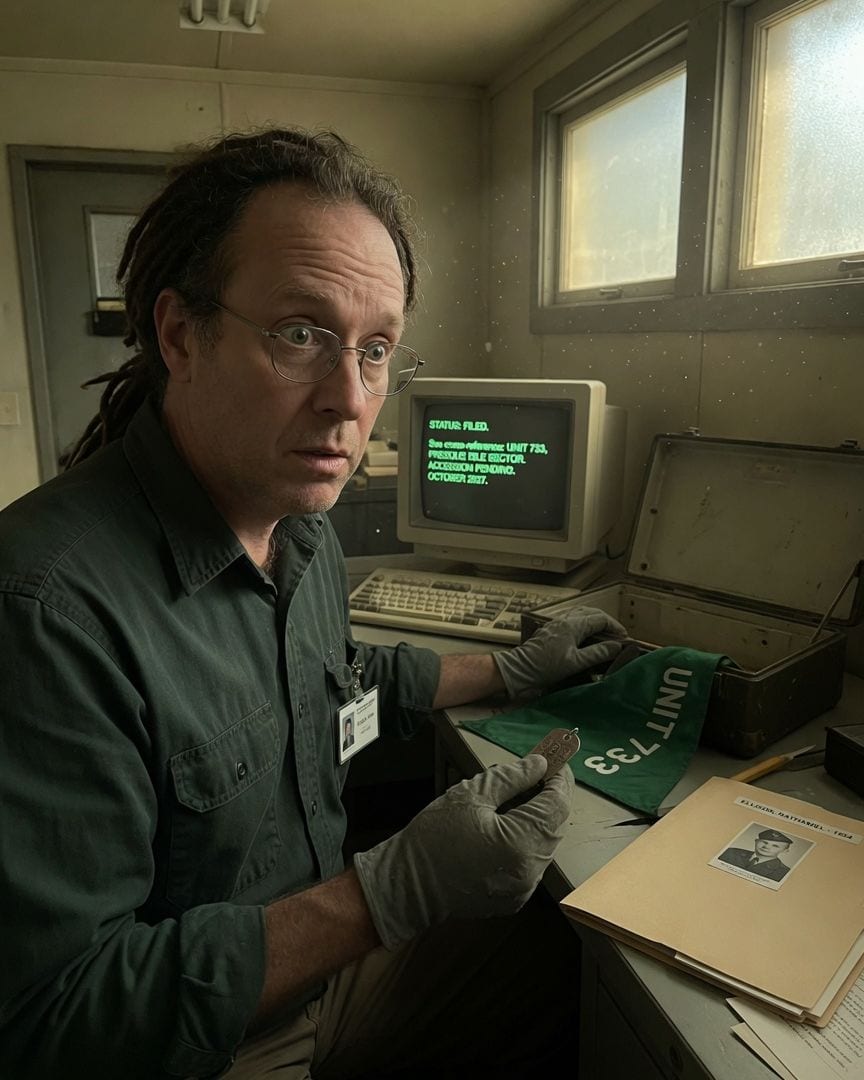
Halden Roe ran a gloved hand over the smooth, cool surface of the display case.
Dust motes danced in the slivers of weak sunlight filtering through the Presque Isle museum’s high windows, illuminating the muted olive-drab and faded blues of the Cold War exhibit.
The entire section was being decommissioned, its contents slated for storage or reallocation, and Halden, meticulous as ever, approached each item with the reverence of an archaeological dig.
He reached the green guidon, a small, triangular flag that had somehow found its way into the museum’s collection decades ago without proper provenance.
Its silk remained remarkably preserved, a vibrant green despite its age, the white lettering of ‘UNIT 733’ crisp and unblemished.
He’d always meant to properly research its origins, but the museum’s chaotic accession records from 1988, the year it arrived in an unlisted footlocker, had never yielded a clear path.
The footlocker itself, a standard-issue military trunk, sat open and empty beside the display, its interior surprisingly clean for an item of its presumed vintage.
As Halden carefully unclipped the guidon from its mounts, his fingers brushed against an unexpected rigidity stitched flat inside the flag’s pole channel. He paused, frowning, and gently worked a small, faded laundry tag free.
It was made of stiff, reinforced cotton, a rectangular patch sewn discreetly into the fabric. Printed on it, in stark, indelible black ink, was a series of numbers and letters.
Halden squinted. 065-38-912. He recognized it immediately. Nathaniel Ellison. A nineteen-year-old airman, reported missing off Greenland in 1954. Below the service number, a company designation, and then, a date: MARCH 2025.
Halden stared at the tag, his rational mind trying to process the impossible. A date almost seventy years in the future, stitched into a Cold War artifact belonging to a boy who had vanished in the Fifties.
The silk felt cool, unnaturally so, against his fingertips, almost humming with a silent chill. He turned the guidon over, then back again, but the tag remained, stark and undeniable.
Unsettled, Halden immediately moved to the small, secure office he used for records research. He pulled Nathaniel Ellison’s personnel file from the museum's limited declassified records, a slim folder that chronicled a brief life and a sudden disappearance.
The file confirmed Ellison’s missing status in 1954; the official record simply stated 'lost at sea, presumed deceased.' There was no mention of a guidon, no recovery, nothing that could possibly explain the tag’s future date.
His gaze lingered on the last known photo: a young man, barely out of his teens, looking earnest and hopeful.
He returned to the empty footlocker. It was a standard olive-drab container, sturdy and functional, but he noticed again its peculiar cleanliness.
Most Cold War-era lockers showed some rust or wear, but this one, despite its age, looked almost new inside, devoid of the usual grime or faint military scent.
Running his hand along the bottom, he felt a slight irregularity beneath the smooth paint. He knelt, probing deeper, his fingers eventually finding a seam, barely visible.
Wedged deep within it, almost fused to the metal, he found a small, heavy metal tag.
It felt denser than a dog tag, more solid, and it had no hole for a chain. It was cold to the touch, almost icy, despite the ambient warmth of the room.
On one side, another service number was precisely stamped: 088-14-776. On the other, a different company designation, and below it, another impossible date: JULY 2026.
Halden’s breath hitched. Two impossible dates. Two separate service numbers, one belonging to a confirmed missing airman, the other to a ghost.
He tried cross-referencing this new number in the museum’s internal records system, then accessed a general military personnel database available to curators for artifact verification. He typed the string of digits, hit enter, and waited.
The system whirred, searched, and then returned: 'No match found.' It was as if the number, and the person it belonged to, simply didn’t exist in any official capacity, anywhere.
Disturbed by the second impossible tag and the baffling lack of an official record, Halden decided to try a specialized declassified records index he rarely used.
This system was a legacy piece, meant for obscure or heavily redacted entries, its interface clunky and temperamental. He typed in the service number from the heavier metal tag: 088-14-776.
The system groaned to life, its ancient hard drives grinding, then resolved with a faint, electronic chirp. The screen displayed a single entry, stark against the gray background: STATUS: FILED. See cross-reference: UNIT 733, PRESQUE ISLE SECTOR. ACCESSION PENDING. OCTOBER 2027.
The words 'Presque Isle' jumped out at him, a direct, chilling reference to the very town and the very museum where he stood. The 'ACCESSION PENDING' date was for three years in the future.
The system, a supposedly static database of historical records, was actively updating, showing a date that hadn’t happened yet.
Halden stared at the screen, the cold metal tag heavy in his hand, its impossible future date seeming to throb against his palm. A profound sense of dread settled over him, cold and sharp.
Everything he thought he knew about archival records, about the nature of 'missing,' had just shattered into a thousand inexplicable pieces.
Halden spent a fitful night, the impossible dates and the 'FILED' status looping through his mind. The next morning, he called Benjamin Yates, a retired military archivist he’d consulted before, known for his encyclopedic memory and discretion.
Yates had worked deep within the labyrinthine federal records systems for decades and possessed a network of contacts that bordered on the legendary.
“Ben, it’s Halden Roe,” he began, trying to keep his voice level. He described the green guidon, the unaccessioned footlocker, and the two tags. He framed them initially as a bizarre provenance puzzle, a unique challenge in artifact verification.
Yates, his voice raspy with age and a lifetime of institutional knowledge, listened intently, humming occasionally.
“A guidon with no papers, eh? Happened more than you’d think in the chaos of a withdrawal,” Yates mused. “And the Ellison boy, 065-38-912, missing ‘54. I remember that one. Greenland. Rough waters.”
Halden took a deep breath. “Yes. But the tag inside the guidon, Ben. It has his service number, and a date. March 2025.” He paused, letting the silence hang. “And then I found another tag, metal, in the footlocker.
Different service number, different company, and a date of July 2026. This second number, 088-14-776, came back ‘FILED’ on the specialized index. It cross-referenced a ‘UNIT 733, PRESQUE ISLE SECTOR’ and an ‘ACCESSION PENDING’ date of October 2027.”
Yates was silent for a long moment, the only sound a faint static on the line. “Halden, are you quite sure about those dates? March 2025? October 2027? That’s… impossible. A clerical error, surely. Or an elaborate hoax, perhaps?”
His tone was initially dismissive, but a flicker of unease entered his voice.
“I’ve checked and re-checked, Ben. The tags are genuine, sewn into the guidon, stamped into metal. And the database entry is live. It updated with the current year plus three years. It’s not static. It’s an active entry.”
Halden insisted on the physical evidence, the professional stitching, the database entry itself.
Yates let out a slow, heavy sigh. “Unit 733, Presque Isle Sector. Never heard of it. Not in any official capacity. But…” He trailed off. “Alright, Halden. This is… peculiar. Give me a few days.
I’ll dig through some personal contacts, some of the old declassified files I’ve kept. See if there’s any mention of a ‘Unit 733’ or anything like these ‘FILED’ statuses, especially concerning missing personnel or ‘lost at sea’ incidents.
This is far beyond a simple provenance puzzle.”
Meanwhile, Halden meticulously reviewed the museum’s own accession logs for 1988, the year the footlocker arrived. The building itself felt different now, every creak of settling wood or groan of plumbing carrying a new, ominous weight.
The old, oversized ledgers, with their brittle pages and flowing copperplate script, usually offered a calming sense of order. But for the 1988 entries, he found only a generic line: ‘Miscellaneous Cold War Artifacts – Large Shipment.’
No specific mention of a footlocker, no detailed inventory. It was a blank space where a specific record should be, a hole in the official history, confirming the footlocker’s unlisted, unacknowledged status.
A chill, unrelated to the old building’s draft, pricked the back of his neck.
Halden dedicated his evenings to the museum archives, cross-referencing old acquisition records with declassified military documents, searching for any trace of ‘Unit 733’ or the chilling ‘FILED’ status.
The deep stacks of the archive, usually a haven of quiet contemplation, now felt vast and watchful.
He dismissed the faint, rhythmic clicking sound from the deeper, uncatalogued sections as the old building settling, or the ancient HVAC system finally giving up the ghost.
The air always felt colder down there, thick with the scent of aged paper and something else, something metallic and sharp.
But then, small things began to shift, subtly at first, then with increasing frequency.
He’d meticulously locked his office door each night, only to return in the morning to find a low-wattage desk lamp left on, its soft glow illuminating a corner of the room.
A particular file on his desk, one detailing Ellison’s disappearance, would be subtly re-stacked, its edge now protruding by a millimeter, or its position rotated ever so slightly.
The hum of the archive’s HVAC system, usually a steady drone, seemed to change pitch, almost listening, then settle back into its rhythm as he moved closer.
The subtle changes were enough to make the hairs on his arms stand on end, a phantom chill brushing against his skin.
One night, after a particularly long session of fruitless searching, Halden returned to his desk after a short coffee break. The office was quiet, the only sound the distant whir of the building’s old elevator.
He stopped dead in the doorway.
In the precise center of his worn oak desk, where he had left nothing but a stack of blank notepads, now sat a pristine, standard-issue manila folder. It was utterly blank on the outside, devoid of any label or mark.
He walked slowly towards it, his heart thudding a heavy, irregular beat against his ribs. He picked it up. It felt heavier than it should, not empty.
Inside, stapled squarely to the folder’s pale interior, was a single, stark white card. Printed on the card, in a precise, almost clinical sans-serif font he didn't recognize, were the words: HALDEN ROE.
Beneath his name, a service number he didn't recognize, had never seen before, was printed: 071-22-401. And below that, in the same unsettling font: ACCESSION PENDING: APRIL 2028.
The card was warm to the touch, almost feverish, as if recently handled, or freshly printed from some hidden machine. A prickle of cold fear, sharper and more invasive than anything he had yet felt, ran down his spine.
Someone knew exactly what he’d found. And they knew his name. And his future. The hum of the HVAC outside his office door seemed to intensify, a low, patient thrum, filling the silence of the room.
The next morning, the folder still warm in his grasp, Halden confronted Vivienne Barlow, the museum director. She sat behind her large mahogany desk, her usual composure unruffled, even after Halden’s abrupt knock and tense entrance.
He placed the guidon, its impossible laundry tag visible, and the two cold metal tags on her polished surface.
Then, with a trembling hand, he pulled up the ‘FILED’ status on his laptop, the screen glowing ominously in the subdued light of her office.
“Vivienne,” he began, his voice tight. “These dates… the database entry… this isn’t a mistake. And this.” He pushed his pristine manila folder towards her, the card inside bearing his name and the impossible date of April 2028.
“Someone put my name on this, Vivienne. With a future date. And it wasn’t me.”
Vivienne, usually unflappable, grew visibly uncomfortable. Her eyes darted from the guidon to the tags, then to the glowing screen, and finally settled on Halden’s folder. She picked up the folder, her brow furrowed. “Halden, this is… it’s disturbing.
But it has to be a prank. An elaborate misfiling, perhaps. You know how these old systems can be.” She tried to dismiss it, her voice betraying a hint of strain.
The air in the room, usually pleasant, felt suddenly dense, suffocating.
Halden pushed, unwilling to let her rationalize it away. “A prank that involves two physical tags, a database entry pointing to our very town, and a personal file with my name on it?
With an accession date four years from now? This isn’t a joke, Vivienne. Something is deeply wrong here.”
Her composure cracked. She set the folder down, her hands shaking slightly. Her gaze drifted to the framed photos on her credenza, then back to Halden, her face pale.
She admitted, hesitantly, that there had been ‘incidents’ over the years – unmarked boxes arriving with no manifest, strange entries in old ledgers that seemed to appear, disappear, then correct themselves.
She recalled an old, retired archivist, a man named Henderson, who used to talk about ‘the Presque Isle Ledger,’ a book he claimed listed items that ‘weren’t supposed to be here.’
Henderson was ‘let go’ decades ago after a nervous breakdown, claiming the ledgers in the deepest part of the archive were ‘writing themselves.’
Vivienne’s eyes, wide and fearful, locked onto Halden’s. “I thought he was just old and confused,” she whispered, her voice barely audible. “He said the ledger was… active. That it was still being written.
And that it always knew who was looking for it.” She looked at the guidon, then at the blank folder with Halden’s name, then back at him, a dawning horror in her eyes. “He claimed it wasn’t just a record.
It was… a process.”
Halden felt a cold certainty settle deep in his bones. The museum itself, or something within its deep, uncatalogued archives, was the ‘secrecy machine.’ It had been operating for far longer than anyone realized, a patient, self-correcting entity.
The wrongness wasn't external; it was embedded in the very foundations of the institution he curated.
Later that day, the ominous hum of the archive’s HVAC seeming to vibrate through the entire building, Benjamin Yates called Halden, his voice strained and tight with controlled panic.
The usual calm, academic detachment was gone, replaced by something raw and ragged.
“Halden, I found something. God help me, I found something,” Yates rasped. “Not one or two, but dozens. Dozens of ‘missing’ personnel files, Halden. Across every branch of service—Korean War, Vietnam, even some from the Gulf.
Each one has a similar ‘FILED’ status, a reference to an unlisted unit—not always 733, but always a three-digit number followed by ‘SECTOR’—and a corresponding ‘accession pending’ date. Always in the future. Decades in the future, some of them.”
Yates described the chilling pattern, his voice a low, horrified monologue. Young men, always officially ‘lost’ – in combat, at sea, in training accidents – their files now bearing these impossible, future-dated records.
He mentioned one particular case, a Marine from the Vietnam War, whose file had a brief, handwritten note in the margins about a ‘personal effect’ found years later: ‘one small, green guidon.’
Halden’s heart pounded, a frantic drum in his chest.
Then Yates dropped the bomb, his voice barely a whisper. “Halden, these aren’t just missing people. Some of these files… they have your name listed as the ‘reviewer’ for their future accession.
And one of them, a Marine named Paul Barlow, missing since ‘68… his ‘accession pending’ date is next month. Halden, Vivienne’s last name is Barlow.”
The phone felt like a block of ice in Halden’s hand, the cold metal biting into his palm.
The pattern wasn’t just about the lost; it was drawing in the living, and it had already reached his colleague, now threatening her own family, pulling them into its inexorable, horrifying grasp.
Halden rushed to Vivienne’s office, the receiver still buzzing in his hand.
He relayed Yates’s terrifying discovery, the dozens of ‘FILED’ cases, the green guidon, and finally, the name Paul Barlow, the accession date for ‘next month,’ and Halden’s own name as ‘reviewer.’
Vivienne, devastated and pale, leaned back in her chair, a single tear tracing a path through the dust on her cheek. “Paul Barlow… he was my older brother,” she whispered, her voice cracking. “A Marine, missing in action since Vietnam.
Our family received a cryptic, official-looking letter years ago, mentioning a ‘final filing,’ but we always dismissed it as military bureaucracy. Just… closing the books.”
She stared at the guidon still on her desk, its green silk now seeming to glow with an unnatural light.
Now, the pieces clicked into place with horrifying clarity, forming a mosaic of dread. “The museum isn’t just a place for records, Halden,” she continued, her voice trembling. “It’s a collection point. A nexus.
The objects aren’t just artifacts of the lost; they’re tokens from them, or markers for them.”
The ‘accession pending’ dates weren’t administrative; they were actual, future dates when these individuals were somehow ‘accessed’ or brought back into a different kind of system.
The museum’s unlabeled footlockers and ‘miscellaneous’ entries, the holes in the official history, were the conduits through which these ‘filed’ items, and their associated ‘records,’ were introduced.
The blank folder with Halden’s name and future date, APRIL 2028, now resonated with a terrifying personal meaning. He was not just a witness, but a participant, a designated ‘reviewer,’ and ultimately, a candidate for ‘accession’ himself.
The ‘Presque Isle Ledger’ Henderson spoke of wasn’t a dusty book; it was the living, evolving archive itself, actively writing, updating, and consuming. “Paul’s file,” Vivienne said, her voice rising in a desperate plea, “it’s here. Somewhere.
And it’s set for next month.”
Driven by dread and a desperate, fragile hope to save Paul, Halden and Vivienne descended into the museum’s deepest basement archives.
The air grew colder with each step, the scent of damp earth and aged paper giving way to something sharper, metallic, like ozone.
Vivienne led him to an area she’d always avoided, an uncatalogued section behind a false wall she’d always believed to be just empty storage.
It was a place where the building’s blueprints ended, yet the passage stretched longer than the museum’s actual footprint allowed.
The narrow aisle was lined with rows of identical, pristine, olive-drab footlockers and blank manila folders, mirroring the one on Halden’s desk. They stood in silent, ordered ranks, stretching into the gloom.
A faint, rhythmic clicking sound, like a very old dot-matrix printer, echoed through the stacks, guiding them. It was the sound Halden had dismissed as the building settling, but now it was distinct, insistent, a pulse.
They walked deeper, the clicking growing louder, until they reached a particular shelf, set apart from the others. On it, glowing with a soft, pulsing red light, was a single footlocker.
It was identical to the one the guidon had arrived in, but stenciled on its side, in the same stark black font as the tags, were the words: BARLOW, PAUL. ACCESSION PENDING.
The clicking intensified, becoming a frantic, mechanical thrum, a buzzing vibration that seemed to shake the very air around them.
Halden reached for the footlocker, his hand trembling, knowing that inside lay the impossible artifact that should not exist, dated to next month. He needed to open it, to see what ‘accession’ truly meant, to try and stop it.
He needed to understand.
But as his fingers brushed the cold metal latch, the clicking abruptly ceased. The red light on the footlocker extinguished, plunging the narrow aisle into near darkness.
A low, almost imperceptible hum resonated from the now-silent shelves, a sound of deep, patient power. They stood frozen, caught in the sudden, absolute silence, the weight of the invisible machine pressing down on them.
Halden and Vivienne spent the rest of the night in a state of suspended terror, huddled together in Vivienne’s office. The clicking did not resume. The red light remained dark. They could not bring themselves to return to the basement.
By morning, the rows of unmarked shelves, the endless aisle, and the footlocker stenciled with ‘BARLOW, PAUL’ were gone. The wall was solid concrete, featureless, as if nothing had ever been there.
Vivienne, utterly broken, resigned from her position as museum director, unable to face the place or the memories. She left Presque Isle, never looking back. Halden stayed, haunted.
He continued his work, but every shadow in the archive, every unexplained sound, carried a new, chilling implication. He checked the military database for Paul Barlow. His status had changed from ‘Missing in Action’ to ‘FILED. ACCESSION COMPLETE.
[Next Month’s Date]’. The ‘reviewer’ field, which once bore Halden’s name, was now blank.
Halden continued his work as curator, meticulously cataloging the remaining exhibits, the memory of the deep archive and the vanished shelves a constant, cold presence. He knew the process was ongoing, that the ‘Presque Isle Ledger’ was still being written.
He glanced at his desk. The pristine, blank manila folder with his name and the future accession date, ‘APRIL 2028,’ was still there. Its white card was still warm to the touch.
He understood now that he was merely a placeholder, a temporary entry in a system that was patient, methodical, and inexorable.
He wondered if, somewhere, in another quiet museum, another meticulous curator was pulling a guidon from an unaccessioned box, finding a new name on an impossible tag, and beginning to follow a thread that would lead them, inevitably, to their own entry in the file.
He knew what he saw, what he touched, what he almost opened. He knew it was real. And he knew his own accession date was still coming.
He turned back to his work, the hum of the archive’s HVAC system a low, constant whisper in the silent building.
The Presque Isle museum’s new director noticed a pristine manila folder on Halden Roe’s desk, untouched for days. Inside, a card was stapled neatly. A new accession tag simply read: ‘MARCH. This year.’
If this one got to you
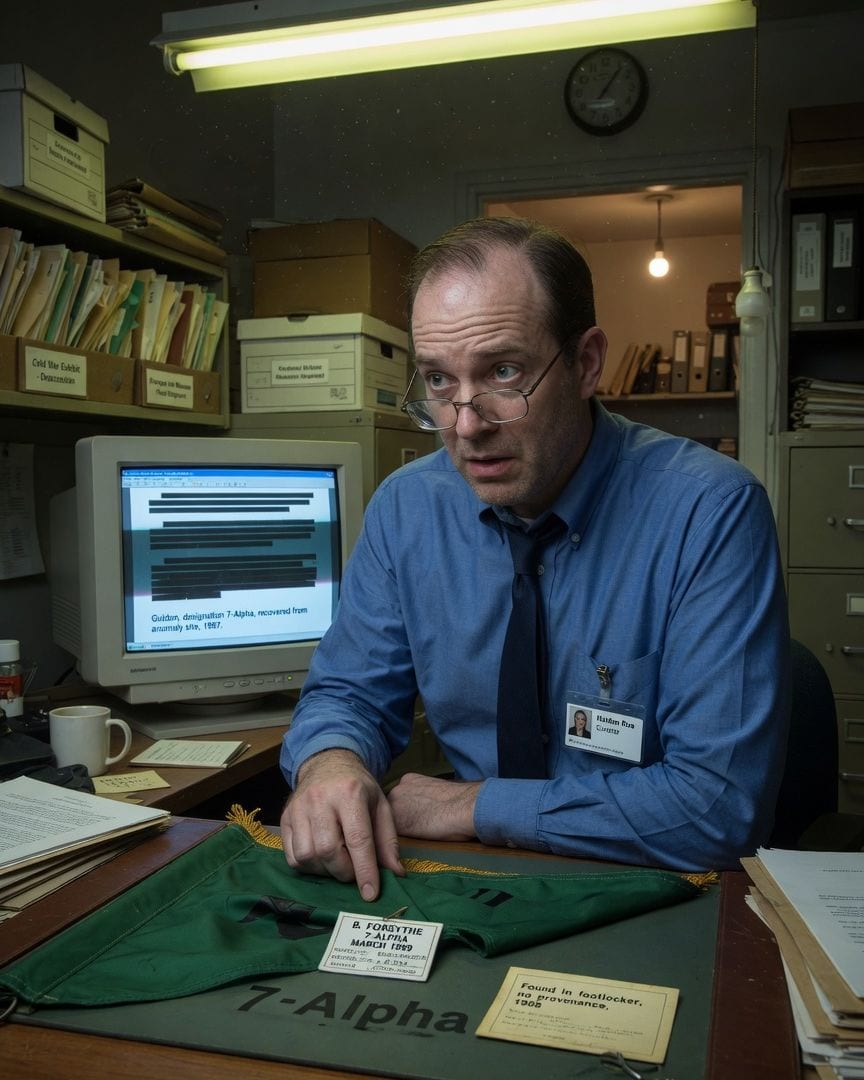
A curator found a guidon dated 1989. The museum took it in 1988, but the Cold War airman on its tag vanished in 1954.
Halden Roe, a meticulous curator, worked against a pressing deadline as the Presque Isle Museum's Cold War exhibit closed for good. In the dusty storage unit, under a single bare bulb, he discovered a small laundry tag sewn into an antique green silk guidon. Its crisp black stitching clearly read 'MARCH 1989' — a date a full year *after* the museum’s intake record for the artifact. As Halden's unease grew, he found the service number on the tag belonged to Benjamin Forsythe, an airman who vanished off Greenland in 1954. How could a museum piece found in 1988 bear a future date and belong to a ghost from decades past?
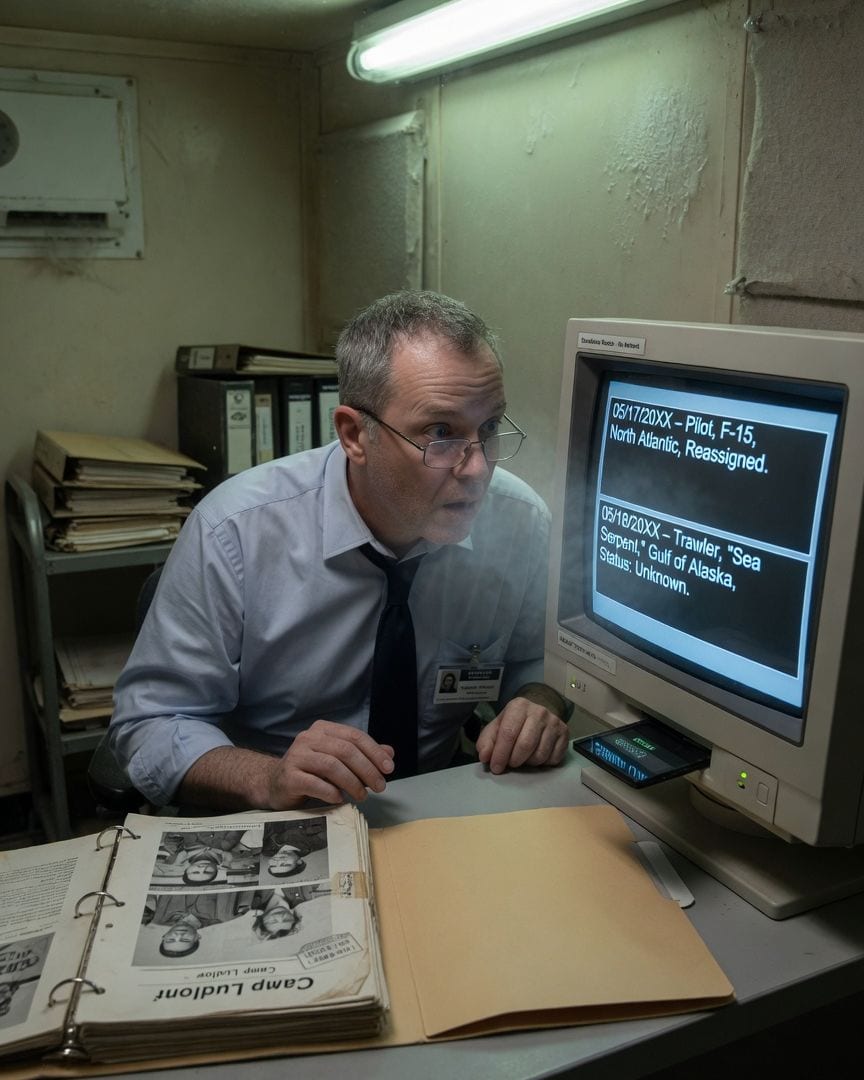
A declassification reviewer opened a Cold War 1959 file. A modern data chip inside showed a pilot missing yesterday.
Declassification reviewer Samuel Vance, whose world was built on the rigid order of official history, smoothed a letter confirming Camp Ludlow’s 1959 closure was a lie. Despite decades of records, the Air Force insisted the Greenland base remained active, its last radio check logged just four days prior. Driven by this profound wrongness, Samuel unearthed the base's ancient physical file, only to find a pristine, modern data chip hidden within its brittle pages. When he inserted it into a secure reader, the screen didn't show history, but a scrolling list of current missing persons—a pilot from yesterday, a trawler from today. How could an archived file hold a living record of the world’s most recent disappearances?
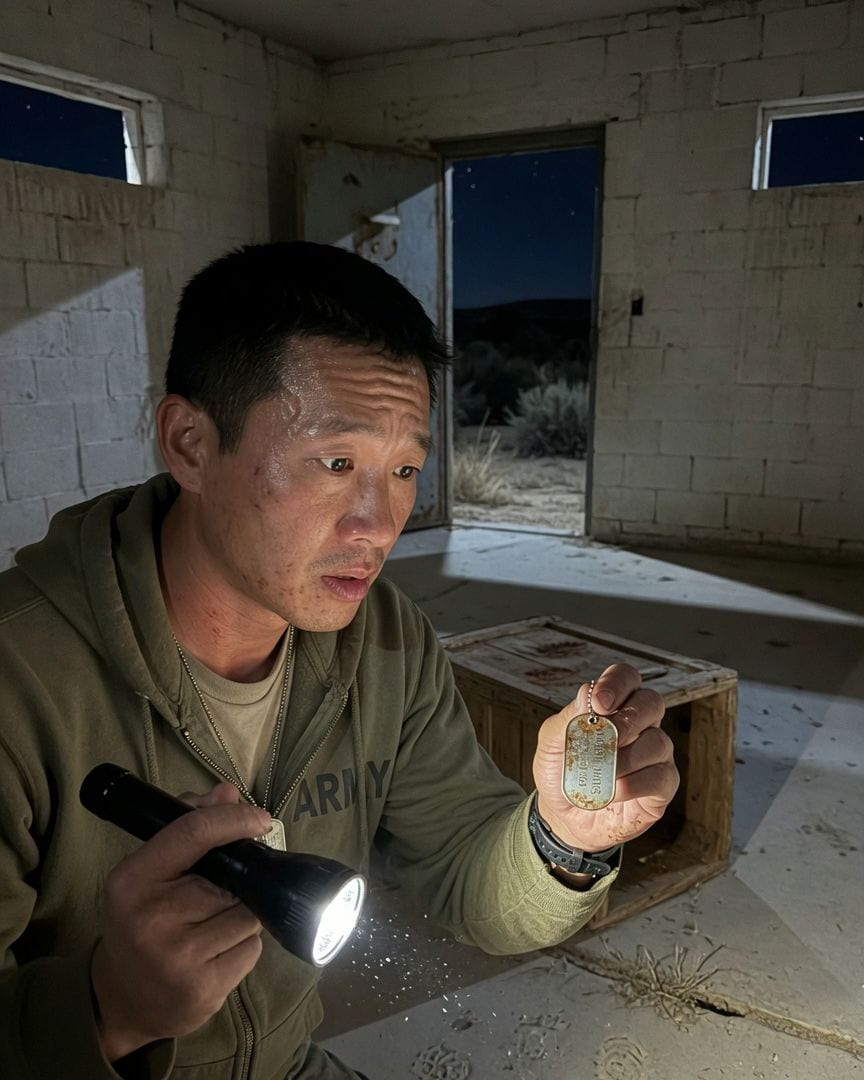
Staff Sergeant Rhee’s squad found a Cold War building not on their map. Range Control confirmed no structure. Minutes later, it vanished, leaving a foundation decades old.
Staff Sergeant Adam Rhee halted his squad at the Yakima Training Center, staring at a cinderblock building that simply wasn't on his map. Range Control confirmed there was no structure at his coordinates, leaving him to wonder what impossible thing stood before them. Moments later, after the range-safety truck arrived, the building vanished, leaving only a rectangular patch of earth with a foundation of decades-old weeds. That night, driven by an unsettling certainty, Rhee returned to find the building reappeared, its door ajar, holding a single, rusted dog tag from 1983. How could a place appear and disappear, leaving behind evidence from forty years ago?
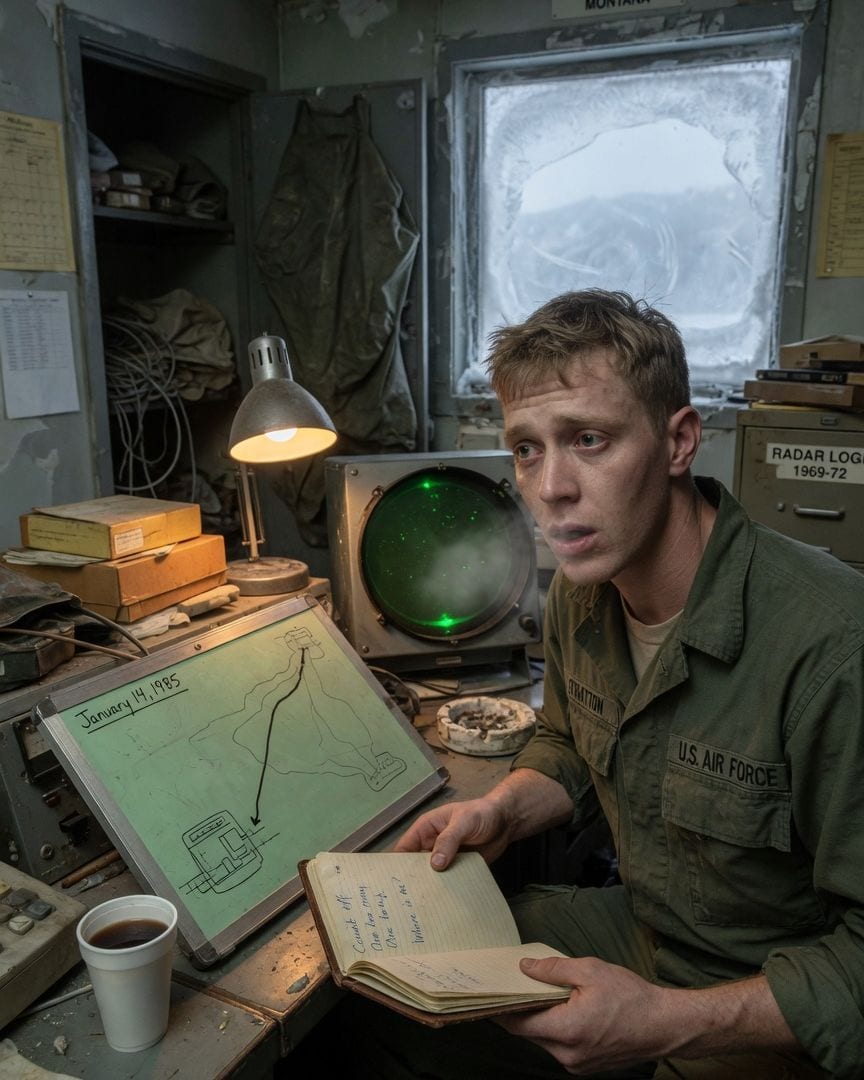
Airman Lars Stratton found an old Cold War manifest listing one name twice: 'Bernard Radcliffe' transferred and 'Bernard Radcliffe' still present.
Airman Second Class Lars Stratton was counting down his final weeks at Echo Station, a desolate Cold War outpost due for mothballing. He longed for home, far from the bitter Montana winds and the constant hum of static. Inside the dim radar shack, he logged the usual nightly ghost blip, a faint contact appearing at 2300, just as it had every winter since 1987. This night, a metallic tang like old blood lingered in the air, raising the hairs on his arms. Seeking distraction, Lars later discovered a leather-bound logbook from 1971, detailing the same 2300 contact, but with chilling notes and a manifest listing one airman's name, Bernard Radcliffe, twice—once transferred, once present. Was he truly alone in the silent, remote station?
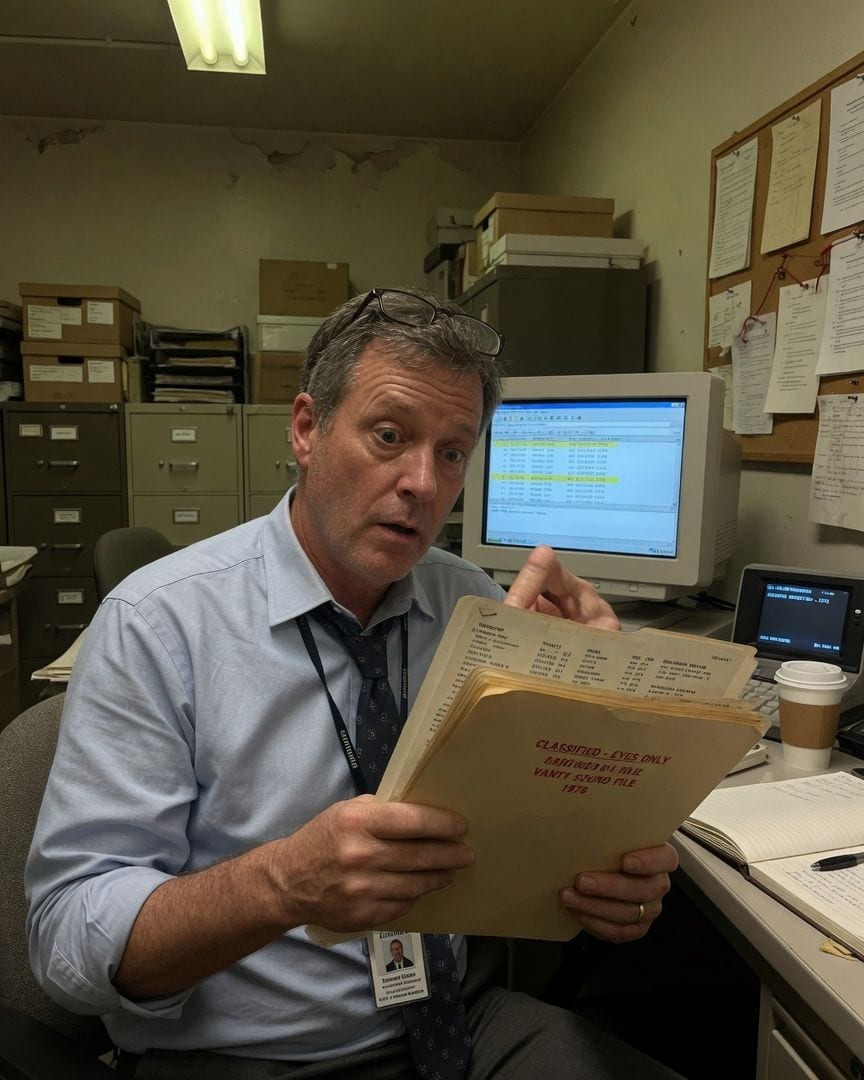
A retiring archivist, Emmett Doane, found a Cold War file from 1978 listing men who wouldn’t enlist until the 1980s. The last name on the classified roster was his four-year-old son’s.
With only six days left until his retirement, archivist Emmett Doane spent a quiet afternoon in the office reviewing old files. He finally pulled the Vantry Sound file, a classified folder from 1978 he'd long dismissed as a clerical error. Inside, the brittle onionskin pages revealed a roster of servicemen who, impossibly, had enlisted years after the file date. As a cold dread tightened his chest, he noticed the file felt warm in his hands, then saw the last name on the list: his own four-year-old son, Samuel. Could a decades-old document truly predict the future, or was something far more sinister at play?
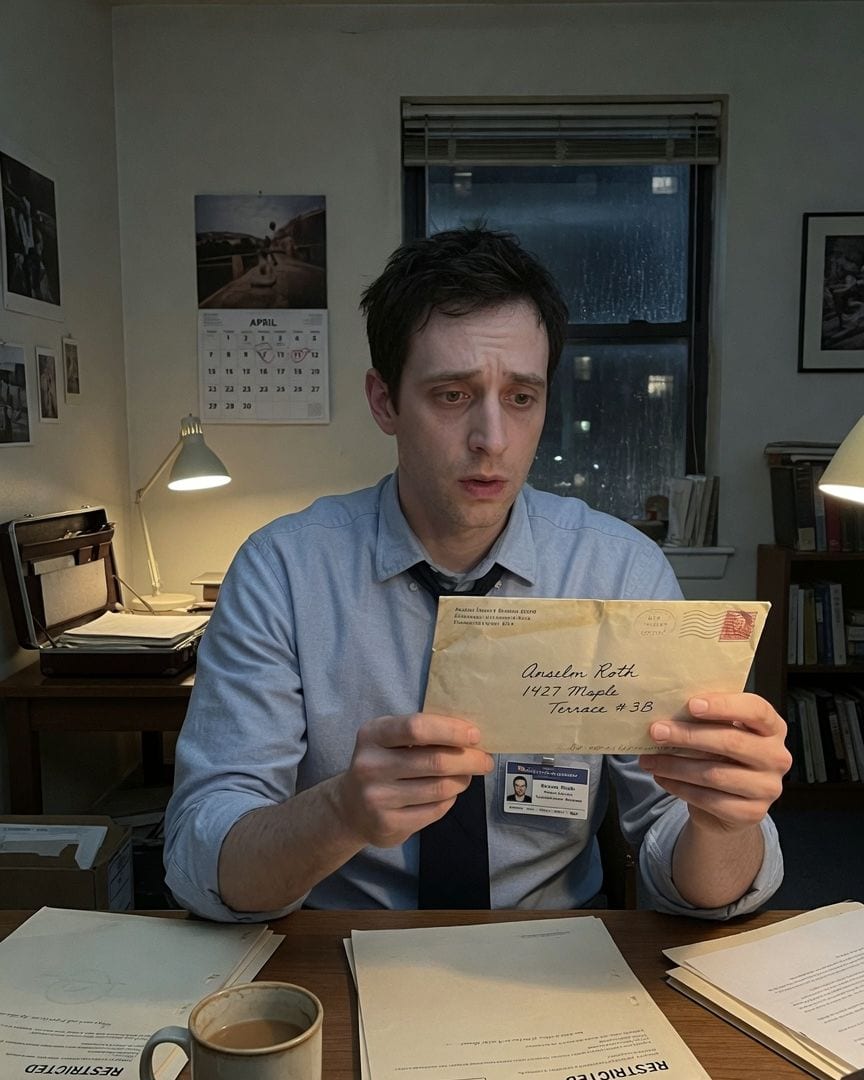
A Cold War declassification reviewer finds his dead grandmother's letter, postmarked 1974, addressed to him years before he was born, and radiating heat.
Declassification reviewer Anselm Roth meticulously sorted through a Cold War-era file on impossible disappearances at the National Archives, a routine 'thirty-year clock' review in 2014. Among the countless records of vanished ships and military units, he found an unscheduled addendum: a thick, sealed envelope addressed to him in his dead grandmother Eleanor Vance’s unmistakable hand. The postmark read 1974, years before he was born, and the paper itself was faintly, inexplicably warm against his fingers, defying every archival principle. Later, a photograph inside revealed his grandmother in an unknown uniform with a stark warning: 'They file us, Anselm. Don't let them finish.' This wasn't just a record of the lost; it was still active.