My new church's communion roll lists twenty-three names, all dead since 1919. Someone still writes them in, present, every Sunday, by hand.
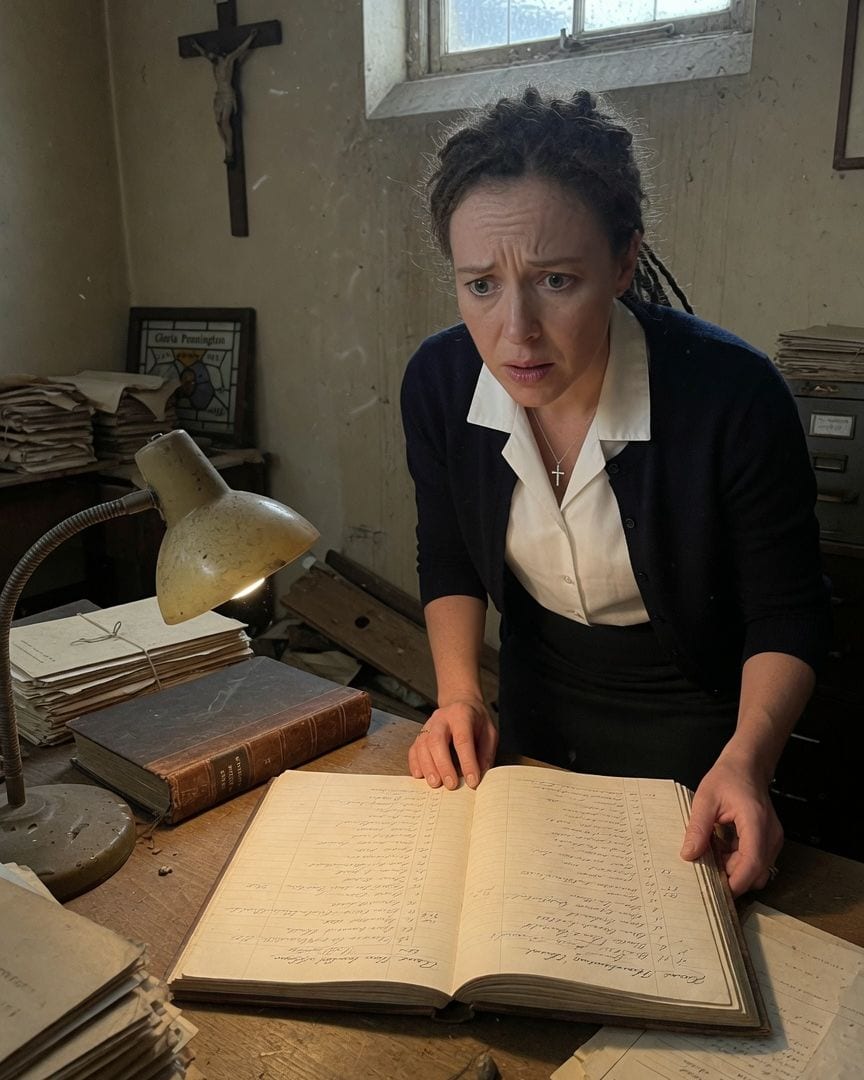
My predecessor, Victor Winslow, wasn’t a man for grand pronouncements.
He was a quiet, unassuming sort, prone to murmuring rather than speaking, and when he gave me the keys to Oakhaven’s rectory three months ago, he offered only one piece of advice.
“Don’t mind the last page, Annika,” he’d said, his gaze fixed somewhere beyond my shoulder. “Just let it be.”
Of course, I minded. I’m Annika Fletcher, thirty-five, and a stickler for detail, especially when it comes to church records. And the communion roll, a thing of worn leather and brittle paper, deserved my meticulous attention.
After Sunday service, with the last lingering scent of old incense still hanging in the air, I closed the roll, my finger tracing the familiar names on the final page.
Twenty-three of them, neatly ruled off and then re-entered, week after week. Each entry was a current, neat script, clearly the hand of Oscar Doyle, our sexton.
And beside each name, in that same precise hand, the single, unsettling word: ‘present.’
There was Nancy Sinclair. Below her current, ‘present’ entry, the faint ghost of another ‘Nancy Sinclair,’ ruled through, a ghost of an earlier ‘present’ entry. The same names, an endless loop on the final page, a quiet defiance of time.
It pricked at me, this repetitive insistence, the impossible longevity of these twenty-three. I tried to rationalise it, of course. A long-standing tradition, a memorial for early parishioners, a quirky habit of a small, insular town.
The scent of old paper and beeswax, heavy in the empty church, felt ancient, but the names, despite their antiquity, felt stubbornly, eerily, contemporary.
The next day, the prickle had become a persistent itch. I found myself drawn back to the church, to the nave, where sunlight poured through the stained-glass memorial windows.
Methodically, I went through the communion roll, comparing the twenty-three names to those etched into the vibrant glass. Isaac Harrington. Gloria Pennington. Marcus Winslow. Each one gleamed back at me, a familiar name now solidified in artistry.
Below each name, the same year: ‘1919.’
I tried to get a handle on it during the next parish council meeting. “That’s a lot of names for one year,” I ventured, gesturing vaguely toward the church.
Cecilia Reynolds, eighty-eight and sharp as a tack, offered a smooth, practised reply. “Just a terrible flu season, dear. Hit us hard that year.” Ethan Porter, eighty-one, nodded in agreement.
Their answers were too quick, too perfectly aligned, like a well-rehearsed chorus. It was unsettling, the uniformity of their evasion.
Later that week, I returned to the dusty church archives, a small, neglected room smelling of damp and forgotten things. I pulled out the original parish registers.
The 1919 register was a sombre thing, confirming the deaths of all twenty-three parishioners. A dark, solemn list, exactly as the memorial windows suggested.
But as I was closing the heavy volume, I noticed something tucked beneath a loose floorboard in the vestry, hidden from casual sight. A smaller, leather-bound ledger, distinct from the official records.
Its pages contained the same twenty-three names, but these entries were different. They weren't death records or communion notes. They were civic duties, community roles, meticulously logged in an elegant, antique script that was not Oscar Doyle’s.
I turned a page, the thin paper rustling like dry leaves. My eyes landed on an entry. ‘Isaac Harrington, Town Council Meeting, October 1967.’ I blinked, rereading the impossible line. Isaac Harrington.
One of the twenty-three names on the communion roll, his death explicitly recorded in 1919, his name carved into the memorial window.
Yet here, in this meticulously kept ledger, he was recorded as having attended a town council meeting almost fifty years after his official demise.
The ledger lay open on the dusty table, the date a stark, impossible fact that vibrated with silent wrongness.
The impossible ledger entry gnawed at me. My initial rationalizations — a mistake, a prank, some bizarre form of ancestral record-keeping — crumbled with each passing day.
For the next week, I cross-referenced, I researched, I became a quiet, relentless detective.
I visited the local historical society, feigning interest in a “project on Oakhaven’s founding families,” and pored over old census records, property deeds, and local newspaper archives.
The names, those twenty-three names, surfaced again and again.
Not always explicitly 'present,' but their properties never quite changing hands, their businesses listed as 'dormant' for decades rather than 'closed,' their names appearing on voter rolls long after their official deaths. Always tiny, overlooked anomalies, almost deliberately subtle.
The pattern was too consistent, too deliberate to be coincidence or clerical error. Each time I uncovered another subtle trace, a prickle crawled up the back of my neck, as if someone was watching me read.
And someone was. Oscar Doyle, the sexton, seemed to appear wherever I was. Polishing a pew in the nave, tending the overgrown rose bushes by the rectory, always with a quiet, observant gaze that never quite met mine.
When I brought up the anomalies to a few long-time parishioners – a question about old properties that never sold, or the peculiar voter registration lists – their genial smiles would tighten.
Their eyes would slide away, and the conversation would swiftly, smoothly, shift to the upcoming bake sale or the unusually warm autumn weather. The ‘Town That Agrees,’ I started calling them in my head.
A wall, not of hostility, but of quiet, impenetrable consensus.
The subtle pressure intensified. I found a small, hand-carved wooden cross on my desk one morning, resting neatly on my sermon notes. It was identical to the ones I’d seen marking the 1919 graves in the churchyard.
There was no note, just the silent, unsettling message. I checked the doors and windows. Locked. It wasn't a prank by some teenager; the craftsmanship was too old-world, too precise.
I tried to convince myself it had always been there, or I’d misplaced it from a box of church trinkets, but I knew I hadn't.
That evening, as I was locking the rectory door, Cecilia Reynolds stopped me. She’d been tending to the small, perfectly maintained flowerbed by the rectory path.
“Some things, dear,” she said, her voice soft but firm, like a stone worn smooth by a river. “Are best left undisturbed. Sleeping dogs, you know.” Her gaze, usually so kindly, was unwavering, ancient.
The implied warning was chilling, the very air around her seeming to thicken and grow cold.
I returned to my office, feeling a profound unease, to find a single, anonymous note slipped under my door. ‘Some things are best not known. They have a way of knowing you back.’
The handwriting was old-fashioned, delicate, but the message was blunt, chilling in its directness. I knew Oscar had a spare key to the rectory, the only other person. The dread shifted from historical anomaly to something intensely personal.
A deep chill settled in my bones. Someone knew. Someone was watching.
I found Oscar Doyle late that afternoon, in the quiet solitude of the church. The late afternoon sun fractured through the stained glass, casting long, broken shadows that stretched like grasping fingers across the floor.
I laid out the hidden ledger, its impossible entries stark against the dusty wood of the workbench. Beside it, printed copies of the census anomalies, the baffling voter rolls, and the current communion list.
“Oscar,” I began, my voice tight, trying to keep it steady. “What is going on here? Who are these people?”
He didn’t deny it. He just sighed, a deep, weary sound that seemed to carry the weight of decades, if not centuries. He polished a small silver chalice, his gnarled fingers moving with slow, practiced grace. “They’re… the present, Reverend.
Always present.” He put down the chalice, picked up a polishing cloth, and began to carefully wipe down a small, wooden cross that sat on the table.
He explained how, in 1919, after the flu took so many, something else came. “A hunger,” he called it, his voice low and raspy, barely audible in the vast silence of the church. “A need for… acknowledgment.”
The town elders, desperate to stem the losses, to protect those who remained, had made a pact. An agreement to keep those twenty-three, not alive in the way we understood it, but ‘present.’
To acknowledge their continued place in the community, week after week, year after year.
“The communion roll,” Oscar continued, his eyes fixed on the cross, not on me. “It’s how we feed them. How we remind them they still belong. It keeps the hunger quiet.”
I felt the pieces click into place, horrifyingly, with the sickening precision of a trap. My predecessor’s quiet warning not to mind the last page. The town’s smooth, perfectly rehearsed lies.
The impossible ledger entries, the hidden voter registrations, the properties that never quite changed hands. It all made a terrible, coherent sense.
The dread was not of ghosts, not of spectral hauntings, but of a quiet, generations-long bargain, a community trapped in a perpetual ritual of appeasement. A cold certainty settled over me, colder than the stones of the church.
Reeling, I demanded to know the full cost of this pact, this generations-long lie. Oscar’s face was grim, lined with a sorrow that looked as old as the church itself.
“The cost of not minding the last page,” he said, his voice barely a whisper, “is always paid.”
He put down the cross, picked up a small, powerful flashlight, and led me to the memorial windows. He shone the beam on the vibrant glass, illuminating the faint, almost invisible etchings that adorned them.
“When someone disturbs the presence,” he whispered, his voice thin as brittle paper, “when they question the agreement… the hunger stirs. And it seeks a replacement.”
He then showed me a ledger, his family’s private ledger, bound in brittle, dark leather.
Its pages were filled with names and dates, not unlike the hidden parish ledger, but this one detailed every instance a newcomer, a curious soul like myself, had broken the unspoken rule.
And next to each entry, a date, and a name: a living parishioner, quietly lost, their name then appearing, faintly, on the 1919 memorial window, replacing one of the original twenty-three.
His gnarled finger, trembling slightly, traced a faint, newly etched name on the 1919 memorial window, barely visible beneath a century of grime: ‘Marcus Winslow.’ Then, slowly, agonizingly, he dragged his finger down, stopping on a spot just below it.
There, another name, incredibly, was already faintly, almost imperceptibly, beginning to form in the glass: ‘Annika Fletcher.’ He looked at me then, his eyes filled with a deep, ancient sorrow, a silent confirmation of my new, inescapable fate.
Oscar explained the full, chilling history. “When the flu came in 1919, it wasn’t just sickness,” he recounted, his voice low and raspy, the words sounding like they were pulled from the deep past.
“Something came with it, something that settled here, in the heart of Oakhaven. It took twenty-three souls, and when it was done, it didn’t leave. It lingered, a void, a hunger for connection to the living.
The elders, my great-grandfather among them, made a bargain: if the town acknowledged the twenty-three as perpetually ‘present,’ it would take no more. But that acknowledgment had to be absolute. No questions. No forgetting.
The communion roll, the subtle mentions, the civic records – it’s all part of the pact. A constant reassurance.
But if that assurance is broken, if the ‘presence’ is disturbed by someone who ‘minds the last page,’ the hunger stirs, and it seeks to rebalance.
It takes a living soul to become part of the ‘present,’ replacing one of the original twenty-three, maintaining the number.”
A cold dread, sharp and sickening, bloomed in my chest. Every strange detail, every evasive glance, every too-smooth answer from the townspeople coalesced into a horrifying, undeniable truth.
The town wasn’t protecting a secret; they were protecting themselves, maintaining a fragile, terrible peace at an unimaginable cost. My name, already etched into the glass, was the proof.
My mind raced, a frantic, desperate scramble for an escape. I was marked. The 'presence' already had a claim. Oscar watched me, his gaze heavy, devoid of judgment, only profound regret.
“You must leave, Reverend,” he said, his voice flat with finality. “And never return. It is the only way some survive.” He handed me his family ledger, the brittle, leather-bound book detailing the replacements, the terrible cost of knowing.
“They will not stop you physically. But the hunger… it will follow. It will try to draw you back.”
I clutched the ledger, its pages feeling cold and ancient in my hands. This was my proof, impossible as it was. I knew, with an absolute, terrifying certainty, that I couldn't stay.
Couldn't become the next name, the next silent replacement. I made my decision in a heartbeat. Survival.
Under the cloak of midnight, I moved quickly, quietly. I packed only essentials, the ledger tucked deep in my bag, its edges pressing against my side like a cold truth.
The rectory felt heavy, the air thick with unspoken presences, a silent accusation hanging in the silence. As I slipped out the door, turning the key one last time, I glanced back at the church.
The memorial windows gleamed faintly in the moonlight, a silent, terrible testament to the town's horrific bargain. I got into my car, started the engine, and drove.
I didn't look back until Oakhaven was a distant cluster of lights in my rearview mirror, shrinking into the darkness, devoured by the miles.
I knew the town wouldn't believe me, couldn't believe me, but I carried the truth, a heavy burden that might just kill me.
I drove for twelve hours straight, not stopping until the sun was high over an unfamiliar city, the landscape utterly changed. I resigned my rectorship by email, offering no explanation beyond 'personal reasons.' My inbox remained empty; Oakhaven never replied.
I tried, once, to tell my story to a sympathetic colleague in my old diocese, showing them Oscar's ledger. It was dismissed as a fabrication, a symptom of stress from a demanding new parish, a breakdown.
The proof I carried was unbelievable, untranslatable to the rational world. I found a quiet apartment, far from any church, far from any small town. I never looked for another position in the clergy. Oakhaven never called, never sent letters.
They had simply closed ranks, as if I had never been there at all.
Years passed. I lived a quiet, solitary life, the ledger locked away in a safe, the memories a dull ache, a constant phantom limb. I rarely spoke of Oakhaven, the words catching in my throat, sounding like madness.
One morning, I woke to find a small, unfamiliar, hand-carved wooden cross on my bedside table. It was identical to the ones I had seen marking the graves of the 1919 parishioners in Oakhaven's churchyard.
I lived alone, the windows and doors locked, an elaborate alarm system installed. No one else had a key.
The cross was warm to the touch, and beside it, a faint, almost imperceptible etching had appeared on the polished wood of her nightstand, a single word: 'Present.'
If this one got to you
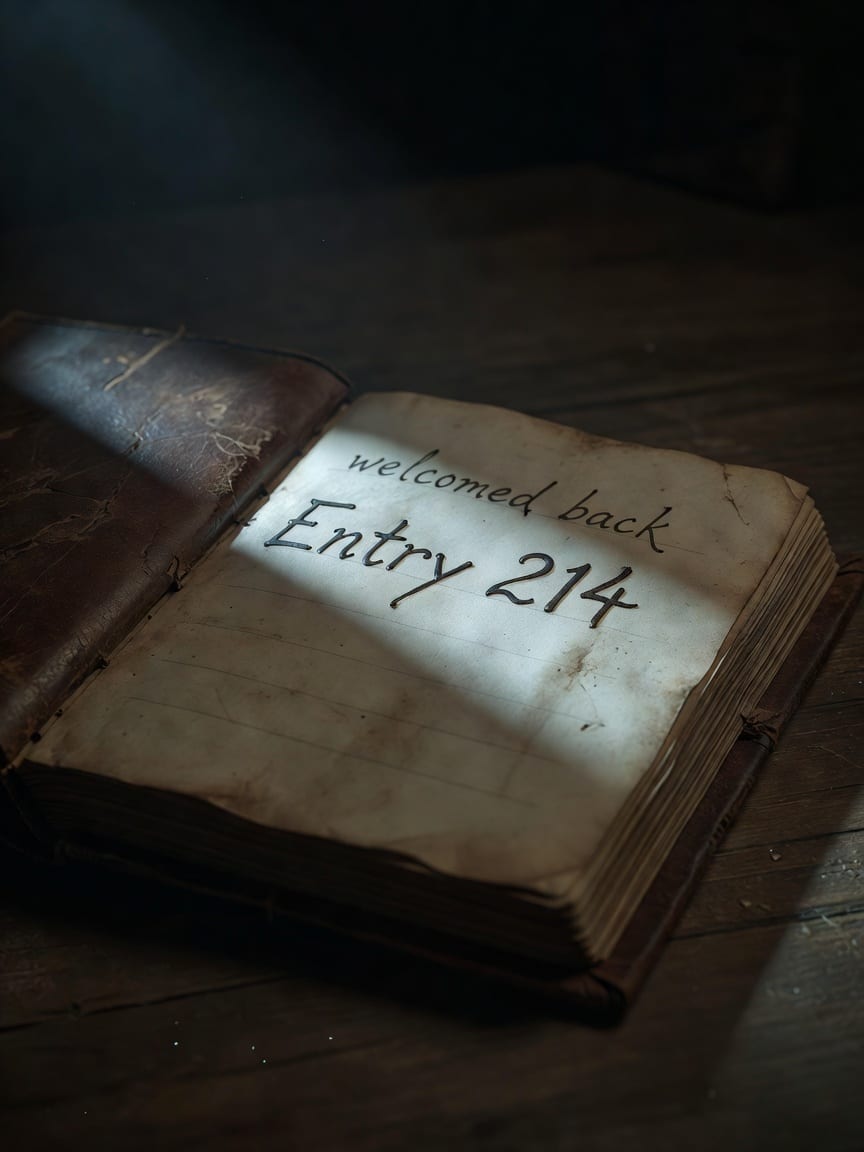
My hand traced the ink of 'welcomed back' beside Entry 214 in the old baptism register. It was the same entry number, used for a christening every seventeen years, inked over and over. Someone had been managing this for over a century.
As the new keeper of my village church's baptism register, I found solace in its unchanging ritual. But when I opened the heavy volume to Entry 214, I saw it was inked over an older, identical number. I soon discovered this specific entry had been used every seventeen years since 1873, each time with the same cryptic note: 'welcomed back'.
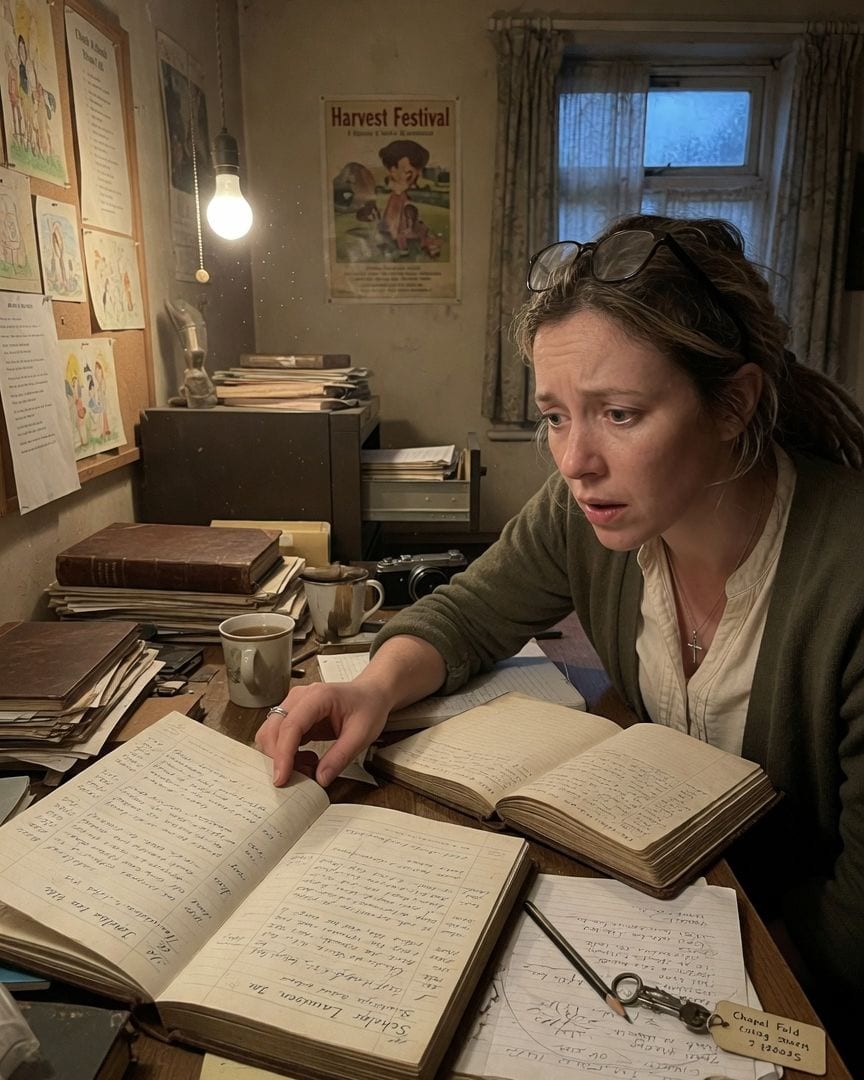
My name is in the chapel's old Sunday school register as 'Scholar 33'. But 'Scholar 33' appears every seventh year since 1907, each child from the same cottage, each marked 'not called for'.
Sorting dusty chapel archives, my job as a local history enthusiast, was a soothing journey through generations. But then my own name, Penelope Lawson, jumped out: 'Scholar 33' for the current year. I'd never attended. Flipping back, I found the same 'Scholar 33' entry repeating every seven years for over a century, always linked to the same old cottage.
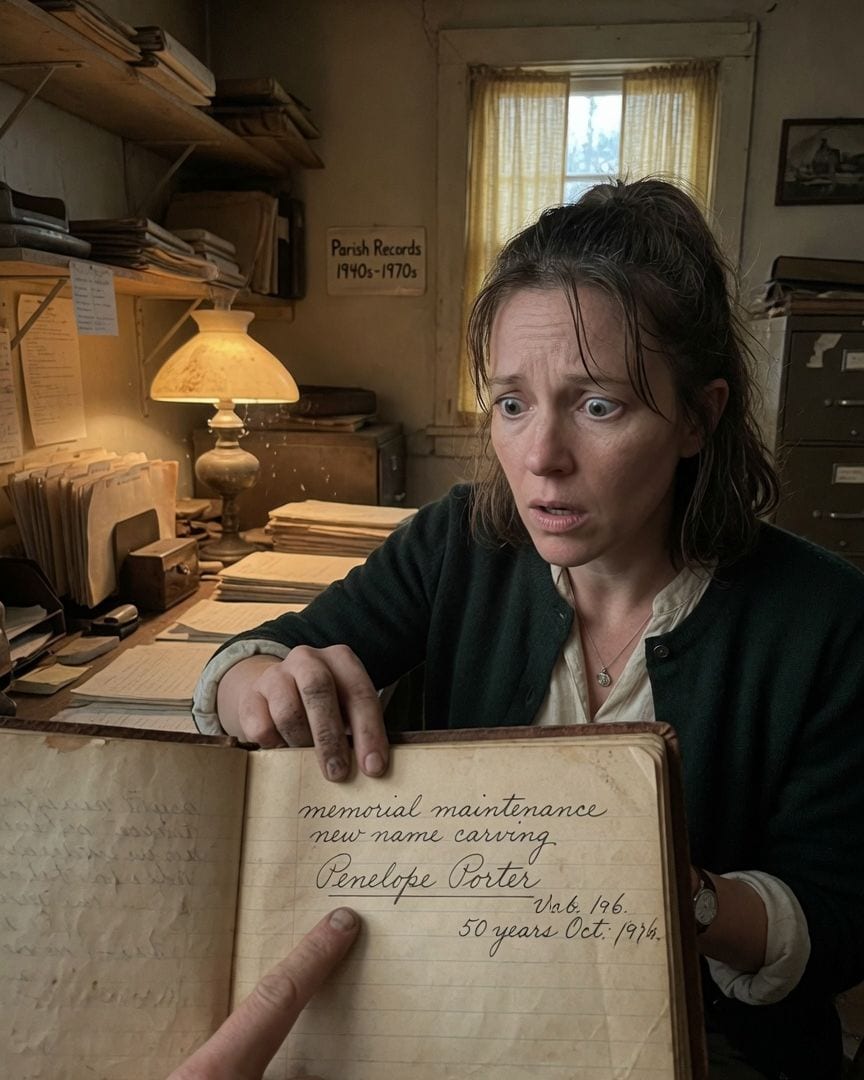
My name is carved on the war memorial with this coming Tuesday's date. The cut is fresh, but the stone inside matches fifty years of age, and a ledger says it was carved exactly fifty years ago.
On a sunny autumn Tuesday, my oldest friend, Gary, urgently called me to the village war memorial. There, carved beneath the names of the fallen, was 'PENELOPE PORTER' with a date from this coming autumn. The fresh carving of my name, dated for a Tuesday yet to arrive, felt like a cold jolt, an impossible message from the stone itself.
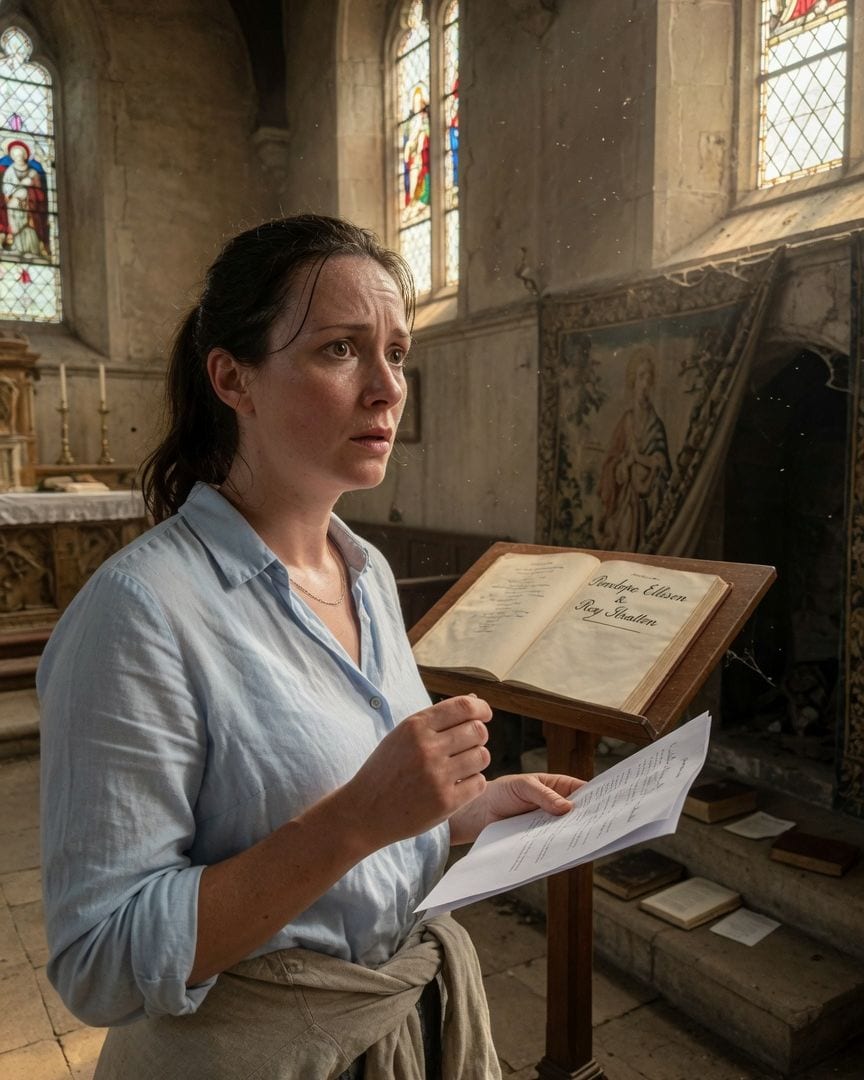
The church's banns book shows a wedding notice, republished every three weeks. Same names, fresh ink. The marriage was never solemnised.
As a newcomer to Marne, I noticed the curate quickly hide a page in the church's banns book. It showed a wedding for 'Penelope Ellison' and 'Roy Stratton' with fresh ink, yet I could find no record of them anywhere in town. The curate's dread-filled warning to leave "some things undisturbed" made the phantom names feel chillingly real.
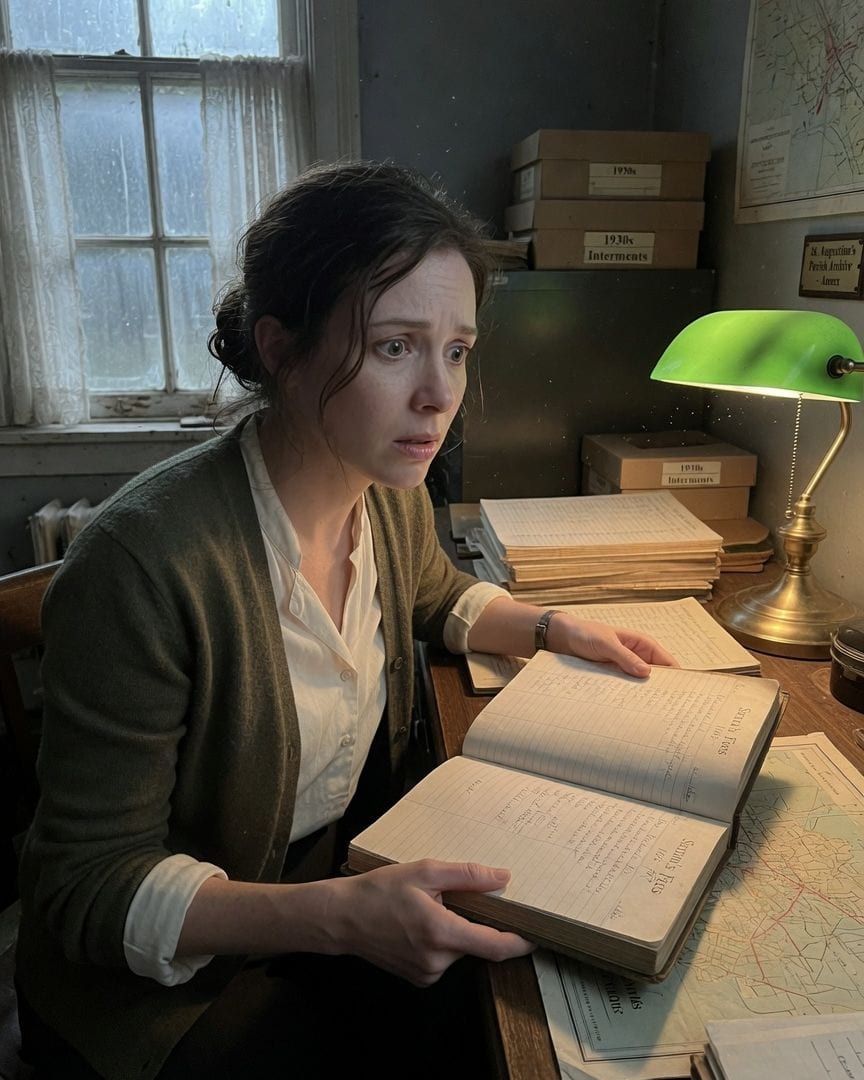
Our churchyard closed in 1974. But the sexton's book shows new graves every month, paid by families whose names are on stones from the 1930s.
As Oakhaven's new archivist, I expected a quiet life of dusty ledgers and ancient records. But a current entry in the sexton's fee book listed a "new burial plot" paid last month for Theresa Romano, who died in 1931. The town ordinance closed the churchyard to new burials in 1974.
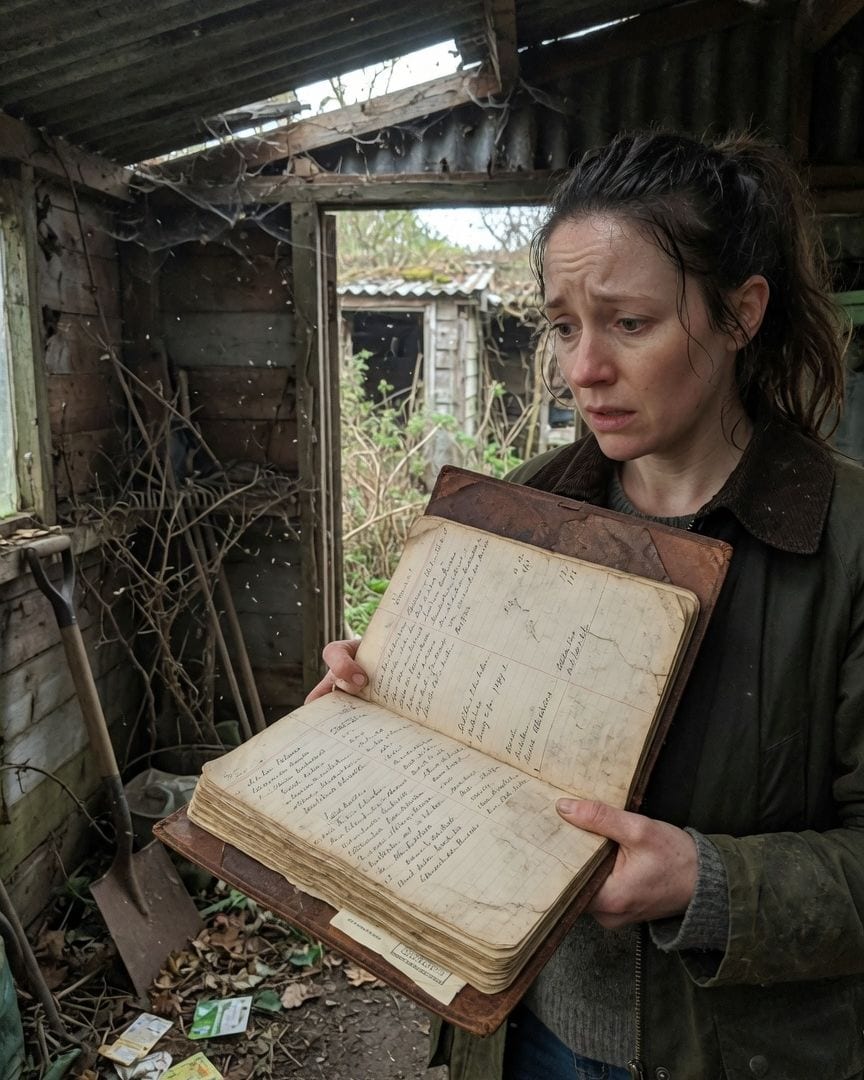
My mailbox holds my own obituary, updated weekly. The postmark reads Cold Ashby allotments, where there's only a standpipe and sheds.
Every Wednesday, a crisp white envelope arrives, containing my own obituary. It's mailed from the desolate Cold Ashby Allotments, a place with no post office, and each week a new, accurate detail of my life is added, leaving only the death date chillingly blank.