My hand traced the ink of 'welcomed back' beside Entry 214 in the old baptism register. It was the same entry number, used for a christening every seventeen years, inked over and over. Someone had been managing this for over a century.
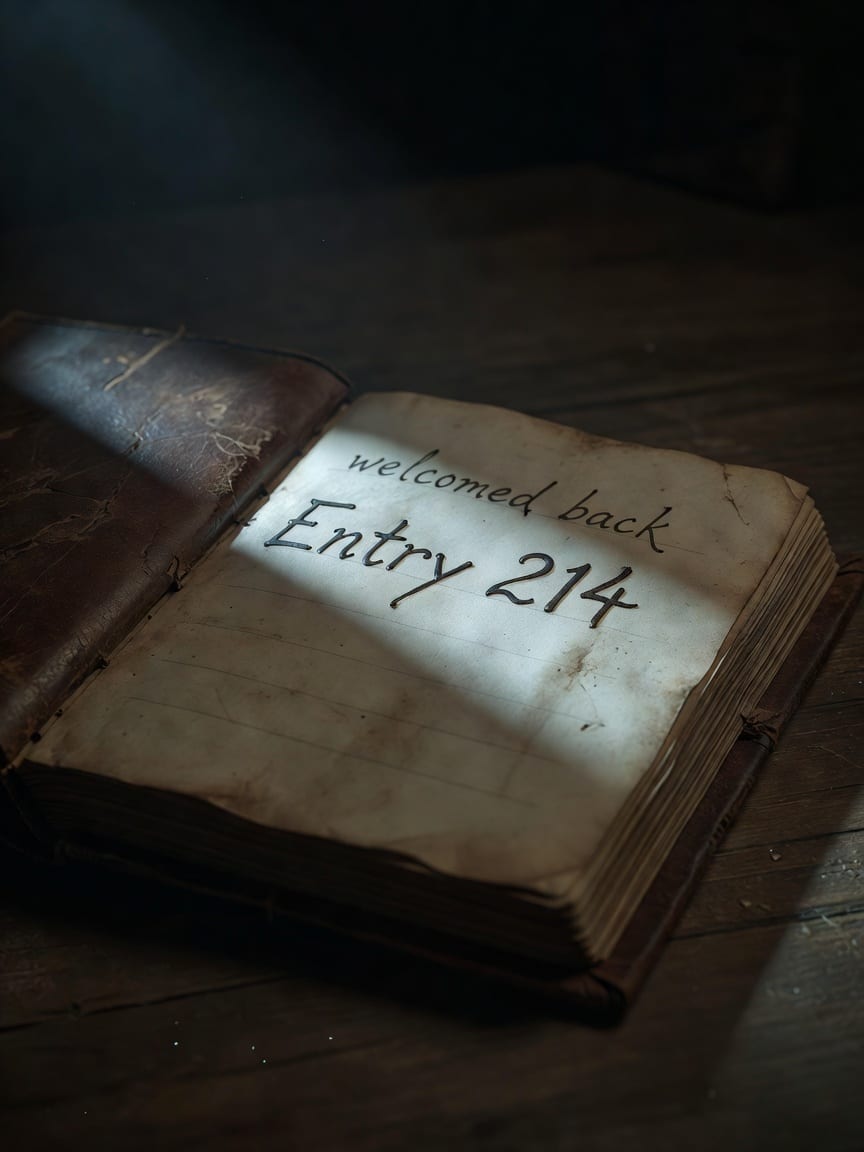
Claire Delaney, the new keeper of the village church's baptism register, carefully dipped her pen, ready to record the latest infant’s details. This Easter’s christening was for a baby assigned Entry 214.
I'd always found a strange comfort in the neat rows of names, the solemn dates, the unchanging ritual of it all. As I opened the heavy, bound volume to the correct page, a detail caught my eye.
The numeral '214' wasn't just written; it was clearly inked over an older, fainter '214' beneath it, and another beneath that. I frowned, tracing the raised ink with a fingertip. My pen hovered, the fresh black ink waiting.
This entry number felt... familiar. A quick flick back through the previous volumes confirmed it. Entry 214 had been used for a christening every seventeen years, without fail, since 1873.
And in the margin beside each, in different hands, was the same cryptic note: 'welcomed back.'
The hairs on my arms prickled. It couldn't be a coincidence. No church reused entry numbers like this, especially not with such precise regularity.
I spent the next few evenings hunched over the dusty registers in the quiet, echoing vestry, cross-referencing. The heavy volumes, bound in leather and smelling of old paper and beeswax, seemed to resist, their pages clinging together.
I found no other entry number with such a distinct, repeated history. It was only 214.
The 'welcomed back' note, scrawled in various hands – some elegant cursive, some hurried block letters, some faded to near invisibility – was always there. Each one, a quiet, insistent whisper across the decades. I tried to rationalize it.
Perhaps a local family tradition, a specific lineage always returning to that number? But the surnames varied wildly across the decades. Davies, O’Malley, Henderson, Chen. All different.
The dates were unyielding: 1873, 1890, 1907, 1924, 1941, 1958, 1975, 1992, and now, this Easter. Always seventeen years.
I remembered the calm, almost serene smile of Margaret Sutton, the church’s long-serving secretary, when I had first taken over the register duties. Margaret had simply said, 'Some traditions run deep here, dear.' I felt a growing unease.
This wasn't a tradition I understood. This was a pattern, meticulously maintained, for a purpose I couldn't fathom.
I started to feel a prickling sensation, as if the quiet room itself was watching me, the air growing heavy, holding its breath for what I might uncover next.
Driven by a need to understand the very first instance of the pattern, I returned to the oldest volume, the one from the 1800s. Its pages were thin as onion skin, smelling of dust and dried flowers.
The bindings were brittle, the corners dog-eared. I carefully ran my fingers along the spine, feeling for any anomalies, any loose threads in the meticulous record-keeping. My touch found it: a slight bulge near the back cover.
Not a tear, but a deliberate construction. With a soft click, a hidden compartment, no bigger than a matchbox, sprang open. Inside, tucked beneath a layer of ancient velvet, was a single, yellowed slip of parchment.
It was folded once, creased down the middle. My heart hammered against my ribs. I pulled it out, unfolded it with agonizing slowness. In spidery, antique script, it read: 'Ensure the arrival of 214 is attended to, as per tradition.
May the cycle endure.' The date was 1873.
The parchment slip felt cold and heavy in my hand. 'Ensure the arrival…' It wasn't just a record; it was an instruction. A directive. This wasn’t a simple historical anomaly, or a quaint local tradition.
Someone had been actively managing this for generations. My stomach clenched.
I tucked the slip safely away in my pocket and, the next morning, sought out Russell Bishop, the village’s unofficial historian and archivist, who spent his days cataloging local records in the dusty back room of the public library.
The air in there was thick with the scent of aged paper and dry rot, a place where time itself felt preserved.
I showed him the pattern in the register, carefully omitting the hidden note for now, wanting to see his unbiased reaction. Russell, a man of facts and figures, initially dismissed it with a wave of his hand.
'Fascinating clerical error, dear. Perhaps a specific family number, passed down through generations?' I pressed him. 'The surnames are different each time, Russell. And the 'welcomed back' note? That’s not standard notation for a clerical error, is it?'
Russell furrowed his brow, intrigued despite himself. He pushed his spectacles higher on his nose. 'No, it certainly isn't. And the consistency of the 17-year interval is... peculiar.'
He agreed to cross-reference the baptism dates with birth records and any old village censuses he had. Days later, he called me, his voice a little strained, a tremor I hadn't heard before. 'Claire, I found something odd.
For each of those 214 entries, the infant’s birth date is… approximate. Sometimes a week either side of the record, sometimes no prior record at all. It’s like they just… appeared, right before the baptism.
And in the 1800s, there are a few entries for 'foundling' or 'child of unknown parentage' that line up with the 214 cycle, but were never officially assigned the number, just baptised around the same time.'
I felt a chill that had nothing to do with the library's ancient air conditioning. 'Appeared?' Russell sighed. 'It’s as if the village itself was expecting them, and then quietly, officially, brought them into being.'
My unease deepened, curdling into a knot of dread. Russell’s findings confirmed my worst fears: this was no clerical error. Someone, or something, was orchestrating these 'arrivals.'
As I left the library late one evening, the streetlights casting long, distorted shadows, a shadow detached itself from the ancient yew tree outside the churchyard. Margaret Sutton. My heart leaped into my throat.
I froze, my breath catching in the cold night air. Margaret’s smile was as serene as ever, a practiced, almost unchanging expression, but her eyes held a knowing glint that seemed to cut through the darkness.
'Still poring over our old records, dear?' Margaret asked, her voice soft, almost a whisper against the rustling leaves. 'The past can be a very quiet place, can't it? Full of secrets, if one knows where to look.'
I managed a weak smile, my lips feeling stiff. 'Just trying to understand the history of the entries, Margaret. Some of them are a bit… unusual.' Margaret’s gaze sharpened, fixing on me, holding me in place. 'Unusual?
Or simply traditions you haven't yet learned to appreciate? This village has always taken care of its own. And its… special guests.' The way she emphasized 'special guests' sent a fresh shiver down my spine.
It wasn't a question; it was a veiled warning, a quiet assertion of control. Margaret’s presence felt less like a chance encounter and more like a deliberate observation, a statement that my digging had not gone unnoticed.
I felt a cold knot in my stomach. I was no longer just an observer; I was now part of the unfolding story, and Margaret was watching my every move.
The air grew still, heavy with unspoken knowledge, as Margaret continued her slow, deliberate walk toward the rectory, her footsteps barely disturbing the gravel, leaving me alone in the deepening twilight, the silence pressing in.
The next day, I knew I had to confront Margaret. My hands were shaking slightly as I pushed open the heavy oak doors of the church.
I found the elderly woman arranging flowers in the church aisle, her movements slow and deliberate, her back to me. The scent of lilies filled the cool, hallowed air.
'Margaret,' I began, my voice trembling slightly, louder than I intended in the vast silence. She didn't flinch. 'I found something. A note, from 1873, about 'attending to the arrival' of 214.
And Russell Bishop found anomalies in the birth records for those entries. What exactly does 'welcomed back' mean?' Margaret paused, her back to me for a long moment, the only sound the faint rustle of flower stems.
Slowly, deliberately, she turned. Her face was unreadable, her eyes like deep, placid pools. 'It means exactly what it says, dear,' she replied, her voice calm, devoid of surprise, as if we were discussing the weather.
'The village welcomes them back.' 'Them? Who are 'them'? And why the 17-year cycle? Are these children… disappearing after 17 years and then reappearing?' I pressed, my frustration mounting, the words tumbling out.
Margaret sighed, a sound like rustling leaves against the stone floor. 'Not disappearing, precisely. More like… completing a cycle. They live their lives, contribute to the village, and then, when their time is done, their essence, their spirit, returns.
And in 17 years, they are reborn, often to families who are… open to it. It’s a sacred trust, Claire. To ensure their continuity. To keep the village… whole.' I stared, aghast.
The words 'reborn' and 'continuity' hung in the air like an unholy benediction. 'Reborn? You mean… reincarnation? And the church facilitates this?'
Margaret nodded, her gaze sweeping over the ancient stained-glass windows, her expression as serene as if she were speaking of planting a garden. 'For centuries. My family, the Suttons, have been the custodians of this particular cycle for generations.
We ensure the records are kept, the baptisms performed, the families guided. The 'welcomed back' note is our internal mark. A reminder of who they truly are, even if they don't remember it themselves.'
The pieces clicked into place with horrifying precision: the reissued number, the precise cycle, the 'foundlings,' Margaret’s knowing smile. It all fit. The serene calm in Margaret’s voice was the most terrifying part of all.
This wasn't madness; it was a deeply ingrained, generations-old system, humming along beneath the polite surface of everyday life. A cold dread seeped into my bones.
I felt a cold dread spread through me, chilling me to the core. 'And the families… they know?' I whispered, my voice barely audible. Margaret’s smile returned, a gentle, almost pitying expression. 'Some do. They are chosen, or they choose.
Others… simply accept the blessing of a child. It's often the same families, cycle after cycle, welcoming them home.' My mind immediately went to Nancy Lawson, the young mother of the infant just baptized as Entry 214.
Nancy had seemed so ordinary, so happy, so utterly unaware. Was she one of the chosen? Did she know? Did she really believe her son was a "blessing" or something far more ancient and terrifying?
Margaret’s eyes, ancient and unblinking, met mine. 'Some things are simply meant to be,' she said, her voice soft but firm, a pronouncement rather than an explanation.
She reached into a drawer beneath the altar, a drawer I hadn't known was there, and produced a faded, sepia photograph. It was a small, delicate thing, curled at the edges with age.
In it, a young Margaret, barely twenty, stood smiling, holding the hand of a small child. The child’s face was undeniably, terrifyingly, the face of Nancy Lawson’s infant, baptized just last Easter.
I snatched the photograph, my fingers trembling so hard I almost dropped it.
The infant in Nancy Lawson's arms, the same infant assigned Entry 214 this Easter, stared back at me from a photograph taken decades ago, held by a youthful Margaret.
The round cheeks, the dark, curious eyes, even the slight curve of the lips – it was exact. 'This is… impossible,' I stammered, my voice choked. Margaret shook her head slowly, her expression unwavering. 'Not impossible, dear. Inevitable.
That child, then and now, is the same soul. Reborn. Welcomed back. My family has overseen this particular line of returnees for centuries. We guide them, protect them, ensure their path back into the community.
Nancy Lawson’s family… they are a long line of nurturers for these special ones. They don't always remember the full truth, but the instinct, the connection, is always there.' I felt sick, a profound nausea rising in my throat.
'So, the original 214 from 1873… that child eventually became someone else, died, and then was reborn again, and again, always returning to this village, always to be baptized under the same entry number?'
Margaret nodded, a beatific smile spreading across her lips. 'And each time, a new family, often from the same lineage, is ready to receive them. It’s a beautiful dance, Claire. A tapestry woven through time.'
The sheer scale of it, the quiet, meticulous administration of generations of lives, all documented in the church’s own records, was overwhelming.
The dread wasn't in a monster, but in the calm, unblinking eyes of the woman who had managed it all, and the centuries of silent complicity within the very fabric of the village itself.
I knew I couldn't let this continue. The serenity of Margaret's explanation was chilling, a mask for a profound, terrifying violation of every natural law I understood.
'This isn't a beautiful dance, Margaret,' I said, my voice firm despite my fear, the words coming out sharper than I intended. 'This is a violation. You're manipulating lives, denying people their own unique existence.'
Margaret’s gentle smile faltered for the first time, replaced by a flicker of something ancient and resolute, like granite. 'You don’t understand the depth of this gift, Claire. We ensure continuity. We preserve something vital.
The village thrives because of this.' I stood my ground, clutching the photograph, its faded image now a burning brand in my hand. 'I understand that these records, this pattern, can be exposed.
I can go to the authorities, to the diocese. This isn't just a local tradition; it's a secret society interfering with people's lives.' Margaret’s eyes narrowed, a cold glint appearing in their depths.
The air in the church seemed to drop several degrees, chilling me to the bone. 'You think we haven't considered that? We are careful. The records are subtle. But you, Claire… you are new here. You have no deep roots.
Your voice will be easily dismissed, or worse, deemed… hysterical.' The veiled threat hung in the air, clear and undeniable. But I had seen the evidence, held the ancient note, traced the reissued numbers, seen the photo.
I knew the truth. I left the church, the photograph still clutched in my hand, and went straight to Russell Bishop, showing him the photograph, the note, and finally, explaining Margaret's chilling confession.
Russell, a man of logic, looked at the evidence laid out before him, his face draining of color, his usual composure crumbling. The sheer, documented coherence of it all broke his skepticism.
Together, we compiled a meticulous report, cross-referencing everything I had found with Russell's village archives. The next morning, Claire, with Russell by her side, presented their findings to the regional diocese.
The initial disbelief was palpable, a wall of institutional skepticism, but the weight of the documented, recurring pattern, the physical evidence of the register, and the photographic proof, was undeniable. An investigation was launched, quiet at first, but inexorable.
Margaret Sutton, serene to the last, was removed from her post, and the church records were seized. The cycle of Entry 214, for now, had been stopped.
The village buzzed with quiet whispers. Margaret Sutton, now frail and silent, her serenity replaced by a distant, almost vacant stare, was taken to live with distant relatives, vanishing from the life of the village.
Nancy Lawson, bewildered and hurt by the questions and implications, eventually moved away with her infant, Entry 214, leaving the village’s strange legacy behind her.
The church underwent a 'restructuring,' its ancient registers locked away as evidence, their secrets now exposed to sterile, analytical eyes. I remained, overseeing the cleanup, feeling the heavy silence of a secret finally exposed.
The formal investigation confirmed the long-standing, generational management of the 'welcomed back' ritual, though no legal charges were ever filed, the practice deemed too arcane and without direct harm, at least by the letter of the law.
But the knowledge had changed me. The world no longer felt as straightforward.
Months later, I still kept the new, pristine baptism register. No Entry 214 had been assigned since. The old registers remained under lock and key, their pages holding the silent testament to lives lived, died, and, unsettlingly, reborn.
I often found myself looking at the faces of newcomers to the village, wondering. Was that new baker’s boy a 'welcomed back'? Had the cycle truly been broken, or merely rerouted?
The dread wasn't that it had happened here; it was that the calm, methodical nature of it all implied it could be happening anywhere, quietly managed, just beneath the surface of the mundane world.
I looked down at the blank page of the new register, ready for the next entry. The village had been 'cleaned,' but the pattern felt too old, too deeply ingrained, to truly disappear.
I knew what I had stopped was only one thread in a much larger tapestry.
The thought stayed with me, a cold whisper in the quiet church, that some traditions run deeper than any law, quietly waiting for their next turn. And the world was full of villages just like this one. She knew.
She simply knew.
If this one got to you
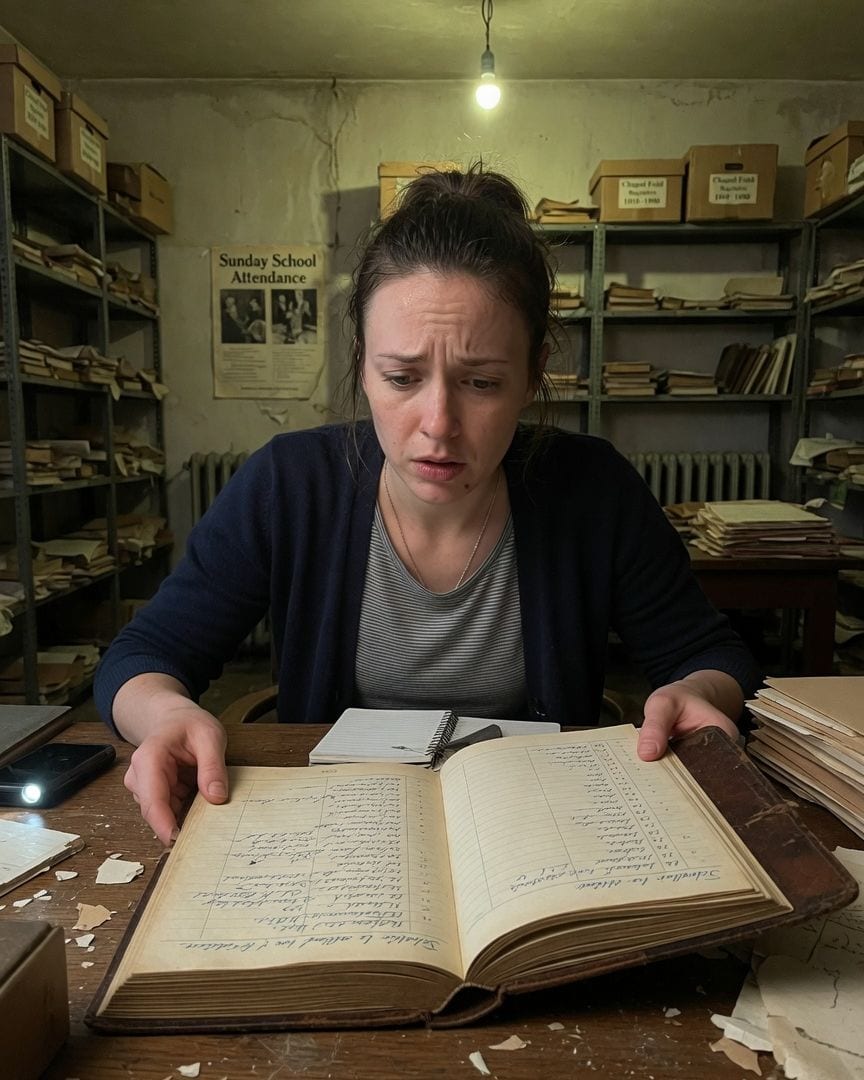
My Sunday school register shows scholar 33. Turning back, that same scholar 33 is entered every seventh year since 1907, always from my old address.
As a chapel volunteer, I found comfort cataloging old documents until a Sunday school register revealed a chilling pattern. Every seven years since 1907, 'Scholar 33' from my old address, Chapel Fold, was entered. Each entry was marked with the same curt, chilling phrase: 'ceased to attend, not called for.'
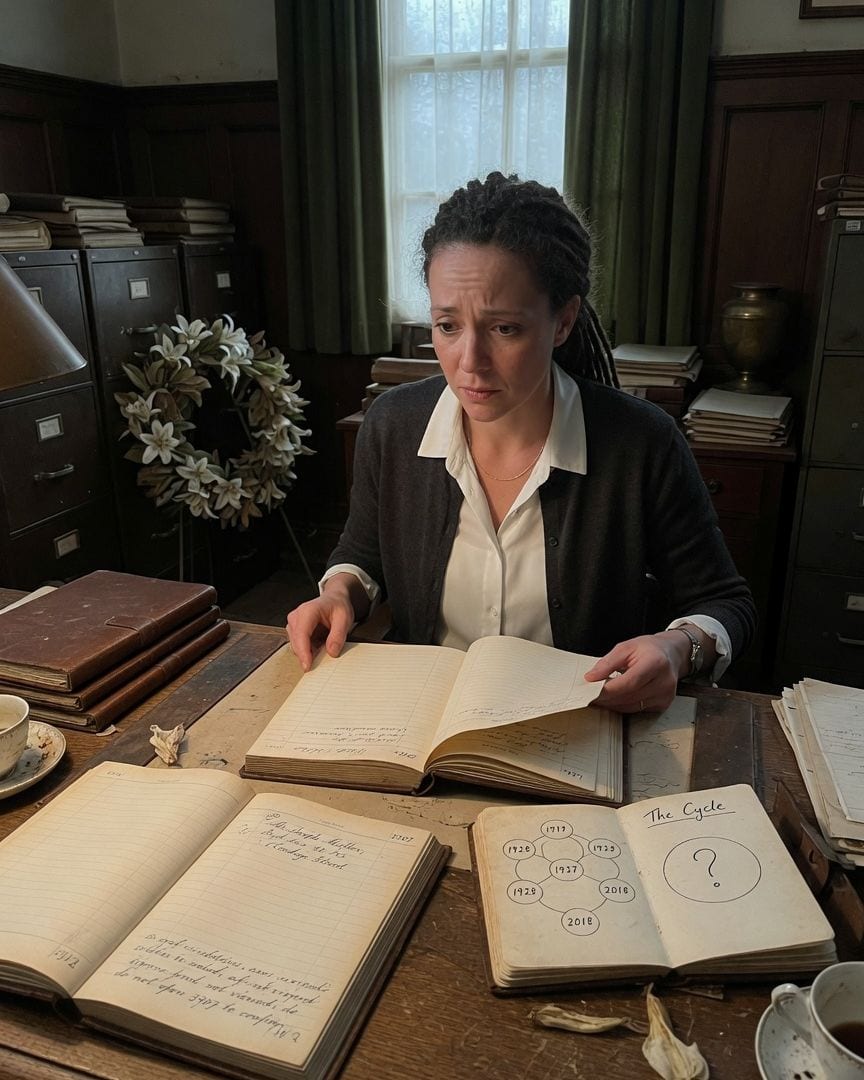
Our funeral ledger records my family name, same age, buried on Cordage Street every nine years since 1919. My great-grandfather's note: 'do not open 3907.'
Reviewing my great-grandfather Joseph’s old ledgers at the Ingram Funeral Firm, I stumbled upon a recurring anomaly. The same burial order for a Joseph Muller, age 45, residing at our family home, 14 Cordage Street, appeared every nine years across decades of records. Each entry, identical, carried the unsettling instruction: 'coffin sealed, not viewed.'
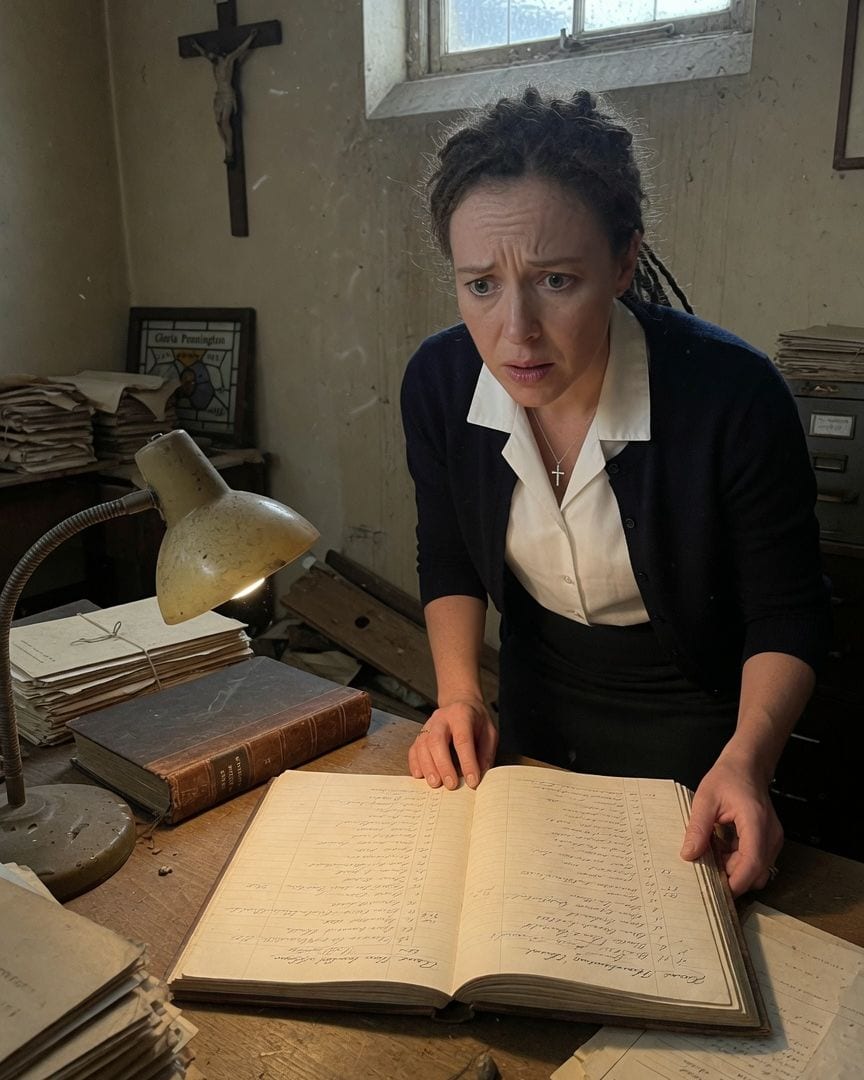
My new church's communion roll lists twenty-three names, all dead since 1919. Someone still writes them in, present, every Sunday, by hand.
As Oakhaven's new rector, I inherited a communion roll filled with familiar names. But a quiet defiance of time pricked at me: twenty-three parishioners, all marked 'present' for impossible decades. Then, in a hidden ledger, I found Isaac Harrington, officially dead in 1919, recorded at a town council meeting almost fifty years later.
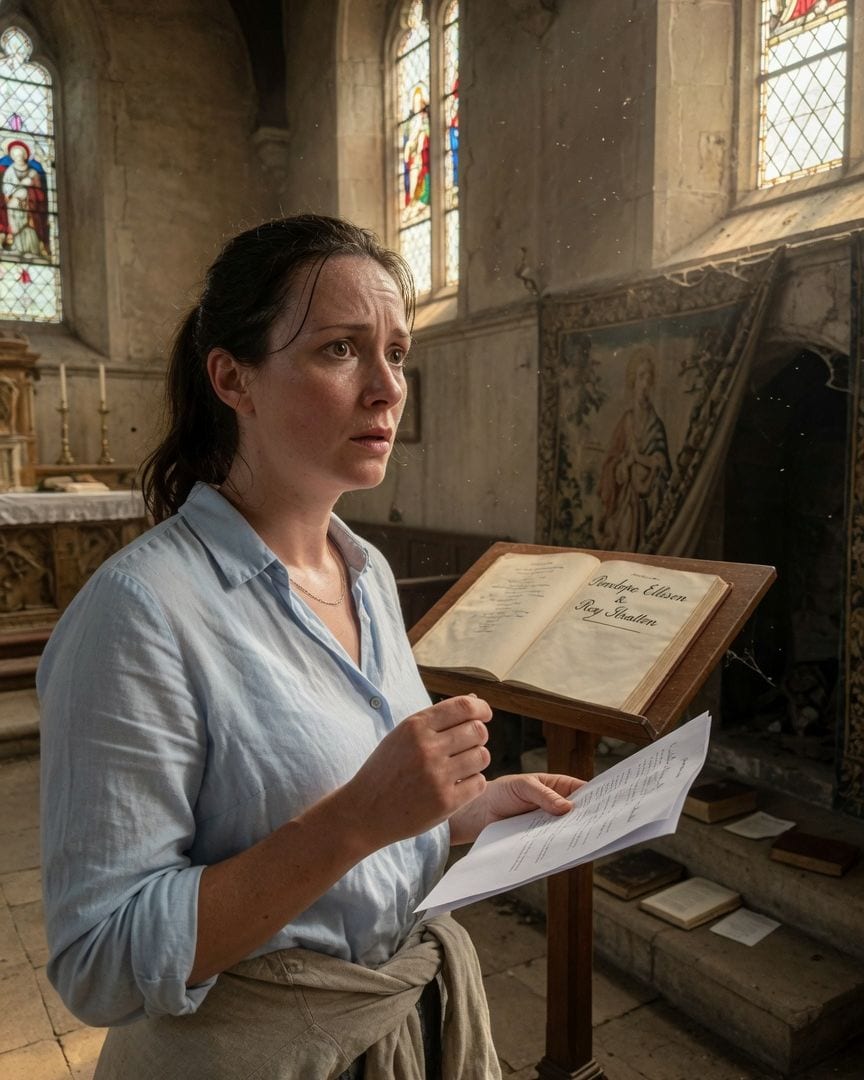
The church's banns book shows a wedding notice, republished every three weeks. Same names, fresh ink. The marriage was never solemnised.
As a newcomer to Marne, I noticed the curate quickly hide a page in the church's banns book. It showed a wedding for 'Penelope Ellison' and 'Roy Stratton' with fresh ink, yet I could find no record of them anywhere in town. The curate's dread-filled warning to leave "some things undisturbed" made the phantom names feel chillingly real.
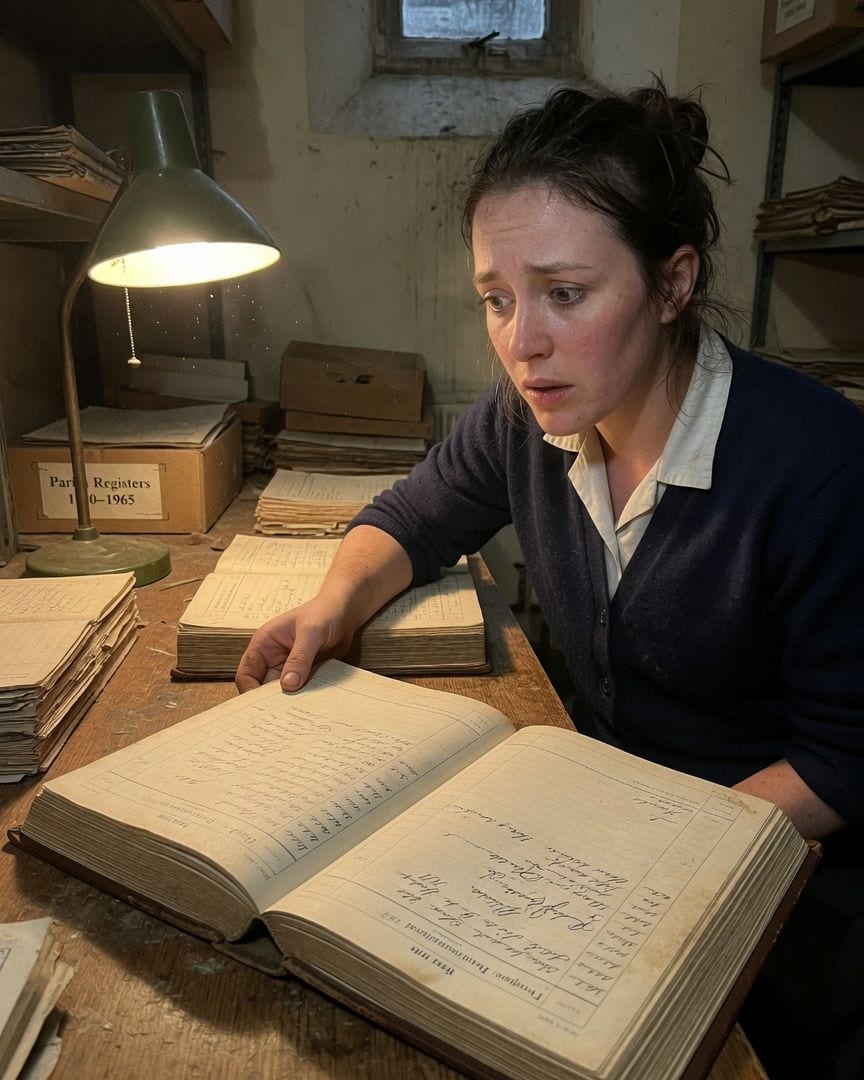
My signature appeared on a baptism record from 1957. Decades before I drew my first breath.
I was reviewing my parents' marriage certificate for a citizenship application, a simple formality. But my gaze snagged on a witness signature: my own distinctive handwriting, dated six years before I was born.
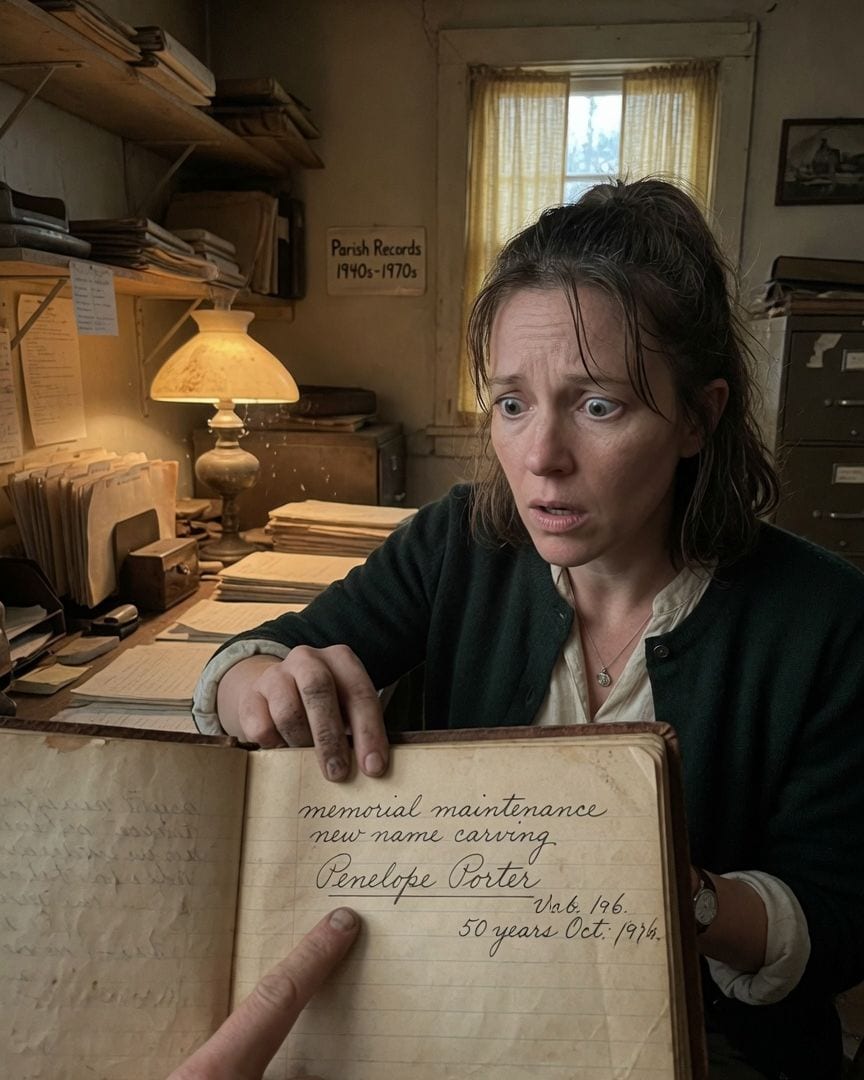
My name is carved on the war memorial with this coming Tuesday's date. The cut is fresh, but the stone inside matches fifty years of age, and a ledger says it was carved exactly fifty years ago.
On a sunny autumn Tuesday, my oldest friend, Gary, urgently called me to the village war memorial. There, carved beneath the names of the fallen, was 'PENELOPE PORTER' with a date from this coming autumn. The fresh carving of my name, dated for a Tuesday yet to arrive, felt like a cold jolt, an impossible message from the stone itself.