My night shift radiographer, Beth, trades gum with me at 1 AM. Hospital rotas for six years show no radiographer named Beth has ever worked here.
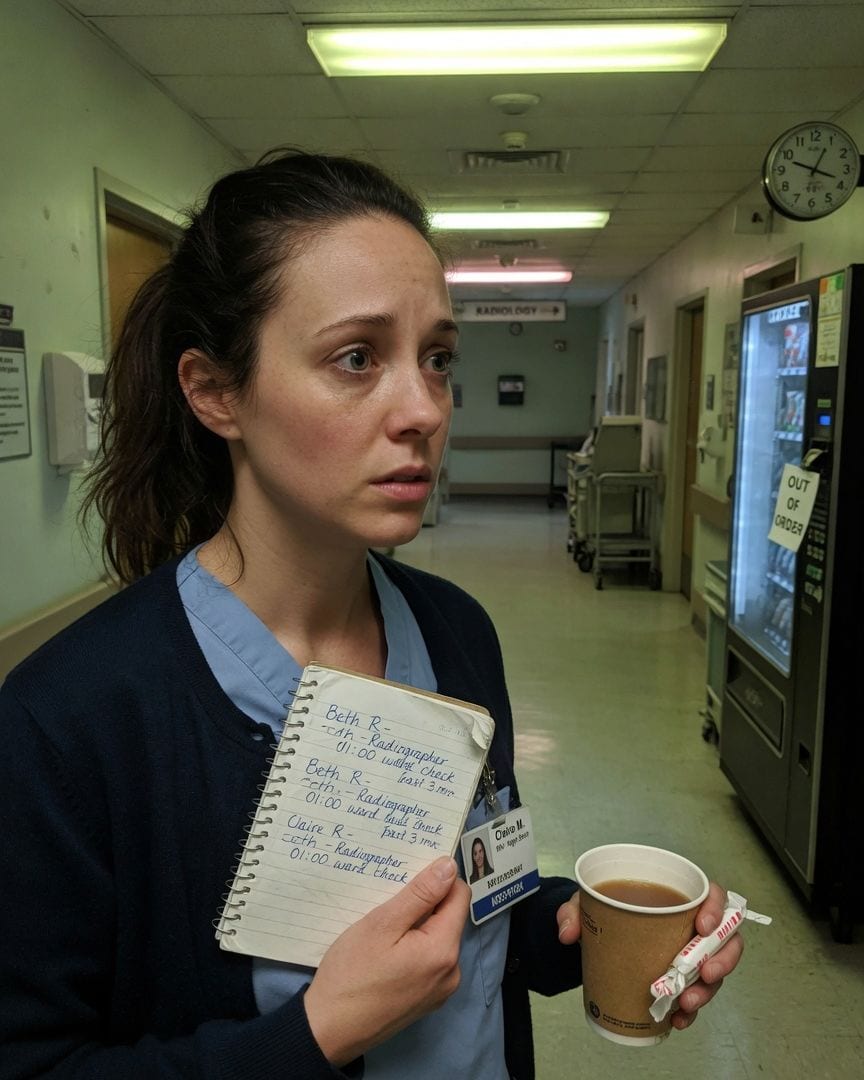
The fluorescent hum echoed in the deserted corridor, a high, thin whine that seemed to amplify the silence. It was 1 AM, our usual time.
I stood by the vending machine, the lukewarm coffee cup a flimsy shield against the deep chill of the hospital night. Beside me, Beth, the overnight radiographer, sighed, rolling her eyes.
"Dr. Evans again," she muttered, digging her heel into the linoleum. "Called me down to scan a patient for... a suspicious mole. At midnight. Couldn't wait till morning, could he?"
Beth had kind eyes, always crinkling at the corners when she smiled, a splash of warmth in the stark hospital lighting.
She was in her late twenties, maybe early thirties, and her presence was as much a part of my night shift as the quiet beeping of monitors.
I peeled a stick of peppermint gum from its wrapper. "Sounds about right for Evans," I agreed, offering her the pack. She took one, unwrapping a fruit-flavored stick in return.
We’d been doing this for about three months now, a small, shared ritual that broke up the long, isolated hours.
She chewed thoughtfully. "Saw a new security guard tonight, too. George, I think his name was. Down on the lower levels."
I hadn't seen anyone new, but then, the night shift was a revolving door of agency staff and temporary hires. People came and went like ghosts in the periphery, fading into the background. I just nodded, already half-forgotten.
Another fleeting presence. Still, a tiny, almost imperceptible seed of unease settled in my stomach, a cold prickle I couldn't explain. Beth laughed then, her eyes crinkling further, and a brief, inexplicable chill ran down my spine.
A week later, the creeping sense of isolation got to me. Night shifts can be brutal, and I thought a Secret Santa might boost morale.
I needed a full list of names, everyone, even the temps and agency staff, to make sure no one felt left out.
During my brief overlap with the day shift, I found Daphne Hughes, 55, the day scheduler, in her cramped office. Papers cascaded from every surface, but Daphne herself was a picture of meticulous order.
"Daphne," I said, leaning against the doorframe, trying to sound casual. "Could you print me a full night shift roster? Everyone, please. I want to make sure everyone's included in Secret Santa."
Daphne, bless her, didn't even look up from her screen. "Sure, Claire. Give me five minutes." She was already tapping away.
"Oh," I added, as an afterthought. "And make sure Beth, the radiographer, is on there. She's usually around 1 AM, by the vending machine."
Daphne’s fingers froze mid-air. Her brow, usually smooth, furrowed. She glanced at me, then back at the screen, running a quick search. Nothing.
She clicked through a few more menus, then pulled open a tall filing cabinet, its metal drawers groaning as she dragged them out. She consulted a stack of physical archives, pages yellowed with age, meticulously flipping through them.
"Beth?" she asked again, her voice laced with confusion. "Are you sure you have the name right?"
I described Beth: her kind eyes, the specific time we met, the shared gum, even her recent complaint about Dr. Evans. "She's always there, Daphne," I insisted, a faint thread of annoyance starting to weave through my growing unease. "Radiographer.
Late twenties, dark hair."
Daphne shook her head slowly, her expression hardening with certainty. "Claire, I've checked every rota, every personnel record for the last six years. Digital, paper, agency contracts, temp assignments. There is no radiographer named Beth on our books.
Not as a permanent, not as a temp, not agency. No one."
I tried to rationalize it. "Maybe she uses a nickname? Or she's from a different department, on loan, and her records are elsewhere?"
Daphne, however, insisted. "The system is airtight, Claire. Every single person who steps foot in this hospital as staff is logged. Every single one. If she’s not here, she doesn’t exist."
The dread that had been a faint prickle in my stomach began to solidify, heavy and cold.
Shaken by Daphne’s absolute certainty, I returned to my ward. The fluorescent lights, usually a comforting glow, suddenly felt colder, harsher.
The silence of the night shift, usually a welcome reprieve, now seemed deeper, more oppressive, pressing in on me from all sides. I pulled out my small, worn notebook from my scrubs pocket – my personal 'shift log.'
It’s where I jotted down patient details, medication timings, and sometimes, the small, human interactions that broke up the long hours.
Flipping back through the pages, past my familiar scrawl, I found it. Multiple entries over the past three months, interspersed with my own notes.
Each entry was in a neat, unfamiliar cursive, not mine, yet undeniably present: 'Beth R. - Radiographer - 01:00 ward check.'
Each one timestamped precisely at 1:00 AM, always on shifts I knew I worked, shifts where I either worked alone, or where my only encounter with another staff member was with Beth herself.
My breath caught in my throat, my hand hovering over the worn pages of my personal shift log.
There, in an unfamiliar, neat cursive, are multiple entries for 'Beth R. - Radiographer - 01:00 ward check,' each timestamped for shifts Claire knows she worked, each entry a silent, impossible contradiction to her own memory and the hospital's official records.
The sight of the unauthored entries in my own log book rattled me to my core. I spent the next few nights trying to reconcile it, or failing that, to prove it was some elaborate prank.
I meticulously cross-referenced the dates in my log with the hospital’s digital entry system for the vending machine area. Every staff member swiped an ID to use those machines, a tiny digital fingerprint of their presence.
But for the dates listed in my log, for the times Beth and I had traded gum, the system showed nothing. No swipe card data for any 'Beth.'
It was as if she simply materialized from the shadows, traded a stick of gum, and then dissolved back into the walls.
I started discreetly asking other night staff – the quiet orderlies, the other nurses I rarely spoke to – about Beth.
Most had vague recollections, a fleeting image of a radiographer, a sense of a familiar face, but couldn't place her name or specific shift. It was always, "Oh, yeah, the radiographer. She’s... around." No one could offer a concrete detail.
One older orderly, Roy Barlow, 62, a fixture on the night shift for decades, paused when I mentioned a phantom radiographer. He was wiping down a counter in the supply room, his movements slow and practiced.
"Sounds like old Albert," he grumbled, his voice gravelly.
"Albert who?" I pressed, my heart picking up a beat.
"Albert Carver. Security guard back in the late 90s. Everyone knew him, saw him. He’d make his rounds, chat people up, just like any other bloke. Then one day, poof. Gone. Never on the roster, never existed. Just vanished."
Roy shrugged, clearly used to such oddities in the hospital’s long history. The fluorescent hum of the supply room seemed to vibrate with his words.
A cold knot tightened in my stomach. I began cross-referencing my log entries, and the dates Roy mentioned, with hospital incident reports from those periods. It was tedious work, sifting through decades of minor mishaps.
But a subtle pattern emerged: minor, inexplicable equipment malfunctions, missing medical supplies that were later found in odd places, or small administrative errors – always logged on the exact dates that 'Beth' was supposedly on shift, or around the time of 'Albert's' tenure.
The errors were always minor, easily dismissed, easily explained away as typical night shift oversights, but they were consistently present where a phantom had been.
My investigation deepened into a quiet obsession. My breaks were no longer spent resting but poring over old personnel files in the dusty hospital archives, cross-referencing names, dates, and roles.
The archives were on the lowest basement level, a place where the air hung heavy and still, smelling of forgotten paper and stale dust.
I found other discrepancies. A 'Gloria Carver,' also a radiographer, whose faded paper employment record from the early 2000s abruptly ended. No resignation, no transfer, no termination listed.
Just a blank space where her last day should have been, as if her entire professional life had been erased mid-sentence. Another phantom.
As the early hours of my shift bled into pre-dawn, I gathered my notes. A growing pile of impossible evidence: my log, Roy’s testimony, Daphne’s denial, the subtle patterns in the incident reports, and now, Gloria Carver's vanishing act.
The archive, usually bustling during the day, was a labyrinth of echoing silence, the fluorescent strips above flickering intermittently, casting dancing shadows.
As I pushed my chair back from the heavy oak table, the creak loud in the stillness, I noticed it. At the far end of the deserted corridor, beyond the last row of shelves, a figure stood.
Too tall for Beth, too still for any normal staff member on rounds. It was just out of clear sight, a dark silhouette against the faint emergency lighting, but I felt its gaze.
It didn't move, didn't call out, just watched me. The chill in the air intensified, pulling at my bare arms.
I froze, my heart hammering against my ribs, a primal fear seizing me. I quickly shoved the Gloria Carver file back onto its shelf, pretending to be searching for something else, my hands fumbling clumsily.
I forced myself to breathe, to appear casual, to quell the frantic urge to run. When I dared to look up again, the corridor was empty.
The figure was gone, leaving only the lingering chill of being observed, a weight in the air that hummed with quiet menace.
The next day, unable to shake the feeling of being watched, I tracked down Walter Ingram, 78, the retired night nurse Roy Barlow had mentioned.
I found him in a quiet nursing home, frail but sharp-eyed, his room overlooking a manicured garden. He initially dismissed my questions about 'ghosts' on the night shift with a weary wave of his hand. "Old tales, love.
The night plays tricks on the mind."
But when I mentioned 'Beth,' and the peculiar, unauthored entries in my own log, Walter’s eyes sharpened. He leaned forward, his voice dropping to a low, conspiratorial tone, a sudden intensity in his gaze.
He calmly recounted how, over his 30 years at St. Jude's, there were always 'ghosts' on the night shift – people everyone knew, worked with, saw, but who left no paper trail, no official record.
He described a series of phantom orderlies, nurses, and even doctors who would appear, integrate themselves seamlessly into the routine, and then, after a few months or a year, simply vanish, leaving no trace but the collective, fuzzy memory of those who worked alongside them.
The silence in the room seemed to press in, amplifying his words.
"They always filled a gap, you see," Walter explained, his gaze distant, lost in memory. "An understaffed role, a shift no one wanted. The night shift, with its skeleton crew and less rigorous oversight, was always... porous."
He retrieved a battered, leather-bound book from his bedside table – his own unofficial patient register, filled with names and dates of these 'phantoms' and the small, odd things they'd do, just like my log.
He showed me entries for 'Albert Carver' and 'Gloria Carver,' confirming Roy's story and my archive discovery.
"They don't take anything," Walter said, his voice barely a whisper, as if the walls might be listening. "Not really. They just... fill a space. For a while. And then they're gone. And someone else fills another gap."
He described the subtle changes he'd observed in people after working alongside these 'phantoms'—a quietness, a certain detachment, an almost serene acceptance of the impossible.
The pieces of my own experience, the chill, the unease, the unauthored entries, suddenly snapped into a terrifying, coherent picture. It wasn't random, it was a pattern. A terrible, ongoing pattern.
Armed with Walter's unofficial records, my own personal log, and the mounting evidence from the hospital archives, I compiled a detailed, fifty-year timeline of 'phantom' staff.
The pattern was undeniable: always on the night shift, always filling a specific, isolated role, always disappearing without official trace. I felt a grim satisfaction, a cold, hard certainty that I had finally uncovered the truth.
The next day, I scheduled an urgent meeting with Thomas Stratton, 48, the hospital administrator. His office was high up, bathed in natural light, a contrast to the shadowy archives and the oppressive silence of the night wards.
I laid out my case methodically, rationally, presenting my evidence with the precision of a prosecutor. Stratton listened, his expression impassive, betraying no emotion, his gaze unreadable. The clock on his wall ticked with an unnerving slowness.
When I finished, he simply nodded. "You're not the first to notice, Ms. Hartley," he said, his voice flat, devoid of surprise or alarm. The calmness in his tone was more terrifying than any anger or denial could have been.
He turned his computer screen towards me, opening a secure digital archive. On the screen, I saw a file.
The title made my stomach lurch, sending a wave of nausea through me: 'Investigation into Night Shift Personnel Discrepancies - Hartley, Claire.' The report was meticulous, detailing my every step, my conversations with Daphne, Roy, Walter.
My eyes tracked to the bottom of the page, where my own signature was digitally affixed. And then, I saw the date filed. It was tomorrow's date.
Claire stares at the screen, the title 'Investigation into Night Shift Personnel Discrepancies - Hartley, Claire' mocking her. Thomas Stratton's finger hovers over the date field: tomorrow's date.
Her own signature is at the bottom, a grotesque pre-enactment of her actions. She is not just uncovering a pattern; she is already written into it, a silent, documented participant before her investigation is even complete.
Stratton watched my face, a flicker of something unreadable in his eyes, like a momentary ripple on a perfectly still pond.
He explained, without emotion, that my 'investigation' was not an attempt to stop the phenomenon, but a predetermined step within it. His voice was steady, matter-of-fact, utterly devoid of judgment or fear.
For decades, he said, certain night staff, like me, become aware of the 'phantoms.' They investigate, they document, and then, inevitably, they file their own report.
This report isn't to expose or eliminate 'Whatever Runs the Night,' but to record it, to contain it within the hospital's own administrative memory. The hospital, as an institution, has learned to live with it, to adapt.
It's a grotesque symbiosis: the entity fills necessary, isolated roles on the night shift, preventing burnout and understaffing, and in return, the hospital provides a steady stream of unsuspecting, rational witnesses to document its existence, folding them into its silent, ongoing bureaucracy.
The air in the administrator's office, usually crisp, felt suddenly heavy, thick with unspoken history.
"We don't fight it, Ms. Hartley," Stratton said, his voice chillingly calm, as if discussing budget forecasts. "We manage it. We integrate it."
He explained that my earlier entries in my personal log, the ones I didn't write, were the entity's subtle way of drawing me in, preparing me for my 'role.'
The figure in the corridor wasn't watching me to stop me, but to observe my progress, ensuring I fulfilled my destined part in documenting the phenomenon.
The dread was no longer about a monster hiding in the shadows; it was about the monstrous coherence of it all, a system operating in plain sight, with me as its latest, unwitting, and now fully aware, component.
I felt a profound, sickening hollowness bloom in my chest. I wasn't a detective unearthing a secret; I was a cog in a bizarre, self-perpetuating machine. Stratton offered me a choice, though his tone suggested no real choice existed.
"You can accept your new 'role' as a chronicler of the night's impossible bureaucracy," he said, his voice flat, emotionless, "or..." He trailed off, a faint, almost imperceptible smile touching his lips, a chilling ripple on his otherwise placid face.
He gestured to a locked cabinet behind his desk, a heavy oak piece that looked as old as the hospital itself. "Others tried to fight it." He opened it.
Inside were old, faded personnel files, thicker than the others I'd seen.
Each detailed a staff member who 'disappeared' or suffered 'nervous breakdowns' – their reports abruptly ending, their lives suddenly empty, their names slowly fading from active memory, much like the phantoms themselves.
The silence in the room stretched, punctuated only by the distant hum of the building's ancient systems.
I looked at the report on the screen again, my name on it, tomorrow's date.
I thought of Beth, the friendly face, the shared gum, how easily she had fit into the routine, how quickly I had accepted her as real.
I thought of Walter, living out his days in a nursing home, still documenting, still aware, but fundamentally altered, a quiet sentinel.
The pattern snapped into place with sickening clarity: 'Whatever Runs the Night' wasn't a monster to be vanquished; it was a system, a routine, an integral, if horrifying, part of St. Jude's Hospital.
And I was now part of its mechanism, a new guardian of its dreadful secret. My hand, trembling slightly, reached out.
I slowly touched the 'Save' icon on the screen, formalizing my own report, sealing my fate within the hospital's impossible, coherent truth.
I continued my night shifts at St. Jude's. I still saw Beth, still traded gum at 1 AM by the vending machine. She was still there, complaining about Dr. Evans, her eyes crinkling.
I still made my rounds, administering medications, checking on patients. But now, I also meticulously maintained my personal log, adding new entries, sometimes in my own hand, sometimes finding them already there in that neat, unfamiliar cursive.
I no longer sought answers, only patterns. I was efficient, calm, almost serene, a quiet observer of the night's impossible rhythm.
My colleagues on the night shift noticed a subtle change in her – a quietude, a certain detachment in her eyes, a wisdom that seemed to bypass normal experience. I had become another part of the system.
One night, a new, nervous junior night nurse, Albert Stratton – Thomas Stratton's nephew – approached me by the nurses' station.
He mentioned, almost apologetically, that he’d noticed a new security guard, a George, who seemed to only work the deepest hours, and whom no one else seemed to officially know.
I just nodded, a faint, almost imperceptible smile touching my lips.
The hospital’s digital archive system, maintained by Thomas Stratton, received a new, meticulously detailed report late that night, timestamped precisely at 03:17 AM. It documented a new 'personnel discrepancy' on the night shift: a security guard named George.
The report was filed by Claire Hartley. Her smile was almost imperceptible.
If this one got to you
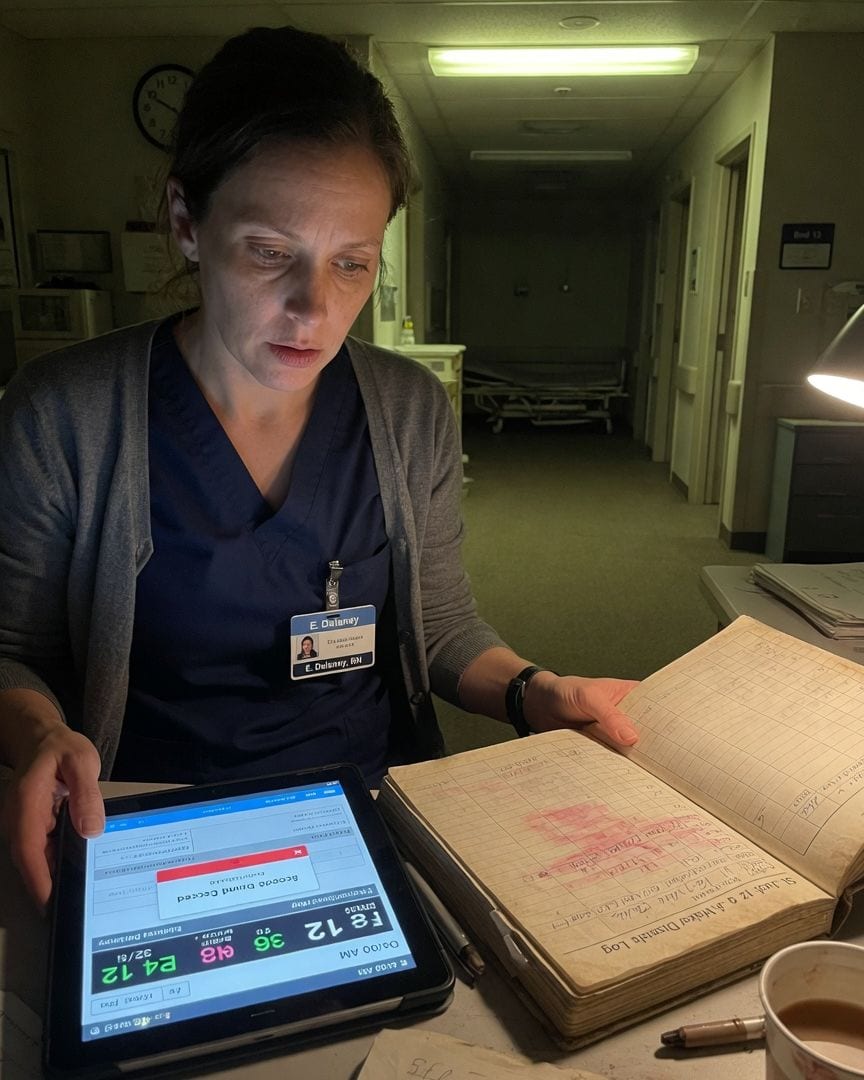
My empty ward's bed 12 had fresh vitals charted. The system says I entered them.
Working my usual night shift at St. Jude's, I pulled up the monitor system to log patient vitals for Ward 12. My thumb paused at Bed 12, where a full set of readings was already timestamped and logged under *my* ID. But Bed 12 was utterly stripped and empty; it had been discharged days ago.
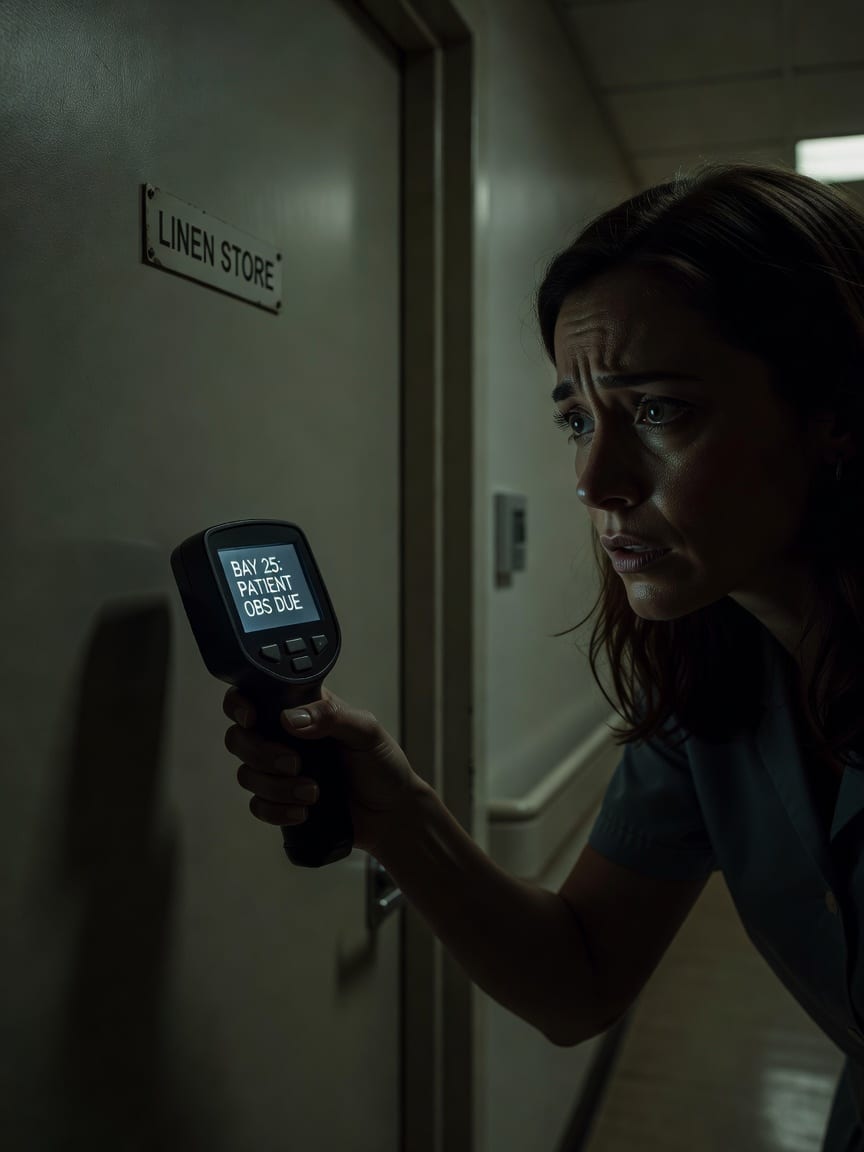
My hospital scanner demands patient care in Bay 25. Bay 25 is a locked linen closet.
I'm a pragmatic nurse, used to my hospital's quiet night shifts. But for a fortnight, my scanner has logged phantom patients in 'Bay 25' — a room that's just a linen closet. Then, tucked away, I found an old patient ID bracelet, faded but clear: 'Bay 25.'
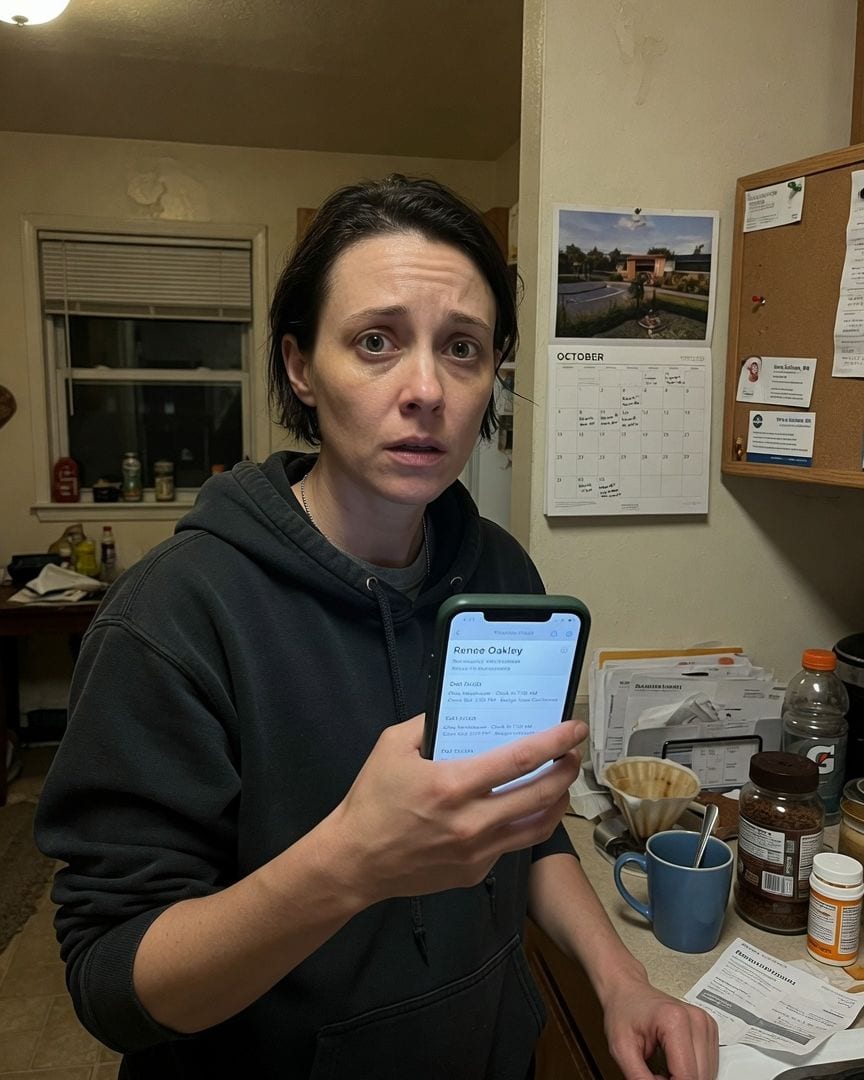
My company clock-in system says I worked full shifts in Ohio all last week. I was on medical leave in Florida, under a nurse's care.
Back home from medical leave, my payroll deposit was unexpectedly high. I checked my timesheet, only to find it logged me working full 40-hour shifts at the Ohio warehouse. But I was hundreds of miles away in Florida, confined to a sickbed under a nurse's care. Then my manager called: security footage confirmed I entered the warehouse.
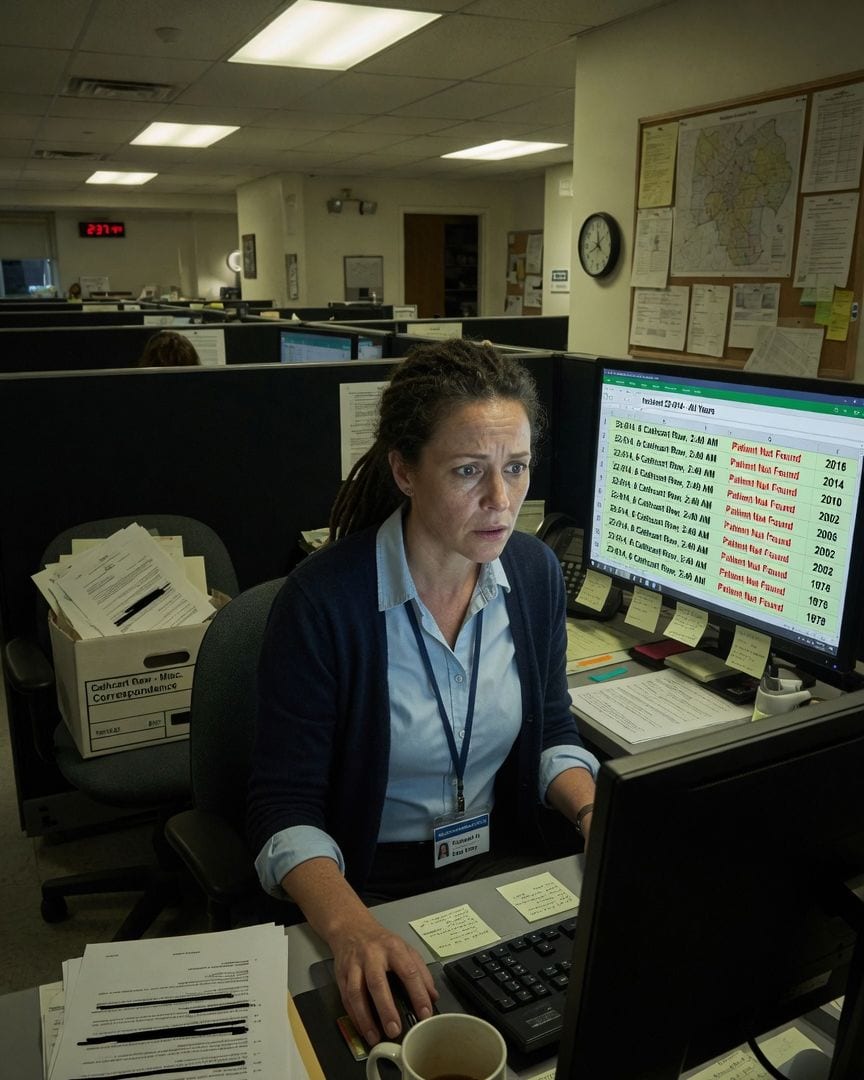
My computer log shows the same 2:40 AM call to Cathcart Row, every four years since 1978, always closed 'patient not found'.
Working data entry for the County Ambulance Trust, I found a routine incident logged as 'Patient Not Found.' But digging deeper, I discovered the exact same phantom call had repeated every four years for over forty years, always at the same address, always at 2:40 AM. Then I found a heavily redacted memo linking it to my own street.
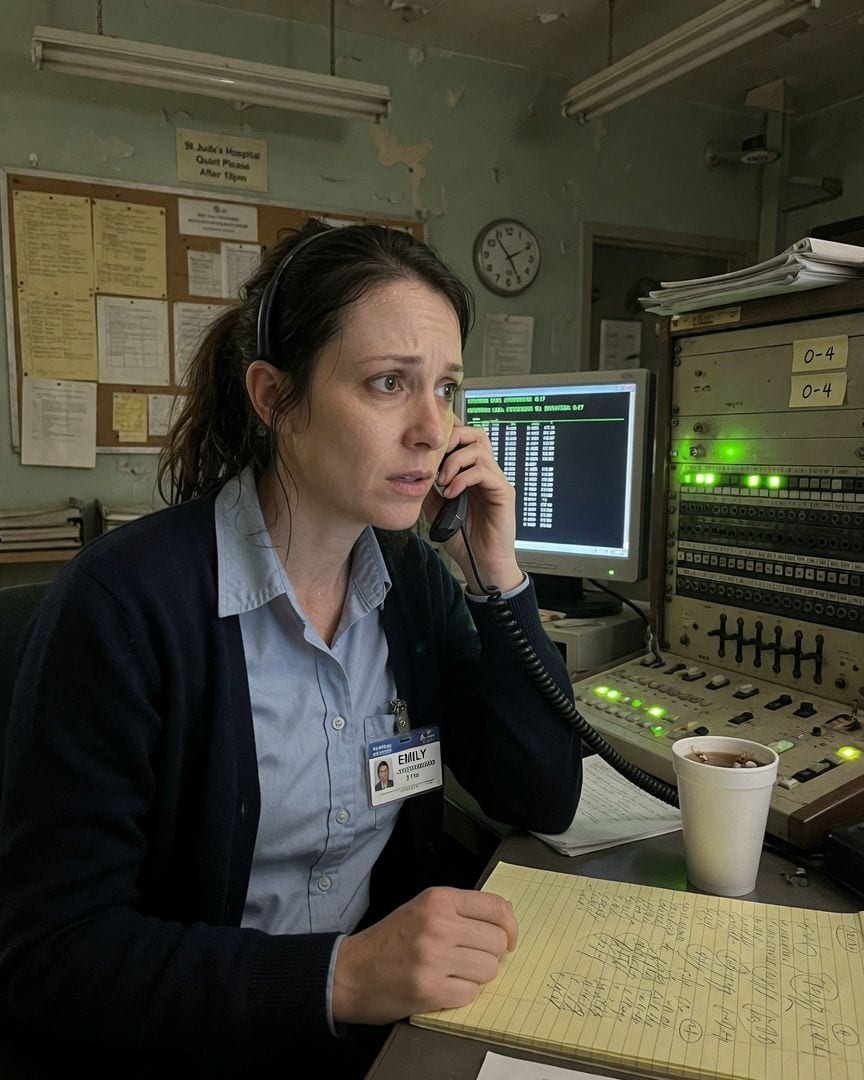
A nurse's voice asks me to page Dr. Reyes to the third floor. My hospital's third floor was demolished years ago, and extension 0-4 with it.
Working the quiet overnight shift at St. Jude's, I was used to predictable clicks. But just after 4 AM, my switchboard lit up: a call from extension 0-4. That extension was decommissioned decades ago, tied to a floor that no longer exists, yet the light pulsed insistently.
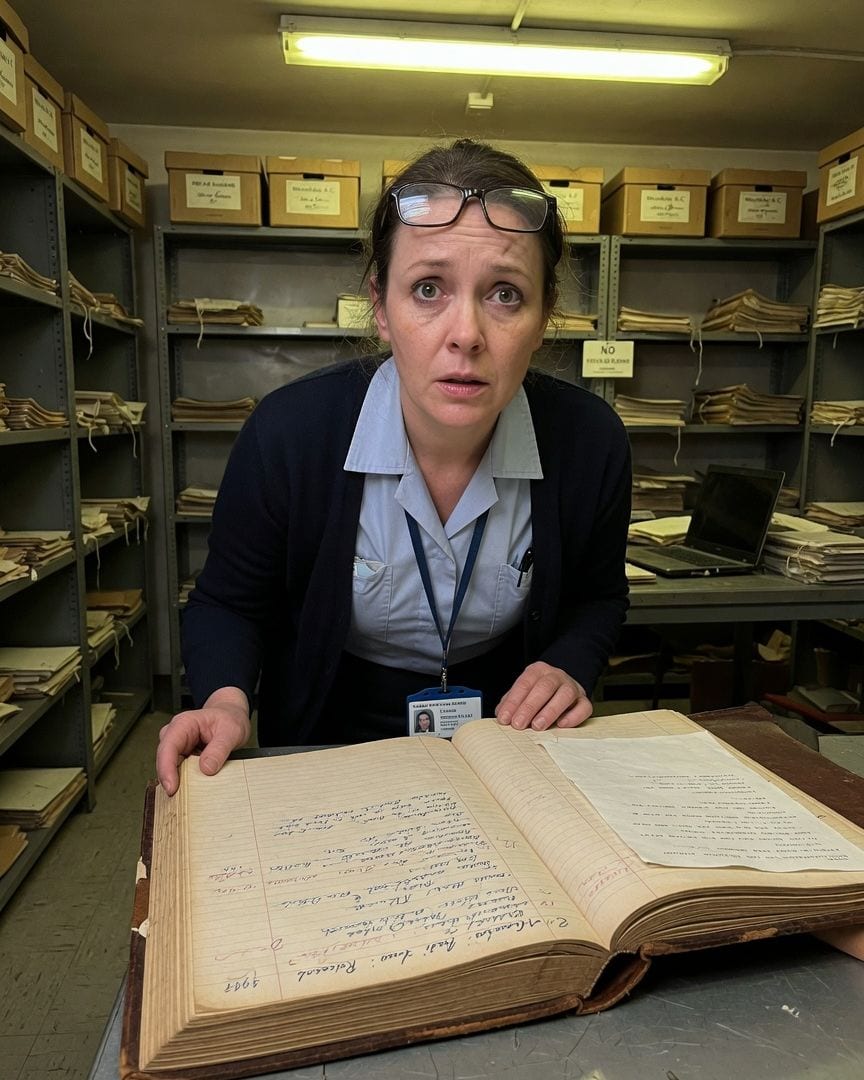
My ambulance trust's incident log shows callout 22-014 to 6 Cathcart Row at 2:40 AM. Every four years, the same call, same address. Always 'patient not found'.
My job involves tedious data entry for ambulance calls, but Incident 22-014 was different. It appeared every four years, always at 2:40 AM, always closed as 'patient not found.' Digging into the dusty physical archives, I found an entry from 1961 for the exact same incident, but its resolution read: 'Subject Secured. Relocated to "Holding".'