My hospital scanner demands patient care in Bay 25. Bay 25 is a locked linen closet.
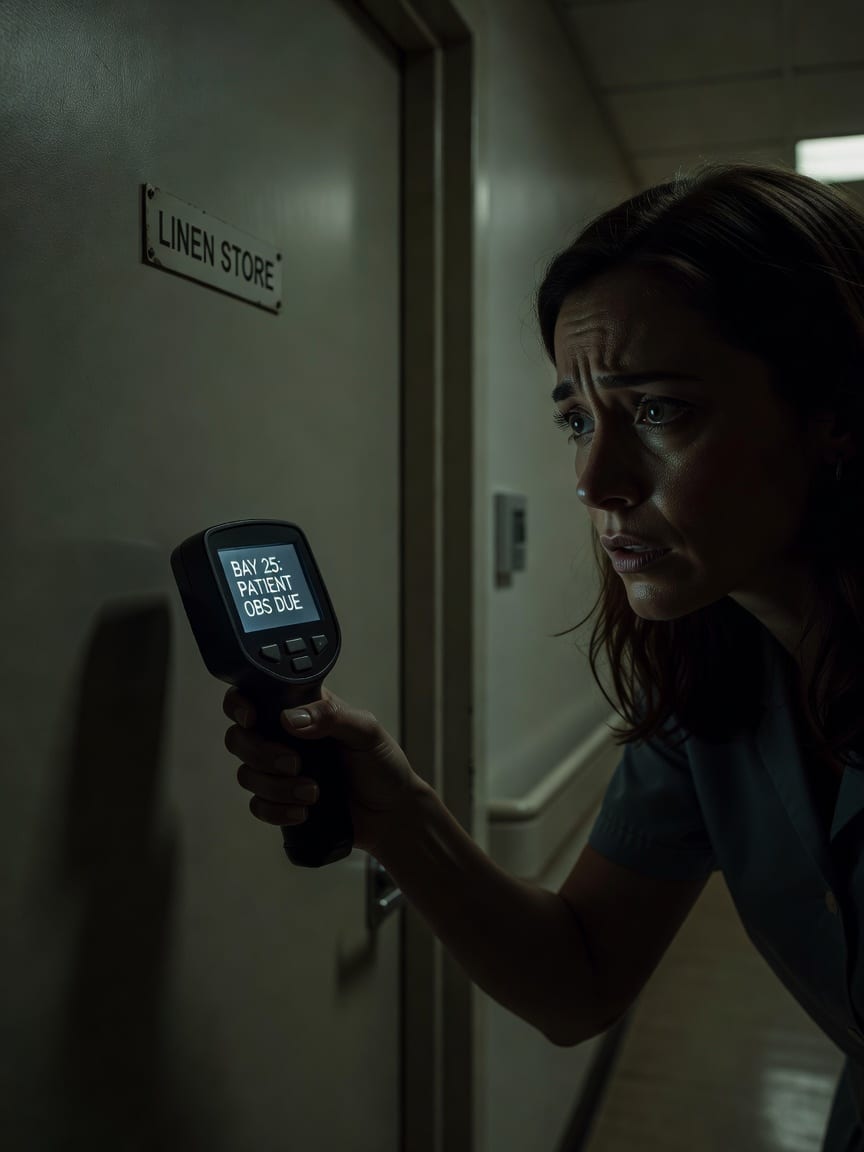
The ward was quiet, just the hum of machines and the shuffle of my shoes on linoleum. My scanner, a standard hospital handset, felt heavy in my hand, its cold plastic casing familiar against my palm.
I was on my usual 3 AM drug round, a rhythm I knew in my bones, scanning door plates, Bay 1 to 24. For a fortnight now, the routine had been broken.
Every night, without fail, after I’d scanned Bay 24, the handset would ping: 'Bay 25. Patient: Smith, A. Observations due.' I’d double-check the screen, the green text glowing faintly in the dim hallway, then look up.
Bay 25 wasn't a bay. It was the linen store, a cramped cupboard barely big enough for a trolley, tucked between the staff break room and the fire exit.
No patient, no bed, just stacks of fresh towels and sheets, neatly folded. I’d walked past it a thousand times in my five years here. It was a utility closet.
But the scanner, an official hospital device, logged a timestamped entry, every single night, for a patient that didn't exist in a room that couldn't be.
My first thought was a glitch. I’m a nurse, pragmatic by nature. Devices malfunction. The following morning, I took the scanner straight to IT, explained the recurring phantom entry. They checked the software, ran diagnostics, even reset the system.
‘Should be fine now, Emily,’ the technician, Mark, said, handing it back. It wasn’t. That night, 3 AM rolled around, and after Bay 24, the screen blinked: 'Bay 25. Patient: Miller, B. Observations due.'
I tried swapping out the handset for a different one on the charge cart. Same thing. Another phantom patient in another phantom bay. I decided to measure.
I found a tape measure in the supply closet and, after my shift, I paced the ward, meticulously. Twenty-four bays, each roughly the same size, each with its patient.
I checked the official ward floor plans, laminated and tacked to the ward office wall. They confirmed it: 24 bays. No Bay 25.
The linen store was clearly marked, a tiny square, not a patient room, far too small even for a cot.
I even checked the old paper archives, hoping for a historical Bay 25 that had been converted into the linen store at some point, but found nothing. The numbers refused to add up.
The physical reality of the ward and the scanner’s digital insistences were completely at odds. I measured the distance from Bay 24 to the linen store, then from the linen store to the fire exit. Consistent. Unchanging.
Yet, the scanner insisted. I started leaving small, innocuous markers – a piece of tape on the linen store door, a folded note inside – checking them each morning.
They were always undisturbed, the linen store always just the linen store. But the logs persisted, a phantom entry in a solid, unchanging world, an impossible digital ghost.
One morning, after another 'Bay 25' log had been added to the system, I pushed open the linen store door. The usual stacks of fresh towels, their clean scent doing little to calm my frayed nerves.
I felt a foolish urge to check again, for what, I didn't know.
As I reached for a fresh bundle, my fingers brushed something hard and plastic, tucked deep into a shelf at the back, almost hidden by a stack of surgical gowns.
It was a patient ID bracelet, old and faded, the kind we haven't used in years, with a snap clasp that had long since become brittle. My breath hitched.
The plastic was discolored, the ink smudged, but I could make out a name: 'Eileen Winslow.' And below it, in faded black print, 'Bay 25.'
I stared at the faded plastic band, the name 'Eileen Winslow' and 'Bay 25' still visible despite the grime. My heart pounded, a cold, hard knot in my chest, as I realized this isn't a glitch, but a ghost.
The ID bracelet for Eileen Winslow was impossible. The flimsy piece of plastic felt heavy in my hand, a tangible contradiction to every hospital record.
I spent my next few days off-shift, deep in the hospital’s physical archives, searching for any record of an 'Eileen Winslow' or a 'Bay 25' in patient admissions from decades past.
The archives were a labyrinth of dusty folders and microfiche, smelling of old paper and forgotten time. Nothing. The digital records, which only went back about twenty years, were equally blank. It was as if she had never existed.
I even tried a public records search for the name, but it was too common to yield anything definitive, just a sea of unrelated Eileens.
I pulled Marco Coleman, a nurse who’d been here longer than me – almost fifteen years – aside in the break room, trying to sound casual.
‘Marco,’ I said, as he poured himself a coffee from the stale pot, ‘have you ever heard of a Bay 25 on this ward? Or a patient named Eileen Winslow?’ He frowned, stirring sugar into his mug. ‘Bay 25?
No, just the linen store, you know that. And Eileen Winslow… doesn't ring a bell. Why?’ I made up a story about a trivia night, not wanting to sound completely unhinged. He shrugged, ‘Old building, lots of strange corners.
Pipes creak, floors settle. But nothing like an extra bay, not in my time anyway.’ His dismissal, his complete lack of recognition, only solidified my unease.
The physical evidence was right there, in my locker, a piece of plastic that defied all official histories.
I started taking photos of the ward at night with my phone, trying to capture any subtle shift, any misplaced shadow that might explain the phantom bay. The ward always looked the same: sterile, ordinary, unyielding in its geometry.
But the scanner kept pinging, and the bracelet felt heavy in my pocket, a silent, unsettling accusation.
My late-night 'investigations' didn't go unnoticed. A few days after speaking to Marco, I found a note on my locker, tucked neatly under my name tag.
It was a plain, white slip of paper, folded once, with neat, almost elegant handwriting: 'Some things are best left alone, Nurse Holloway.' No signature. My blood ran cold, a sudden, internal plummet.
I immediately suspected Donald Montgomery, the hospital administrator. He was an institution himself, a man in his sixties who had worked here for what felt like forever, quietly overseeing everything from his corner office.
He had a way of knowing things, a calm, unbothered presence that was almost unnerving. The next day, he stopped me in the corridor near the staff entrance, just as I was heading into my shift.
The air in the hallway seemed to cool, the usual bustle of people receding into a muffled drone. 'Nurse Holloway,' he said, his voice even, almost a whisper, yet it cut through the noise with impossible clarity.
'I understand you've been asking questions about the ward's layout, and perhaps some... historical patients.' My heart hammered, a frantic drum against my ribs. 'Just curiosity, Mr. Montgomery,' I managed, trying to keep my voice steady, to appear unaffected.
He smiled, a thin, almost imperceptible curve of his lips. It didn't reach his eyes. 'Curiosity can be a valuable trait, Emily. But sometimes, it can lead to places best undisturbed. This hospital has a long history.
Some of it, shall we say, is not for public consumption.' His gaze was steady, calm, and utterly devoid of menace, which only made it more terrifying.
He wasn't threatening me; he was simply stating a fact, like a doctor explaining a terminal diagnosis. The silence stretched between us, thick and heavy. He knew. He knew exactly what I was looking for, and he wasn't surprised.
The fluorescent lights overhead hummed, a low, constant thrum that suddenly sounded like a warning.
I decided to confront him directly. The calm certainty in his eyes was too much to ignore.
Later that day, after my shift, I marched into his office, the ID bracelet for Eileen Winslow and a printout of the 'Bay 25' scanner logs clutched in my hand.
His office was surprisingly ordinary, dominated by a large mahogany desk and a view of the hospital grounds. He looked up as I entered, no surprise on his face.
'Mr. Montgomery,' I began, my voice tight with a mixture of fear and outrage. 'I need to know what's going on. This scanner logs a patient in Bay 25 every night, a bay that doesn't exist. And I found this.'
I placed the faded, brittle bracelet on his desk, sliding it across the polished wood. He picked it up, his expression unreadable, turning it over in his fingers. 'Eileen Winslow,' he murmured, the name sounding foreign, ancient on his tongue.
'It's been a while since that name surfaced.' He didn't deny it. He didn't even feign surprise. The absence of a normal reaction was chilling. 'You're right, Emily. Bay 25, as a permanent structure, doesn't exist on any blueprints.
But it does... manifest.' My jaw dropped. 'Manifest?' He nodded slowly, his gaze still on the bracelet. 'This wing of the hospital, built on a particular parcel of land, experiences a unique architectural phenomenon. Call it a geometric anomaly.
Periodically, usually in the quiet hours of the early morning, the space around the linen store shifts. A small pocket of reality, if you will, opens up. Just enough for a bed, a patient. A Bay 25.'
He looked at me then, his eyes calm, clear, completely unfazed. 'The scanner, being part of the hospital's operational system, registers this temporary space. It logs a patient, because for a brief time, there is one.
Or, rather, there was one.' He set the bracelet back down, aligning it precisely with the edge of his desk blotter. 'Eileen Winslow was one such patient, many years ago. She was admitted for a routine procedure, and then...
she transferred.' The word 'transferred' hung in the air, cold and clean, a euphemism for something far more sinister, far more permanent. 'So, patients just... disappear into this phantom room?'
I asked, my voice barely a whisper, dread coiling in my stomach. 'Some do,' he confirmed, his voice still level. 'Yes.' The reality of it slammed into me, reframing every late-night scan, every empty linen store, every unexplained log.
It wasn't a glitch. It was real. And it was cyclical. The entire office, once ordinary, now felt like the center of an impossible, horrifying truth.
Donald Montgomery's calm admission had shaken me to my core. The hospital, this place of healing, harbored a hidden, predatory space. He had explained it with such chilling detachment, as if discussing a leaky faucet or a broken lightbulb.
'We've learned to live with it, Emily,' he'd said, his voice as smooth as polished stone. 'It's simply part of the building's character.' But the words 'Eileen Winslow' and 'transferred' still echoed, like a faint, mournful bell.
It couldn't be just a single, isolated incident, a one-off tragedy. His calm suggested a deeper, older knowledge, a practiced acceptance.
After our conversation, I felt a desperate need to find more, to prove that this wasn't some isolated, unfortunate incident, but a relentless pattern. I remembered his casual mention of the hospital's 'long history.'
I knew there was a forgotten sub-basement, full of old records and dusty administrative offices, rarely used, rumored to be haunted by a cold draft.
Driven by a grim certainty, a cold anger that burned away my fear, I found my way down there after my next shift, navigating the labyrinthine corridors with a flashlight, its beam cutting through the oppressive gloom.
The air grew colder with every step, heavy with the scent of damp concrete and forgotten paper.
In a small, disused office, buried beneath stacks of ancient payroll slips and medical equipment manuals from the 1970s, I found it: a thick, leather-bound logbook, its cover worn smooth, not a digital record, but a physical one, heavy in my hands.
Its spine was hand-lettered in faded gold: 'WARD A-7 ANOMALIES.' I opened it, my fingers trembling, and the first entry I saw was dated 1963.
Emily’s fingers trace the faded ink on the page: 'Patient S. Foster, transferred to Bay 25, 1983.' Below it, dozens more entries, names and dates stretching back decades, each a chilling echo of the same impossible event.
She looks up, the dust motes dancing in the single shaft of light from her flashlight, and the quiet calm that has permeated Donald Montgomery’s office now feels like the hush of a tomb.
The next day, the logbook heavy in my arms, I returned to Donald Montgomery's office. This time, there was no gentle warning, no quiet observation.
I slammed the thick book onto his desk, the sound echoing unnaturally in the plush room. 'You didn't tell me it was this many,' I said, my voice tight with suppressed fury, a raw edge I hadn't known I possessed.
'You didn't tell me it was a cycle.' He merely picked up the logbook, his fingers tracing the worn leather. He leafed through the pages calmly, his gaze gliding over the handwritten entries, an almost nostalgic expression on his face.
'It's a comprehensive record, isn't it? My grandfather started it. And his father before him.' He looked at me, his eyes devoid of judgment, only a deep, weary understanding. 'The geometry of this particular site has always been... fluid.
The hospital was built upon it, perhaps unwisely. Every so often, the latent anomaly activates. A temporary dimensional pocket, a spatial ripple. We call it Bay 25. It manifests, takes a patient, and then dissipates, only to return.
It's like a tide. We monitor it. We've tried to understand it, to prevent it. But it's beyond our control.'
He explained how the scanner's system was built to accommodate the ward's inherent spatial inconsistencies, which is why it always logged Bay 25, even when it wasn't physically present.
The patient ID bracelets, the names in the logbook – they were all real, all victims of this recurring architectural hunger.
'Eileen Winslow was one of the first I personally remember, when I was a boy,' he said, his gaze distant, fixed on a point beyond the wall. 'It's an unfortunate, but consistent, aspect of this facility. The hospital simply... continues.'
Every piece clicked into place: the scanner's impossible logs, the phantom bracelet, the unyielding plans, the spatial discrepancies, the hidden archive. It all fit. And the coherence was the most terrifying part, binding me in its terrible logic.
I felt a cold dread settle deep in my bones, heavier than the logbook itself. 'So, you just... let it happen?' I asked, the words tasting like ash in my mouth. 'You keep a ledger of people who disappear?'
Donald Montgomery closed the logbook gently, the soft thud a final period on a chilling statement. 'We manage it, Emily. We ensure that patients are not left unattended in the linen store, for example. We've learned the patterns, the indicators.
But the anomaly itself, the underlying geometry, is fundamental to this place. You cannot fight the foundation of a building.'
He rose from his desk, walking to the window, looking out over the quiet hospital grounds, bathed in the pale morning light. 'You now know, Emily. You carry this knowledge. It changes things, doesn't it?'
He wasn't accusing me, but stating a fact, a simple, irrefutable truth. The calm in his voice was horrifying. He wasn't a monster, just a custodian of an unimaginable, unchangeable horror. He had accepted it. And now, I had to.
The implication was clear: I was part of the cycle now too, not as a victim, but as one who knew, one who would continue the work of monitoring, of managing, of silently accepting.
The terror wasn't in a jump scare or a violent threat, but in the quiet, crushing weight of an immutable truth. There was no escape from the knowledge, no way to unsee the pattern.
The hospital would continue its work, and Bay 25 would continue to manifest, and patients would continue to 'transfer.'
And I, Emily Holloway, would be there, making my rounds, knowing exactly what the 3 AM ping truly meant, every single time.
Donald Montgomery offered no further explanation, no apology. He simply returned to his work, the logbook now openly on his desk, a regular fixture amongst his paperwork.
I left his office, the chill of the sub-basement still clinging to me, an invisible shroud. The ward lights seemed harsher, the quiet hum of machines more sinister, each beep and whir an unnerving whisper. My shifts continued.
I still scanned the bays, administered medication, spoke to patients, offered comfort. But every movement, every sound, every shadow held a new, chilling implication.
I saw the linen store not as a benign cupboard, but as a dormant mouth, waiting for its appointed time. My colleagues noticed nothing, wrapped in their mundane routines, unaware of the architectural horror that underpinned their daily lives.
Marco Coleman still joked about the strange noises from the old pipes, attributing them to age and drafts. I just smiled, a quiet, knowing smile that didn't reach my eyes, a secret held tight.
The hospital continued, oblivious to its own dark truth, or perhaps, perfectly at peace with it.
I still worked the night shift, still scanned the bays. Sometimes, at 3 AM, the handset would ping, its green text glowing, and I'd glance at the screen, then at the linen store door, and just keep walking. I knew.
I knew what the system was logging, what the hospital was acknowledging. It wasn't a glitch, not anymore. It was a cycle, an immutable fact of this place, as constant as the rising sun or the turning of the tides.
The world had not ended. The hospital had not been shut down. Nothing had changed, except for me. The knowledge was a permanent fixture, an extra bay in my own mind, always present, always demanding attention, always waiting.
The calm acceptance I'd seen in Donald Montgomery now felt like a heavy cloak, settling over my own shoulders, insulating me from the shock, binding me to the truth. I was part of it now, a witness to the unchangeable.
The dread wasn't in what might happen, but in what always would.
Later that week, the ward log showed Bay 25, scanned and timestamped, its patient's observations due, just as it always had.
If this one got to you
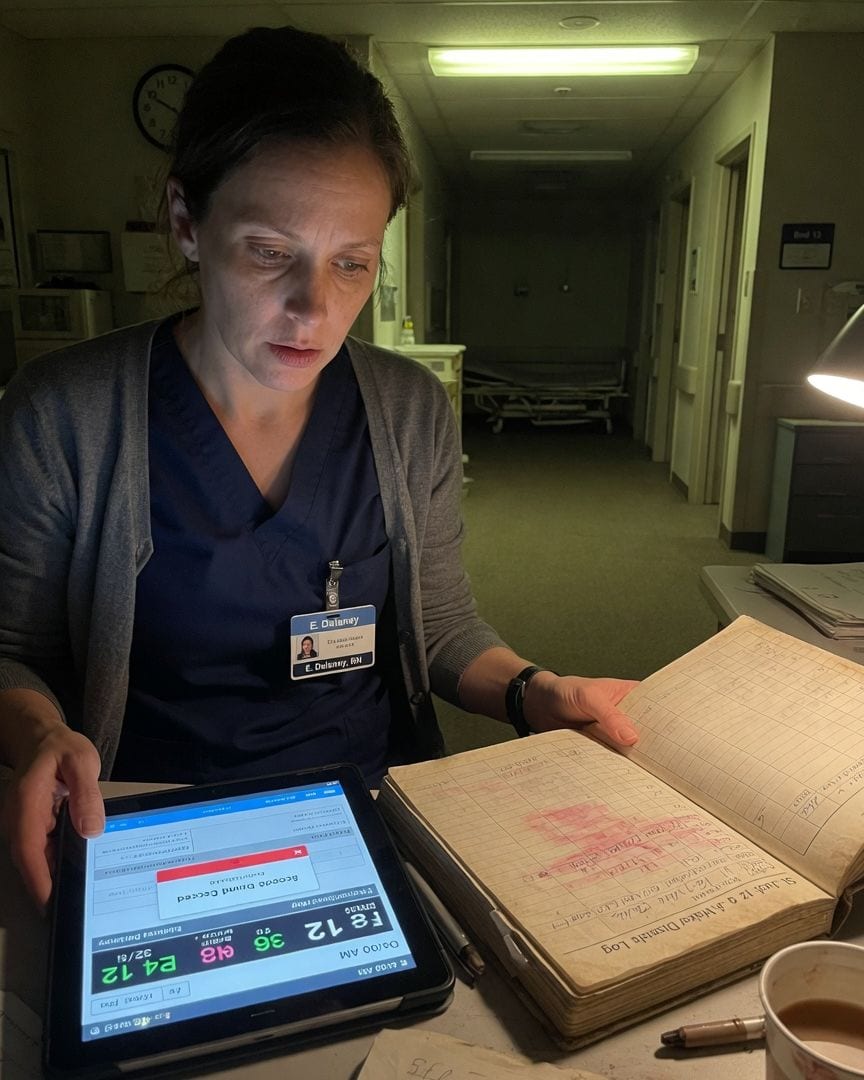
My empty ward's bed 12 had fresh vitals charted. The system says I entered them.
Working my usual night shift at St. Jude's, I pulled up the monitor system to log patient vitals for Ward 12. My thumb paused at Bed 12, where a full set of readings was already timestamped and logged under *my* ID. But Bed 12 was utterly stripped and empty; it had been discharged days ago.
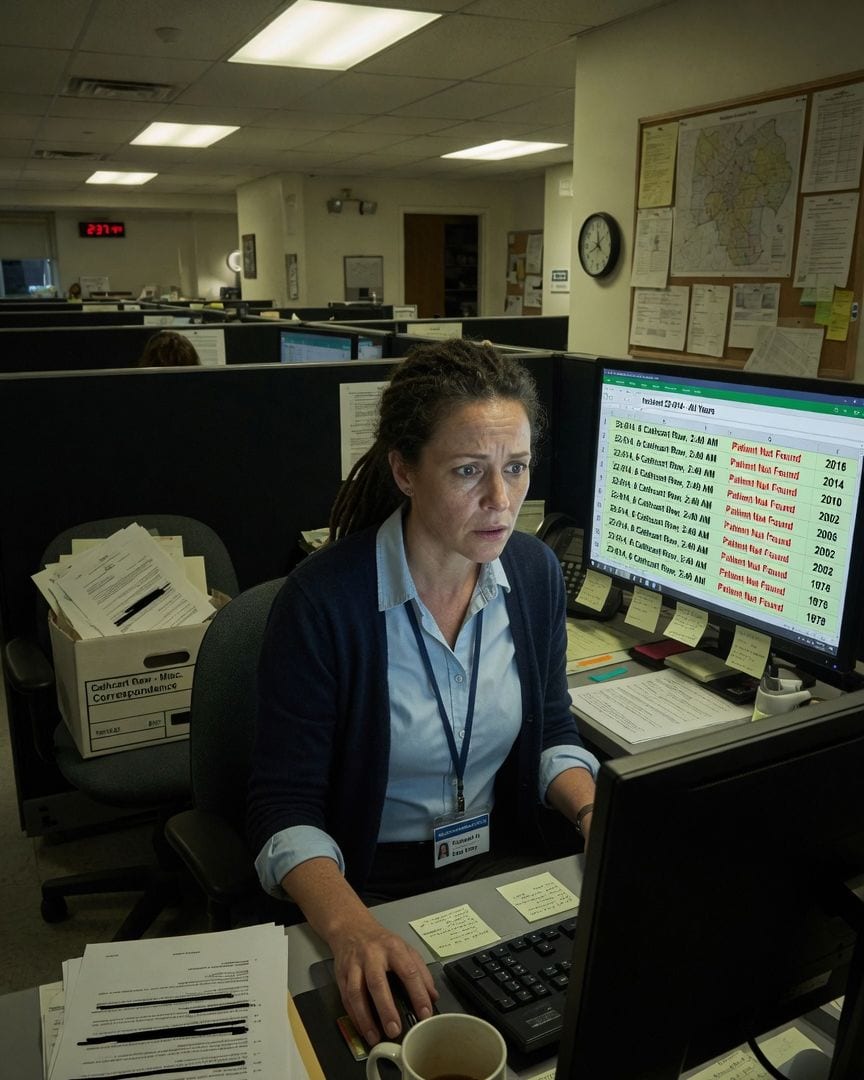
My computer log shows the same 2:40 AM call to Cathcart Row, every four years since 1978, always closed 'patient not found'.
Working data entry for the County Ambulance Trust, I found a routine incident logged as 'Patient Not Found.' But digging deeper, I discovered the exact same phantom call had repeated every four years for over forty years, always at the same address, always at 2:40 AM. Then I found a heavily redacted memo linking it to my own street.
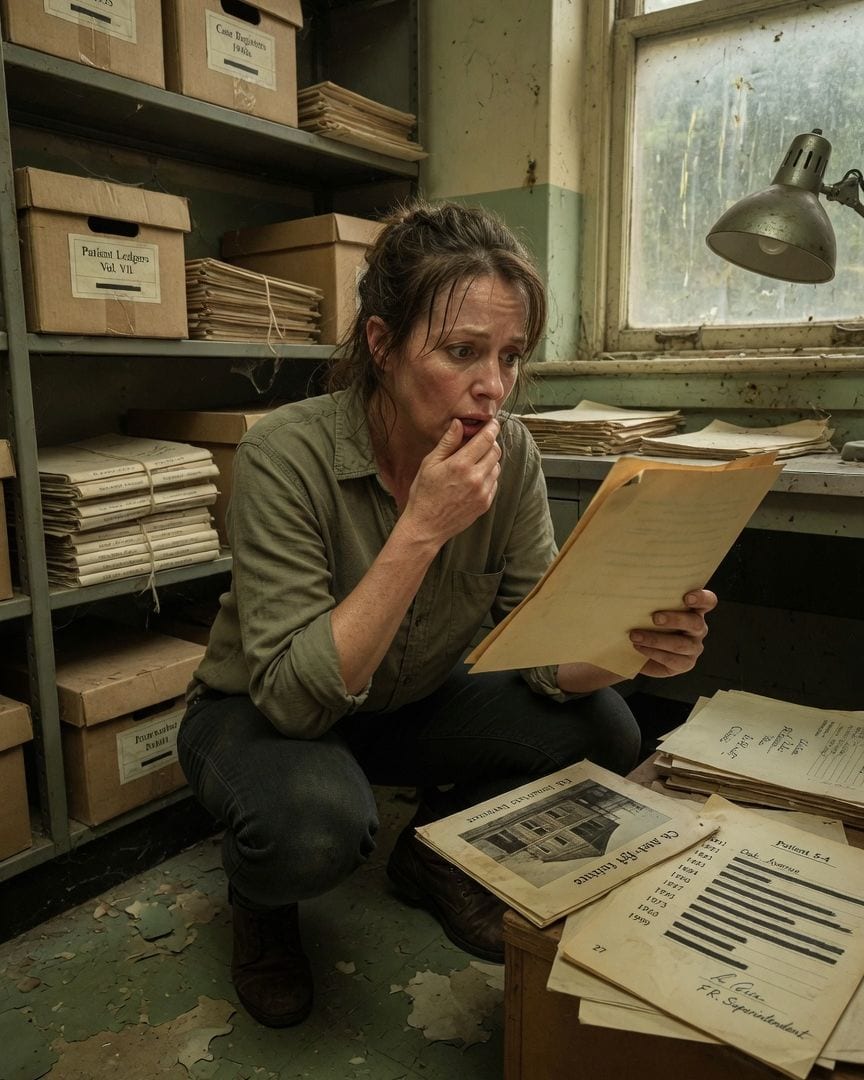
Patient 5-4 keeps checking into my aunt's old sanatorium chalet. The same initials sign them out, 'not traced,' every thirteen years since 1921.
Sifting through my aunt Margaret's estate, I found her old sanatorium file from 1999. Her patient record listed her as 'Patient 5-4,' discharged 'not traced.' But when I accessed the archives, I found 'Patient 5-4' was admitted every thirteen years since 1921, always with identical discharge notes.
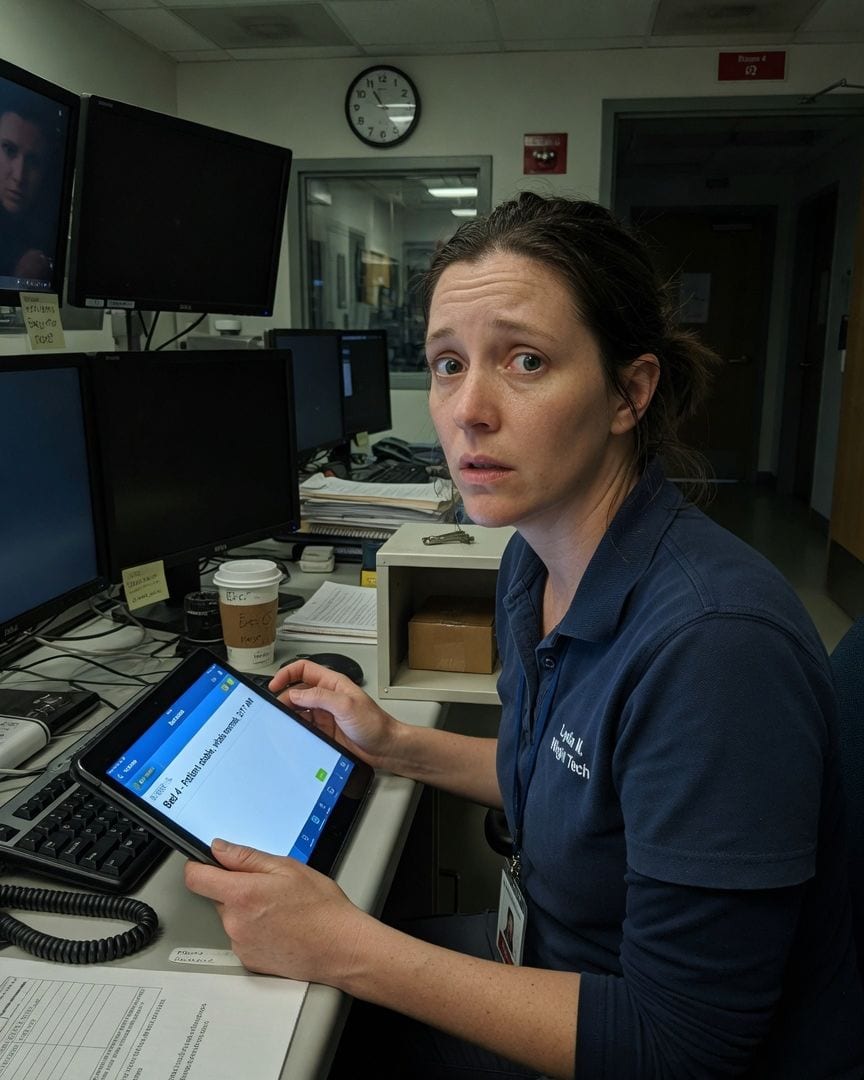
My sleep clinic's Bed 4 patient waves and asks about the humming — but the bed's empty, and its intercom was disconnected.
It was 3 AM, and the sleep clinic should have been empty, especially Bed 4, which was officially offline for repair. But for the third night in a row, a patient in Bed 4 was waving at me, their voice asking about a humming sound through a disconnected intercom.
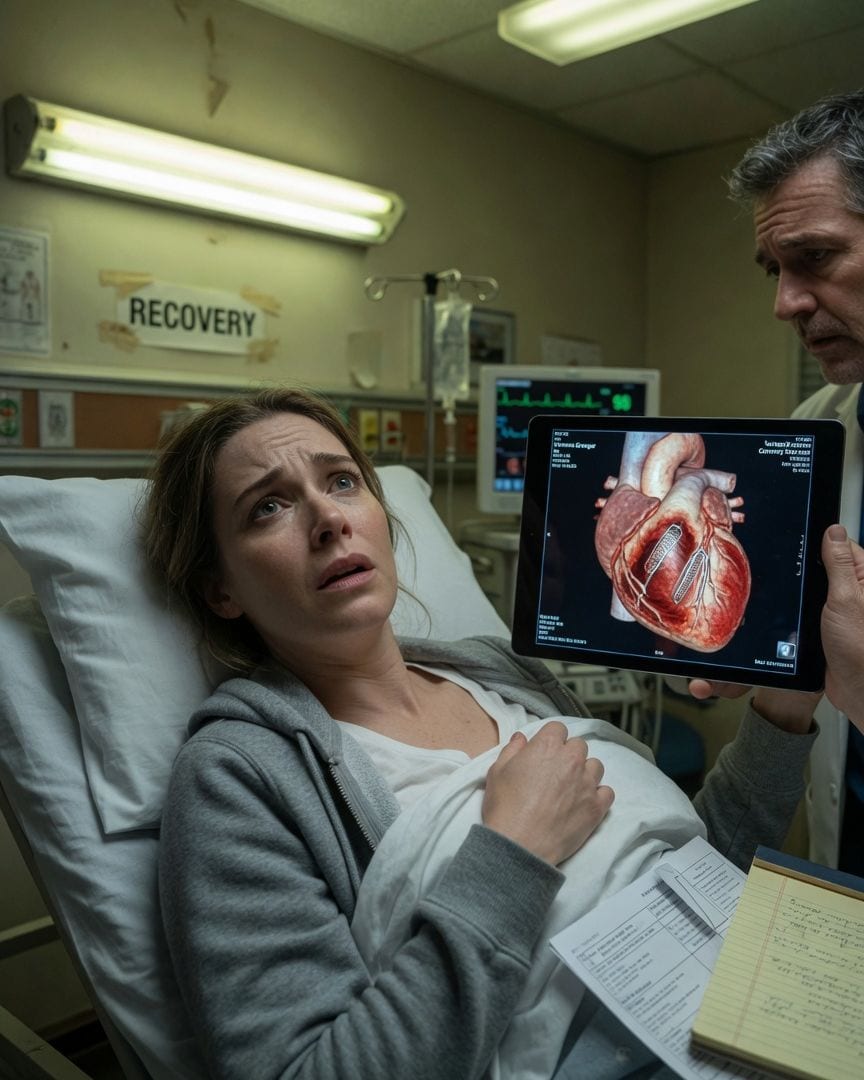
Metal stents are propping open my heart. The doctor rotated the image, but I've never had a cardiac procedure.
After years of dismissed chest pain, a CT scan revealed an impossible truth: my heart contained two metal stents. Dr. Maddox confirmed there was no record of any cardiac procedure in my entire medical history, and I had no memory of ever having surgery. My own body held a secret, alien architecture I couldn't explain.
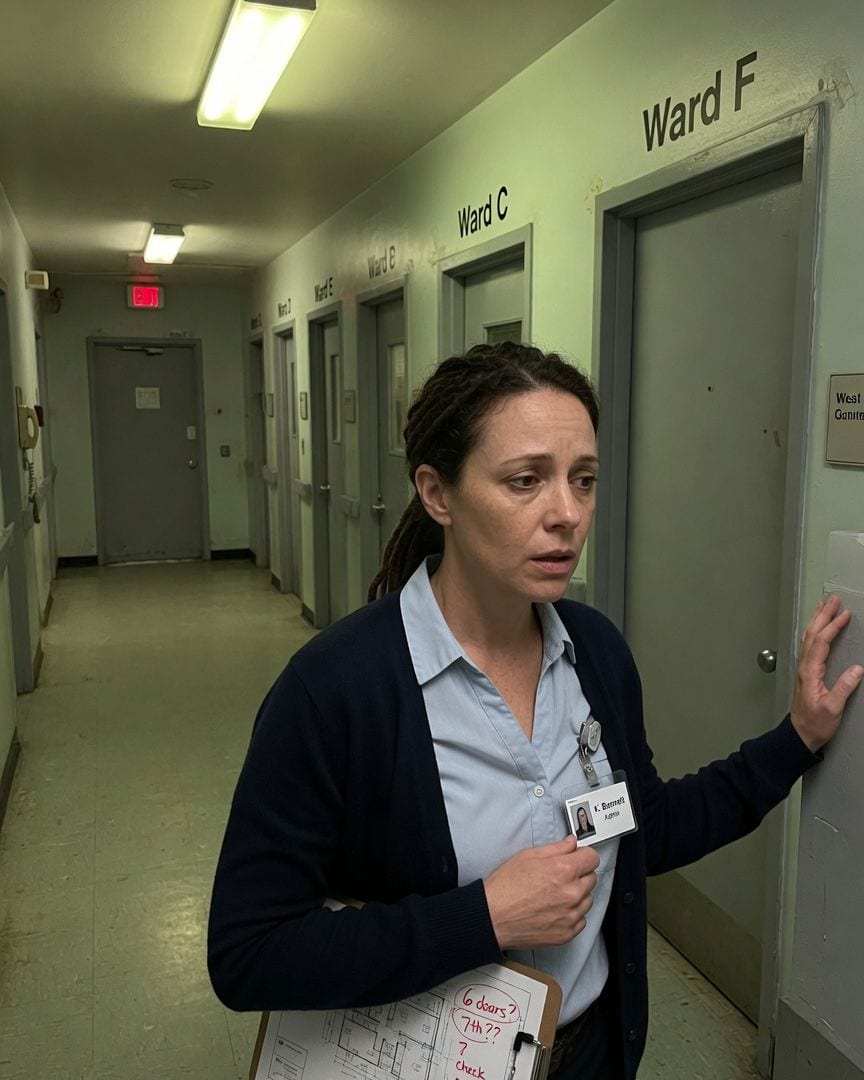
My hospital corridor has six doors, then seven, then six again.
As a hospital administrator, my job is to fix anomalies. But when I tried to verify a night nurse's rounds by counting the West Wing's doors, the corridor itself began to shift. One moment there were six doors, the next there were seven, then six again, refusing to stay consistent.