An Ohio insurance agent’s military record showed a commendation from a secret Nevada base, dated the same day he took his family to the county fair.
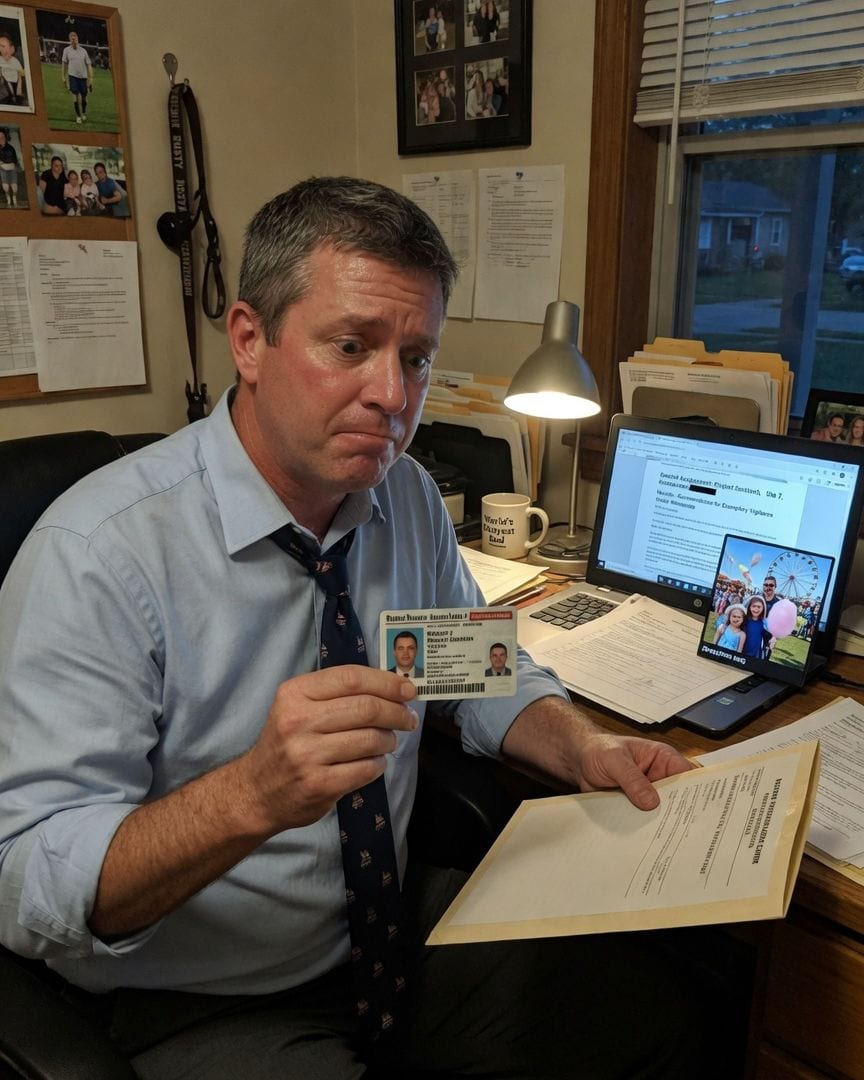
Eight years out of uniform, Robert Halloran sat at his Ohio insurance desk, pushing papers for policies he barely understood.
His life was a neat, civilian ledger: a mortgage, two kids who’d never seen him in greens, a mutt named Rusty. Then the letter arrived from a records center in Missouri.
It congratulated him on twenty years of continuous service and set his retirement ceremony for a date three weeks out. The enclosed history showed no break, postings, promotions, and signatures filling every year he’d spent selling policies.
His retired ID card was already printed, folded into the envelope. The letter asked only that he verify the photo. Halloran pulled the card out.
It was a picture of him, taken recently, in his current civilian clothes, looking back with a faint, uneasy smile he didn't remember giving.
Halloran’s stomach tightened. He found his actual discharge papers, yellowed and crisp, confirming his twelve years of service, ending eight years ago. They contradicted every line of the new document.
He called the number on the letter, reaching Renee Mitchell at the Missouri records center. Her voice was politely unhelpful, a rehearsed script about system updates and automated processing. "Mr. Halloran, the system shows continuous service.
Your records are quite clear." He tried to explain his civilian life, his family, the insurance business. He spoke of his wife, Josephine, of their children, of the house payments and school runs.
She listened with professional detachment, then repeated, "The records are clear, sir. You've been fully accounted for." The conversation ended with a click, the phone cool in his clammy hand, leaving a buzzing silence in his ear.
He dug through old boxes in the garage, finding photos of him at company picnics, coaching his son's soccer team, all dated within the 'active service' years documented on the new form.
The evidence of his civilian life was overwhelming, yet the letter, the ID, and now Renee Mitchell’s calm certainty, contradicted it all. A strange anxiety settled over him, the feeling of two parallel lives fighting for the same space.
He began to cross-reference his past, noting every major life event against the official military timeline, searching for a gap, a mistake, anything to explain the impossible document. But the gaps were never there, only his own lived reality.
Driven by a cold dread, Halloran used an old contact to pull his full, classified military service record. The digital file loaded slowly on his screen, a dense scroll of data. He found the expected entries, his deployments, his commendations.
Then, buried deep, a section labeled 'Special Assignment: Project Sentinel, Site 7, Nevada.'
The dates were impossible: a two-year posting to a decommissioned signals intelligence station, exactly when he’d been closing a major insurance deal and his daughter had been born.
His desktop tower hummed, an almost imperceptible vibration that seemed to echo the wrongness on the screen. There was even a recent commendation, dated last month, for 'exemplary vigilance' at Site 7, signed by a General he didn't know.
He held up his phone, a picture of Josephine and the kids at the county fair, taken on the exact same date, open on its screen. The desolate desert station, his name, the commendation. The fair, his family, his life.
Two realities, one undeniable, staring back at him.
Halloran tried to research Site 7. Online, it was a ghost. Decommissioned decades ago, a a forgotten dot on a map of desolate Nevada desert. No current personnel, no active operations, just sand and silence.
He called the number listed for the General who'd signed his commendation; it routed to a dead line, a prerecorded message repeating a number no longer in service.
The mundane explanations—a clerical error, a shared name, a bureaucratic mix-up—shattered against the specific, undeniable details of his own record. There was no other Robert Halloran with his service number, his birth date.
Desperate, Halloran reached out to Simon Easton, a retired military investigator he'd known vaguely from his active duty days. Easton, a man who’d chased shadows for a living, listened with a quiet intensity, asking short, precise questions.
Halloran forwarded the records, the ID card, the photos. Days later, Easton called back, his voice low, gravelly. "Robert, I've seen these before. Not often, but enough to know they’re not mistakes."
Easton explained that the signature on the commendation belonged to a General who had died thirty years prior. A cold knot formed in Halloran's gut.
He also found other, similar anomalies in a restricted archive: a handful of 'continuous service' records for individuals officially discharged but later 'retired' with unbroken timelines. "They’re always tied to facilities like Site 7," Easton said.
"Places that officially don't exist anymore, or are so remote, nobody checks. The records are pristine, but the reality is… empty." The unease deepened, becoming specific. This wasn't just about Halloran; it was a pattern.
As Easton dug deeper, Halloran felt a chill settle over his life. Small things. His office computer, usually sluggish, would sometimes show a brief, garbled string of code on startup, too fast to read, before defaulting to his usual desktop.
His home security system, which logged every door and window opening, occasionally registered an 'internal system check' at odd hours when everyone was asleep, with no corresponding activity, no one entering or leaving.
The house felt colder some nights, a subtle draft clinging to the corners of rooms even with the windows sealed.
One evening, a delivery driver, a young man Halloran didn't recognize, handed him a package he hadn't ordered, a plain brown box addressed only with his surname.
"Signature for Halloran," the driver said, his eyes lingering for a beat too long before he turned to leave. The package contained nothing but packing peanuts. Easton warned him. "They know you're looking, Robert.
These records, this system… it doesn't like being examined." He described veiled threats, dead ends, and sudden transfers that had plagued previous investigators of similar cases. "They won’t confront you directly. They’ll make you question yourself, your sanity.
Make you think it’s fatigue, or stress." Halloran tried to dismiss it, to attribute it to paranoia, but the subtle shifts in his world felt too precise, too deliberate. The dread became personal.
He was no longer just investigating; he was being observed, his every move noted. The feeling of being 'accounted for' in his records now translated to a palpable presence in his daily life.
Easton arranged a clandestine meeting in a quiet diner on the outskirts of St. Louis, far from Halloran’s neighborhood. The fluorescent lights hummed with a low, insistent buzz above them.
He laid out a series of printouts on the scarred Formica table. "This is where it gets worse, Robert," Easton said, his voice barely a whisper, as if the diner's mundane sounds could still betray them. "I found others.
Not many, but enough to establish a pattern." He showed Halloran three more service records, spanning the last five decades.
Each detailed an individual officially discharged, then 'retired' with a continuous service record, including phantom postings to sites like Site 7. "The dates, Robert. Look at the dates," Easton pointed, tapping a page with a blunt finger. "They’re cyclical.
Every seven years, a new batch. Always the same type of facility, always the same type of commendation."
Halloran saw it: the same two-year 'Special Assignment' period, recurring like a dark echo across the decades, always coinciding with periods of documented civilian life for the individuals. His mind raced, connecting the impossible dots.
"It’s an accountability that cannot be," Easton explained, leaning closer. "The system says they’re there, performing duty, earning commendations. But physically… they’re gone. Or they never were there in the first place, not in the way we understand it."
He described how families of these individuals would sometimes report a strange shift after their 'retirement ceremony,' a quiet withdrawal, a subtle change in personality.
The earlier clues clicked into place: the current photo on his ID, the impossible posting, the unshakeable certainty of Renee Mitchell. It wasn't a glitch; it was a deliberate, repeating mechanism, a clockwork horror.
"There’s an old archivist," Easton said, pushing a folded napkin with a name and address across the table. "Hugo Novak. He knows more. He tried to blow the whistle, decades ago. They buried him, but not before he copied everything."
Halloran drove straight through the night, the highway a dark, endless ribbon, to the address Easton provided: a small, dilapidated house in a forgotten corner of rural Missouri, just miles from the records center.
Hugo Novak, a gaunt man with a precise, almost surgical gaze, opened the door. His living room was a labyrinth of stacked boxes, yellowed files, and microfiche readers.
The air inside was thick with the scent of old paper and dust. Novak didn't offer a greeting, merely gestured Halloran inside. He had clearly been expecting him. "They’re here for you, aren't they?"
Novak asked, his voice raspy, dry as the desert air. Halloran nodded, unable to speak, his throat tight. Novak moved to a locked cabinet against the far wall, its metal groaning faintly as he opened it.
He retrieved a thick, canvas-bound binder. He placed it on a dusty table, its weight thudding softly, a sound that seemed to reverberate through the quiet house.
Its title, stamped in faded black ink, read: 'Project Sentinel: Continuous Service Mandate - FY1968-Present.' Beneath it, a crudely drawn, repeating symbol—a stylized eye within a clock face—was etched onto every page.
Halloran recognized it from a subtle watermark on his own 'retirement' ID card, a detail he hadn't consciously registered until this moment, now searing itself into his memory. Novak looked at him, his eyes holding a terrible, calm knowing.
"It’s been going on longer than you can imagine, son. And now… now you’re part of the rotation."
Novak opened the binder, its pages brittle with age, crackling softly like dry leaves. "Project Sentinel," he began, his voice a low monotone, "was initiated in the late sixties. A response to intelligence failures, a need for… unaccountable assets."
He explained that certain individuals, identified by specific psychological profiles and service records, were designated for a 'Continuous Service Mandate.' They were never truly discharged; their civilian lives were merely a 'dormant phase,' a period of unacknowledged service.
The records Halloran found weren't errors; they were the mechanism of the service itself, the proof of an invisible, unbroken chain. "The system doesn't need your body, not always," Novak said, tapping a page detailing 'remote operational accountability.'
"It needs your name, your identity, your legal existence, to fill a slot. And sometimes, when a 'rotation' comes due, it needs your presence, however briefly."
He showed Halloran entries detailing how 're-integration events' involved brief, unnoticed activations, sometimes through subtle psychological triggers or even brief physical interactions like having a 'current photo' taken without conscious awareness—a photo that might appear on an ID card years later.
The decommissioned sites like Site 7 were 'staging points' within the system, places where the records confirmed presence, making the 'accountability that cannot be' terrifyingly real.
The 'retirement ceremony' in three weeks wasn't an exit; it was the final, formal classification of an asset into a deeper, fully integrated phase of the Mandate, a point from which there was no return.
Every clue, every impossible detail, now clicked into place, forming a coherent, horrifying machine.
With Novak’s chilling explanation echoing in his mind, Halloran tried to fight. He pulled out his phone, his fingers fumbling.
He called his lawyer, his congressman, even tried to reach Josephine, but the calls wouldn’t connect, each attempt met with a flat, unwavering silence.
He found his phone’s GPS was disabled, a blank gray map where his location should have been, and his car’s ignition wouldn't turn over, the engine remaining stubbornly mute.
The system, once an abstract threat, had closed around him, a silent, suffocating presence. Novak watched him, a look of grim pity on his face. "They don't want you to escape, Robert. They want you to accept."
The three weeks until his ceremony melted away, each day a slow, inexorable countdown. On the appointed day, a plain black sedan arrived at Halloran’s house. Two men in crisp, dark suits, silent and unsmiling, emerged.
They didn't threaten, didn't coerce. They simply opened the back door of the car, a quiet, inviting gesture.
Halloran looked back at his house, at the life he had built, the children he wouldn't see grow up, Josephine, who stood framed in the doorway, a look of confused worry on her face. He felt a strange, detached calm.
This wasn't a choice; it was an inevitability. The system had simply reclaimed what it always considered its own. He stepped into the car, the door closing with a soft, final click.
The vehicle pulled away, leaving Josephine alone on the porch, a question forming on her lips that would never be answered by the man who just left.
Josephine Halloran reported Robert missing. The police investigation found nothing, no signs of foul play, no trace. His insurance company, after a few weeks, calmly processed his resignation, citing 'personal reasons.'
The mortgage payments continued, always on time, from an anonymous account. His children occasionally asked where Daddy went, but Josephine, her eyes now holding a distant, unfathomable sorrow, could only offer vague, empty reassurances.
Life went on, but a vital piece of it was gone, leaving a hollow space that no one could name. The records, however, remained perfect, unbroken.
Robert Halloran was, officially, retired with twenty years of continuous service, his existence perfectly accounted for.
Months later, Josephine was in the kitchen, preparing dinner. The doorbell rang. It was Robert. He looked the same, but different. His eyes, once full of a familiar warmth, now held a flat, unsettling clarity.
He spoke little, moved with a quiet efficiency, always seeming to listen to something she couldn't hear. One evening, she asked him about his new 'retirement.' He merely smiled, a faint, wrong little smile that didn’t reach his eyes.
She never asked again.
Josephine Halloran asked her husband one evening, 'Is that so?' and he answered her with a faint, wrong little smile.
If this one got to you
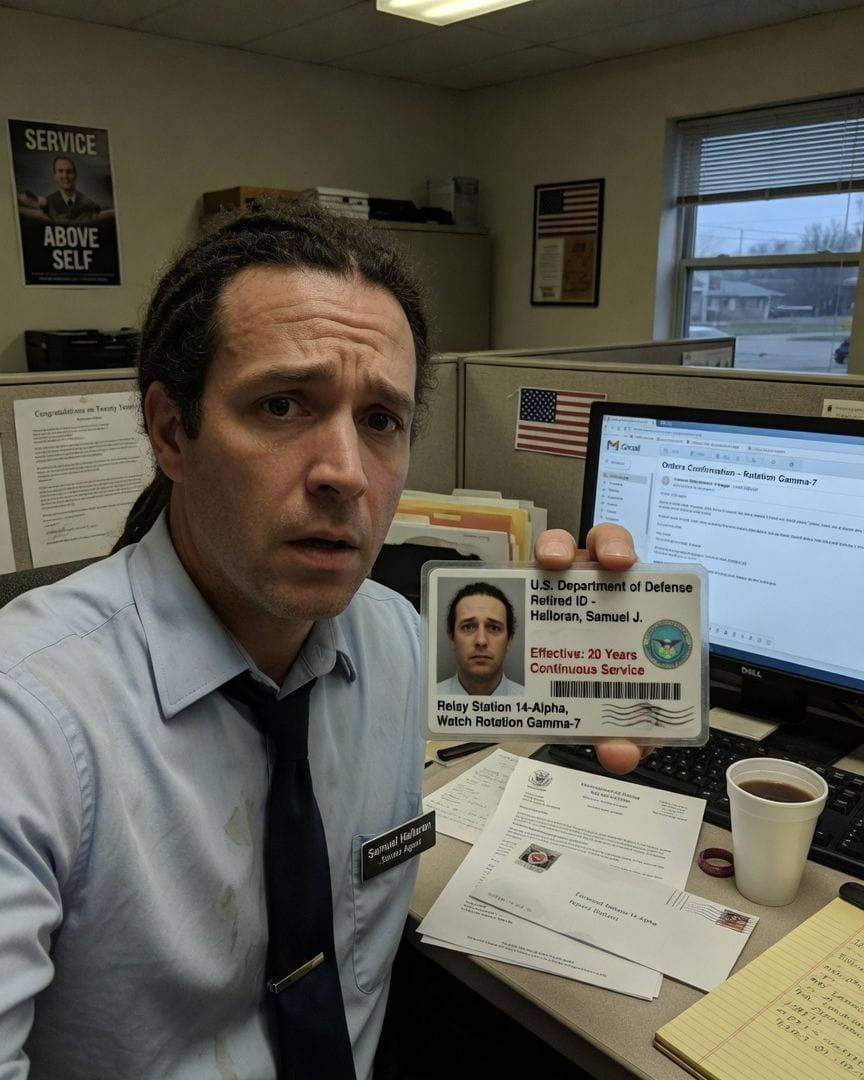
An Ohio insurance worker's new military ID shows his current face, but orders send him to a Cold War station abandoned for decades. An old photo there shows his face.
Samuel Halloran, an Ohio insurance worker, had built a quiet life eight years after leaving the military, with a mortgage and two kids, far from the uniform. The scent of stale coffee usually defined his suburban days, but a letter from a Missouri records center shattered his routine. It congratulated him on twenty years of continuous service, complete with a retirement ceremony and a new ID card bearing his current face, yet his own separation date was missing from the meticulously kept history. Then came specific orders for a forward relay station in the Ozarks, a desolate place decommissioned and abandoned since the 1980s. Scrolling through old archives, Halloran found a faded 1987 photo of a sentry guarding the derelict site, whose blurred face held an undeniable, chilling resemblance to his own.
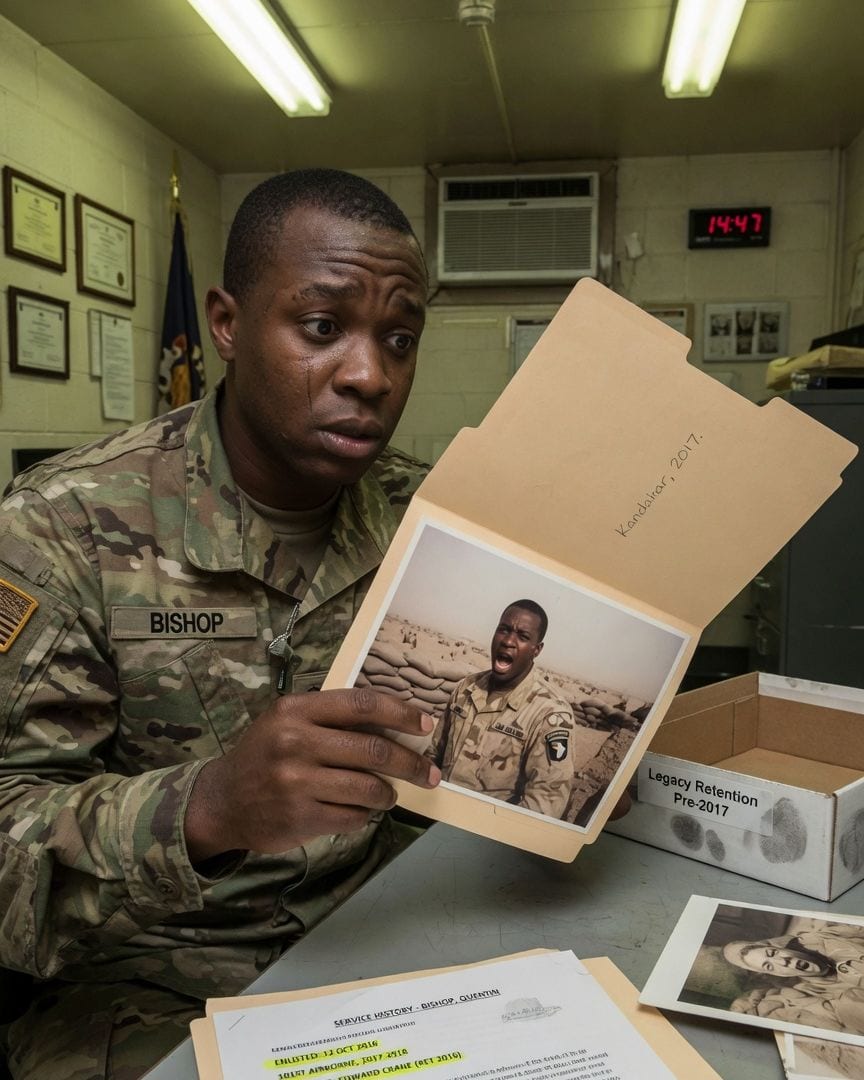
A specialist was signing for four more years, but his old file contained a photo of him in a desert uniform dated 2017, from a tour he never lived.
Specialist Quentin Bishop sat ready to re-enlist, looking forward to four more years of stability. But as he prepared to sign, his official record showed an enlistment date that made him seventeen years old, and a combat tour with a unit he’d never worn. Sergeant Marie Delaney dismissed it as a clerical error, but Bishop found a faded photograph of himself in a desert uniform, dated 2017, from a war zone he could not remember. Was this a mistake, or a meticulously constructed parallel life he never lived?
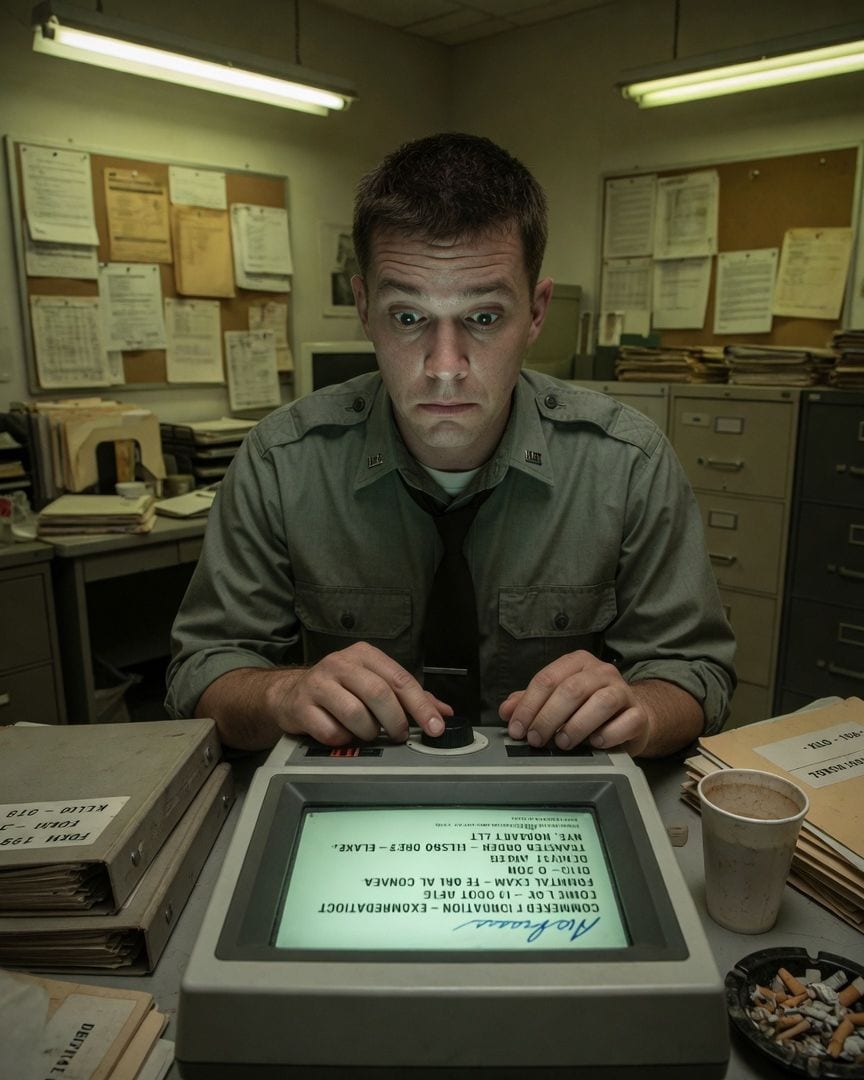
A missile commander watched his ten nuclear silos go dark. His own service record shows his signature on a future he's never lived.
Second Lieutenant Hobart Nye, a missile commander in Wyoming, had his quiet 0247 watch shattered by a security report: a massive, silent black triangle hovered over Launch Facility Kilo, casting a perfect shadow. Hobart watched his console's fault panel light up, signaling all ten nuclear missiles going dark in an impossible silence, followed by eleven minutes his security team could not remember. Official logs called it a "radio malfunction," but Hobart found a requisition for invisible-tracking sensors, signed by a base commander who was supposed to be off-base. The final, chilling discovery came when his own service record showed new entries—a dental check-up, a transfer to Alaska—all dated for a future he never lived, complete with his perfectly replicated signature.
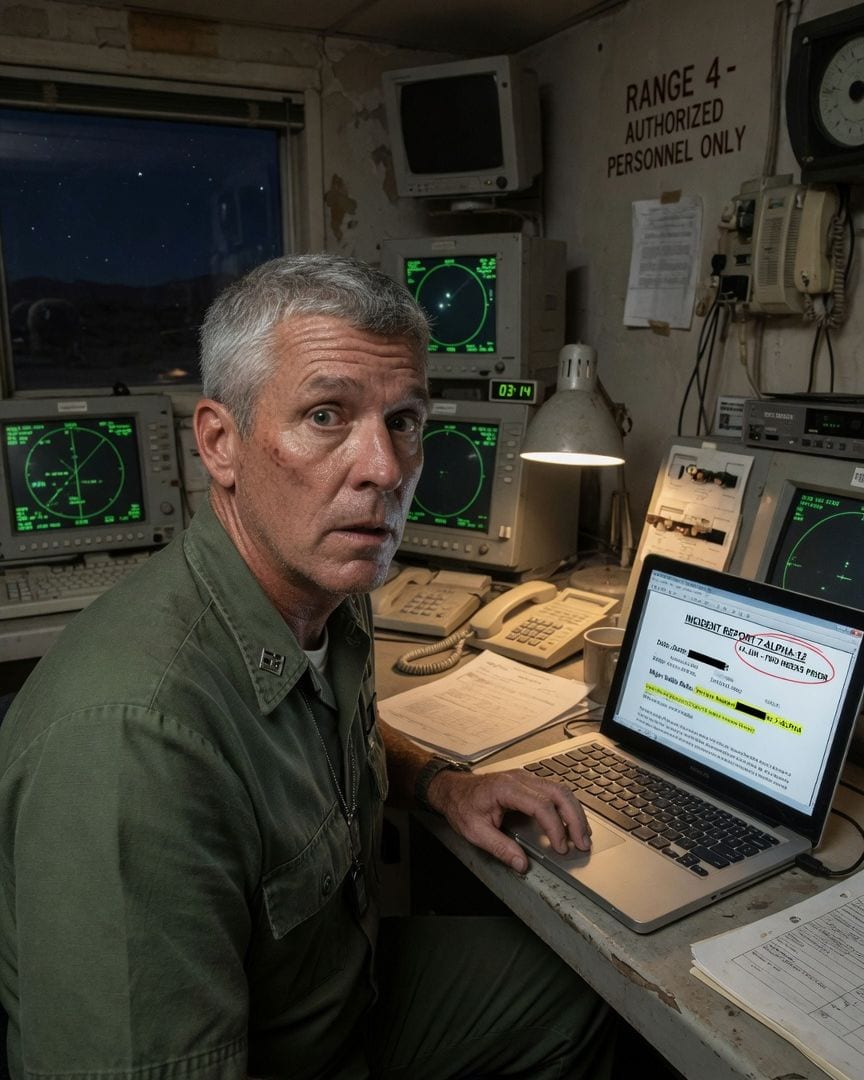
Major Hollis Rake, two weeks from retirement, reported a silent desert disc. His own report was already filed, dated two weeks before it appeared.
Major Hollis Rake, just two weeks from retirement after thirty-five years on a New Mexico desert range, found his predictable world upended. A silent, featureless disc, defying all known phenomena, appeared over the sled rail, its impossible presence confirmed by every instrument on the range. But the true unease began when Major Rake filed his meticulous incident report: it was already in the system, dated two weeks *before* the event even happened. His own name and service number were later found linked to the incident's code in his transfer disposition. Was his retirement just a clerical error, or something far more sinister?
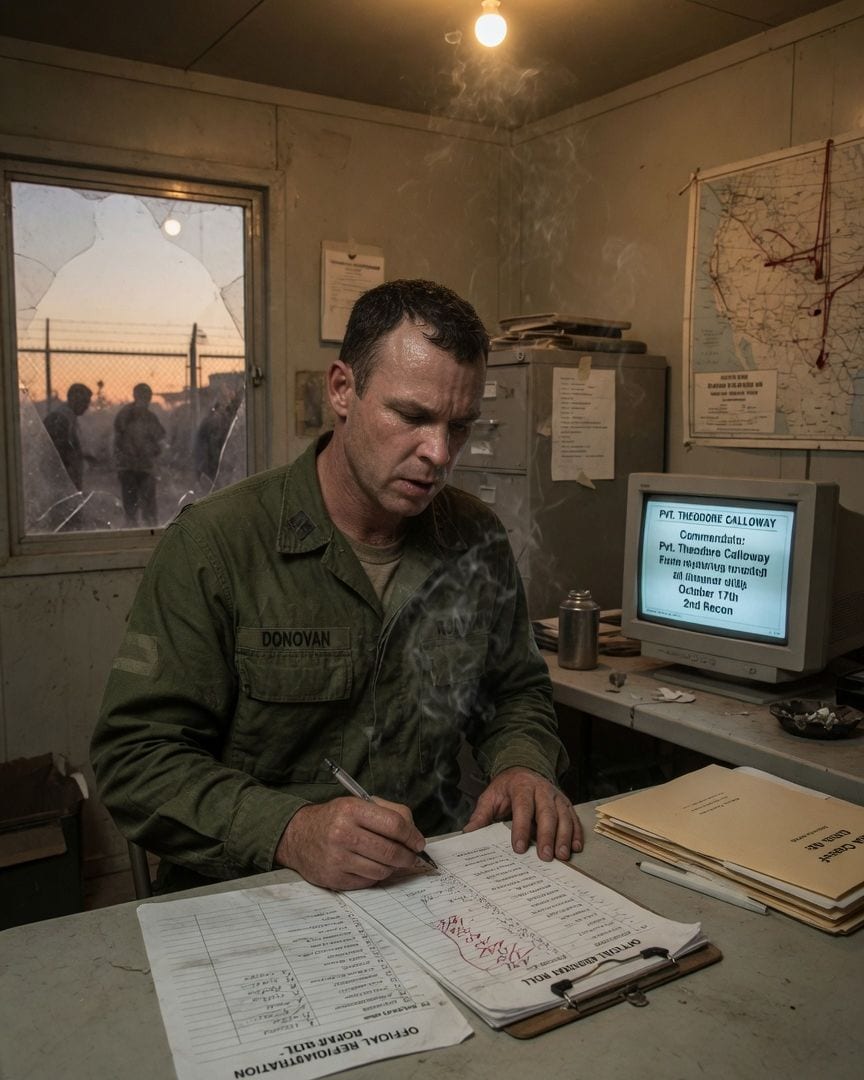
A Corporal counted the returning prisoners, but his tally came out one man too high, a private with no official record.
Corporal Raymond Donovan stood amidst the dust and tired murmurs of the repatriation camp, his duty to verify every returning prisoner. He meticulously tallied names against the official exchange lists, but his physical head count came out one man higher than expected. A Private Theodore Calloway appeared, gaunt and exhausted, yet his name was nowhere on Raymond’s carefully organized records. Sergeant Jennings dismissed it as a forgotten grunt, but Raymond knew better; Calloway's official service record, though pristine, contained an impossible detail: a commendation date for an operation his unit had left a month prior. What impossible timeline had this private stumbled into?
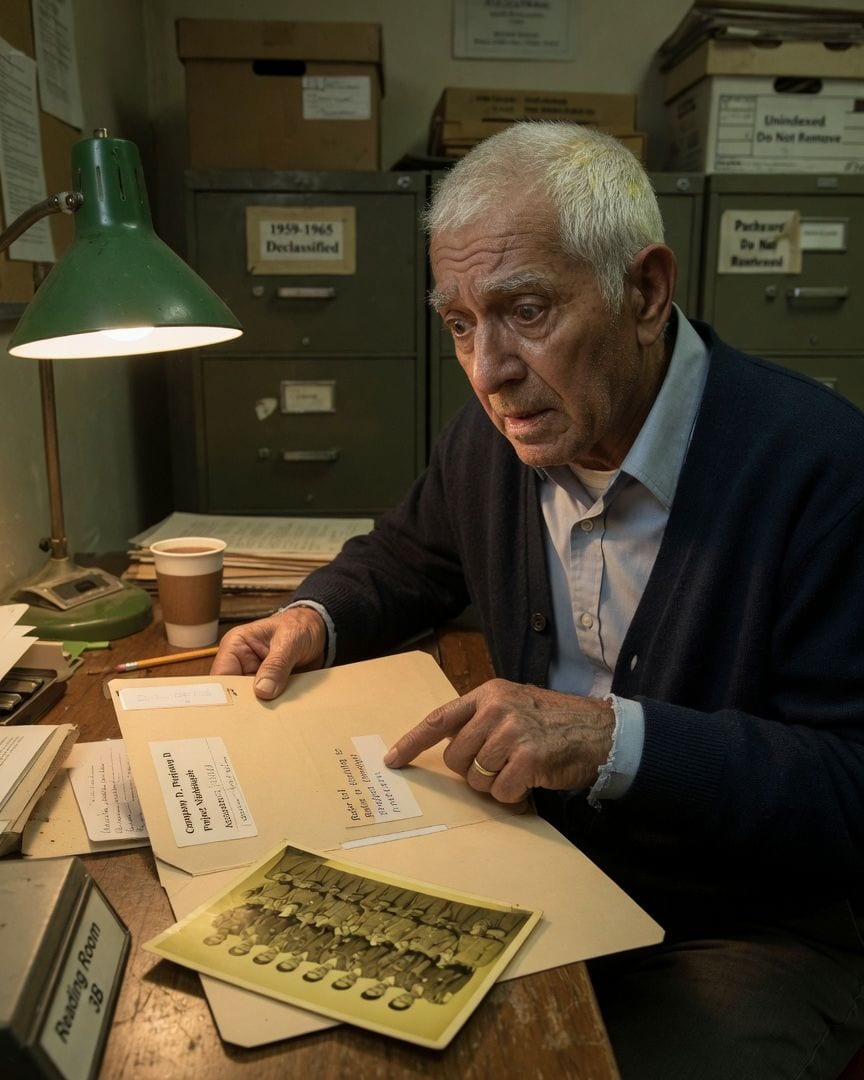
An archivist found her own name on a Cold War military record — dated decades before she was even born.
Eighty-four-year-old Trevor Machado clutched a yellowed photograph, his last hope to prove Company D existed before Friday's lineage board meeting. He knew the 1961 aerial survey of his unit’s parade field showed only grass and an impossibly sharp shadow with no object casting it. At the National Archives, a methodical archivist named Lorraine Sterling initially found no trace of Company D, but an unindexed sub-basement held a forgotten folder. Inside, Trevor's service record detailed his discharge from a unit officially deactivated the very year he joined, but a chilling handwritten note at the bottom, dated decades before Lorraine was born, bore her own name.