An Ohio insurance worker's new military ID shows his current face, but orders send him to a Cold War station abandoned for decades. An old photo there shows his face.
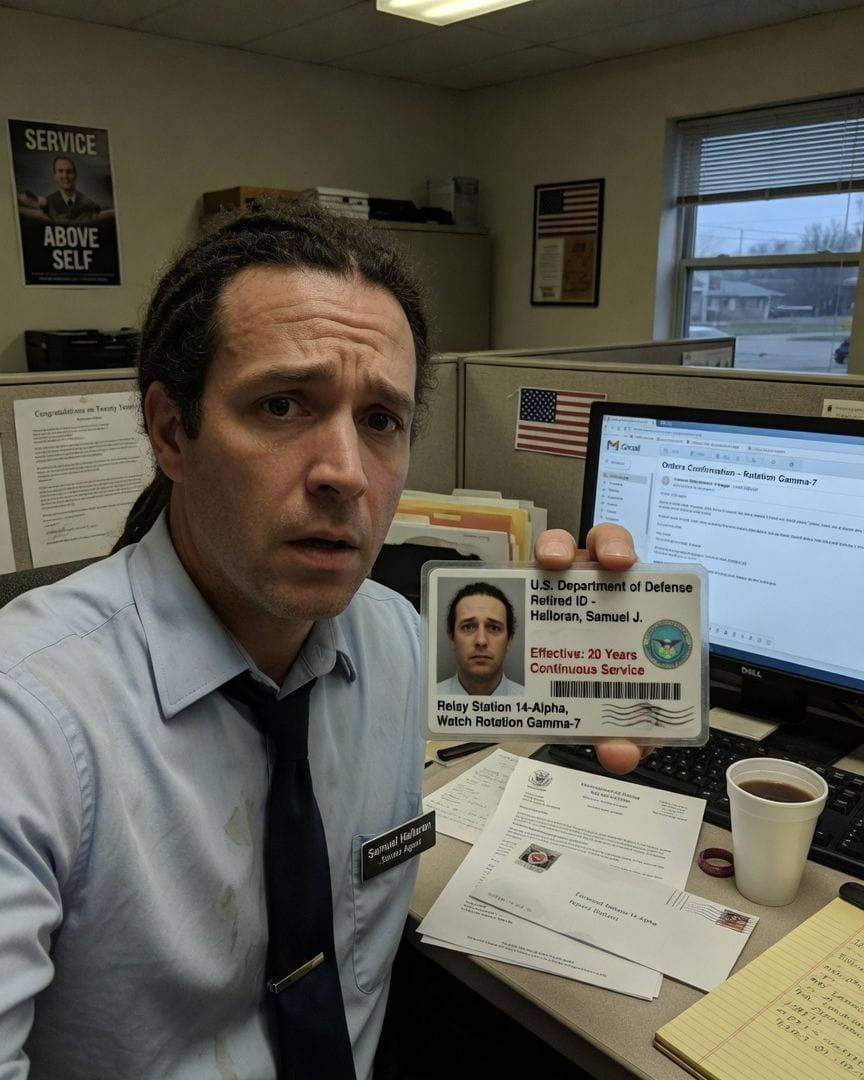
Samuel Halloran, 38, adjusted his tie, the scent of stale coffee clinging to his insurance desk in suburban Ohio.
Eight years out of uniform, a mortgage, two kids who only knew him in khakis, and this morning, a letter from a records center in Missouri. He tore it open. The paper felt heavy, official.
Inside, a congratulatory note on twenty years of continuous service, a retirement ceremony scheduled three weeks out.
His enclosed service history showed no break at all; postings, promotions, and signatures meticulously filled every year he’d spent selling policies from this very desk.
He remembered the exact date he’d signed his separation papers, the relief he’d felt walking away from the uniform. That date wasn’t in this record.
Folded beneath it was his new retired ID card, already printed. He picked it up. The plastic felt cool and strangely new.
The letter simply asked him to verify the photo, which was undeniably current, capturing him exactly as he looked right now, here in Ohio, at his insurance desk.
The faint lines around his eyes, the slight silver in his temples—all present, all accounted for.
He ran a thumb over the plastic, the image of his own face staring back, a ghost of a life he hadn't lived for nearly a decade, yet here it was, rendered in the present tense of bureaucracy.
Halloran’s first thought was clerical error, a monumental screw-up that somehow managed to be both absurd and unnervingly precise.
He spent his lunch break on the phone, navigating automated menus and unhelpful customer service representatives who insisted his file was “active and up-to-date.”
Each call ended with a polite but firm redirection back to the very records center that had sent the letter, a cyclical wall of officialdom.
He even tried calling an old sergeant he occasionally still spoke to, a man named Miller, who just laughed. “Twenty years? Man, they got you working past the grave, Sammy!” The humor died in Halloran’s gut.
That afternoon, a follow-up email arrived. It wasn't about the photo. The subject line read: "Orders Confirmation – Rotation Gamma-7." The email detailed a specific set of orders for 'Watch Rotation Gamma-7' at a 'Forward Relay Station 14-Alpha.'
The coordinates placed it deep in the Ozarks, a desolate, forgotten corner of Missouri. The date for the rotation was for the day after his ‘retirement ceremony.’ Halloran stared at the screen, his fingers suddenly cold.
He typed the station's designation into a search engine. The results showed grainy photos of a rusted, abandoned tower, overgrown with weeds, its remote location decommissioned since the late 1980s.
The station had been a ghost for decades, yet his new orders were sending him there.
Scrolling through the sparse online archives for Relay Station 14-Alpha, Halloran found an old forum post from a local history enthusiast.
It detailed the station's lonely history, mentioning 'unusual personnel rotations' and 'extended watches' that sometimes lasted for years without relief. The words seemed to hum on the screen. Attached was a single, faded black and white photo, dated 1987.
It showed a sentry, bundled against a harsh wind, standing guard beside the station’s perimeter fence.
The image was blurred, the man's face indistinct, obscured by shadow and the ravages of time on the film, but the angle, the set of his shoulders, the very way he stood on that desolate, forgotten hill… Halloran felt a chilling jolt of recognition.
The sentry’s face, though distorted by time and poor resolution, held an unnerving, undeniable resemblance to his own, a mirror image from a past that wasn't his.
The resemblance haunted Halloran. He dug deeper, sacrificing sleep and family time to the glowing screen of his laptop. The sentry’s face, his own face, seemed to float in the periphery of his vision.
He found oblique references to the 'Ozark Watchmen' in local historical societies, whispered legends of soldiers assigned to remote outposts who never truly left, their names fading from memory but their posts remaining.
He cross-referenced names mentioned in the dusty forum posts with old news articles, uncovering a disturbing number of missing persons reports from the area around Relay Station 14-Alpha. All involved veterans, all dating back decades.
Their service records, like his phantom one, showed continuous active duty long after their disappearances were documented by local police.
One name recurred with particular frequency: Kenneth Reynolds, a local boy who vanished in 1990.
The newspaper clippings about his disappearance mentioned his wife, Deborah Reynolds, a local archivist who had written a small, self-published book about the region's forgotten military history, a thin volume Halloran managed to track down online.
It referenced 'peculiar deployments' and 'unconventional assignments' around the Ozarks, phrases that now resonated with an unsettling clarity. He found her address in an old phone book, her number unlisted.
The next Saturday, telling Laura he was scouting for new insurance leads, he drove the three hours to her quiet, isolated home, a small, cluttered house filled with dusty books and the scent of old paper.
He hoped she could shed light on the 'unusual personnel' mentioned in her writings, and perhaps, on Kenneth.
Deborah Reynolds, a woman with kind but weary eyes, offered Halloran a glass of iced tea and listened to his story with a growing tension that pulled at the corners of her mouth.
The old house seemed to hold its breath around them. When he mentioned the 'unusual personnel rotations' and the phantom orders, her demeanor shifted from polite interest to thinly veiled fear.
She spoke in hushed tones, warning him, "Some things are better left buried, Mr. Halloran. The Army… it has long arms."
She refused to elaborate, her gaze darting to the window as if expecting someone to materialize in the overgrown garden. She mentioned her husband only in passing, her voice distant, as if speaking of a ghost already too far gone.
The conversation ended abruptly, leaving Halloran with more questions than answers.
On his drive home, winding through the rolling hills of rural Missouri, he noticed a dark sedan, unremarkable but persistent, in his rearview mirror for miles. It kept a respectful distance, never too close, never falling too far behind.
Back in Ohio, the feeling of being watched intensified. His phone developed a faint, constant static during calls, like a distant whisper at the edge of his perception. A few days later, a plain brown package appeared on his porch.
No return address, no postmark. Inside, nestled in shredded paper, was a single, pristine military ID card. It was blank, save for the 'United States Army' insignia and a serial number subtly embossed at the bottom.
The plastic was cool and smooth, but the emptiness of it felt like a silent threat, a chilling invitation. Someone knew he was digging.
Halloran called Deborah again, his voice urgent, the static on the line a constant irritant. "Mrs. Reynolds, I need to know about Kenneth. About the station." He told her about the blank ID card, about the dark sedan.
Her voice, thin and strained, finally broke. She invited him back, her tone resigned, the words barely audible over the phone’s crackle.
When he arrived, she led him to a small study, its walls covered in yellowed maps and old photographs, a faint smell of mildew and forgotten lives clinging to the air.
"Kenneth… he got a letter too," she said, her voice barely a whisper, her eyes fixed on a map of the Ozarks. "Orders to that station. Just like yours. His service record… it never ended."
She pulled open a drawer in a heavy oak desk and produced a faded photograph. It was Kenneth Reynolds, a young man in an old-fashioned uniform, smiling broadly, a boyish charm evident even in the monochrome image. Halloran’s breath hitched.
The resemblance to himself was not just unnerving; it was profound, almost identical. The same set of the jaw, the same curve of the lips, the same thoughtful look in the eyes.
"He left, said it was a special assignment," Deborah continued, tears welling, tracing the face in the photo. "Said he’d be back. But he never came home. His record… it just kept going.
Promotions, commendations, deployments to places that didn’t exist." She gestured to a shelf filled with binders, crammed full, their spines cracking with age. "I kept track. For decades. Always active. Always accounted for."
Halloran stared at the photo, then at his own reflection in the window, seeing two faces that could have been brothers, separated by decades. The phantom service wasn't a mistake. It was a pattern.
The 'unusual personnel rotations' weren't just long watches; they were a means of absorption, a way for the system to reclaim its own, indefinitely.
Deborah sank into a worn armchair, her face pale, the room feeling suddenly colder. "Kenneth told me things," she confessed, her voice barely audible, like dry leaves rustling. "Before he left.
He said there were others like him, that the system… it updates them. When it’s time for the next cycle."
She pointed a trembling finger at a faded, framed newspaper clipping on her wall, a story about a 'local hero' from years ago.
The picture showed a young Kenneth Reynolds, shaking hands with a much older, stern-faced officer, clearly a formal ceremony. Kenneth was smiling, but the officer’s expression was unreadable.
"He was already gone, then," Deborah whispered, her eyes wide with a familiar terror, fixated on the image. "That wasn't Kenneth. Not really." Halloran leaned closer to the photograph.
The officer’s face was subtly out of focus, his features indistinct, almost blurred by some trick of the light or the printing press.
But his uniform bore no name, no rank insignia, only a subtle, unfamiliar symbol on the collar: a stylized, interlocking double-helix, half-star, half-coil.
Yet, as he looked at it, a profound, unsettling recognition washed over him, a cold certainty that he had seen it countless times, perhaps even worn it himself, though he couldn't remember where or when.
The symbol on the officer's uniform, the uncanny resemblance to Kenneth Reynolds, the blank ID card, the continuous service record – it all clicked into place with horrifying clarity inside Halloran’s mind.
The pieces of the puzzle weren't just fitting; they were snapping together, forming an image he wished he could unsee. He finally understood. The system didn't just keep records; it reclaimed. It didn't just track personnel; it repurposed them.
The 'retirement ceremony' wasn't an end to his service, but a final, irreversible transition.
The ageless officer in the photo, whose features remained subtly blurred but whose presence felt impossibly solid, was an agent of this process, an 'updater,' a shepherd of the 'next cycle.'
The uncanny resemblance between Halloran and Kenneth wasn't a coincidence; it was a feature, a subtle re-patterning, a way to maintain the 'lineage' of these perpetually active personnel.
Halloran was being assimilated into a silent, ancient corps, his identity subtly altered, his civilian life a temporary illusion. He was not retiring; he was being re-routed, re-forged, his very essence folded into a continuous, unbroken chain of service.
His family, his job, his life in Ohio – they were just placeholders until his 'update' was complete. He was not unique; he was just the latest iteration in a long, quiet rotation, a fresh face for an old post.
With three weeks dwindling until his 'retirement ceremony,' Halloran felt the invisible net tightening around him, each day a new knot.
The dark sedan was a constant presence outside his home, always parked a few blocks away, a silent reminder of the futility of escape.
He knew he couldn't outrun a system that had tracked him for eight civilian years, that had maintained his phantom record, updated his photo, and now waited for him at the threshold of a new life.
He made arrangements, quiet and final, for his family: a new life insurance policy with terms he hoped would protect them, a trust for the kids, small notes to Laura filled with things he knew he could never say aloud.
He attended the ceremony alone, not at a bustling military base, but a nondescript government building in downtown Columbus, its windows dark and uninviting, reflecting nothing.
The room was sparse, just a long table and two chairs, the air still and heavy, like the silence of a tomb.
The officer from Deborah’s photo, now looking exactly as he had decades ago, sat opposite him, his face unlined, his eyes holding an ancient, unblinking stillness that seemed to absorb the light.
He offered no greeting, no explanation, only a new uniform, subtly different from standard issue, and a new, blank ID card, its surface gleaming under the fluorescent light.
Halloran felt a profound shift, a quiet emptying, as if a part of him was being replaced by something else, something ancient and disciplined.
He tried to speak, to resist, but the words caught in his throat, replaced by an unfamiliar calm that was not his own, a quiet acceptance that settled deep in his bones.
He donned the uniform, the fabric settling over him like a second skin, unfamiliar yet perfectly fitted. The officer simply nodded, a faint, almost imperceptible smile touching his lips.
Halloran felt his own lips mirror the movement, an automatic, unsettling response.
Halloran returned home. His wife, Laura, and his children noticed a subtle change in him – a new stillness, a different cadence to his voice, his movements precise and economical, as if every gesture was calculated.
He performed his insurance job with unnerving efficiency, closing deals, filing paperwork, his eyes holding a distant, almost watchful quality, as if always scanning the horizon for a threat only he could perceive.
The original retirement letter from Missouri was gone, vanished without a trace, replaced by the blank ID card in his wallet, its surface still pristine, its purpose now chillingly clear.
He was never truly retired; he was simply reassigned, his 'service' continuing in ways no one could ever understand.
His wife, Laura, asked him about his day at the insurance office one evening, if anything interesting happened.
He just smiled, a faint, almost imperceptible shift in his expression that she had never seen before, and said, "Just another day of service."
Samuel Halloran's mortgage payments were always on time, his children always picked up from school, his insurance policies always filed. He was, to all appearances, the ideal citizen, a man who had served his country well.
He always answered the roll call, even when no one was asking.
If this one got to you
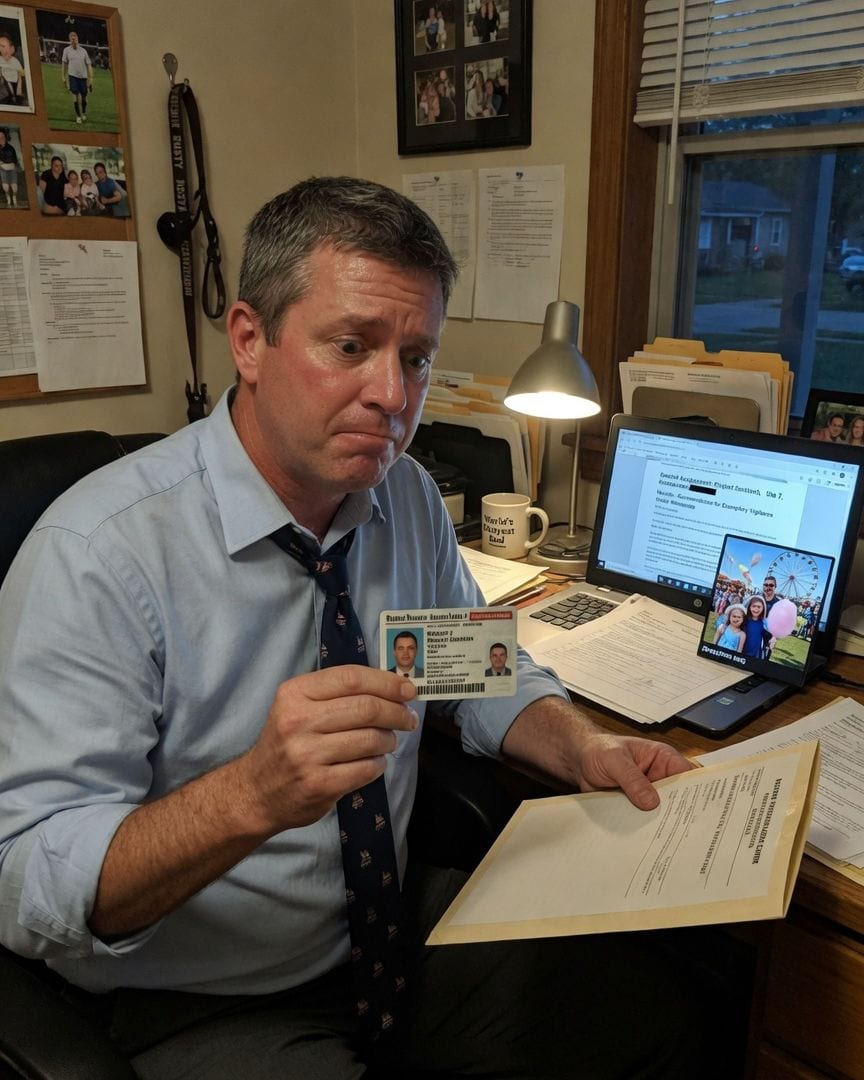
An Ohio insurance agent’s military record showed a commendation from a secret Nevada base, dated the same day he took his family to the county fair.
Robert Halloran, an Ohio insurance agent, thought his military days were long behind him, replaced by a quiet civilian life with a mortgage and two children. But a letter arrived from a records center, congratulating him on twenty years of continuous service and detailing a career he never lived. His official ID card even bore a recent photo of him, looking back with an uneasy smile he didn't remember giving. As he found his own discharge papers, crisp and yellowed, they directly contradicted every line of the new document, confirming his service had ended eight years ago. Now, two realities fought for space: his family life and a secret military history he couldn't explain.
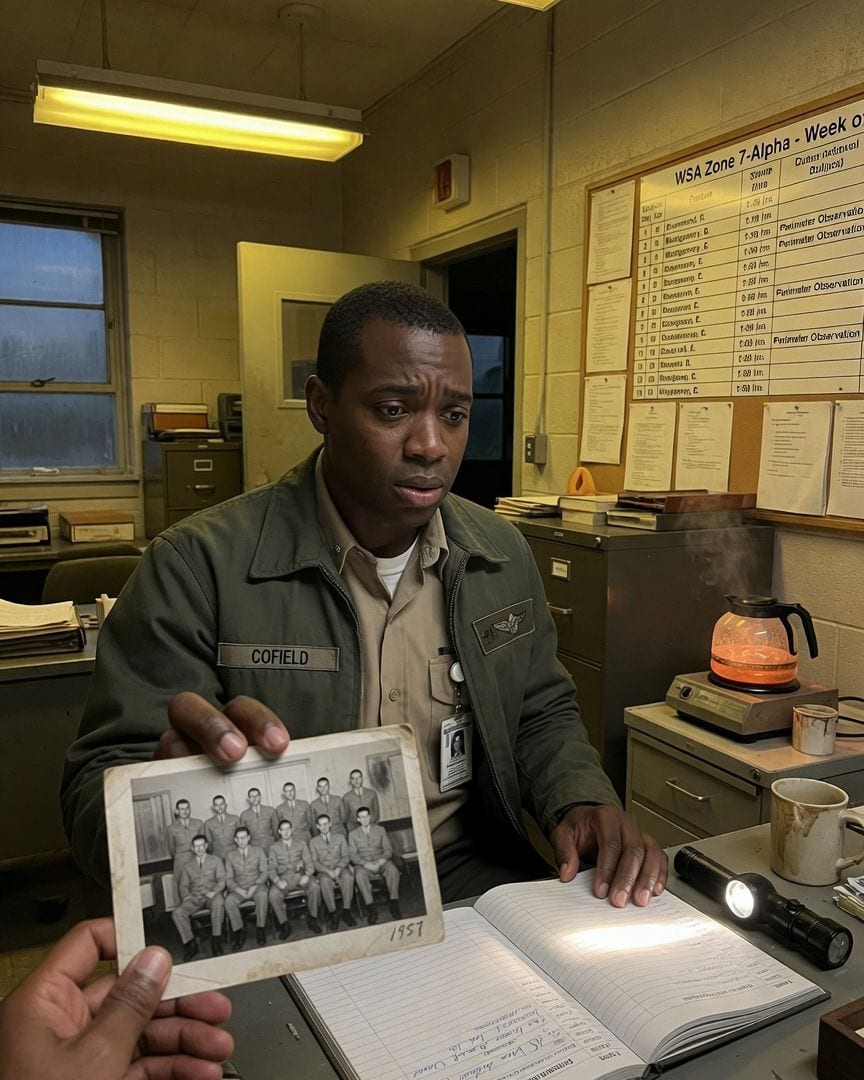
On his last patrol, Senior Airman Cofield found hot coffee steaming inside a base building mothballed since 1992. The fresh roster was signed by a man from a 1957 photo.
Senior Airman Felix Cofield was on his last perimeter patrol of the decommissioned Weapons Storage Area when an impossible light bloomed in the pre-dawn dark. The building had been mothballed for decades, yet a warm, unnatural glow pulsed from within. Ignoring Central Security's all-clear, Cofield found an unlocked door and a brightly lit office, as if someone had just stepped out. A freshly printed roster for the coming week lay on a corkboard, and a coffee pot on the counter was still steaming hot. Then he saw the faded group photo from 1957, showing the very man who had just signed today's logbook.
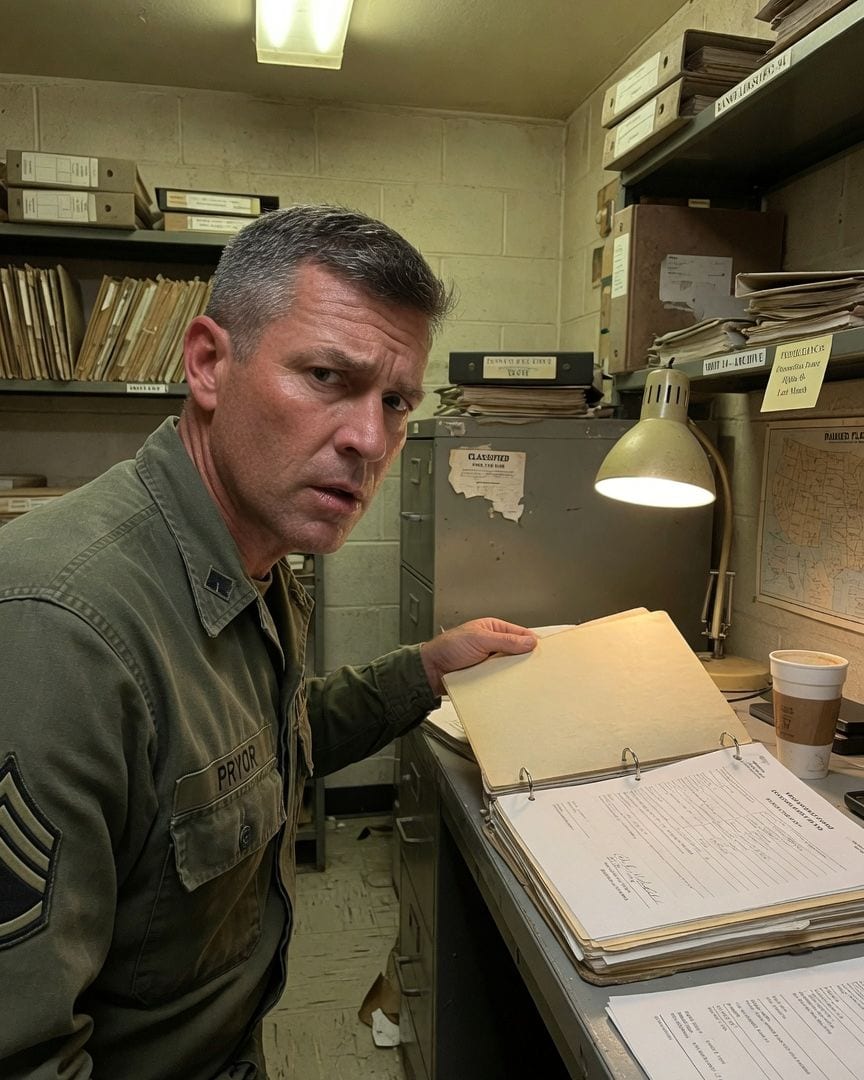
A sergeant with eleven days left finds a warm, glassed crater. Its file shows a captain lost thirty years ago is still signing reports from last week.
Sergeant Alden Pryor was counting down his final eleven days on a twenty-year hitch, expecting to spend them on routine patrols along the Ranier Flats fence line. Instead, his truck stopped at a bizarre sight: a four-hundred-foot glassed crater, miles from anywhere, its sand faintly warm at dawn despite no one recalling a blast. The air above it shimmered with an unnatural distortion, a silent scar of erased violence, and the official file for 'Shot 14' showed recent maintenance sign-offs for a decommissioned tower at the crater site. All these active documents were signed by Captain Everett Caldwell, who had been officially lost in operations thirty years ago, leaving Sergeant Pryor to wonder how a dead man could still be filing reports.
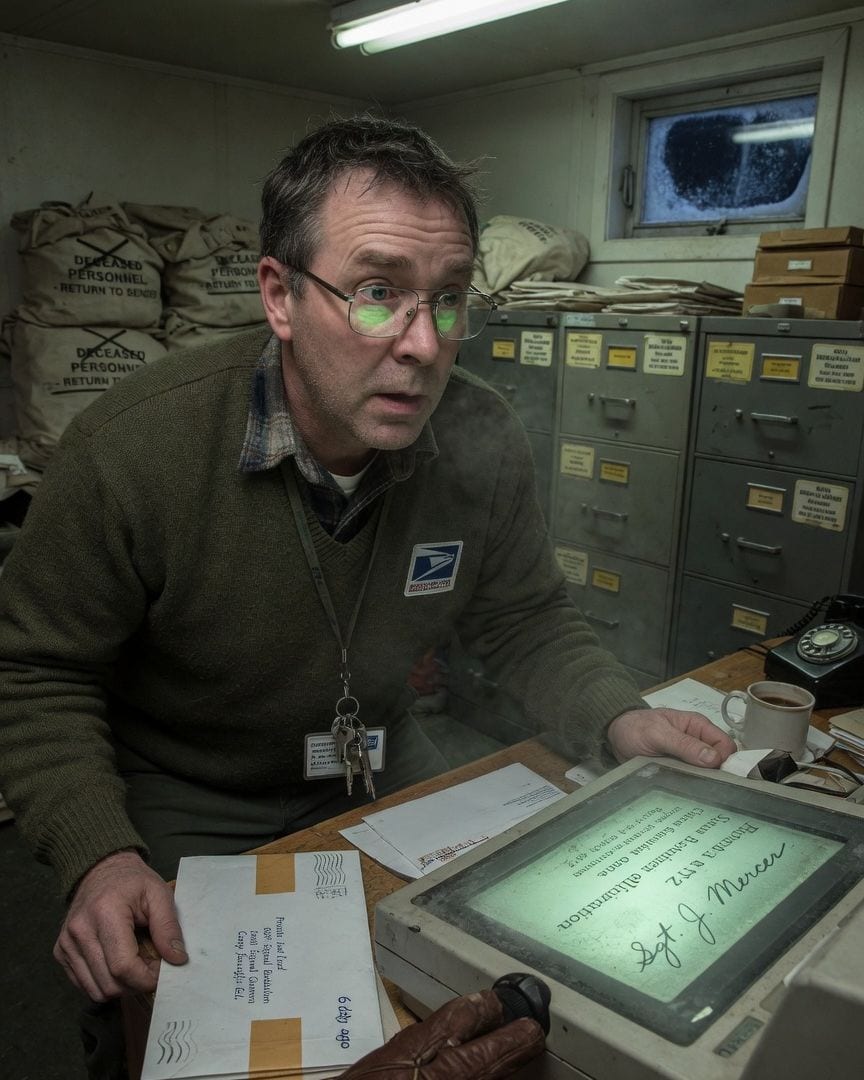
A postmaster at a Cold War Alaskan outpost still received mail for soldiers declared dead in 1969. Then he found their base was active three years later.
Postmaster Rowan Ashcroft had spent two decades watching the weekly mail plane land at Camp Bidwell Annex, a lonely outpost in the bitter Alaskan wind. His methodical mind, accustomed to order, was jolted when the latest mail sack contained forty-three letters for men officially declared dead in 1969. Each envelope, postmarked within days, was addressed to a soldier who wasn't coming back, and Rowan found one already opened and neatly resealed. Driven by duty, he began to sift through declassified Army archives, only to uncover a chilling maintenance log entry for the camp's equipment, dated three years after the base was officially shuttered. What was still happening at Camp Bidwell?
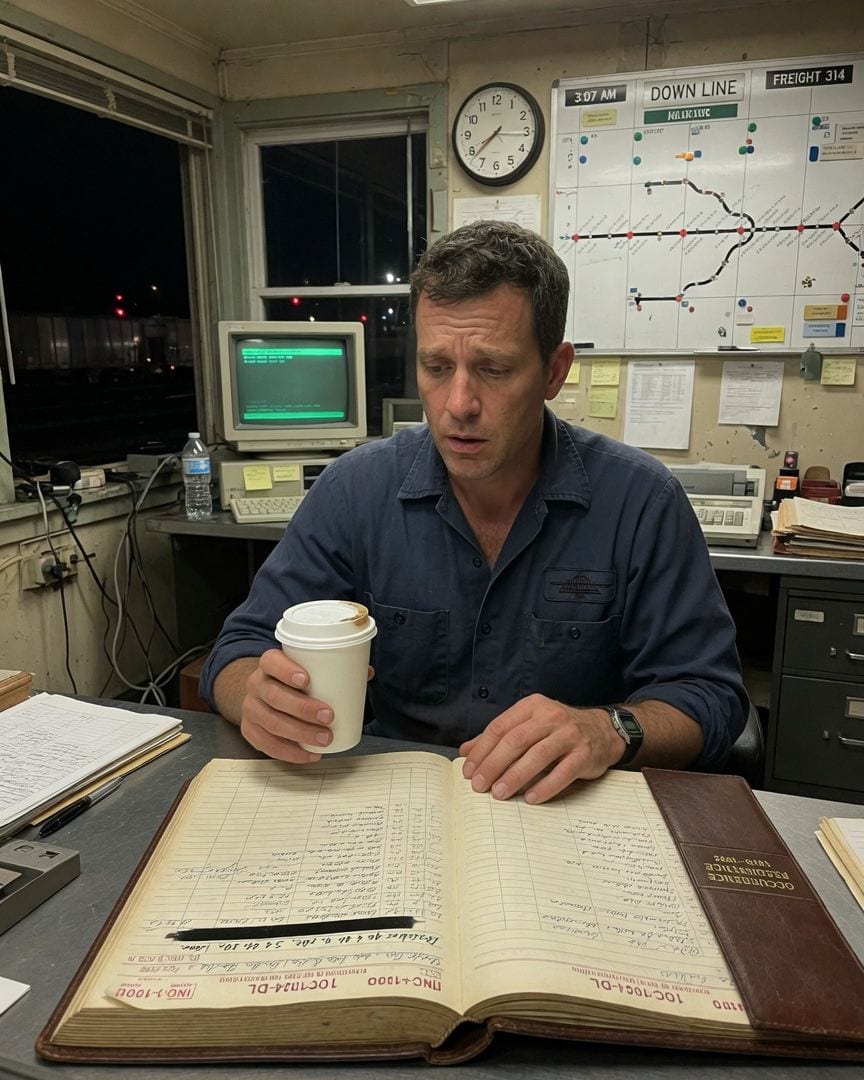
My new colleague's face is identical to a woman in a 1958 archive photo. She was declared 'the woman on the down line' for decades.
Working my solitary shift in the signal box, I found a blacked-out entry in the old occurrence register. It noted 'the woman on the down line' and the instruction 'do not stop.' This same strange entry, word-for-word, recurred every October 4th, back through the years from 1988. It felt like a chill in the routine, a silent dread in a book of transient events.
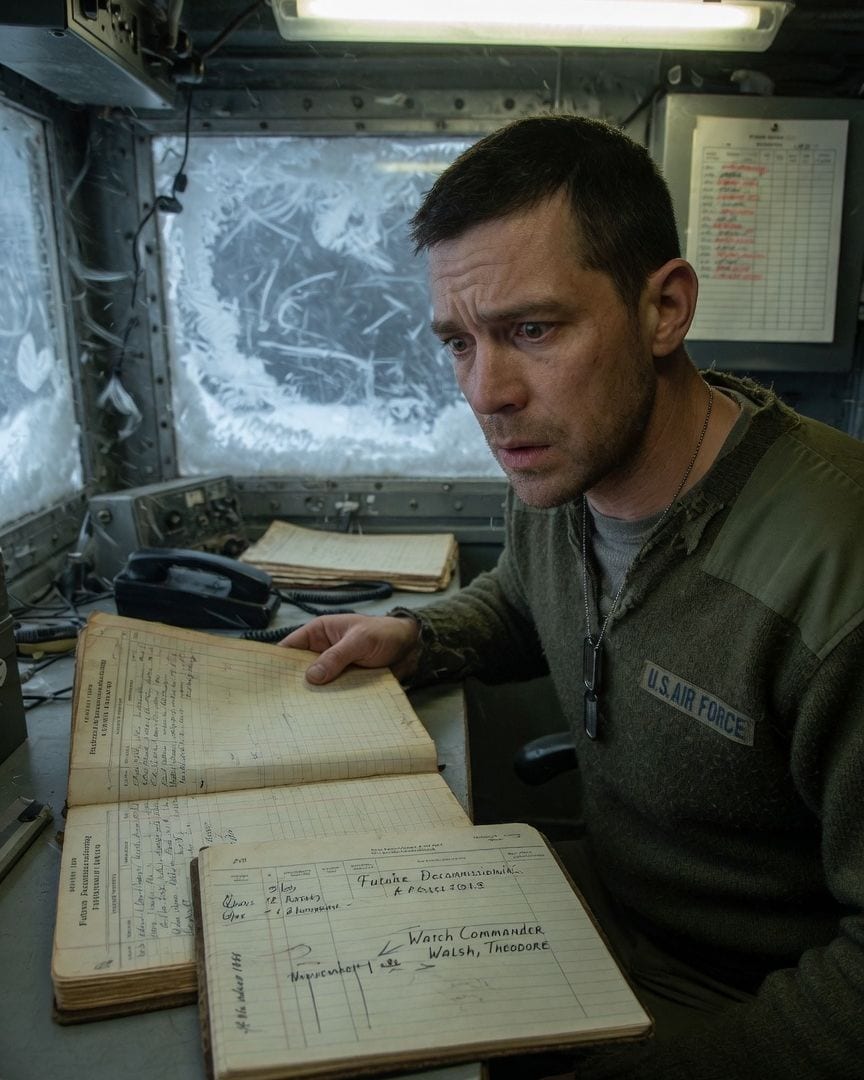
A Cold War DEW-line specialist's dead phone rings with a crew roster from eleven years ago, for a station that should be silent.
Specialist Theodore Walsh huddled in the radar shack, isolated by an Arctic storm that had severed the station's landline, leaving him cut off from the world. Suddenly, the field phone on his console, connected to that very dead line, rang with a sharp, insistent clarity. A voice crackled through, reading a watch rotation for a crew roster Theodore didn't recognize, names that didn't belong to anyone on the remote outpost. As he searched old logbooks for answers, he found those exact names listed for this station, on this date, eleven years prior, as if they had never left. But the true chill came when he saw his own name, assigned to a watch in a logbook dated eleven years in a future that couldn't possibly exist.