My own hand signed a seventy-pound refund slip for a coat I never purchased. I was at the dentist, and the store's CCTV went dark at that exact minute.
The fluorescent hum of the department store returns desk was the only normal thing. I gripped my receipt, my knuckles white. Edward Winslow, the manager, slid a faded print-out across the counter.
"Here it is, Ms. Thornton. Seventy pounds cash refund for a winter coat, processed last month. Signed by you."
My gaze locked onto the signature. It was unmistakably mine, a perfect cursive of 'S. Thornton,' timestamped 2:15 PM on October 22nd. My stomach lurched.
"I've never owned a coat like that," I said, my voice thin. "And on the 22nd, at 2:15 PM, I was in a dentist's chair having a root canal."
Edward frowned, pulling up a digital log. "The CCTV over this desk... it went dark for precisely that minute. Just a glitch, I suppose." He shrugged, a small, dismissive gesture.
But I knew, with a cold certainty that deepened with every beat of the silence, that it was no glitch. The air in the store felt suddenly too still, the background chatter too distant. It was a blank.
Back home, I meticulously cross-referenced my calendar with my dentist's appointment confirmation. October 22nd, 2:15 PM. Confirmed. I even had the post-procedure pharmacy receipt, timestamped 2:45 PM. My timeline was solid, unyielding.
I pulled up my bank statements, searching for any anomalies. The refund itself wasn't there, no seventy pounds credited to my account, which ruled out a simple administrative error on the store’s part.
But three months prior, a small, recurring direct debit for £15 appeared: 'Oakley Community Centre.' I'd never heard of it. The first payment was dated July 18th, a Tuesday.
Checking my calendar, I saw I’d been on a business trip, two hundred miles away, with verifiable hotel and flight bookings. It was impossible.
I called my bank. The automated voice confirmed the direct debit was set up via an online form. When I finally reached a representative, she was polite but firm. "Can you verify the signature on the form?"
I asked, a tremor in my voice I couldn't control.
The representative confirmed, "Yes, Ms. Thornton, it appears to be your digital signature, verified through our system."
Another signature. Another impossible place. Another undeniable record. My initial refund slip suddenly felt less like a one-off error and more like the first ripple of something far deeper.
A chill that had nothing to do with the autumn evening outside began to settle in my chest.
That evening, I drove aimlessly, the 'Oakley Community Centre' address pulled up on my phone, until I found it. It was a modest brick building, nestled between a laundromat and a bakery, looking innocuous.
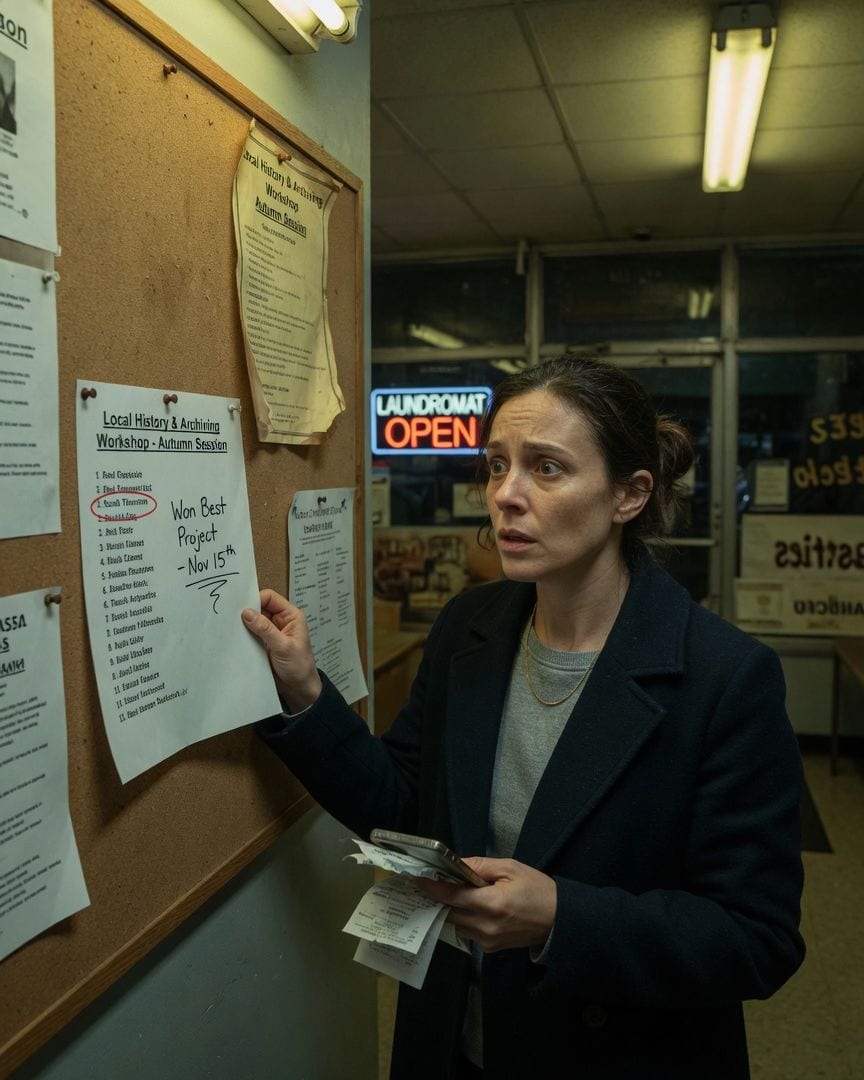
On a corkboard near the entrance, a faded poster advertised a 'Local History & Archiving Workshop.' It looked months old, curling at the edges.
Below it, tacked with a rusty thumbtack, was a small, printed list of participants. My heart hammered against my ribs as my eyes scanned the names. And there it was: 'Sarah Thornton.'
Circled in red pen, with a handwritten note scrawled beside it: 'Won Best Project - Nov 15th.'
November 15th. I hadn't even been in town then. I took a shaky breath, the evening air suddenly cold enough to sting my lungs.
The next morning, the Oakley Community Centre felt different in the daylight, somehow more real and, consequently, more unsettling. The coordinator, a pleasant but forgetful woman named Eleanor, was in her office, surrounded by stacks of paper.
I explained my situation, trying to keep my voice even, rational.
Eleanor blinked at me over her spectacles. "Oh, yes, Ms. Thornton! I remember you. You were quite keen on the local archives, weren't you? Came to several sessions." She smiled, a warm, genuine smile that made my stomach clench.
"No, I assure you, I've never been here," I insisted, my voice tightening. "I only just found this direct debit."
Eleanor frowned, a slight furrow appearing between her brows. She rummaged through a filing cabinet, producing a large, hardbound ledger, its cover a worn, dark green. "Well, it's all here in the sign-in book."
She flipped to a page, the paper rustling like dry leaves.
My stomach dropped. My signature, clear and confident, was there under several dates: July 18th, August 2nd, September 10th. All days I could prove I was elsewhere, miles away, living my actual life.
The July 18th entry was even the exact date the direct debit began.
Eleanor tapped a page with a blunt finger. "You even helped us catalog some old town records. Mr. Bennett, from the Historical Society, was very impressed with your dedication."
I felt a prickle of unease, a cold sensation spreading up my spine. "Mr. Bennett?"
Eleanor nodded. "Simon Bennett. He oversees all the historical archives. He might have even more detailed records of your contributions. You two had quite the chat about the old mill ledgers, I recall."
The idea that someone else, someone legitimate and completely unconnected to the original department store refund, could corroborate this impossible version of my life was terrifying. The mundane explanation of a simple error was crumbling, piece by piece.
I asked for Simon Bennett's contact details, my hand shaking as I wrote them down. The paper felt heavy, saturated with a truth that shouldn't exist.
I managed to secure an appointment with Simon Bennett at the local Historical Society for later that week. The building itself was quiet, hushed, filled with the scent of old paper and dust that seemed to cling to everything.
I sat in the waiting room, surrounded by glass display cases holding faded photographs of solemn-faced town elders and forgotten artifacts – a rusty pocket watch, a child's worn shoe. The silence in the room felt thick, almost oppressive.
An older man, distinguished with silver hair and wire-rimmed glasses, sat across from me in an antique armchair. He was engrossed in a massive, leather-bound ledger, its pages yellowed with age, its spine cracked.
He looked up slowly, his gaze meeting mine over the top of his glasses. A faint, unreadable smile touched his lips before he returned to his book, his fingers tracing the faint lines of ancient script.
I felt a shiver, a cold draft that seemed to come from inside me.
When my name was called, I realized it was him – Simon Bennett. He was polite, almost unnervingly so, his movements precise and economical. The meeting was cordial but yielded little.
He acknowledged the 'discrepancies' in my records with a detached academic interest, assuring me he'd 'look into it' with a tone that implied it was merely an interesting curiosity, not a profound violation of reality.
The room itself seemed to hold its breath around him, the dust motes dancing in the afternoon light.
Later, as I returned to my car, a small, folded note was tucked under my wiper blade. It was handwritten, in elegant, precise script: 'Some records are best left undisturbed.' There was no signature.
The chill wasn't just in the brisk autumn air; it had settled deep in my bones. Someone knew I was digging. And that person hadn't just observed me; they had warned me.
I confronted Simon Bennett again, my voice tight with suppressed fear, the note crumpled in my hand. "Who sent that note? What do you know about these impossible records?"
Simon's calm was absolute. He didn't deny the note; he didn't even acknowledge it directly. He simply nodded towards his desk, where the same antique ledger he'd been reading earlier lay open, a vast, imposing thing.
"You're not the first, Ms. Thornton. These 'discrepancies,' as you call them, are a recurring pattern." He ran a finger down a column of faded ink, his nail barely touching the paper. "We call them echoes."
He pointed to an entry, dated meticulously in looping script: 'Robert Maxwell – Registered for marathon, May 1972. Finished 3rd.'
I squinted. "And he didn't run it?"
Simon simply smiled faintly, a ghost of a smile. "Mr. Maxwell had both legs broken in a car accident in April 1972. A month before the race." He turned a few more pages, the old paper sighing.
Each page revealed similar impossible entries for various individuals, spanning decades. Each entry was meticulous, complete with signatures, witness accounts, or official stamps, all for events that demonstrably never happened to the named person.
It was a coherent, undeniable history of what didn't happen.
"The CCTV blackouts you mentioned at the department store," he continued, as if discussing local weather, "are a known side effect. A momentary blind spot when the recording medium struggles to reconcile overlapping realities. It simply… blinks."
He looked at me, his eyes unblinking, utterly devoid of judgment or surprise. "The signature that is yours, on a document for an event you didn't attend, is the most common and, shall we say, convincing evidence of an echo."
The seventy-pound refund slip, the Oakley Community Centre sign-up, the workshop prize – it all clicked into a terrifying, coherent pattern, not of error, but of an undeniable, systematic wrongness.
The mundane explanations I’d clung to crumbled into dust, like old paper. This wasn't a mistake. This was a truth, cold and precise, like the air in the room.
My mind reeled, trying to process the sheer, quiet horror of 'echoes.' "But… why? What are they?" My voice was barely a whisper.
Simon merely shrugged, a gesture of profound, unsettling acceptance. "We don't know the 'why,' Ms. Thornton. Only the 'what.' And the 'who,' in a manner of speaking."
He turned another page in his ledger, his finger tracing a line of ancient script. "The pattern isn't always isolated. Sometimes, it threads through families."
I leaned forward, my breath catching in my throat.
His finger stopped on an entry from decades ago, from 1965, for a name I knew intimately, a name that had been hers before marriage: 'Eleanor Granger – Registered for local art exhibit, June 1965. Prize winner.' Eleanor Granger.
My own mother's maiden name. My mother, who had never shown an artistic inclination in her life, and who had been living in a completely different town in 1965, one hundred miles away.
Before I could articulate the question forming on my lips, Simon's finger moved again, to a more recent entry, dated just last week. My blood ran cold. 'Philip Vaughn – Attended 'Introduction to Beekeeping' workshop, last Tuesday.'
Philip. My partner. He had been with me last Tuesday, helping me paint the spare room, covered in white paint and complaining good-naturedly. The echoes were not just generational; they were current.
And they were inside my life, closer than I could have ever imagined.
I stared at the ledger, at Philip's name, my own mother's name, my own. "What are these things?" I demanded, my voice barely a whisper, ragged at the edges.
Simon Bennett closed the massive ledger with a soft thud that echoed in the quiet room. "They are not 'things,' Ms. Thornton. They are… a natural phenomenon. A temporal bleed-through. Imagine a stone dropped into a still pond, creating ripples.
Now imagine those ripples are not just spreading outwards, but also subtly overlapping with other, parallel ponds.
These 'echoes' are the physical manifestations of those overlaps – a person existing, acting, and leaving a record in a timeline that is not their primary one."
He explained that the 'echoes' themselves were typically unaware of their dual existence, living out their parallel lives with perfect coherence, without a flicker of recognition.
The CCTV blackouts I’d heard about, he reiterated, weren't malicious interference, but the world's systems struggling to capture two realities in one frame. "The technology simply… blinks," he said.
He then opened another, smaller, more recent ledger, its pages stark white compared to the ancient tome. He pointed to a faint, almost invisible line, drawn in pencil.
It connected the department store refund slip entry – 'Sarah Thornton, Oct 22, 2:15pm' – to a similar entry from five years prior, for a different individual, at the exact same department store, for a similar impossible transaction.
"The points of overlap are often… linked," he concluded, his voice utterly devoid of emotion, like he was reading from a dry textbook. "A pattern, not of intent, but of occurrence."
I felt a wave of nausea, cold and acidic. "So, what do I do? What can be done about it?"
Simon Bennett leaned back in his chair, a faint, unsettling smile playing on his lips. It was the same unreadable smile I’d seen in the waiting room. "Nothing, Ms. Thornton. You simply learn to live with the discrepancies.
Or you become… unmoored." He gestured towards a photograph tucked into the front of his larger ledger, carefully placed there as a bookmark.
It showed an older man with hollow eyes, his face utterly blank, standing next to an impossible record of a life he couldn't recall. "Some can't reconcile the two.
The constant slippage, the undeniable proof of a life they didn't live, alongside the one they did. It breaks them."
I felt a cold dread seep into my bones. The calm with which he spoke, the detached academic interest, was infinitely more terrifying than any snarling monster. It implied a cosmic indifference, an unstoppable, unchangeable truth.
I stood, trembling, my eyes falling upon a fresh entry in his ledger, right there on the top page of the smaller, newer book. My own name: 'Sarah Thornton – Consultation with S. Bennett, Archivist. November 10th, 3:00 PM.'
It was today's date, this exact time. And beneath it, my signature. A perfect, undeniable 'S. Thornton.' I hadn't signed it. I hadn't touched the book.
The echo was here, now, in this very room, documenting an event I was living, yet simultaneously, not truly living. I was already becoming a record.
I left the historical society in a daze, the afternoon sun feeling too bright, too normal, almost blinding. The world around me seemed to shimmer at the edges, like looking through heat haze.
I tried to articulate it to Philip later that evening, tried to explain about the echoes, the signatures, the ledgers, but the words felt clumsy, unreal, even to me. They tangled in my throat, sounding like nonsense.
The small direct debit for the Oakley Community Centre remained, a constant, impossible drain from my account, a silent hum in the background of my life.
A new flyer appeared in my mailbox a few days later, advertising a local photography club. My name was circled at the bottom, marked as a 'New Member.' I hadn't signed up for that either. The echoes were not stopping.
They were growing.
I sit at my kitchen table, the photography club flyer spread before me, its glossy paper reflecting the overhead light. Philip enters, pausing by the doorway, his silhouette framed against the hall. "Rough day?" he asks, his voice soft, concerned.
I look up, a faint, almost imperceptible smile touching my lips. My eyes, however, are still. "Just reconciling some records," I say.
Philip watched her for a long moment, a subtle, cold knot tightening in his stomach. He knew her, but the way she looked at the flyer, the way she smiled… it wasn't quite Sarah.
He couldn't quite place what was wrong, only that something was.
If this one got to you
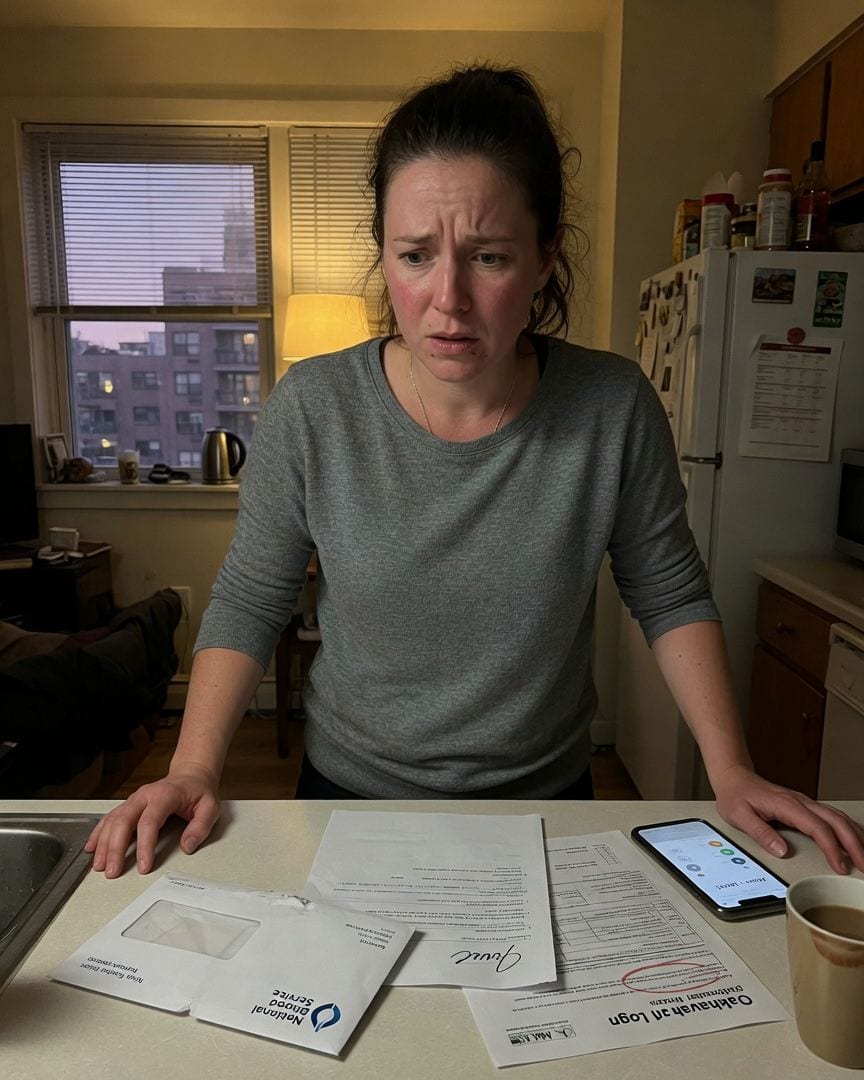
My signature appeared on a blood donation form, thanking me for my sixth. I've never set foot in that town.
An ordinary envelope arrived, but inside, a letter from the National Blood Service thanked me for a sixth blood donation. I’ve never given blood in my life, and the thought makes me queasy. But then I saw the enclosed consent form, signed unmistakably with my own hand, for a donation made in a town I’d never heard of. It was my signature, but it wasn't me.
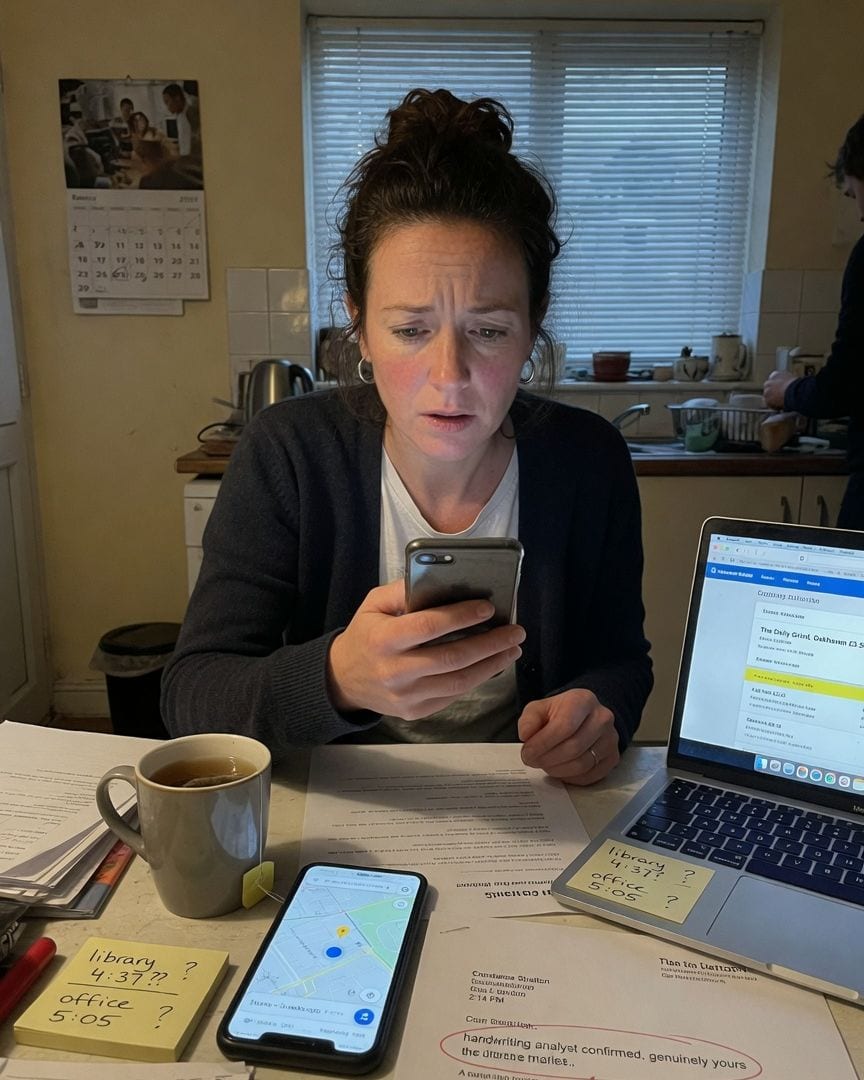
My signature covers a twelve-thousand-pound loan agreement. It's witnessed three hundred miles away, the day my phone confirms I was home.
My afternoon takes a chilling turn when the bank calls about a £12,000 loan, signed with my own handwriting in a town 300 miles away. My phone proves I was at my kitchen table at the time, yet a handwriting analyst confirms the signature is genuinely mine. The impossible truth deepens when a keycard log places me 100 miles away, just minutes before I entered my office.
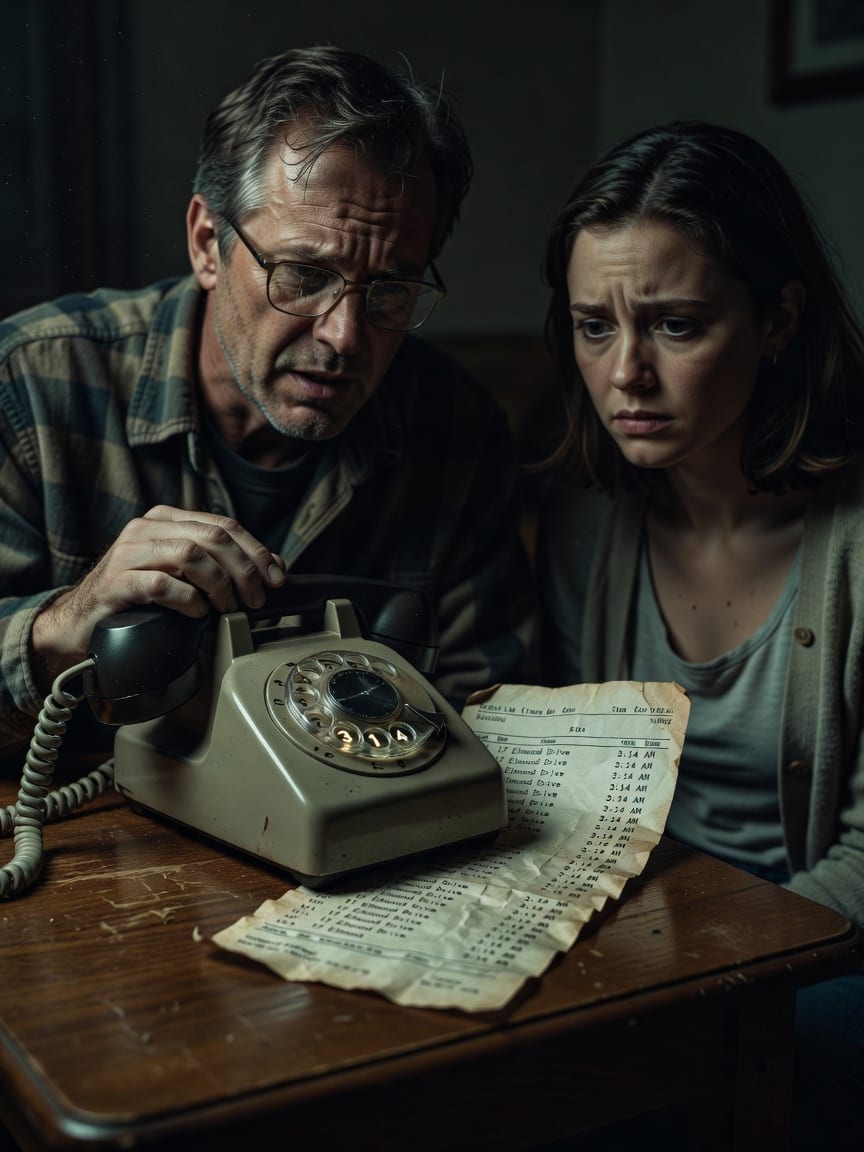
My phone bill itemised forty calls from my number to a house demolished in 1990. Each call at 3:14 AM, lasting eleven minutes. The bill arrived postmarked from a flattened building.
I expected the usual mobile bill, but my landline statement listed forty calls from my number to '17 Elmwood Drive.' That address was for a house torn down in 1990, a vacant lot I remembered from childhood. The phone company insisted the calls were legitimate, leaving me profoundly unsettled by the impossible charges.
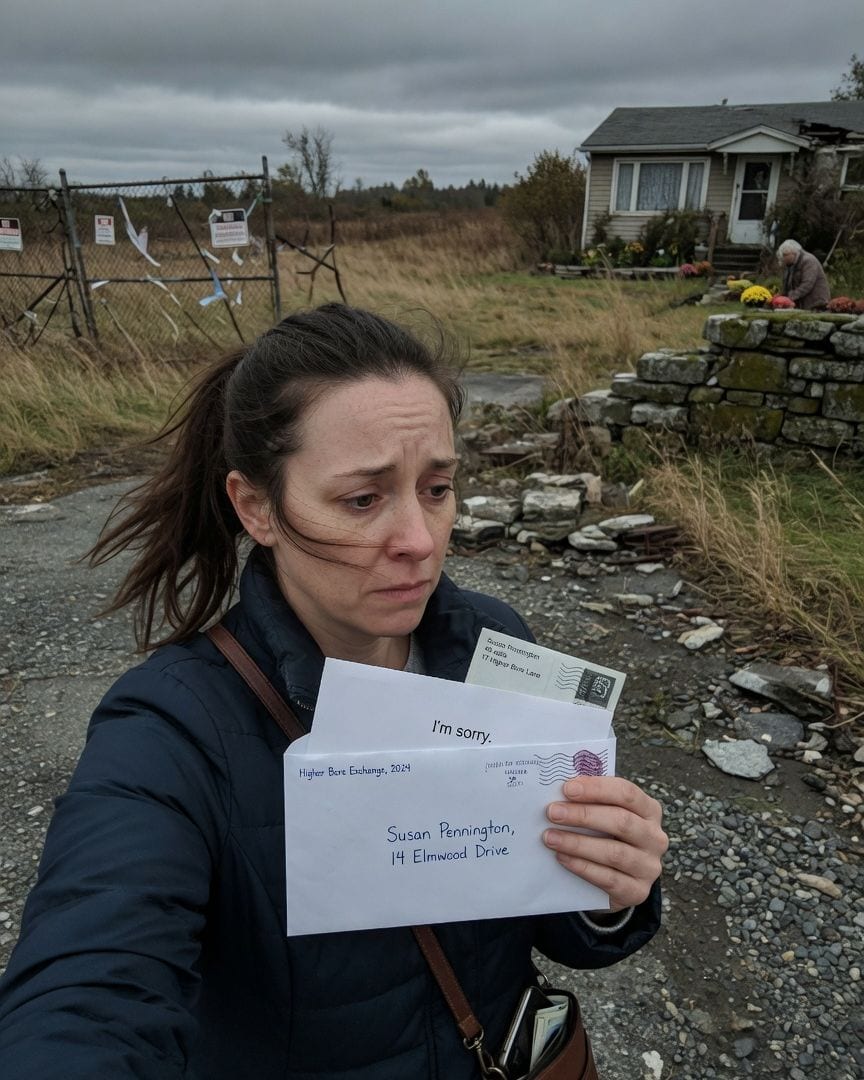
My phone bill listed forty calls made at 3:14 AM to a house demolished in 1990. The paper bill came from a flattened building. My name is on it.
I stared at my phone bill, my morning coffee forgotten. It detailed forty calls, each at 3:14 AM, to an address I knew was a vacant lot where a house had stood decades ago. But the real dread began when I saw the bill's return address: a telephone exchange flattened years before.
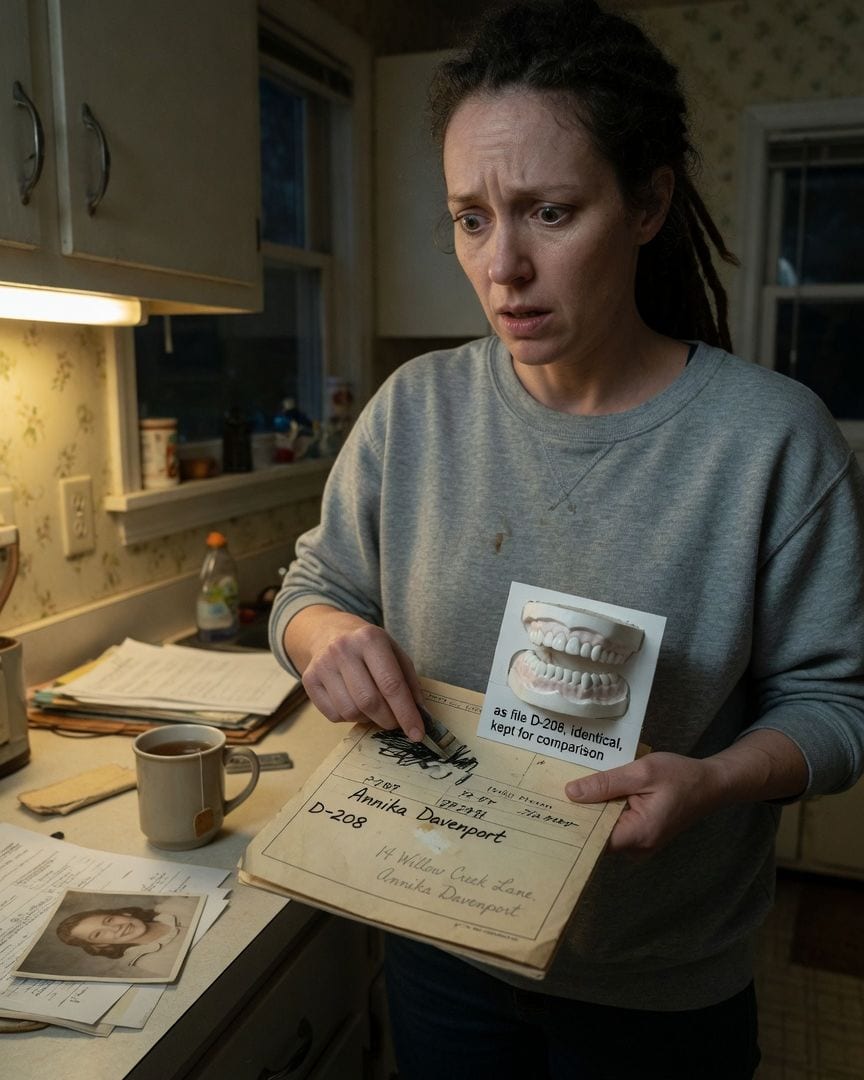
My childhood dental chart lists the house I bought last year — in my own name, years before I was born. A second set of my teeth sits filed beside it, marked 'identical.'
Sifting through old dental records, I found my chart, D-208, with my 1988 birth date. But a line from 1958 was blacked out, and a clipped card with an impression of my teeth listed my name and current home address, decades before I was born. The impossible facts knotted into a cold certainty.
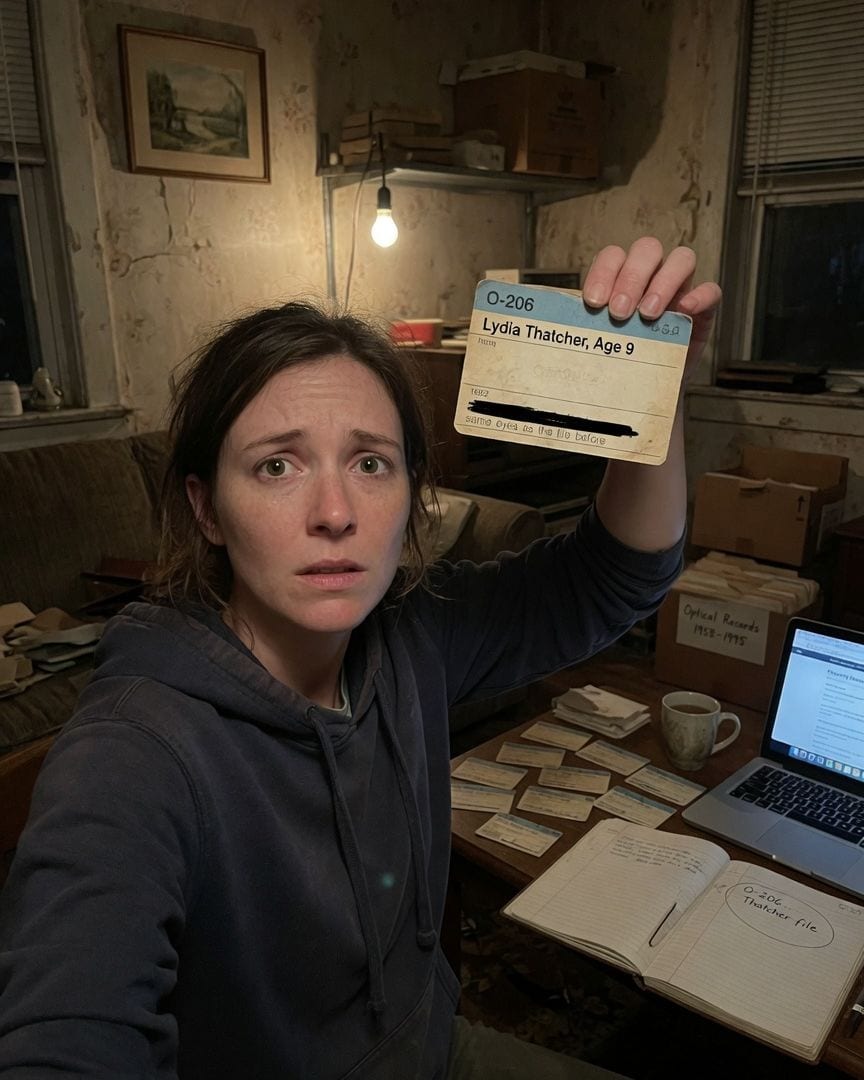
My own optical card is dated 1962, with my name on it. I wasn't born until 1993.
Sifting through old patient files from my former optical practice, I found my own O-206 card. It had my name, Lydia Thatcher, and my current home address printed on it. But the card was dated 1962, decades before I was even born, and a redacted note mentioned 'same eyes.'