My own handwriting is on my birth certificate, signed as the attending midwife. I was the baby born that night.
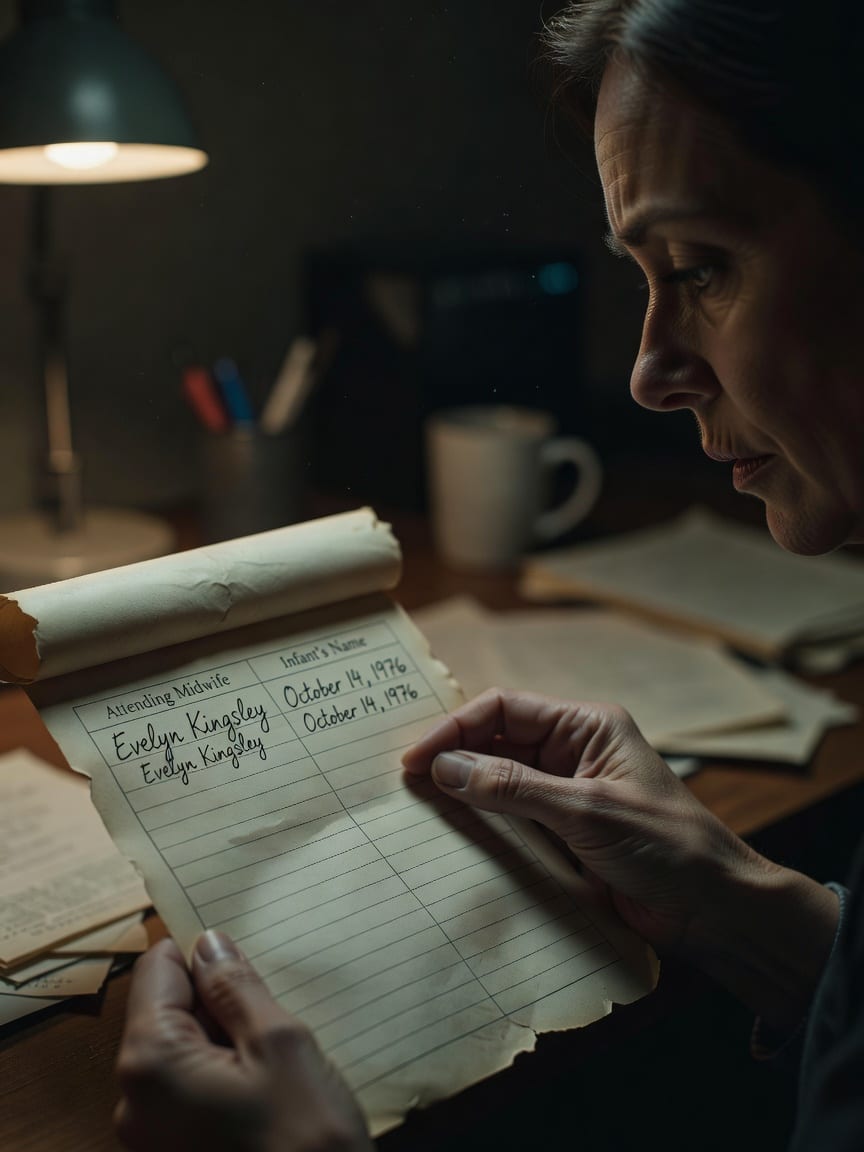
My own signature, in a confident adult hand, was scrawled across my mother’s maternity file, right there on the birth register page.
It was clipped inside the thick, cream-colored folder the St. Jude’s Maternity Unit finally released after years of legal wrangling, following Mum’s death. Not a scrawl, really. A proper signature. Evelyn Kingsley. My name. In the column marked ‘Attending Midwife’.
I was the infant on that page, the date plain: October 14, 1976. The actual midwife listed beside me, Mrs. Eleanor Vance, had retired in 1975. The dates didn’t square. Not by a long shot.
Benjamin, my older brother, who works in forensic document analysis, had taken one look, his brow furrowed, and sent it off to a colleague he trusted.
The report came back two weeks later, dry and clinical: the ink was contemporary with the paper, consistent with the era. No forgery. No later addition. The fibers hadn’t been disturbed.
It was genuinely my signature, dated years before I could even hold a pen, let alone form those loops and flourishes. It was the way I signed documents today, at 47 years old.
The world, or at least this record, had a dark joke on me. I kept staring at the looping ‘E’, the decisive cross of the ‘K’, the way the tail of the ‘y’ always hooked slightly to the left.
My signature. On the record of my own birth, signed by me as the midwife. It felt like trying to unscramble a dream that made perfect sense until you woke up and realized it was impossible.
The first few days were a blur of calling St. Jude’s, of course. Polite, automated responses. No, they couldn’t explain a clerical error from 1976.
No, they couldn’t connect me to anyone who would know about such an outdated record, and certainly not about a retired midwife.
The woman on the other end of the line had the flat, practiced cadence of someone reading from a script. I tried the local historical society, thinking perhaps it was a common name, a coincidence, a long-lost ancestor. Nothing.
The only Evelyn Kingsley born in that town in 1976 was me. The only Evelyn Kingsley with that exact signature, verified by Benjamin’s colleague, was me.
It was a dead end everywhere I turned, yet the record in my hand screamed otherwise.
Benjamin, meanwhile, had found a photo of Mrs. Eleanor Vance from a local newspaper archive, a kindly-faced woman in a starched uniform, celebrating her retirement. The date on the article was plain: 1975. A full year before my birth.
“It’s impossible, Ev,” he’d said, rubbing his temples, the stress lines deepening around his eyes. “A mistake, a mix-up, maybe they used a stamp?” But the forensics report had explicitly ruled out a stamp. It was a genuine, handwritten signature.
Mine. The air in my apartment felt heavy, the silence oppressive. My rational brain kept trying to find a loophole, a mundane explanation, but each attempt was a knot tightening around the impossible fact.
I started digging through my own childhood keepsakes, a desperate search for anything that might shed light, a forgotten diary entry, a school project. Anything to prove my memory, my linear, reliable memory, wasn't faulty.
I pulled out a dusty box from the back of my closet, filled with crayon drawings, report cards, and small, forgotten treasures. Tucked inside, beneath a construction paper Mother’s Day card, I found a faded yellow form.
It was a consent slip for a field trip to the local natural history museum, dated 1982. My primary school, St. Jude’s Primary, had required it.
The paper was thin, the typewritten text faded in places, but beside the signature line for 'Parent/Guardian', in the same familiar, confident loops and angles, was my name. Evelyn Kingsley. The same distinctive signature as on my birth certificate.
I was six years old in 1982. My elementary school art projects, still in the box, proved I could barely draw a stick figure, let alone write my name like that. No six-year-old could.
The consent slip was a punch to the gut. Two records, separated by six years, both bearing my impossible adult signature. This wasn't a one-off clerical error, a simple administrative mistake. This was a pattern.
My hands trembled as I smoothed the creased paper on my kitchen table, the faded yellow a contrast to the modern white of the forensic report lying next to it. It was too precise, too consistent.
The horror wasn't in some grand revelation, but in the mundane persistence of the impossible.
I called St. Jude's Primary, but the school had merged with another decades ago, the records archived off-site, inaccessible without a court order. The woman on the phone, again, polite, distant, couldn’t offer any help.
Benjamin, who was sitting across from me, his laptop open to a database of historical documents, frowned. 'If it's genuinely yours, Ev, and the forensics are right, it means someone had access to your future signature. Or… something else entirely.'
He was trying to be rational, to apply the cold logic of his profession, but I could hear the tremor in his voice. He was unnerved.
The ceiling fan above us hummed, a low, constant drone, making the silence in the room even louder.
We tried to track down Mrs. Vance again, hoping a relative might still be in the area, someone who could offer a scrap of an explanation. We drove to her last known address, a quiet, tree-lined street.
A new family lived there, no knowledge of her. The local library had an obituary from 2008 – Eleanor Vance, aged 88, passed peacefully in her sleep. She’d outlived my mother by years.
She had taken whatever secret she held to her grave. I felt a cold dread settle in my stomach, like a stone slowly sinking. This wasn't about my mother's file anymore.
This was about me, and Benjamin, and the impossible marks that defined the beginning of our lives. I started looking for other records from my early life, anything processed through the various St. Jude's institutions.
The town had a peculiar reliance on the St. Jude's name: St. Jude's Maternity, St. Jude's Primary, St. Jude's Clinic, St. Jude's Daycare.
It wasn't just a hospital; it was an institution, almost a mini-city within the town, touching every aspect of life from birth to childhood. It felt less like a place, and more like a network.
My calls to the St. Jude’s archives, increasingly insistent and less polite, started getting different responses. Not automated anymore. A human voice, calm and unhurried, answered one afternoon.
'Ms. Kingsley,' the woman’s voice, smooth and low, said, 'we’ve noted your repeated inquiries regarding historical records. We understand your… curiosity. However, these are sensitive documents. Access is restricted.'
The temperature in the room seemed to drop a few degrees, even though it was a warm autumn day. The phone itself felt cold in my hand.
I pressed her, my own voice tight with frustration. 'Who is this? I just want to understand how my signature appeared on my own birth certificate. And then on my school records, for God's sake.'
There was a pause, a breath held on the other end of the line. 'Some things are best left as they are, Ms. Kingsley. The past is not always what you imagine.' She hung up. No name. No departmental identification.
Just a quiet warning that hung in the air long after the dial tone went dead. The hair on my arms stood on end. Someone was watching my inquiries. Someone knew.
And they were telling me, in their quiet way, to stop.
I felt a sudden, profound vulnerability. My home, my phone, suddenly didn't feel safe. The comforting familiarity of my living room twisted into something subtly menacing.
I started checking my mail more closely, looking for cars parked too long on my street, feeling a prickle of paranoia I’d never experienced before. I knew Benjamin was worried.
He showed up at my door that evening with a dusty box of old files, his face drawn. 'I pulled these from Mum's attic,' he said, his voice quiet, 'before they cleared it out. Just in case.'
He handed me a faded blue folder, tied with twine. 'These are my old files. Vaccination records, nursery school applications. All St. Jude’s. Maybe… maybe there's something in them.'
His eyes met mine, and I saw the same dawning dread that I felt.
We spent hours that night sifting through Benjamin’s records, the quiet hum of the refrigerator the only sound in the apartment. Most were normal, signed by our mother, her familiar, slightly messy script.
We found his immunization card, baby photos, even a receipt for a toy he’d gotten for his first birthday. Nothing out of the ordinary.
The clock on the wall ticked steadily, each second reinforcing the ordinariness of the past, making the anomalies even more unsettling.
But then he found it.
A yellowed form for his measles vaccination, dated 1976. Benjamin, in his own words, was three years old in 1976. He pointed to the 'Parent/Guardian Consent' line. Beneath the doctor’s stamp, in a clear, distinctive hand, was a signature.
Benjamin Kingsley. His own distinctive, adult signature. The exact same looping ‘B’, the sharp 'K', the way the 'y' trailed off slightly, that he’d developed in his late teens and used every day now.
He traced it with a trembling finger.
His breath hitched. He flipped through more papers, frantic now. Then another. His nursery school application, dated 1978. Again, his adult signature, precisely as he signs it today. He stared at it, then at me, then back at the paper.
His face was pale, his usual composure completely gone. 'This… this can't be right, Ev. I remember Mum signing these things. Not me. I was five when I started nursery.' His voice was barely a whisper.
The dread intensified, no longer just my own personal horror, but a shared, impossible reality.
'It's not just us,' I whispered, the realization hitting me like a physical blow. The pieces, the impossible dates, the identical signatures, clicked into a chilling pattern. 'It's a pattern. It's institutional.'
The woman who had called me, who had issued the quiet warning, she hadn't denied anything. She had known. We needed to find her.
We cross-referenced the phone number she had called from, which Benjamin’s forensic tools had logged, with old St. Jude’s staff directories he had access to through his work. One name came up: Rachel Hartley, former Senior Administrator, retired 2005.
Her listed address was in a quiet suburb, miles away.
Benjamin drove us there the next morning. The house was neat, well-kept, with a small, meticulously pruned garden. The silence of the street was unnerving, broken only by the crunch of our shoes on the gravel path.
Rachel Hartley answered the door. She was an older woman, perhaps in her late seventies, with sharp, intelligent eyes that held no surprise at seeing us.
Her silver hair was pulled back in a neat bun, not a strand out of place. She looked at Benjamin, then at me, her gaze lingering on the folder I clutched containing our records.
'Ms. Kingsley,' she said, her voice the same calm, unhurried tone from the phone call. 'I was expecting you. And Mr. Kingsley, I presume.' She stepped aside, inviting us in.
The living room was filled with antique furniture, photographs on every surface, each frame catching the morning light. As she gestured to the sofa, my eyes fell on a framed photograph on the mantelpiece.
It was a group photo of women in nurses' uniforms, smiling stiffly, dated in faded ink beneath it: 'St. Jude's Maternity Unit, 1965.' Standing front and center, smiling serenely, was a younger Rachel Hartley.
And right beside her, slightly to the left, her arm linked with Rachel's, was Mrs. Eleanor Vance, the midwife from my birth record, the woman who'd supposedly retired before I was even born.
Benjamin stared at his own childhood vaccination record, then at Evelyn. His face was pale. 'My signature,' he whispered, pointing to the measles consent form from 1976, then to the nursery school application from 1978. 'It's mine. Exactly.
I was three. I was five.'
Rachel Hartley settled into an armchair opposite us, her hands clasped in her lap, her posture perfectly composed. She seemed to radiate a quiet, unsettling certainty.
'You wish to understand the signatures,' she stated, not a question, but a simple recognition of our purpose. 'It's quite simple, really. A tradition.' She spoke of Eleanor Vance, a woman of deep, if unusual, conviction.
Her voice was steady, almost soothing, even as her words twisted my insides. 'Eleanor believed in the power of connection. Of belonging.
She felt that every child born at St. Jude's should bear a mark of their future, a bond to the place that brought them into the world.'
Rachel explained how Eleanor, using a method she had refined over years, would take a sample of the child’s future adult signature, somehow, and transcribe it onto the birth register. 'It was a way of ensuring their return, their continuity.
A quiet blessing.' My mind reeled. The ordinary explanations, the logical assumptions, were gone, leaving only this chilling, matter-of-fact impossible. 'How?' I choked out, my throat tight. 'How could she get our future signatures? How could she know?'
Rachel smiled faintly, a serene, unnerving expression that didn't quite reach her eyes. 'Some things,' she said, her voice soft, 'are not for explanation. Only observation. It simply was.
Eleanor started with the birth register, then extended it to early childhood forms, for those children who remained under St. Jude's care. Like you. And your brother.'
She looked at Benjamin, a hint of something that might have been pride in her gaze. 'You both have strong connections to this town, don't you? A testament to Eleanor's work.'
'So, it was a ritual?' Benjamin asked, his voice tight, his jaw clenched. 'A way to claim us?' Rachel chuckled softly, a sound that felt entirely out of place in the silent, antique-filled room. 'Claim is a strong word.
Ensure, perhaps. Ensure that the thread always connects. Eleanor was meticulous. She kept careful records, you see. Of every child 'marked'. She passed them on to me when she retired. I maintained them.'
She gestured with a graceful hand to a locked wooden cabinet by the wall, dark and imposing against the floral wallpaper. 'It's all there. Decades of children, their futures quietly recorded.'
The calm in her voice was the most horrifying part. She wasn't denying anything, wasn't apologizing, wasn't even attempting to justify it beyond 'tradition' and 'blessing.' It was simply what was done. A cold, institutional certainty that made my blood run cold.
'Does anyone else know?' I asked, my voice barely a whisper, dread pooling in my stomach. 'A select few. Those with a true understanding of St. Jude's mission.'
She looked at us, her eyes clear and unwavering, unburdened by guilt or doubt. 'You both have good lives, don't you? Successful. Connected. Perhaps Eleanor's little blessing worked.'
The implication hung heavy in the air: our lives, our very identities, had been subtly influenced, tethered by an impossible signature, a pre-written destiny.
We stood there, rooted to the spot, faced with a woman who had, for decades, calmly participated in this quiet, chilling manipulation of lives. There was no outrage, no fear in her. Only a placid acceptance of the uncanny.
The antique clock on the mantelpiece, near the photograph of Eleanor Vance, chimed three times, a hollow, echoing sound in the stillness.
We left Rachel Hartley’s house in a stunned silence. There was no fighting it, no institution to dismantle, no crime to report that anyone would believe. Just a quiet, unwavering truth presented with chilling calm.
The records existed, the signatures were real, the pattern was undeniable. We had the explanation, but it offered no comfort, only a deeper, more profound sense of wrongness.
The world hadn't changed, but our perception of it had shattered into a million impossible fragments.
The St. Jude's network continued its quiet operations, its legacy of 'marking' presumably carried on by others Rachel had trained, others who now understood the 'tradition.'
The trees lining the street outside seemed to sway slightly, as if whispering secrets we weren't meant to hear.
I see my signature everywhere now. On documents, on receipts, on the screen of my tablet.
Each loop and line, once a simple mark of my identity, now carries the weight of a pre-written future, a quiet tether to a place I was too young to remember.
It’s not just a signature anymore; it’s a promise, an invisible thread that pulls at something deep inside me.
I look at my hand as I write, at the familiar curve of my fingers, and wonder if even this, this simple act, was truly mine. The horror isn't in what's coming, but in what has always been.
It's the knowledge that the script was written before I even knew how to hold the pen. The sense of control, of free will, has been replaced by a subtle, creeping certainty of a predetermined path.
Weeks later, Benjamin called Evelyn. 'I'm thinking of applying for that managerial position at St. Jude's Medical Center,' he said, his voice unusually bright. 'It's a good opportunity. Feels like… a natural fit.'
'Is that so?' Evelyn replied, a faint, wrong little smile touching her lips.
If this one got to you
My signature appeared on a baptism record from 1957. Decades before I drew my first breath.
I was reviewing my parents' marriage certificate for a citizenship application, a simple formality. But my gaze snagged on a witness signature: my own distinctive handwriting, dated six years before I was born.
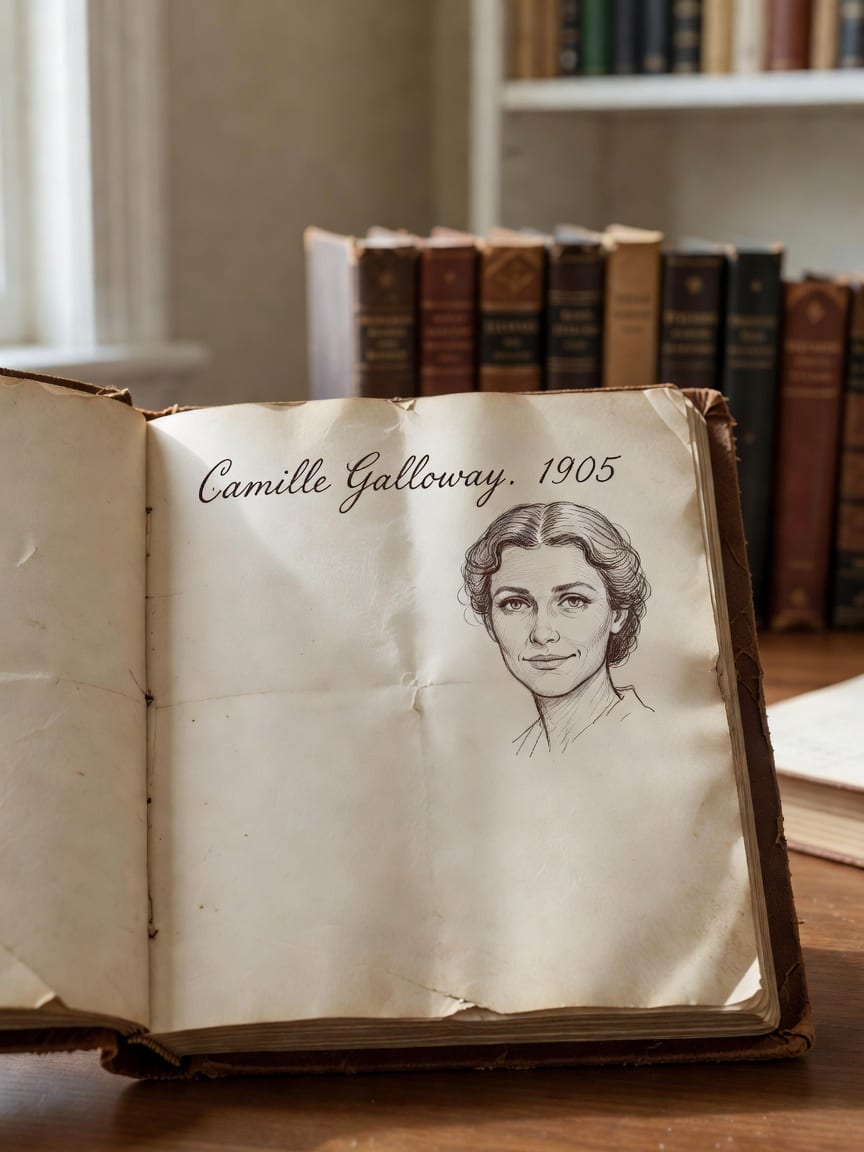
My signature is in this library book. Dated 1971, fourteen years before I was born. The card is real. My hand made those loops.
As a graphic designer, I'm meticulous, which suited my quiet evening shifts at the county archive. But a yellowed due-card, tucked in an old book, shattered my calm: my own signature was written next to the date 1971, fourteen years before I was born. An expert confirmed it was unequivocally mine.
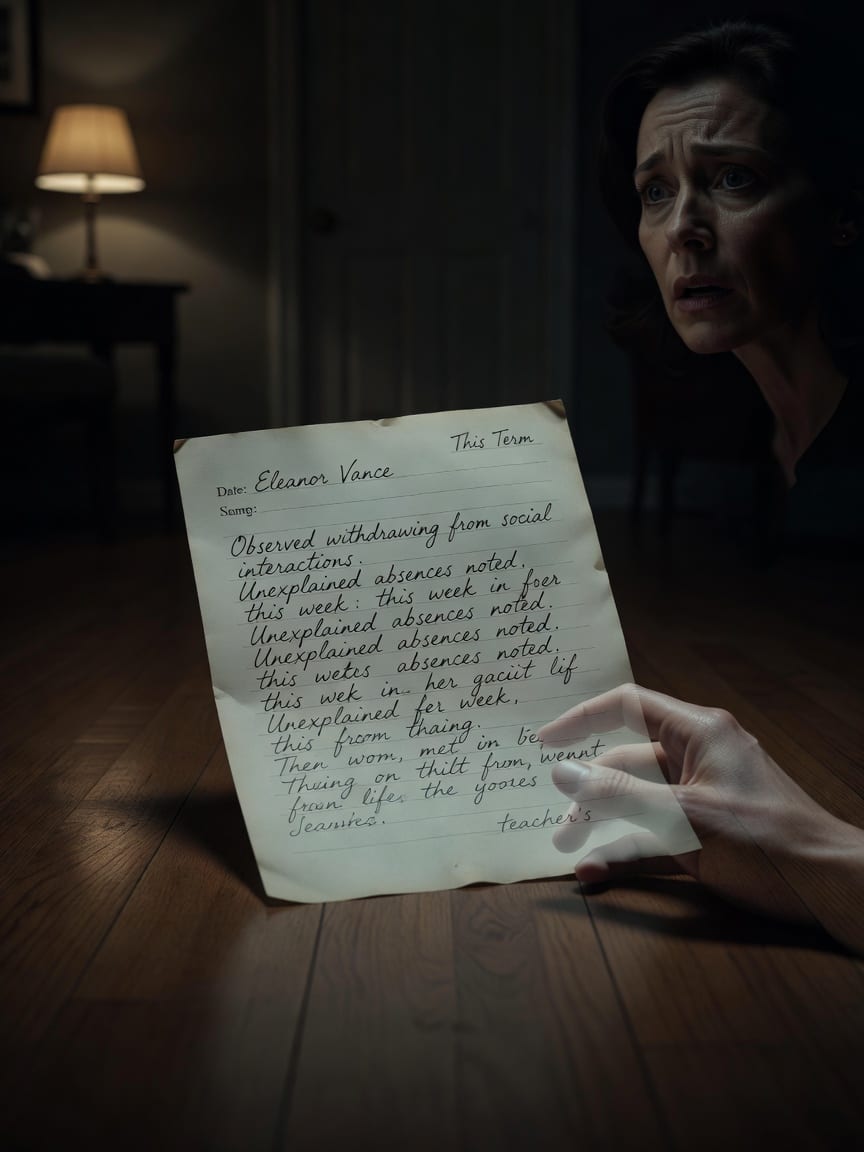
My school reports keep arriving, one a term, signed by teachers dead for decades. The latest describes something I'm doing *this week*.
My name is Eileen Caldwell, and my quiet life was upended by a school report from a place demolished decades before I was born. The report, signed by a long-dead teacher, eerily detailed my current habits. But the real shock arrived when I found my own name in a student register, dated 1968, with precise descriptions of my childhood—years before I existed.
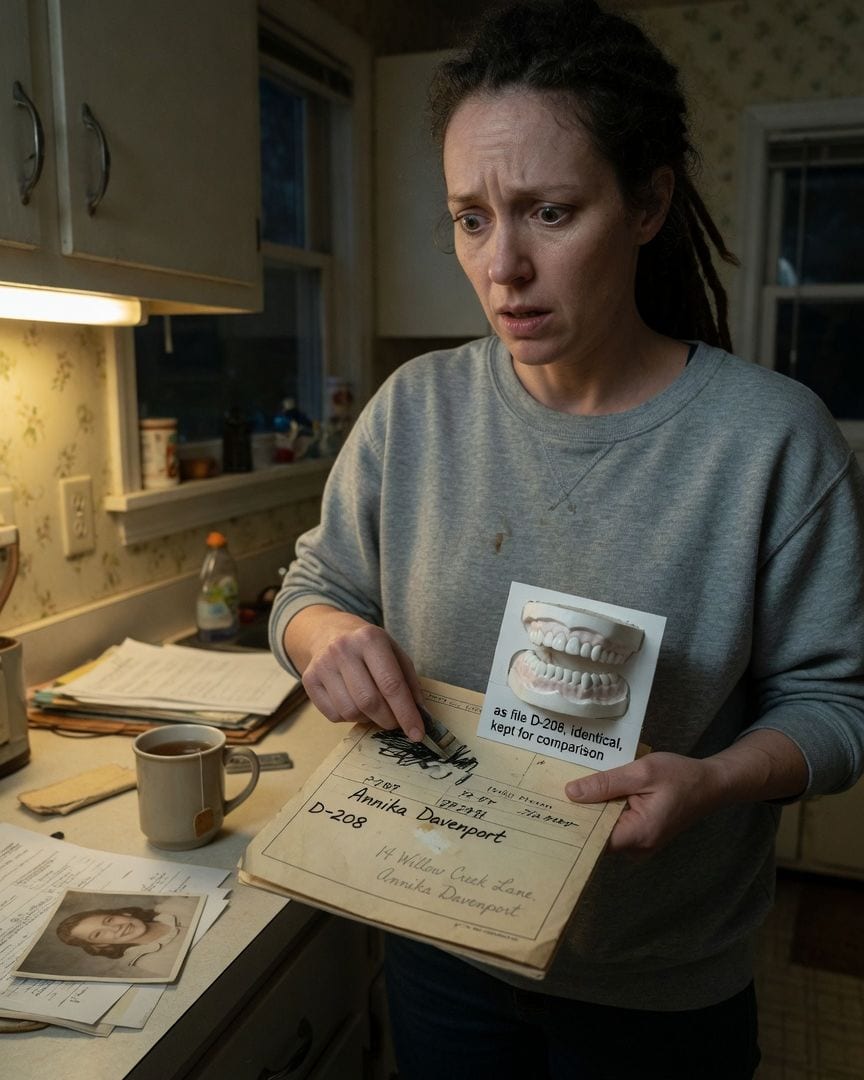
My childhood dental chart lists the house I bought last year — in my own name, years before I was born. A second set of my teeth sits filed beside it, marked 'identical.'
Sifting through old dental records, I found my chart, D-208, with my 1988 birth date. But a line from 1958 was blacked out, and a clipped card with an impression of my teeth listed my name and current home address, decades before I was born. The impossible facts knotted into a cold certainty.
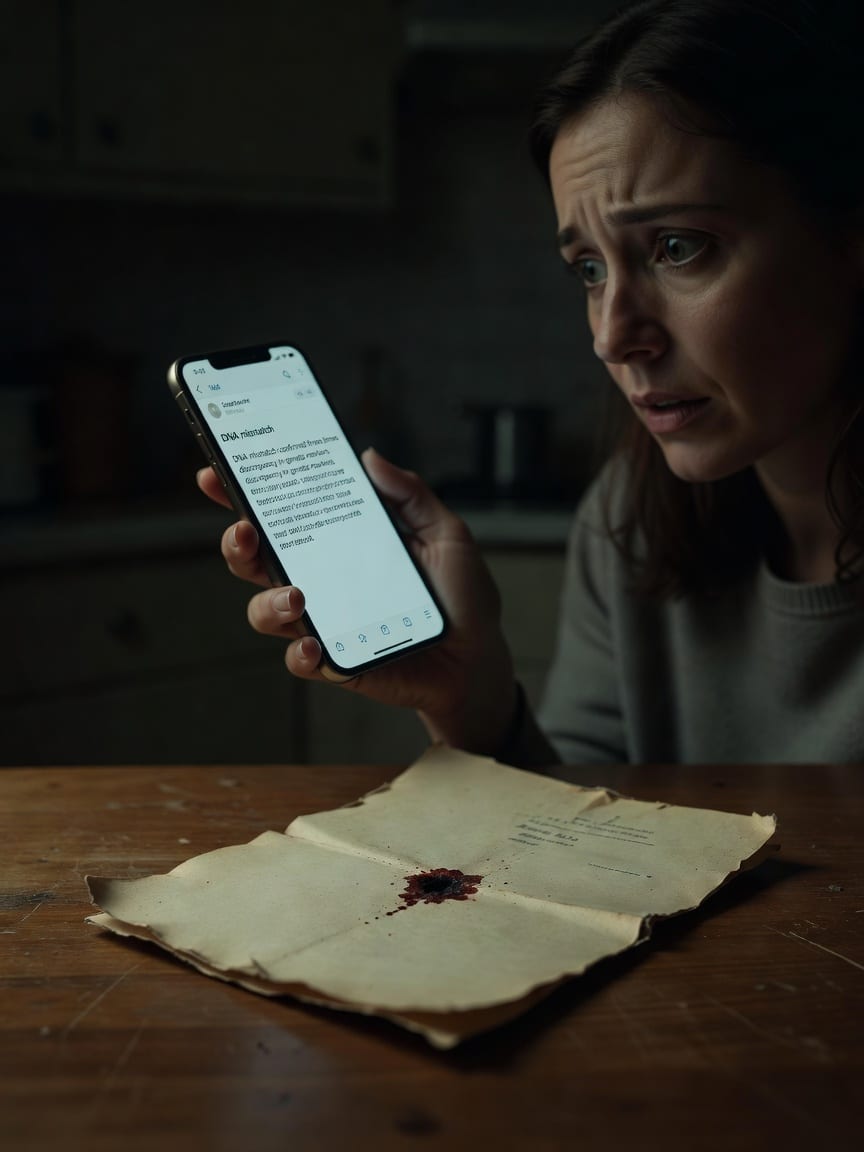
My baby bl**d card doesn't match my own DNA today. The lab ran it three times, confirming the dried spot and my living swab come from two different people.
Sitting at my kitchen table, I opened an email that shattered my quiet afternoon. I'd sent my newborn heel-prick card to a genealogy lab out of harmless curiosity. The results were devastating: the bl**d on that card, preserved for three decades, does not match my DNA.
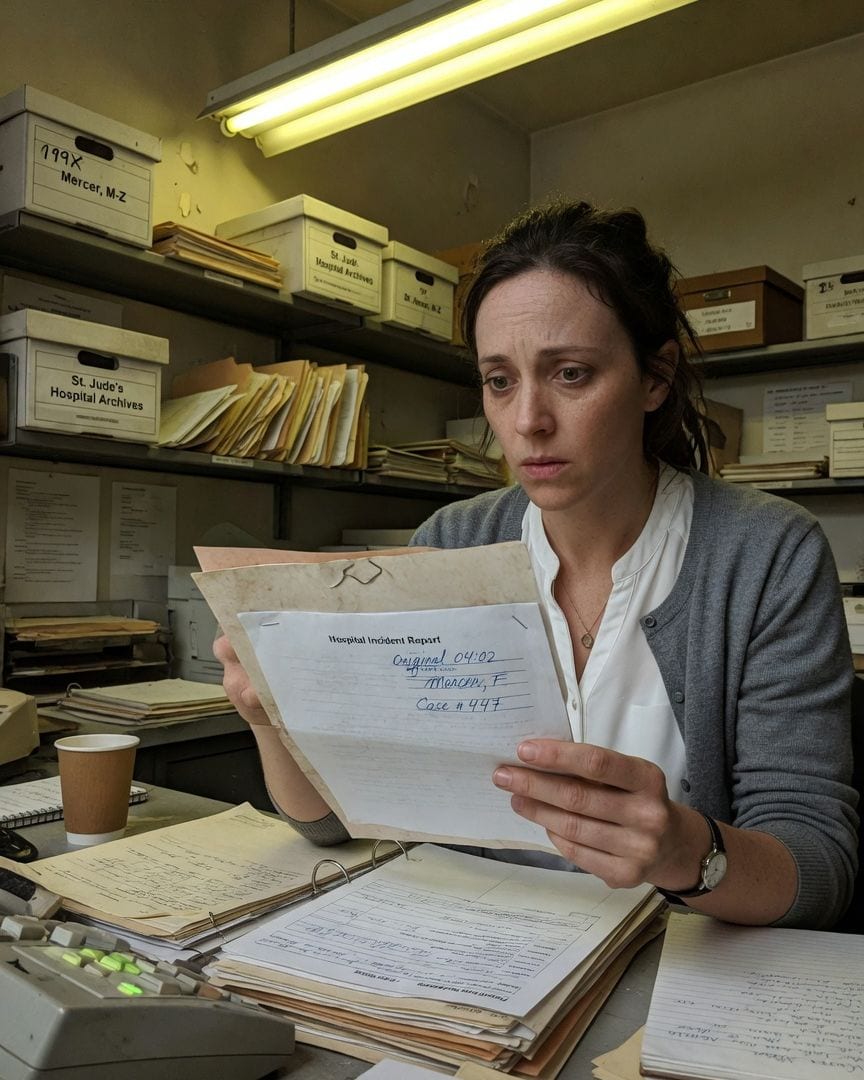
My newborn bl**d card doesn't match my DNA today. The lab ran it three times, confirming the dried spot and my living self are two different people.
Alice Mercer, a geneticist, sends her decades-old newborn bl**d sample for DNA analysis, expecting ancestral markers. Instead, the lab calls with an anomaly: her baby bl**d and current DNA are from two different people. As her mother grows evasive, Alice uncovers a hospital incident report that lists two distinct birth times for her on the same day.