Private Marsh's boots kept reappearing at the Cold War memorial, worn deeper each dawn, even after Staff Sergeant Brooks put them away.
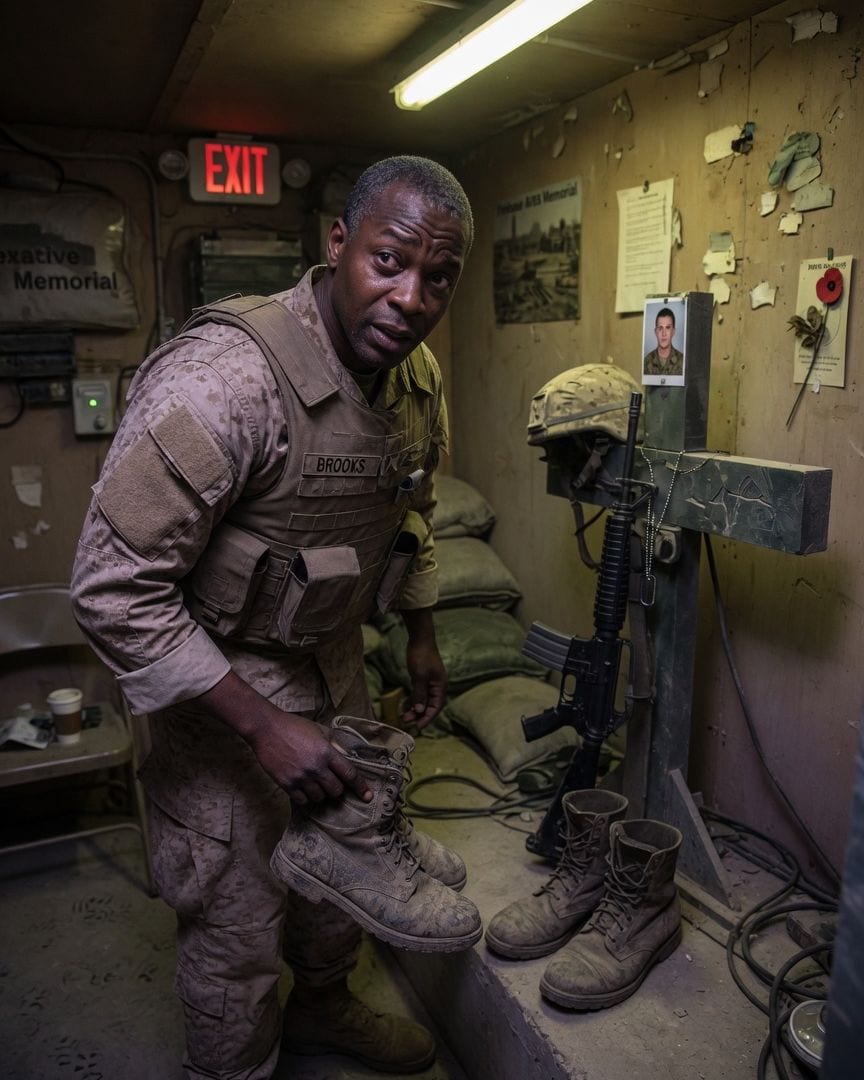
The memorial alcove at Firebase Ares was usually quiet, a place for somber reflection. Tonight, Staff Sergeant Samuel Brooks found it profoundly unsettling.
Private Marsh’s combat boots, scuffed and mud-caked, sat neatly at the base of the battle cross rifle, laces open as if just shed. This was the third morning Brooks had found them there.
He himself had placed them back in Marsh’s bunk each previous night, lacing them tight. Marsh, a cocky new recruit, had straightened a fallen dog-tag chain on the cross a week ago on a dare, a seemingly innocuous act.
Now, his boots walked themselves. Brooks picked them up, the leather stiff and cold, but undeniably more worn, the tread on the soles noticeably shallower than he remembered.
He checked Marsh's bunk again; the kid was still asleep, his own feet tucked under a blanket. No way he'd been out. Brooks sighed, running a hand over his close-cropped hair. Prank? Fatigue?
The quiet hum of the base generators felt suddenly amplified, and the memorial alcove, usually a place of honor, now felt like a stage for a silent, impossible ritual, the boots waiting for their next dawn performance.
Brooks spent the next few days observing. He moved Marsh’s boots back to the bunk each morning, then logged the time he found them back at the memorial. The pattern was precise: always between 0200 and 0300.
He even set up a motion-activated camera, but the footage showed nothing but static during the crucial hour. No one entered or left the alcove. Yet, each morning, the boots were there, and the wear on them deepened.
Not just scuffs, but actual, measurable erosion of the rubber soles, scuffs consistent with hard movement over rough terrain. Marsh himself seemed oblivious, complaining only about his boots feeling 'tight' or 'off.'
Brooks tried to rationalize it: a unit prank gone too far, a sleepwalker, a faulty camera.
He even swapped Marsh's boots with an identical pair from supply, but the new boots, too, began their nightly pilgrimage, returning to the memorial with inexplicable wear. The only constant was the battle cross itself.
One evening, after placing the latest pair of 'walking' boots back in Marsh's locker, Brooks returned to the alcove alone. He examined the memorial rifle, a standard-issue M16, its bayonet plunged into the earth.
He ran his hand over the cold metal, searching for anything amiss. A loose screw, a hidden mechanism. Nothing.
But as his fingers traced the worn stock, he felt something: faint, almost imperceptible indentations beneath layers of paint and grime, a texture that wasn't part of the rifle's manufacturing.
Brooks returned that night with a high-intensity flashlight and a fine-bristled brush. He carefully cleaned a section of the rifle stock, then angled the light, his breath held tight in his chest. The faint indentations resolved into etched script.
A name. 'PFC. Montgomery, E.' Followed by a series of numbers, a partial service number. And a date: 1987. Not Marsh’s name, not anyone from their current unit, and certainly not a date from any recent conflict.
This wasn't a memorial to a single fallen soldier. This was a record. He cleaned another section, revealing another name, another older date.
The memorial wasn't just a monument; it was a ledger, carved into steel, and its entries stretched back decades, far beyond the history of Firebase Ares as they knew it.
The etched names sent a cold shiver down Brooks's spine that no rational explanation could dispel. He began digging into the old records of Firebase Ares.
The base was slated for decommissioning in a month, so access to archived manifests and after-action reports was easier than usual. He spent his off-duty hours in the dusty administrative office, poring over microfiche and digitized files.
He found no 'PFC. Montgomery, E.' in any official records for the base's known operational history.
But a pattern emerged: every few years, a soldier would be listed as 'transferred' or 'reassigned' under unusual circumstances, often without a clear destination unit or a follow-up record.
These 'transfers' seemed to cluster around periods of command change or significant base events. He cross-referenced the names he found on the rifle with the 'transferred' lists. A few matched, their records ending abruptly, their service effectively vanishing.
The official explanations were vague: 'administrative error,' 'lost paperwork,' 'desertion.' But the pattern was too consistent. He felt Captain Florence Donovan’s eyes on him often.
Her office was across the hall from the archives, and she’d occasionally step out, offering a cool, polite inquiry about his research. 'Looking into base history, Staff Sergeant? Fascinating, but I'd recommend focusing on our current redeployment plans.
Older records can be... unreliable.' Her voice was calm, almost soothing, but there was an underlying current of warning, a subtle implication that he was treading where he shouldn't. The unease grew.
The 'unreliable' records, the 'lost' soldiers, the 'walking' boots, and the captain's unnerving composure. It all started to coalesce into something far more sinister than a prank or a glitch.
The warnings from Captain Donovan became less subtle. Brooks found his personal locker subtly disturbed one morning, his spare boots moved from their usual spot.
His radio, left on a secure channel in his barracks room, crackled to life in the dead of night, not with static, but with a faint, distorted whisper, a voice that seemed to be saying his name.
He dismissed it as interference, but the hairs on his neck stood up. He felt watched, not just by Donovan, but by something else, something unseen that knew his movements, his thoughts.
One afternoon, he found Sergeant Vanessa Hartley, one of his subordinates, trying to access the old administrative files he’d been using. She looked startled when he walked in. 'Captain Donovan asked me to tidy up the archives, Staff Sergeant.
Said they were getting a bit... cluttered.' Hartley looked genuinely uncomfortable, her eyes darting away. It was a clear message: Donovan was actively trying to cover his tracks, or prevent him from making new ones.
That night, Brooks decided to set a trap. He left a specific, unmarked file on his desk in the archives, a file containing a blank manifest.
He then hid in a storage closet nearby, watching through a narrow gap in the door. Hours passed. Then, the door to the archives creaked open. It wasn't Donovan, nor Hartley.
It was Private Maxwell Hawkins, another of his soldiers, looking pale and nervous. Hawkins went straight to Brooks’s desk, picked up the unmarked file, and placed it inside a locked cabinet, one Brooks hadn't even known existed.
Hawkins moved with a strange, almost robotic precision, his eyes wide and unfocused, as if he wasn't fully himself. The dread solidified: it wasn't just Donovan, it was already inside the unit, using his own soldiers.
Brooks confronted Captain Donovan in her office the next morning, the blank manifest file in his hand. 'Captain, I need to understand what's happening.
The boots, the names on the rifle, the missing records, Private Hawkins moving files he shouldn't even know about.' Donovan listened, her expression unreadable. She motioned for him to sit. 'Staff Sergeant, you've been persistent. More so than others.'
She leaned forward, her voice a low, steady hum. 'Firebase Ares isn't just a strategic outpost. It sits on a... particular location. A place where a covenant was made, long ago, by those who came before us.'
Brooks felt a chill that had nothing to do with the air conditioning. 'A covenant?' Donovan nodded. 'The memorial isn't for the dead, Staff Sergeant. It's a ledger for the claimed. A payment. To keep something far worse from surfacing.'
She explained that the entity beneath the base required periodic 'tribute.' A soldier, chosen by... a certain criteria, would be marked. Their boots would begin to walk, signifying their transition to 'service' on the other side.
The wear on the boots, the impossible journeys, were real. 'The system,' she continued, 'our meticulous military records, our rotations, our transfers... it all creates the perfect cover. A way to account for the unaccountable.'
Brooks thought of the 'transferred' soldiers, their records ending abruptly. He thought of Marsh’s boots, the increasing wear. It all clicked into a horrifying, coherent pattern. 'And the names on the rifle?' he asked, his voice tight.
'The roster,' Donovan confirmed. 'Each name is a payment. A life given, to maintain the balance. My predecessors, and now I, have been tasked with ensuring the covenant is honored. It’s a grim duty, but necessary.'
She looked at him, her eyes ancient and tired. 'Some things are worse than war, Staff Sergeant. Far worse.'
Brooks stared at her, the words like ice in his veins. 'How are they chosen? How do you… select?' Donovan’s gaze was unsettlingly calm as she pointed.
Samuel Brooks’s eyes followed her finger to the rifle stock, to a fresh, almost invisible etching nestled among the old, forgotten names. His own name. Staff Sergeant Samuel Brooks. Followed by his service number.
And a date just three weeks from now. His breath hitched. He wasn't just an investigator. He was an entry.
Brooks felt a sickening lurch, a sudden, horrifying clarity. His own name. He looked up at Donovan, his face pale. 'This isn't just about Marsh, is it? It was always about me.' Donovan’s composure remained unbroken.
'The entity beneath Firebase Ares is ancient, Staff Sergeant. It predates any military presence here. It's a territorial claim, a hunger. When the first outpost was established, a... compromise was made. A covenant.
Certain individuals, those who show a particular aptitude for observation, for seeking truth where none should be found, are periodically marked. They become the 'eyes' and 'ears' on the other side, maintaining the balance.'
She explained that the military's rigid structure, its constant flow of personnel, inadvertently provided the perfect 'harvest.' The memorial was a focal point, a conduit. Marsh, by disturbing the dog tags, had simply activated the latest claim: Brooks himself.
The entity had noticed his meticulousness, his refusal to accept mundane explanations. His investigation hadn't led him to the truth; it had merely confirmed his suitability for the 'role.'
Every 'transferred' soldier, every name on the rifle, every worn boot — it all clicked into a terrifying, perfect machine.
The military, the most ordered system on earth, was unknowingly feeding an ancient, insatiable chaos, and Captain Donovan was its quiet, unwilling steward.
Brooks stood, pushing back his chair with a scrape that echoed in the quiet office. 'I won't. I won't be another name on your ledger.' Donovan merely watched him, her eyes devoid of judgment or fear.
'You don't have a choice, Staff Sergeant. The covenant is binding. If it's broken, if the tribute is refused, the entity will simply take what it's owed, and far more besides. The 'greater horror' I spoke of?
It's not a metaphor. This base, this entire sector, would be consumed. We contain it, we manage it. You are simply the next payment.' Brooks's mind raced. He could try to expose her, expose the truth.
But who would believe him? A decorated Staff Sergeant claiming an ancient entity demanded human sacrifice, managed by his commanding officer? He pictured the reaction: immediate psychiatric evaluation, dishonorable discharge, his career, his life, utterly destroyed.
And even if they believed him, what then? Would they fight an ancient horror with artillery? He thought of Private Marsh, still oblivious, still sleeping in his bunk. He thought of Hawkins, used as a puppet.
He looked at Donovan, her face etched with a silent, profound weariness. She was trapped too, an unwilling cog in a terrible machine. The calm in her eyes was not resignation, but an acceptance of the inevitable.
He could not fight the system. He could not fight the covenant. He could only choose how he entered the ledger. He stared at the rifle stock, at his name, now horribly clear.
He saw no escape, only a choice between chaos and a chilling, personal sacrifice.
Firebase Ares was decommissioned precisely on schedule. The last units pulled out, leaving the remote outpost to the dust and wind. Captain Florence Donovan was honorably discharged, her service records impeccable, and she disappeared quietly into civilian life.
Staff Sergeant Samuel Brooks, after a brief, unexplained medical leave, was transferred to a new, equally remote post, far from any memorial alcoves. He carried no scars, no physical wounds, but the quiet in his eyes was different, deeper.
He was meticulous in his duties, more so than ever, but his gaze often lingered on the faces of new recruits, a calculating assessment in their bright, eager eyes.
Months later, at his new post, Samuel Brooks was assigned a fresh-faced Private, barely out of basic training. The young man, Private Sutton, was a quick study, observant, and asked too many questions about local history.
Brooks found himself watching Sutton, a familiar dread settling in his gut, but now mixed with something else: a cold, detached understanding.
One morning, Brooks walked past the small, dusty memorial alcove at the new base, a modest display for local fallen heroes. He paused. A pair of worn, muddy combat boots sat at the base of the memorial rifle, laces open.
They were not Sutton’s. Not yet. Brooks knew the drill. He picked them up, his fingers brushing against the cold leather, already feeling the subtle, impossible wear. He knew where they would go next. He knew what they meant.
He had become the one who knew. He had survived, but he was not saved.
He walked away from the memorial, the boots in his hand, and for the first time in months, a faint, knowing smile played on his lips.
The new Staff Sergeant, a fresh face and sharp uniform, found the boots again, neatly placed, waiting to be filled, and Samuel Brooks watched him from the shadows, a faint, knowing smile playing on his lips.
If this one got to you
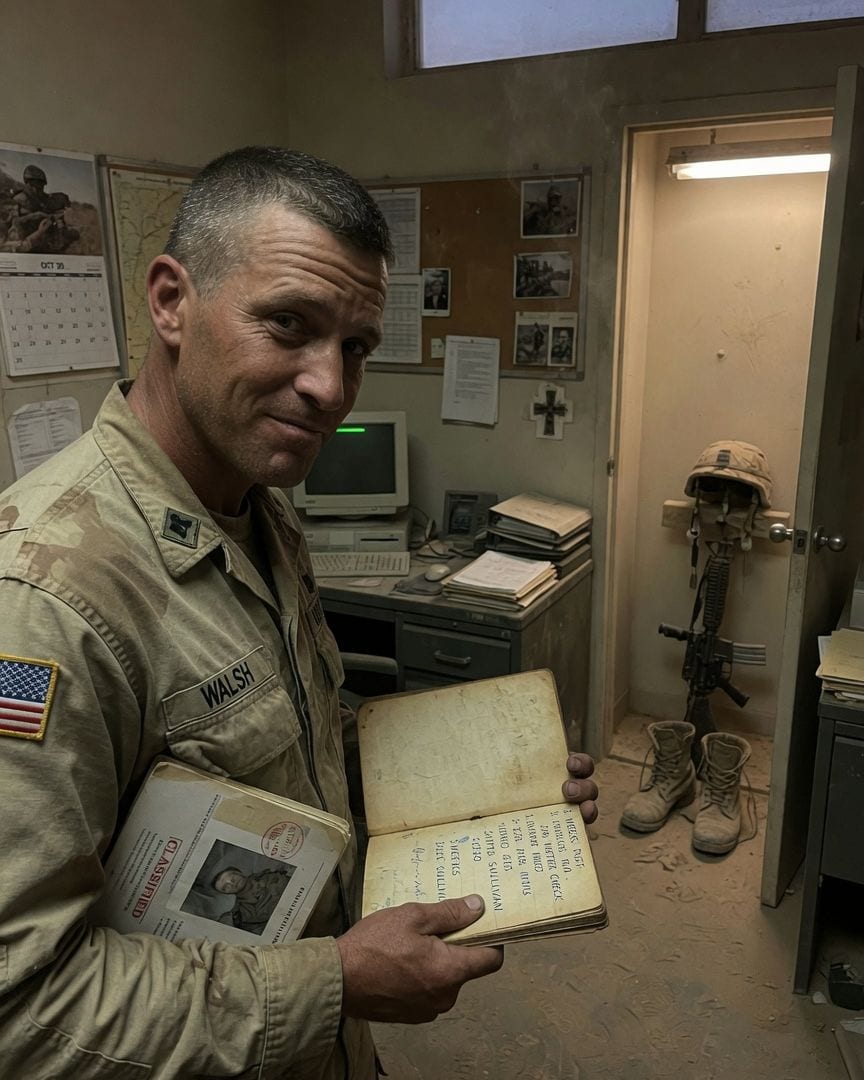
A Staff Sergeant watched combat boots reappear at the memorial each dawn, their soles deepening with scuffs that no living soldier made.
Staff Sergeant Raymond Walsh walked his routine patrol at FOB Kestrel, passing the memorial alcove where a battle cross stood reverently. The quiet space held a pair of worn boots at its base, a detail Raymond first dismissed as a sophomoric prank. But each dawn, the same combat boots reappeared at the memorial, their laces open, showing fresh scuffs and deepening wear inconsistent with any living soldier’s duties. Raymond's rational mind struggled as the boots defied logic, mirroring the growing dread of Private Marsh, who swore they never left his locker. Why did these boots keep returning, carrying the marks of impossible journeys?
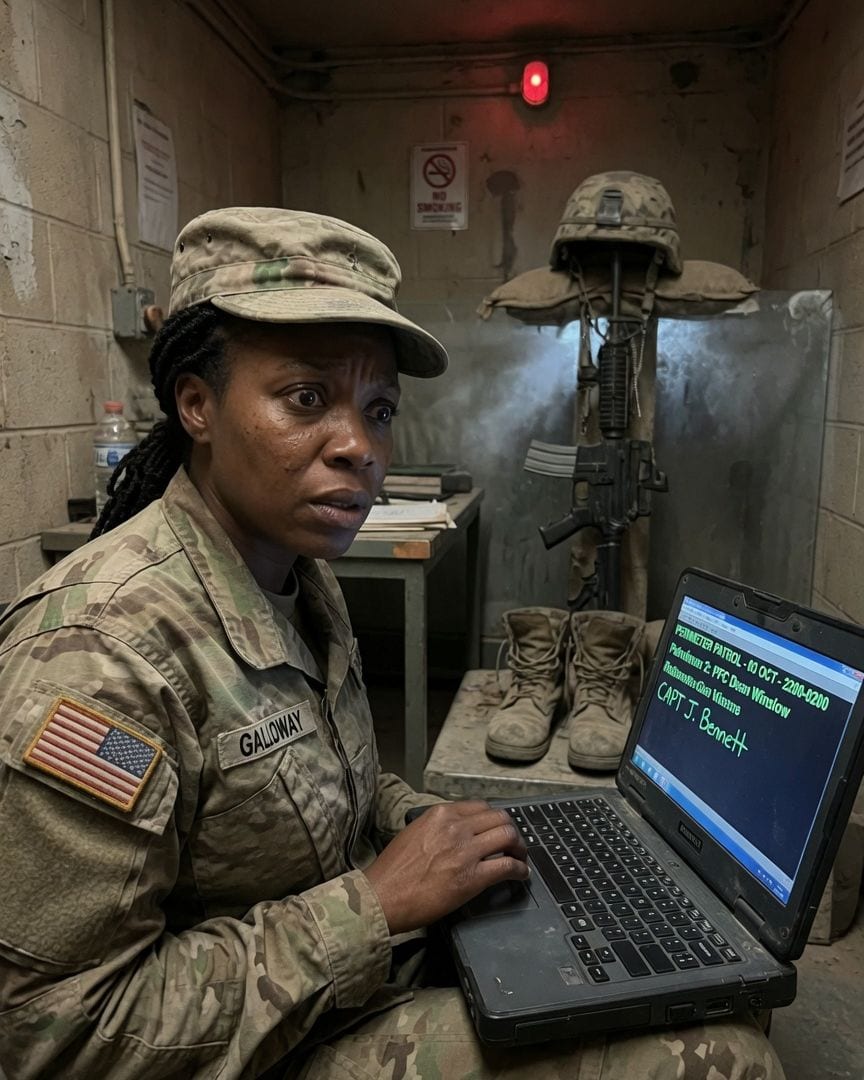
A sergeant found a dead soldier's dog tags on the memorial. He'd been MIA seventy years, but signed a patrol log last Tuesday.
Sergeant Constance Galloway, a squared-away NCO, maintained order at Firebase Alpha, where the desert sun baked the concrete and a solemn battle cross memorialized the fallen. After Private Marsh's rookie prank, Galloway found his combat boots inexplicably at the memorial, then reappearing more scuffed the next dawn. Marsh's genuine fear and the boots' unexplained travels pricked her professional doubt, leading her to investigate the memorial's history. Her search revealed the dog tags belonged to PFC Dean Winslow, declared MIA seventy years ago, yet his name appeared on the base's patrol log for last Tuesday. How could a soldier lost for decades be listed as completing a perimeter patrol just days ago?
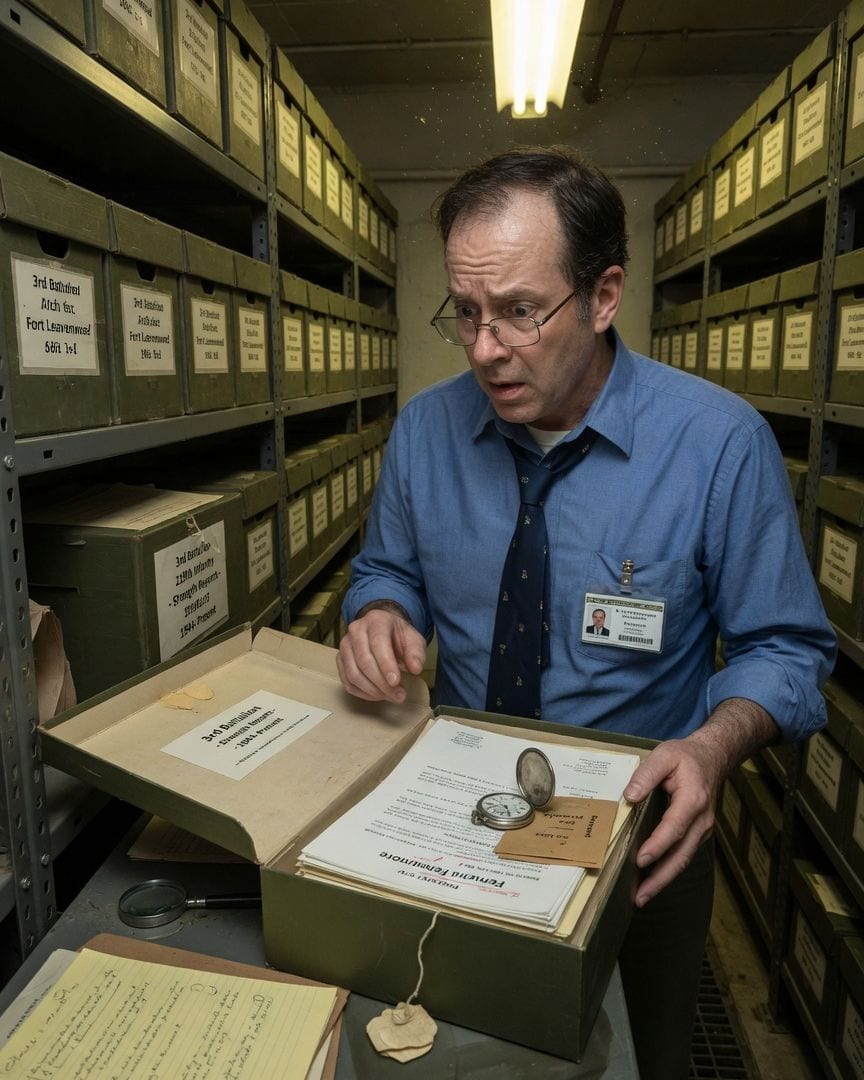
On his last Friday, an archivist finds his dead father's pocket watch in a Cold War ghost unit's file, ticking and warm.
Marcus Fennimore, a meticulous archivist, was on his final Friday at Fort Leavenwood's lineage vault, a place he knew intimately after thirty-one years. He stumbled upon twenty-two dust-sealed boxes for '3rd Battalion, 219th Infantry'—a unit that, according to every official record, simply did not exist. Inside, reports ran from 1944 to just last month, with the most recent listing his long-dead father, Kenneth Fennimore, as 'absent.' Marcus’s own father. Then, from a 1944 folder, he pulled his father's actual dog tags and a silver pocket watch, inexplicably warm and steadily ticking, freshly engraved with 'K.F. - Present for Duty.'
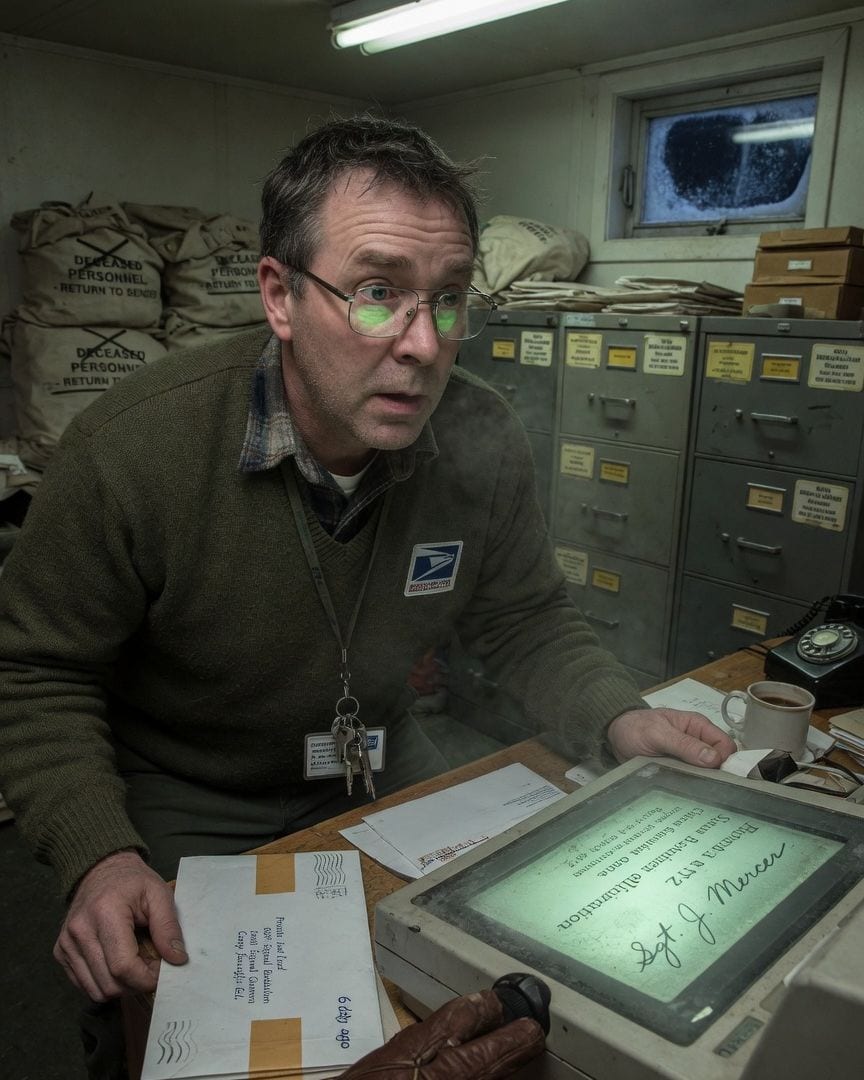
A postmaster at a Cold War Alaskan outpost still received mail for soldiers declared dead in 1969. Then he found their base was active three years later.
Postmaster Rowan Ashcroft had spent two decades watching the weekly mail plane land at Camp Bidwell Annex, a lonely outpost in the bitter Alaskan wind. His methodical mind, accustomed to order, was jolted when the latest mail sack contained forty-three letters for men officially declared dead in 1969. Each envelope, postmarked within days, was addressed to a soldier who wasn't coming back, and Rowan found one already opened and neatly resealed. Driven by duty, he began to sift through declassified Army archives, only to uncover a chilling maintenance log entry for the camp's equipment, dated three years after the base was officially shuttered. What was still happening at Camp Bidwell?
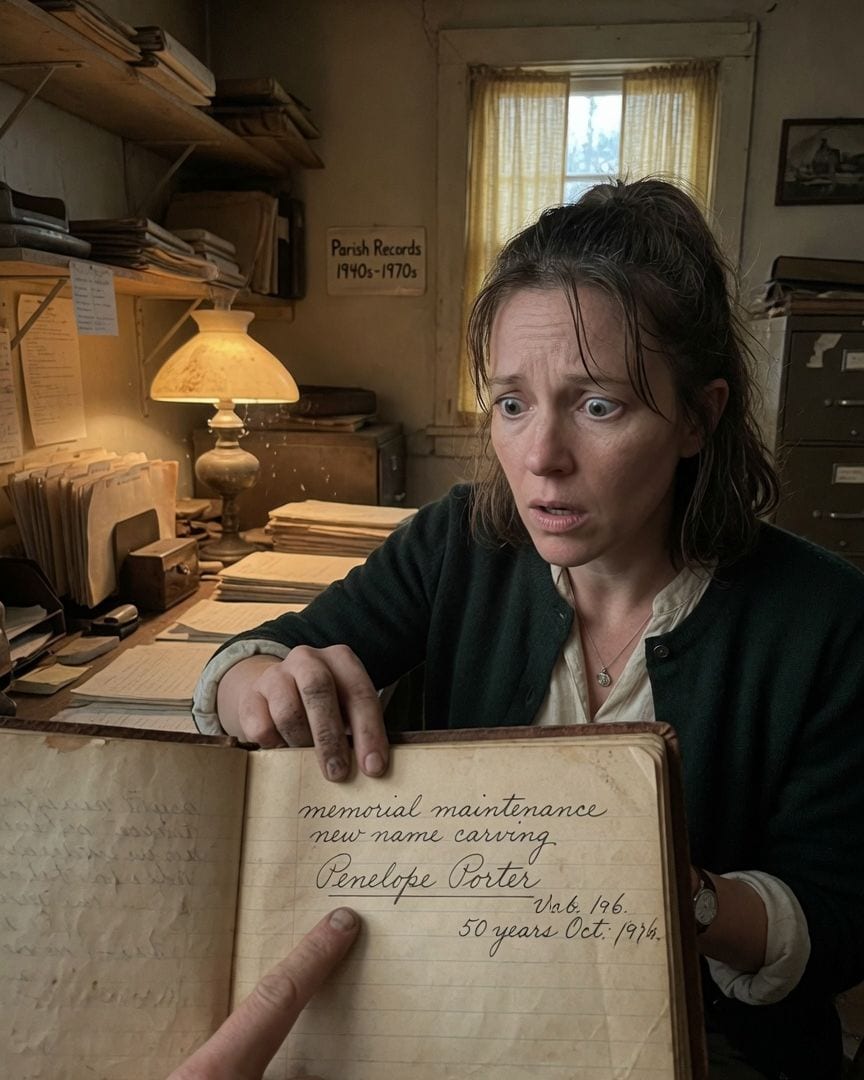
My name is carved on the war memorial with this coming Tuesday's date. The cut is fresh, but the stone inside matches fifty years of age, and a ledger says it was carved exactly fifty years ago.
On a sunny autumn Tuesday, my oldest friend, Gary, urgently called me to the village war memorial. There, carved beneath the names of the fallen, was 'PENELOPE PORTER' with a date from this coming autumn. The fresh carving of my name, dated for a Tuesday yet to arrive, felt like a cold jolt, an impossible message from the stone itself.
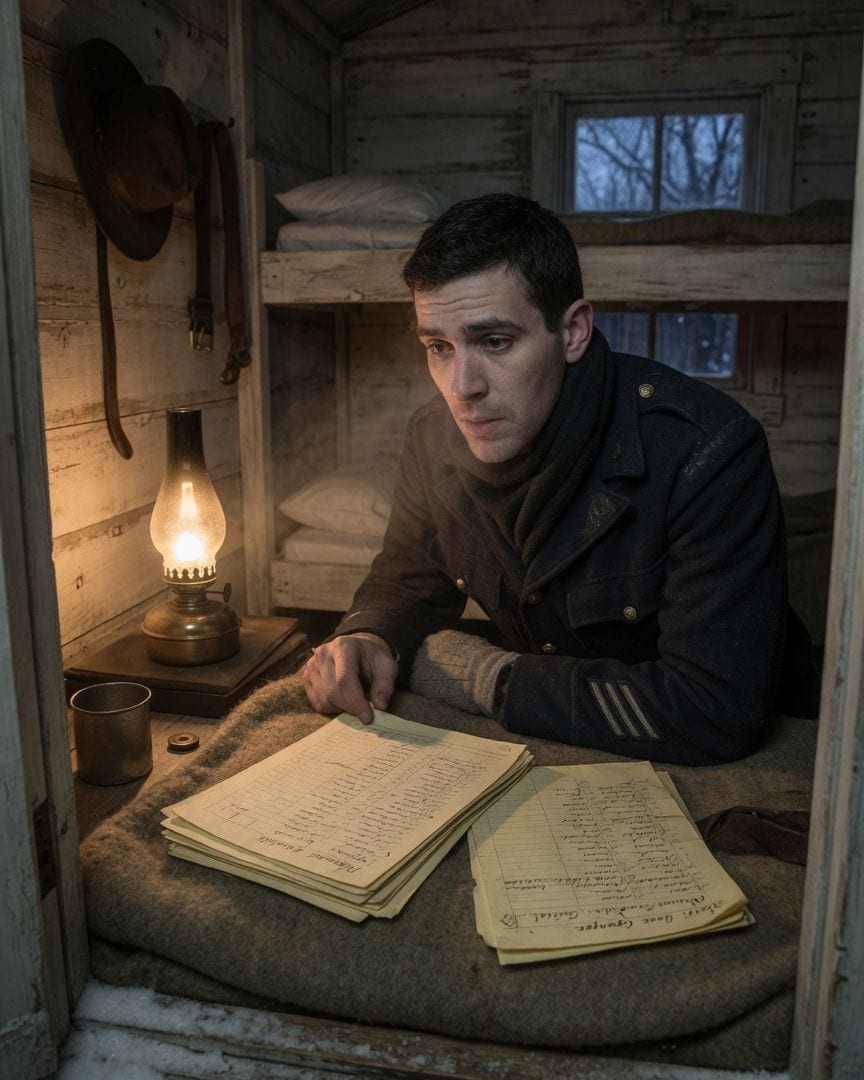
On his last watch, Corporal Carter found boot prints ending inside a sealed magazine, and a blood-red handprint from a soldier decades out of time.
Corporal Franklin Carter shivered, not from the biting November wind, but from the chill of his last pay muster at Fort Taggart before its winter abandonment. His final duty was to count every man, tallying thirty-seven, precisely the company strength. But his breath hitched when he saw the completed roll: it ran thirty-eight names long. An impossible extra slot, filled by a voice that answered 'Here, Corporal,' for a soldier whose name, Pvt. Isaac Granger, vanished from all official records, only to reappear in a forgotten supply log from 1863. Was Fort Taggart abandoning its dead, or something far older?