Public Affairs Officer Reece Alderfield watched the Cold War destroyer escort Lunt Hemmerly livestream. Its hull bore an impossible weld: 'JAN 1949,' the very day it vanished.
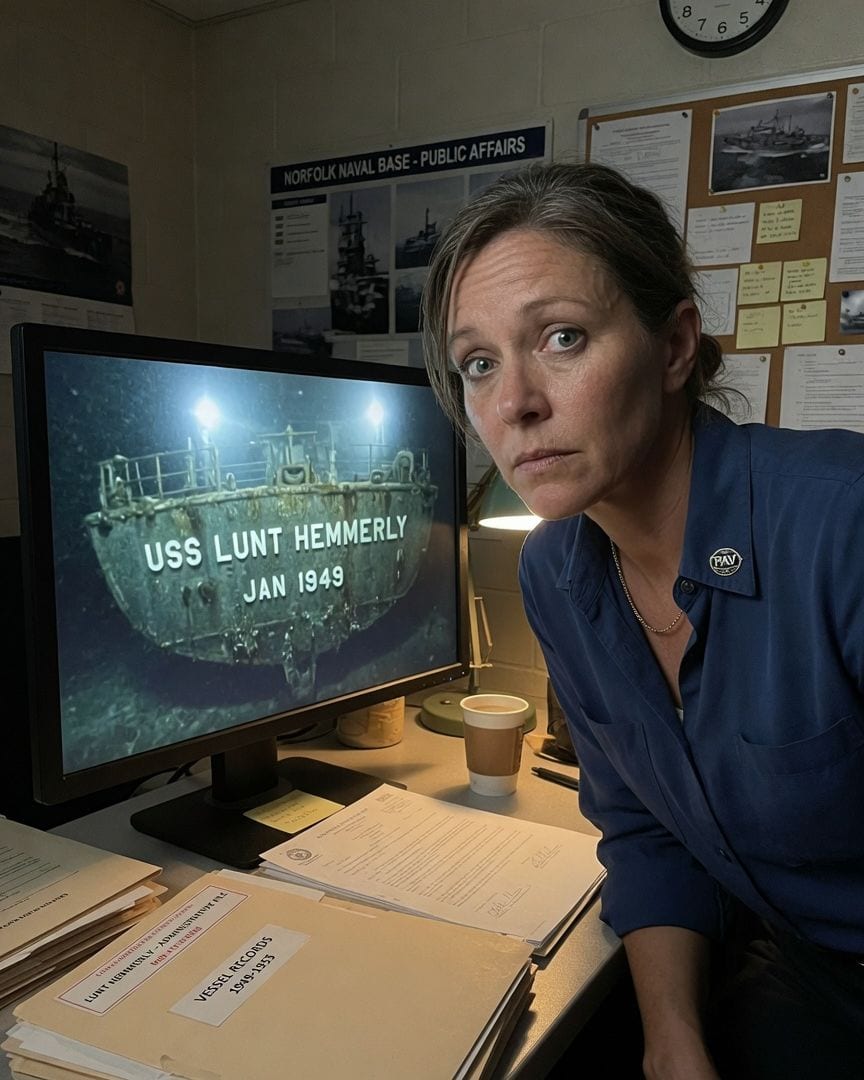
Public Affairs Officer Reece Alderfield leaned close to the monitor, the cold glow of the wreck survey livestream reflecting in her eyes.
The pier at Norfolk had been full of families at dawn on a January morning in 1949, waiting on the destroyer escort Lunt Hemmerly, and it had filled again at dawn last month when the wreck survey began to livestream its first floodlight.
Reece, 38, watched the feed from her office, a necessary bureaucratic chore for the Navy, but she couldn't deny the morbid pull.
The remote camera, mounted on an ROV, came around the sunken ship's stern, its hull encrusted with decades of growth. The ship's name, 'USS LUNT HEMMERLY,' emerged from the gloom, clear and stark.
And under it, welded to the plate in a neat, unhurried bead, was a second line of letters that no shipyard had ever put on a ship: the date, in numerals, of the morning they were all standing in.
'JAN 1949,' it read. Reece blinked. An impossible detail. A joke, maybe, or a trick of the light, but the feed was crystal clear, and the weld looked as old as the rust around it, yet undeniably there.
Reece spent the next two days trying to debunk the image. She pulled every available record on the Lunt Hemmerly. Logbooks, decommissioning papers, missing vessel reports – all consistent. The ship vanished without a trace in January 1949.
No distress call, no wreckage beyond a few life rafts found weeks later, no survivors. Yet the date on the hull, a stark, precise 'JAN 1949,' nagged at her. It wasn't just a date; it was the date.
She started digging deeper, past the public records, into the obscure archives accessible only to senior PAO staff. She searched for any anomalies, any misfiles or contradictory reports.
She checked the shipyard manifests for the Lunt Hemmerly's construction, reviewed photographic archives from its launch, even cross-referenced common naval pranks from the era. Nothing. The date was an anachronism, a ghost in the steel, and no standard explanation fit.
What she found wasn't a clerical error, but a chilling consistency. Tucked away in a sub-section of 'historical vessel records,' she located the Lunt Hemmerly’s full administrative file. It was thick, meticulously kept. And it didn't end in 1949.
There were muster rolls signed in 1950, requisitions for spare parts dated 1951, maintenance sign-offs for hull inspections in 1952. Each entry was in a different, steady official hand, complete with stamps and signatures.
The paperwork continued, as if the Lunt Hemmerly were still an active vessel, years after everyone named in it was gone.
Reece scrolled through the last pages of the Lunt Hemmerly’s file, her heart thumping. The entries finally tapered off in late 1953. The final document was a personnel transfer order.
It listed a Petty Officer First Class, a boiler technician named Simon Bryant, being reassigned from the Lunt Hemmerly to a 'Special Records Unit' at Norfolk Naval Base. The date on the transfer was November 12, 1953.
But what stopped Reece cold, making her lean back from the screen, was the signature. It wasn't the ship's captain, or any naval officer she recognized. It was a civilian name, neatly penned: H. Stratton.
Reece immediately cross-referenced H. Stratton within the Navy's personnel archives. The search yielded a single, dusty file: Harold Stratton, civilian records manager, employed at Norfolk Naval Base from 1947 until his retirement in 1978.
His record was unremarkable, filled with routine annual reviews and commendations for 'meticulous record keeping in sensitive operations.' A grainy, black-and-white photograph was attached to the file, showing a thin, bespectacled man with a precise, unsmiling demeanor.
He looked exactly like the kind of person who might sign off on an impossible transfer. The 'Special Records Unit' proved harder to trace.
Its official existence was brief, a footnote in a 1950s administrative reorganization, quietly dissolved in the early 1980s.
Its archives, a single line noted, were transferred to a 'deep-storage facility' on the base's periphery, a vast, climate-controlled bunker not unlike a tomb. The air in Reece's office seemed to grow heavier, pressing in around her.
This wasn't a clerical error; it was a deliberate, sustained effort. She requested access to the deep-storage facility's index, citing 'historical research for public outreach' – a common enough PAO request to bypass immediate suspicion.
The request was approved, with an unusual caveat: access required an escort from the facility's senior archivist. It felt less like a precaution and more like an observation.
The next morning, Reece found her access to the internal personnel database intermittently failing, specifically when she tried to search for any connections between Harold Stratton and other 'lost' vessels.
She tried to rationalize it as a server issue, restarting her computer twice, but the timing felt too pointed. The system seemed to recoil, the screen flickering to a 'data unavailable' message only when she entered specific search terms.
Then, an anonymous email landed in her inbox. The sender was '[email protected],' untraceable. The subject line was blank. The attachment was a single scanned page from a 1950s naval regulation manual. Reece opened it cautiously.
The page detailed 'Procedures for the Disposal of Irregular Records.' A section, highlighted in yellow, outlined the destruction protocols for documents deemed 'unfit for general archive due to classified or anomalous content.' The regulations read like boilerplate, impersonal and rigid.
But at the very bottom of the page, scrawled in a tight, precise hand that looked eerily similar to the signature of H. Stratton, was a handwritten note: 'Some files are never irregular.' The message was clear.
Someone knew she was digging. Someone was watching. The dread, once a cold intellectual puzzle, now felt like a hand on her shoulder, pressing down with a silent warning.
Reece met Charlotte Merritt, the senior archivist, at the deep-storage facility. Merritt, a woman in her early seventies with shrewd, observant eyes, moved with an unsettling quietness. Her sensible shoes made no sound on the polished concrete floors.
She led Reece through cavernous, temperature-controlled aisles, past rows upon rows of metal shelves that disappeared into the gloom. The hum of the climate control was the only sound, a low, constant drone that seemed to vibrate in Reece's bones.
Reece, feigning casual interest, asked about the 'Special Records Unit' archives. Charlotte paused, her gaze steady, fixing on Reece. 'A fascinating administrative footnote,' she said, her voice soft but clear, carrying unnervingly well in the vast space. 'They managed… continuity.'
Reece pressed, keeping her voice even, 'Continuity for what, exactly?' Charlotte gestured to a row of heavily secured filing cabinets, their steel doors gleaming faintly under the fluorescent lights. 'For things that required… extended administrative life. Beyond their physical one.'
Reece felt a chill, a spider-web touch against her skin despite the cool air. The pieces began to connect, terrible in their logic. She requested to see the specific file mentioned in Stratton's commendations, a 'Series 7-Delta: Operational Adjustments.'
Charlotte unlocked a drawer with a heavy key, the click echoing sharply. Inside, Reece found what looked like a ledger. It wasn't a ship's log. It was a record of records.
For the Lunt Hemmerly, it listed dates for payroll runs, supply requisitions, and position reports, all noted as 'maintained for continuity.' It wasn't about the ship's physical operations, but its administrative existence.
'The lost were never lost,' Reece whispered, the words tasting like ash in her mouth. 'They were filed.' Charlotte merely nodded, her expression unreadable. 'Meticulously. For as long as necessary.'
The date on the hull, the continuous paperwork, the 'Special Records Unit' – it all clicked into place, a horrifyingly coherent system. The dread was not in the mystery, but in the terrible logic of it all.
Reece continued to flip through the 'Operational Adjustments' ledger, her mind racing, trying to process the implications. If the Lunt Hemmerly's administrative ghost had been maintained for decades, what else? Who else?
She saw entries for other vessels, other units, some she vaguely recognized from other 'unexplained disappearance' files she’d reviewed as a PAO.
Each entry was a tiny puncture in reality, proving that the world was far more carefully cataloged than anyone understood. The air in the archive felt thinner now, harder to breathe.
Then, near the bottom of a page, in a different, more recent hand – less precise than Stratton's, but just as neat – she saw an entry that made the blood drain from her face.
It was dated just last week. The text was stark, undeniable, a punch to the gut. 'Alderfield, R. – File initiated. Projected maintenance: Ongoing.' Her own name.
Her own name, in a record that shouldn’t exist, in a system that shouldn’t be, marked with a status that promised no end. She looked up, her eyes wide, meeting Charlotte Merritt's. The archivist offered a faint, unsettling smile.
Reece felt a cold, quiet terror settle over her. 'My file?' she managed, her voice barely a whisper, the vast archive suddenly feeling claustrophobic. Charlotte Merritt nodded, her smile never wavering, her eyes holding an unnerving glint of understanding.
'You were always quite thorough, Ms. Alderfield. A rare quality, especially in this era. Your inquiries, your persistence… they indicated a certain aptitude.'
Charlotte led Reece to a small, unassuming office tucked away in a corner of the archive, a room filled with more ledgers and an old, humming computer.
The light here was softer, warmer, a contrast to the clinical glare of the main aisles. 'The 'Special Records Unit' never truly dissolved, you see. It simply evolved. It's a… necessary function.
Some things, some events, some individuals, are not meant to cease entirely. They are merely… reclassified. Given a new operational status. And for that, the records must continue.'
She gestured to the rows of files, to the hum of the computer. 'Every detail, every payroll, every requisition, every position report – it creates a continuous administrative existence. A proof. The date on the Lunt Hemmerly’s hull?
A simple receipt of filing. Its transition was complete, but its administrative life, its 'maintenance,' continued. Just as yours will.' The horror was in the calm, rational explanation, the bureaucratic precision of it all.
It wasn't evil; it was simply a process, cold and indifferent, consuming everything in its path.
'My administrative life?' Reece repeated, her mind reeling, trying to grasp the impossible concept. 'What does that mean?' Charlotte gestured to the chair opposite her desk, a plain wooden seat that looked as old as the ledgers.
'It means you have a choice, Ms. Alderfield. Your aptitude for understanding the true nature of these records is evident. You can become a keeper. You can assist in the ongoing maintenance. Or… you can become one of the maintained.'
Charlotte's gaze was placid, devoid of threat or malice, which made her words all the more chilling. The offer felt like a trap, carefully laid and impossible to avoid. 'The system requires diligent scribes. It is self-sustaining, as you've observed.
Your 'filing' has been initiated. Your old role, your public affairs duties, your conventional existence… they are already being administratively wound down. It will be a smooth transition, either way.'
Reece stood her ground, her fists clenched, the faint tremor in her hands the only sign of her terror. 'I won't be a part of this. And I won't let you… file me.'
Charlotte merely chuckled, a soft, dry sound that grated in the quiet room. 'My dear, the files are already signed. You are already part of it. The question is simply what form your continued existence will take.
The files always find their own scribes. Or they create them.' Reece felt a surge of cold defiance. 'I'll expose this. The Navy will shut you down.' Charlotte smiled, a serene, knowing expression that stretched across her face.
'The Navy manages what it understands. This… this is merely an extension of its deepest, most patient function. A quiet, necessary arrangement.' Reece turned to leave, to find a phone, to call anyone, to shout.
Charlotte's voice, calm and unbothered, followed her to the door. 'The process is already underway, Ms. Alderfield. Your file is active. It is, as they say, ongoing.'
Within days, Reece Alderfield’s access to naval databases was quietly revoked. Her office was cleared out, her personal effects boxed and left for pickup in the building's mailroom.
Her colleagues were informed she had transferred to an 'undisclosed special project,' a common enough occurrence in the sprawling bureaucracy of the Navy that no one questioned it too deeply.
Her name was quietly removed from active rosters, her email address deactivated. Calls to her personal line went unanswered, eventually leading to a recorded message indicating the number was no longer in service.
Her apartment lease was terminated, her utility accounts closed. The records department at Norfolk Naval Base continued its work, undisturbed, its files growing thicker every day, each page a testament to a quiet, meticulous process.
A new entry was added to the internal 'Special Records Unit' log, nestled between two older entries for 'Vessel 417-B' and 'Unit 9-Omega.' In Charlotte Merritt's neat, unhurried hand, it read: 'Alderfield, R. – Status: Filed. Maintenance commenced.'
Later that week, a junior archivist, passing Charlotte's office, heard her murmuring to herself. 'Another one filed,' she said, tapping a pen against an open ledger. 'The system is always in need of new entries.
And new hands to write them.' The pen clicked, a faint, rhythmic sound in the quiet office. The file was still being signed.
If this one got to you
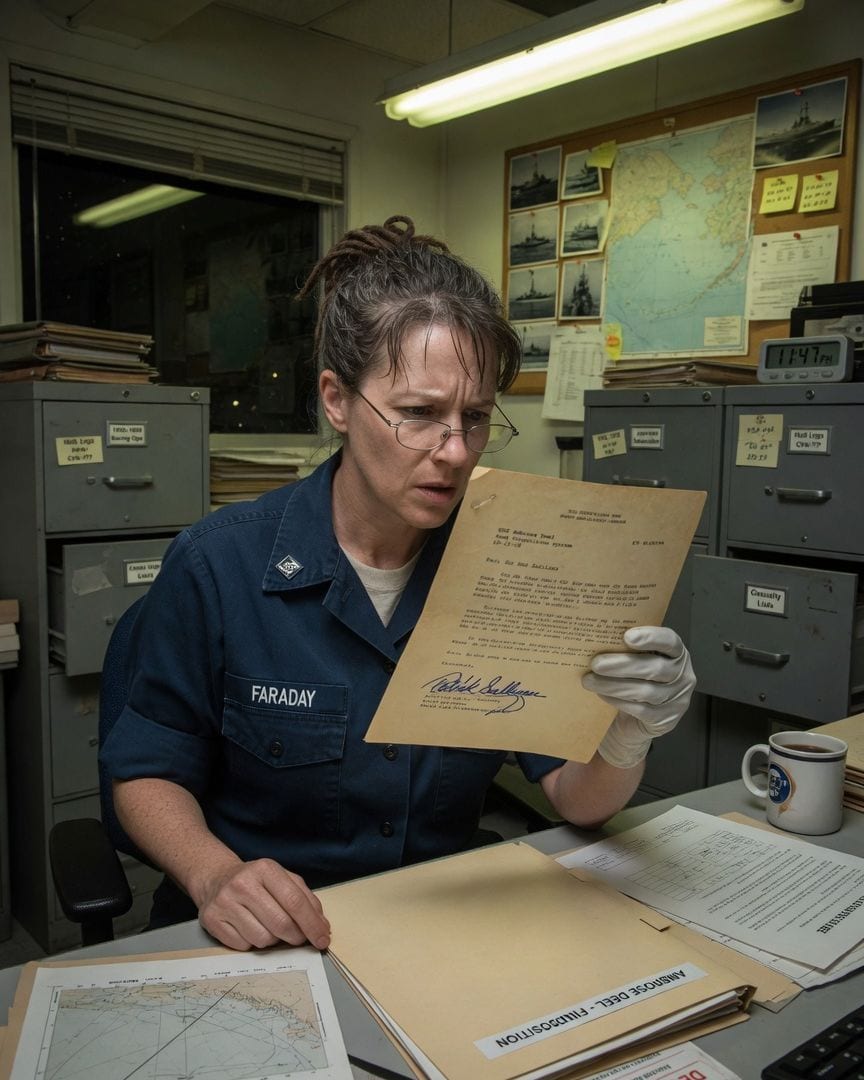
A naval officer closing a Cold War loss found the sunken ship's Chief Engineer signed its log three years after he died.
Lieutenant Commander Josie Faraday faced a Friday deadline to close a sixty-year-old Cold War naval tragedy, reviewing the USS Ambrose Deel's final disposition in the declassification office. Unease pricked at her as three official records agreed on the sunken fleet tug's location and towing vessel, yet Josie found no ship matching that hull number had ever been built. Sifting through brittle, salt-and-dust-scented papers, she then discovered a maintenance sign-off for the Ambrose Deel dated three years after its official loss. The signature belonged to Patrick Sullivan, the Chief Engineer officially lost with the ship in 1955. How could a dead man sign off on repairs to a vessel already at the bottom of the Bering Sea?
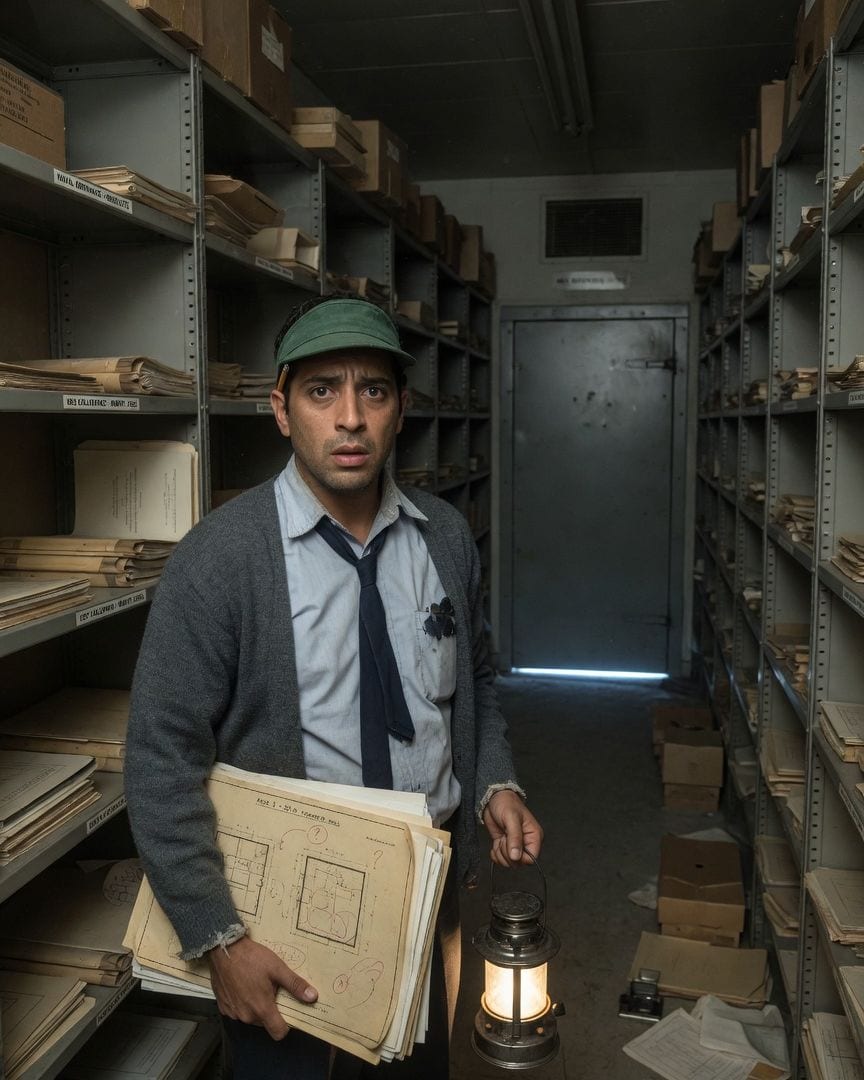
A Cold War records clerk found a lost ship's supply run, signed yesterday by its crew, dead since 1943.
Aurelio Bosch, a methodical night-shift clerk, worked through the Cheyenne records vault in Winter 1957, verifying shelf contents. He discovered an aisle forty feet longer than any blueprint showed, ending in a heavy steel door with no lock. From under it pulsed an unnatural light, and the unmistakable thrum of a printing press ran deep inside. Hours later, buried in old naval records, Aurelio found maintenance logs for a ship lost in 1943, meticulously dated into 1948 and signed by its dead crew. Then he found a new supply requisition for the same ship, dated just yesterday, signed by a crewman officially lost decades ago.
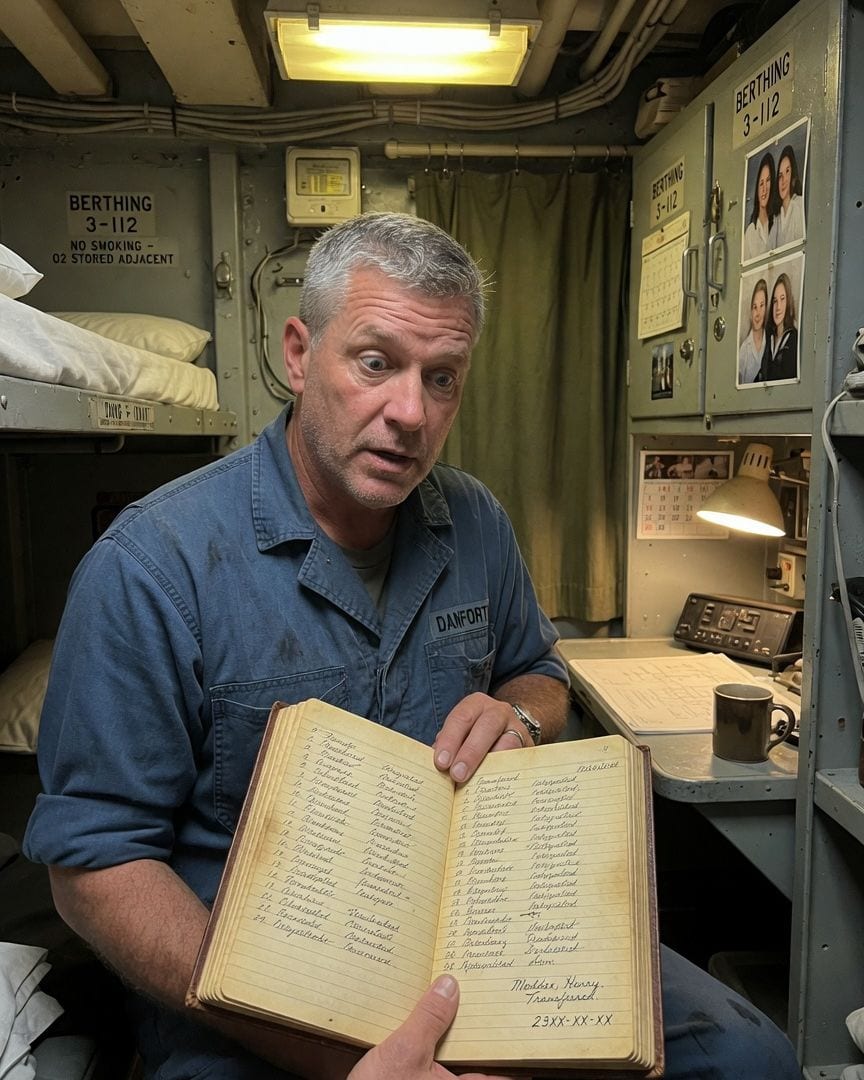
A Chief Petty Officer found a strange logbook. Its last entry listed a living crewman, dated next week.
Chief Petty Officer Russell Danforth was weeks from retirement, his three decades of service nearing an end aboard the USS Weatherall. Deep in the destroyer's familiar steel passages, he stumbled upon a sealed hatch where official plans insisted only solid bulkhead should be. Forcing it open, he discovered a cramped, unsettlingly 'lived-in' compartment holding a bare bulb and a mysterious logbook. Its final entry, stark and fresh, named a living junior petty officer from his own division, dated a week from today. What chilling fate awaited Henry Maddox, according to the Weatherall's secret history?
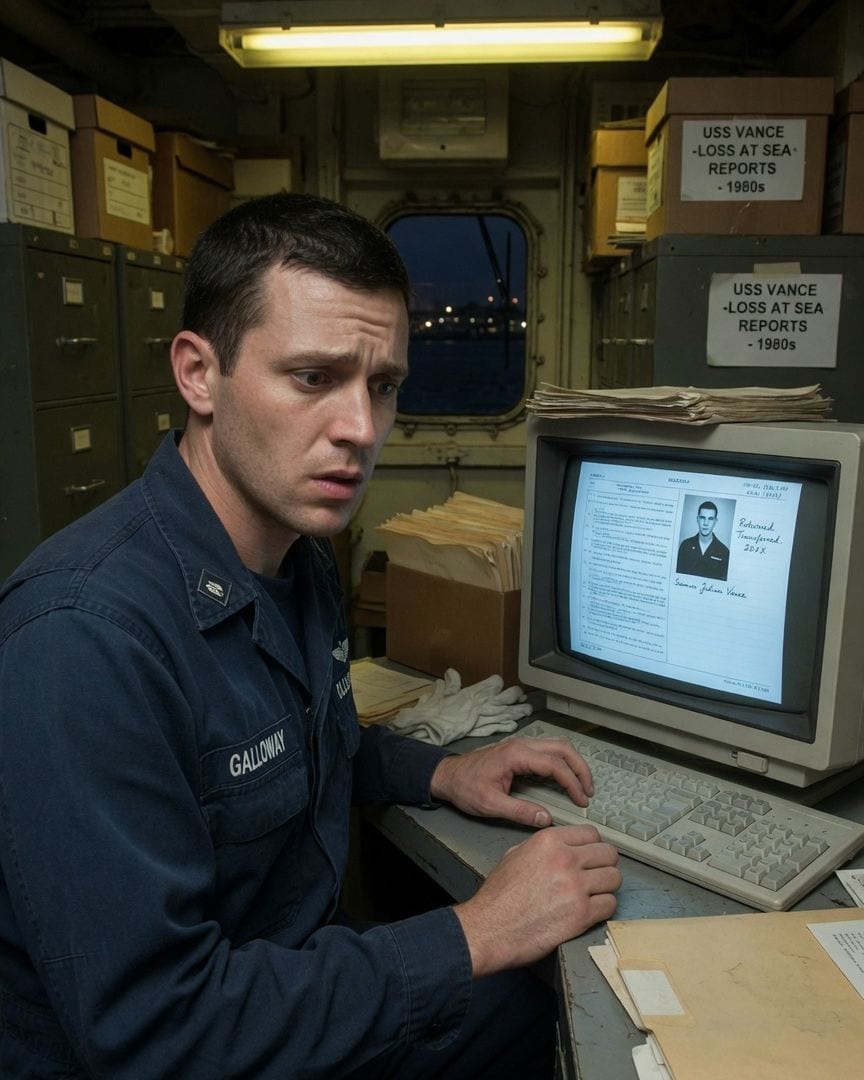
Petty Officer Galloway logged a sailor onto his ship. The man died at sea 40 years ago.
Petty Officer Joel Galloway scanned a sailor's ID on the USS Vance quarterdeck. The man's name, 'Seaman Julian Vance,' and his out-of-date uniform pricked at Galloway's memory. Later, the ship's berthing count came back one over, with an extra entry in the system but no physical body.
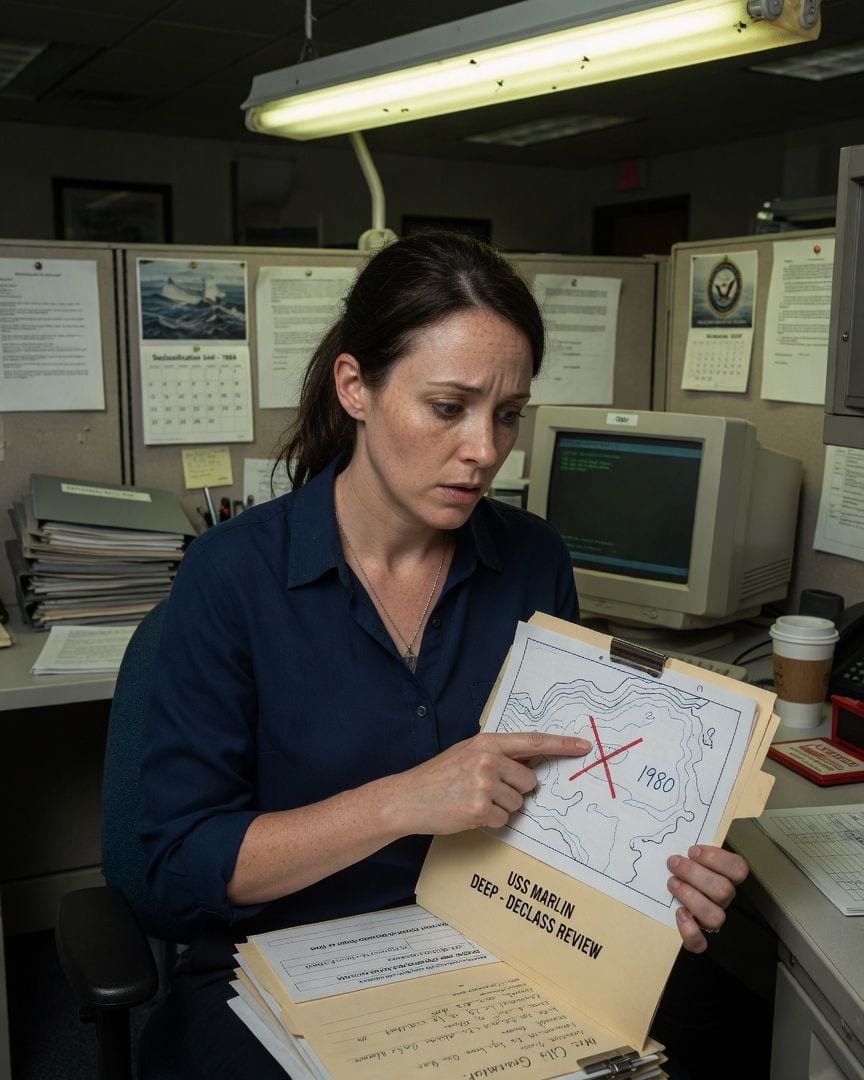
A declassification reviewer finds a dead Cold War submarine officer's report, filled out three years after his official loss.
Declassification reviewer Cass Berrigan understood the quiet anguish of widows, sifting through files like the USS Marlin Deep's. The submarine was lost in 1978, leaving behind Lily Granger's desperate letters, asking where her husband Arthur Thatcher's body was. But deep within the file, Cass found a chart of the wreck site, dated 1980—two years after the loss—in Thatcher's unmistakable hand. The dread solidified when she later uncovered an official report, also in his hand, dated 1981, stating 'Station Maintained. Status: Green.' How could a man officially dead for three years still be filing reports?
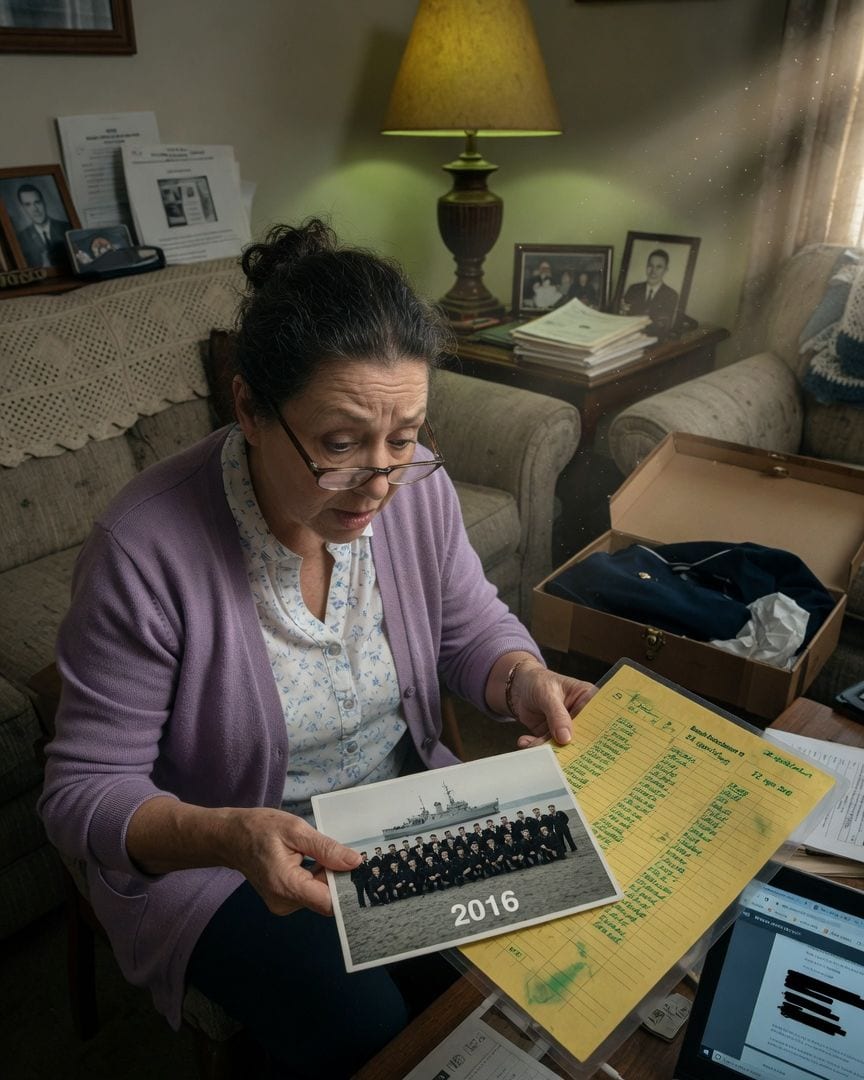
Marisol Frayne unlatched her husband's old footlocker. A photo inside showed his ship, pristine in 2016, three years after the Navy declared it lost.
Marisol Frayne, 62, finally unlatched her husband’s old footlocker in 2024, eleven years after the Navy declared his ship, the Kaskillan, lost at sea. Dust motes danced in the afternoon light as she lifted the lid, releasing the scent of old canvas and cedar. Inside, beneath his perfectly folded dress blues, she found a photograph of David and his crew standing before a pristine Kaskillan. Her breath caught: the photo was dated 2016, three years after the official reports claimed the ship vanished with all hands. Marisol's methodical search then revealed official logs showing a K-class vessel designation active in 2016, leaving a chilling void where her husband's fate should have been.