My pub's karaoke videos show a man at the back table. The landlord says no one's sat there in forty years.
I leaned back on my sofa, phone in hand, scrolling through the highlight reel from last week's karaoke night at The Salty Dog.
It's my local, the kind of place where everyone knows your order and Roland, the landlord, can tell you who built the church down the road.
I smiled at a blurry clip of Brenda from accounting belting out an ABBA song, then at young Tom trying, and failing, to hit the high notes in "Bohemian Rhapsody." It was all standard Friday night chaos.
Then I noticed him. In the back corner, at the small, round table tucked behind the dartboard, a man sat alone. He was still, almost unnervingly so, watching the stage.
Most people moved, swayed, clapped, or at least nursed a drink. He did none of that. Just watched. His posture was rigid, his gaze fixed.
I scrolled to another clip, a different singer, different angle, but there he was again, same posture, same quiet intensity. I paused the video, zooming in.
His face was indistinct in the pub's dim light, just a blur of features, but his presence was undeniable. A dark, unmoving silhouette against the shifting backdrop of tipsy regulars.
A shiver ran down my spine, though I told myself it was just the late hour.
I remembered Roland Ellison, the 65-year-old landlord, telling me just last week that no one’s sat at that table since 'it happened,' forty years ago. "It's been Harold's table ever since," he'd said, a strange note in his voice.
I played the clip again, the man still there, still watching. Still as a photograph.
The next day, the image of that man still bothered me. I told myself it was probably just a trick of the light, someone who blended into the background, or maybe a new regular Roland hadn't noticed.
But the memory of Roland's tone, the way he'd almost whispered "Harold's table," kept gnawing. So, I went back to The Salty Dog. Roland was behind the bar, wiping it down with practiced, slow movements.
I ordered a soda, trying to sound casual, as if the thought had just occurred to me.
'Hey, Roland,' I began, 'you still keep all those old karaoke videos, right? From way back?'
Roland nodded, a bit gruff. 'Aye, got a box of old tapes in the back, why?' He didn't look up from polishing a pint glass, his movements precise.
I hesitated, then plunged in. 'I saw something... in last week's clips. A man, at that back table.' I gestured subtly with my head towards the corner. Roland's hand stilled on the bar. The cloth paused its sweep.
His eyes, usually cheerful and crinkled at the corners, darkened. He looked at me, really looked, and for a second, his gaze felt heavy, like he knew what I was going to say.
'That table's been empty, Vera,' he said, his voice lower now, almost flat. 'Since Harold Prescott vanished.' He turned away, busying himself with stacking glasses on a shelf, his back to me. The shift in his demeanor was stark.
'But he's in the videos,' I pressed, refusing to let it go. 'Always there. In every clip I looked at from last Friday.'
Roland sighed, a long, weary sound. He turned back, his expression tight. 'Some folks say it holds an echo. Old stories.' He wouldn't elaborate, just shrugged and picked up another glass. The conversation was clearly over.
That evening, back home, Roland's words only fueled my resolve. An echo? I found the pub's official YouTube channel. I scrolled back, past months, then years of karaoke nights. And there he was.
Every clip, every single one, featured the man at the back table. Always the same, always watching. It wasn’t just last week. It was a pattern, impossibly consistent. My throat felt dry.
He was in clips from five years ago, ten years ago. Same still posture. Same indistinct face. I remembered Roland mentioning 'old tapes.' If he was in digital recordings going back years, what about the original, physical ones?
I decided I needed to see them.
I asked Roland again the next day, pressing him until, with another reluctant sigh, he pointed me to a dusty, unlabeled cardboard box in the back storage room, buried beneath stacks of old beer mats and empty kegs.
I lugged a handful of the oldest-looking VHS tapes home. My VCR, a relic from my childhood, usually only saw service for forgotten Disney movies. It whirred to life as I slotted in the first tape.
The screen flickered, a cascade of white noise, then settled on a blurry, static-laced image of The Salty Dog.
The decor was jarringly different: floral wallpaper I’d never seen, a different bar layout, patrons in clothes from another era – big collars, wide ties, hairstyles that screamed "seventies." But there he was.
At the back corner table, the same man, Harold Prescott, sat perfectly still, watching. His posture, his empty stare, unchanged. He was an anchor in a sea of shifting time. The pub changed, the people changed, but he remained.
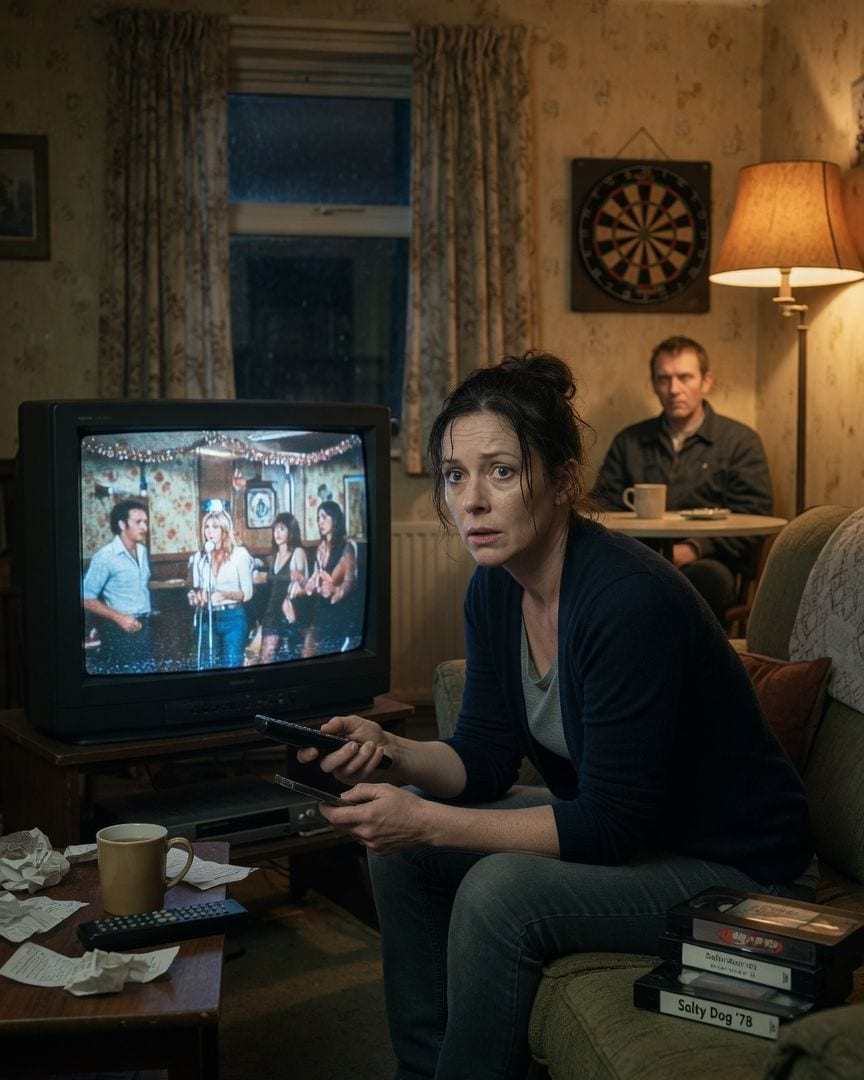
I sat bolt upright, remote in hand, finger hovering over 'pause,' staring at the television screen.
Harold Prescott, perfectly still and unblinking, occupied the back corner table in a version of The Salty Dog pub that is clearly decades older, a ghost of its current self.
The discovery of Harold in the old footage sent me down a rabbit hole. The rational part of my brain screamed for an explanation, any explanation. A prank? An elaborate inside joke?
But the sheer consistency, spanning decades, defied anything I could conjure. I spent days at the local library, the smell of old paper and dust filling my lungs, sifting through microfiche of old newspapers.
My eyes ached, scanning headlines about local council meetings and village bake-offs.
It took time, but I found it: a small article from forty years ago, tucked away on an inside page. The headline read, "Local Man Vanishes."
It reported the disappearance of a quiet local, Harold Prescott, last seen at The Salty Dog pub. The article mentioned he was a solitary regular, known for always sitting at 'his' back corner table.
No foul play was suspected; he had simply 'vanished without a trace.'
Armed with the article and a segment of the old VHS footage playing on a loop on my phone, I returned to Roland.
He was wiping down the bar again, his face worn, but he didn't seem surprised to see me.
'I found him,' I said, my voice tight. 'Harold Prescott. Forty years ago. He just... disappeared.' I held out the phone, playing the grainy footage of the man at the table, then the newspaper clipping.
Roland watched, his face grim. He didn't take the phone, just nodded slowly. 'I told you, Vera. That table… it holds him. My granddad used to say it. Harold wasn't just a regular, he was a fixture.'
'What does that mean, Roland?' I pressed, my stomach a knot of nerves. 'An echo? A ghost? A residual haunting?' I was still trying to fit it into a framework I understood.
Roland shook his head slowly, his gaze distant. 'Not like that. Not a ghost that walks around. More like… a recording that keeps playing. The pub, it remembers him. It’s got a strong memory, that corner.
And anything that films that spot, it picks him up. It’s not just seeing him, it’s like the recording itself is him, caught in a loop.' He looked at me, his eyes serious, his jaw set.
'Some things are better left undisturbed, Vera. You're poking at something that doesn't want to be poked. Leave it alone.'
Roland’s warning, instead of deterring me, only intensified my unease. His quiet certainty, the way he'd spoken of a 'recording that keeps playing,' it burrowed under my skin.
I tried to shake it off, to go back to my normal routine, but the image of Harold, unmoving in that back corner, was now superimposed over everything.
Then, things started getting strange online. I'd scroll through my social media feeds, and ads for a new, obscure streaming service, 'EchoStream,' kept popping up.
They were generic, just a logo and a tagline like 'Relive Your Memories,' but their persistence was unsettling. I dismissed them as algorithm quirks, a result of my recent deep dives into old newspaper archives and VHS footage.
My phone was probably listening, I told myself, connecting dots where there were none.
But then, a notification appeared on my phone, an email from an unknown sender. The subject line was stark: 'New upload to Vera Russo's Feed.'
I stared at it, a cold knot forming in my stomach. My name. I hadn't created any 'feed.' I didn't even know what 'EchoStream' was, beyond the ads.
My first thought was a malicious prank, someone I knew messing with me. But who? And how? Reluctantly, my thumb hovering over the delete button, I clicked the link.
It opened to a sparse, black screen with a single play button. My heart hammered against my ribs, a frantic bird. I pressed it. A blurry, silent clip played for less than two seconds: it’s my own living room.
My couch, the worn velvet. My coffee table, with its familiar ring marks. A stack of books I'd been meaning to read. It was filmed from an impossible, high-angle perspective, as if from the ceiling, or even higher.
It was my living room, unmistakably, yet from a vantage point no one could physically reach. Then it cut out, the screen snapping back to black.
I slammed my laptop shut, the metallic clang echoing in the sudden silence of my apartment. My breath caught in my throat.
The image of my living room, a place I thought was private, filmed from a perspective that defied logic, replayed in my mind. Someone, or something, was watching me, and it had found a way inside.
I rushed back to The Salty Dog, the 'Vera Russo's Feed' notification still glowing, faintly but persistently, on my phone screen.
Roland was behind the bar, polishing glasses, trying to project his usual calm, but I saw the slight tremor in his hands.
'Roland, you have to see this,' I gasped, shoving the phone at him. He glanced at the notification, and his face, already pale, seemed to drain of what little color it had left.
'I warned you, Vera,' he said, his voice barely a whisper. He set down the glass he was holding, his movements slow and deliberate, as if controlling them took immense effort. 'This is what happens when you disturb the echoes.
They… they notice. They find a way to reach out.'
'What is this?' I demanded, my voice raw with a mixture of fear and desperate frustration. 'How does it know my name? How did it film my living room?' The questions tumbled out, urgent and unanswerable.
Roland led me to a quiet corner of the pub, away from the few early patrons, who seemed oblivious to the quiet drama unfolding. He leaned against a wall, his gaze fixed on some point beyond me, beyond the pub.
'Harold wasn't just an echo, Vera. He was a marker. A focal point. Certain places, certain people, they hold onto things. Energy. Memories. And sometimes, those memories play back. The pub is a strong place, a nexus.
A concentration point for these things. But some people are… sensitive. Tuned to it. You, Vera, you're one of them.'
A cold dread spread through me, numbing my limbs. Roland's voice was calm, almost academic, and that made it infinitely worse. He explained that his own family has a history with this phenomenon.
'My great-aunt, generations ago, she started seeing them. 'Recordings' of her own life, distorted, mixed with other things. Until one day, she just… joined them. Walked out of her home and was never seen again.
Just another part of the pattern, my granddad said.'
He looked at me, his eyes filled with a deep, ancient fear that spoke of generations of witnessing this horror. 'The Feed,' he explained, 'it’s not just playing recordings. It's a lure.
It shows you what you know, what you've seen, what it thinks will draw you in. But with a twist. It wants to draw you in. To record you fully. To make you part of its loop.'
The pieces clicked into place, not with a sense of understanding, but with a horrifying, sickening coherence. The man in the videos, the empty table, the impossible footage of my home – it all fit into a terrifying, undeniable pattern.
Harold Prescott wasn't just a static image; he was the first note in a long, chilling song. Roland looked at me again, his face etched with something beyond worry. 'You need to disconnect, Vera. Now. Before it's too late.'
Roland's warning rang in my ears, but my scientific, rational mind struggled with the implications. A "recording that plays back"? People "joining" them? It sounded like madness, a folktale told to scare children.
I tried to delete the 'EchoStream' app, to block the sender, to wipe any trace of it from my devices.
But the notification for 'Vera Russo's Feed' persisted, a faint, insistent glow in my mind, a subtle phantom vibration in my hand even when my phone was off. It was less a notification and more a presence.
My curiosity, a dangerous, magnetic force, pulled me back. I told myself I was being rational. I had to understand what it was, how it worked, before I could truly sever it.
I opened the app again, resolved to simply delete my account, to sever the connection permanently, to break the 'lure' Roland spoke of.
But before I could navigate to the settings, a new clip auto-played. This one was longer, more distinct than the two-second flash of my living room. It was me.
Me, as a small child, maybe six years old, wearing a bright yellow sun hat, playing in my grandmother's overgrown garden. The footage was silent, slightly grainy, but unmistakably real.
The familiar chipped birdbath, the wonky wooden fence, the sprawling rose bushes. A wave of nostalgia washed over me, a vivid memory of summer days, quickly replaced by a growing dread as the footage continued.
As the camera panned slightly, following my child-self as I dug a hole with a plastic spade, I saw it. Behind a cluster of vibrant red roses, partially obscured by the leaves, a figure stood. Still. Watching.
The posture was unmistakable. The quiet intensity. The indistinct blur of his face that I now recognized. It's Harold Prescott.
I stared at my laptop screen, a shaky hand covering my mouth, as the blurry, grainy footage shows my small, six-year-old self playing in my grandmother's garden, and in the background, half-hidden by a rose bush, the unmistakable figure of Harold Prescott watches her.
I showed Roland the childhood footage, my voice trembling so badly the words were almost lost. He didn’t flinch. There was no surprise in his eyes, only a profound, weary sadness.
'I was afraid of this, Vera,' he said, his gaze fixed on the screen, on the still figure in the roses. 'Harold wasn't just tied to the pub. He was a gatherer.
Drawn to certain people, those 'tuned' to the echoes, from a young age. He sought them out, recorded them, in his own way, even before the digital channels existed.
The pub was just a strong nexus, a place where the 'recording' was more obvious, more easily caught.'
He explained that the 'Feed' isn't just playing back memories; it's an advanced form of Harold's 'gathering.'
It creates a complete 'recording' of a person, a full energetic imprint, drawing them deeper until they become part of the pattern, indistinguishable from the echoes themselves.
He then revealed the grim truth, the one his family had carried for generations. His own grandfather, the previous landlord, was one such 'sensitive' person.
He too started seeing impossible 'recordings' of his life, until one day, he simply walked out of the pub, leaving everything behind, never to be seen again. 'His 'echo' occasionally flickers in the oldest, most corrupted tapes Roland told me.
'A ripple in the pattern, a lost connection.'
'The recording,' Roland said, his voice flat, devoid of emotion, 'doesn't just capture what's there. It can pull you into it. Make you part of its loop.'
The horror of coherence washed over me, a chilling wave that left me breathless. Every odd detail, every impossible recording, every evasive answer Roland had given, now made chilling, undeniable sense.
Harold Prescott wasn't just an echo; he was a silent, patient predator, and the 'Feed' was his digital net, cast specifically for me, weaving a web that had begun even before I could remember.
I understood the terrifying implication: Harold isn't a passive recording; he's an active, insidious force, trying to pull me into his endless loop. I had to sever the connection, not just with the app, but with the source.
Roland, pale but resolute, looked at me.
'There’s one way,' he said, his voice barely audible. 'The original recording. The first anchor. It's still here. My family kept it hidden, hoping it would fade, or that no one else would ever find it.'
He revealed that Harold's 'first capture' wasn't on film, but an even older, more primal imprint on a specific, ancient VHS tape, locked away in a hidden compartment behind the bar. 'It's what started it all. The nucleus.
If you destroy that, you might break the loop. Or at least, break his hold on you.'
The thought of breaking into The Salty Dog, a place I considered a second home, filled me with a strange mix of betrayal and desperate urgency. That night, I waited until well after closing.
The pub was dark, silent, the usual Friday night revelry replaced by an oppressive stillness. The air felt heavy, expectant, as if something ancient held its breath.
As I fumbled behind the bar, following Roland's whispered instructions, a low hum started to emanate from the back corner table. It wasn't a sound I could physically hear, more a vibration, a pressure in my chest.
On the pub's dormant television screens, the static flickered to life. Not images, but fragmented, ghost-like outlines of Harold Prescott. His face was contorted in a silent scream, his hand reaching out, indistinct but clear in its intent.
It was as if the "recording" itself was waking, resisting my intrusion.
My fingers closed around the hidden compartment, a small, wooden panel tucked beneath a loose shelf. Inside, nestled in a layer of ancient dust, was a single, unlabeled VHS tape, thick with age.
It felt cold, almost alive, in my hand. The images on the screens intensified, Harold's face looming larger, clearer, his eyes fixed on me, wide and unblinking.
With a surge of adrenaline that burned through my fear, I pulled the tape free.
Then, with a primal cry that echoed in the empty pub, I smashed it against the corner of the bar, again and again, until the plastic shattered and the magnetic ribbon spilled out in a tangled, irreparable mess.
The hum died. The screens went dark, returning to their blank, black silence.
The 'Vera Russo's Feed' channel vanished from my phone, all traces of it gone. My browser history, my email inbox – it was as if it had never existed.
The karaoke videos at The Salty Dog, when I dared to check them a week later, no longer showed Harold Prescott at the back table. That corner, once an unsettling focal point, now simply felt empty, a quiet space.
The pub felt lighter, the oppressive stillness in that corner finally lifted. The back table remains empty, a silent memorial to a pattern broken, a loop severed.
Vera Russo returned to her life, but not to the one she knew. She still visited The Salty Dog, though she always chose a seat far from the back corner table.
She found herself avoiding screens late at night, especially unfamiliar channels or suggested videos. The ordinary world now hummed with a subtle, unnerving potential, a thin veil over unseen layers.
She knew the recording was broken, the loop severed, but a part of her wondered if Harold's 'recording' was truly destroyed, or merely disconnected, waiting.
The quiet, watchful part of her now understood that some patterns are never truly erased, only paused.
Roland Ellison, behind the bar, still sometimes found himself watching new patrons. Occasionally, he'd see a quiet one, drawn to the back corner, ordering little, just observing. He'd watch them, a familiar dread in his eyes, knowing the pattern.
He knows the recording never truly ends.
If this one got to you
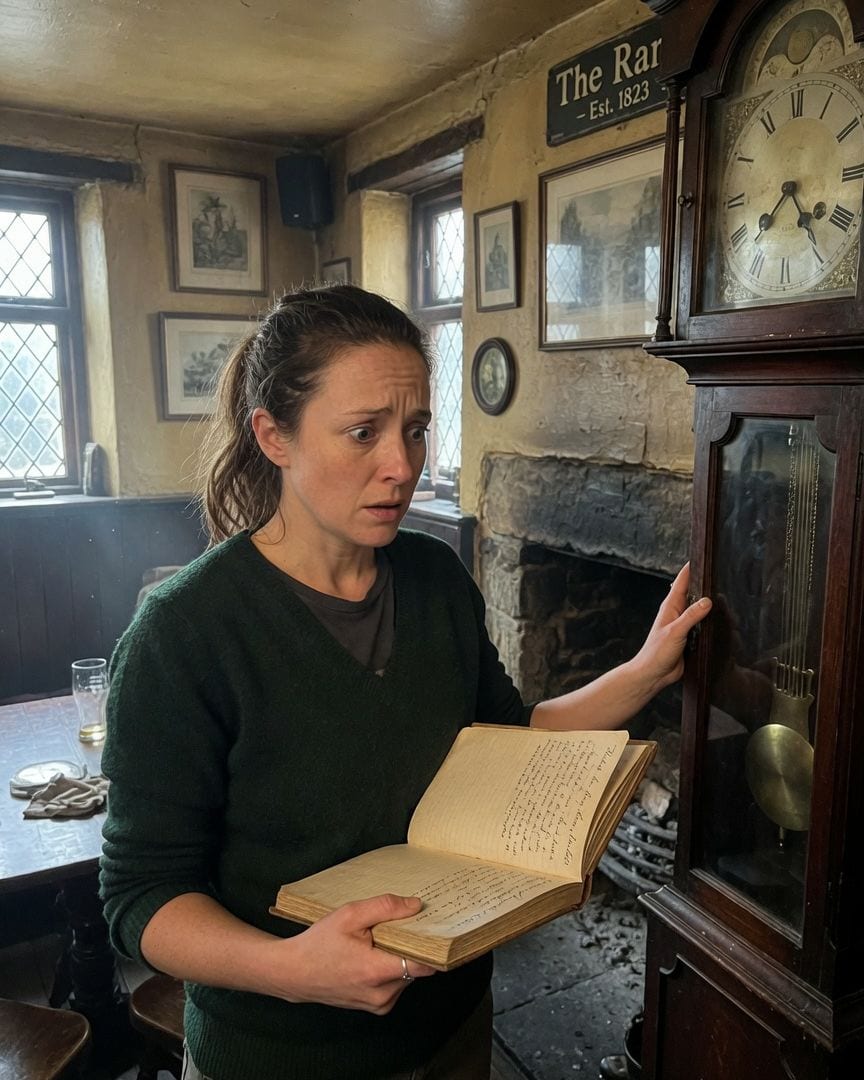
My pub window holds a vanished landlord's face in an old photo, staring out, weeks after he supposedly left the village.
As the new landlord of The Ram, I was getting used to the pub's two-century-old clock when I accidentally stopped its pendulum. The next morning, checking the cellar book, I found an entry dated yesterday. In an archaic, looping script, it simply read: 'Thank you for winding it before the house was empty again.' I was the only person in the locked pub all night.
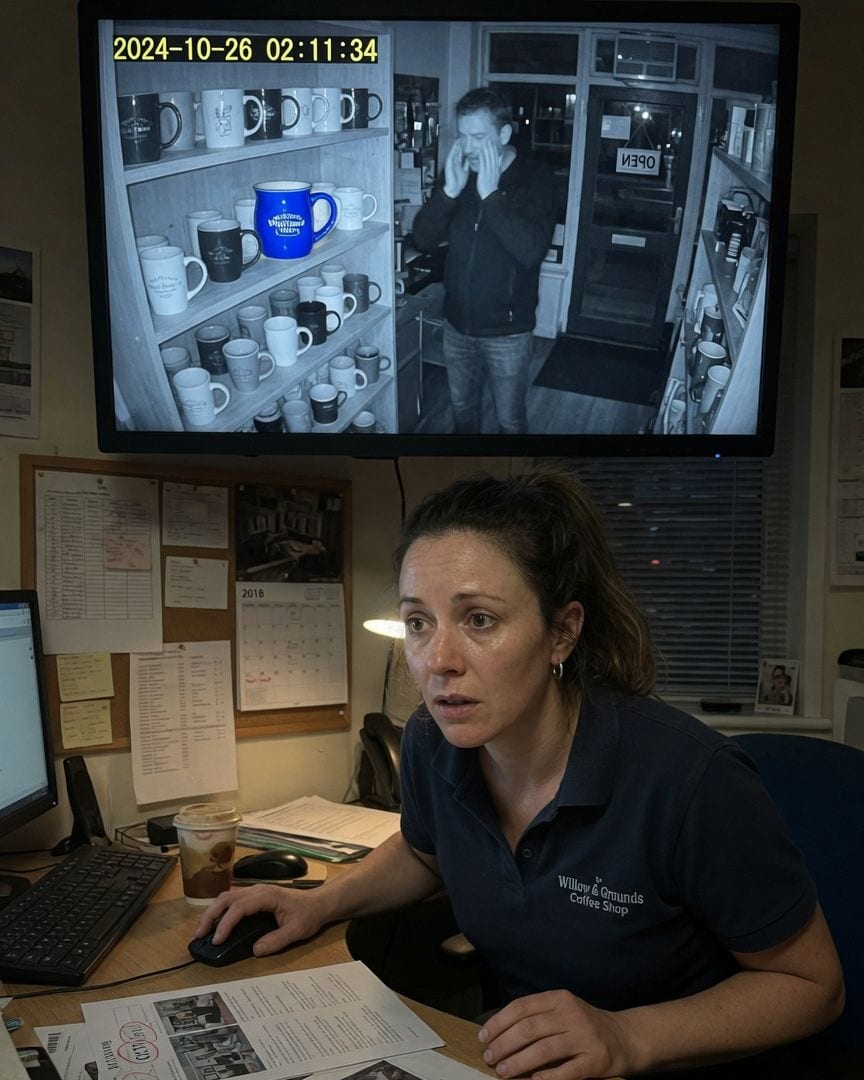
My shop's CCTV caught a customer who hasn't aged a day in eleven years of footage. He enters every night at 2:11, buys nothing, and leaves.
I was reviewing CCTV footage when I discovered a man who appeared inside my closed shop every night at 2:11 AM. He moved identically, never aging across eleven years of recordings, all confirmed as unique files. Yet, last night's footage clearly shows a specific coffee mug on the shelf that I know I sold seven years ago, and is definitely not there now.
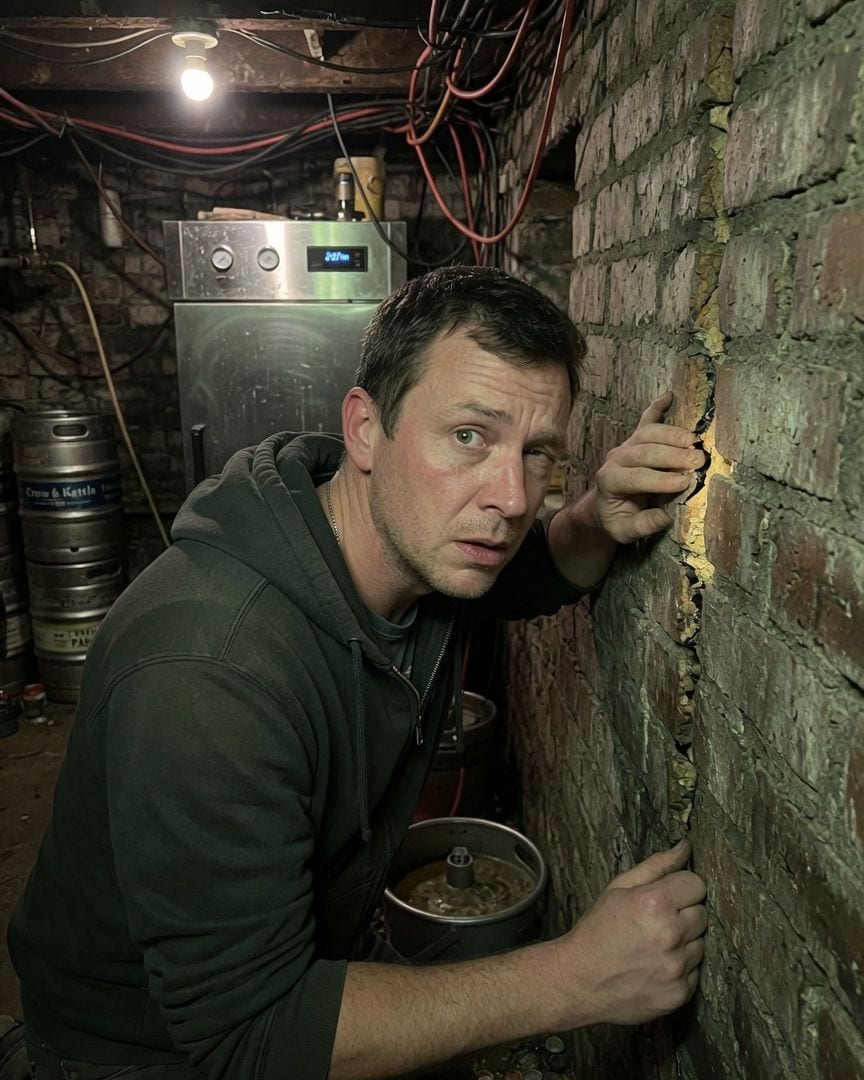
My cellar doorway opens onto an old bar-room. The brewery bricked it up decades ago.
Running my new pub is exhausting, especially doing late-night rounds in the damp cellar. But one night, a hairline crack appears in an old bricked-up wall. Through it, I see a bar-room from another time, filled with men frozen mid-drink, their pipe smoke still clinging to the air.
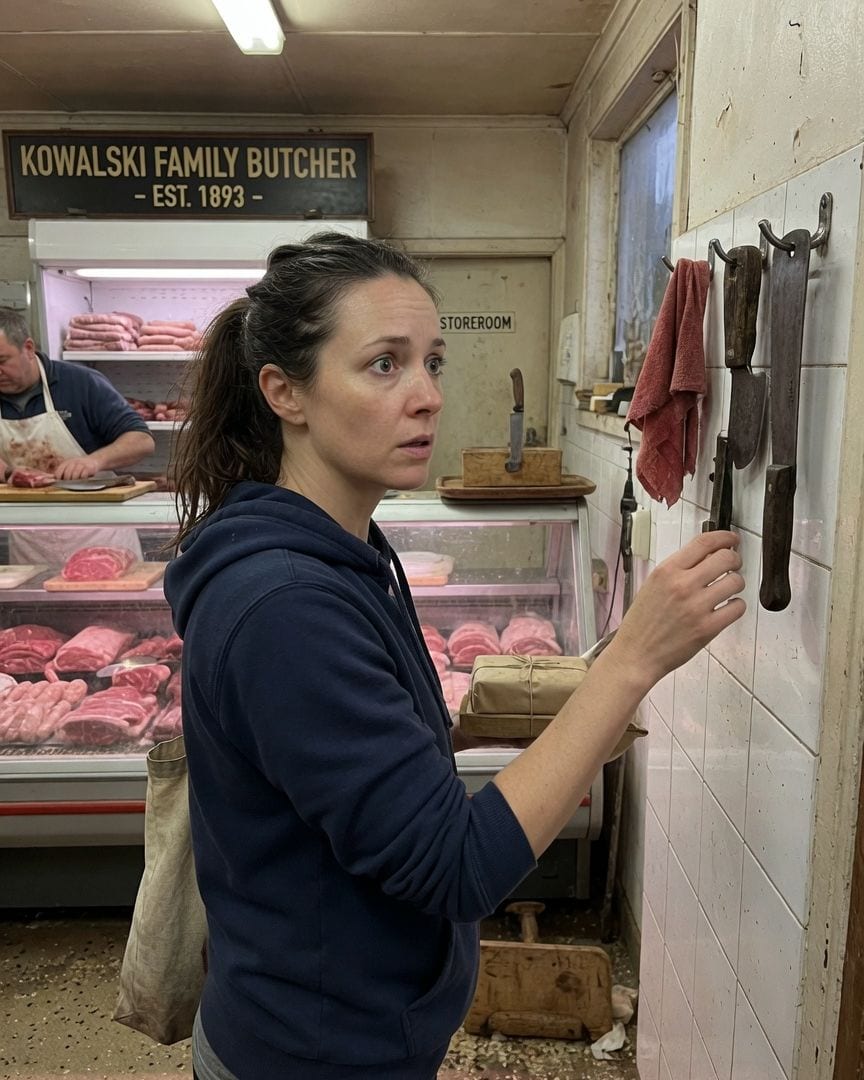
The butcher's back hook always hangs empty, draped with a red cloth. It holds a standing order since 1911 for the Hall, which burned down before the first war. The meat is gone every Friday, but no one's seen a cart.
Still new to Longnor, I stepped into Oscar Kowalski's butcher shop, needing a place to hang my bag. My hand brushed a simple hook, but Oscar's knife suddenly thudded, and he snapped, 'Not that one, dear.' He insisted the empty hook was 'reserved,' leaving me with a strange prickle of unease.
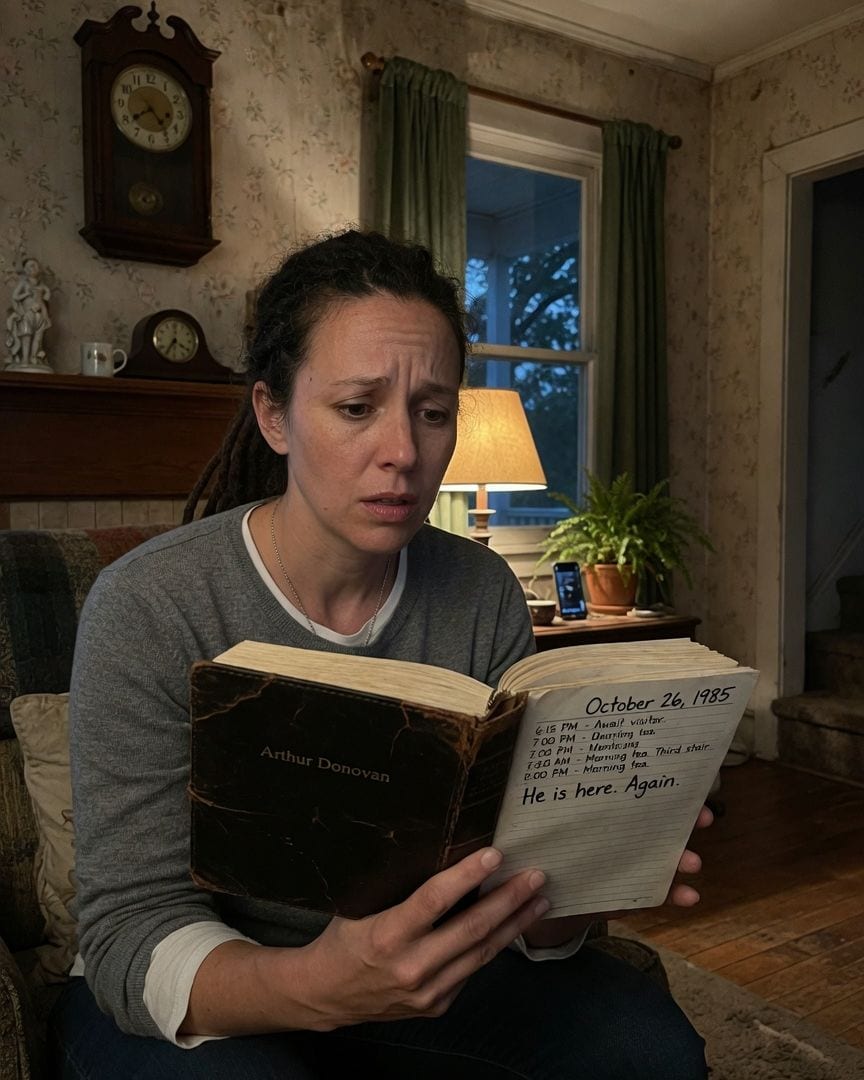
My front door gets three firm knocks every 6:15 PM. Nobody's ever there, but the doormat is always nudged, like someone just wiped their feet and left.
I moved into my inherited house expecting quiet, but every evening at 6:15 PM, three firm knocks hit my door. Each time, I find the porch empty, with no one in sight. My phone camera confirms it: only the doormat subtly shifts, echoing the clear knocks, like an invisible visitor wiping their feet.
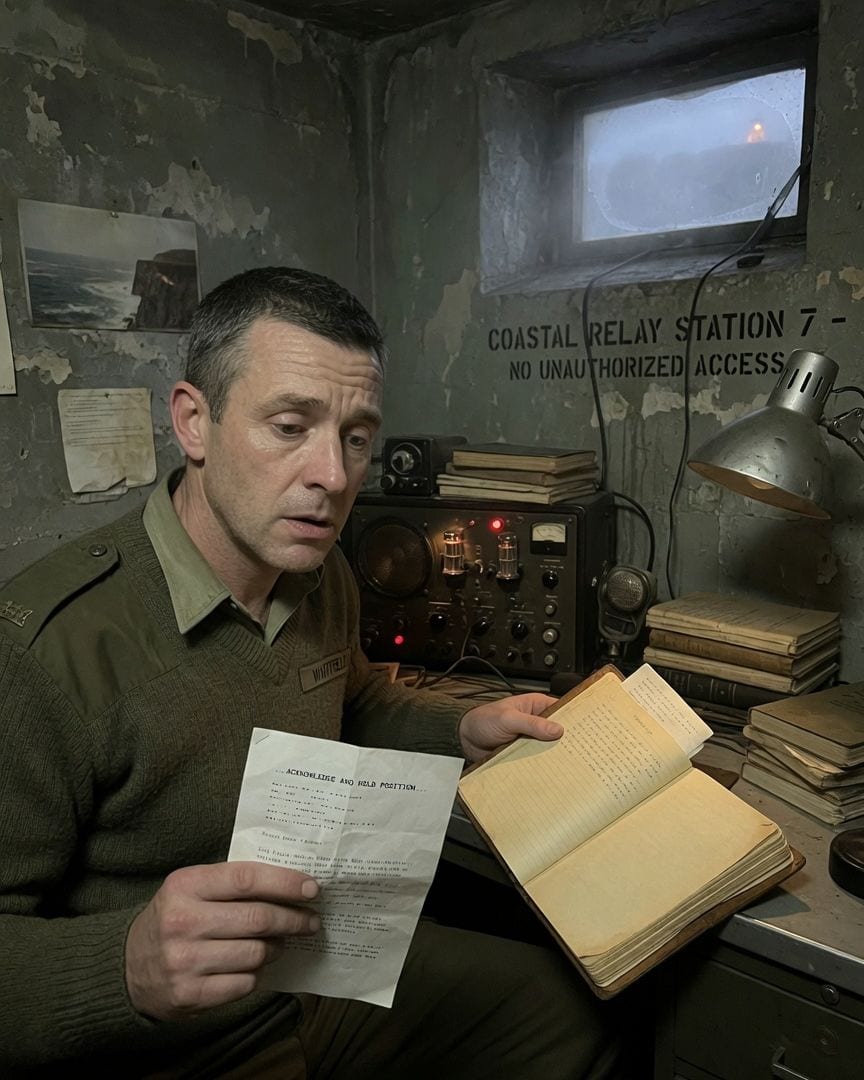
A corporal on his last watch decoded a Morse order for his station. It was sent forty years ago, for *this* very night.
Corporal Greg Whitfield stood watch on one of the final nights before his old coastal relay station was mothballed. The fog-bound English coast echoed with the lonely boom of the sea, the bunker's ancient equipment humming its last familiar tune. Suddenly, a burst of Morse code cut through the static on a long-dead frequency, an impossible convoy sighting for a shipping lane closed for forty years. Decrypted, the message named his exact station and tonight's date, instructing the operator to acknowledge and hold position, no matter what. Later, a dusty archive revealed a logbook entry from precisely forty years ago, recording the same message, acknowledged by a Private Barlow, followed by a chilling blank page. What happened to the last operator who acknowledged a forty-year-old ghost order?