My cellar doorway opens onto an old bar-room. The brewery bricked it up decades ago.
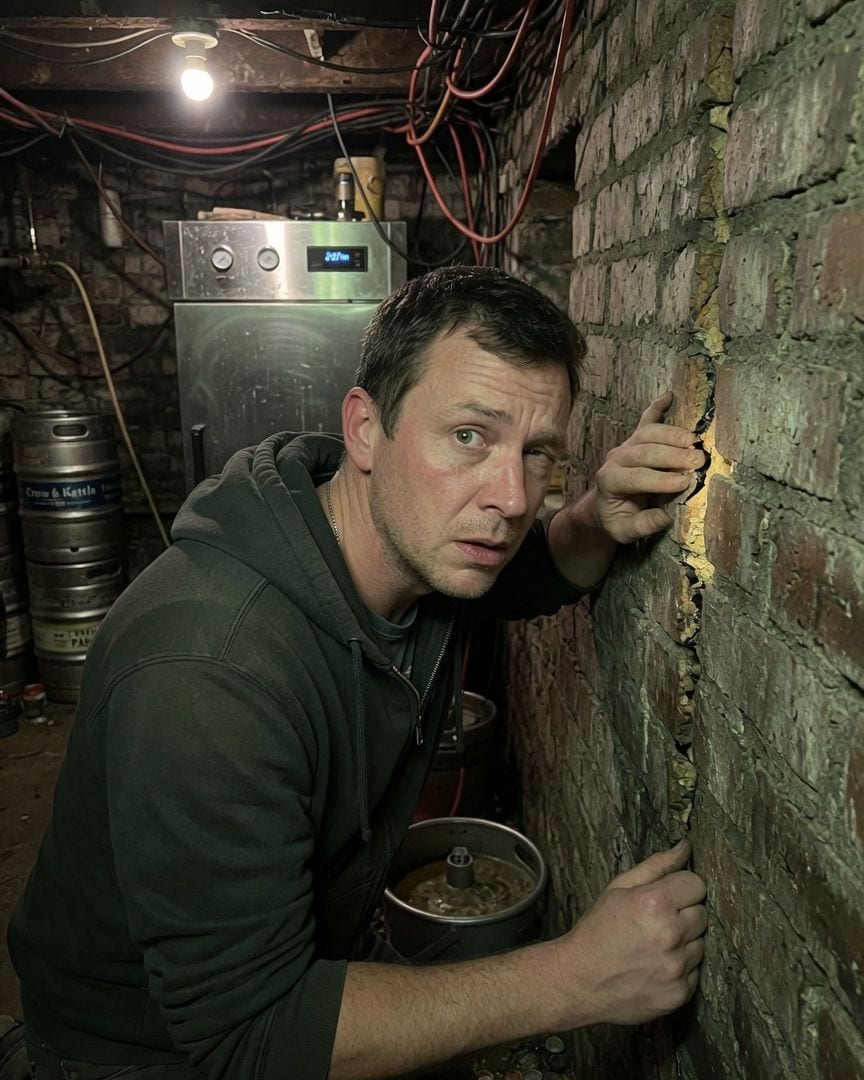
The clanking of the beer lines in the cellar of The Crow & Kettle was a familiar, comforting sound, a steady, mechanical tick-tick-tick as the cooler worked its magic.
It was late, almost 2 AM, and the last of the Saturday night crowd had finally stumbled out. I was doing my rounds, checking pressures, making sure nothing had sprung a leak.
Running a pub alone in a new town was exhausting, but I’d poured every last penny and ounce of energy into this place, and I intended to make it work.
Down here, in the oldest part of the building, the air was always damp, heavy with the smell of earth and stale hops.
I ran my hand over the cool stone of the far wall, where the brewery had decades ago bricked up what their plans called an 'old coal chute.'
It was a thick, solid patch of masonry, rough to the touch, no doubt about it. Except tonight, there was a hairline crack running vertically through the mortar.
And through that crack, a sliver of darkness that shouldn't have been there.
My first thought was a settlement crack, maybe a structural issue. But then a faint, unfamiliar smell wafted through: sawdust, not the sawdust from my mop bucket, but old, dry wood.
And something else, a cloying sweetness of stale pipe tobacco, entirely out of place. The tick-tick-tick of the beer lines, which had been a constant drone, abruptly ceased. The silence that followed was thick, immediate, almost painful.
I pressed my eye closer to the crack. The darkness inside seemed to deepen, then resolve into a dim, amber glow. Oil lamps, I thought, because it was too soft for electric. And in that light, a room.
Not my cellar, but a bar-room. Dark wood, heavy settles, and figures. Men, three of them, in vests and tweed caps, seated around a small, round table, their faces turned away, frozen in a tableau.
One had a tankard raised halfway to his lips. The air in there, through that impossibly small gap, felt warm, almost humid. A low murmur, like distant conversation, hummed just beneath the edge of hearing.
I pulled back, blinking hard. My eyes were burning from fatigue, I reasoned. Long hours, stress, that dodgy curry I had for dinner. It was a hallucination, a trick of the light on the old stone.
I rubbed my eyes, knuckles digging into my sockets, then forced myself to look again.
The brickwork was solid. No crack. No amber glow. No figures. Just the rough, cold mortar, stretching unbroken across the wall. And behind me, the familiar, mechanical tick-tick-tick of the beer lines resumed, as if it had never stopped.
The sudden noise made me jump. I stood there for a long moment, the back of my neck prickling. It had to be exhaustion.
But the faces of those men, seen only for a fleeting second, felt too distinct, too real to simply vanish.
I secured the cellar door, double-checking the bolt, a chill settling in my bones that had nothing to do with the damp air.
A week later, I was downstairs wrestling with a stubborn keg when I saw it again. The crack. Wider this time, a definite gap where the mortar had been.
The tick-tick-tick of the beer lines cut out the moment my gaze landed on it. That smell, too: old wood, pipe smoke, and something else, a faint, metallic tang. Curiosity warred with the memory of the sheer impossibility of it.
I pushed my eye to the gap, heart hammering. The bar-room was clearer now. The oil lamps cast long shadows. The men were still at their table, just as I’d seen them, seemingly unchanged, unmoving.
But this time, another figure caught my attention. A stout man with a magnificent walrus mustache, leaning against the dark wood bar, an empty tankard held loosely in his hand.
He wore a heavy wool jacket, the kind you only see in sepia-toned photographs. The scene was utterly, unnervingly still, like a perfectly preserved diorama, every dust motte suspended in the dim light.
No movement, no breath, just a frozen moment in time.
I stared, holding my breath, straining to hear the phantom murmur of voices, but there was nothing. Only the heavy silence of my own cellar, amplified by the absence of the beer line's rhythmic beat.
I wanted to understand, to rationalize, to find the seam where the illusion began. I took a deep, shaky breath and forced myself to look away, turning my head completely to face the modern stainless steel of my beer cooler.
"Right," I muttered, trying to sound normal. "Just a trick. Nothing there."
Then I looked back. The brickwork was solid. No crack. No light. The tick-tick-tick resumed, startlingly loud in the sudden breaking of the silence.
It couldn't be a trick of the light. Not twice. Not with the smells, the silence, the sheer clarity of that frozen scene. I needed to understand what this building was doing.
I spent the next few days in the local town archives, pouring over brittle old ledgers and dusty maps. The Crow & Kettle, I learned, was built on the foundations of a much older inn, "The Blackwood Arms."
It had burned down catastrophically in 1923, taking a few souls with it, though the cellar structure remained. Tucked away in a folder marked 'Local Tragedies,' I found a grainy, sepia photograph, a promotional shot from before the fire.
My blood ran cold.
It was The Blackwood Arms' main bar-room. Identical. The heavy wooden bar, the settles, the oil lamps hanging from the low ceiling. And there, in the foreground, leaning against the bar, was the stout man with the walrus mustache.
His tankard was held at the exact same angle. The same heavy wool jacket. He was a real person. This wasn’t a hallucination. This wasn’t fatigue. This was something else entirely.
The dread that had been a faint whisper was now a solid, cold knot in my stomach.
I stumbled out of the archives, the dusty smell of old paper still clinging to my clothes, the image of that man, of Mr. Walrus Mustache, burned into my mind. The ordinary explanation had evaporated like smoke.
What I had seen was real. More than real, it was there, somehow.
Back at the pub, the cellar felt different. Heavier. More watchful. I made my way downstairs, my hand trembling slightly as I reached for the light switch.
The familiar low hum of the coolers was there, the tick-tick-tick a constant, yet now unnerving, rhythm.
I ran my hand along the cold stone wall where the doorway had manifested, a desperate need for a tangible connection to the impossible. The mortar felt solid, unyielding.
My fingers brushed against something. Not part of the wall, but something foreign, wedged deep in a forgotten crevice, almost hidden by decades of dust and spiderwebs. It was cold, heavy, and metallic.
I worked my fingers around it, pulling it free with a soft scraping sound against the stone.
It was a brass tap handle.
Tarnished, dark with age, but unmistakably brass. Worn smooth in places where countless hands must have gripped it, polishing it to a faint, ghostly sheen.
It was old, impossibly old, not the kind of sleek, modern tap handle I used upstairs. I turned it over in my palm, and then I saw it.
The distinctive, ornate scrolling around the base, the slight curve of the handle, the very specific, almost abstract floral pattern etched into its face.
My breath hitched. My hand tightened around the cold metal. It was the exact tap handle I had seen behind the bar in my vision of The Blackwood Arms, glinting under the oil lamps, just above the stout man's shoulder.
Too solid. Too real. Too impossible to be here now.
I spent the rest of the evening cleaning the tap handle. The brass gleamed faintly under the sink light, a dull gold, revealing the intricate patterns I’d glimpsed in the dark.
It was a relic, a tangible link to a place and time that shouldn’t exist.
The next morning, I cornered Carl Kowalski at his usual spot at the bar. Carl, at 78, was practically a fixture, a living archive of local history.
“Carl,” I started, trying to sound casual, “you know a lot about this place, right? The Crow & Kettle, before it was… The Crow & Kettle?”
He took a slow sip of his pint, his eyes, watery and blue, giving me a shrewd once-over. “Aye, lass. Built on the bones of the old Blackwood Arms. Good pub, that was. Right up until the ‘23 fire.
Bad business, that.”
“The fire?” I prompted, trying to steer him. “What exactly happened?”
Carl shifted uncomfortably on his stool. “Just… a fire. Tragic. Took a few folk with it. Some say the cellar’s unlucky. Heard tell of a few owners who got strange ideas, you know? Started seeing things.
Then they just… moved on, quick-like. Always a quick sale.” His gaze flickered towards the cellar door.
My blood ran cold. “Strange ideas? What kind of ideas?”
He just shook his head, looking out the window, past the street. “Old pub memories, that’s all. Best left alone.”
I pressed him. “The bricked-up doorway in the cellar. The brewery plans say ‘old coal chute.’ But it looks… older. Like it was part of the original structure.”
Carl sighed, a puff of air. “Coal chute? Hah. No, lass. That was bricked up long before my time, long before even my father’s. Not for coal. Things happened down there. Things that wouldn’t stay put.”
He paused, then leaned in, lowering his voice. “There was a regular, a Mr. Fairfax. Quiet man, kept to himself. Always sat at the same settle by the bar, drinking his ale. Never accounted for after the fire.
They say his ghost, well, they say he’s still down there, somehow. Still waiting for his pint.”
A profound chill settled over me. Mr. Fairfax. The walrus mustache. The man in the photograph, frozen in my impossible vision. My breath hitched. It was him. He was the one.
The encounters with the doorway became more frequent after that. Daily, sometimes twice a day. The 'tick' of the beer lines would just stop whenever I was in the cellar, that unsettling silence a prelude to the shifting brick.
The visions were no longer fleeting blurs but vivid, almost tangible scenes. The men at the settle, Fairfax leaning against the bar, the faint smell of sawdust and stale ale.
I started to feel a prickling sensation on the back of my neck, a sense of being observed, even when the doorway was sealed, when the brick was solid and unbroken.
It was like an invisible presence, a cold stare from an unseen eye.
One morning, I went down to open the cellar, and the heavy wooden door, which I had triple-locked the night before, was ajar. Just a crack, barely noticeable, but enough.
Nothing was disturbed, no sign of forced entry, no footprints in the light dust. But the air was thick with the smell of old ale and pipe tobacco, a smell that clung to the damp stone like a shroud.
I slammed the door shut, my heart hammering, and wedged a spare beer keg against it for good measure.
Later that afternoon, the doorway shimmered open again. This time, I didn't resist the urge to look. Fairfax was there, his back to me, still in his heavy wool jacket. But then, slowly, agonizingly slowly, he turned his head.
His eyes, dark and still, seemed to meet mine for a fraction of a second. There was a flicker, a profound, unsettling awareness in their depths, a momentary break in the otherwise frozen tableau.
It wasn’t a ghost’s vacant stare; it was a gaze, a recognition. It felt like a silent question. Or a silent demand.
I backed away, stumbling on the uneven flagstones, my skin crawling. I tried to dismiss it, to say it was just my mind filling in the blanks, but the precision of that glance, the shift in his posture, was undeniable.
Carl Kowalski found me later, pale and distracted, wiping down the bar upstairs with too much force. He watched me for a long moment, his gaze steady. “You’re seeing things, aren’t you, lass?” he asked, his voice low, without judgment.
“Down there.”
I didn't answer, just kept wiping.
“Leave it alone, lass,” he warned, his voice sharper now, a sudden edge. “Some things are best left buried. The pub remembers what it wants to remember. And it doesn’t like to be disturbed.”
The warning felt less like advice and more like a threat, or perhaps, a desperate plea. The pub, he said. Not the cellar, not the doorway. The pub itself.
Haunted by Fairfax’s unsettling gaze and Carl’s ominous warning, I found him nursing his usual pint the next evening. This time, I didn't try to be subtle.
I pulled the brass tap handle from my pocket and placed it on the bar between us. It gleamed under the pub lights, an undeniable, anachronistic object.
Carl’s eyes widened, a rare flash of surprise. He reached out a trembling hand, tracing the ornate scrolling. “Where did you…?” he began, his voice barely a whisper.
“It was in the cellar wall,” I said, my voice steady despite the tremor in my hands. “Near that bricked-up doorway.” I leaned forward. “What happened to Mr. Fairfax, Carl? Really.”
He looked at the tap handle, then at me, then back at the handle, his shoulders slumping. “My grandfather worked at The Blackwood Arms,” he confessed, his voice rough. “He was there, the night of the fire.
Said it wasn’t accidental. Some disgruntled patron, had a row with the owner. Started it himself. Fairfax, poor soul, he was trapped in his usual spot by the bar. The emergency exit was blocked by rubble almost immediately.
My grandfather swore he saw him, through the smoke, just sitting there, waiting for someone to pour his last pint. He swore Fairfax was ‘still there, somehow, waiting.’ He knew it. They all did.”
Carl took a long, shuddering breath. “The brewery, when they rebuilt as The Crow & Kettle, they just built right over the old cellar. Tried to seal it off, forget about it.
Bricked up that doorway, because the memory wouldn’t die. It kept… manifesting. Not just ghosts, not exactly. More like… a stuck record. A moment in time playing itself over and over.”
He picked up the tap handle, turning it slowly. “This was from the old bar. My grandfather would’ve handled it a thousand times.” He placed it back on the bar. “There was another owner, in the seventies. Rosemary Delaney.
She came to me, asking questions, just like you. Said the men in the bar-room were trying to tell her something. She got… obsessed. Spent all her time down there, muttering. Then one day, she just… vanished. Left everything behind.
Her car was still in the lot. Just gone.”
The pieces clicked into place with a horrifying inevitability. The old photograph, Mr. Fairfax, his gaze meeting mine, the impossible tap handle. It wasn’t just a vision; it was a replaying, a recurring loop.
And Rosemary Delaney, a previous owner, hadn’t just moved on. She had been drawn into it.
Driven by Carl’s confession, I raced back to the pub office. Carl had mentioned Rosemary’s “things left behind.” I remembered seeing an old, dusty fireplace in a corner, bricked up like the cellar doorway.
I ran my hands over the rough brickwork, searching, pushing, desperate. Behind a loose brick, just as Carl described, I felt a hollow space. I prised it out.
Inside, tucked away, was a small, leather-bound journal. Rosemary Delaney’s.
My heart hammered against my ribs as I opened it. The first entries were rational, almost scientific. She described the doorway, her attempts to understand its appearances, the men she saw. But then, the tone shifted.
It grew more fervent, more desperate. Rosemary wrote of the men in the bar-room, their ‘empty eyes,’ their ‘thirst.’
She detailed her growing conviction that they were not ghosts, but ‘memories trapped in amber,’ endlessly waiting for someone to ‘serve’ them, to complete their last moments. The words seemed to jump off the page, burning into my mind.
The last entry, dated decades ago, was a frantic, sprawling account. Her handwriting was jagged, barely legible. She described her plan to ‘step through,’ to ‘join them in their service.’
Beneath it, a detailed, almost obsessive, drawing of a brass tap handle, identical to the one now in my pocket. And the chilling final words, scrawled across the bottom of the page: ‘They want me to serve.’
I read Rosemary’s journal late into the night, the pages crackling like dried leaves in the silence of the office. Her words painted a terrifying picture, solidifying the dread that had been growing in me.
She believed the doorway was more than a vision; it was a wound in time, constantly replaying the inn's last moments, the brief, happy hours before the fire.
The patrons, frozen in that perpetual loop, were perpetually waiting for service that would never come, forever thirsty.
She recounted an incident, described with an almost unbearable blend of empathy and horror. In a moment of desperate connection, she had extended her hand through the doorway, holding a tray of empty glasses, a silent offer of service.
The moment her hand crossed the threshold, she felt a profound draining sensation, as if ‘a piece of my own spirit’ had been taken, a cold, silent siphon. After that, the men in the bar-room began to notice her.
They no longer seemed unaware. They would turn their heads, slowly, their empty eyes now fixed on her, raising their empty tankards, their gazes no longer vacant, but expectant. They had seen her. They were waiting.
Rosemary’s entries described the growing, overwhelming pull to step through, to provide the endless service they craved, to become part of the house’s memory forever.
She believed that by joining them, she could finally 'complete' their last moments, bring them peace.
The journal ended with her final, feverish decision to 'cross over,' to 'end their waiting,' and a desperate plea to anyone who might find her words: 'not to follow, not to serve.'
Rosemary’s journal clutched in my trembling hand, I descended to the cellar. The air was cold, damp, but tinged with that familiar, ancient scent of stale ale and pipe tobacco.
I could feel the presence now, a palpable weight pressing down. The doorway was wide open. Not a crack, but a yawning rectangle of amber light, humming with a strange, inviting warmth that somehow promised comfort.
The old bar-room was vivid, pulsating. The men were there, frozen in their positions, but this time, Fairfax, the man with the walrus mustache, looked directly at me.
His head was turned, his eyes fixed on mine, not with a vacant stare, but with a profound, almost sorrowful expectation.
He slowly raised his empty tankard, and his lips, in the still tableau, seemed to form a silent, beckoning word: “Serve.”
A profound weariness washed over me, a bone-deep exhaustion that made every muscle ache.
An intense longing to step into that quiet, unchanging place, to join them, to pick up the tap handle and pour the eternal pint, flared in my chest. It felt like a promise of peace, of belonging.
I felt a cold, insistent pressure against my mind, a whisper of calm, of endless rest, if only I would yield.
The brass tap handle, still in my pocket, felt impossibly heavy, both an anchor holding me to the present and a key promising entry.
I fought the overwhelming pull, my knuckles white around Rosemary’s journal. I saw a faint, almost transparent flicker of a woman behind the bar next to Fairfax, her hand outstretched for a glass, her movements indistinct, like smoke.
It was Rosemary. Her face was indistinct, her eyes empty, but I knew. She was there, serving, trapped.
With a guttural cry that tore from my throat, I lunged forward, not into the doorway, but to slam it shut.
The ancient wooden door, a lie of a door, groaned, a deep, mournful sound, as I pushed with all my might.
It sealed, severing the connection with a sickening thud, just as I felt a cold, ephemeral touch graze my cheek, a whisper of “no…” on the vanishing air, a soundless scream that echoed only in my mind.
I sold The Crow & Kettle within weeks, taking a significant loss.
I couldn't bear to be in the building, couldn't shake the smell of pipe smoke that sometimes seemed to cling to the walls even when the pub was empty.
I avoided eye contact with Carl Kowalski, who just gave me a long, sad look whenever he saw me in town, a silent acknowledgement of what I’d seen, and what I’d escaped.
I never entered another pub; the smell of stale beer now triggered a deep, visceral unease that would set my teeth on edge.
I left the brass tap handle with the pub, a silent offering, a piece of the past I refused to carry forward, a burden I refused to claim.
Yet, I sometimes caught myself unconsciously tracing patterns on surfaces, the ornate scrolling of that handle, a faint, lingering echo of the house’s memory in my own mind.
Months later, I’m settled in a new apartment, far from that town, far from the pub. I try to build a quiet life, to forget. But the memory of the doorway, of Fairfax, of Rosemary, never truly fades.
I find myself drawn to antique shops, to old, forgotten objects, feeling a strange resonance with them, a flicker of something almost familiar.
I often wake in the middle of the night, convinced I smell pipe smoke and stale ale, and sometimes, in the dead quiet, I hear a faint, distant 'tick-tick-tick' that isn't my new apartment's plumbing.
I have started collecting antique barware, polishing them with an almost ritualistic care, always stopping at a specific, ornate brass tap handle I bought at a dusty market on a whim.
Her new neighbor, Margaret Bishop, visited one afternoon, admiring Naomi’s collection, neatly arranged on a reclaimed wood shelf. Margaret pointed to the antique tap handle, its brass gleaming in the afternoon light. "Where did you find that one, dear?
It looks ancient." Naomi smiled, a faint, wrong little smile, her eyes distant. "It called to me."
If this one got to you
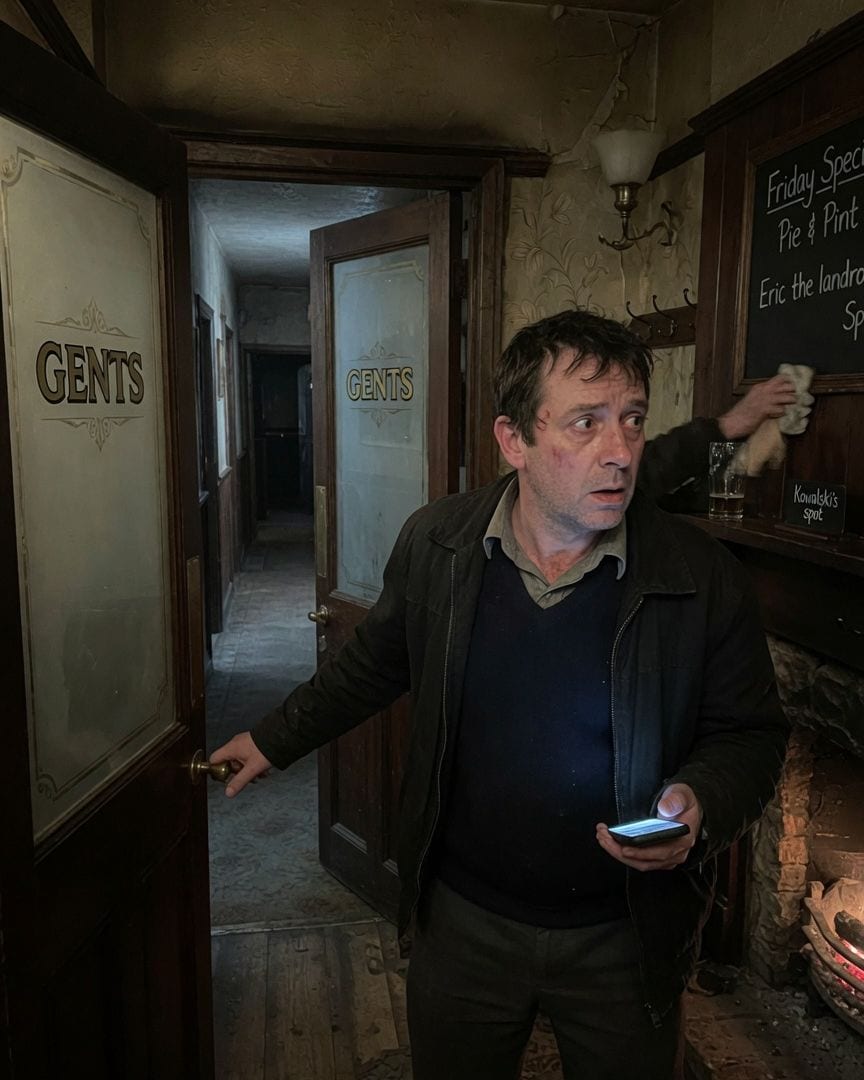
My pub's gents has a second identical door right beside it. Behind it, a corridor longer than the building, with rooms no one else can see.
My Friday night ritual at The Old Bell pub has been the same for years: a quiet pint by the fireplace. But last week, I spotted a second, identical 'GENTS' door beside the first, opening to an impossible, cold corridor stretching far beyond the pub's walls. The landlord denies it exists, but I know what I saw.
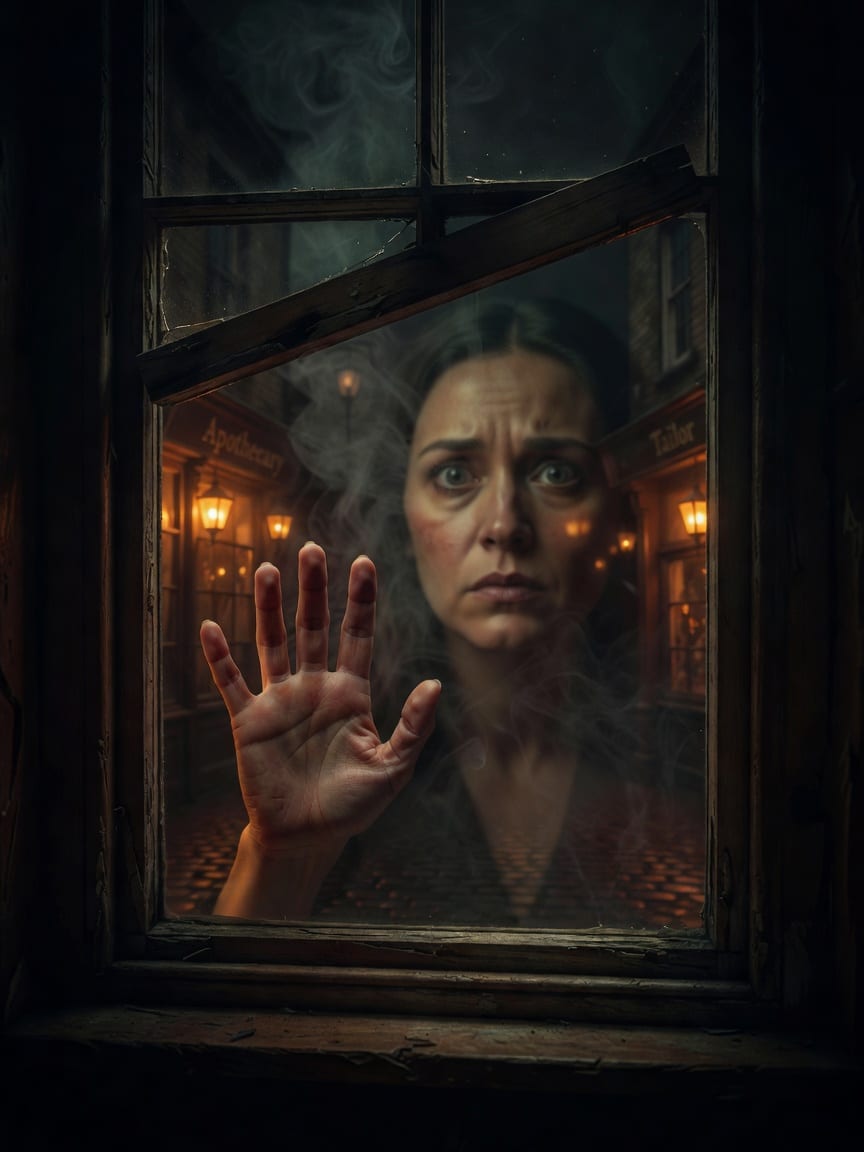
My new flat has a boarded window. I pried a plank loose and saw a gaslit Victorian shopfront across the street. I nailed the board back. The nails went into wood soft and new.
I'd only been in the flat three weeks when the boarded-up window revealed a bustling, gaslit street from another era. Shaken, I nailed it shut, only for the old planks to feel like freshly milled, wet wood. Then, the kettle started whistling at 6 AM every morning, cold and untouched, leaving behind a faint, sweet smell of brewed tea.
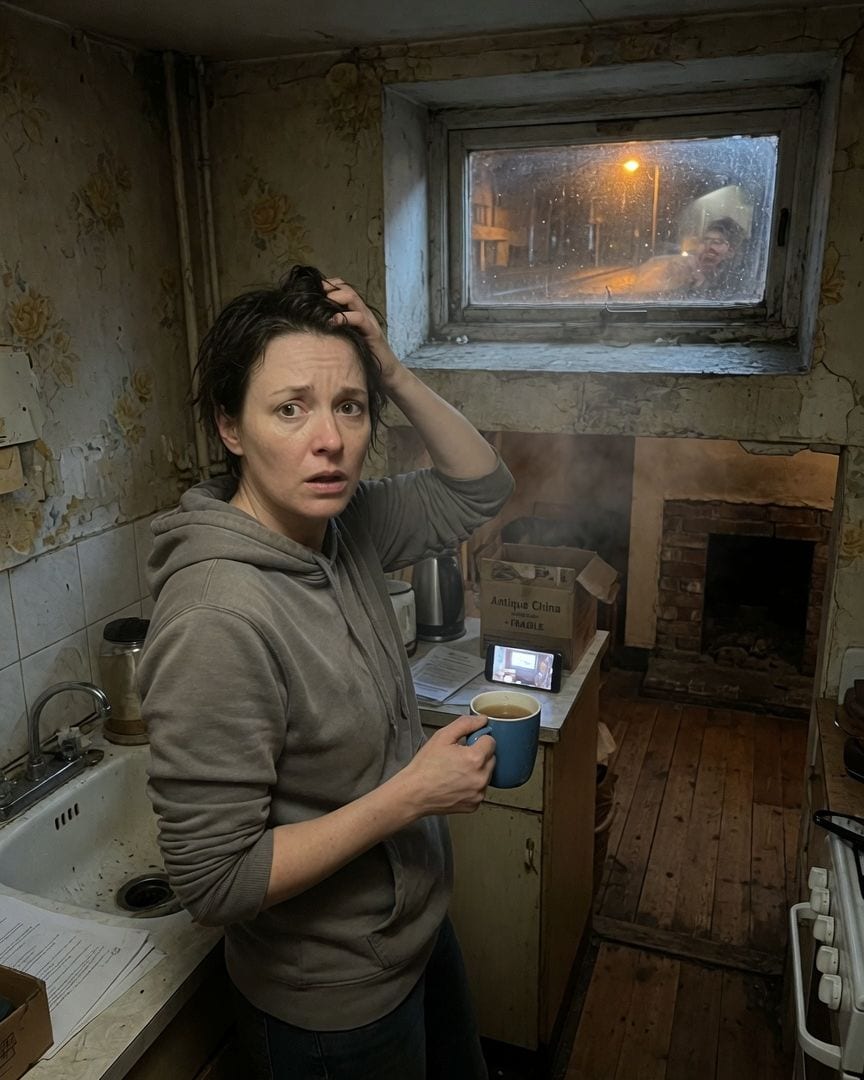
My basement window shows a gaslit kitchen moving at midnight, hams hung from the ceiling. My own kitchen is dark.
Settling into my new basement flat, I was making tea late one night when I glanced out my kitchen window. Instead of the concrete well, I saw a gaslit kitchen with an enormous cast-iron range, a young scullery girl, and cured hams hanging from the rafters. The vision was too sharp, too real, and the smell of coal smoke lingered long after it vanished.
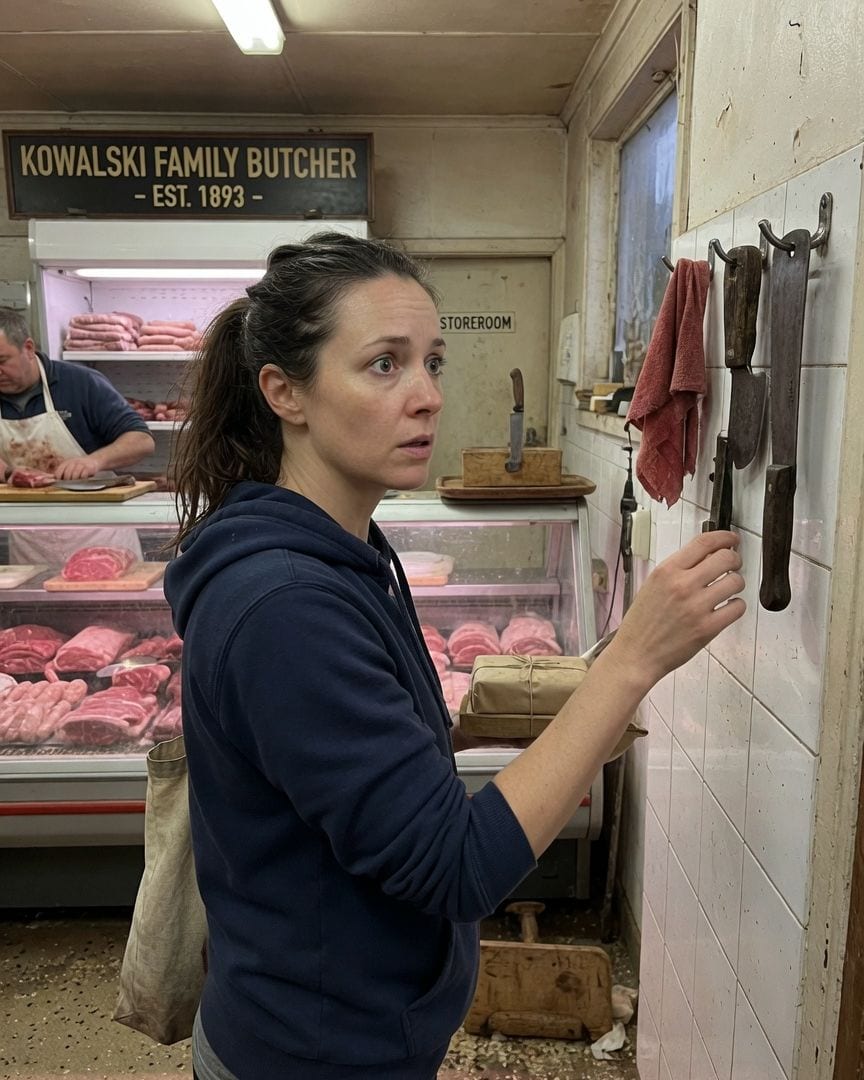
The butcher's back hook always hangs empty, draped with a red cloth. It holds a standing order since 1911 for the Hall, which burned down before the first war. The meat is gone every Friday, but no one's seen a cart.
Still new to Longnor, I stepped into Oscar Kowalski's butcher shop, needing a place to hang my bag. My hand brushed a simple hook, but Oscar's knife suddenly thudded, and he snapped, 'Not that one, dear.' He insisted the empty hook was 'reserved,' leaving me with a strange prickle of unease.
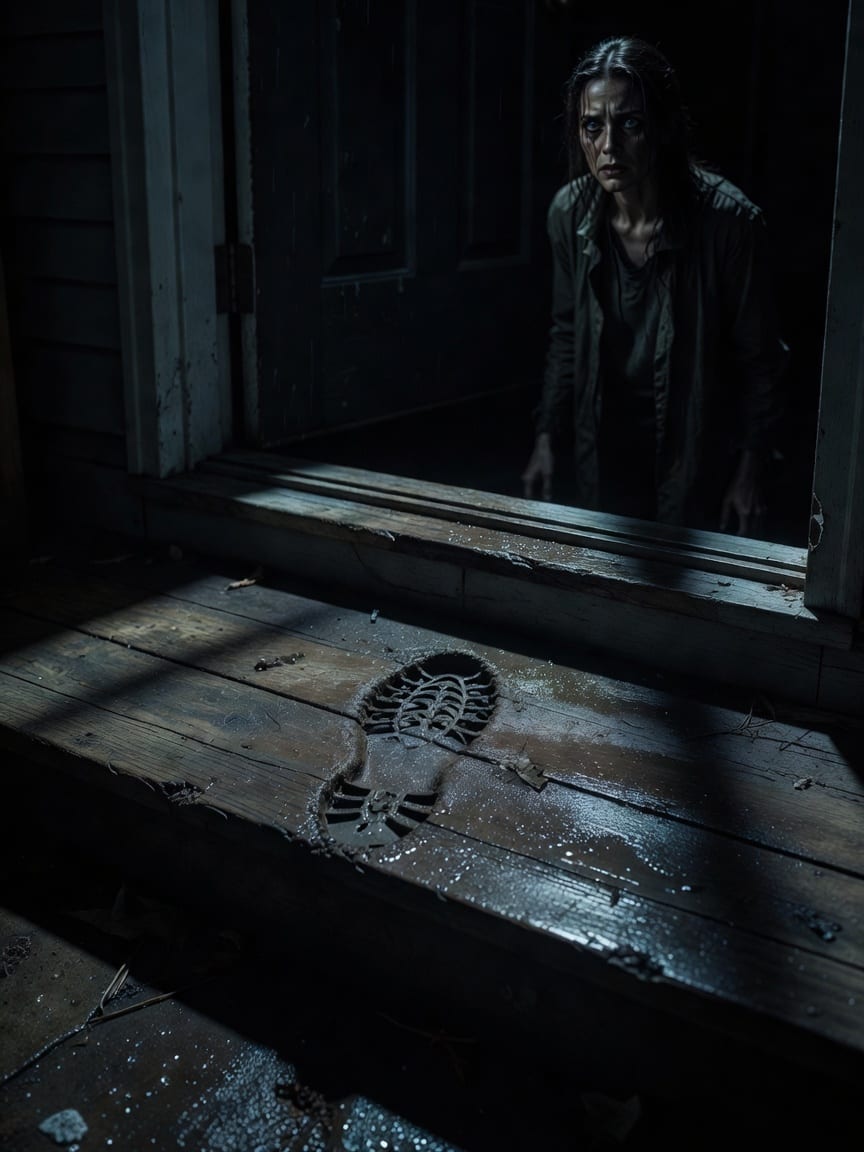
My landlord's only rule: never let the outside tap run after sundown. Last week it dripped. This morning, wet bootprints ringed the back step from the tap to my door, all the same size. The tap was off.
We'd just settled into Waterside House, with its strange landlord rule about the outside tap. After the washer broke, I found perfect, wet bootprints leading from the tap to our back door, but the tap was cranked completely off, tighter than I could manage.
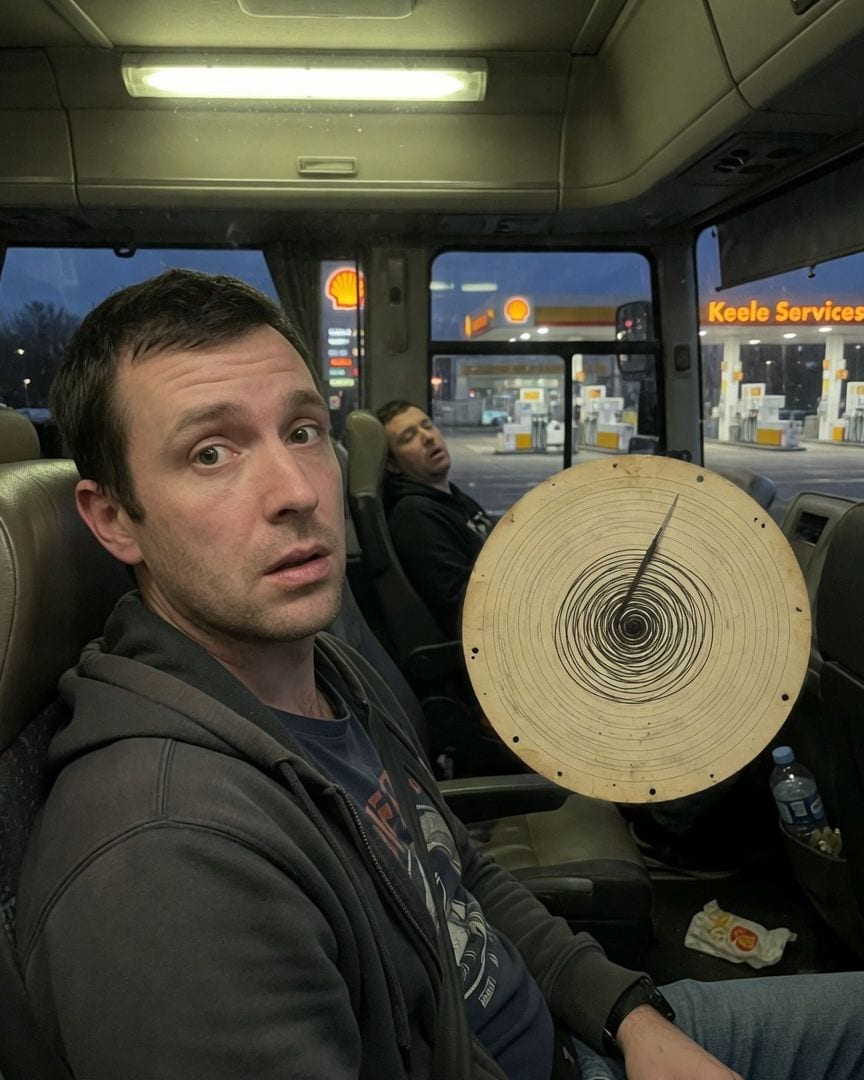
My coach stopped twice at Keele services this morning. Same pumps, same lit sign, the driver's log disc spinning a tight circle, never leaving the one place.
I was on an overnight coach, tired and stiff, when I first woke at Keele Services at 3:20 AM. An hour and a half later, I woke again to find us still there, the driver's log disc spinning a perfect, impossible circle of stasis.