My pub's gents has a second identical door right beside it. Behind it, a corridor longer than the building, with rooms no one else can see.
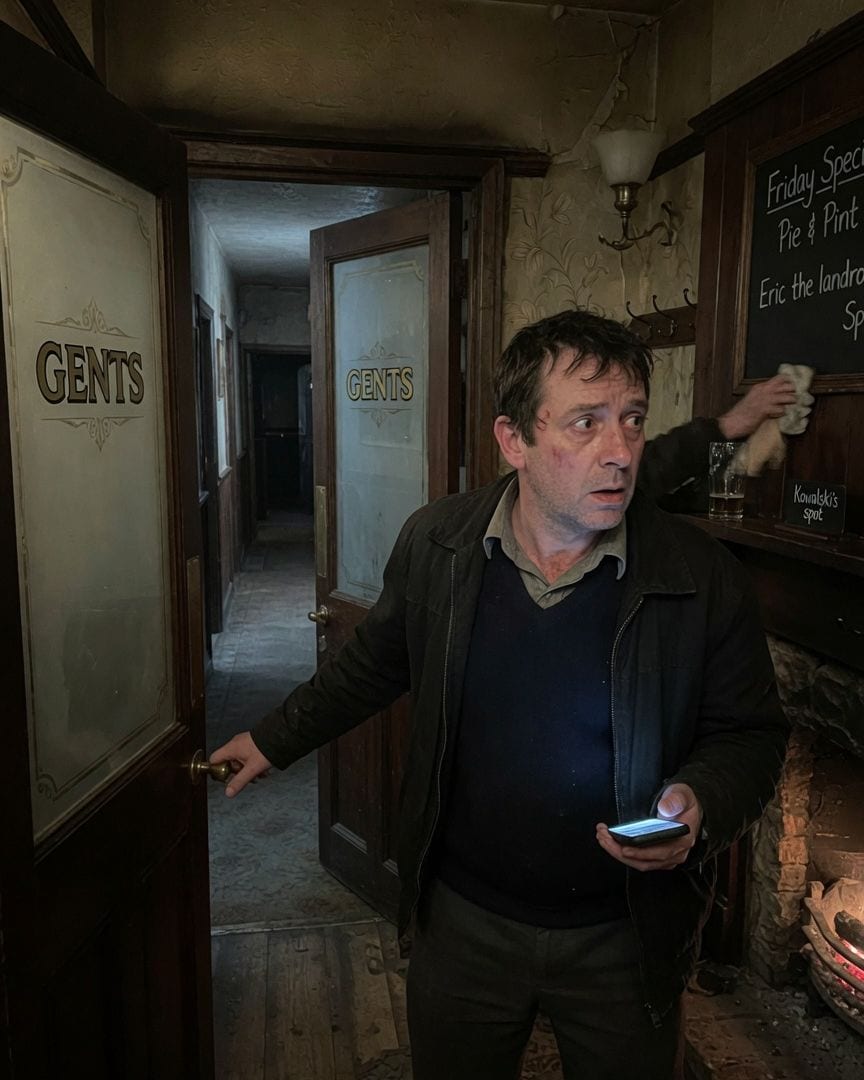
The Old Bell is my Friday night ritual. Been that way for years. A quiet pint, usually in the same spot by the fireplace, watching Eric Sheppard, the landlord, do his thing. Last Friday, though, was different.
Maybe it was the third pint, or maybe it was the way the low light caught the brass hooks on the coat rack I’d been idly counting, but I saw it. A second door. Right beside the gents. Identical.
Frosted glass, same ornate ‘GENTS’ sign, same heavy brass handle. I’d never seen it before.
My first thought was that I was more sloshed than I’d realized. I blinked, rubbed my eyes. Still there. Curiosity, a very bad idea when fueled by cheap lager, pulled me towards it. I pushed the handle. It turned.
The door swung inward with a faint, dry sigh. Behind it wasn't a broom closet, or a wall, or anything I could explain. It was a corridor. Narrow, unlit, stretching into what looked like absolute gloom. It was impossibly long.
I took a step, another. My pub, The Old Bell, is an old building, but not that big. This corridor felt like it extended far beyond the pub's known footprint. Longer than the entire building, I was sure.
The air in there was colder, somehow thinner.
A shiver went down my spine, suddenly very sober. I stumbled back, pulling the door shut with a soft click, my heart thumping against my ribs like a trapped bird. I walked straight to the bar.
Eric was wiping down the counter, slow and steady.
"Eric," I said, my voice a little too loud. "Since when did you have two gents doors? The one by the fireplace."
He paused, a rag in his hand. Looked at me, then at the wall I was pointing to, then back at me. A blank look. "Two, Mr. Kowalski? Never. One gents. Always been one. What have you been drinking?"
He went back to polishing, dismissive. But I knew what I’d seen.
Sober the next morning, I tried to dismiss it all as a drunken hallucination. My mind playing tricks. It was Friday night, after all. But the memory gnawed. That impossible length, the sudden cold.
It wasn’t a trick of the light. I kept seeing the frosted glass, the 'GENTS' sign.
That evening, against my better judgment, I returned to The Old Bell. I ordered a tonic water, feigning thirst. Eric nodded, didn’t comment.
I waited until the bar was busy, then, my heart doing a strange little flutter-kick in my chest, I walked towards the fireplace.
The second door was still there. Solid. Real.
I pushed it open. No protest from the hinges this time, just a faint sigh of stale air. The corridor was still there too, stretching into gloom. I pulled out my phone, thumbed on the flashlight.
The beam cut through the thick dust motes dancing in the heavy air. The walls, I saw now, were lined with doors. Six on each side, old timber, plain, unpainted. Six doors.
But the pub’s layout, its square footprint, couldn't possibly allow for any. There was no space. It was a solid wall on the other side of the regular gents.
I tried the first door on the left. The handle rattled, locked tight. The second, locked. Every door, locked. The air grew colder the deeper I went, heavy with a faint, musty scent like old paper and damp stone.
Not quite mould, more like something long forgotten.
I paced, counting my steps. It was at least fifty feet, probably more. I tried to rationalize it again: a forgotten storage space, a neighbor’s property somehow bleeding through.
But the geometry felt wrong, a forced perspective that pulled the light in, making the far end seem to recede even as I approached. It was like looking down a hallway in a funhouse, but without the fun.
It felt like a forced perspective, a trick of light and shadow, yet utterly solid. I ran my hand along the wall, feeling the rough plaster.
My fingers caught on a faint, almost invisible seam in the old plaster near the end, a hairline crack revealing a hint of intricate, faded wallpaper beneath. A pattern I couldn't quite make out in the dim light.
I took a photo with my phone, a shaky, blurry shot of the impossible length, the impossible doors, the impossible crack. The phone felt cold in my hand.
Driven by a growing unease, an itch I couldn’t scratch, I returned to the corridor the next day. This time, I had a small pry bar in my hand. My hands felt clammy, but I pushed on.
I walked past the six locked doors on each side, the air growing colder with every step, the musty smell stronger now. At the very end, partially obscured by shadow, was another door. Unlike the others, this one wasn't locked.
Just stiff. I braced myself, pushed with my shoulder. It scraped open with a sound like a buried coffin lid dragging across stone, a slow, grinding shriek that made the hairs on my arms stand up.
Beyond it was a small, square room. No windows, no modern fixtures. The air was thick, still, and impossibly cold, as if it hadn't moved in a century.
The walls were covered in an ornate, faded wallpaper, a pattern of swirling leaves and forgotten flowers, the colours muted to sepia tones. I hadn't seen anything like it outside of a museum.
In the center of the room, on a small, dusty, three-legged table, a single, remarkably preserved newspaper clipping lay open.
Its headline, stark and black against the yellowed paper, screamed about a 'Local Man Vanishes Near Old Bell Inn,' dated October 17, 1923.
The newspaper clipping was too specific, too perfectly preserved, to ignore. My accounting brain latched onto the facts. October 17, 1923. Local man vanishes. Near The Old Bell. This wasn’t a hallucination or a prank. This was a record.
I spent the next few days at the local library, then the dusty county archives, poring over old maps and property deeds for The Old Bell.
Every map I found, every blueprint, every historical record, showed the pub as a simple, rectangular structure. No annex. No extra corridor. No room at the back. Nothing. It simply didn't exist on paper.
I cross-referenced the 1923 missing person report, finding a terse police file: a local tailor, Arthur Finch, last seen leaving The Old Bell. No body, no trace. The case remained cold. Just vanished.
My leads dried up fast. I needed someone with a deeper knowledge. I remembered Margaret Marsh, a retired archivist known for her encyclopedic knowledge of local history. She lived in a small cottage, surrounded by stacks of books and folders.
When I described the impossible corridor and the room, the faded wallpaper, her calm, professional demeanor fractured. She looked at me with an unnerving mixture of recognition and fear, her knuckles white where she gripped the armrests of her chair.
She slowly stood, pulling a small, leather-bound album from a shelf. She opened it to a faded photograph from the 1930s of The Old Bell, taken from an unusual angle, from the alleyway behind.
In the background, barely visible, a faint, almost ghost-like outline of a narrow, elongated structure appeared, where no such structure should have been. It was indistinct, like a smudge or a flaw in the film, but I could see it.
It was where the corridor would be.
"It's happened before," she whispered, her voice barely audible, like dry leaves rustling. Her eyes, magnified by her thick glasses, fixed on mine. "The geometry… it shifts."
Margaret’s words, "The geometry… it shifts," echoed in my mind. It explained nothing, yet everything. My rational accountant’s brain was screaming, but a deeper, colder part of me was listening. And then I felt watched. It started subtly.
A dark sedan, a generic model, parked on my street for two consecutive nights. First, just a glimpse from my window. The second night, I decided to walk around the block. It was there.
When I rounded the corner and approached it, the car would drive off slowly, smoothly, never speeding, never lingering. Just… gone.
One evening, after another fruitless search at the archives—no mention of spatial anomalies or shifting geometry—my phone rang. An unknown number. I almost let it go to voicemail, but some instinct told me to answer.
"Stop looking," a calm, deep voice advised. Male. Unfamiliar. No inflection. "Some things are better left buried."
The line went dead. My blood ran cold. I tried to call back. The number was disconnected. Just a few rings, then a sterile message. The dread crept in, a slow, insidious seep, replacing the initial shock.
This wasn’t just a local mystery or a historical quirk anymore. This was something far larger, something that knew I was digging.
I returned to Margaret Marsh the next day, abandoning all pretense of polite inquiry. I pressed her, my voice tight. "Who knows about this? Who would want me to stop?"
She hesitated, her hands trembling as she fiddled with a stray thread on her cardigan. She glanced at the window, then back at me. "The… the Borough Surveyors Office," she finally murmured, her voice barely above a whisper.
"They have… a special department for 'anomalous structural deviations'. They keep records. Very old records." She looked away, her eyes fixed on a distant point, as if recalling a phantom.
"They sent someone to my office decades ago, after I made an inquiry about a similar 'discrepancy' in an old property deed. A man named Carl Sinclair. He was polite, very calm. Told me to let it go.
And I did."
Carl Sinclair. That name had lodged itself in my mind. The Borough Surveyors Office. Anomalous structural deviations. It sounded like something out of a pulp novel, but I was living it.
I found Carl Sinclair’s address listed in an old, dusty phone book I’d retrieved from the local library’s reference section.
The former clerk lived in a quiet, unassuming house on the outskirts of town, neat rose bushes bordering the path to his front door.
Carl, frail but surprisingly sharp, greeted me with an unsettling lack of surprise. His eyes, though aged, held a knowing glint. "You found the corridor, didn't you?" he stated, not asked.
He just looked at me, a calm certainty in his gaze.
I felt a chill, a shiver that had nothing to do with the cool autumn air. I confirmed it, my voice barely a whisper. "And the room? The clipping?"
Carl nodded slowly, a deep sigh escaping him. "Arthur Finch. He was the one before you."
"The one before me?" My voice was colder than the air. "What are you talking about?"
He waved me in, led me to a small, cluttered living room, filled with stacks of old newspapers and books.
He poured tea from a chipped pot, his movements steady, unhurried, as if this was a conversation he’d had many times before. "The Old Bell is a 'node.' That's what we called it in the office.
A place where reality thins, folds in on itself. It happens every few decades. The corridor appears, sometimes the room. And someone… notices."
"The Borough Surveyors Office," I pressed, the words tasting like ash in my mouth. "What do they do?"
Carl sighed again, a heavier sound this time. "They document. They categorize. They try to contain. They’ll buy up properties that exhibit these 'deviations,' then 'redevelop' them, often burying the anomaly deeper. But mostly, they observe.
They've known for a long, long time. The records go back to the 1880s." He stared into his teacup. "It never goes away, though. Just… shifts. And it always takes someone with it."
He paused, his gaze lifting, fixing on me with an intensity that made my breath catch. "The ones who notice, who dig too deep. They become part of the geometry. They vanish. Like Arthur Finch. Like others before him.
Like… you."
Carl led me to a dusty, locked cabinet in his study, the wood smelling of aged cedar and forgotten secrets. He fumbled with a small brass key, the lock clicking open with a soft thud.
"I kept some of the classified files when I retired," he mumbled, pulling out a heavy, leather-bound ledger, its pages brittle with age. "The ones they didn't know I had. Or maybe they just let me keep them. To… observe."
He laid it open on the table, a puff of dust rising. "These are the 'Observer Recurrence Patterns.' Each entry details a discovery, an investigation, and then… a disappearance."
His finger, thin and trembling slightly, traced a line down a page, yellowed and fragile. "Look closely."
The entry was dated 1978. It detailed an 'Observer, male, approximately 42, accountant by profession, noted for persistent investigation of 'The Bell' anomaly.' My stomach plummeted. Below it, a partial name: 'P. Kowalski.'
And then, a faded, black-and-white photograph. A grainy image of a man. He stood in front of The Old Bell, younger, but there was no mistaking the features. The same high forehead, the same slight downturn to the mouth.
He was undeniably wearing my own watch, the steel bracelet glinting dully even in the poor resolution. The man in the picture stared out from the past, his eyes wide with a familiar, dawning terror.
Carl pointed a trembling finger at the faded entry. His voice was a dry rattle. "They've known, Mr. Kowalski. They've known for decades. And you… you're not the first."
If this one got to you
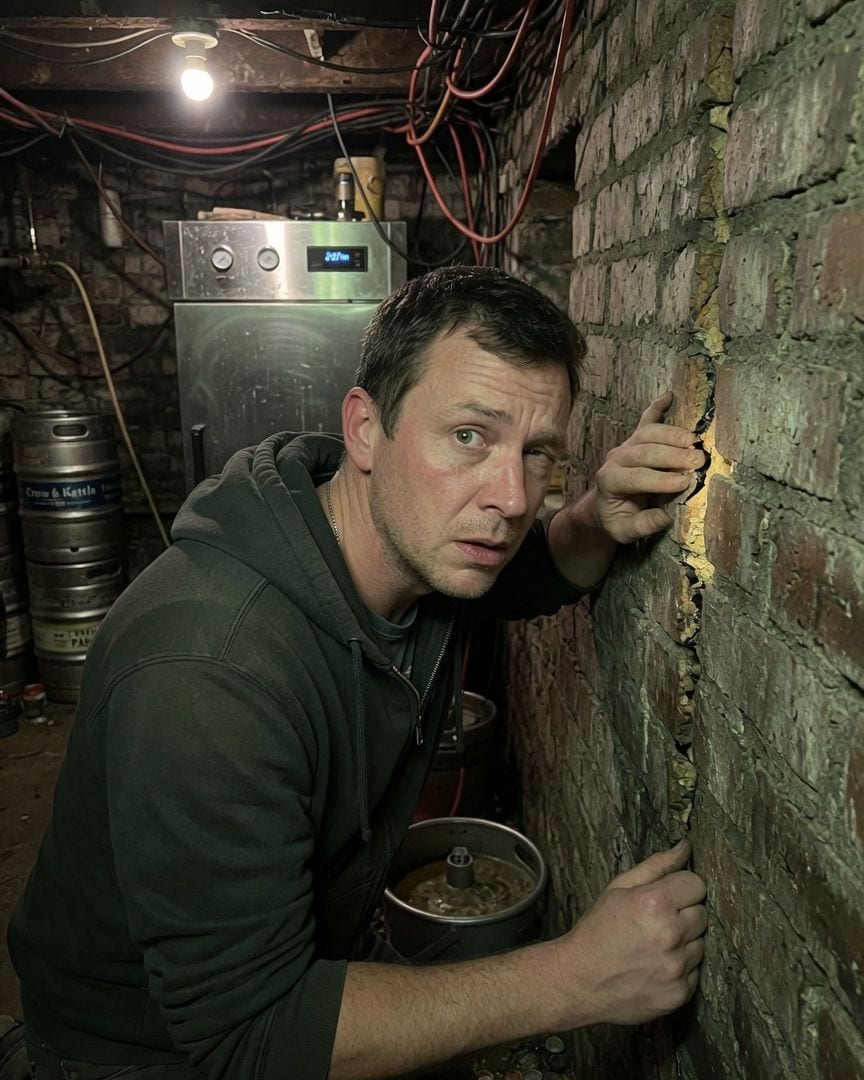
My cellar doorway opens onto an old bar-room. The brewery bricked it up decades ago.
Running my new pub is exhausting, especially doing late-night rounds in the damp cellar. But one night, a hairline crack appears in an old bricked-up wall. Through it, I see a bar-room from another time, filled with men frozen mid-drink, their pipe smoke still clinging to the air.
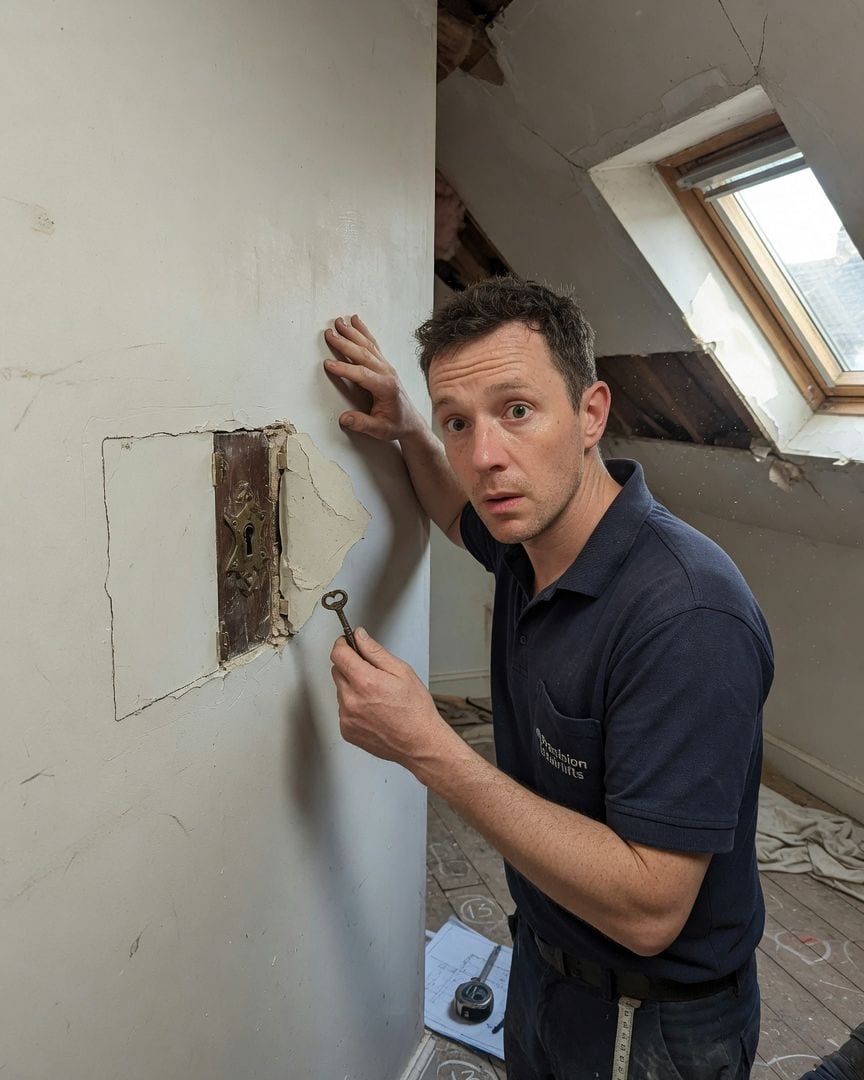
My stairlift tape measures thirteen steps, but my own feet always find a fourteenth — to a door that isn't there.
As a meticulous fitter, I measured my client's new loft stairs, confirming thirteen solid steps. But my foot found a shallow, impossible half-step, leading to a plain wooden door that shouldn't exist. Now the door is gone, leaving only a ghost outline.
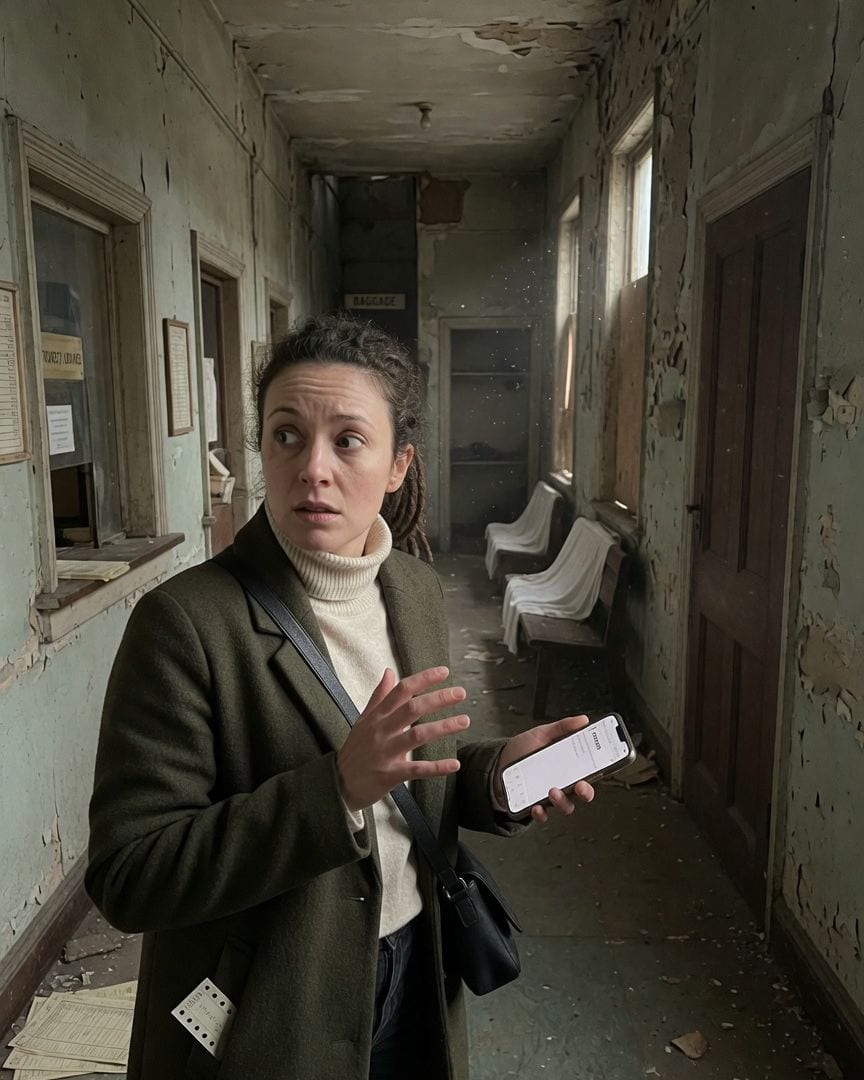
My scenic railway loop repeated six times. The same trestle bridge, the same waterfall, over and over, the conductor punching my ticket each pass. We never left the circle.
My scenic railway journey was supposed to be a gentle, thirty-minute loop through the gorge. But after only fifteen minutes, the same landmarks rolled past again, and again, and again. The conductor, Henry Kingsley, punched my ticket six times as if each was the first, his gaze utterly devoid of recognition.
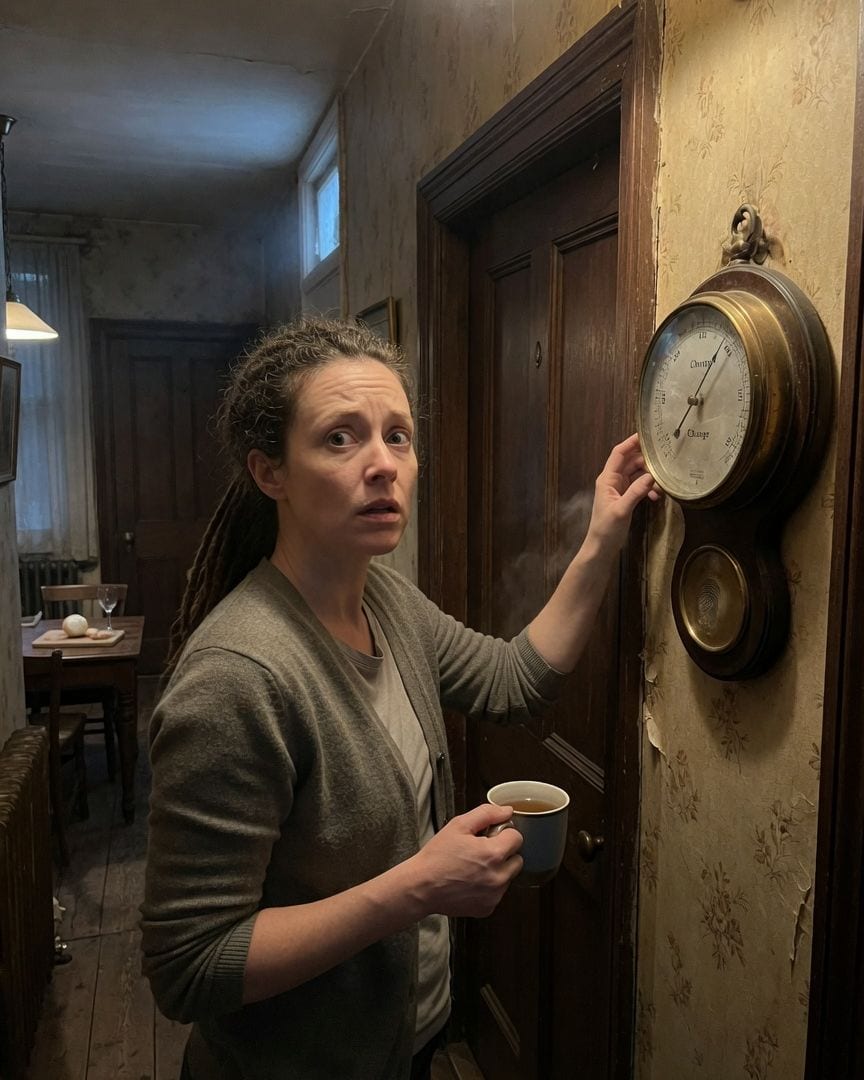
My hall barometer taps itself every night at six. From the next room, with nobody there.
After moving into Oscar Vaughn's old house, I became accustomed to the strange noises that came with it. But then, a heavy, locked oak door in the dining room, one I'd never been able to open, slowly pushed itself ajar at precisely six o'clock one evening. I hadn't touched it, and no one else was there.
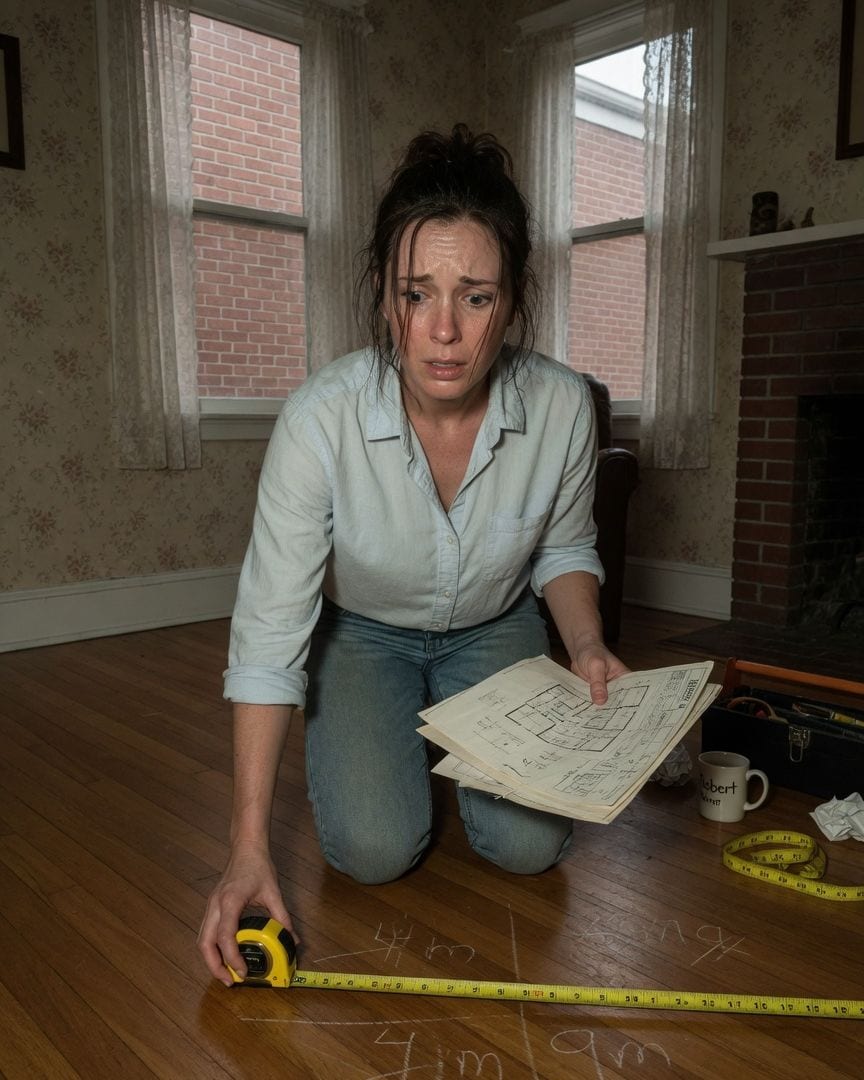
Our living room measures four by five metres. But the outside wall is nine metres long. A metre of house, gone, and I can't find it.
After moving into our charming 1920s house, I was meticulously measuring the living room when the dimensions refused to add up. My calculations of the interior space led me to discover a narrow, unpainted fifth door in the hallway, tucked almost out of sight. It wasn't on any original plans, and it opened to absolute, impenetrable darkness.
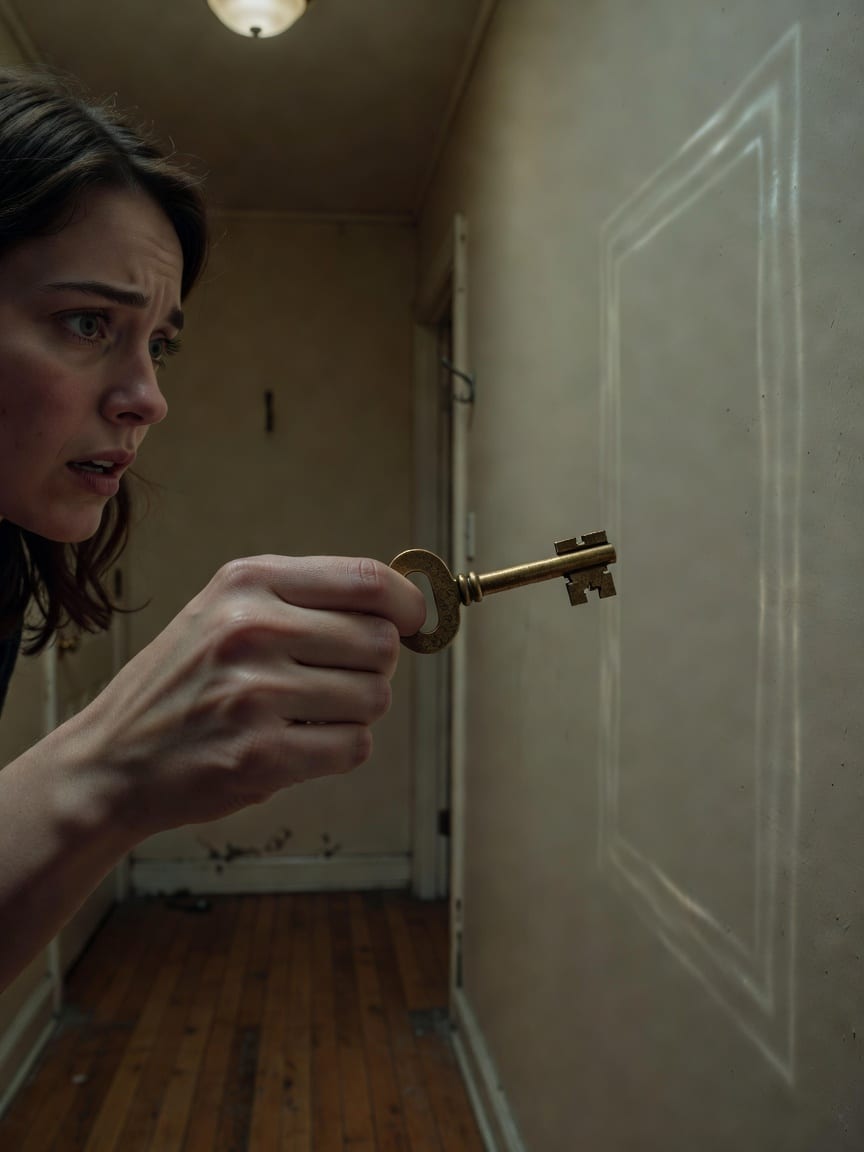
My new house has seven rooms. The removal men counted six. Now one of them asks who's in the locked seventh, on a landing with only six doors.
Moving into my new house, I supervised the removal men hauling boxes. But on the landing, Paul, the senior man, asked about a locked seventh room upstairs, pointing to a blank wall. His quiet certainty, despite the clear absence of a door, filled me with a sudden, icy dread.