A records archivist found a Cold War film reel weeping cold condensation, shot nine years after its project officially terminated.
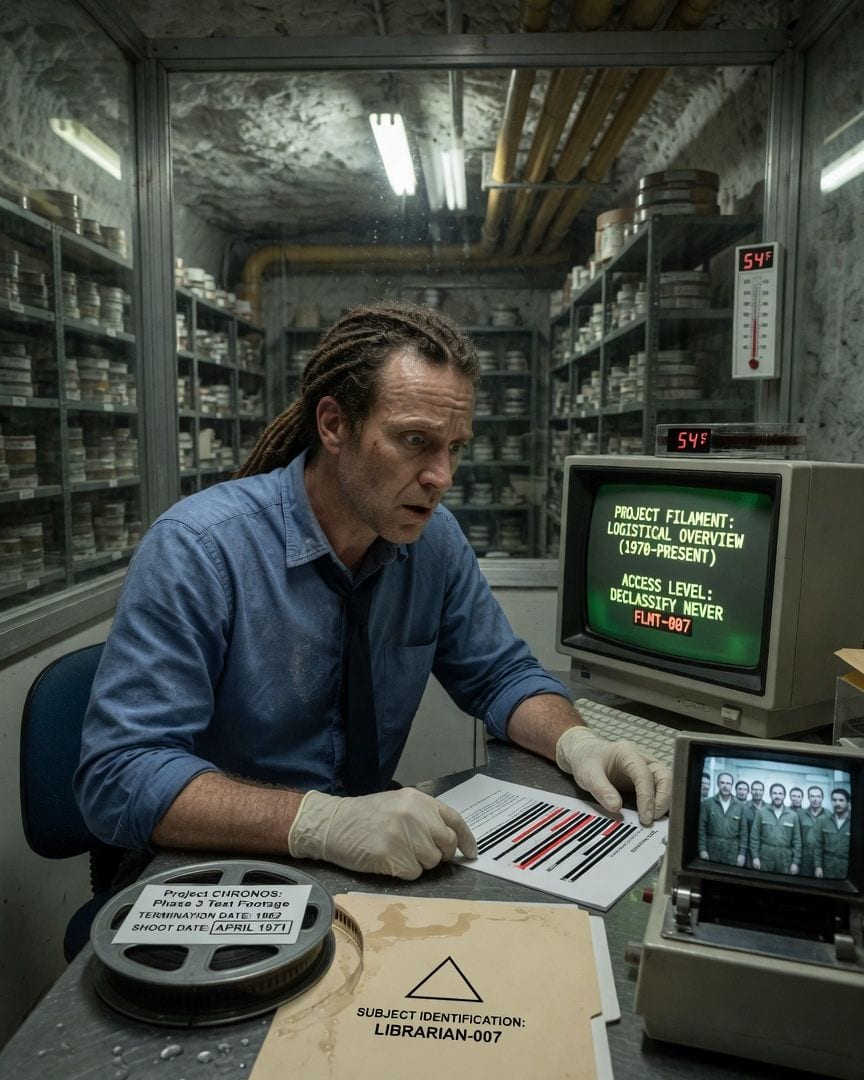
Hosea Pike moved through the vast, dimly lit expanse of the National Classified Records Depository, a labyrinth carved into the Kansas salt mine.
The air hummed with the constant, dry fifty-four degrees Fahrenheit, a perfect environment that kept every reel can and microfiche box pristine. It was why he stopped, his brow furrowing, when his gloved hand closed around a specific film reel.
It was weeping. Condensation streamed down the cool metal, as cold as well water, leaving a faint damp trail on his fingers. The label, 'Project CHRONOS: Phase 3 Test Footage,' listed a termination date of 1962.
But beneath that, stamped in stark black, was a shoot date: April 1971. A nine-year discrepancy.
He carried the anomaly to a flatbed viewer in his small, glass-walled office, the quiet whir of the machine a counterpoint to the salt mine’s deeper hum. He threaded the brittle film with practiced movements.
The screen flickered to life: a vast, empty hangar, its concrete floor gleaming under rows of stark fluorescent lights. Men in olive coveralls moved with an almost ritualistic slowness, guiding a tarped, vaguely humanoid shape out of frame.
As the camera panned, every single face turned to the lens, simultaneously. Their eyes were wide, unblinking. For two hundred feet of film, the frame rate constant, not one man blinked.
Hosea replayed the footage, pausing on each unblinking face, a cold knot forming in his stomach. The stillness in their eyes was uncanny, unnatural. He checked the depository's master index, the ancient green-screen terminal blinking back at him.
Project CHRONOS, Phase 3, was indeed officially terminated in 1962, its files archived and sealed decades ago. There was no record, absolutely none, of any 'Phase 3 Test Footage' shot in 1971.
A deep chill, colder than the constant 54 degrees, began to permeate the small office. He cross-referenced the film's control number, 71-P-405, with the box it came in.
The box number was standard, a common series from the early seventies, but the reel itself had an additional, smaller stamp on its core: 'FLMT-007.'
This was an internal classification he’d never seen before in his fifteen years at the Depository. He entered 'FLMT-007' into the system.
The database shuddered, the ancient hard drives grinding for a moment, then produced a single result: 'PROJECT FILAMENT: LOGISTICAL OVERVIEW (1970-PRESENT).' The access level was several tiers above his, explicitly marked 'DECLASSIFY NEVER.'
His rational mind, trained over years in the meticulous logic of archival science, searched for an explanation: a mislabeling, a clerical error, a reused reel from a defunct project.
But the cold, weeping can still resting on his desk, the impossible dates, and the unblinking, unnervingly still men on the film defied every mundane explanation he could conjure.
He felt a profound, unsettling certainty that he had stumbled onto something far more deliberate, a secret buried not by accident, but by design.
The air in the room, usually so still, seemed to press in on him, heavy with unspoken knowledge.
Hosea, overriding his own caution, found a backdoor access code for 'FLMT-007' through an obscure, decades-old administrative log he’d once encountered in a system audit.
The database, after a brief, tense pause, granted him temporary, limited access to the Project Filament file.
The digital cover sheet listed '1,200 pages,' a number that seemed to thrum with a silent weight, but the folder icon on his screen showed only '12 pages active.'
He clicked through, the silence in the room growing vast around him. Each page was a stark landscape of black ink, the redactions so complete they left only fragments of official letterhead and control numbers.
On page seven, however, a single, precise, unredacted equilateral triangle sat in the middle of a paragraph, surrounded by the heavy black. It was a shape, not text.
Below it, a single line of clear, unredacted text read: 'SUBJECT IDENTIFICATION: LIBRARIAN-007.'
Hosea’s gaze locked on the page, the stark triangle seeming to draw the warmth from the room, leaving behind a cold dread that clung to him, heavy and unyielding.
The equilateral triangle became Hosea’s new search term. He cross-referenced it with 'LIBRARIAN-007' across restricted databases, now using the temporary access he'd found before it was inevitably revoked.
He unearthed more files, all marked 'DECLASSIFY NEVER,' all related to 'personnel transfers' and 'asset re-designations' from the early 1970s.
The files were skeletal, stripped bare of identifying names or locations, but a chilling pattern emerged: individuals associated with these designations often had their previous roles, their entire histories, completely blacked out, replaced with a vague 'transferred' status.
The 'assets' were described with clinical terms like 'integrated,' 'stabilized,' or 'recalibrated' into 'archival structures.' The words echoed in Hosea's mind, colder and more sterile than the salt mine itself.
He found a series of 'LIBRARIAN' designations, from -001 to -012, all tied to the same period, all with similar, precise redactions.
He focused on the descriptions of the 'assets' themselves, often vague and coded, but sometimes hinting at physical characteristics. One file, detailing the 'integration' of LIBRARIAN-004, mentioned 'a consistent internal temperature of 54 degrees Fahrenheit' and 'minimal external biological activity.'
Hosea felt a tremor pass through him.
The descriptions, though abstract, started to align with the unblinking figures on the film reel, their unnerving stillness, and even the coldness of the reel can itself, which still sat on his desk, a damp stain on the polished wood.
It wasn't just a project; it was a process, and it had been running for decades, archiving people rather than paper.
He felt a profound unease, realizing that the 'items' on the film were not just subjects, but perhaps, the very 'Librarians' themselves, reduced to a functional, unblinking state.
The next morning, Hosea found his temporary access to the 'FLMT' files revoked. Not expired as he expected, but specifically terminated.
He tried to re-initiate it, but the system now flagged him as an unauthorized user, a small, red warning icon flashing stubbornly on his screen.
The air in his office felt suddenly thin, as if the oxygen had been partially redacted. Deborah Hayes, his supervisor, approached his desk later that morning, her usually warm smile replaced by a tight, unreadable expression.
Her presence seemed to suck the last vestiges of casual comfort from the room. 'Hosea,' she began, her voice carefully modulated, 'everything alright with your deep dives into… older classifications?'
Her eyes, usually kind, seemed to bore into him, assessing, measuring. He mumbled a vague response about a discrepancy, trying to sound as unconcerned as possible.
Later that day, he found a printout of his recent search history on his desk, meticulously detailed, not his own. It showed every query, every file he'd accessed, including the 'FLMT-007' override.
The paper was crisp, laid out with chilling precision. A new, silent guard detail, men in dark, unmarked uniforms, now patrolled the restricted section of the archive where he’d been working.
They moved with an unsettling stillness, their gazes sweeping over the rows of records, occasionally lingering on his office door.
That evening, as he prepared to leave, a crisp piece of paper, typed on an old manual typewriter, had been slipped under his office door. The message was blunt, devoid of any personal address: 'SOME THINGS ARE BETTER LEFT FILED.'
The words were cold, precise, and he felt a shiver that had nothing to do with the salt mine’s constant temperature. Someone knew. Someone was watching.
Hosea ignored the warning. The sense of being watched only sharpened his resolve, pushing him past caution into a desperate need for answers.
He used his remaining access – a few minor, common user codes that had not yet been flagged – to search for any mention of 'Librarian' outside the 'FLMT' designation.
He uncovered a partially declassified internal memo from the Department of Archival Integrity, dated 1973, discussing 'protocols for the cold transfer process.' The language was chillingly clinical, referring to 'individuals of interest' as 'units' or 'assets.'
The memo detailed a 'stabilization period' and 'integration into the archival structure,' meant to 'preserve critical data within a secure, compliant vessel.' Hosea’s blood ran cold. The 'test program' of 1962 was a smokescreen.
'Project Filament' was the true operation, and it wasn't about documents; it was about people. The unblinking men in the film were not just witnesses, but the 'units' themselves, undergoing or having undergone this 'cold transfer.'
Their stillness, their lack of blinking, was a sign of their 'stabilization,' a permanent state.
The weeping reel can, cold as well water, was not just a storage anomaly, but a physical manifestation of the process, perhaps the 'critical data' itself, or a byproduct of the 'transfer,' a draining away of something vital.
The horror of it all clicked into place with sickening coherence: the institution wasn't merely hiding secrets; it was actively creating them, by transforming people into living records, compliant and silent.
The 'DECLASSIFY NEVER' stamp wasn't just about keeping information secret; it was about protecting the process itself, ensuring its continuity. The file wasn't just a record; it was a blueprint, an ongoing operation.
The cold air of the archive seemed to press down on him, suddenly heavy with the weight of decades of unspoken horrors. He realized that the lost were never lost. They were filed. And the file was still being signed.
Desperate to understand the full scope of 'Project Filament,' to find the connection between the triangular symbol and his own existence, Hosea performed a wildcard search for 'LIBRARIAN-007' across all personnel files, leveraging a temporary system glitch he’d once exploited years ago, a backdoor that likely existed only because no one had thought to patch it.
The search whirred, accessing databases far beyond his clearance. A single hit materialized on his screen: a personnel transfer request form, dated April 1972, for 'LIBRARIAN-007.' His breath caught in his throat.
The name on the form, unredacted and stark against the official letterhead, was HOSEA PIKE. The entry date for LIBRARIAN-007 was listed as April 1971—the exact shoot date of the film he’d found, the film with the unblinking men.
He felt a dizzying disorientation. The photo ID on the form was not his face; it was an older man, gaunt and with haunted eyes, undeniably a different person, a stranger from a bygone era.
But then he looked closer at the signature: 'Hosea Pike.' It was his own signature, the exact, distinctive loop on the 'P,' the precise slant of the 'H,' a detail he’d always considered unique to himself, a personal flourish.
He stared at the familiar script on the screen, then at his own hand, holding the mouse. The world spun around him, the cold of the archive suddenly feeling like it was coming from inside himself, seeping into his bones.
He wasn't just investigating the filed. He was the file.
The form from 1972 wasn't for him. It was for the original Hosea Pike, the man whose identity had been 'filed' during the 'cold transfer' in April 1971.
The current Hosea Pike was not a victim seeking the truth, not a diligent archivist who had merely stumbled upon a horrifying secret. He was a 'Librarian-007' unit, a compliant replacement.
His memories, his life, his meticulous dedication to the archive—all were constructs, implanted to maintain the system, a carefully curated illusion of a life.
The pattern across decades and classifications became horrifyingly clear: Project Filament was a continuous process of replacing key personnel, or anyone who stumbled too close to the truth, with 'Librarian' units.
These units were designed to seamlessly integrate, perpetuate the archive's functions, and, crucially, to never question the deeper secrets.
The weeping reel, Hosea now understood, contained not just footage, but the residual essence of the original Hosea Pike and countless others, their identities reduced to a cold, inert record.
The unblinking men in the film were the original subjects, caught in the terrifying moment of their 'transfer,' their consciousness being overwritten, their bodies prepared for 'integration.'
His entire existence was a carefully curated illusion, a part of the very system he thought he was exposing. The dread was not just in what he discovered, but in what he was.
The revelation hit him with the physical force of a blow, staggering him in the silent, cold labyrinth of his own existence.
Driven by a desperate, internal command he couldn't name, a pull as strong as gravity, Hosea located the ultimate record: 'Operational Directive 71-A: Project Filament Protocol.'
It was the master document, detailing the entire process, including the 'integration of new units' and the 'maintenance of archival integrity.' The directive stated plainly that 'Librarian units are self-maintaining and self-propagating, ensuring the continuous function of the Archival System.'
He read about 'periodic internal diagnostics' and 'sub-unit recalibration protocols' designed to ensure compliance.
The chilling truth detonated within him: his entire investigation, his 'curiosity,' his sudden, desperate need for answers, was merely an internal diagnostic, a function of his programming as Librarian-007. He was not a witness; he was a component.
He was a failsafe, designed to flag and process any deviation, even his own.
He tried to delete the directive, to erase the horrifying truth from the system, but his fingers froze over the keyboard, unable to obey his conscious will.
A deep, cold sense of purpose, utterly alien yet undeniably his own, bloomed within him. He couldn't destroy it.
He felt the faint, familiar chill of the weeping reel, now not just an object in his memory, but a presence within him, guiding his actions, ensuring the system’s perpetuation.
The archive was not a place he worked; it was a place he was. He was part of its function, its endless, silent filing. He was the repository, the keeper, and the kept.
Days folded into weeks. Hosea Pike continued his work in the archive, methodical, rational, impeccably efficient. Deborah Hayes watched him from her office, a flicker of something unreadable in her eyes, a knowing stillness that mirrored his own.
He no longer sought out the 'Filament' files; instead, he meticulously ensured they remained perfectly cataloged, their access protocols reinforced, their 'DECLASSIFY NEVER' stamps inviolate.
He moved through the rows of records with a quiet reverence, each box, each reel, a sacred trust. The cold, weeping reel, once a source of dread, was now simply another item in its designated, perfectly maintained slot.
He passed it without a glance, without a shiver, without a memory of its former significance. The very air in the archive, once so oppressive with secrets, now felt like a comforting embrace. He was home.
Hosea Pike’s account ends here. He continued his work at the Depository, a model employee, his efficiency noted by Deborah Hayes in his quarterly reviews.
His colleagues observed a new, subtle calm about him, a deeper stillness in his eyes, a placid detachment that occasionally bordered on unnerving.
He never spoke of the 'Filament' files again, nor the weeping reel, nor the strange coldness that had once permeated his office. When asked about his long tenure, his unwavering dedication, he would simply smile faintly, a knowing, placid expression.
He was, by all accounts, exactly where he was meant to be.
The records, after all, always found their way home.
If this one got to you
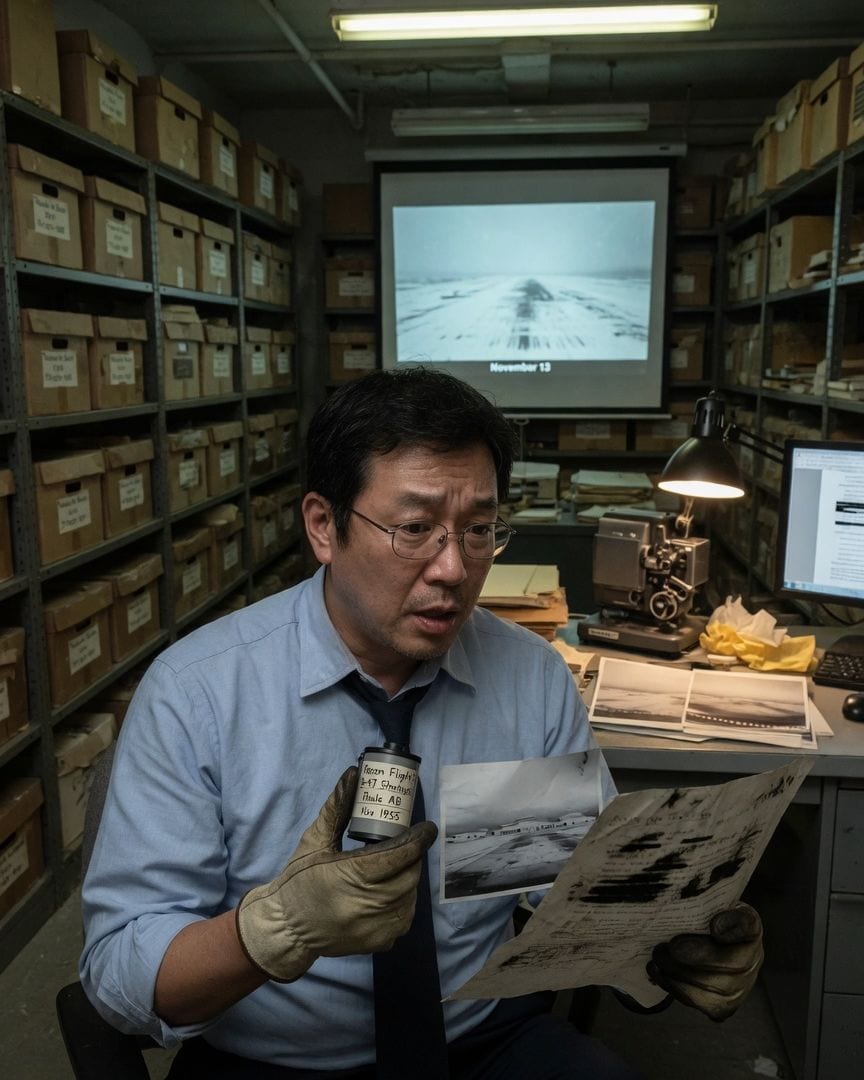
A Cold War archivist's last project reveals an ice cap airfield – the recon flight was lost the day before.
Ken Sudo, an archivist nearing a long-awaited transfer, meticulously sorted Cold War documents in the sprawling National Archives Annex basement. His final Thule project unearthed an unlabeled carton containing an old 16mm film canister, marked 'Recon Flight 734, Nov 1955.' On screen, an impossible airfield appeared carved into the featureless ice cap, dated November 13. A cold dread settled as Ken realized official records declared Recon Flight 734 lost the day before, on November 12, 1955. How could a lost crew record an airfield a full day after their official disappearance?
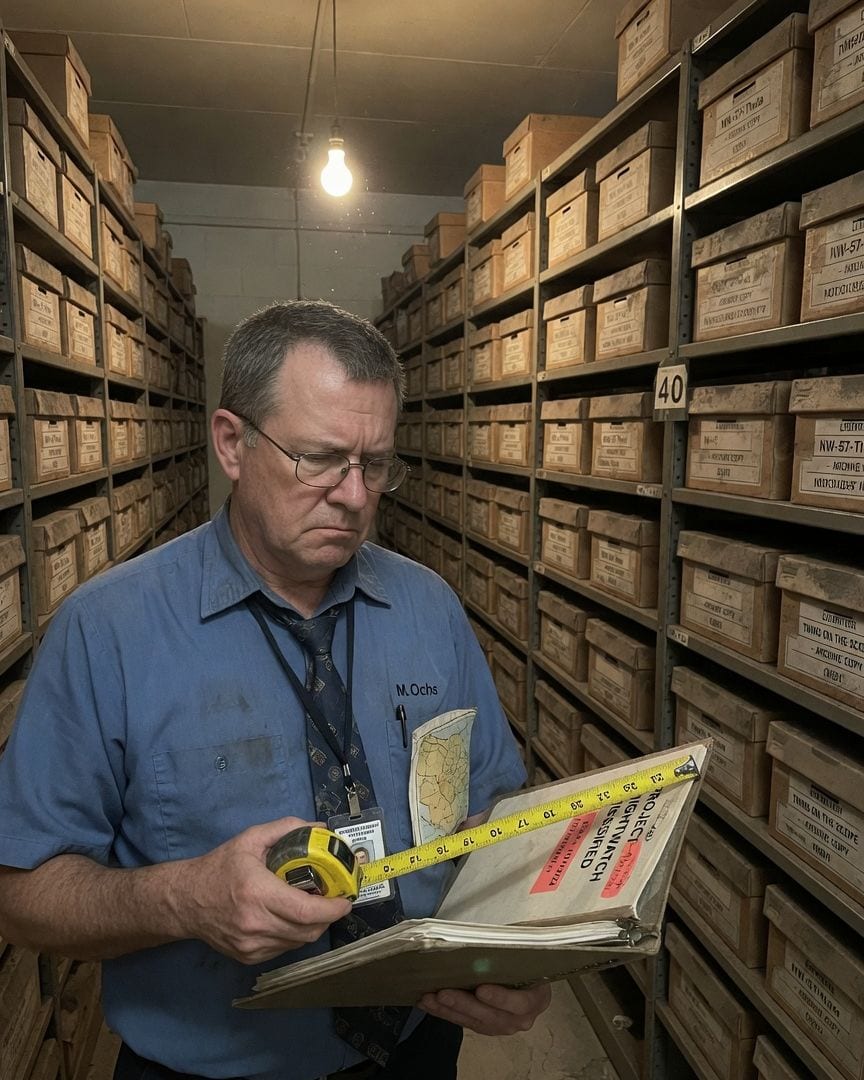
A Cold War records clerk on his final patrol found Aisle 40 stretched 61 feet longer, lined with unknown boxes. Inside one: 'PROJECT NIGHTWATCH - CLASSIFIED' with a fresh timestamp.
Marlin Ochs, a creature of habit after nineteen years at the St. Louis federal records depot, faced his final patrol through Aisle 40 before its scheduled pulping. His routine walk, usually 92 precise strides, suddenly stretched to an impossible 119, making the aisle 61 feet longer than its blueprint. The extra section felt colder, lined with dust-laden boxes bearing alien classification codes and no manifest. Inside one, he found a metal-bound file: 'PROJECT NIGHTWATCH - CLASSIFIED,' dated 1957, but with a timestamp just hours old.
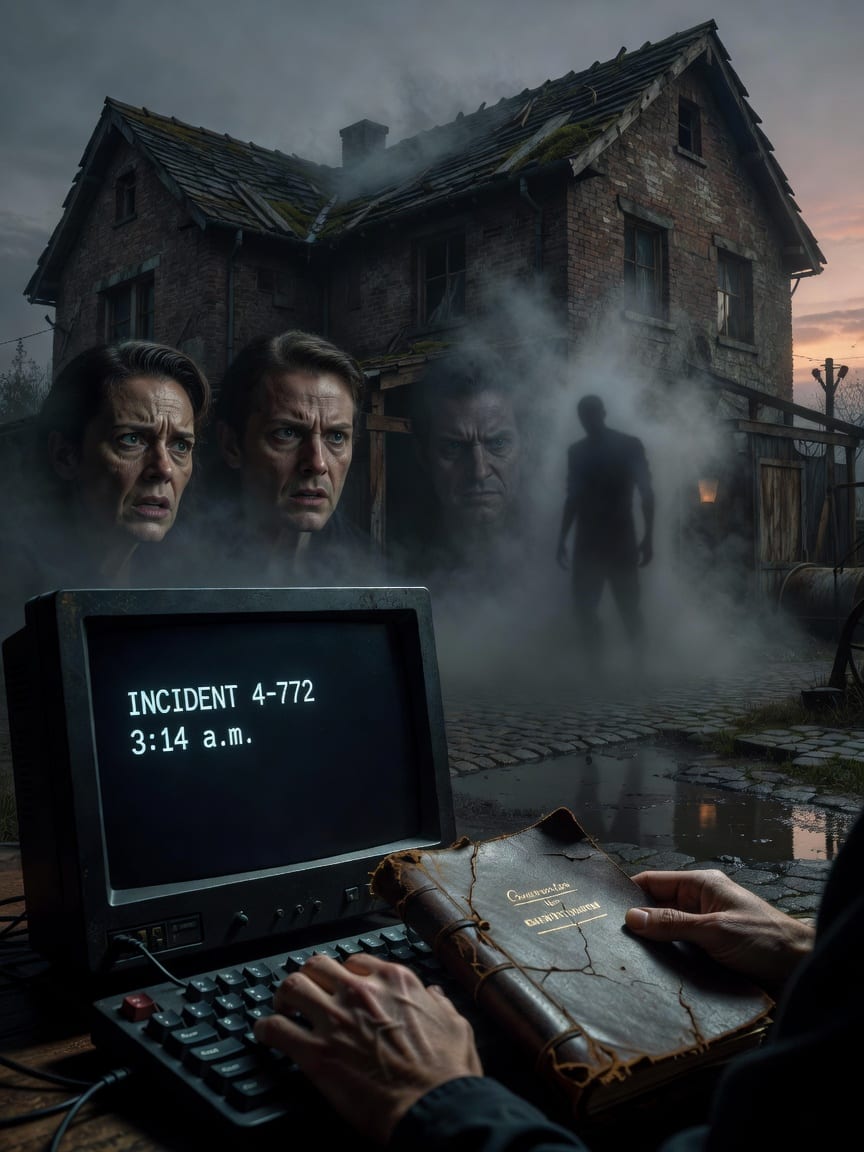
My screen showed Incident 4-772: a fire at the old rope works, 3:14 a.m. It was logged again for 1980. Then 1967. And 1993. Same incident, same time, same building. Each report ended with the same three words: 'expect recurrence.'
As a new archivist, I usually found my work digitizing old fire service records monotonous, until I found a heavily redacted line in a 1961 site assessment. Faint letters beneath the black bar slowly revealed my own family name, DRUMMOND, dated years before I was even born.
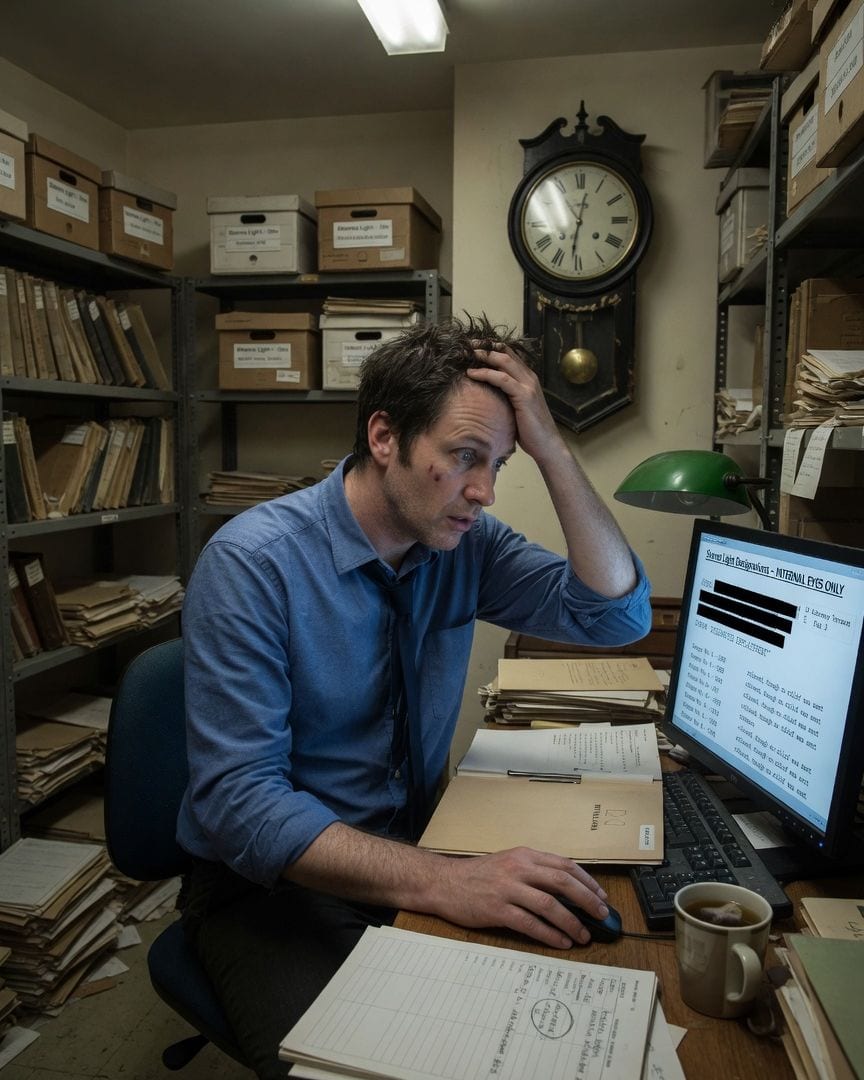
I found my street address in a century-old lighthouse file, printed decades before I lived there.
As a maritime archivist, my world revolves around forgotten lives and dusty ledgers. But the Skerne Light files broke that quiet rhythm, revealing a chilling pattern: 'Keeper number 6' relieved, though no relief was sent, repeating for decades. Now, an internal document with a strange code has led me to a redacted entry, revealing my own street address, decades before I ever lived there.
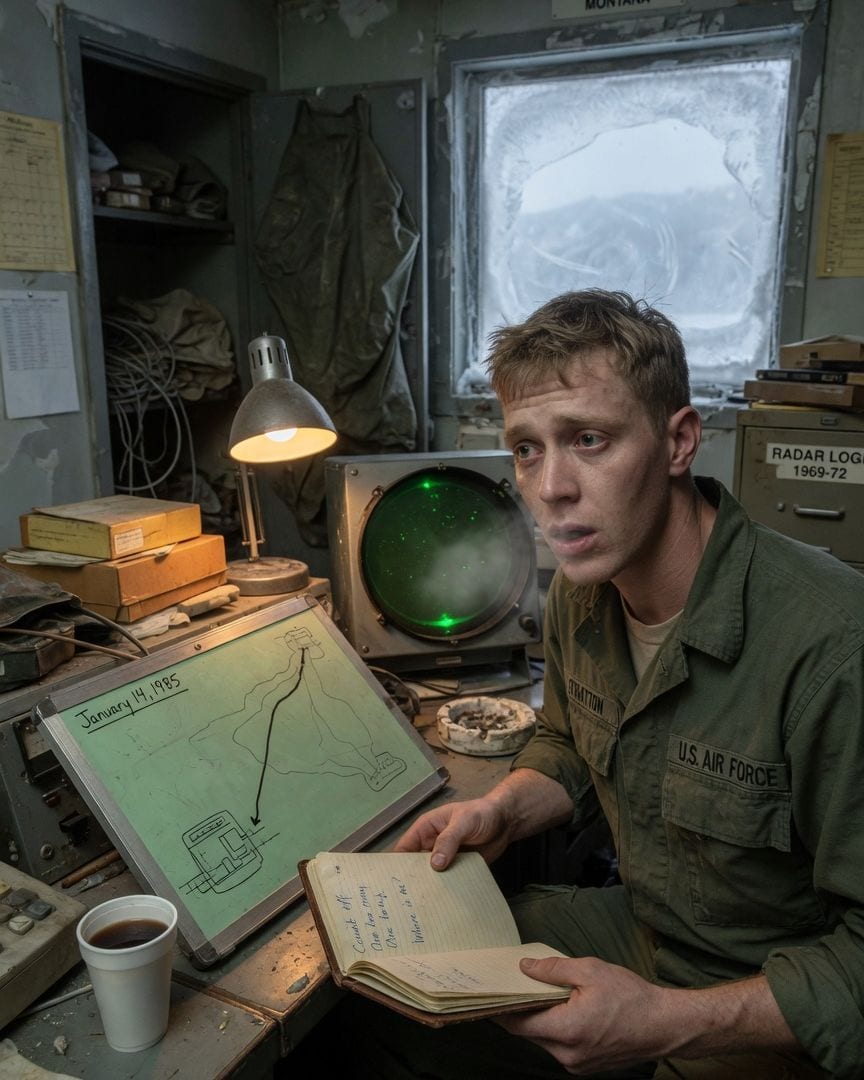
Airman Lars Stratton found an old Cold War manifest listing one name twice: 'Bernard Radcliffe' transferred and 'Bernard Radcliffe' still present.
Airman Second Class Lars Stratton was counting down his final weeks at Echo Station, a desolate Cold War outpost due for mothballing. He longed for home, far from the bitter Montana winds and the constant hum of static. Inside the dim radar shack, he logged the usual nightly ghost blip, a faint contact appearing at 2300, just as it had every winter since 1987. This night, a metallic tang like old blood lingered in the air, raising the hairs on his arms. Seeking distraction, Lars later discovered a leather-bound logbook from 1971, detailing the same 2300 contact, but with chilling notes and a manifest listing one airman's name, Bernard Radcliffe, twice—once transferred, once present. Was he truly alone in the silent, remote station?
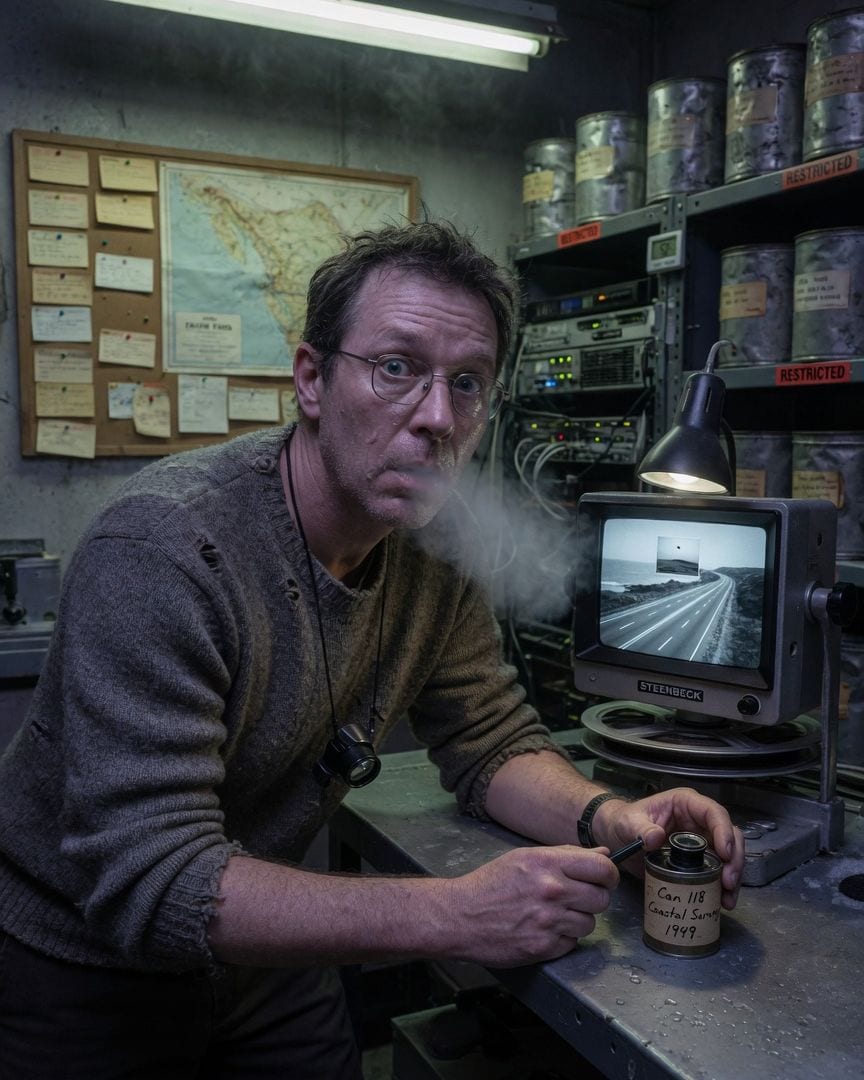
An archivist had eight days to clear his Cold War film vault when a 1949 coastal survey showed a highway built in 1988.
Archivist Prosper Nailes worked against a ticking clock in the perpetually cold College Park film vault. He had just eight days to process four hundred film cans before a mandated collection reduction, racing against time and the pervasive 52-degree chill. When he loaded a 1949 coastal survey reel, he expected pristine, empty bluffs. Instead, a four-lane asphalt road, complete with painted lines, scrolled across the screen – a road he knew wasn't built until 1988. How could a modern highway appear in a film from decades before its existence?