A researcher uncovers a 1961 Cold War flight's 'unknown' cargo, then finds a photo of the same plane dated 17 years after its flight.
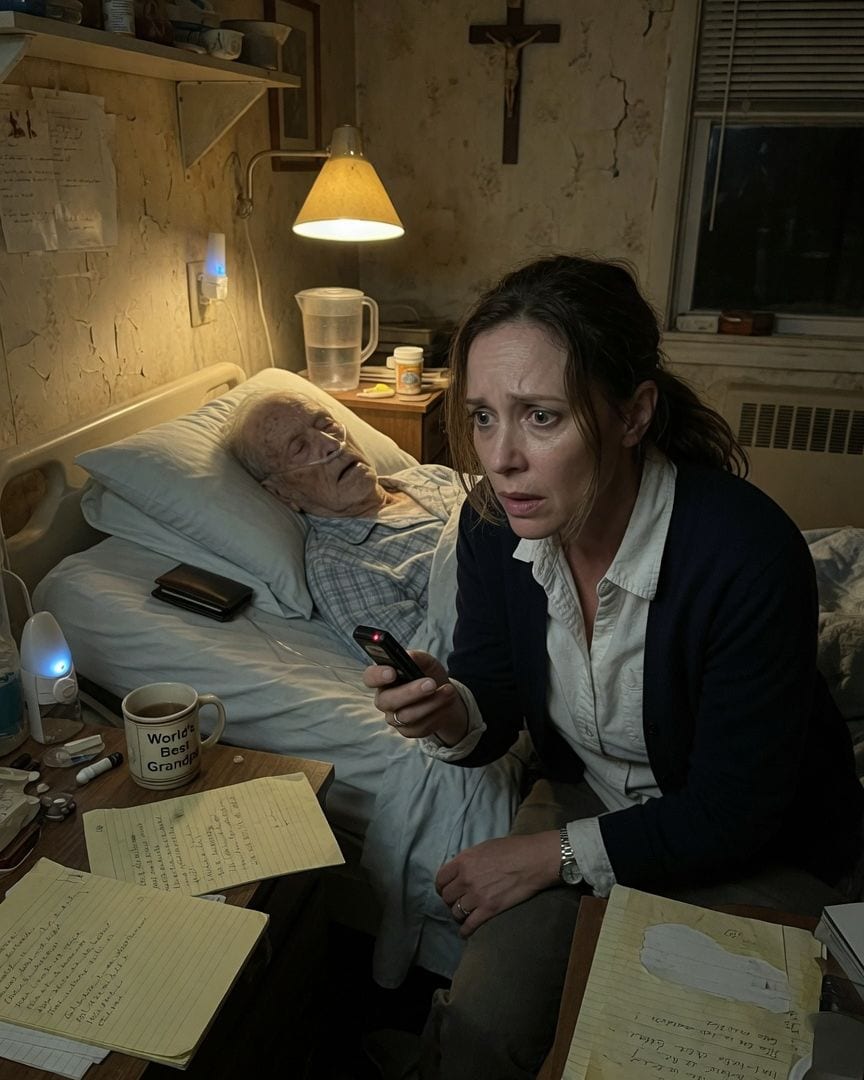
Iris Vance watched the small, rhythmic rise and fall of Anselm Boyd’s chest. He was eighty-four, frail, but his unconscious mind was a roaring storm.
She adjusted the microphone of her recording device, the tiny red light a steady pulse in the dim room. Anselm’s stroke had stolen his daytime words, but at night, a different language surfaced. Tonight, he murmured, 'Kansas.
The tail sat down. It wasn't cores.' His voice, thin and reedy, held the conviction of a man recounting a fresh wound. Iris had transcribed hundreds of these fragments: 'The pilot's face said don't ask.' 'Forty-one hundred pounds.
The plane disagreed.' He’d been awake for sixty years, reliving a single impossible flight.
She knew the official manifest for a C-124 cargo flight in 1961 from a Louisiana field should have listed engine cores, but the trim sheet Anselm kept in his wallet had always told a different story.
The dread was in the coherence of his sleep-talk, not its incoherence. The plane's tail, he always insisted, had sat down on its own struts, like a dog told to stay, under a load the paperwork denied.
The next morning, Iris brought Anselm his coffee. He was lucid, if slow. 'Kansas,' he rasped, pointing a gnarled finger toward his wallet, still tucked under his pillow.
Inside, nestled among faded photos, was not a chart, but a square of brittle, yellowed paper, folded four ways. It was a hand-drawn map, crudely sketched in pencil, of an airstrip.
No names, no coordinates, just a runway, a single hangar, and a faint 'X' marked at one end. Below it, in a shaky hand, Anselm had written, 'The place where the UFO landed.'
Iris had dismissed it for months, a stroke patient's delusion. But the intensity in his eyes, the way he clutched the paper, felt different today. She tried a mundane explanation. 'Anselm, this looks like a private strip.
Maybe one that's been decommissioned?' He shook his head slowly. 'Never on the chart.' He tapped the paper. 'No. Not on any chart.' Iris felt a prickle of unease. Anselm was a meticulous man, even in his decline.
He wouldn't invent a detail like that. He’d shown her the actual C-124 trim sheet once, a smudged carbon copy with a pilot’s scrawled note: 'Weight discrepancy noted. Trim adjusted for unknown.' The official manifest said 'engine cores.'
The trim sheet, and Anselm’s memory, said something else entirely. The hand-drawn map, however impossible, now seemed to fit the impossible weight. It was a place for something that didn't belong.
Driven by Anselm's insistence, Iris began her own quiet search. She started with declassified military aviation records from the early 1960s, a long shot.
After days of sifting through dry logistics reports and routine flight paths, she found it: a heavily redacted incident report, filed under 'Anomalous Transport Protocol, 1961.'
It detailed an 'unusual weight discrepancy' and 'unscheduled diversion' for a C-124 flight originating from Louisiana, matching Anselm’s story precisely. Her heart hammered. This wasn't a delusion. It was documented.
On one page, a faded, official-looking stamp read: 'Filed: B-7, Kansas Sector.' As she turned to the next page, a blurred, grainy photograph came into view.
It showed the tail section of a C-124, unmistakably a Globemaster, sitting low on its struts in a desolate, overgrown field. But the date printed beneath the image read 'October 1978,' seventeen years after Anselm’s flight.
The 1978 date on the photograph was a cold splash of water. It couldn't be Anselm’s plane. Or could it? Iris drove to the public library, a brick building smelling of old paper and dust.
She spent hours cross-referencing military aircraft dispositions, trying to find any C-124 still operational in 1978, let alone one that might have ended up in Kansas. Nothing.
Every C-124 from the 1960s was either scrapped, sold, or in a museum by then. The photo was an anomaly within an anomaly. She expanded her search, looking for any mention of 'B-7, Kansas Sector' in declassified documents.
The term was rare, almost nonexistent in public records, but she found a few oblique references: a logistical requisition for 'specialized containment units' in a Kansas county known for its remote airfields, dated 1979; a memo about 'unconventional payload handling procedures' at a 'designated off-grid facility,' dated 1982.
Each mention was heavily redacted, but the pattern of secrecy was clear. She recalled her father, Daniel Vance, a retired government archivist, always with a quiet, knowing look when the news mentioned anything 'unexplained.'
He'd often said, 'The real stories aren't in what they classify, Iris, but in what they file.' She decided to call him. He might have access to older, less public archives, or at least understand the language of obfuscation.
He’d always kept boxes of 'personal research' in his attic, unofficial files he swore held more truth than the official stacks.
The idea that Anselm's 'UFO' wasn't a one-off, but part of an ongoing, systematic process, was slowly taking root, a chill that had nothing to do with the library's air conditioning.
Iris's call to her father, Daniel, was met with unusual caution. 'B-7, Kansas Sector?' he repeated, his voice tight. 'Where did you hear that?'
She explained Anselm’s story, the flight manifest, the hand-drawn map, and the declassified report with the 1978 photo. Daniel listened, his silence heavier than usual. 'Iris, some things are best left buried,' he finally said, but his tone lacked conviction.
He agreed to look through his 'personal research,' but warned her, 'Don't go digging where you don't belong. The files have a way of… filing you back.' The next day, Iris felt a subtle shift.
Her usually predictable internet searches for 'Kansas unmarked airfields' began yielding strange results—broken links, error messages, and occasionally, pages that loaded with a brief, almost imperceptible flicker of static before displaying irrelevant content.
Her phone, which she used to record Anselm's night-time murmurs, seemed to drain its battery faster than usual, and sometimes, late at night, she’d hear a faint, almost subliminal hum from it, even when it was off.
One evening, after leaving the library, she noticed a dark sedan parked across the street from her apartment building, its windows tinted. It was still there when she left for work the next morning.
She dismissed it as coincidence, a neighbor, but the unsettling feeling persisted. Daniel called a few days later, his voice barely a whisper. 'Iris, I found something. It's in the old boxes.
Come to my place, but don't tell anyone you're coming. And don't use your phone on the way. Just… come.'
Iris arrived at her father's house, the sedan from her street nowhere in sight. Daniel met her at the door, his face pale. He led her to his study, a room lined with towering bookshelves and stacked archive boxes.
On his desk, he’d laid out a series of documents. 'Anselm's flight,' he began, tapping the declassified C-124 report. 'It wasn't just a transport. It was a recovery.' He pushed a faded aerial photograph across the desk.
It showed a desolate expanse of prairie, and in the center, a perfectly intact, unburnt saucer-shaped craft, partially buried. 'This was the real cargo,' Daniel said, his voice low. 'A downed craft, not from here.'
He then showed her a second document, marked 'PROCUREMENT / B-7 / KANSAS SECTOR.' It was a detailed logistical plan for the construction of a highly secure, subterranean facility.
'The 'unmarked strip' Anselm spoke of,' Daniel explained, 'was the initial staging ground. The facility itself went deep, designed to contain… whatever was inside that thing.'
He then pulled out a series of internal memos, spanning from 1961 to the late 1980s. They outlined protocols for 'asset processing,' 'containment integrity,' and 'personnel re-integration.' The memos repeatedly mentioned 'anomalous biological signatures' and 'non-inert payloads.'
Iris felt a cold wave wash over her. 'The 'engine cores' were a lie,' she whispered. 'It was alive.' Daniel nodded, his gaze distant. 'And Anselm Boyd, a simple crew chief, was the first human point of contact.
He felt the thing shift, didn't he? He felt the weight that wasn't on the manifest?'
He pointed to a paragraph in a 1965 memo: 'Individuals with direct sensory exposure to Asset 7-A are to be monitored for long-term psychological and physiological integration anomalies. Subject files to be opened under 'B-7 Proximity Protocol'.'
Iris's blood ran cold. The photo of the C-124 in 1978, sitting low in the field, now made chilling sense.
It wasn’t a separate plane; it was the same plane, brought back years later, perhaps for inspection, or perhaps because it had become part of the 'asset' itself.
The facility wasn't just containing alien objects; it was containing the effects of those objects, including the people who came too close.
Daniel then pulled out another box, smaller, labeled 'Personal - Unofficial.' He opened it carefully, revealing meticulously organized folders, each with a handwritten label. 'This is where I kept the things they tried to bury,' he said. 'The patterns.'
He showed her files on missing naval vessels, aircraft disappearances, even whole ranger patrols in national parks, all with internal designations like 'B-9, Alaskan Sector,' 'B-2, Pacific Sector,' or 'B-4, Nevada Sector.'
Each file detailed inexplicable weight anomalies, impossible recoveries, or personnel who 'returned wrong.'
The chilling truth emerged: the 'B-7, Kansas Sector' wasn't an isolated incident; it was one node in a global network, a systematic process of 'filing' anomalies and those who witnessed them.
The secrecy machine wasn't just a cover-up; it was an active, patient entity. Daniel then picked up a plain manila folder from the top of the stack. It was newer, crisp, unlike the others.
He looked at Iris, his eyes filled with a deep, weary sorrow. 'This one… this one is active.' He pushed it across the desk. The label, stark and clear, read: 'Vance, I. - Proximity to Filed Asset (Boyd, A.).
Status: Monitoring.' Iris’s own name. Her breath hitched. She slowly opened the folder. Inside, among surveillance logs and transcribed snippets of her conversations—even her recent call to Daniel—was a recent entry.
It was a single line, typed in an official font: '23:47 - Subject observed accessing restricted data, 'B-7 Kansas Sector.' Proximity to Asset confirmed. Begin Phase Two.'
Iris shoved the folder back into the box, her breath catching in her throat. The file labeled 'Vance, I.' is real, active, and current. Her own name, her own case.
She glances at the timestamp on the folder's last entry: '23:47.' She checks her watch. It's 23:48. Someone, somewhere, just updated her file.
Daniel slumped into his chair, watching Iris with profound regret. 'Phase Two,' he explained, 'is subtle. It’s not about silencing you with a bullet. It’s about integration. They don't kill the witnesses, Iris. They file them.'
He revealed that the 'filing' process wasn't just about records; it was about slowly isolating, discrediting, and eventually absorbing those who became too aware. 'Anselm Boyd was a Phase One,' Daniel continued, 'monitored for decades.
His stroke… it wasn't just a medical event. It was accelerated, a subtle weakening. His fragmented memories are the system’s way of processing him, extracting the data it needs, before filing him away for good.'
The 'Thing That Came Back Wrong' wasn't just the cargo; it was Anselm himself, slowly being absorbed by the system that filed him. Daniel pointed to a series of old memos about 'observer integration' and 'data extraction via cognitive degradation.'
The recordings Iris had made of Anselm's night-time whispers were not just her medical notes; they were part of the system’s ongoing collection.
The hum from her phone, the broken links, the sedan outside her apartment—all part of Phase One for her. 'I was an archivist,' Daniel confessed, 'and I saw the pattern forming. I tried to collect the traces, to understand it.
But the more you understand, the more you become part of the file. My own file, 'Vance, D.,' has been open for twenty years. They let me retire, but they never let me go.'
He showed her a final, deeply disturbing document: a flow chart titled 'File Progression: Awareness to Assimilation.' It detailed steps from 'Initial Proximity' to 'Cognitive Deterioration' to 'Full Integration (Asset Retention).'
The final step on the chart showed a stylized human figure, its outlines dissolving into a stack of papers, all marked 'FILED.'
Every clue, every strange detail, from Anselm's impossible cargo to the C-124 photo dated decades later, clicked into place. The secrecy machine was a living, consuming bureaucracy, and she had walked right into its maw.
Iris felt a cold terror unlike anything she'd ever known. This wasn't just a conspiracy; it was a slow, methodical erasure. 'What about Anselm?' she asked, her voice trembling. 'Can we do anything?'
Daniel shook his head, his face a mask of defeat. 'Anselm is almost fully integrated. His memories are being harvested, his life force slowly filed away. He's safe from overt harm, but he's already gone, in a way.
His body is just the last container.' He then looked at Iris, his gaze hardening. 'You, however, are still in Phase Two. You have a choice. You can stop. Stop digging, stop talking, erase your notes, delete your recordings.
Go back to your life. They will monitor you, but if you show no further interest, your file will eventually be marked 'Inactive.' You'll live, but you'll always know. Always be watched.'
Iris thought of Anselm, his words echoing in her mind: 'It wasn't cores.' She thought of the C-124, sitting in that field, a ghost of a machine.
She thought of her father, a man who had spent his life battling shadows, only to be consumed by them. She couldn’t just stop. The knowledge was a burning coal in her stomach.
'No,' she said, her voice firm despite the tremor in her hands. 'I can't. I have to warn someone.' Daniel closed his eyes. 'Then the file will progress. They will tighten the net. Your professional life will suffer.
Your personal life will unravel. Eventually, you will be isolated, discredited, and then… integrated. Like me. Like Anselm.' He opened his eyes, a flicker of defiance in them. 'But if you must fight, Iris, fight smart. Don't confront them directly.
Expose the pattern, not the asset. Make them visible, even if it's just a whisper in the wind. The files are their strength, but they are also their weakness. They can't delete every trace.' Iris nodded slowly.
The fear was still there, but a fierce resolve was growing. She wouldn't let them file her away quietly. She would become a ghost in their machine, leaving her own traces.
Iris didn't go back to her apartment. She stayed with Daniel for a few days, meticulously copying his unofficial files, digitizing everything she could.
She deleted all the recordings from her phone and computer, scrubbed her online search history, and changed her email. She stopped treating Anselm Boyd, citing 'personal reasons,' a lie that felt like another entry in her burgeoning file.
The dark sedan was gone from her street, but she knew it didn't mean she was free. It meant Phase Two was truly underway.
She felt the subtle pressure almost immediately: her grant applications for new research were mysteriously rejected, her professional reputation slowly eroded by anonymous online comments questioning her methods.
She saw Daniel grow more distant, his eyes often fixed on unseen horizons, his own integration continuing. She was alive, but the world around her was slowly being re-filed.
Months later, Iris was working in a quiet, obscure research lab, far from her old life. She kept a low profile, but she still pursued the patterns, quietly, carefully, leaving digital breadcrumbs in plain sight.
One evening, she received an anonymous email. It contained a single, unredacted image. It was the photo of the C-124, sitting low on its struts in the desolate field.
But this time, in the foreground, was a figure, small and hunched, staring directly at the camera. It was Anselm Boyd, younger, but unmistakably him, standing beside the plane in 1978.
He wasn't just a witness; he was part of the scene, part of the file. Iris knew she was being watched, always. She knew the pattern was still unfolding, and she was now a part of it, too.
She had survived, but she wasn't saved. She was simply… filed.
Anselm Boyd passed away quietly in his sleep a few weeks later. His official medical report listed 'natural causes.' The last entry in his file, however, was a single line, typed in a familiar font: 'Asset (Boyd, A.) fully integrated.'
If this one got to you
A retired crew chief finds the Cold War transport plane he loaded 32 years ago; its flight log shows today's date and still-damp ink.
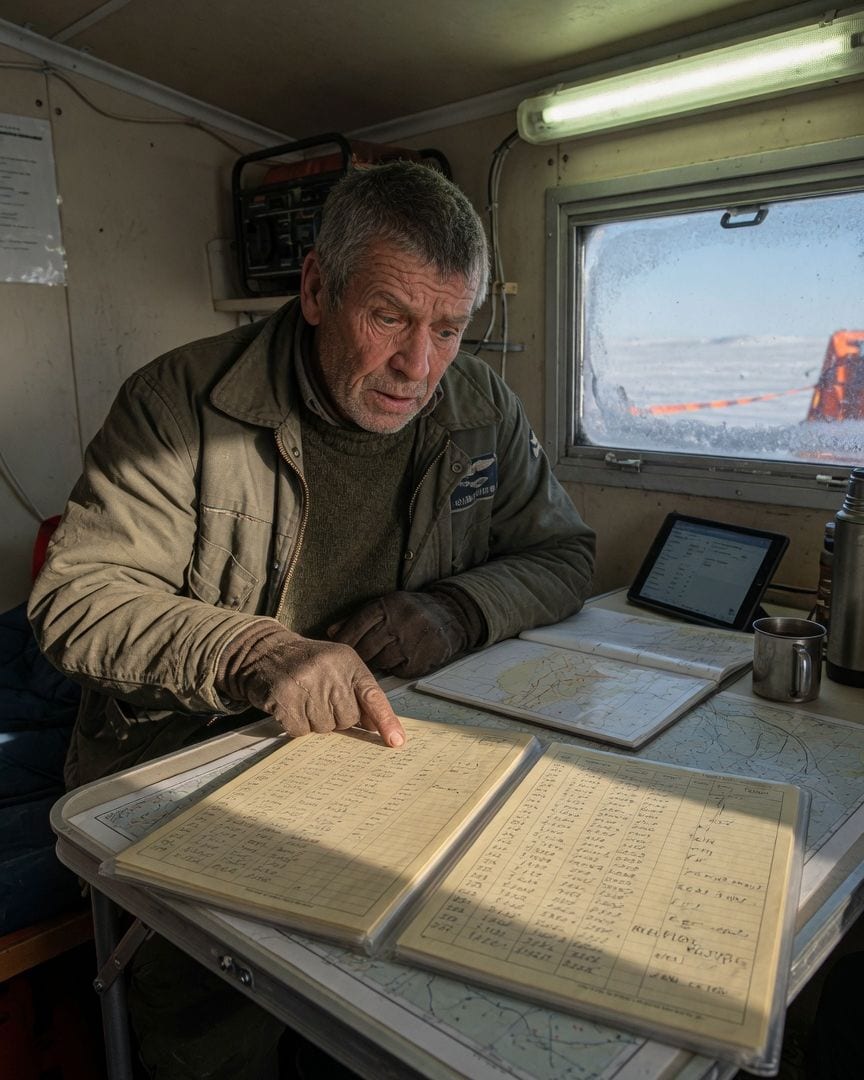
Retired Air Force crew chief Ivo Barlas, 62, faced a deep arctic cold in Greenland, but nothing matched the chill radiating from the Osprey Nine. He had personally loaded the transport plane with classified equipment 32 years prior, never expecting to see it again after its disappearance. Now, the plane sat unbroken on a frozen lake, a ghost of his past, its cargo bay eerily empty despite the eleven pallets he'd secured. The retrieved cockpit log only deepened the mystery, detailing impossible hours of fuel consumption and routes veering into the stratosphere. Yet, the most unsettling entry was dated *today*, with impossible coordinates and ink still faintly gleaming, leaving Ivo to wonder: what truly happened to the Osprey Nine?
An inventory clerk finds 1943 files for a vanished wing. The paper is new, and photos show its 'lost' plane with impossible tech.
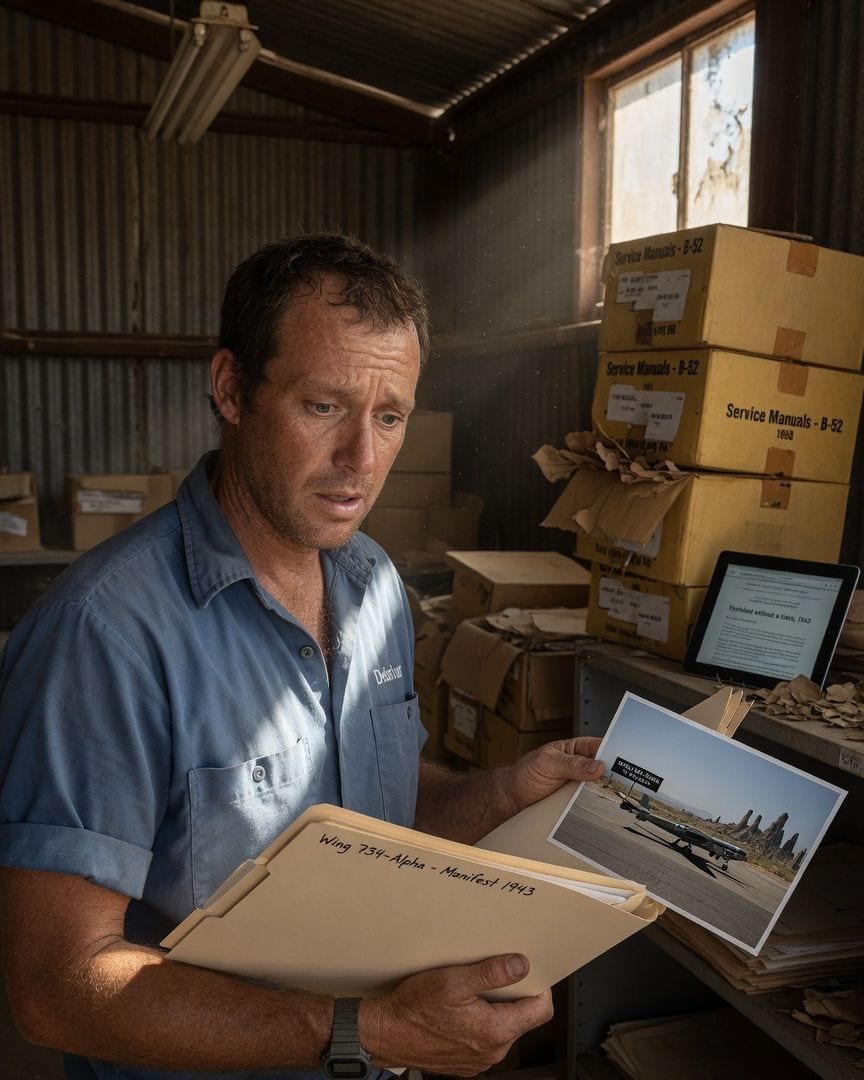
Inventory clerk Rafe Delahunt worked through the Kingman boneyard, his month-long task almost done, the Arizona sun baking through the roof. Amidst crumbling, forgotten records, his hand brushed eleven folders for a 'Wing 734-Alpha'—a designation that never officially existed. Unlike the brittle paper surrounding them, these felt supple and cool, smelling faintly new despite their 1943 dates. Then he found a pristine, modern-resolution photograph of a prototype aircraft officially vanished in 1943, now bearing impossible modifications on an unmapped runway. It was like seeing a ghost in high definition, hinting that these 'recoveries' might be happening closer than he imagined.
A Chief Warrant Officer's HUD tape shows a phantom jet, impossibly close, off his wing. Forty years ago, another Cold War pilot logged the same impossible sight.
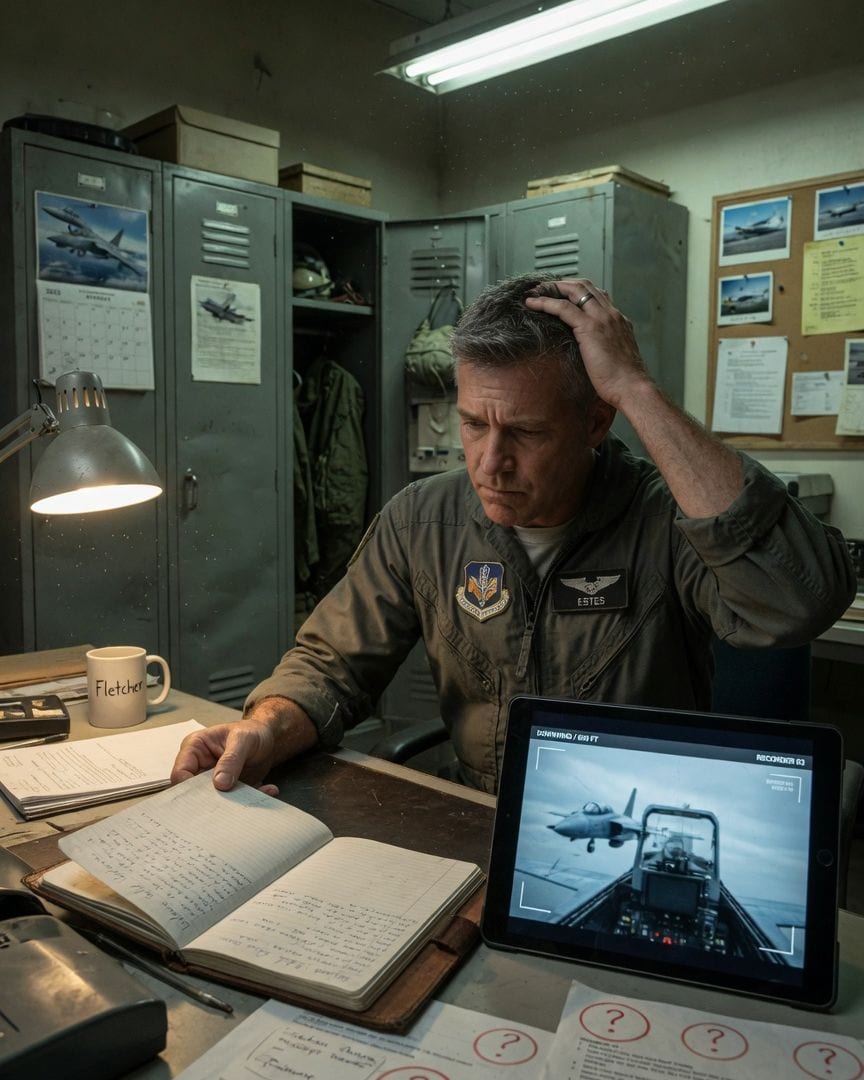
Chief Warrant Officer Nathaniel Estes, a pilot whose career hinged on absolute precision, was under evaluation for a critical promotion. His nightly review of HUD tapes from routine Mojave test flights was a meticulous habit, but for a week, it revealed an impossible detail. At precisely 800 feet, one frame showed a sleek, experimental jet tucked impossibly close off his left wing—a craft ground radar never detected. When his maintenance chief found no equipment fault, Estes unearthed a dusty, decades-old logbook detailing identical phantom sightings from 1978. What unseen presence shadowed the desert skies?
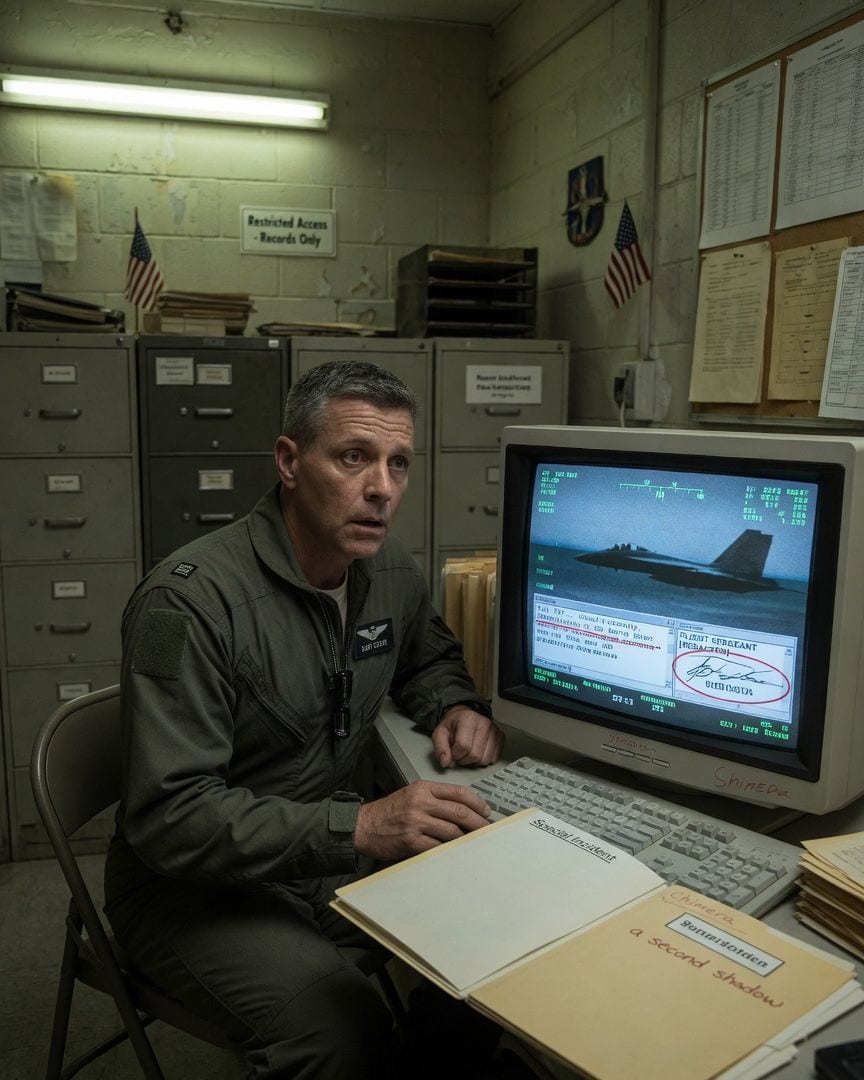
A Chief Warrant Officer's HUD showed a second aircraft watching his plane. He later found a log for *his* tail number reporting the same anomaly weeks ago, but he was grounded for medical leave.
Chief Warrant Officer Gary Estes, a man whose career was built on precision, found his impending Pentagon transfer shadowed by a baffling anomaly. On every flight, at exactly 800 feet, his aircraft's display would briefly show a sleek, dark second plane tucked off his right wing, its canopy subtly angled toward his, watching him. Ground radar never saw it, and his wingmen swore they flew alone. Desperate to maintain his clean record, Estes dug into maintenance logs and uncovered an entry for *his* tail number from weeks prior. It described the exact same 'visual anomaly' during a flight he knew, with chilling certainty, he had never flown.
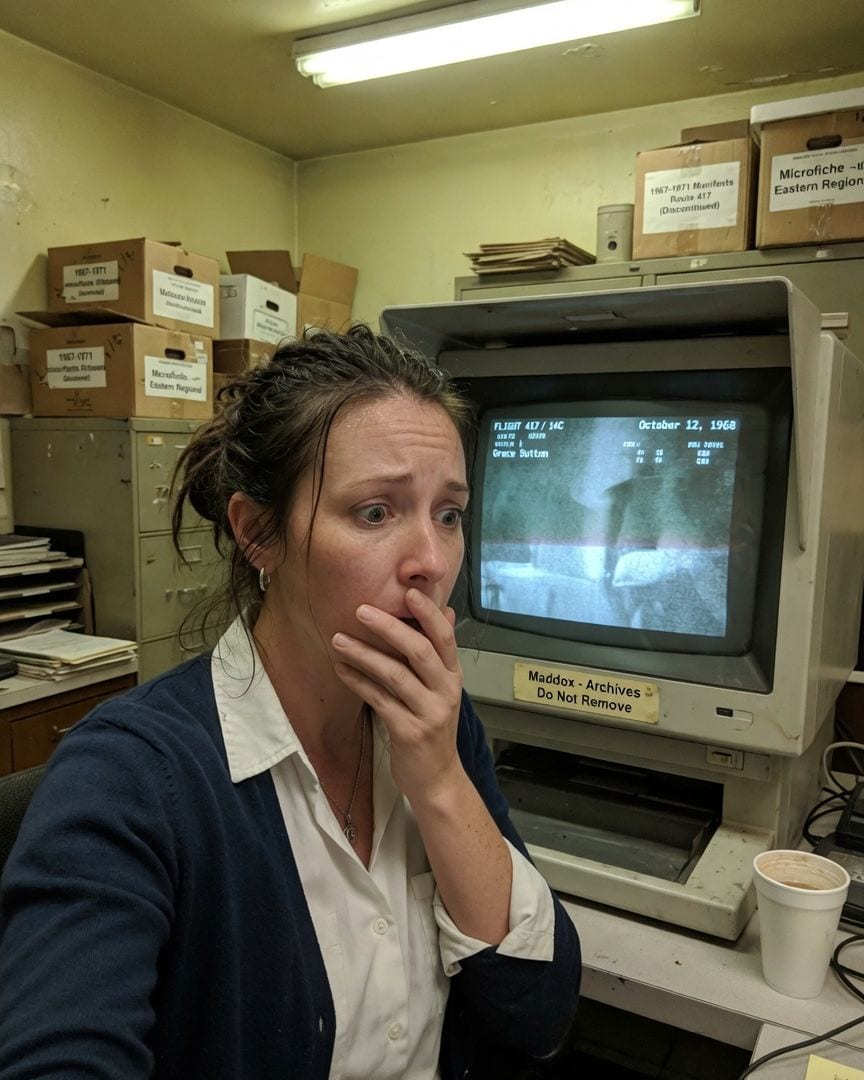
A woman I'd never met leaned across the aisle, said 'I'm sorry, Grace,' and warned me about the landing. We landed fine — but the airline says seat 14C flew empty.
My routine flight home took an unsettling turn when a woman in seat 14C spoke to me. She knew my name, warning me about the landing, then simply vanished from her seat after we touched down. Airline records confirmed seat 14C was unoccupied, as if she was never there.
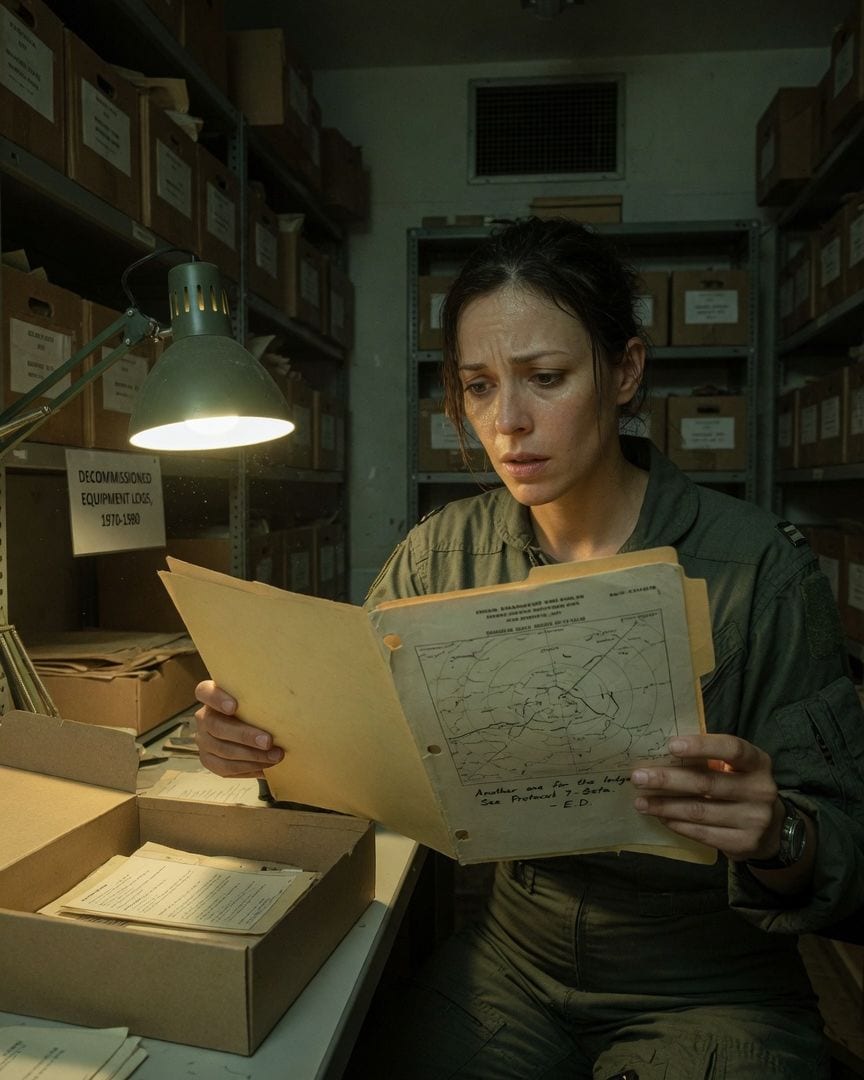
A radar captain's scope went clean, but the pilot swore a mile-wide UFO still filled his windscreen. Then she found a Cold War ledger of impossible sightings.
Captain Ines Bardolph, a 34-year-old radar operator in Bavaria, lived by the precise hum of her console. One quiet night, an impossible contact appeared over the Danube, then vanished from her scope just as a pilot swore it filled his windscreen. Replays showed the object had crossed the Alps in a single blink, defying all known physics. When bureaucracy sought to bury the incident, Captain Bardolph sought answers, leading her to a forgotten archive where a brittle folder revealed a chilling pattern: 'Another one for the ledger.'