Sergeant Belanger's transfer was a week away when two Marines answered for 'Fletcher.' The impossible service number belonged to a man who shouldn't exist.
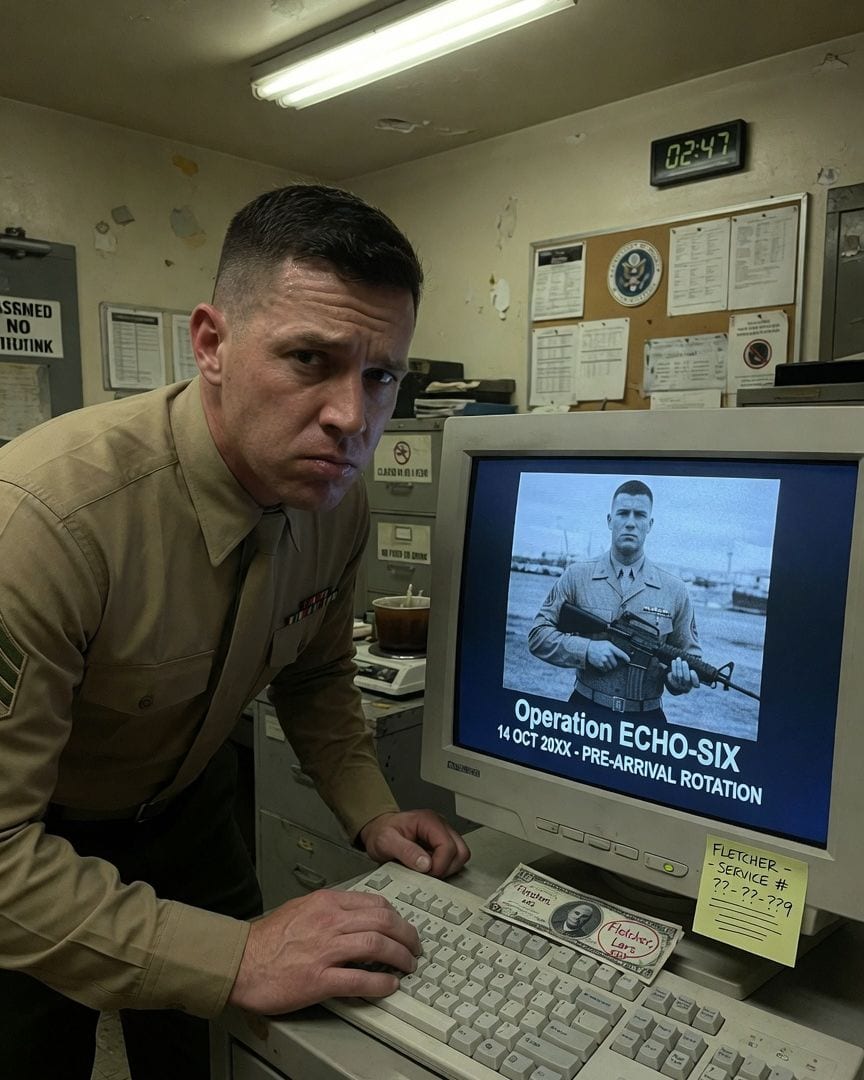
The air in the embassy’s guard mount room was thick with the smell of stale coffee and industrial cleaning solvent.
Sergeant Quentin Belanger, 32, stood with his back straight, the familiar scent a signal of another long shift nearing its end. His transfer home was a week away, and all he wanted was a clean watch, no paperwork, no trouble.
He mentally counted his relief as they shuffled into formation: seven Marines for seven posts, plus the reserve. But as they snapped to attention, he saw eight figures, not seven.
Belanger, a stickler for protocol, felt a familiar tension tighten his shoulders. He pulled out the watch bill, its laminated surface cool under his thumb.
“Fletcher!” he barked, calling the first name on the list. Two voices, one from the second man in line, one from the eighth, answered crisply, “Sergeant!” Belanger’s eyes narrowed.
The eighth Marine, identical in uniform to the second, held eye contact with an unnerving stillness. His name had already been claimed by the man standing directly beside him.
The first Fletcher shifted his weight, looking uncomfortable, but the eighth Marine remained perfectly rigid, an echo in the lineup.
Belanger dismissed the relief, his gut twisting. He pulled Marine Lars Fletcher, 21, aside. The younger man, pale and bewildered, swore he had been alone in his bunk, had walked to guard mount alone.
Belanger tried to find a mundane explanation: a prank, a miscount, maybe a blurred roster. He returned to the small, fluorescent-lit office and pulled up the barracks logs on the clunky desktop computer. He typed in “Fletcher, Lars.”
The screen populated with entries. Under the name, he found two identical entries for the same bunk, same check-in time, same everything. But the service numbers were different. One was correct, a standard nine-digit sequence.
The other, associated with the ‘extra’ Fletcher, contained a sequence of digits that ended in an impossible ‘9’—a number that didn't exist in any official military service number system.
The digital hum of the computer seemed to intensify in the quiet room, a cold, mechanical confirmation of a man who shouldn't exist.
Belanger, needing to trace the impossible service number, found himself in a deserted administrative office late that night. The quiet hum of the building around him felt less like silence and more like held breath.
He accessed a restricted terminal, its screen glowing an eerie blue in the darkness, trying to cross-reference the anomalous data. After several attempts, typing in override codes and bypassing firewalls, he managed to unlock a file titled 'Operation ECHO-SIX.'
The screen flickered, and the file flashed open, revealing a single, pixelated, grainy image. It was a Marine on guard duty, his face obscured by shadow, but the uniform, the posture, the way he held his rifle—it was unmistakably Belanger.
And the date beneath the image was from a rotation before he had ever set foot in this embassy.
The image rattled Belanger to his core, a cold spike driven straight through his composure. He spent the next day discreetly questioning other Marines, mentioning 'ghosts on watch' or 'phantom reliefs' in casual conversation.
Most dismissed it as sleep deprivation or barracks legends, rolling their eyes at the old, tired superstitions.
But a few, like Marine Vincent Hughes, 23, exchanged uneasy glances with him, hinting at hushed rumors whispered over the years, quickly dismissed, but never fully forgotten.
Belanger realized the official records weren't just erroneous; they were deliberately obscuring something, a systematic erasure of the impossible. He needed deeper access, a way to peel back the layers of official denial.
He sought out Evelyn Granger, 58, a civilian archivist who had worked at the embassy for decades.
He fabricated a story about researching historical security protocols for a transfer report, hoping she could guide him to older, physical records that might have escaped the digital purges.
Belanger’s inquiries didn't go unnoticed. He returned to his bunk after his shift, the familiar smell of his linen now tinged with something else, something metallic and faint. His personal effects were subtly disturbed—not stolen, but repositioned.
His uniform shirt, which he always folded in the same way, was inside out on his bed.
His journal, usually tucked securely under his pillow, had been moved to the footlocker at the end of his bunk, its spine facing the wall. It was a small thing, easily dismissed, but it prickled at his nerves.
During a lonely late-night shift on Post 3, the deepest, quietest part of the embassy, his secure radio crackled. A garbled, off-frequency transmission, barely a whisper, cut through the static, making the hairs on his arms stand on end.
“Belanger,” the voice hissed, distorted and cold, “Don't look too close, Sergeant. Some things are better left uncounted.” The transmission cut out, leaving only the hiss of dead air.
He felt a prickle on his neck, a profound sense of being observed, not just by the security cameras whose lenses he knew intimately, but by something unseen, a presence that had been there all along, watching him watch.
The concrete walls of the embassy seemed to press in on him, listening.
Belanger, now genuinely unnerved, pressed Granger for help with 'historical anomalies' for his fabricated report. She, initially skeptical, grew intrigued by his detailed descriptions, her archivist's curiosity piqued by the precise discrepancies he recalled.
The fluorescent lights of the archive hummed, casting long shadows over the rows of forgotten history. She began pulling dusty boxes from the deep archives, the air thick with the scent of old paper and dust.
Among them, they found a pattern of 'personnel discrepancy reports' filed by former Sergeants of the Guard at this very embassy, dating back to the 1970s.
Each report described similar 'extra' Marines, always at Post 3, always answering to a name already on the roster.
Granger, a meticulous archivist, recalled these files were usually 'purged' but sometimes lingered in the physical archives, too obscure to be worth the effort. Her finger, stained with printer ink, traced a faded paragraph.
She then uncovered a heavily redacted memo from a high-ranking officer, Captain Iris Foster's predecessor, ordering 'containment protocols' for 'unaccounted personnel events' at this specific location.
The memo implied the phenomenon had been recurring for decades, a problem to be managed, not solved, with strict instructions to 'minimize disruption to operational readiness.'
The dread wasn't in the anomaly itself, but in the cold, institutional knowledge of it, the chilling realization that this wasn't an accident but a procedure.
Belanger, the implications of the memo chilling him to the bone, realized the 'extra' Marine wasn't a one-off error or a prank. This was a cycle, a horrifying, predictable pattern.
He pressed Granger for any master list, any comprehensive record of these 'events,' his voice tight with urgency.
After hours of searching through microfiche and decaying paper, the mechanical whir of the reader a rhythmic counterpoint to his frantic thoughts, she finally located a deeply buried, classified manifest.
Its title was simple, typed in stark black letters: 'UNACCOUNTED PERSONNEL LOG - EMBASSY XXXXX.' Belanger's finger traced down the columns, past names from rotations long before his time, names he didn't recognize, each one an incident of quiet horror.
His eyes locked onto a recent entry: 'Lars Fletcher – UNACCOUNTED, Post 3, 0300h.' He glanced at the date. It was last night. His own watch. A cold dread seeped into his bones, numbing his fingers.
Then he scrolled further, the manifest pages turning slowly on the screen, and his breath hitched. The next scheduled 'event,' flagged for the next rotation, bore his name: 'Quentin Belanger – UNACCOUNTED, Post 3, 0300h. ETA: 24 hours.'
The manifest confirmed his deepest fear: the 'extra' Marine wasn't just an anomaly; it was a replacement, and it was coming for him. The full truth, now horribly clear, detonated in Belanger's mind like a silent grenade.
The files in the log weren't just 'discrepancies'; they were records of a swap. The entity duplicated a Marine, took their place, and the original became the 'unaccounted for' one, quietly removed from existence.
The institution had known for decades, classifying it as a 'containment protocol,' moving the original to a black site or simply erasing their record, a ghost in the system, managed. The grainy photo of 'Sgt.
Quentin Belanger' he'd seen in the Operation ECHO-SIX file wasn't a mistake; it was a previous instance, a prior 'Quentin Belanger' who had been replaced.
The 'impossible service number' was the code for a ghost in the machine, a placeholder for a stolen identity. His impending transfer home was a cruel, meaningless countdown.
With only hours left before the 'ETA,' Belanger made a desperate decision. He had to escape. He tried to warn Captain Iris Foster, 40, his superior officer, explaining in a low, rushed voice what he’d found.
She listened, her face impassive, then dismissed his frantic claims as stress and fatigue. "Sergeant, you're due for transfer. Get some rest,” she said, her voice flat, devoid of concern. Belanger knew he was out of options.
No one would believe him. No one could believe him. He packed a small bag, intending to go AWOL, to make a desperate run for the gate, to get to the airport and out of the country.
He moved through the embassy's deserted corridors, the silence amplifying the thumping of his own heart against his ribs. The air felt heavy, as if the building itself held its breath.
As he approached the final checkpoint, the main entry control point, he saw his relief forming up. They stood at attention, awaiting inspection, their forms indistinct in the dim night lighting.
And among them, standing perfectly still, was a Marine whose face was his own, but with an unnerving, vacant stare. The 'extra' Belanger, already in place, waiting.
Sgt. Quentin Belanger was never seen again. His transfer orders went unfulfilled, a file growing thicker with 'no contact' reports. The embassy reported him as a deserter, a blot on an otherwise exemplary service record.
Captain Foster, after a brief, quiet internal investigation, filed a final 'personnel discrepancy' report, noting the transfer of 'Sgt. Quentin Belanger' to a highly classified 'Special Operations detachment.' The system, as always, closed ranks and accounted for the unaccountable.
A year later, Captain Iris Foster, now stateside and promoted to Major, sat in her new office, the sterile air of the Pentagon a sharp contrast to the old embassy.
She saw a new report from the embassy scroll across her desk: 'Personnel Discrepancy, Post 3, 0300h. Marine Vincent Hughes – UNACCOUNTED.'
She sighed, stamped 'Containment Protocol Initiated' with a practiced hand, and then, as she pushed the file aside, she noticed the date on her own promotion orders: 0300h, one year ago, the day after Sgt. Belanger vanished.
She glanced at her reflection in the darkened office window, a faint, almost imperceptible smile playing on her lips. Is that so?
If this one got to you
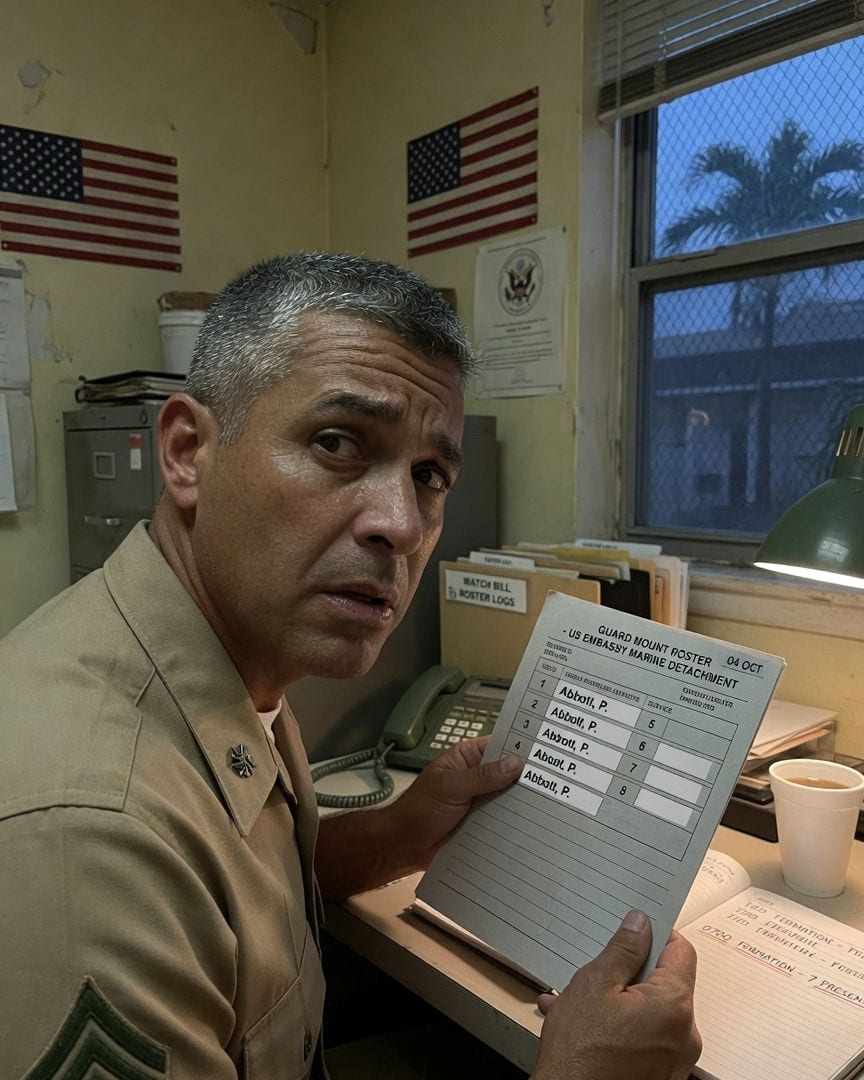
A meticulous Marine Sergeant counted eight men for guard mount, but his roster showed seven. The extra Marine gave a name already called, and a service number that was perfectly blank.
Sergeant Gordon Belanger, a career Marine NCO a month from his rotation, stood in the pre-dawn chill of the embassy courtyard. His meticulous count for guard mount revealed eight Marines, but the official watch bill listed only seven. When he confronted the extra man, the Marine gave a name already called, identical to the man standing beside him. Belanger's investigation of the impossible duplicate only deepened the mystery, as all records swore only seven Marines were present. Yet, his own signed roster confirmed an eighth man, whose service number was a stark, unnerving blank.
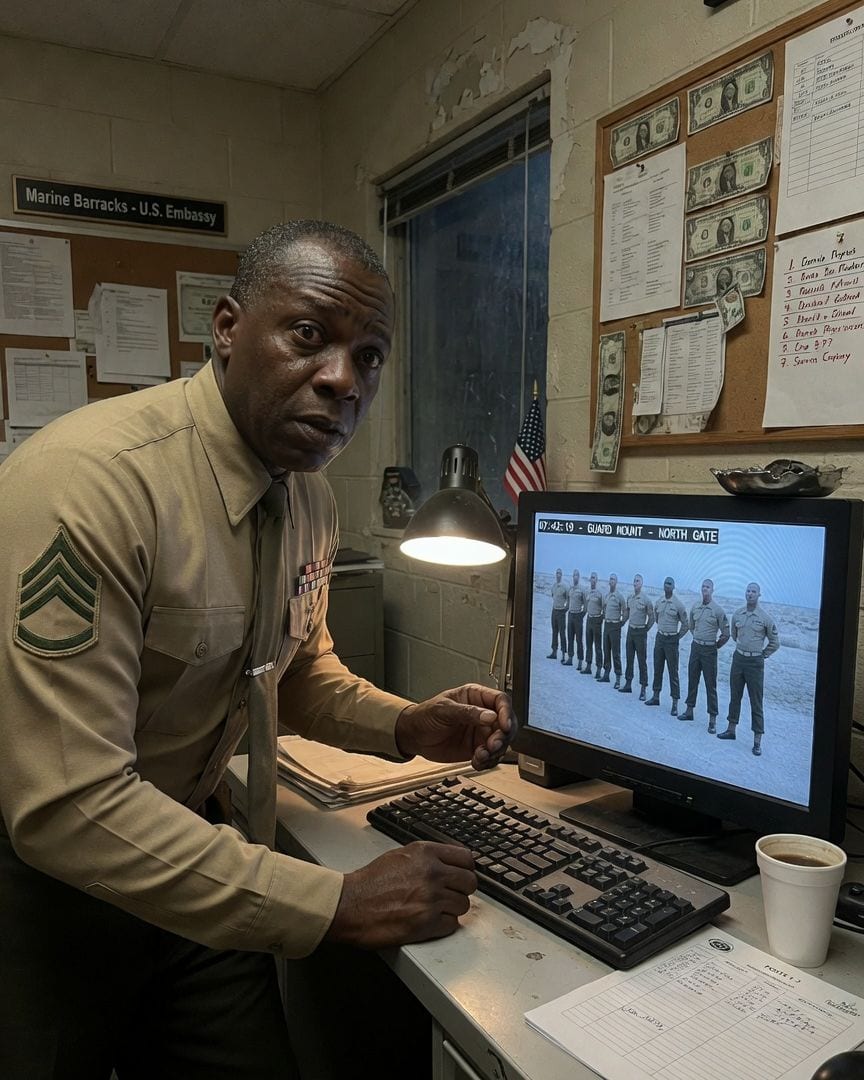
Sergeant Belanger's guard mount had an eighth Marine. The camera footage shows him vanish.
Sergeant Maxwell Belanger conducts a routine guard mount with his seven Marines, but counts an impossible eighth man in the formation. This extra Marine answers to a name already claimed, and later vanishes without a trace. Security camera footage briefly captures the eighth figure, solid and clear, before it warps and blurs from the frame.
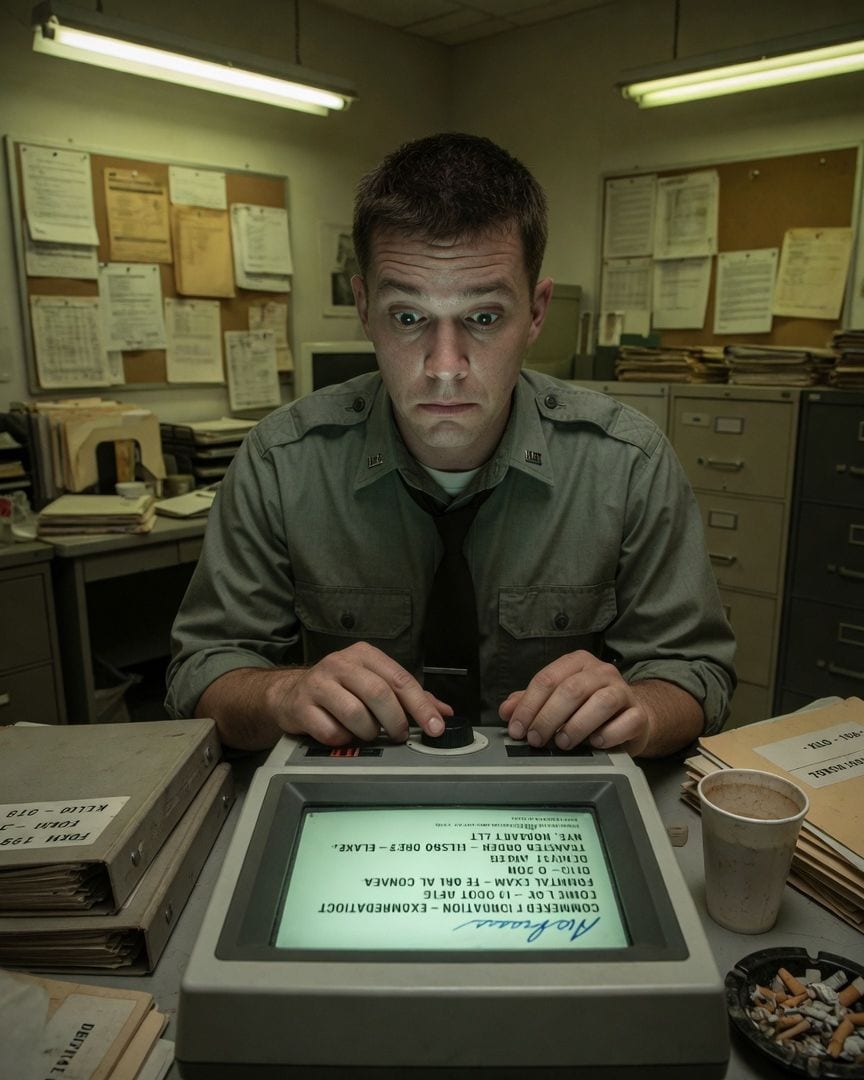
A missile commander watched his ten nuclear silos go dark. His own service record shows his signature on a future he's never lived.
Second Lieutenant Hobart Nye, a missile commander in Wyoming, had his quiet 0247 watch shattered by a security report: a massive, silent black triangle hovered over Launch Facility Kilo, casting a perfect shadow. Hobart watched his console's fault panel light up, signaling all ten nuclear missiles going dark in an impossible silence, followed by eleven minutes his security team could not remember. Official logs called it a "radio malfunction," but Hobart found a requisition for invisible-tracking sensors, signed by a base commander who was supposed to be off-base. The final, chilling discovery came when his own service record showed new entries—a dental check-up, a transfer to Alaska—all dated for a future he never lived, complete with his perfectly replicated signature.
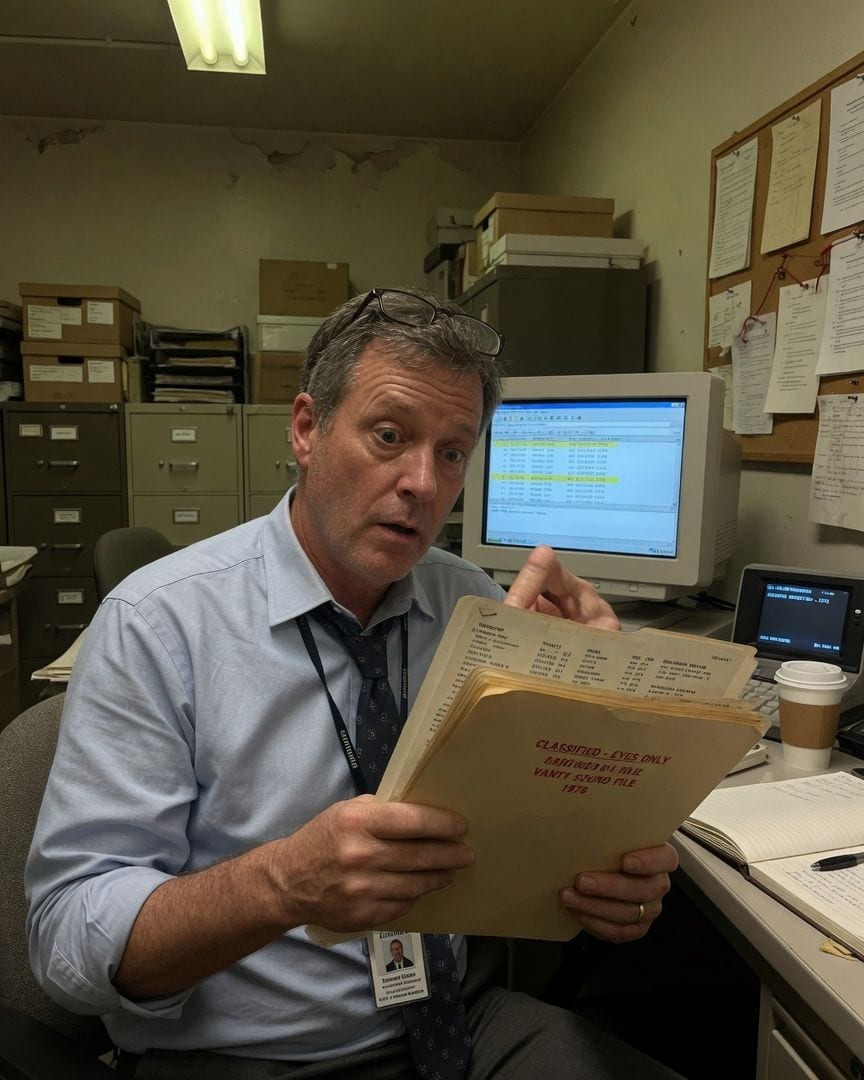
A retiring archivist, Emmett Doane, found a Cold War file from 1978 listing men who wouldn’t enlist until the 1980s. The last name on the classified roster was his four-year-old son’s.
With only six days left until his retirement, archivist Emmett Doane spent a quiet afternoon in the office reviewing old files. He finally pulled the Vantry Sound file, a classified folder from 1978 he'd long dismissed as a clerical error. Inside, the brittle onionskin pages revealed a roster of servicemen who, impossibly, had enlisted years after the file date. As a cold dread tightened his chest, he noticed the file felt warm in his hands, then saw the last name on the list: his own four-year-old son, Samuel. Could a decades-old document truly predict the future, or was something far more sinister at play?
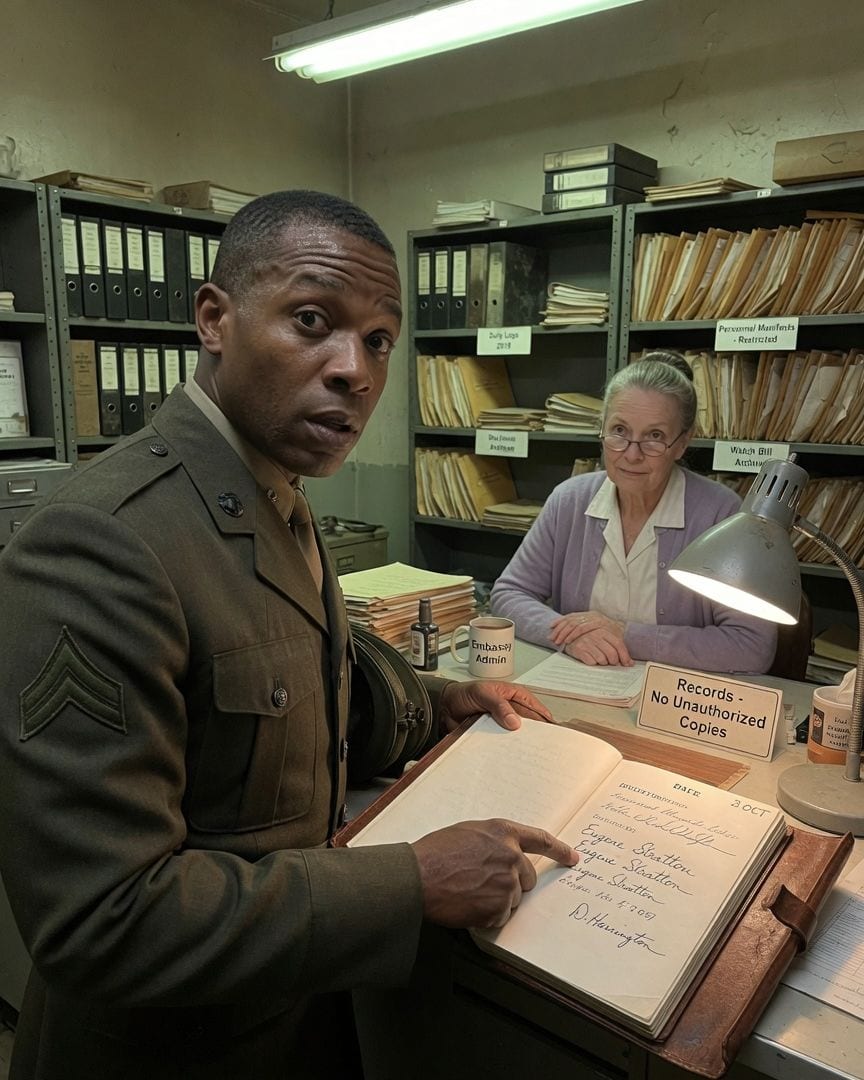
An embassy sergeant counted seven Marines, but eight stood before him, two identical men named Stratton.
Sergeant Daniel Harrington was just six months from his honorable discharge, feeling the weight of civilian life as he called his final embassy guard mount. The familiar routine in the cool courtyard was shattered when he counted seven Marines for seven posts, yet eight stood before him. His gaze sharpened, he found two identical Private First Class Eugene Strattons, both answering roll call with the same crisp voice and even the same scar. Later, his own signature appeared in the duty log, verifying an eighth Marine he never saw. Why did the civilian clerk meet his stunned gaze with such calm, knowing eyes?
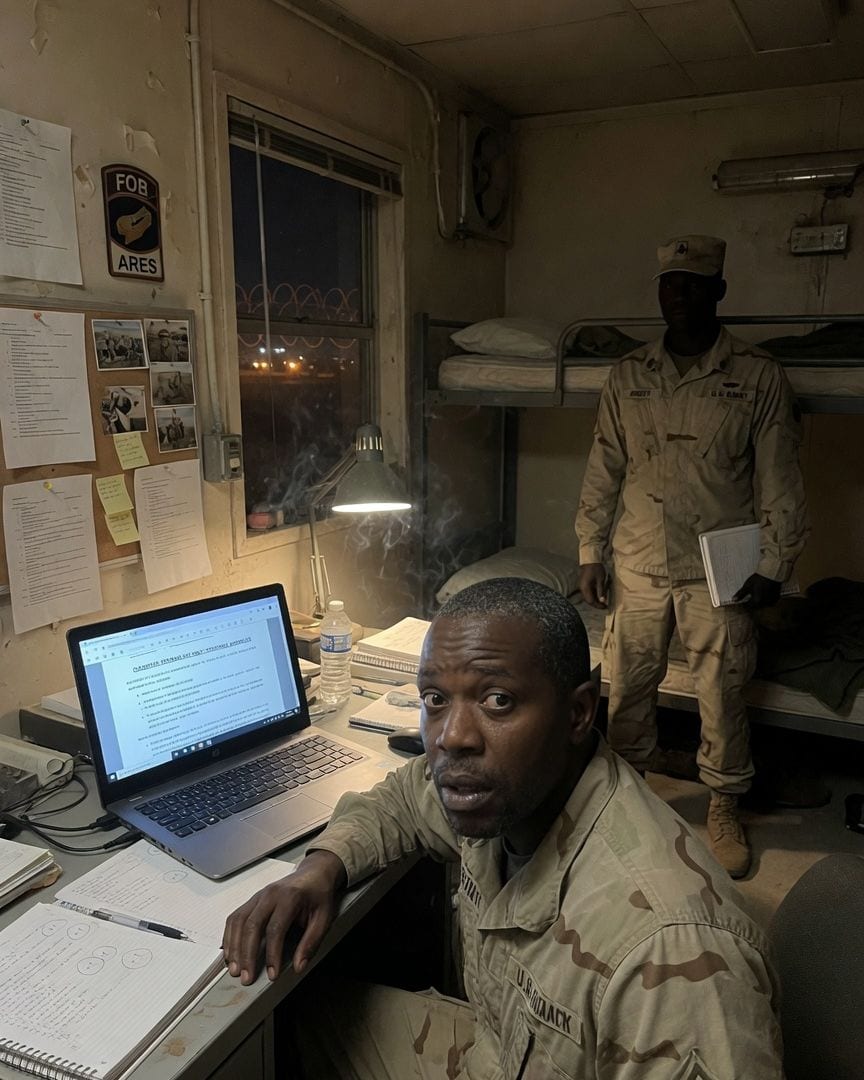
On his final rotation home, Sergeant Abbott counted his platoon: one man too many. The base’s secret files called them 'phantom units,' always watching him.
Sergeant First Class Malcolm Abbott was on his final rotation at FOB Ares, ready for transfer home. He called his platoon to formation, watching the sun break over the desolate desert as he counted each man. But the numbers didn't add up; there was always one extra soldier, standing at rigid attention, perfectly aligned with the others, yet only Malcolm could see him. Despite cross-referencing every manifest, the phantom remained, its face obscured in shadow, a silent sentinel that defied all logic. What secret did the base archives hold about these unacknowledged personnel?