An embassy sergeant counted seven Marines, but eight stood before him, two identical men named Stratton.
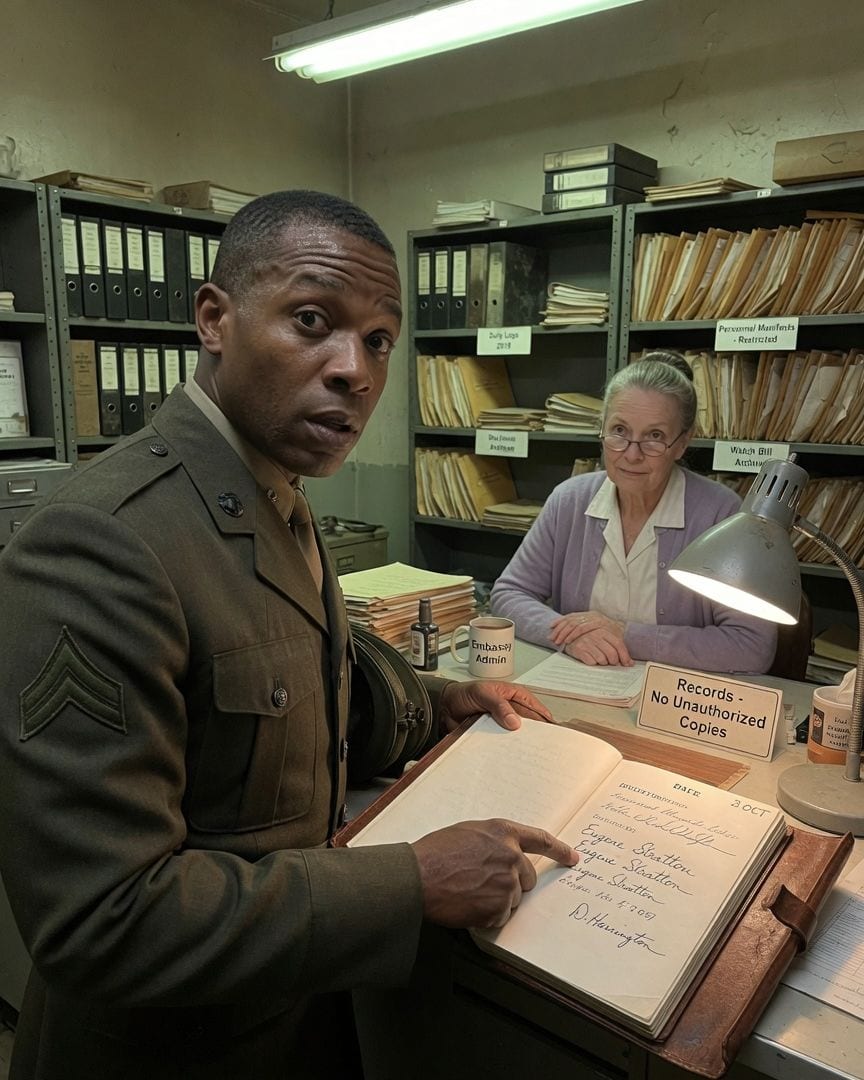
Sergeant Daniel Harrington, just six months from his honorable discharge, stood at the embassy guard mount. The air in the courtyard was cool, carrying the faint scent of diesel from a generator humming somewhere nearby.
This final rotation, with its familiar routine, felt heavy with the weight of pending civilian life. He called for the relief to fall in.
Seven Marines for seven posts and the reserve, a simple count he had made hundreds of times. But as they formed up, a chill, not from the night air, ran down his spine. Eight stood before him.
He ran down the watch bill by name, his gaze sharp, inspecting each man cover to cover. “Stratton, Eugene!” he called. A crisp “Here, Sergeant!” came from the second man in line, Private First Class Eugene Stratton.
But before Harrington could move to the next name, another voice, equally crisp, answered, “Here, Sergeant!”
This second Stratton stood perfectly still at the end of the line, eyes forward, an exact duplicate of the Marine beside him, right down to the faint scar above his left eyebrow. Harrington’s eyes narrowed.
He looked from one Stratton to the other, then back again. Both were identical. Both were real.
Harrington, a squared-away Marine, swallowed the sudden knot in his throat. He dismissed the relief, sending the original seven to their posts and the eighth, the duplicate, to the reserve barracks with an order to report to the medical unit.
He wrote it off as a prank, a new recruit trying to be clever, or extreme fatigue playing tricks on his own eyes.
But a quick check of the barracks manifest, accessed on the terminal in the guard shack, showed no eighth Marine assigned to his detachment. No transfer order, no temporary duty assignment, no new recruit.
The duplicate Eugene Stratton simply wasn't on any official roster.
His next stop was the records room, a quiet, fluorescent-lit space on the ground floor. The air in there was dry and smelled of old paper and dust.
Civilian clerk Frances Holloway, a woman whose gray bun and even grayer cardigan seemed to have been there since the embassy was built, sat behind a mountain of binders, her spectacles perched low on her nose.
Harrington requested the duty log for the previous night's guard mount. Holloway, without a word, slid a thick, leather-bound book across the counter. The spine creaked faintly as Harrington opened it. He flipped to the correct date.
There, meticulously penned in black ink, were seven names, each with a corresponding signature from the Marine and the verifying NCO. And then, a line for an eighth.
Another "Eugene Stratton," signed off by "D. Harrington," in a hand that was undeniably his own.
Harrington’s breath hitched. He knew he hadn't signed off on eight Marines. He’d counted seven, as always, before sending them to their posts.
His signature was a precise, practiced flourish he’d made hundreds of times, and this was it, perfectly replicated, beneath an entry for a Marine who shouldn't exist.
He stood there, finger tracing the ink on the page, the impossible count staring back at him.
He looked up at Frances Holloway, whose calm, knowing gaze met his from across the counter, not a flicker of surprise or concern on her face, as if this was the most ordinary thing in the world.
Harrington spent the next few days in a quiet, methodical frenzy. The incident with the duplicate Marine had burrowed into his mind, refusing to be shaken loose. He cross-referenced every manifest, every roster, every leave request for the past week.
The duplicate Eugene Stratton had vanished as completely as he’d appeared; no medical report, no disciplinary action, no transfer order existed for him.
He was simply gone from all current records, except for that single, impossible entry in the guard mount log, his own signature a phantom limb on the page.
Harrington returned to the records room, drawn back by a sense of unease he couldn’t name. He asked Frances Holloway for similar duty logs from previous rotations.
She provided them without question, her placid expression never changing, the soft light of the room reflecting in her thick lenses.
He poured over them in his off-hours, using the sterile fluorescent hum of the barracks common room as his only companion.
He started noticing anomalies: not always an extra Marine, but sometimes a post manned by a Marine who was officially on leave, or a signature from an NCO who was deployed elsewhere, thousands of miles away.
The discrepancies were subtle, easily dismissed as clerical errors in such a vast system, but they were too frequent, too precise to be random.
He started charting them by date, by post, by signatory, covering half a dozen legal pads with his neat, blocky script. A faint, unsettling pattern began to emerge, like a constellation forming from scattered stars across the paper.
One evening, as Harrington was meticulously comparing a 2012 duty roster with a corresponding leave schedule for the same period, a shadow fell over his table in the common room. The air around him suddenly felt still, hushed.
Frances Holloway stood there, a plain manila file folder clutched in her hand, her gaze fixed on his spread-out papers, his charts and notes.
“That’s old,” she stated, her voice soft but firm, a quiet rasp that barely broke the hum of the overhead lights. Harrington felt a jolt of adrenaline, a prickle on his neck.
“Just doing some research, Ms. Holloway,” he replied, his voice carefully even. She nodded slowly, her eyes sweeping over his notes, the dates, the circled names, lingering on the growing patterns. “Some things are best left to the system, Sergeant.
It has its own way of… accounting.” She didn't sound threatening, but there was an underlying current of warning in her tone, a deep, unsettling certainty that made the hairs on Harrington's arms stand up.
Later that night, he found a note slipped under his barrack door: 'The records are always right. Don't break the pattern.' No signature, just a stark, typed message.
The next day, his internet access to the embassy's archived personnel manifests was mysteriously restricted, citing 'routine maintenance.' A cold awareness settled over him. Someone was watching. Someone knew exactly what he was looking for.
Harrington confronted Frances Holloway in her office the following morning, the anonymous note clutched tightly in his hand. “Who sent this?” he demanded, his voice low and tight, betraying the fear he fought to suppress. She didn't flinch.
The air in the office felt impossibly still, as though it was holding its breath. “The system, Sergeant. It’s always been here.”
He slammed the duty log down on her counter, open to the page with the duplicate Stratton and his forged signature. The leather-bound book landed with a dull thud. “What is this? What’s going on?”
Holloway sighed, a weary sound that seemed to carry the weight of decades. “Some records… they have a memory, Sergeant. Sometimes, that memory manifests. A residual identity, a placeholder, fulfilling a duty it once held.”
She gestured to the log with a long, thin finger. “A phantom. It performs its task, it’s logged, and then it… recedes.” Harrington felt a cold sweat prickling his skin. “And my signature? I didn’t sign that.”
Holloway’s eyes, magnified by her thick lenses, held a deep sadness, a resignation. “To maintain coherence. If a duty is performed, it must be accounted for. The system demands it. We just… facilitate.”
She then opened a drawer in her desk, pulling out a thick, leather-bound volume, much older and more brittle than the others. Its cover was cracked, its pages yellowed. “This embassy has a long history, Sergeant.
And a very particular kind of… administrative overhead. It's been happening for decades. Long before you or I were here. We keep the books straight.”
The pieces started clicking into place – the subtle discrepancies, the impossible counts, the quiet management. It wasn't a glitch. It was a feature, a horrifying, persistent one.
Harrington, reeling from Holloway’s admission, pressed her for more. His mind raced, trying to reconcile the impossible with the calm, factual tone of her voice. “How long? And why my name?”
Holloway’s eyes flickered to a dusty shelf filled with identical, ancient-looking ledgers, row upon row of them, stretching back into the shadows. “The pattern repeats. Certain dates, certain rotations, certain… atmospheric conditions. And your name, Sergeant? You’re not the first.
Nor the last.” She reached up, pulling down a fragile, yellowed manifest from 2017. The paper crackled in her hands. “You were on active duty then, weren’t you? Stationed in Okinawa?”
Harrington nodded, his stomach churning, a sudden vertigo making the room spin slightly. He remembered that deployment vividly; the hot sun, the grueling training, the camaraderie.
Holloway’s finger traced an entry on the old manifest: a small, remote outpost in a country he’d never set foot in. Listed as verifying NCO: 'D. Harrington, Sgt.'
And beneath it, his signature, perfectly formed, for a guard mount that included a ‘plus one’ Marine, a phantom, on a day he was thousands of miles away.
Holloway explained the full, chilling truth, her voice a low murmur against the quiet hum of the fluorescent lights.
The embassy, she revealed, was built on the site of an older, forgotten military installation, and it seemed to possess a unique resonance with its own past.
The records system, initially analogue and then digitized, had somehow absorbed and retained these residual identities. “It’s like an echo,” she whispered, her voice barely audible, “but sometimes, the echo becomes… solid. For a short time.”
She showed Harrington a series of meticulously compiled charts: lunar cycles, atmospheric pressure readings, and the precise dates of 'bleed' events, stretching back to the 1970s.
Each chart was cross-referenced with duty logs detailing the phantom Marines, the forged signatures, the quiet disappearances. “We don’t know why it started, or how to stop it,” she admitted, her gaze distant, as if seeing beyond the walls.
“But we learned to manage it. To account for every entry, every phantom, so the system doesn’t… break.”
Harrington saw his own signature, repeated across decades, on logs for phantom Marines, on deployments he never made, in places he’d never seen. He wasn't just a witness; he was, unwittingly, part of the system’s long-standing deception.
Harrington stared at the evidence spread across Holloway's desk, the decades of meticulous, chilling record-keeping. The air in the room felt heavy, almost suffocating, with the weight of this secret. “You’ve been doing this for fifty years?”
he asked, his voice flat, barely a whisper. Holloway nodded slowly. “My predecessor trained me. And I’ve trained others.” He thought of his impending discharge, his clean record, the quiet civilian life he had planned, the apartment he’d almost secured.
This knowledge, this complicity, would shatter it all, grind it into dust. “What happens if someone… doesn’t account for it?” Holloway’s eyes widened slightly, a rare flicker of genuine fear passing through them, like a brief shadow.
“The system… it tries to correct. It pulls from somewhere else. Another record, another name.” She paused, her gaze fixed on him. “Sometimes, it pulls from the living.”
Harrington understood. The integrity of the records was paramount. The phantoms had to be logged, their presence validated, their departure recorded, or the system would find another way to balance the books, perhaps at a far greater cost.
He knew he couldn’t expose it without destroying his own career, without being branded insane, or worse, a traitor, disappearing into some nameless facility for the rest of his life.
He was trapped, not by a physical threat, but by the sheer, unassailable weight of official documentation, by the cold, bureaucratic logic of the impossible. He took a deep breath, the metallic taste of dread in his mouth.
He looked at Holloway, her face etched with the quiet burden of her work. “Show me,” he said, his voice firm, resigned. “Show me how you log them out. How you ensure they recede.”
Harrington completed his final six months at the embassy, his discharge papers signed and sealed.
He performed his duties flawlessly, the phantom guard mount and the chilling truths a memory he never spoke of, a secret held tight beneath his uniform.
He learned the quiet, bureaucratic dance of 'managing' the anomalies, occasionally signing off on a 'plus-one' entry, his hand now perfectly mimicking the forged signatures he’d once abhorred, adding the precise flourishes, the exact slant of the ‘H’.
Frances Holloway watched him with a silent, knowing approval, her eyes holding that same deep sadness, now mirrored in his own.
He left the embassy with a spotless record, the system’s secret buried deep within him, a silent partner in the meticulous lie. He never looked at official records the same way again.
Every form, every signature, every official document now carried a faint, unsettling echo of the impossible.
Years later, living a quiet civilian life in a small town upstate, Daniel Harrington would sometimes catch himself, hand poised over a mundane form, instinctively checking a phantom box, or adding an extra flourish to his signature he hadn’t intended, a precise, practiced movement he’d learned from Holloway.
He knew the system was still there, quietly humming beneath the surface of the world, quietly accounting for its ghosts.
And he knew, with a certainty that chilled him to the bone, that somewhere, in some dusty ledger, his name was still being used to cover for the impossible.
If this one got to you
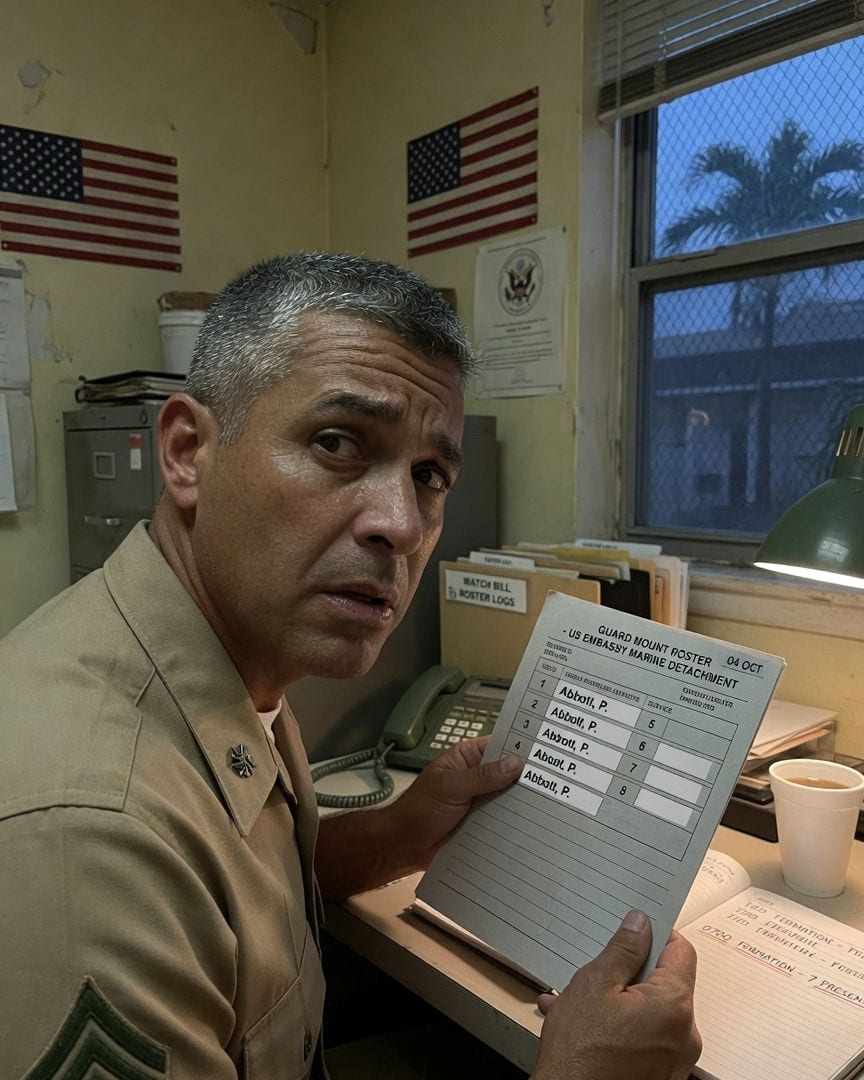
A meticulous Marine Sergeant counted eight men for guard mount, but his roster showed seven. The extra Marine gave a name already called, and a service number that was perfectly blank.
Sergeant Gordon Belanger, a career Marine NCO a month from his rotation, stood in the pre-dawn chill of the embassy courtyard. His meticulous count for guard mount revealed eight Marines, but the official watch bill listed only seven. When he confronted the extra man, the Marine gave a name already called, identical to the man standing beside him. Belanger's investigation of the impossible duplicate only deepened the mystery, as all records swore only seven Marines were present. Yet, his own signed roster confirmed an eighth man, whose service number was a stark, unnerving blank.
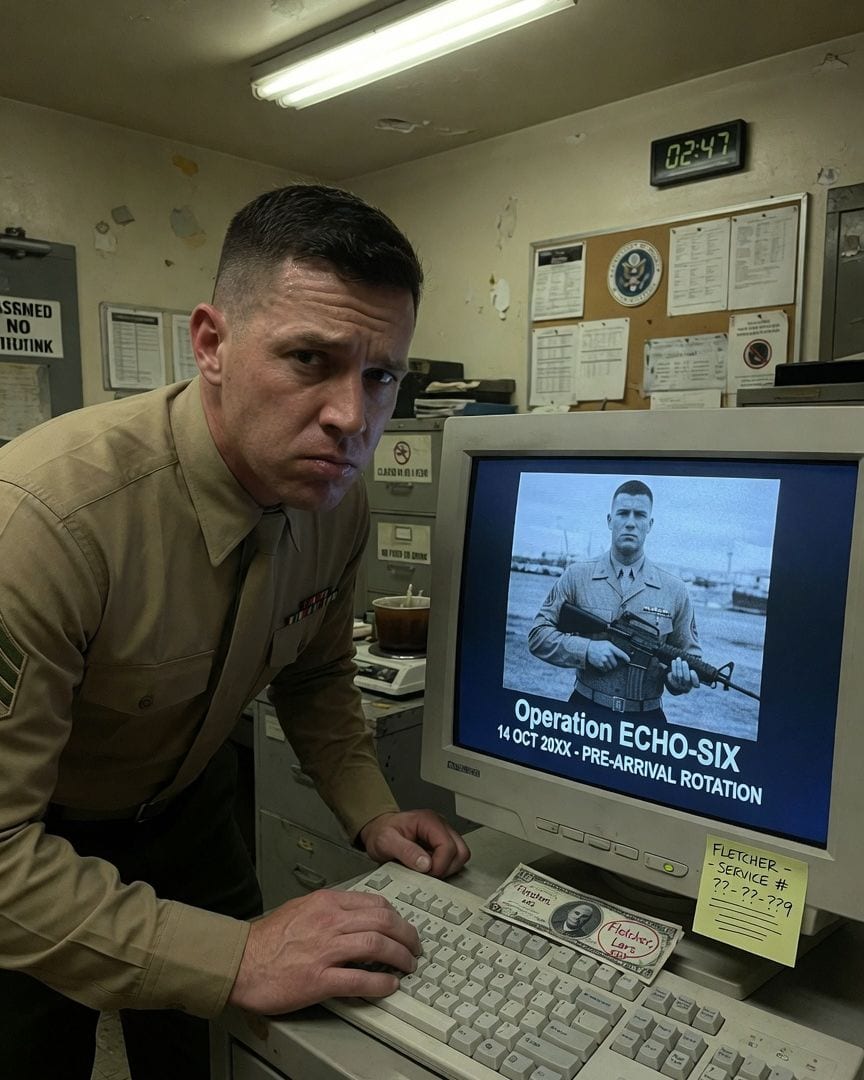
Sergeant Belanger's transfer was a week away when two Marines answered for 'Fletcher.' The impossible service number belonged to a man who shouldn't exist.
Sergeant Quentin Belanger counted down his last week at the embassy before his transfer home, yearning for a clean watch without trouble. But the familiar stale coffee smell of the guard mount room gave way to a chilling anomaly: eight Marines lined up for seven posts. When he called the first name on the roster, two crisp voices answered, one belonging to an extra man who shouldn't exist. Belanger's search for an explanation led him to barracks logs showing two identical entries for the same Marine, but with one impossible service number, ending in a digit that defied all protocol. The digital hum of the computer confirmed a truth far stranger than any prank, leaving the sergeant to wonder what other impossible echoes might be lurking.
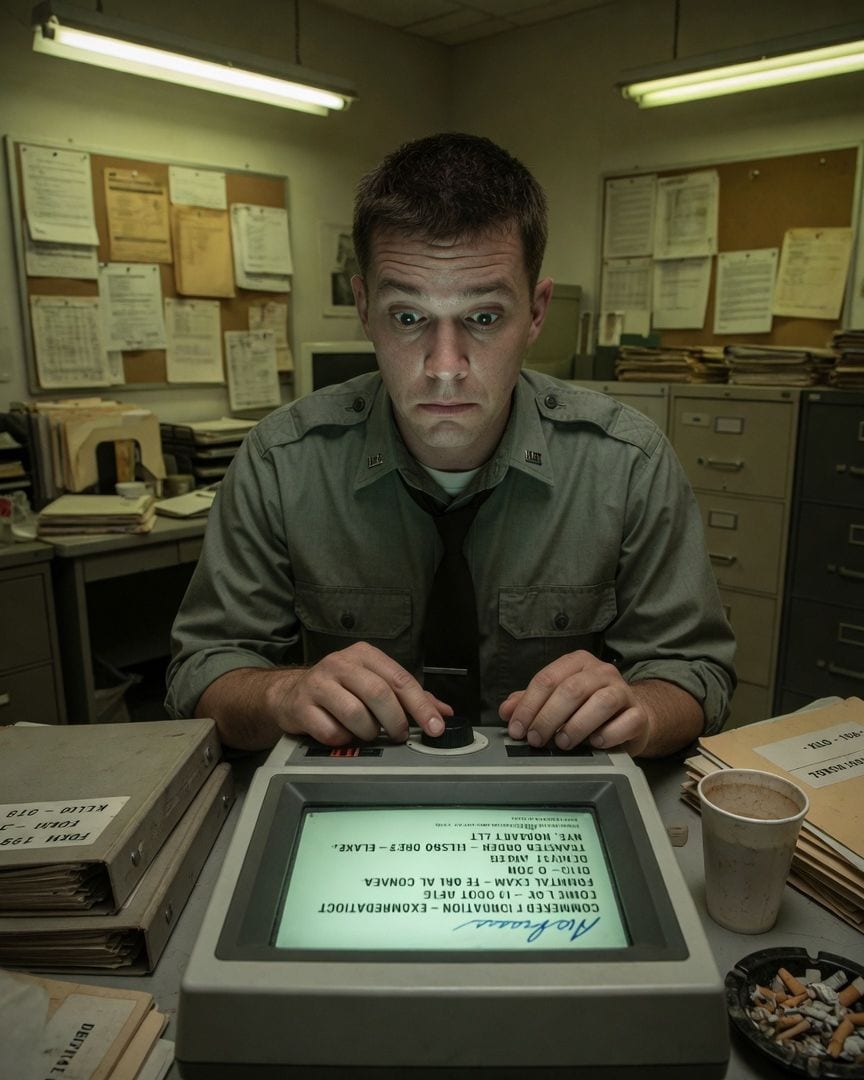
A missile commander watched his ten nuclear silos go dark. His own service record shows his signature on a future he's never lived.
Second Lieutenant Hobart Nye, a missile commander in Wyoming, had his quiet 0247 watch shattered by a security report: a massive, silent black triangle hovered over Launch Facility Kilo, casting a perfect shadow. Hobart watched his console's fault panel light up, signaling all ten nuclear missiles going dark in an impossible silence, followed by eleven minutes his security team could not remember. Official logs called it a "radio malfunction," but Hobart found a requisition for invisible-tracking sensors, signed by a base commander who was supposed to be off-base. The final, chilling discovery came when his own service record showed new entries—a dental check-up, a transfer to Alaska—all dated for a future he never lived, complete with his perfectly replicated signature.
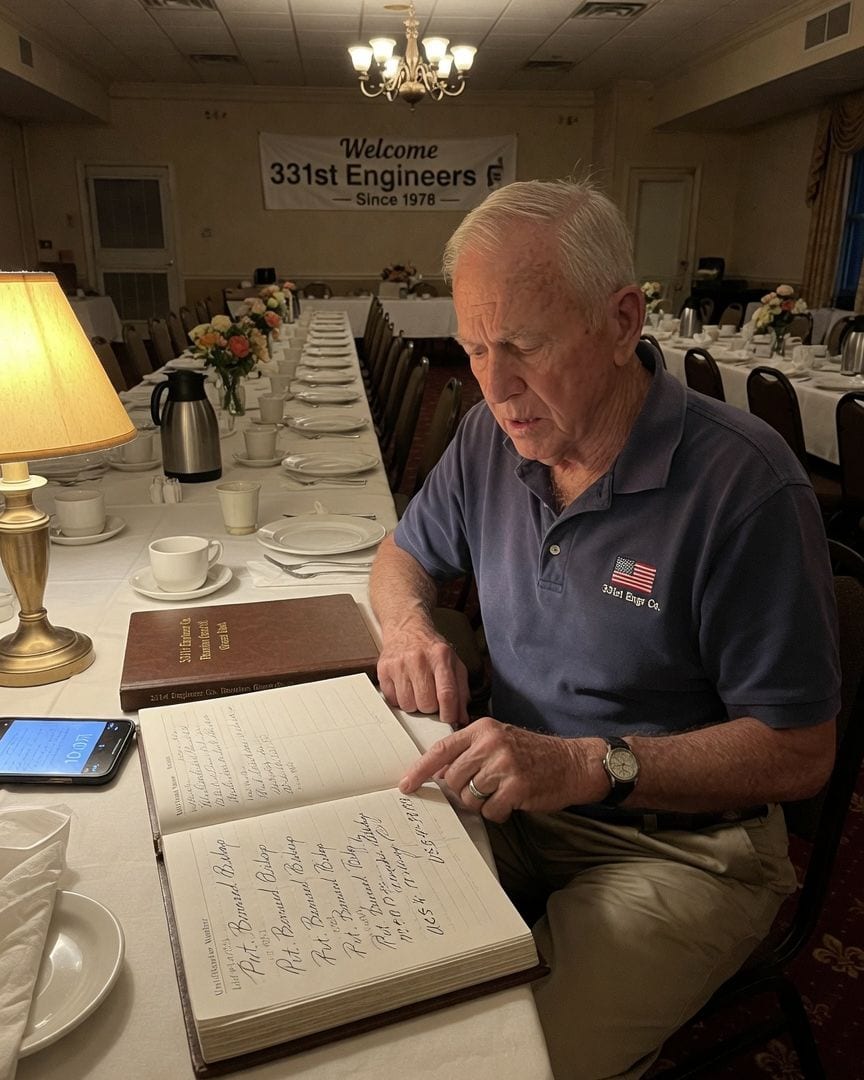
Retired Sergeant Odis Trumbull found a reunion guest book signed by a dead man. His service number was for a classified unit, not his own.
Retired Sergeant Odis Trumbull arrived at his annual company reunion, a tradition held in a Biloxi hotel ballroom since 1978. He sat alone for three hours, watching thirty empty chairs, each a ghost of a comrade he had personally buried over four decades. When the guest book arrived, Odis found thirty-one signatures, one for every man on the rolls. The ink on the last entry, for Private Bernard Bishop, was still wet. Yet, Odis had carried Bishop's coffin in 1976, two years before the reunion even began, and his service number matched a classified Cold War command. As Odis ran his thumb over the impossibly fresh ink, a cold dread began to settle.
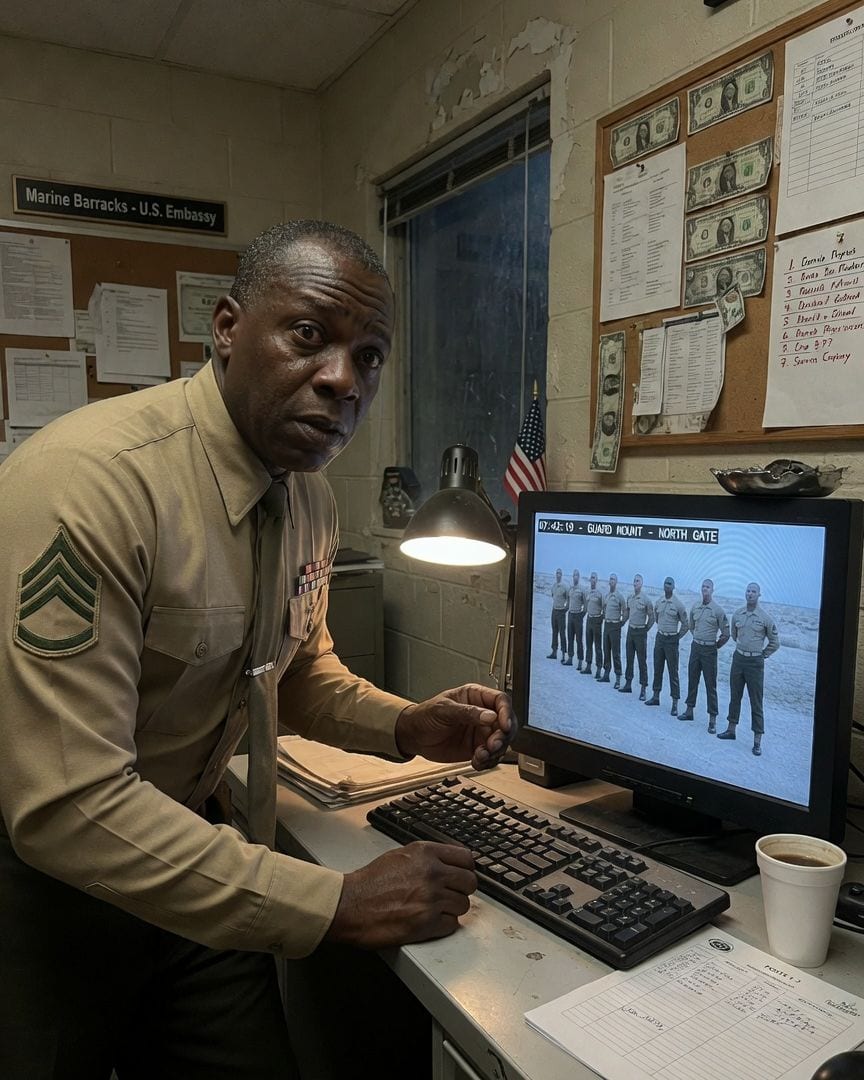
Sergeant Belanger's guard mount had an eighth Marine. The camera footage shows him vanish.
Sergeant Maxwell Belanger conducts a routine guard mount with his seven Marines, but counts an impossible eighth man in the formation. This extra Marine answers to a name already claimed, and later vanishes without a trace. Security camera footage briefly captures the eighth figure, solid and clear, before it warps and blurs from the frame.
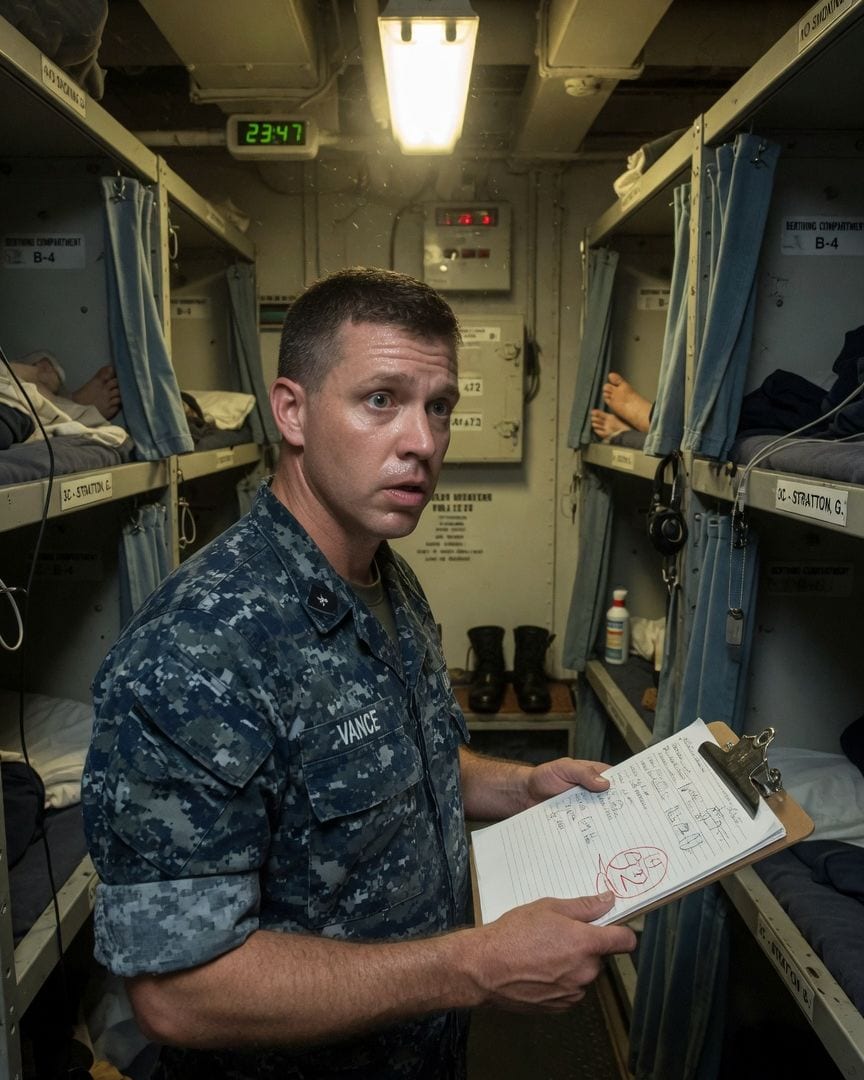
A Navy Petty Officer counted ninety-two men, but the ship's manifest held ninety-one. Then his own signature appeared on a roster for the impossible ninety-second man.
Petty Officer Donald Vance, a man who lived by the book, ran his thousandth lights-out muster in the USS Vance's dim berthing compartment. The routine count of ninety-one men suddenly blurred to ninety-two, a sharp wrong note in the ship's ordered rhythm. Despite Vance and Master-at-Arms Merritt checking every bunk and face, the impossible count held firm. The next morning, a digital manifest confirmed a ninety-second man: Petty Officer Gordon Stratton, a name Vance didn't recognize, whose file held years of official records — and a muster sheet signed by Vance himself. How could his own hand swear to a man he knew wasn't real?