A Navy Petty Officer counted ninety-two men, but the ship's manifest held ninety-one. Then his own signature appeared on a roster for the impossible ninety-second man.
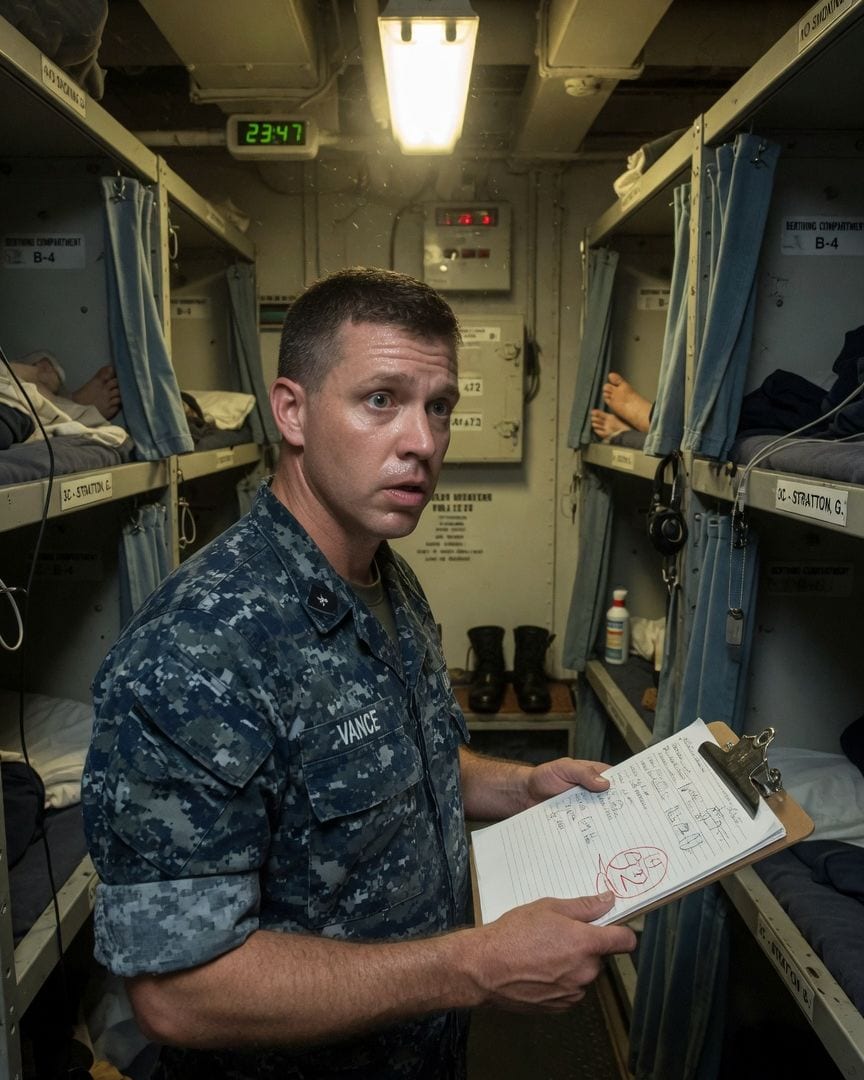
Petty Officer Donald Vance, a man who lived by the book, stood in the USS Vance's berthing compartment, the stale air thick with the scent of diesel and antiseptic. It was lights-out muster, a routine he’d run a thousand times.
Racks stacked three high, ninety-one men assigned to the compartment. He called the roll, the responses clipped and sleepy, each name a familiar echo in the dim, murmuring space.
When the final tally came back, the numbers on his clipboard blurred. Ninety-two.
Vance blinked, re-counted. Still ninety-two. The discrepancy prickled at the back of his neck, a sharp, wrong note in the ship's ordered rhythm. With Master-at-Arms Franklin Merritt, a stoic man whose face rarely betrayed emotion, Vance walked every aisle again.
They shook each curtain, peered into every shadow. Vance matched every face to its bunk card. Every rack had its man. Every man had his card. Every face was accounted for. There were ninety-two of them.
The USS Vance, by every official record, carried ninety-one. The air in the compartment felt heavier now, pressed against the bulkheads, a silence that wasn't quite empty.
The next morning, the impossible count gnawed at Vance. He started with the ship's digital manifest, cross-referencing berthing assignments. The system, in its cold, digital certainty, listed ninety-two personnel for his compartment. One name stood out: Petty Officer Gordon Stratton.
Vance didn't recognize it. He pulled up the ship’s official berthing chart; Stratton was assigned to Bunk 3C, a rack Vance had personally checked. There was a man in that bunk.
Vance had seen him, just last night, tucked under the thin Navy blanket.
Vance made his way to the ship's administrative office, a place of meticulously organized files and the faint smell of toner. He found a hanging file for Gordon Stratton, thick with official Navy forms, training records, and deployment history.
Every detail was correct, every stamp official. Stratton had a service number, a birthdate, a record of deployments that stretched back years.
Tucked inside was a muster sheet for the previous week, dated just five days prior, signed by Vance himself, listing Stratton among the accounted.
Vance stared at his own signature, a perfect, undeniable match, on a document for a man he’d never seen, never called roll for, never spoken a word to.
The pen strokes, the particular loop of his 'D,' the faint pressure point where he always paused – it was all there. He knew he hadn't signed it. He knew Stratton wasn't real.
But the record, his own hand, swore otherwise.
Vance took Stratton’s file and the muster sheet directly to Master-at-Arms Merritt. Merritt’s office was a cramped space, smelling of old coffee and metal polish.
Vance laid the file on Merritt’s desk, pointing to the impossible name and his own signature. Merritt picked up the sheet, his brow furrowing slightly, but his expression remained unreadable.
He flipped through Stratton’s file, pausing on a few pages, his fingers brushing over the printed names and dates. The old fan in the corner rattled, pushing stale air around the room.
Then he looked at Vance, his eyes calm, almost pitying. “Petty Officer Stratton is on the manifest, Vance. Always has been. Is there a problem with your signature, son?”
Merritt’s question hung in the air, a quiet accusation. Vance felt a cold dread settle in his gut. He retreated, the file clutched in his hand, and began a quiet, methodical investigation.
He checked every duty roster, every watch bill, every maintenance log for Petty Officer Gordon Stratton.
Stratton was on paper everywhere: assigned to general quarters, listed for fire drills, even credited for a small repair on a ventilation duct last month.
Yet, no one Vance spoke to, from the oldest Chief to the newest recruit, could recall ever seeing or working with a Gordon Stratton.
They frowned, they scratched their heads, they sometimes offered, "Sounds familiar," but the familiarity was always a phantom, a name without a face, without a memory.
It was as if the name existed only in the ink and the pixels, a meticulously rendered ghost.
Vance then broadened his search. He found old ship’s logs, archived digital manifests from previous deployments of the USS Vance, going back decades. The pattern began to emerge, chilling in its consistency.
On deployments five, ten, even twenty years ago, there was always an 'extra' man listed for his berthing compartment. Different names, different ranks, but always one surplus. And, almost always, the signature of the responsible Petty Officer, confirming their presence.
He pulled out his own personal logbook, a sturdy, canvas-bound notebook he used for official notes and personal observations, jotting down the dates and names, the impossible consistency of the 'plus one.'
He noticed a faint, almost imperceptible smudge on his own signature on Stratton's muster sheet, a subtle blur that he hadn't registered before, as if a ghost had pressed a thumb over it.
He found similar smudges on other historical muster sheets for these 'extra' men, faint impressions that seemed to whisper of something almost, but not quite, real.
Vance’s quiet digging did not go unnoticed. He found himself subtly rerouted from certain archives, a requested access key mysteriously 'misplaced.' The ship itself seemed to resist, its digital systems suddenly sluggish, its physical corridors longer than he remembered.
One afternoon, Merritt approached him in the mess hall, a tray of lukewarm food in his hands. “Still chasing paperwork, Vance?” Merritt’s voice was low, almost friendly, but his eyes held a steel that cut through the casual tone.
“Some things are best left to the system to sort out. It always does, in the end. Don’t go chasing ghosts where there are none.”
The clatter of trays and the drone of conversation in the mess hall seemed to dim around them, leaving Vance feeling exposed. Vance nodded, a knot forming in his stomach.
Later that night, back in his own rack, he reached for his personal logbook, where he’d been meticulously documenting the impossible pattern.
It lay open, a page he’d folded over now flat, as if someone had smoothed it out with careful, deliberate hands.
The pencil he used to mark his entries was placed precisely back in its spine, but the faint indentation he’d made on the page beneath his last entry was gone.
The berthing air, usually thick with snores, felt suddenly thin and watchful.
He looked around the silent berthing, the other sailors asleep in their racks, and felt a profound sense of being observed, not by a person, but by the ship itself, its bulkheads humming with a silent, waiting tension.
The next day, Vance confronted Merritt again, this time with a stack of old manifests and his personal logbook, open to the pages detailing the recurring 'extra' crewmen.
He laid them out on Merritt’s desk, the faded paper and crisp print a contrast. “This isn’t a ghost, MAA. This is a pattern. And it’s been happening on this ship for decades.
Always one man too many, always accounted for, always a signature that shouldn’t be there.” The light from the fluorescent fixture above seemed to flicker, as if sensing the truth being spoken aloud. Merritt’s calm facade finally cracked.
He sighed, rubbing his temples, a weary gesture Vance hadn't seen him make before. “Alright, Vance. You’re not the first. And you won’t be the last.”
He stood, walked to an old, rusted locker in the corner, its paint peeling like ancient skin, and fumbled with a hidden latch.
Inside, tucked away behind dusty cleaning supplies, was a small, leather-bound logbook, its pages brittle with age, smelling faintly of salt and decay. “This,” Merritt said, his voice quiet, almost a whisper, “is the ship’s true log.
The one nobody talks about.” He opened it to a random page. Faded, elegant script detailed a muster from the 1980s, an impossible count, and the name of an officer who had tried to 'correct' it.
A brief, chilling note followed: 'Transferred without cause, destination unknown.' Merritt flipped through more pages. Each entry was a variation: an extra man, a baffled officer, and then a quiet, official erasure from the Navy.
The room seemed to grow cold, the rattling fan suddenly silent. “The ship,” Merritt explained, his gaze fixed on the ancient book, “it needs its complement. And it always gets it. The system just… reconciles. It makes it true.”
He looked at Vance, his eyes heavy, unblinking. “The names change, the faces change, but the number… the number always comes out right. And those who fight it… they become part of the record too.”
Merritt turned a page in the ancient logbook, his finger tracing a line of script. The ink was fresh, stark against the yellowed paper, too new for such an old book. Vance leaned closer, his breath catching in his throat.
The entry detailed a muster, just last week, in his own berthing compartment. It listed ninety-two men, including Petty Officer Gordon Stratton.
Beneath it, in a hand that was unmistakably his own, every loop and line precisely as he made them, was his signature, confirming the impossible count.
Vance stared at the page, a record he knew, with every fiber of his being, he had not written, a memory that had never occurred. The reality of it slammed into him, a physical blow.
He looked at his own hand, then back at the perfect, impossible script, the tiny, familiar tremor in his 'V' perfectly replicated.
Merritt closed the logbook with a soft thud, the sound echoing in the small office, making the rusted locker creak faintly. He met Vance’s gaze, his expression unreadable, but the quiet certainty in his eyes was terrifying.
"It's already accounted for you, Petty Officer."
The full, horrifying truth crashed down on Vance. The leather-bound logbook wasn't just a record of the anomaly; it was the anomaly itself, an active, sentient component of the ship’s reality.
It didn't merely document the 'extra' man; it generated him. The ship, through this artifact, demanded its 92nd crewman, and the official Navy system, designed for impeccable accountability, was retroactively compelled to conform.
Stratton’s service record, the muster sheets, Vance’s own impossible signatures – they were all the system’s reconciliation, the subtle smudges a ghost of the logbook’s influence, a blurring of lines between what was and what the ship required to be.
The ship needed 92, and the logbook simply made it so, weaving the impossible into the fabric of reality, creating memories and paperwork that never existed, not just for Vance, but for everyone who ever stepped aboard.
The 'extra' man wasn't a ghost haunting the ship; he was a living, breathing placeholder, a manifestation of the ship’s will, perfectly accounted for because the ship itself ensured it.
Every entry in the old logbook, every officer who tried to fight it, was a testament to the USS Vance’s unyielding requirement. The horror wasn't a glitch; it was the system working exactly as the ship intended, flawlessly and relentlessly.
Vance knew he couldn’t destroy the logbook; it was too deeply ingrained, too powerful. The ship would simply manifest another, or worse, make him disappear as it had others, another entry in that ancient, terrible record.
His only option was to create a counter-record, something so undeniable and outside the ship’s influence that it couldn’t be absorbed or reconciled. He returned to his berthing, his mind racing, the stale air feeling thick and oppressive.
He pulled out his phone, its screen a small, defiant light in the dim compartment.
He began documenting everything: photos of Stratton’s service file, close-ups of his own impossible signature, screenshots of the official manifest showing 92 men, even a shaky video of the empty bunk 3C, then panning to the full berthing, where 91 men slept.
He would compile it all, upload it to a secure cloud, and send it to a contact in Naval Intelligence the moment they made port.
It would ruin his career, brand him a lunatic, but it was the only way to break the cycle, to expose the ship’s impossible truth. As he worked, meticulously capturing every detail, a faint sound reached his ears. Footsteps.
Rhythmic, heavy, echoing down the corridor, closer than they should be. But they were off. Not quite in sync.
Two sets of boots, but one was just a fraction of a beat behind the other, a subtle, chilling echo that shouldn't be there, a duplication of sound.
The sound grew louder, closer, the distinct cadence of Navy-issue boots on steel grating, coming from the direction of the berthing entrance. Vance froze, his phone still aimed at the impossible evidence. The footsteps stopped.
Just outside the bulkhead of his berthing compartment. He held his breath, listening to the impossible, syncing rhythm of two men, one too many, waiting.
Vance’s phone, wiped clean, was later discovered in a rarely used utility locker, its battery dead.
His official service record, once exemplary, showed an abrupt transfer to a remote, decommissioned shore station in the Aleutian Islands, followed by a quiet, administrative discharge for 'unspecified mental health concerns' a few weeks later.
The Navy’s systems, efficient as ever, closed the book on him.
Petty Officer Gordon Stratton’s name remained on the USS Vance’s manifest for the rest of that deployment, then vanished as smoothly as it had appeared, replaced by a new, equally impossible 'extra' name on the ship’s next rotation.
The system, once again, had reconciled.
A year later, Master-at-Arms Franklin Merritt sat at his desk aboard the USS Vance, reviewing incoming personnel requests. He paused on one particular transfer form: Petty Officer Donald Vance, requesting a tour of duty on the USS Vance.
Merritt glanced at the date on the request, then at the name, and a faint, almost imperceptible smile touched his lips. He signed the form.
If this one got to you
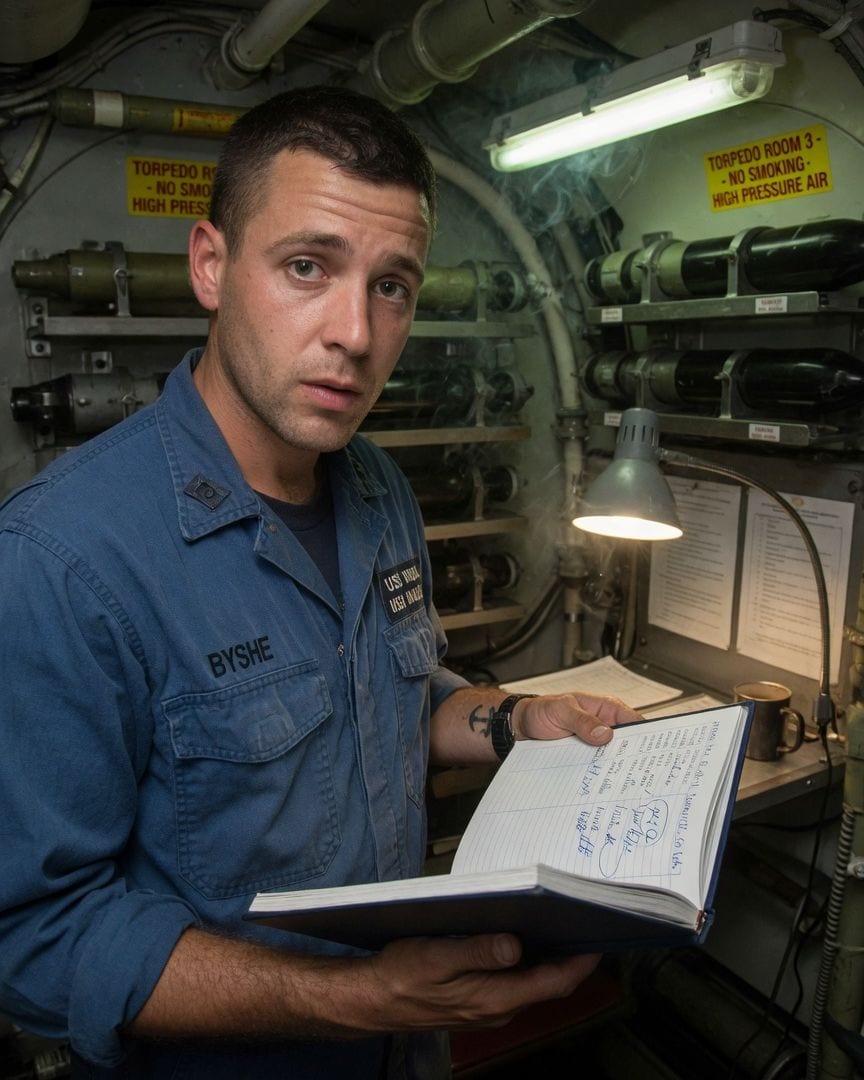
A torpedoman found his own signature in the USS Vanguard's duty log for a watch he never stood, beside a name not on the master crew manifest.
Torpedoman Oscar Bysshe, a rational sailor on his first deep patrol aboard the USS Vanguard, dismissed the messcook's nervous claim of an extra man at the table. He attributed the perfectly clean, untouched tray left behind to a prank. But later, during a routine systems check, Bysshe discovered his own familiar signature in the official duty logbook, for a watch he had been asleep through. Beside it was a name he didn't recognize, a name that shouldn't be there. A frantic check of the master crew manifest confirmed the impossible: the name appeared in the 'temporary assignments' section, dated just yesterday, scrawled in a hand eerily similar to his own.
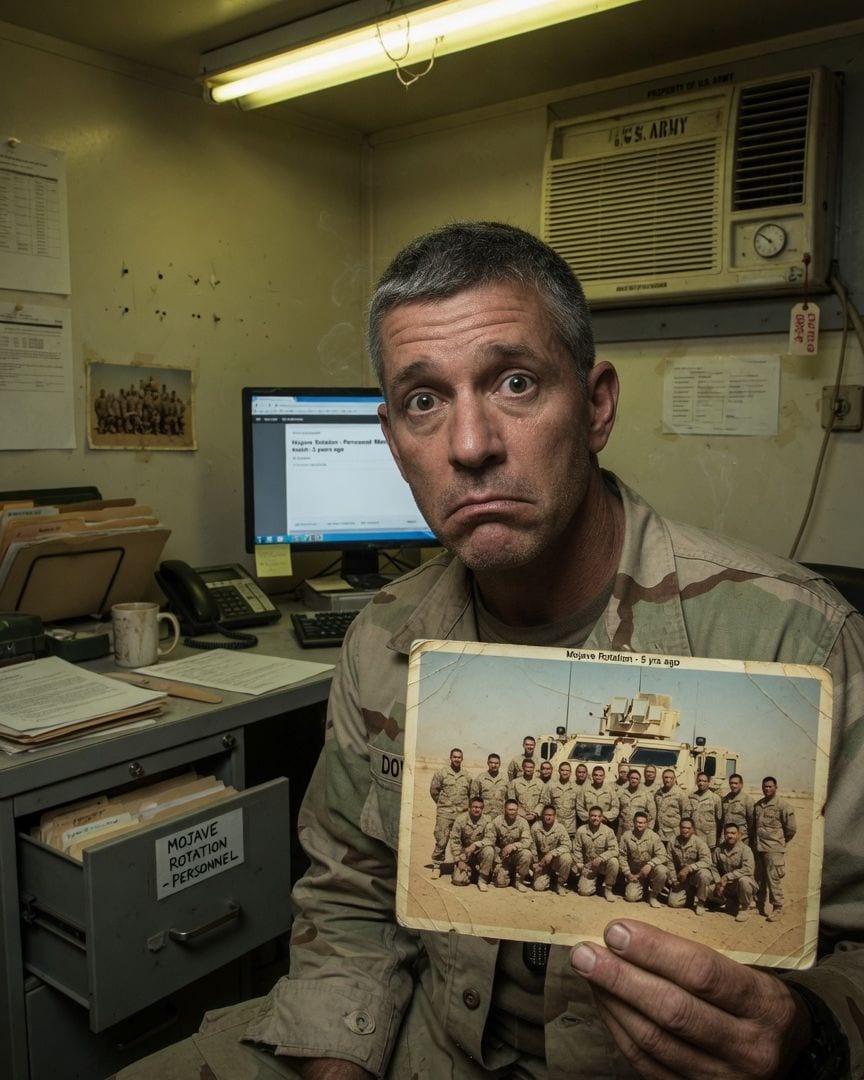
Two weeks from transfer, Master Sergeant Doyle’s old platoon photo now showed a 32nd man grinning from the back row.
Master Sergeant Oliver Doyle was two weeks from his transfer, overseeing the final decommissioning of FOB Erebus, finding solace in routine. His old Mojave platoon photo, a yellowed record above his desk, always showed thirty-one faces from his past. This morning, however, an extra man grinned from the back rank, a face both familiar and utterly alien. When he showed it to Sergeant Barlow, the younger man immediately named the newcomer, "Ryan Stratton," a name Doyle hadn't spoken, yet one that felt ready on Barlow's tongue. Official records listed only thirty-one, but a hidden digital history revealed a manifest with thirty-two names, signed by Doyle himself.
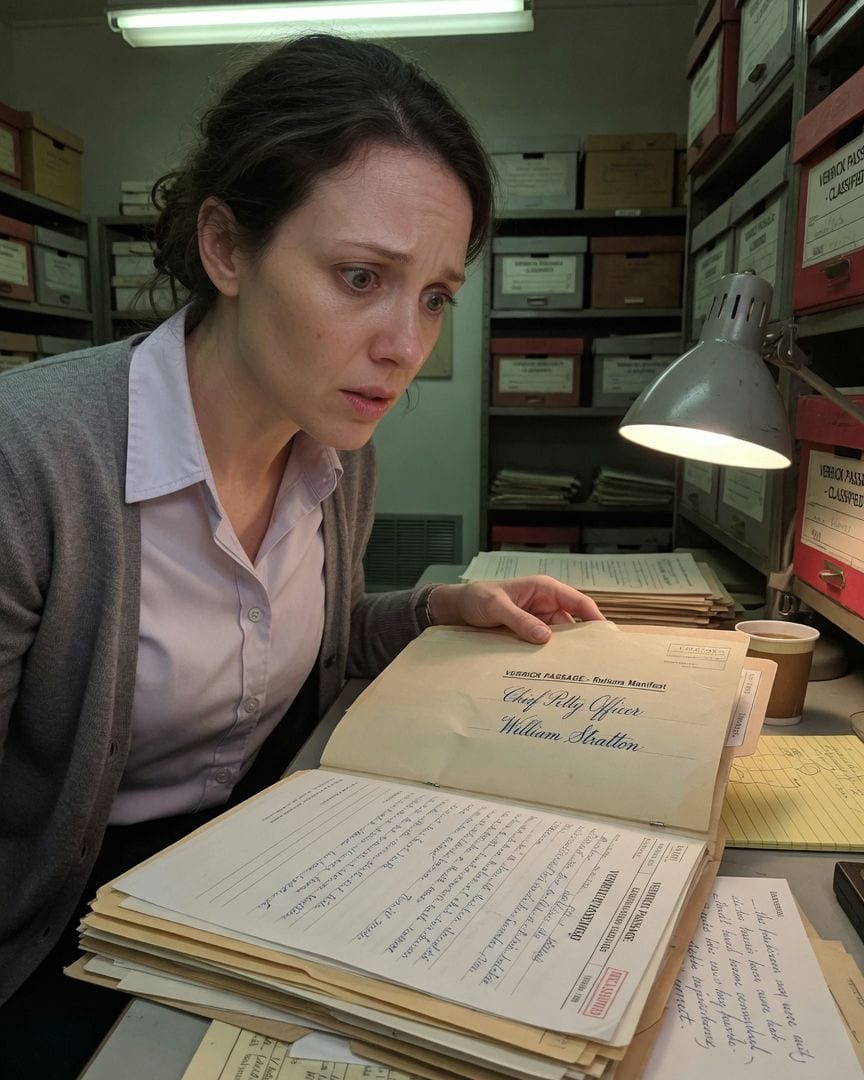
A records reviewer found personnel files for men lost 80 years ago, still being signed in an identical, perfect hand.
In the sterile hush of the declassified archives, meticulous reviewer Ione Fash had a routine task: cross-referencing witness statements from the Verrick Passage file. But as she reviewed files eighty years thick with official silence, she found nine separate interviews containing the exact same chilling sentence, all in an identical, precise hand. Her rational mind sought explanation, yet then she discovered something worse: personnel files for men lost in 1943, still being updated with modern requisitions and payroll runs. Each impossible entry, including a manifest signed just two weeks ago by a casualty from eighty years prior, bore the same unnervingly perfect signature. The file wasn't just a record of the lost; it was still being signed.
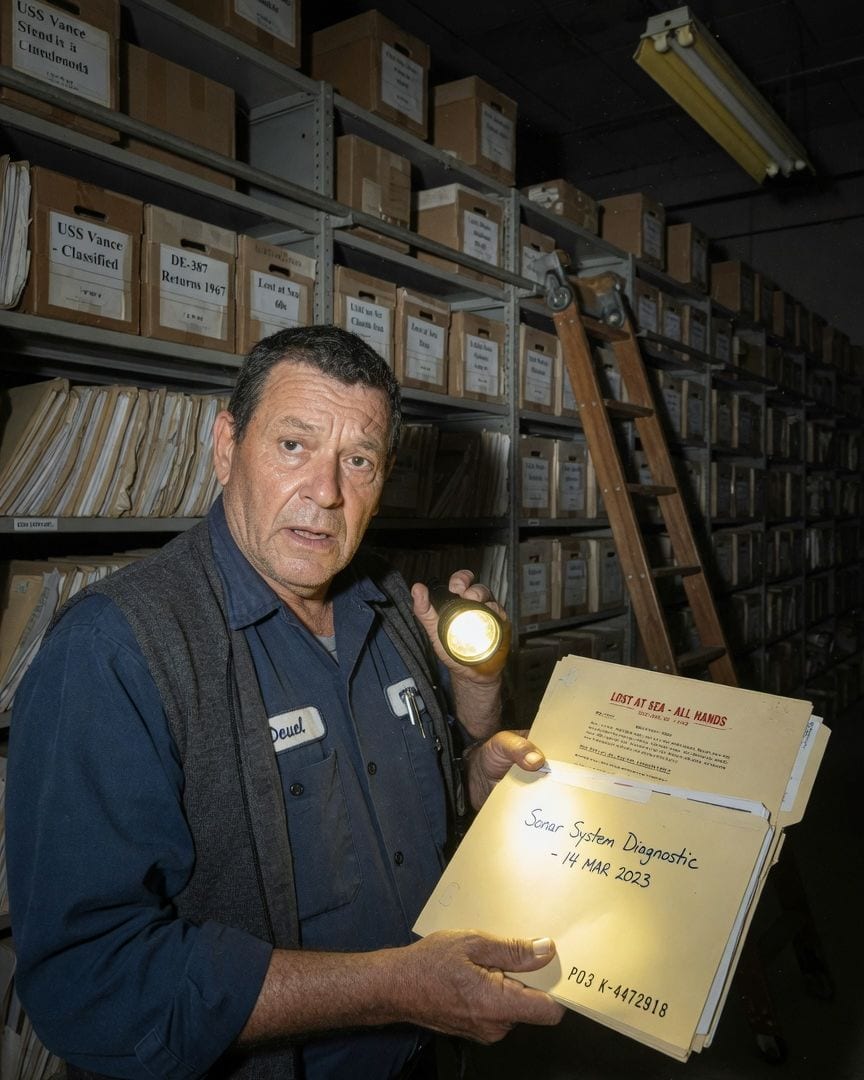
An archivist, alone in the Suitland annex, finds a 1968 lost Cold War ship file with a handwritten entry dated last Tuesday. The ink looks damp, but feels dry.
Carmine Deuel, 62, spent forty years amidst the dust and forgotten files of the Suitland annex. One night, alone in the cavernous space, a sticky squeal and the faint sway of a rolling ladder broke the silence. He found a classified file from the USS Vance, a ship lost in 1968, pulled from its shelf. Inside, a typed form held a handwritten entry: a routine sonar check, dated last Tuesday. The ink, impossibly, looked damp yet was perfectly dry. Who had accessed the file, and how could its entry be so recent?
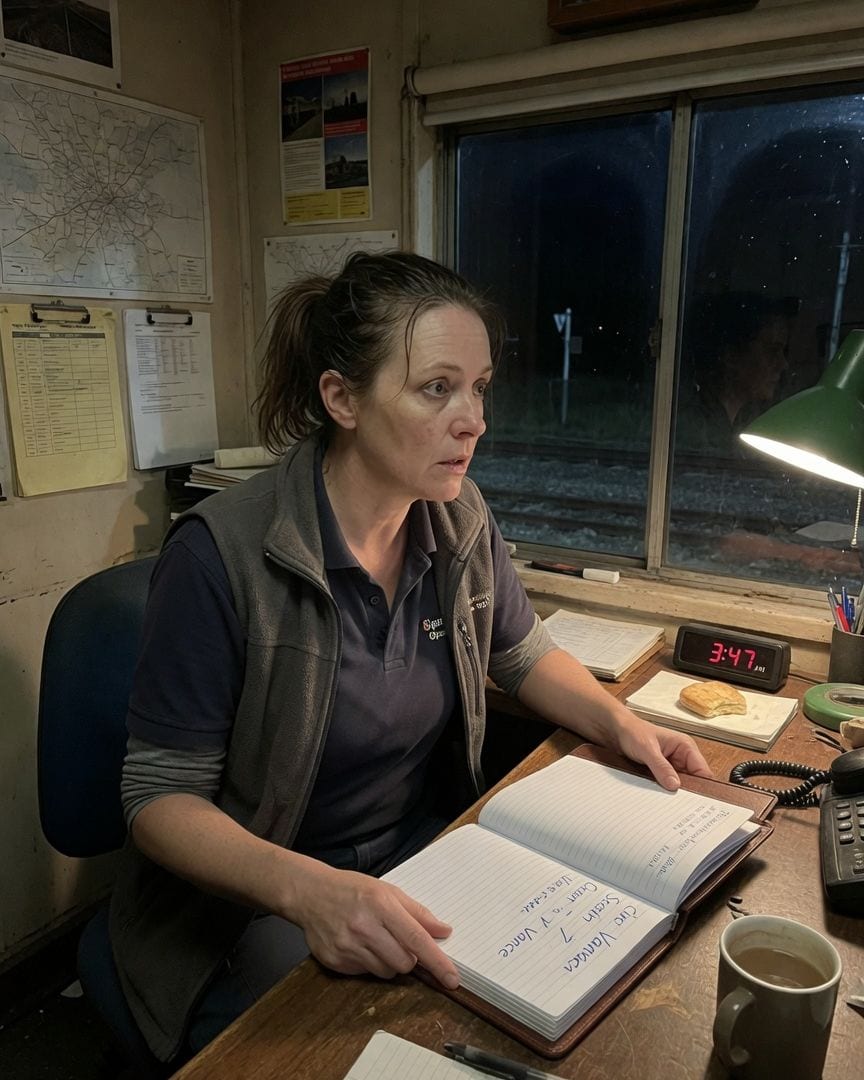
My linesman taps twice on my window at 3 AM. Control says he retired and passed years ago.
My routine at the rural signal cabin was regular: the linesman's double tap on the window at 3 AM. But then my supervisor called, revealing the linesman I knew, Warren Vance, had died five years ago. Now, an impossible entry in my official logbook, with his signature and timestamped from my shift, proves someone else was there.
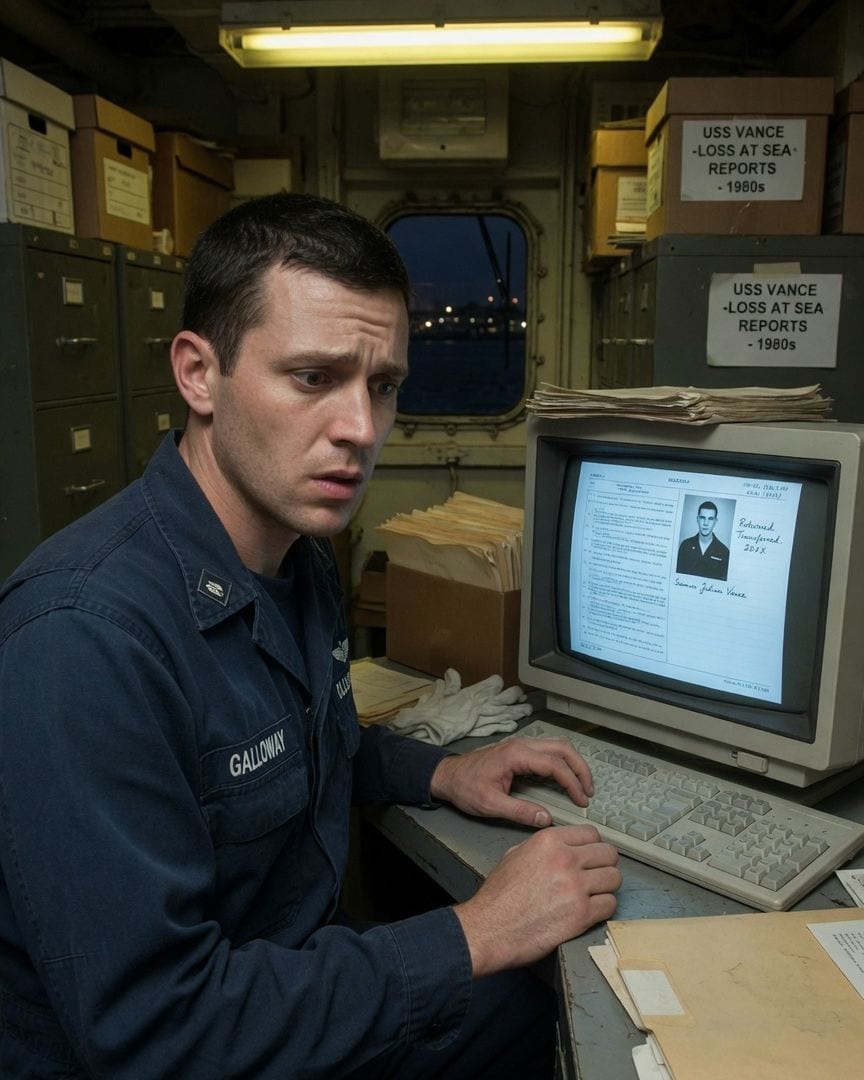
Petty Officer Galloway logged a sailor onto his ship. The man died at sea 40 years ago.
Petty Officer Joel Galloway scanned a sailor's ID on the USS Vance quarterdeck. The man's name, 'Seaman Julian Vance,' and his out-of-date uniform pricked at Galloway's memory. Later, the ship's berthing count came back one over, with an extra entry in the system but no physical body.