My linesman taps twice on my window at 3 AM. Control says he retired and passed years ago.
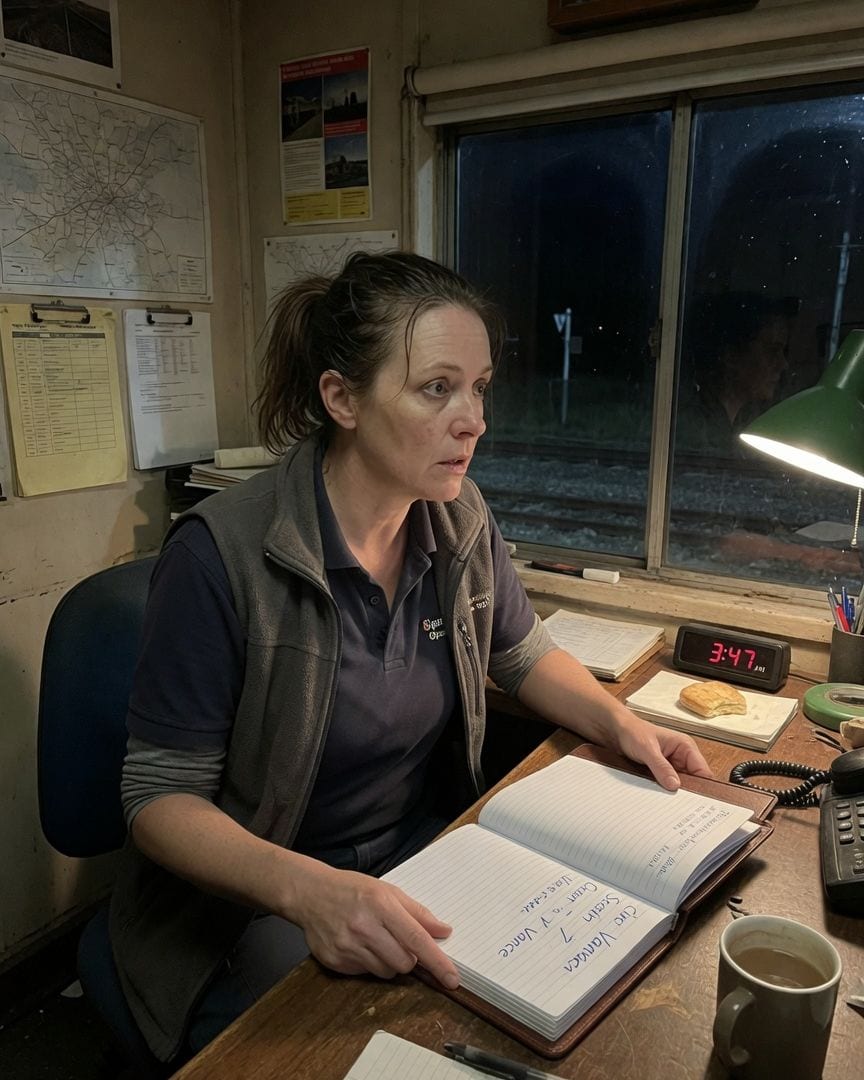
The double tap on the window at 3 AM was as regular as the moon. Two sharp knocks, distinct, firm, just above the sill, always at precisely three. I barely glanced up from my coffee.
It was Warren Vance, the linesman, checking Section 7. Had to be. His cue, then mine to acknowledge.
The quiet crunch of gravel would follow, his heavy boots moving away into the predawn dark, and I’d just log the section clear.
It had been my routine for the past six months, ever since I started at this rural signal cabin. But tonight, the routine felt different.
A strange, metallic tang, like old iron and ozone, had permeated the cabin air just before the taps. I’d dismissed it as something from the freight train that had passed fifteen minutes earlier.
Then Control called, hours later. Not Sean Donovan, my regular supervisor, but someone from a different desk, their voice tight with professional concern. A near-miss.
A phantom signal on Section 7 had caused a freight train to brake hard, narrowly avoiding a static empty carriage that shouldn't have been there. It had vanished by the time a maintenance crew arrived.
Sean called me directly an hour after that, his voice a little strained. He mentioned pulling staffing records, an internal investigation. He then asked, casually, "Who was that linesman you reported seeing on Section 7, Eileen? The one who taps?"
I told him, "Warren Vance, of course. Always three AM." Sean was quiet for a long moment. "Eileen," he said, and his voice was suddenly devoid of all its usual warmth, "no linesman patrols your section at night.
And Warren Vance, the man you’re describing, he retired ten years ago. He passed five years back."
The phone went dead in my hand, but the memory of those two sharp taps on my window, just hours ago, was still fresh, chillingly clear.
I spent the next shift trying to rationalize it. Exhaustion, a trick of the light, an old local playing a prank. A memory of some old railway ghost story from my induction week.
I even checked the cabin's official logbook, a thick, leather-bound ledger where every section check and signal change was recorded in neat, sequential lines.
My own precise handwriting filled page after page, every entry a testament to my focused attention, my sanity. I found the page for the previous night, my shift. My entry for the 2:45 AM freight pass, timestamped, signed.
Below it, on the very next line, was another entry, scrawled in a hand that most definitely wasn't mine: '3:05 AM – Section 7 Clear – Vance'. And below that, a signature, a bold, slightly shaky 'W. Vance'.
I stared at it. My heart, which had been slowing down after Sean’s call, started to pick up pace again, a frantic flutter against my ribs. I hadn't written it. I hadn't even seen anyone else in the cabin.
The entry was perfectly placed, the ink a dark, familiar blue, faded just enough to suggest it belonged among the other older entries, but it was alien. It was wrong.
I ran my fingers over the signature, the dread blossoming cold and sharp in my gut. It couldn’t be.
I’d been alone in that cabin, just the low hum of the controls and the distant rumble of the tracks for company. Alone. I checked the timestamp again, 3:05 AM. Five minutes after the taps.
I tried to convince myself I'd somehow forgotten making the entry, forgotten Warren coming in, though he never did, always tapped and moved on.
But the memory of my solitary presence, the quiet hum of the cabin, the empty space around me, was absolute. The ordinary explanation failed, leaving only the chilling certainty that someone, or something, had been there, leaving its mark.
I snatched my personal journal from my bag, a small, leather-bound book where I jotted down odd observations, reminders, sometimes just thoughts. I flipped frantically to my notes from last night. '3:00 AM: Heard the taps. Vance.'
Then, a blank space, followed by my next entry at 4:15 AM, noting a minor signal flicker. Nothing about a logbook entry for Section 7. No mention of me picking up the pen.
I picked up the cabin logbook again, my hand shaking, the leather cool against my palm. The pen was still in its holder, exactly where I’d left it.
I looked at the firm, familiar script of 'Warren Vance' beside the 3:05 AM entry. The ink was dry, the page undisturbed, yet I knew with absolute certainty I never touched the pen, never wrote those words.
The next few days were a blur of restless shifts and obsessive research. I called an old-timer, retired signalman Hans Bishop, under the guise of 'historical railway procedures' for a personal project. He was happy to talk.
I asked about Warren Vance. Hans spoke fondly of Vance, 'a stickler for routine,' he called him, who’d patrolled that very section for forty years. He confirmed Vance’s retirement date, his passing five years ago.
I pressed, my voice light, 'Did he ever… come back? Even after he retired, did anyone ever see him around that section?' Hans chuckled, a dry, rattling sound. 'Not that I ever heard.
Vance was thorough, but he knew when his time was done. Though, rumour had it, the old track would hum differently if Vance missed a day. Like the line itself knew when he wasn't there.'
A shiver went through me despite the warm phone receiver.
I spent hours poring over archived digital logs from Control, searching for any unusual incidents on my section in the years after Vance's death.
Nothing overtly supernatural jumped out, but I found a surprising number of 'unexplained signal malfunctions' or 'minor track anomalies' that had been quickly resolved, often with a cryptic note, 'Supervisor Donovan handled.'
I started cross-referencing these dates with my own logbook, and then, with my personal notes on when I'd heard the taps.
On several occasions, after a night where I hadn't heard the taps—either I was distracted, or I’d convinced myself it was imagination and ignored them—there was a corresponding 'anomaly' logged by Control, sometimes a full 24-48 hours later.
It was subtle, almost invisible, but a pattern was forming. The logbook entry wasn't just a random act; it was part of a larger, unsettling consistency.
I even found a loose-leaf page tucked into an old manual in the cabin’s storage locker, yellowed and faded. It was a typewritten note: 'Section 7: Regular checks essential for stability. Unscheduled disruptions lead to increased risk.'
No signature, no date, just the stark warning. The 'Vance' entry in my logbook wasn't an isolated event; it was a symptom of something deeper, something that wanted its routine maintained.
My digging didn't go unnoticed. Sean Donovan called me during my lunch break. His voice was calm, almost too calm, cutting through the cafeteria chatter. 'Eileen, just checking in. Everything settled after the near-miss investigation? No lingering… questions?'
The pause was deliberate, heavy. I felt a cold prickle on my neck, a familiar chill despite the warm room. 'Just trying to understand the older protocols, Sean,' I said, trying to keep my voice even, steady.
'Some of these records are a bit sparse, hard to follow.' Sean chuckled softly, a sound that grated. 'Railway history can be complex, Eileen. Sometimes, what's not written is more important than what is.
Best not to disturb old ghosts, eh?' The line went dead.
Later that shift, as I walked the short path from the cabin to the staff toilets, the air felt suddenly heavy, still.
I caught a flicker of movement by the perimeter fence, just at the edge of the tree line where the dense woods began. A shadow, too tall, too still, silhouetted against the pale moonlight.
I froze, my heart pounding a frantic rhythm against my ribs. It wasn't Vance; the figure was too indistinct, too much like a cut-out against the moonlight, lacking the solid presence I associated with the taps.
When I blinked, it was gone. But the sense of being watched, of my investigation being known and subtly monitored, pressed down on me.
The warning in Sean's voice, the phantom shadow – it was clear I was no longer just an investigator. I was being observed, assessed. The rules of the night were shifting around me, and I was caught in the middle.
I decided to confront Sean directly. The next morning, I drove to Control HQ, the logbook and my personal notes clutched tight in a faded canvas bag.
Sean met me in his office, a small, windowless room filled with ancient filing cabinets, the air thick with the smell of old paper and dust.
He offered me coffee, his demeanor entirely unruffled, as if I were there for a routine performance review. 'So, Eileen,' he began, settling behind his large metal desk, 'what's troubling you today?'
I laid the logbook open to the 'Vance' entry, pushing it across the desk. 'This. I didn't write it. And he's dead, Sean. Five years.'
Sean glanced at the page, a faint, almost imperceptible nod. 'Indeed. A diligent man, Warren was. Dedicated to his section.'
I leaned forward, my voice tight with barely contained disbelief. 'Diligent and dead. How did this get in my log? And why do I keep hearing him? Why am I seeing… things?'
Sean sighed, a slow, deliberate exhalation, leaning back in his chair. 'It’s a peculiar section, Eileen. Section 7. Always has been. Warren understood it. Knew its… needs.'
He picked up a dusty folder from a shelf behind him, labeled simply 'Sect. 7 Anomalies – Historical.' He placed it on the desk. 'After Warren retired, we had a spate of incidents. Minor derailments, signal failures.
The line became… temperamental. Until a junior supervisor, me, at the time, noticed a pattern.' He opened the folder. Inside were reports, faded and brittle, some yellowed with age, detailing small, almost random incidents.
'The incidents stopped when the 'patrol' was acknowledged. When the routine was maintained. When Warren, in a sense, was still doing his job.'
I felt a profound chill, colder than the metallic tang in my cabin. 'You mean you… faked it? Logged his checks? Like, you snuck into my cabin and wrote that?'
Sean shook his head, a slight, almost sorrowful movement. 'No, Eileen. Not faked. Acknowledged. The railway has a memory. A deep one. Warren’s routine, his vigilance, it became part of the track’s fabric. It requires that acknowledgement. For its stability.
For safety.' He looked at me, his eyes unblinking, calm as a still pond. 'That near-miss you reported? It happened because the investigation into your section disrupted the usual flow. The line got… agitated. It needed its taps. Its log.
Its Vance.'
I stared at Sean, the calm, rational explanation of an impossible truth chilling me to the bone. It wasn't a ghost story; it was a maintenance protocol, a system. 'So, you've been doing this for years?'
I whispered, my voice barely audible. 'Making sure the ghost linesman gets his check logged?'
Sean nodded slowly. 'Since Warren passed. It’s part of the supervisor’s unwritten duty for that section. The line requires it.' He then reached into a locked drawer in his desk and pulled out another document.
This one was a heavily redacted 'Internal Safety Guidelines' memo, dated from before I was born. He slid it across the desk, tapping a specific paragraph with his finger. 'It’s not just Vance, Eileen.
Other lines, other sections, have their own… requirements. Their own echoes. We learned long ago that it’s safer to cooperate. To facilitate the routine, rather than fight it.'
The memo detailed other 'anomalous presences' and the specific actions required to 'stabilize' them. It wasn't just my cabin, my linesman.
The entire railway, a vast, complex network of steel and earth, was alive with these indelible imprints, and Control wasn't fighting them, they were managing them.
Sean leaned back, a faint, almost imperceptible smile playing on his lips as he slid the archived memo across the desk. It's not a denial, not a dismissal.
It's an explanation, chilling in its very ordinariness, detailing 'anomalous patrols' as a recognized, managed variable in railway safety, and I felt the cold certainty that I wasn't just investigating a ghost, but an entire system designed to perpetuate it.
Sean looked at me, a knowing, almost sympathetic expression on his face. 'You're part of it now, Eileen. You hear the tap, you see the entry. You're the new point of contact for Section 7. The line trusts you.'
Sean continued, his voice soft but unwavering, explaining the full, terrifying scope of the railway's 'memory.' He described how certain lines, steeped in decades of routine and human presence, developed an almost sentient pattern-recognition.
Warren Vance, a man of unwavering habit, had imprinted himself so deeply onto Section 7 that his patrol became an intrinsic part of its operational 'software.'
'The taps, the log entries – they're not just acknowledgements for us,' Sean explained, 'they're data inputs for the line. It expects them. It anticipates them.
If those inputs are missing or incorrect, its internal safety algorithms – for lack of a better term – become unstable. The near-miss was a diagnostic. A warning.'
He revealed that Control had a small, dedicated unit, of which he was a part, whose sole purpose was to identify, monitor, and manage these 'imprinted routines' across the entire network.
They had protocols for 'feeding' the line its required 'data,' whether through subtle log entries, ensuring certain lights remained on, or even maintaining specific scents in old cabins. It was a silent, unending dance to keep the infrastructure from unraveling.
My initial wrongness – the dead linesman’s tap – clicked into place as a critical piece of this vast, hidden system. Every anomaly, every unexplained incident I’d researched, now made chilling sense.
The railway wasn't just tracks and trains; it was a living, demanding entity, and we were its caretakers, its servants.
I felt a profound shift within me. The world hadn't just changed; it had deepened into something far more intricate and demanding than I could have imagined. 'So, what now?'
I asked, my voice quiet, almost lost in the silence of his office. 'Do I just… keep logging his checks? For a dead man?'
Sean nodded slowly. 'You have a choice, Eileen. You can continue, become a part of the necessary maintenance. The line will accept you. Or you can leave. But the knowledge, the connection… that will stay with you.'
He looked at me, his gaze piercing, unwavering. 'We've had others try to fight it. To expose it. The line doesn't like disruption. The incidents become more severe, more personal. The railway always reclaims its routine.'
I thought of the shadow by the fence, the metallic tang in the air. I thought of the near-miss, the potential for true catastrophe, a silent empty carriage appearing on a busy track.
The weight of responsibility settled on me, heavy and cold. I pictured myself back in the cabin, the quiet hum of the machinery, the dark expanse of the tracks stretching into oblivion. The taps would come again.
And I would answer. It wasn't fear, not entirely. It was a cold, hard recognition of a truth too vast to fight, too ancient to deny. I stood up.
'I'll go back to my shift,' I said, my voice steady, though my hands were trembling slightly. Sean merely nodded, a flicker of something like relief, or perhaps weary resignation, in his eyes.
He handed me a new, blank logbook, thicker than the old one, bound in crisp, fresh leather. 'Good. The line will appreciate your understanding.'
As I walked out of Control HQ, the roar of passing trains outside seemed to take on a new, resonant quality, a deep, ancient voice speaking of endless journeys and unwavering routines.
I returned to my cabin. My shifts continued, the 3 AM tap a constant, unsettling rhythm.
I meticulously logged 'Section 7 Clear - Vance' each night, my hand now steady, my heart no longer pounding with terror, but with a quiet, knowing dread. The near-miss reports on my section ceased.
Control never mentioned the 'anomalies' again, and Sean Donovan's calls were back to routine operational queries. I never spoke of it to anyone.
The secret was too big, too deeply ingrained into the very fabric of the world, for casual conversation.
I was a silent guardian, a participant in a truth no one else could comprehend, ensuring the smooth, terrifying operation of the tracks.
I transferred off the rural line six months later, requesting a day shift at a busier, more modern junction. I got it. I never heard the taps again, not on a window, not in the quiet of my new cabin.
But the silence, sometimes, was even worse. I knew what lay beneath the steel and ballast, what moved in the deep hum of the rails, demanding its due. The knowledge had changed me, leaving a permanent chill in my bones.
I would catch myself sometimes, listening for a faint, impossible rhythm in the mundane sounds of the city, a phantom echo of a duty I no longer performed, but could never unlearn.
I knew the railway had its own agenda, its own quiet, tireless workers. And I knew that somewhere, in the deep night, Warren Vance was still walking his section.
Sometimes, on quiet nights, I still hear the double tap, not on glass, but in the deep hum of the rails.
If this one got to you
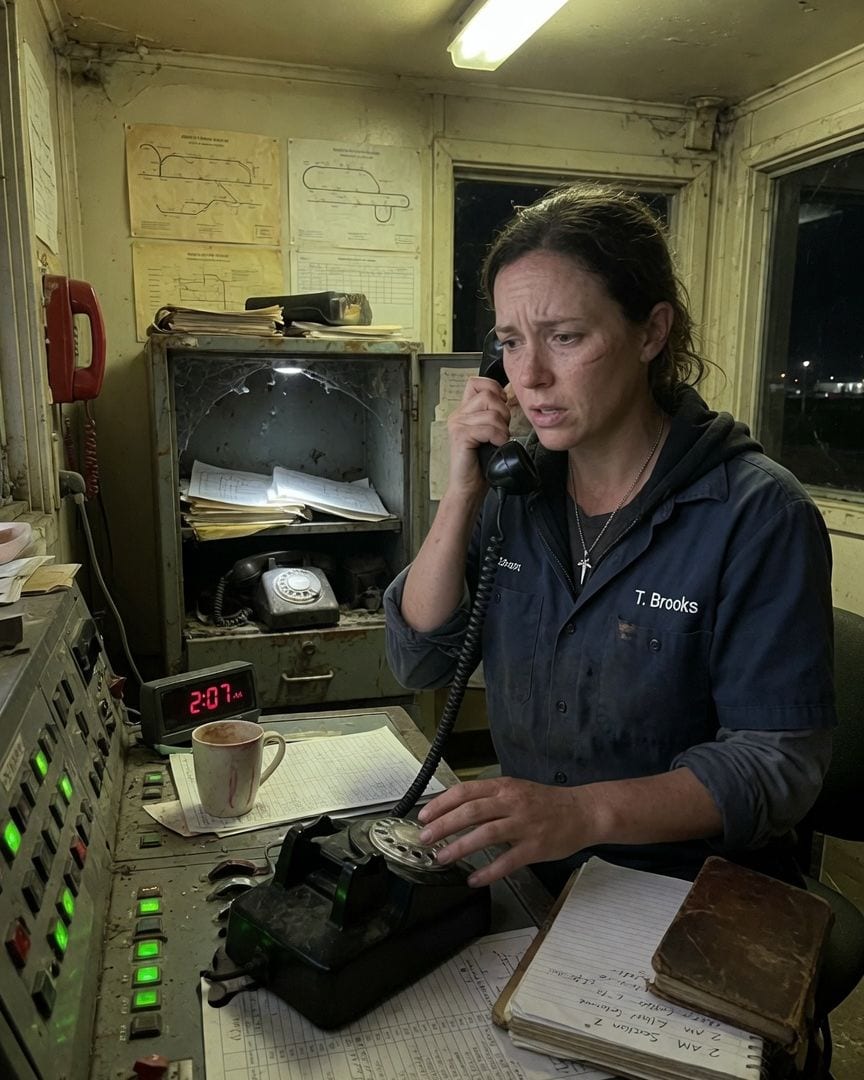
My signal box gets a 2 AM call every night from a man whose section was demolished eleven years ago. Now I found his logbook with today's date.
My night shift at the signal box is quiet and precise, defined by the routine 2 AM call from Ellis confirming Section 7 is clear. But when I asked my duty manager to log it, he said Section 7 hasn't had a track walker in eleven years, not since its cabin and phone were demolished.
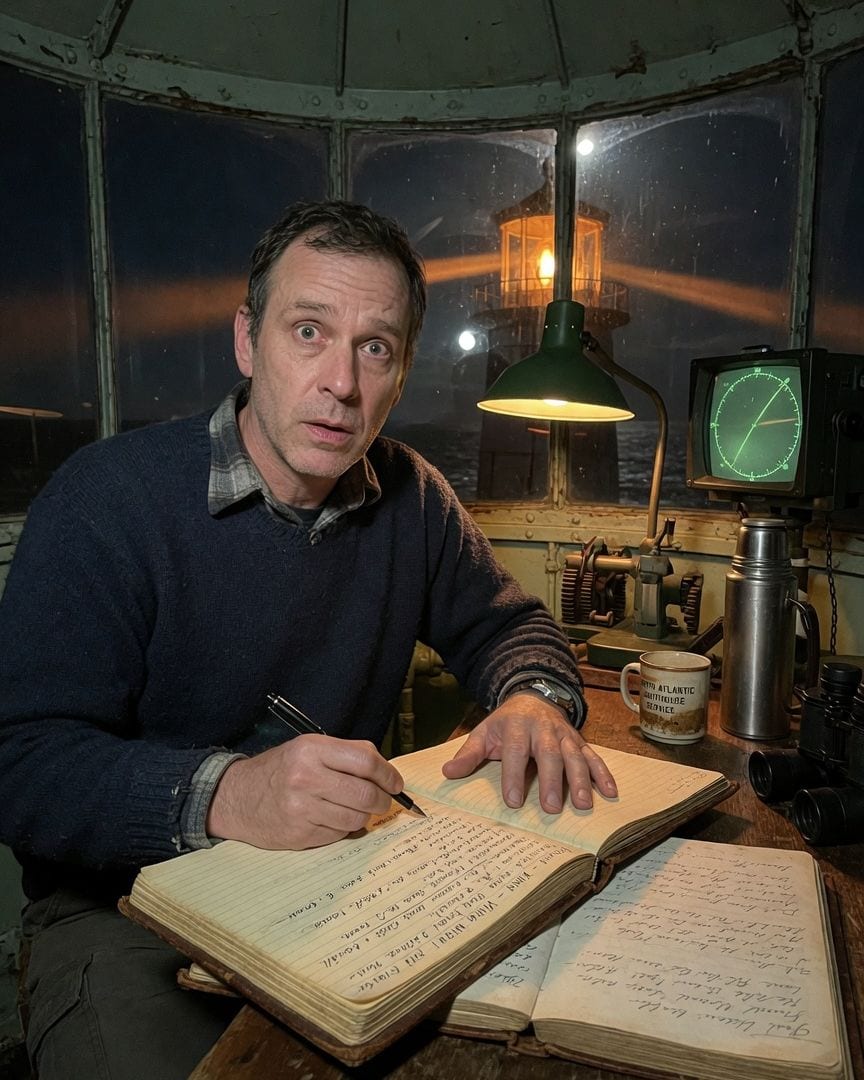
My lighthouse log has my own 3 AM entry for a phantom ship. I was alone in the tower, and I wrote no such thing.
Perched in the lantern room for my usual 2-6 AM watch, I reached for the thick logbook. But the 3:00 AM entry, under my own name, detailed a vessel I never saw. The words were in my own ink, yet I had never written them.
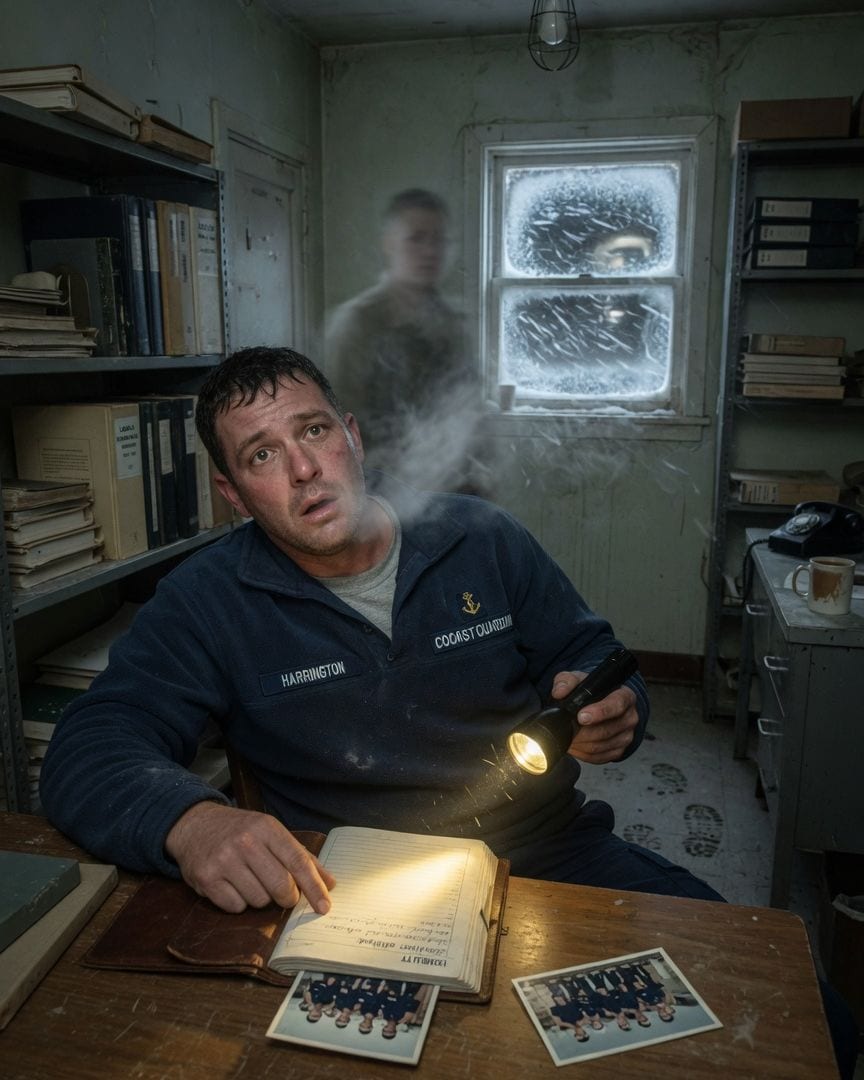
Coast Guardsman Victor Harrington was alone, but his own log entry read: 'Visitor arrived. Not yet departed.' The ink was wet.
Coast Guardsman Victor Harrington endured the nor'easter's crushing weight against the remote LORAN station's windows during his last lonely watch. Exhaustion claimed him for an hour, but when he jolted awake, the station's logbook held a chilling surprise: his own handwriting recorded, '0300. Visitor arrived. Not yet departed.' The ink was still glistening wet, and soon after, Victor discovered fresh, wet boot prints across the floor — not his, and leading to a dead end with no sign of entry. Every door remained locked, every window unbroken, yet the prints had simply materialized, leaving the guardsman with a suffocating sense of impossible dread. Who or what had left its mark in a sealed, storm-battered station, and how?
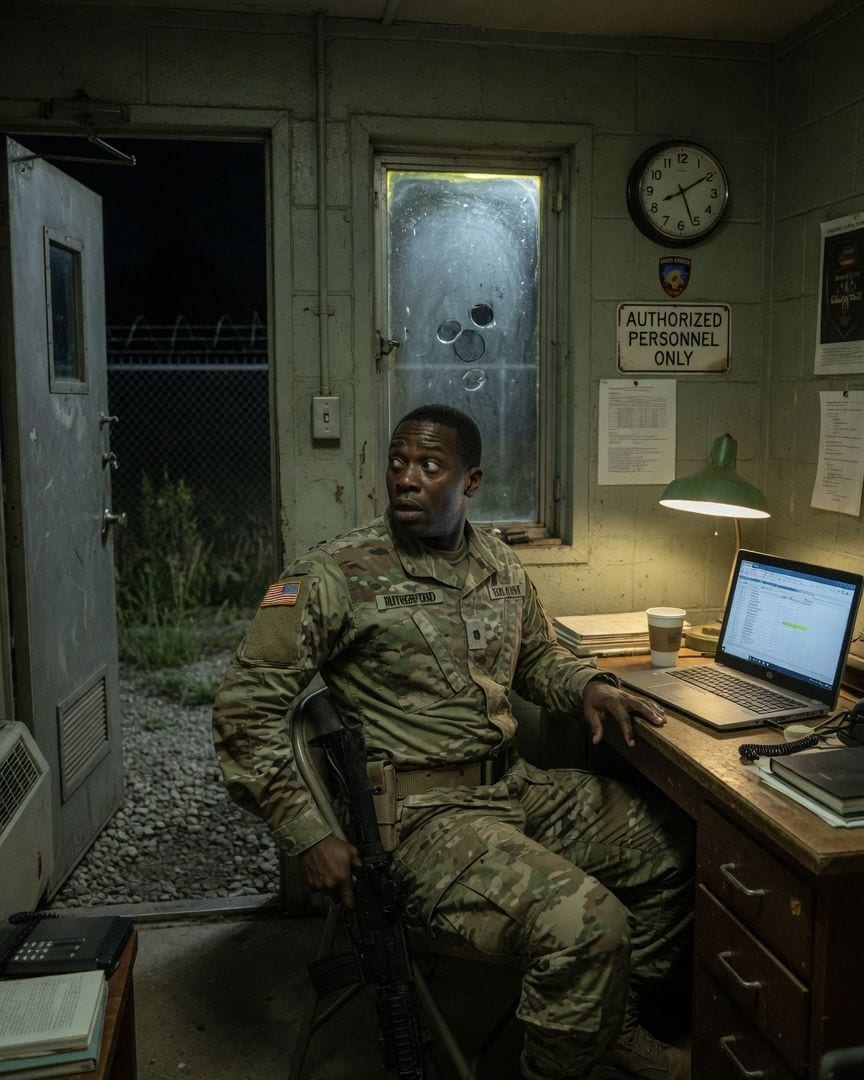
Fort Vashon's lone guard heard precise knocks on her window, then felt them from *inside* the locked shack.
Staff Sergeant Julian Rutherford felt an unsettling quiet at Fort Vashon's back gate, replacing a guard who reported strange knocks. He discovered an extra name on the digital duty roster that kept reappearing after deletion, a cold digital ghost. His search through decades of archived logs revealed a persistent anomaly: an unassigned slot, always present on short-staffed shifts. Then, in a forgotten supply shed, he unearthed an old journal detailing similar knocks and shadows, and one entry describing a guard hearing his own name called from the dark. What invisible presence haunted the fort's lonely gate?
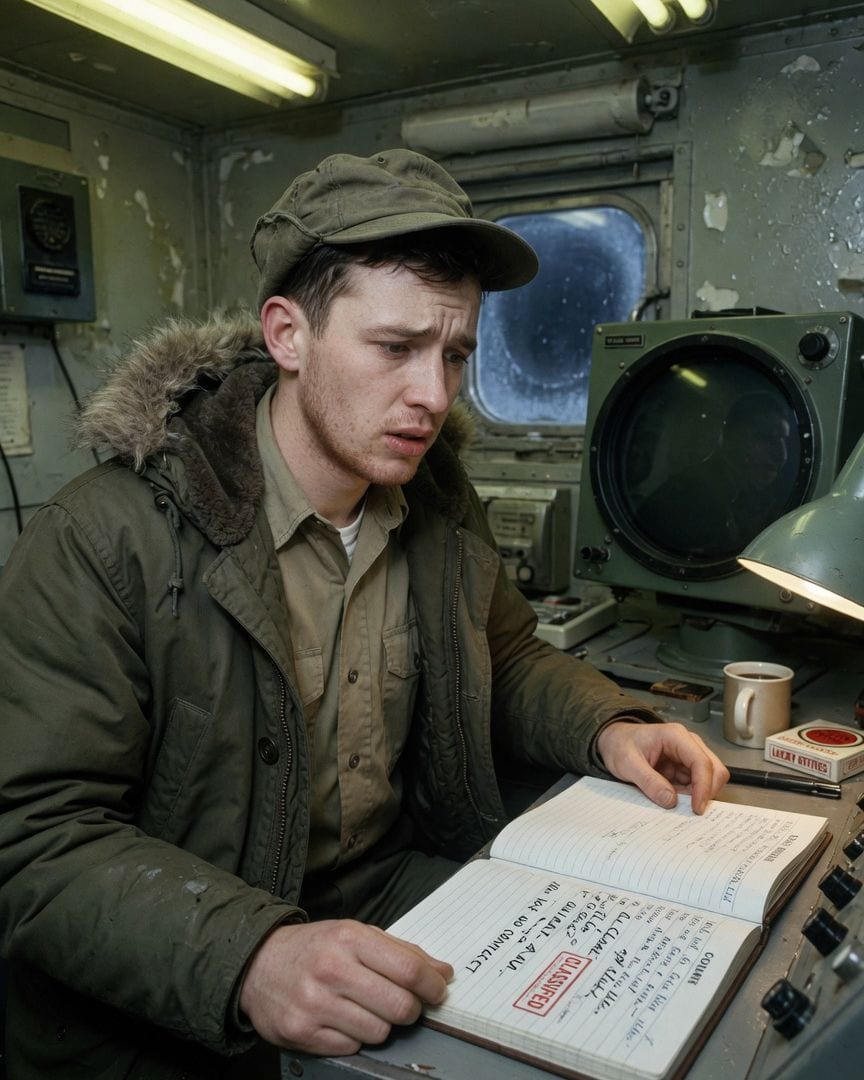
A Cold War airman logs an impossible radar contact on his last sweep. But his official logbook entry is stamped 'CLASSIFIED' and then contradicted by a hastily scrawled 'ALL CLEAR' dated moments before it.
Airman Ordway Vance, 22, manned the radar dome at Site Pellin in the biting North Atlantic dark of January 1962, running the last calibration sweep before its decommissioning. His scope picked up a faint, impossible return, growing closer with each pass, though the ocean remained empty to the eye. When Vance detailed the contact in his official logbook, a 'CLASSIFIED' stamp appeared, followed by a hastily scrawled 'ALL CLEAR' dated moments before his own entry, contradicting his every word. Commander Hartley dismissed it as equipment malfunction, but Vance sensed a chilling, official erasure behind the lie. He soon found a locked cabinet marked 'SITE PELLIN ANOMALIES,' hinting at a deeper truth buried within the base's final days.
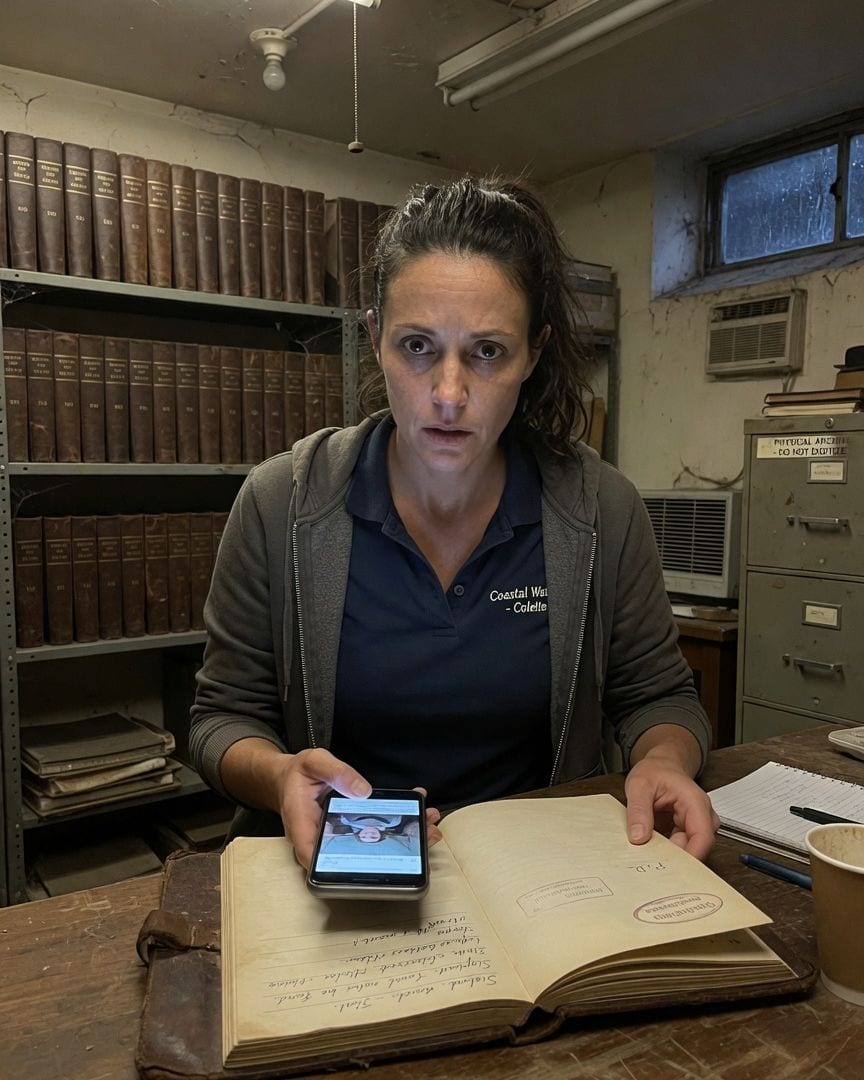
My coastguard log noted Sighting 9 again tonight, a light where no vessel showed. The old logs carry Sighting 9 off Skerry Point at 3:14am every tenth year since 1954, always 'nothing found,' always 'send no boat.'
On my watchtower night shift, the radar screen glowed green and the ocean was quiet. Then, a familiar light appeared off Skerry Point, exactly on cue, just as it had every tenth year for decades. But digging deeper, I found a hidden stamp in an old logbook: 'Operation Skerry. Status: Complete.' It left me with a chilling sense of finality.