Retired Sergeant Odis Trumbull found a reunion guest book signed by a dead man. His service number was for a classified unit, not his own.
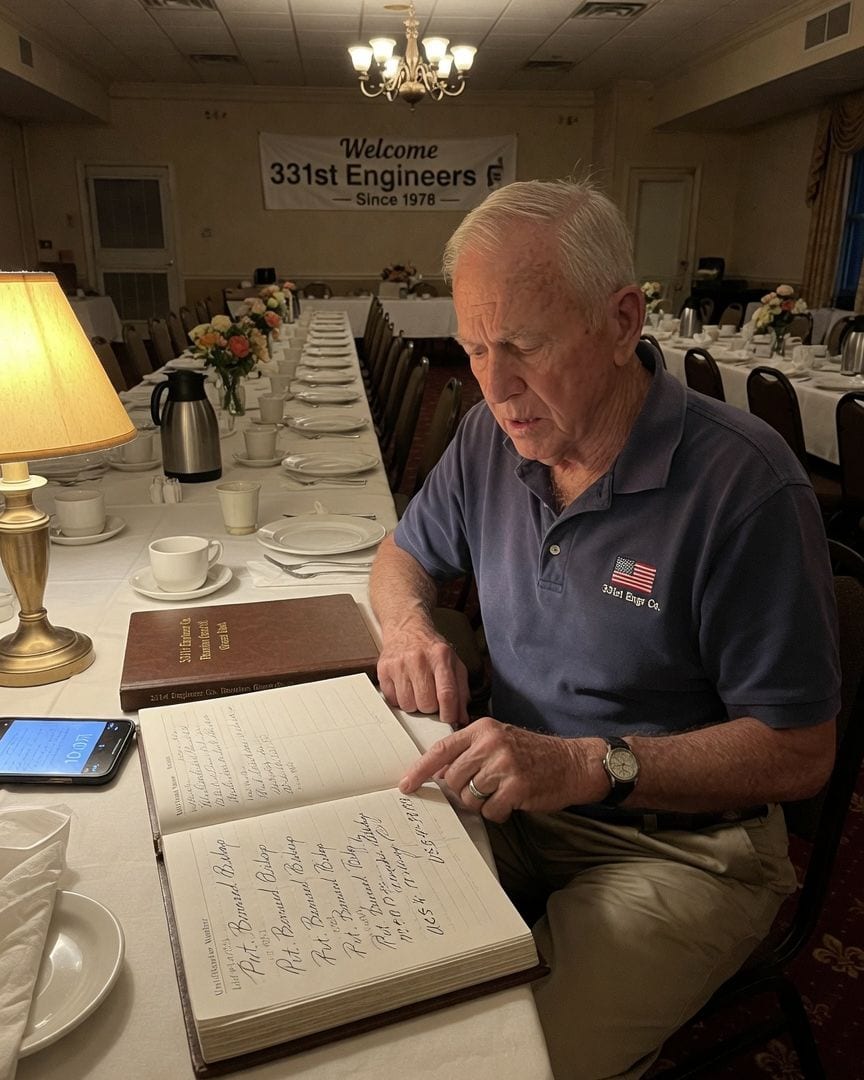
Retired Sergeant Odis Trumbull walked into the Magnolia Ballroom of the Biloxi Grand Hotel, the scent of stale linens and lukewarm coffee filling the air. It was October, the 331st Engineer Company's annual reunion, a tradition since 1978.
The banquet staff, efficient as ever, had set thirty-one places at the long, linen-draped tables, just as the association's rolls dictated. Odis, a man of precise habits, arrived at six, alone, and found his usual seat.
He sat until nine, watching the empty chairs. He had personally attended every funeral on that list – thirty of them, over forty-four years, the last one for Private First Class David Larsen just this past March.
At ten, a smiling front desk clerk approached, handing him the heavy, leather-bound guest book. Odis took it, his fingers tracing the embossed '331st Engineer Co.' on the cover. He opened it.
Thirty-one people had signed in, in thirty-one different hands, and the ink on the very last one had not dried.
Odis's gaze lingered on the fresh signature. 'Pvt. Bernard Bishop,' it read, in a neat, almost too-perfect script. Below it, a service number: 'US54-321-098.'
Bernard Bishop had died in a training accident in 1976, two years before the reunion even began. Odis had carried his coffin.
He ran a thumb over the still-wet ink, a shiver running down his spine that had nothing to do with the hotel's overactive air conditioning. He flipped through the book, examining other pages.
The signatures were all there, familiar names from his company, many of them long dead. But some, like Bishop's, felt less like personal handwriting and more like a carefully replicated stamp.
He also noticed an additional column, not usually present in a social guest book: 'Unit/Service Number.' It was a detail only a military man would notice, and it struck him as profoundly out of place.
He remembered Bishop's actual service number, etched into his memory from the casualty reports. It started with 'US24,' not 'US54.'
The 'US54' prefix, he recalled from his time in records management, was typically assigned to specialized, highly classified commands, not a standard engineering company.
He tried to rationalize it – a clerical error, a new system, a joke by a younger clerk. But the wet ink, the wrong service number, the unnatural precision of the signature, it all coalesced into a cold, undeniable wrongness.
Odis, his heart thumping, pulled out his phone and snapped a photo of the page with Bernard Bishop's signature and the impossible service number. Back in his room, unable to shake the unease, he spent hours online.
He started with the 'US54' prefix, then cross-referenced it with 'classified commands' and 'personnel transfers.' He sifted through layers of redacted documents and obscure forums until, just before dawn, he found it.
A partially declassified document, a roster from a highly secure facility, detailing personnel movements. The document was grainy, clearly old, but legible. And there, listed under a section labeled 'Project CHRONOS,' was 'BISHOP, BERNARD E.' with the service number 'US54-321-098.'
The transfer date listed was April 12, 1978 – two years after Bernard Bishop's funeral. The document itself was watermarked 'PROJECT CHRONOS.'
Odis stared at the screen, the impossible date burning into his mind, the implication of it all a cold, sickening grip around his chest.
The next day, Odis, fueled by black coffee and a growing obsession, made calls. He reached out to Franklin Galloway, another retired sergeant from the 331st, a man Odis trusted.
Franklin, however, was hesitant, his voice tight with an unspoken anxiety. When Odis mentioned 'Project CHRONOS' and Bernard Bishop's name, Franklin quickly changed the subject, muttering about 'letting sleeping dogs lie' and 'some things are better left buried.'
His evasion only intensified Odis's resolve.
Unable to get a straight answer, Odis decided on a more direct approach. He drove to a regional military records office, feigning interest in compiling his own service history for a memoir.
There, he navigated the labyrinthine archives, subtly trying to gain access to restricted sections. He met Sophia Bishop, a sharp, efficient records clerk in her mid-thirties, who, despite her youth, had an encyclopedic knowledge of the filing system.
Odis, using his veteran charm, managed to get Sophia to help him locate an obscure index for 'historical classified projects.'
As she pulled up the digital index, Odis caught glimpses of 'CHRONOS' appearing multiple times, associated with terms like 'missing personnel,' 'reclassification,' and 'transferred to deep cover' across different decades and branches of service.
It wasn't an isolated incident; it was a sprawling, systemic operation. The unease in Odis deepened, solidifying into a specific, tangible dread.
As Odis left the records office, the afternoon sun glinting off the polished glass doors, he noticed a dark sedan, nondescript and clean, parked across the street.
He didn't think much of it until he saw it again, hours later, outside his Biloxi hotel, idling in the shadows of the parking lot. A cold knot tightened in his stomach. Someone was watching him.
He tried to dismiss it as paranoia, but the feeling persisted.
Later that evening, an anonymous email landed in his inbox. The sender was untraceable, the subject line blank. He opened it with a trembling finger. Attached was a single image: a grainy, black-and-white photograph from 1974.
It showed a remote desert landscape, an unidentifiable, disc-shaped object half-buried in the sand, surrounded by military personnel in period uniforms.
The caption was heavily redacted, but the visible coordinates matched a training ground where the 331st Engineer Company had been deployed that year. Odis recognized the uniform patterns, the distinctive heavy equipment.
He felt a chilling certainty that settled deep in his bones. This wasn't just a random photo; it was a warning.
Someone knew exactly what he was looking for, and they were showing him a piece of the puzzle he wasn't supposed to see, reminding him of the true scale of the 'filing' he was uncovering.
Odis drove directly to Franklin Galloway's house, the grainy photo clutched in one hand, the guest book in the other. He laid them both on Franklin's kitchen table. "Franklin," Odis began, his voice low, "I found this.
And I found Bernard Bishop's name in a file dated 1978, with a service number that doesn't exist for him." Franklin's face, usually ruddy, went pale. He picked up the photo, his fingers tracing the outline of the crashed object.
"God almighty," he whispered, his voice barely audible. "I hoped I'd never see this again."
Odis pressed him, demanding answers. Franklin, visibly shaken, finally broke. He confirmed that in 1974, the 331st had been deployed not for a training exercise, but to a crash site.
"It wasn't a plane," Franklin said, his eyes wide with a distant horror. "It was… a thing. Silent. Too big. Not ours." He described the immediate, overwhelming classification, the arrival of unmarked vehicles, the men in dark suits.
"A few of the boys went inside," Franklin continued, his voice cracking. "Bernard was one of 'em. They never came out the same. Or they just… didn't come out. Officially, they were transferred. Or KIA in some 'unrelated' incident.
Lies, all of it." Franklin confirmed that Bernard Bishop was one of the men 'transferred' to Project CHRONOS. "The reunion," Franklin said, a new, terrible understanding dawning in his eyes, "it wasn't just for us. It was for them.
To keep track. To see who was still… unfiled." He looked at the guest book with revulsion. "The signatures. They're not from the living, Odis. They're… confirmation. A formality.
And now," Franklin's voice dropped to a terrified whisper, "you're on their list. You're unfiled, and they know you're looking. They'll come for you, Odis. They'll file you." The words hung in the air, chilling Odis to the bone.
The seemingly innocuous guest book, the impossible signatures, the strange service numbers – it all snapped into a horrifying, coherent picture.
Odis tried to process Franklin's confession, the truth of the 'secrecy machine' chilling him to his core. He understood now that the reunion was a grotesque census, a way for the institution to track its 'assets.'
He thanked Franklin, his mind racing, and drove back to his hotel. He pulled up the declassified roster he'd found online, the one with Bernard Bishop's name and the impossible transfer date.
He scrolled past Bishop's entry, past other names from various, vaguely described 'Projects,' each with a 'transfer' or 'reclassification' status. He saw names from other units, other branches, other decades – a chilling pattern of disappearances and reassignments.
The scale of it was immense, far beyond just his company. His fingers, almost independently, scrolled further down the list. He saw names he didn't recognize, then a block of entries under a 'Project CHRONOS' file dated 1974.
And there, among them, his breath caught in his throat. It was his own name: 'TRUMBULL, ODIS J. - SERVICE NO. [his actual service number] - STATUS: PENDING.' His service number. His name.
In a file from nearly fifty years ago, long before he was ever supposed to be 'pending.' He stared at the screen, a suffocating realization washing over him. The reunion wasn't just checking in on the survivors.
It was checking in on him. He wasn't a witness; he was a target. He was already on the list, and his 'filing' was imminent.
The full, horrifying truth detonated in Odis's mind. He wasn't just investigating a mystery; he was caught in a decades-old net.
He was supposed to have been 'filed' back in 1974, a survivor of the crash site incident who, through some bureaucratic oversight or stroke of luck, had slipped through the cracks.
The 'secrecy machine' was not just patient; it was infinitely persistent, its records meticulously maintained, its processes spanning generations.
The reunion, he now understood, was a sophisticated, low-profile mechanism to identify any remaining 'unfiled' personnel, to bring their records up to date.
The guest book was not a sentimental keepsake; it was a live ledger, a registry for the 'filed.'
The signatures, perfect and precise, weren't from ghosts; they were institutional marks, administrative confirmations that a life had been absorbed, re-written, converted into paperwork.
The wet ink on Bernard Bishop's signature wasn't a sign of a recent arrival; it was the chilling proof of a recent 'filing,' a life administratively erased and updated in the system.
The 'Thing on the Scope' wasn't just a UFO; it was an event that opened a doorway for this bureaucratic absorption, turning human lives into data points. Odis was next.
The pattern was horribly clear, every clue, every strange detail, clicking into place with a dreadful, mechanical precision. The horror wasn't what they were, but what they did: erase you without a trace, and then record it in triplicate.
Odis knew he had to act, and fast. He couldn't fight the 'secrecy machine,' but he could try to escape its immediate grasp and expose its methods. He called Sophia Bishop at the records office, his voice strained but calm.
"Sophia, I need your help. I've uncovered massive discrepancies in old classified files related to Project CHRONOS, and I have reason to believe these documents are about to be 'updated' or 'disappeared'."
He didn't explain the full horror, just the urgency. He directed her to specific archived microfiches and digital logs, including the one with his 'PENDING' status.
He gave her precise instructions: copy everything, encrypt it, and send it to an anonymous dead drop he'd set up online.
"If you don't hear from me in 24 hours," he instructed, "send this pre-written message to the journalist contact I'm about to email you. Tell them to look for 'Project CHRONOS' and 'reunion files'."
Sophia, though clearly confused, sensed the gravity in his voice and agreed.
Odis then checked out of his hotel, leaving no forwarding address, no trace. He abandoned his phone and credit cards, paid cash for a bus ticket heading west, and began a desperate journey to become as 'unfiled' as possible.
He knew this wasn't an escape from the truth, but a desperate flight from its consequences. He clutched a small, encrypted USB drive, the only physical proof he carried, containing the files Sophia had sent.
He knew the 'secrecy machine' was vast, patient, and methodical, and it would eventually find him. But he would make it harder for them. He would carry the proof, even if no one would ever believe it.
Weeks blurred into a relentless cycle of cheap motels, greasy diners, and constant vigilance. Odis lived off the grid, a ghost in his own country, using only cash, avoiding any digital footprint.
The life he had known was gone, replaced by a permanent, gnawing paranoia. He tried to contact the journalist, but the fragmented files, while damning, were too fantastic, too easily dismissed as the ravings of an old man.
Sophia Bishop, back at the records office, found her access to the 'Chronos' files mysteriously revoked. A new, locked cabinet appeared in the restricted archive, its label blank, radiating an unsettling, official silence.
The system had closed ranks, absorbing the disturbance without a ripple.
Odis sat in a rented room in a small, nameless town, the anonymous burner phone heavy in his hand. He opened a new, anonymous email account, his fingers hovering over the keyboard.
He drafted a message to Sophia, just to let her know he was okay, to thank her. Before he could send it, an incoming email notification popped up. The sender was anonymous. The subject line was blank. He opened it.
The body of the email contained a single attachment: a scanned image of his own service record, updated just yesterday, with his status changed from 'PENDING' to 'FILED.'
Days later, a records clerk at a remote, off-site storage facility noticed a new entry in a rarely accessed digital ledger.
The entry was for a Sergeant Odis J. Trumbull, his status updated from 'Pending' to 'Filed' on a specific date. The clerk, a young woman named Laura Bishop, noted the change, then moved on to the next task.
The file was still being signed.
If this one got to you
On his final project before retirement, a lineage historian found 41 soldiers buried in 1955 with no death dates. He then found their Cold War transfer order, dated *after* the burial.
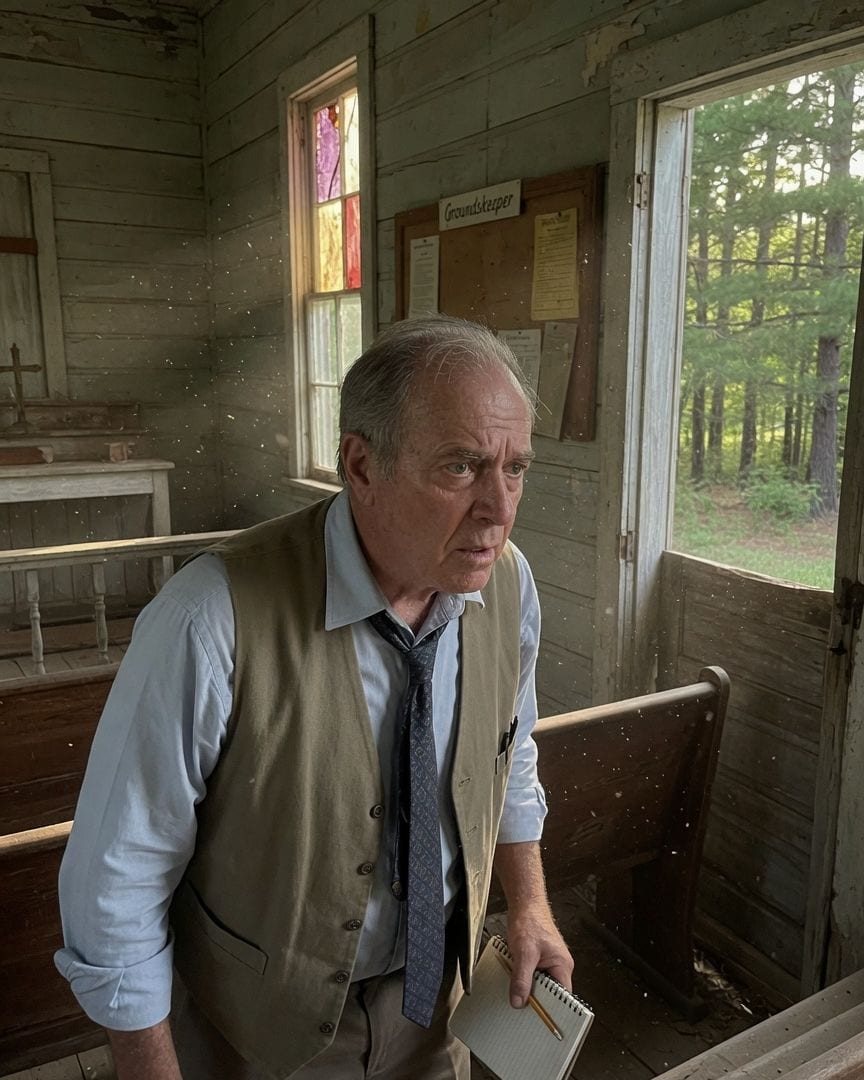
Owen Sarkis, a lineage historian nearing retirement, sought to close his career with one final, simple project: resolving the mystery of the phantom 250th Chemical Company. His search led him deep into a Carolina pine forest, to an isolated chapel with a meticulously mowed plot. Forty-one headstones stood in neat rows, each bearing a name and regimental number, but beneath every name, the dates of birth and death were unsettlingly blank. The local groundskeeper hinted the men "just… left," and Owen found their names on no military lists after 1955; their lives seemed erased. But the true shock came with a "TOP SECRET" military transfer order, listing all 41 men from the chapel, ordered to a non-existent facility *two weeks after* their supposed burial. What really happened to the 250th Chemical Company?
Specialist Cole's cemetery logbook showed a dead Cold War soldier's fresh signature. Then he signed into the base itself.
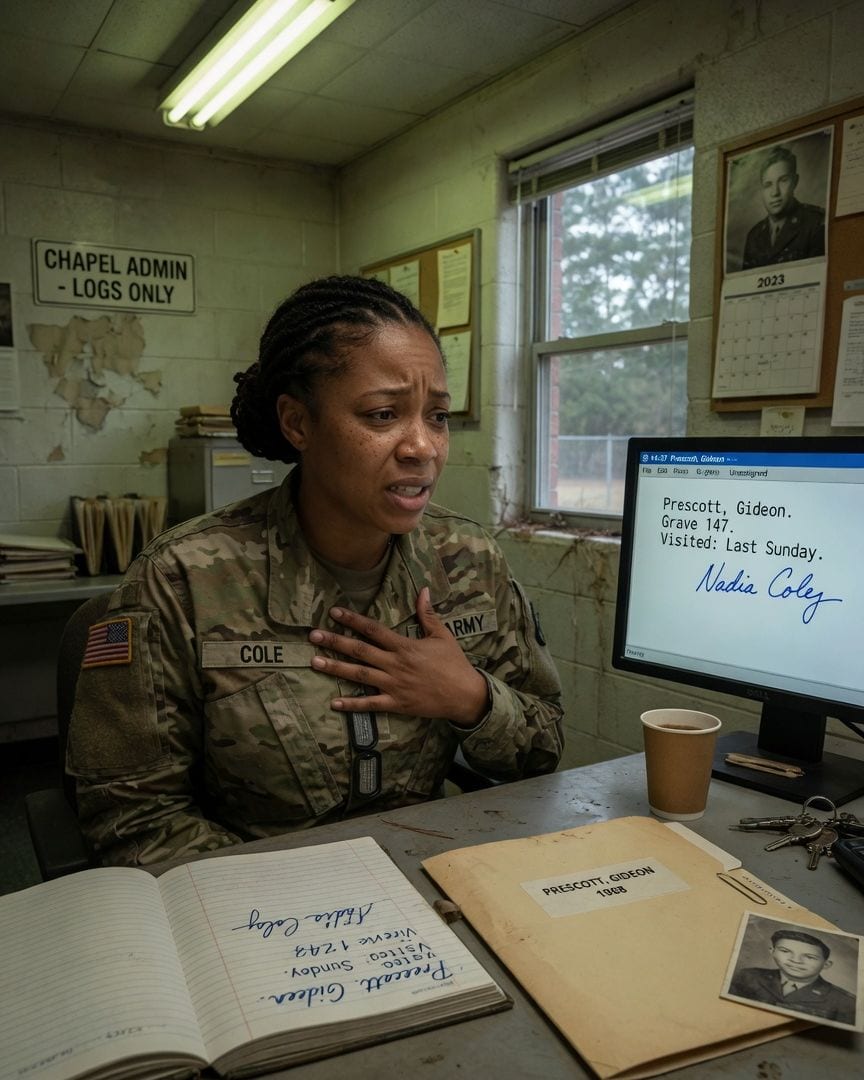
Specialist Nadia Cole hated her quiet Sunday shifts in the base chapel office, where her main duty was maintaining the cemetery visitor log. One peaceful afternoon, she found a fresh, dark blue entry for Private Gideon Prescott, a soldier who had died in 1968. His signature, identical to his decades-old enlistment papers, stopped her cold. Despite her superior's dismissal, Cole's dread deepened when she discovered the same impossible signature, belonging to the dead man, had also logged into the main base access system just hours later. The digital record glowed with an undeniable, chilling impossibility.
Corporal Aldous Sutton found his own name, rank, and call sign in a 1987 logbook from his exact outpost, decades before he was born.
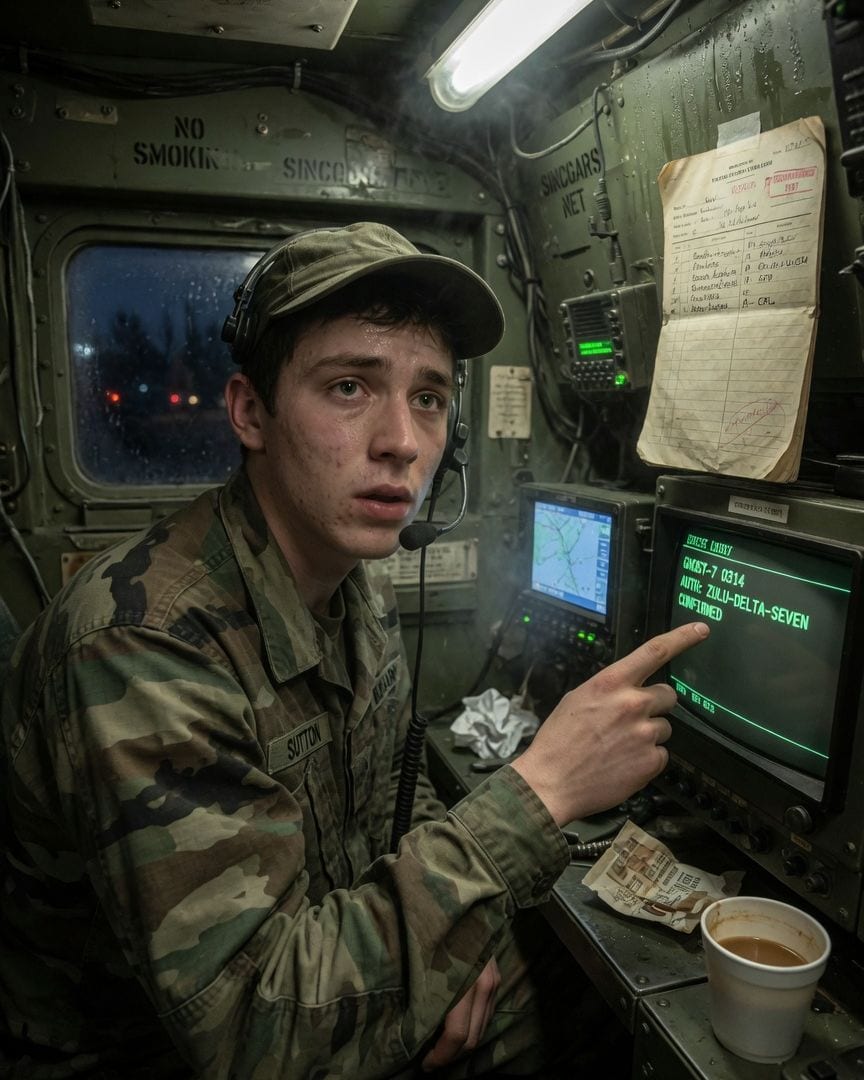
Corporal Aldous Sutton, 22, was hunched in his cramped comms track, the air thick with stale coffee, monitoring a quiet German night. The division exercise outside was routine, all units accounted for, until an unknown call sign crackled through his headset. 'Ghost-7' requested authentication using a protocol decommissioned years before Aldous was even born. Despite his superior dismissing it as a glitch, Aldous found official logs confirming the impossible exchange, even dating his own hesitant responses. But the real dread landed when he cross-referenced the phantom unit and discovered his own name, rank, and call sign listed in a 1987 logbook, attached to 'Ghost-7' at his exact outpost.
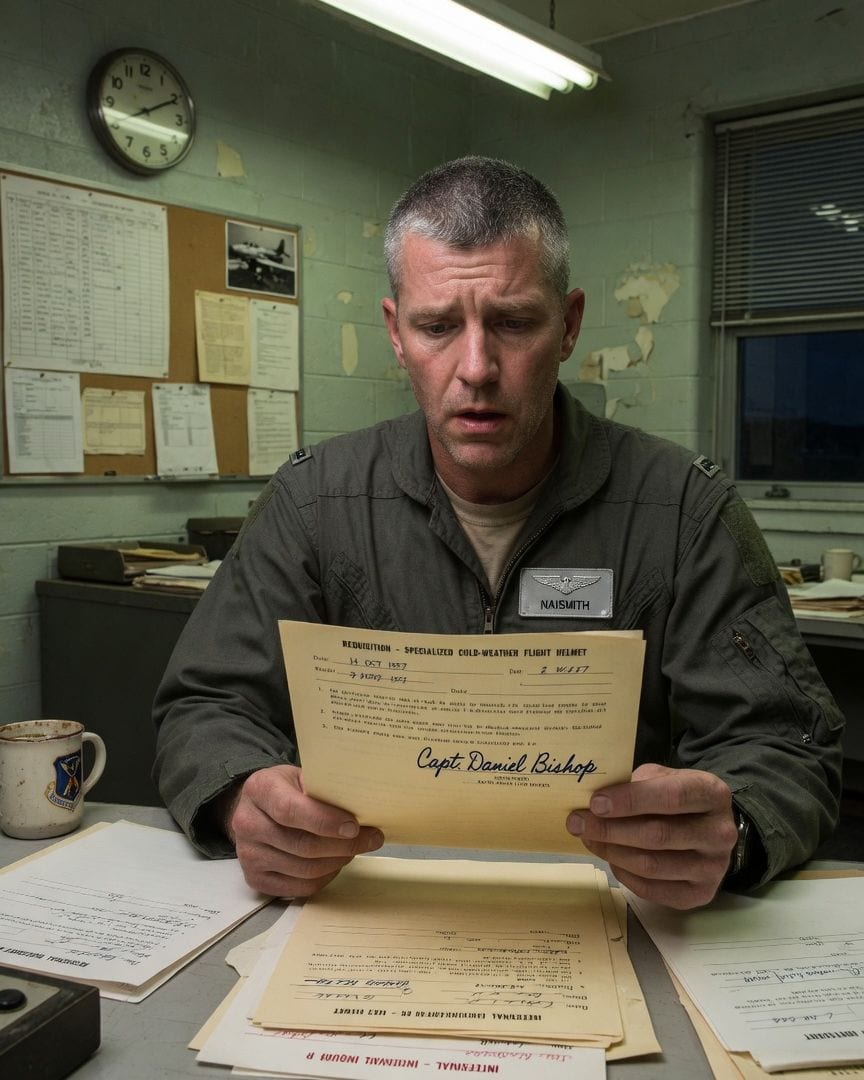
A Cold War Colonel reviews a missing pilot's file and finds Captain Bishop's signature on a form dated weeks after he vanished.
Colonel Ward Naismith faced the grim task of reviewing Captain Daniel Bishop’s personnel file, a routine chore for a man listed as Missing in Action. Bishop had vanished days after he and Naismith chased an impossible, silent disc over Lake Superior, leaving only an empty patch of air and a knot of unease in Ward's gut. Sifting through commendations, Ward found a requisition for flight gear and a maintenance sign-off, both dated *after* Bishop’s disappearance. The true chill came with the requisition for a specialized flight helmet, bearing Captain Bishop’s unmistakable signature, weeks after he was presumed lost. How could a man presumed lost have signed anything?
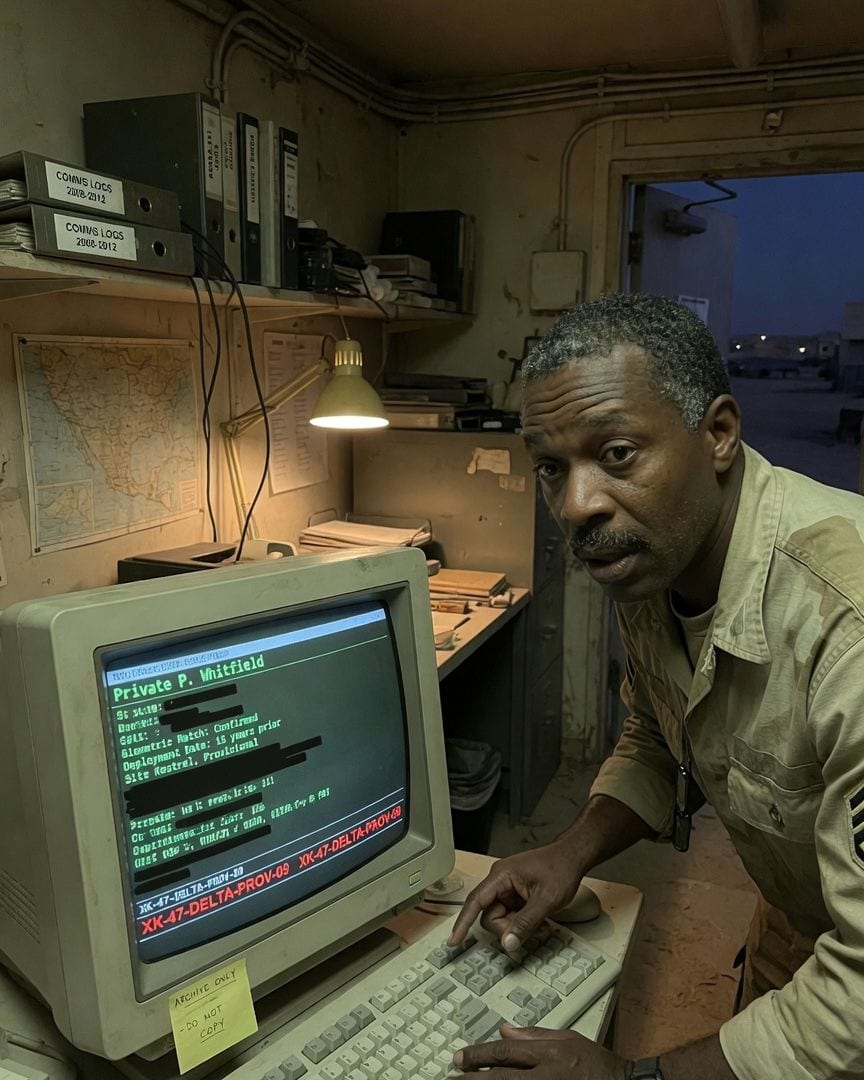
Sergeant Bishop's corporal was logged in two places at once — and deployed fifteen years before their base existed.
Sergeant Isaac Bishop yearned to clear his desk, just three weeks from finally going home from the FOS Kestrel. The low thrum of the base's servers was as constant as the desert wind, but a new anomaly hummed louder in his mind. Chow hall footage showed Corporal Patrick Whitfield in the serving line at 0530 for two weeks straight, yet Bishop's own comms logs confirmed Whitfield was simultaneously on patrol a kilometer away. As Bishop dug deeper, cross-referencing every roster and log, he found no errors, no pranks; instead, an archived service record for a "Private P. Whitfield" emerged, matching the corporal's biometrics and dating his deployment fifteen years ago to "Site Kestrel, Provisional"—a full decade before the FOS Kestrel officially existed.
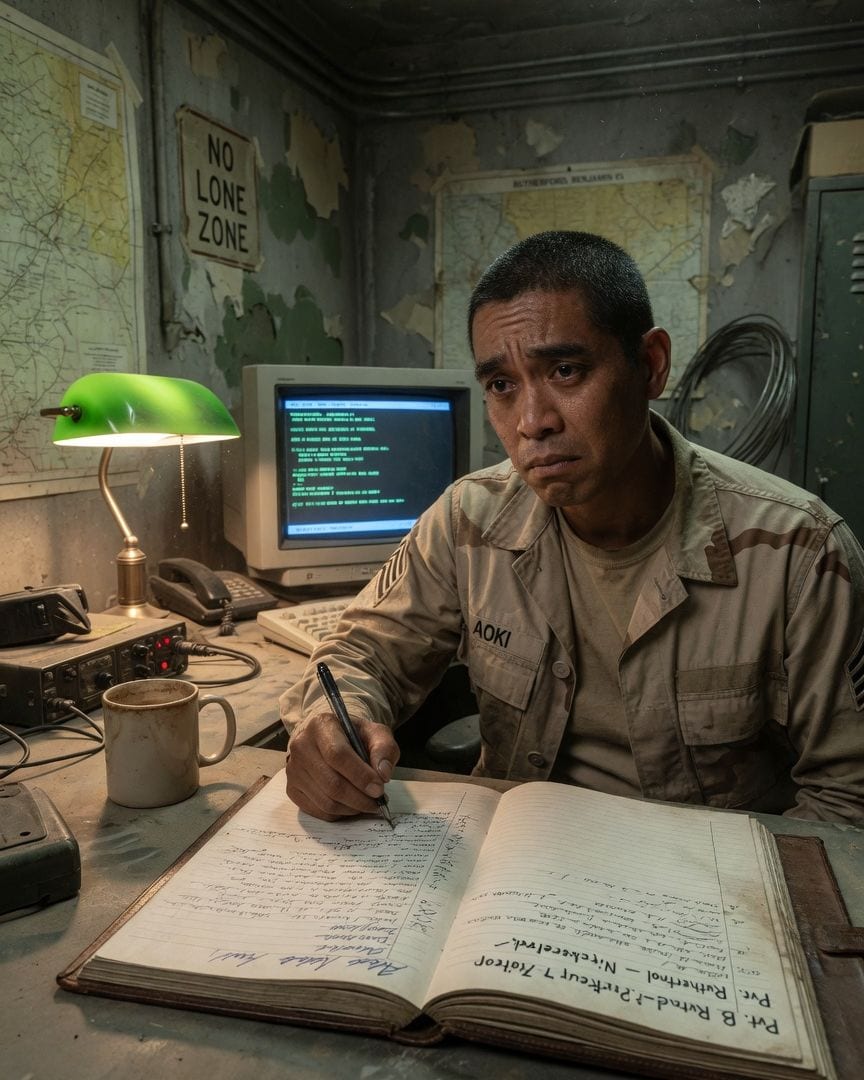
Sergeant Aoki's four-man patrol hears a fifth voice answer their count. A fresh name then appears in the duty log beneath his own signature.
Sergeant Isaac Aoki's final rotation at Outpost 7 was nearing its end, with relief due at dawn. On his four-man night patrol, he broke an old superstition, counting his team aloud in the dust-choked desert. A fifth voice answered, clear and unsettling, from the moonless dark. Back inside the bunker, the chill deepened when a fresh name appeared in the duty log, 'Pvt. B. Rutherford,' beneath Aoki's own signature, a soldier no one knew. Even more disturbing, Aoki later found his own signature on a valor citation for Rutherford, an event he never witnessed.