On his final project before retirement, a lineage historian found 41 soldiers buried in 1955 with no death dates. He then found their Cold War transfer order, dated *after* the burial.
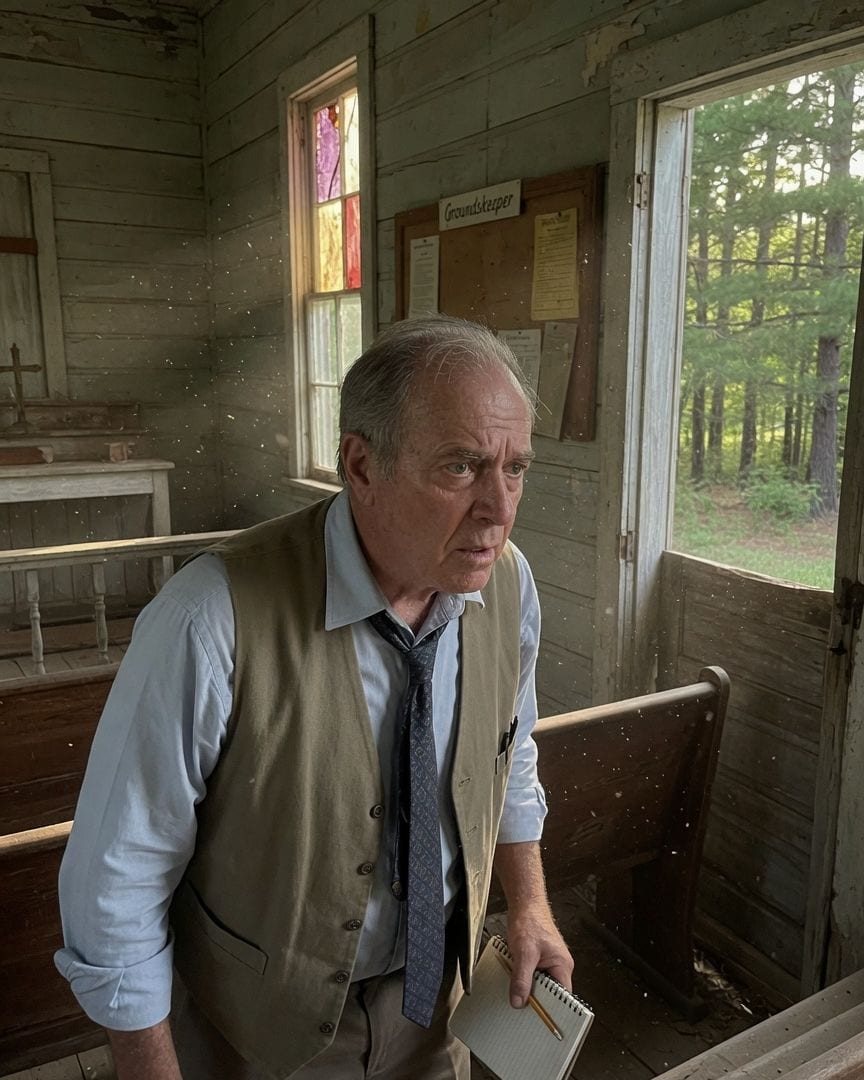
Owen Sarkis, a lineage historian on the cusp of retirement, found himself in a Carolina county courthouse, dust motes dancing in the afternoon light. His final, supposedly simple project: resolve the phantom 250th Chemical Company.
It had appeared once, in a 1955 parade program, then vanished from history.
The courthouse records yielded a partial answer: the company had leased forty acres of remote land outside town, paid property taxes for two years, and even hired a handful of local men.
The final entry was a grim ledger notation: 'Interment of Company Personnel, Chapel Grounds'. This led Owen to a small, isolated chapel, its paint peeling, deep within a pine forest. Behind it, a meticulously mowed plot.
Forty-one headstones stood in neat rows. Owen walked among them, the silence broken only by the chirping of unseen insects. Each stone bore a name – private, corporal, sergeant – and a regimental number.
But beneath every name, where the dates of birth and death should have been, there was only blank, uncarved stone. Forty-one names, forty-one men, no dates of death.
Owen found Joseph Hale, the groundskeeper, trimming hedges near the chapel. Hale was a wiry man in his late eighties, his movements slow but precise. Owen introduced himself, explaining his genealogical research.
Hale listened, his eyes sharp, then nodded towards the graves. "They're always kept tidy," he rasped, "been that way since before I took over from my daddy." Owen asked about the lack of dates. Hale shrugged. "Never were any.
Just the names. Folks around here say they just… left. Or went where nobody could follow." Owen pressed, asking about who paid for the upkeep. Hale paused, then lowered his clippers. "A man. Comes every month, like clockwork. Cash.
Always asks if anyone’s been around, asking questions. Says his name is Mr. Drummond." Owen noted the name, a prickle of unease touching him.
Later, back in the courthouse, Owen cross-referenced "250th Chemical Company" with military archives, seeking any record of the 41 men. He found none. Their names didn't appear on any casualty lists, nor any transfer rosters.
It was as if they never existed, save for the headstones and a single parade program entry. It wasn't just that their deaths weren't recorded; their lives after 1955 seemed to have been erased.
Eleanor Carter, a sharp-eyed records clerk in her seventies, took pity on Owen. She’d worked in that courthouse for fifty years. "Some things," she mused, her voice raspy, "they don't want you to find in the main stacks."
She pointed him to a dusty, unlabeled box in an obscure corner of the archives, marked simply "Local Land Use - Special Projects."
Buried beneath decades of faded zoning permits, Owen found it: a brittle, yellowed document, stamped "TOP SECRET - PROJECT ECHO - SITE 3." It was a military transfer order, dated two weeks after the 41 men were supposedly buried.
Every name from the headstones was there, listed as "transferred." Owen stared at the faded, official stamp on the transfer order, confirming the date: two weeks after the 41 men were supposedly buried.
The names matched, every single one, ordered to a facility that never existed. The implication, cold and undeniable, settled over him like grave dirt.
The transfer order became Owen’s obsession. He tried to find "Project ECHO, Site 3" through every available channel—military historians, declassified intelligence archives, even obscure academic papers on Cold War black sites. It was a ghost.
Yet, the order was undeniably real, signed by a Colonel Franklin Drummond. The same Drummond mentioned by Hale. Owen drove back to the chapel, finding Hale tending a rose bush, the shears clipping the air with a soft snick.
"Mr. Hale," Owen began, "the man who pays you. Mr. Drummond. Do you know where I can find him?" Hale stiffened, pruning shears freezing mid-snip, a single rose petal fluttering to the ground.
"He doesn't have a fixed address, not really. Sends the money by post, sometimes drops it off in person. Always in a black car." Hale's eyes, usually placid, held a flicker of something close to fear.
"He's particular about this place. Very particular." Owen pressed, asking if Drummond ever spoke about the men. Hale shook his head, looking away. "Just that they were… important. And that some things are better left undisturbed."
Owen spent days tracing the postmarks on money orders Hale had saved, leading him to a small, nondescript post office box in a neighboring town.
He rented a room in a motel there, staking out the post office, hoping to catch Drummond. The unease deepened.
On the third morning of his stakeout, Owen saw him. An elderly man, impeccably dressed in a dark suit despite the Carolina heat, collected mail from the box Owen was watching.
His posture was ramrod straight, his silver hair neatly combed. This had to be Franklin Drummond. Owen watched him drive away in a gleaming black sedan, discreetly following.
The car led him not to a residence, but to a quiet, isolated research facility, its entrance guarded by a single, uniformed security officer. The facility bore no name, only a discreet emblem: a stylized, interlocking circle.
Owen parked a distance away, trying to appear casual. As he watched, the security officer, a young woman, turned her head. Her gaze swept over Owen’s rental car, lingered for a moment, then moved on.
But a prickle of cold awareness ran down Owen's spine. He wasn't just observing anymore. He was being observed. That evening, back at his motel, a single, unmarked envelope was slipped under his door.
Inside, a crisp, typed note: "Some files are best left buried, Mr. Sarkis. You are nearing the end of your career. Do not jeopardize your retirement."
The note galvanized Owen. He knew he had to confront Drummond. He returned to the facility the next day, this time walking directly to the gate. The same security officer met him. "May I help you, sir?"
she asked, her voice calm, her eyes unreadable. "I need to speak with Franklin Drummond," Owen stated, holding up the transfer order. Her expression didn't change. "Mr. Drummond isn't available."
"He signed this," Owen insisted, "a transfer order for 41 men to Project ECHO. Two weeks after they were supposedly buried." A faint shift, a tightening around her eyes. "You have incorrect information, sir. There is no Project ECHO."
Owen held her gaze. "Then why are these men's names here? Why are there no death dates on their graves? Why does Mr. Drummond pay to keep them tended, and ask about visitors?"
The officer paused, then spoke into a comms unit, her words too low for Owen to hear. A few minutes later, the gate opened with a low hydraulic hiss.
Franklin Drummond, looking as composed as ever, emerged, walking slowly towards Owen. "Mr. Sarkis," he said, his voice surprisingly robust for his age. "I understand you've been… persistent." Drummond didn't deny anything. He invited Owen inside.
In a sparsely furnished office, the air cool and still, Drummond revealed the truth, calmly. "The 250th Chemical Company was a cover. In '55, something came down, out on those forty acres. Not of this world.
The 41 men were… exposed. They didn't die, Mr. Sarkis. Not in the way you understand it. They changed. They became part of it. The transfer order was for their containment. Project ECHO was the containment protocol.
The graves were a necessary fiction."
Drummond leaned forward, his gaze unwavering. "The object, Mr. Sarkis, was a conduit. It absorbed. Not just biological material, but consciousness. The men… their patterns, their memories, their very essence, became part of a larger, collective intelligence.
We monitored it, tried to understand it, but it was beyond us. The graves mark where they entered the system, not where they died. And the system… it still reaches out."
He gestured to a thick, declassified file on his desk. Its cover, a dull buff color, seemed to absorb the light. "We tracked the object's influence, its residual energy patterns. And we tracked the families of those involved.
Their genetic lines. Just to be safe." Owen's heart hammered, a frantic drum against his ribs. "My family?" Drummond nodded, pushing the file towards him. "You are a lineage historian, Mr. Sarkis. You should appreciate thoroughness." Owen opened the file.
It was a genealogical chart, meticulously detailed, spanning generations. He scanned down the page, past names and dates, past branches of families he recognized from his own research. Then he saw it, a section marked "Sarkis." His own branch.
And beneath his mother's name, his own. "Sarkis, Owen," it read, followed by his birthdate, his current address, and the chilling note: "Subject of ongoing interest. Regular checks via local asset."
His finger traced his own name, "Sarkis, Owen," beneath the chilling text: "Subject of ongoing interest. Regular checks via local asset." The file, dated just last year, listed his current address.
He glanced up at the window, suddenly aware of the quiet hum of the country night, and a shadow that might have just passed the edge of the chapel.
Drummond watched Owen's face, a faint, almost imperceptible sadness in his eyes. "The 'local asset' is Joseph Hale, Mr. Sarkis. He's been doing it for decades, just as his father did before him. A simple exchange: cash for observation.
He reports on anyone asking about the graves, or any… unusual occurrences in the area. And on the Sarkis family." Owen felt a cold wave wash over him, leaving him hollow.
His entire life, unknowingly observed, every move a data point. "The object," Drummond continued, his voice steady, "it was never truly contained. It simply… settled. And it still exerts an influence.
The 'Thing on the Scope' was what we saw briefly, before it cloaked itself. It was not a craft, not a vessel, but a single, vast consciousness. And the men… they were its first intake.
Their names on those stones are like markers on a map, not epitaphs. They are still there. And it still needs more."
The 250th Chemical Company, the land lease, the nonexistent facility, the lack of death dates – it all clicked into place with horrifying coherence, a vast, complex mechanism of deception turning beneath his feet.
A meticulously constructed lie to cover an ongoing, impossible reality. The pattern across decades and classifications was a testament to the institution's chilling patience and its quiet, unyielding vigilance against a threat it couldn't defeat, only manage.
Owen, feeling hollowed, stood. The chair scraped faintly on the polished floor. "What do you want from me, Mr. Drummond? Why tell me this now?" Drummond sighed, a weary sound, like a deep exhaled breath.
"You found the thread, Mr. Sarkis. You were persistent. We could have stopped you more forcefully, but your family line… it's of particular interest. You see, the object's influence isn't always direct. Sometimes, it resonates. Calls out.
We've seen it with other descendants. A sudden urge to visit the site, to investigate old records, to feel a pull towards something they can't quite articulate." Drummond looked at him directly, his eyes ancient and knowing.
"You didn't just stumble upon this, Mr. Sarkis. Something called you here. Just as it called your great-uncle, Corporal Thomas Sarkis, who was one of the 41 men in 1955. His service number is listed on one of those stones.
His name is on your family tree." Owen felt a lurch, a dizzying spin, as if the floor had dropped out from under him. His great-uncle.
He remembered seeing the name in his own genealogy, a blank space where the dates should have been, a forgotten corner of his research. Now, the blankness was filled with a terrifying truth.
Drummond continued, his voice calm, an unshakeable current. "We let you find this, Owen. Because we need to know if the connection is strong enough. If the call is becoming… active.
We need to know if you are merely investigating, or if you are being drawn in." The calm in Drummond's voice was the worst part. It wasn't a threat, but an assessment. A clinical diagnosis of Owen's fate.
Owen left the facility, the gate closing silently behind him, a quiet click that echoed in his ears.
He drove away, the black sedan remaining motionless in his rearview mirror until he rounded a bend, the facility vanishing behind the trees. He never returned to the chapel, nor did he finish his retirement project.
The records of the 250th Chemical Company remained in the courthouse, gathering dust, waiting for the next curious soul to find the thread.
Joseph Hale continued to mow the quiet graves, receiving his monthly cash payment, and faithfully reporting on any "unusual occurrences."
Owen Sarkis sits in his living room, surrounded by boxes of unpacked genealogy files, the scent of old paper and dust filling the air. Retirement has been quiet, perhaps too quiet.
He often finds himself staring out the window, listening to the wind in the pines, a strange, hollow feeling in his chest.
Sometimes, late at night, he feels a faint, distant hum, a resonance that seems to call to something deep within him, a pull towards the Carolina woods he can no longer ignore. He wonders if his great-uncle felt it too.
His phone sits on the coffee table. A notification flashes: 'Owen, are you coming to dinner? You've been staring at that wall for an hour.' He picks up the phone, a faint, wrong little smile playing on his lips.
"Is that so?"
If this one got to you
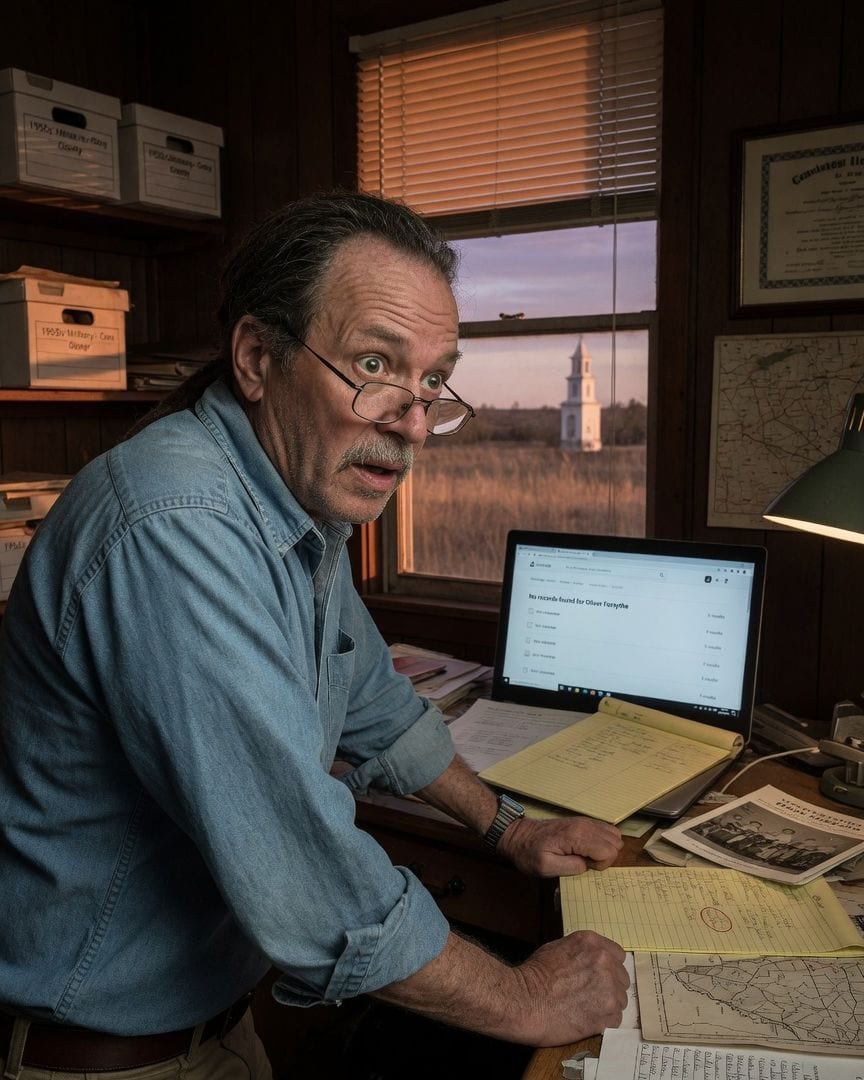
On his final project, a historian found forty-one Cold War headstones, all with names but no death dates.
Approaching retirement, lineage historian Owen Sarkis took on one final project: solving the mystery of the 250th Chemical Company, a unit that vanished after a single 1955 parade. His search led him down Carolina backroads to a lonely, weathered chapel, behind which lay forty-one identical gray headstones in neat rows. Each stone bore a name, but chillingly, not one had a date of death, a silence louder than any inscription. Then, on one stone, he found a small, industrial metal plate bearing a cryptic code and a symbol he recognized from a declassified document on 'unconventional materials handling.' The true nature of these 'graves' began to curdle in his mind, suggesting something far colder than death itself.
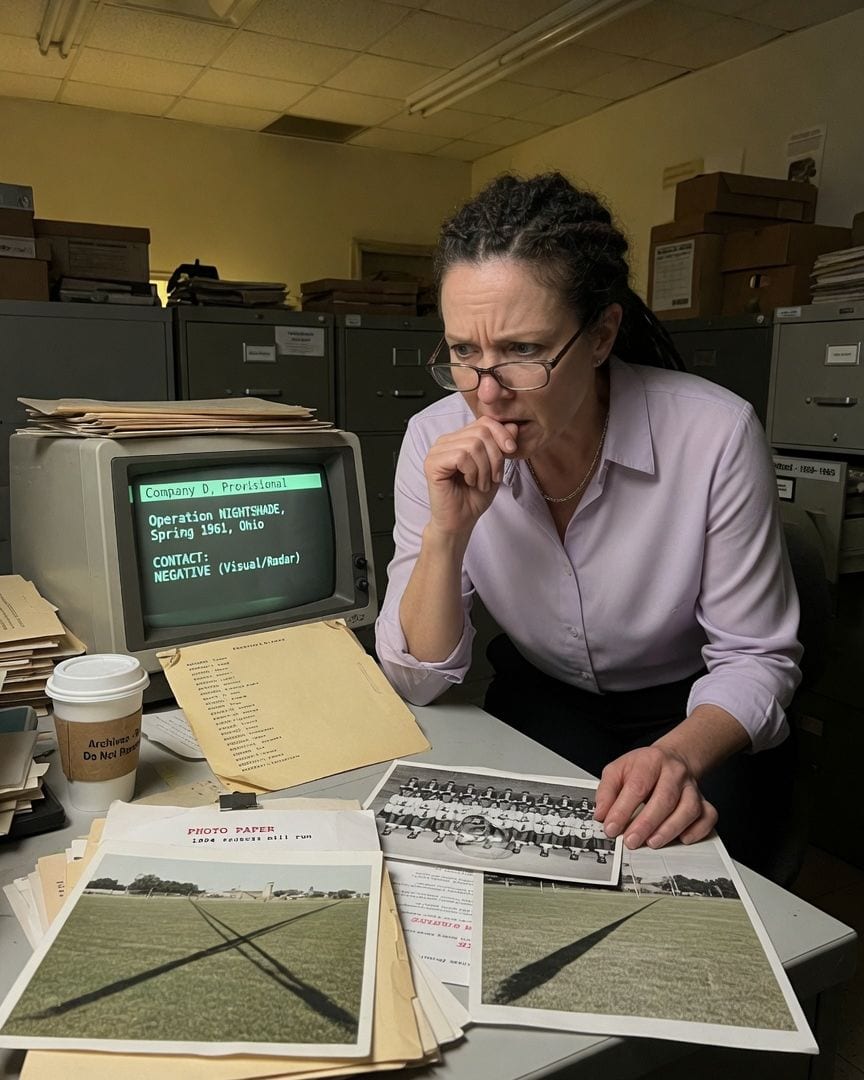
A declassification reviewer finds a 1961 Cold War photo of soldiers. The field was empty, only an impossibly long shadow.
Declassification reviewer Cynthia Walsh had until Friday to verify the existence of Company D, a military unit slated for official erasure. Her initial evidence, a 1961 photo of sixty-two uniformed men, quickly dissolved under scrutiny: lab reports dated the paper to 1994. Worse, an aerial survey from that same 1961 afternoon showed only empty Ohio grass – save for one impossibly long, slender shadow stretching across the field. Hours spent sifting microfiche then uncovered a roster for 'Company D, Provisional,' detailing their 'Operation NIGHTSHADE' and listing a man officially still alive.
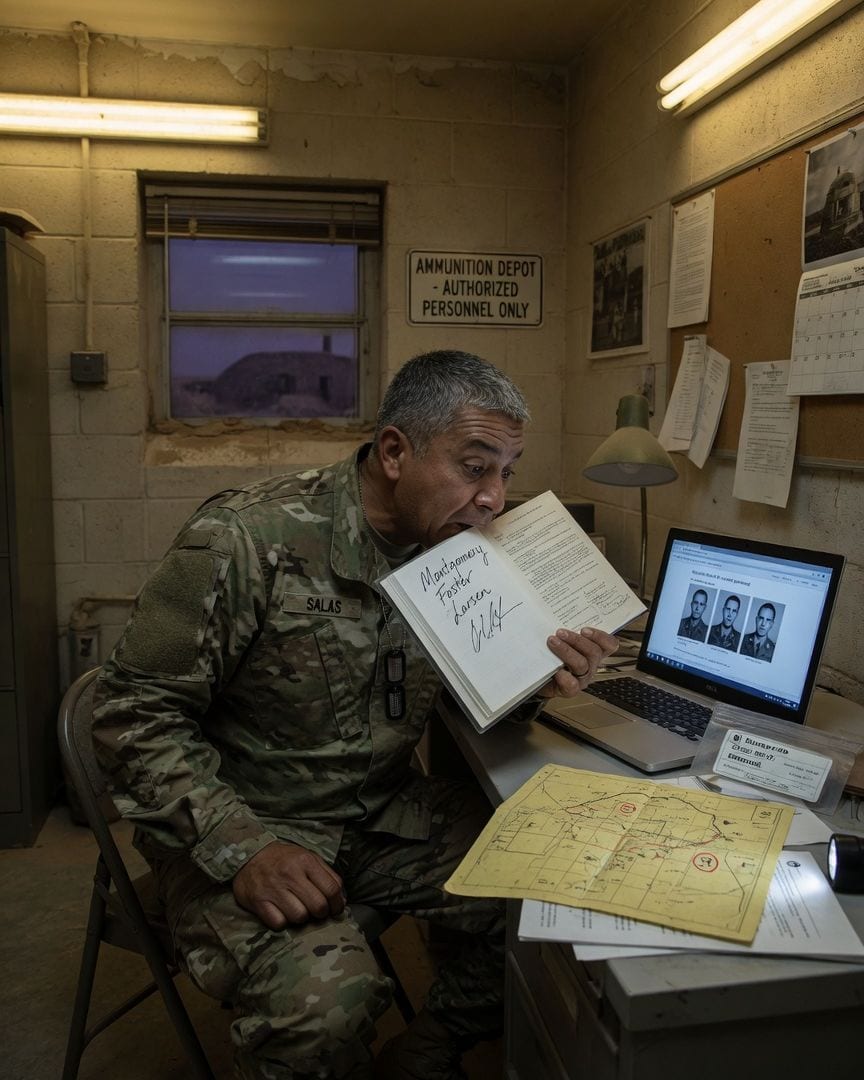
Chief Salas finds a new bunker seal signed by men d*ad or discharged decades ago.
Chief Warrant Officer Curtis Salas completes a final inventory at a desert munitions depot, finding an impossible fortieth bunker not on any map. Its fresh security seal bears signatures from three men: two officially K*lled in Action, and one honorably discharged, all decades ago. Someone, or something, just signed d*ad men's names to a new Army seal.
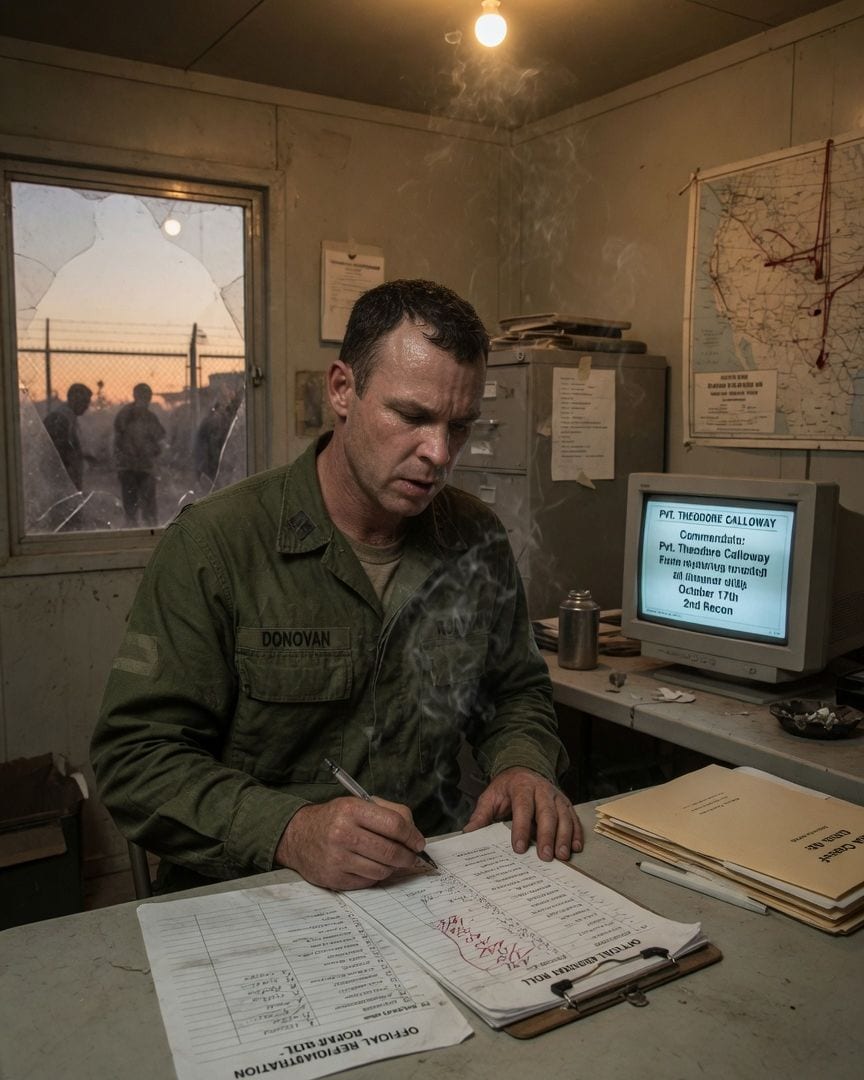
A Corporal counted the returning prisoners, but his tally came out one man too high, a private with no official record.
Corporal Raymond Donovan stood amidst the dust and tired murmurs of the repatriation camp, his duty to verify every returning prisoner. He meticulously tallied names against the official exchange lists, but his physical head count came out one man higher than expected. A Private Theodore Calloway appeared, gaunt and exhausted, yet his name was nowhere on Raymond’s carefully organized records. Sergeant Jennings dismissed it as a forgotten grunt, but Raymond knew better; Calloway's official service record, though pristine, contained an impossible detail: a commendation date for an operation his unit had left a month prior. What impossible timeline had this private stumbled into?
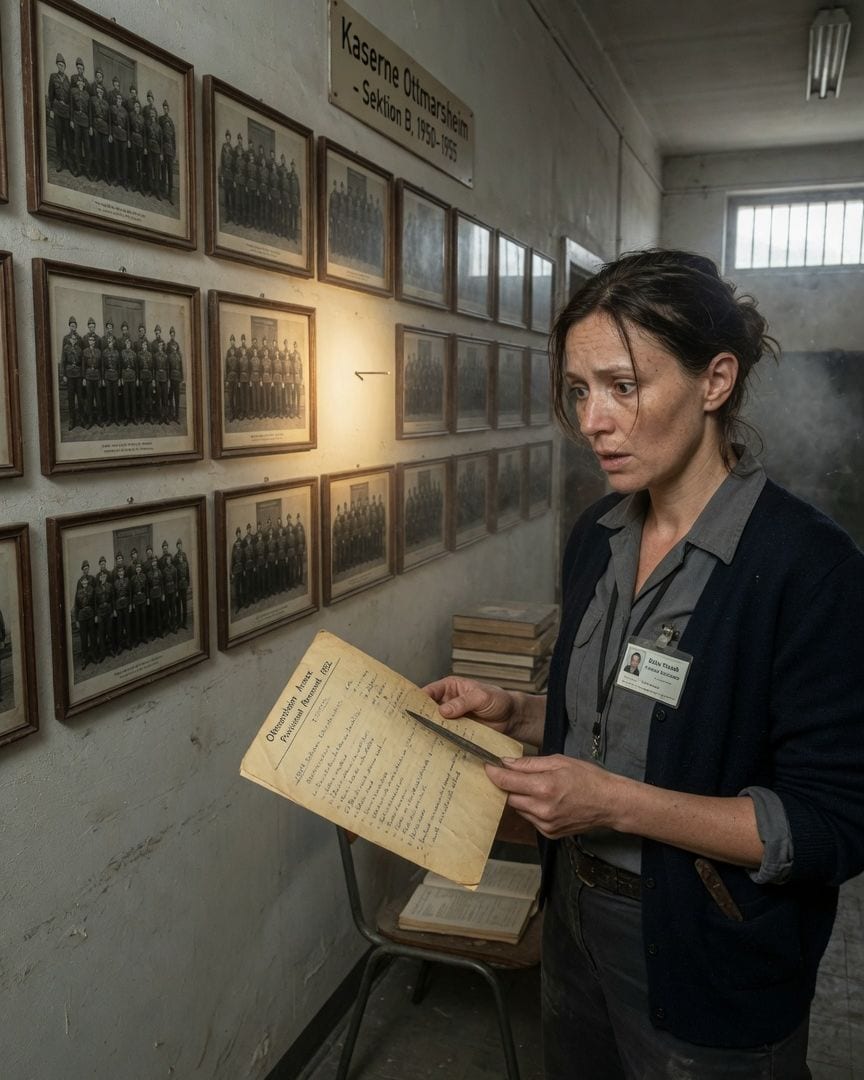
At a Cold War kaserne days from demolition, inventory clerk Delia Straub found a missing photo frame for a unit that never existed. Every soldier on the wall stared directly at its empty space.
Inventory clerk Delia Straub had eleven days to log every item at Kaserne Ottmarsheim before demolition crews arrived, turning history into rubble. Amid the dusty halls, she found a stark anomaly: a missing photo frame for the 604th Ordnance Detachment, a unit never officially stationed at the base. What made the empty space chilling was that every soldier in the surrounding photographs was looking not at the camera, but directly into that void. Delia's search for answers unearthed an unofficial manifest listing the 604th, with names of men officially declared killed in action years before. Who were these phantom soldiers, and why did their impossible record persist?
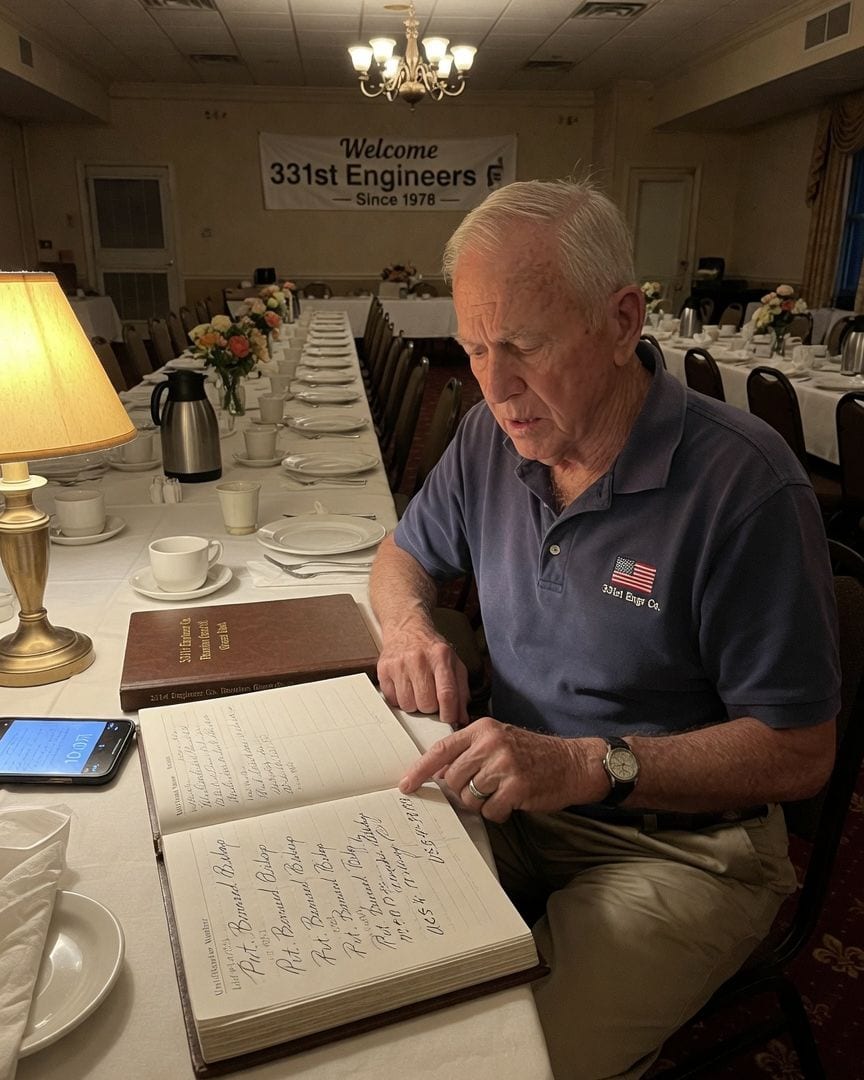
Retired Sergeant Odis Trumbull found a reunion guest book signed by a dead man. His service number was for a classified unit, not his own.
Retired Sergeant Odis Trumbull arrived at his annual company reunion, a tradition held in a Biloxi hotel ballroom since 1978. He sat alone for three hours, watching thirty empty chairs, each a ghost of a comrade he had personally buried over four decades. When the guest book arrived, Odis found thirty-one signatures, one for every man on the rolls. The ink on the last entry, for Private Bernard Bishop, was still wet. Yet, Odis had carried Bishop's coffin in 1976, two years before the reunion even began, and his service number matched a classified Cold War command. As Odis ran his thumb over the impossibly fresh ink, a cold dread began to settle.