On his final project, a historian found forty-one Cold War headstones, all with names but no death dates.
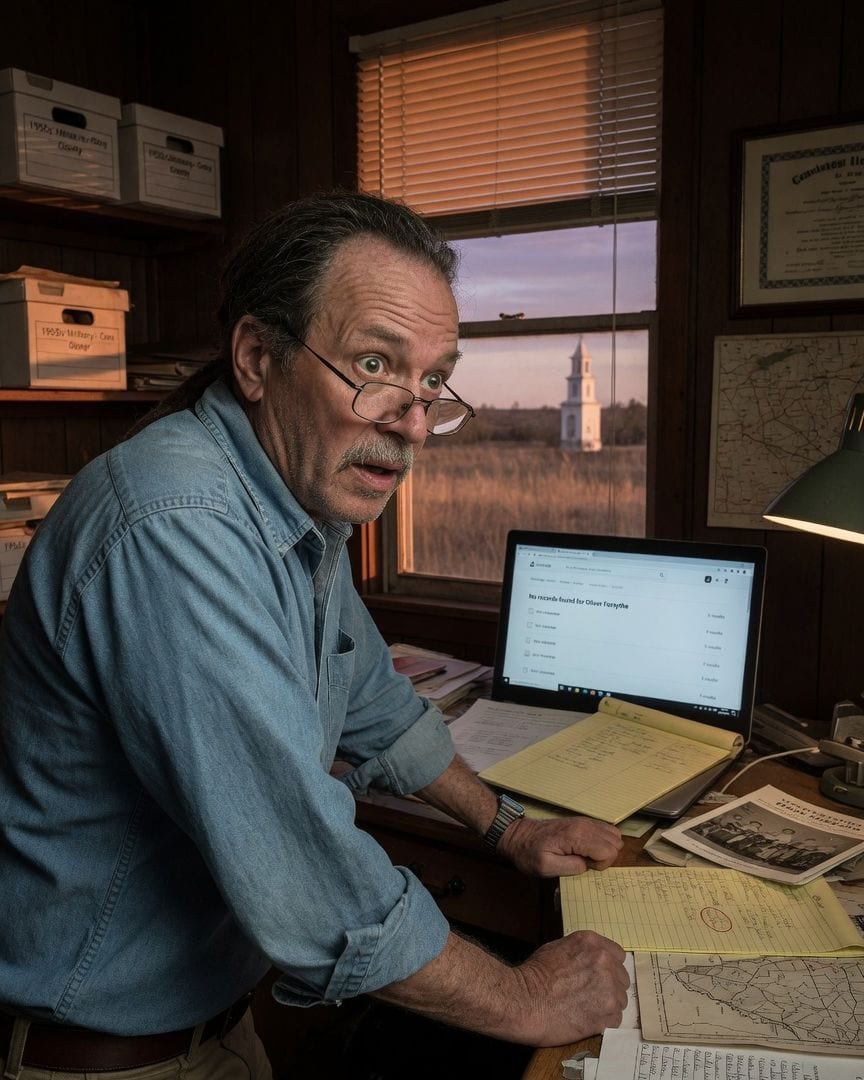
Owen Sarkis, 58, a lineage historian, felt the quiet hum of the Carolina courthouse, a familiar comfort as he meticulously cross-referenced old records.
His final project before retirement was supposed to be simple: resolve the mystery of the 250th Chemical Company, a unit that appeared in a single 1955 parade program and nowhere else.
He expected to find a forgotten disbandment, perhaps a clerical error.
He spent weeks in the courthouse's climate-controlled archives, tracing dusty paper trails. He finally found fragments: a leased forty-acre plot in a forgotten corner of the county, tax records, even local men hired for "site maintenance."
The trail, thin but undeniable, led him down winding, dusty backroads, past endless fields of tobacco and silent stretches of pine, to a small, weathered chapel. It stood alone, an ancient sentinel against a vast, indifferent sky.
Behind it, amidst tall, whispering grass, was a perfectly mowed, rectangular plot. Forty-one identical, plain gray headstones stood in neat rows, their surfaces smoothed by decades of wind and rain.
Each bore a name—Thatcher, Reynolds, Stratton—but none, not a single one, had a date of death. It was the absence that struck him, a silence louder than any inscription. A chill, not from the autumn air, brushed against his skin.
Gideon Montgomery, the groundskeeper, a man in his early seventies with sun-worn hands and a face like crinkled leather, confirmed the anomaly. "A man comes every month," Gideon rasped, his voice as dry as the Carolina summer heat.
"Pays me cash to keep this section neat. Always asks if anyone's been around asking about them." He gestured vaguely at the silent stones. Owen felt a prickle of unease, a cold wrongness that defied the peaceful setting.
Forty-one names, forty-one men, filed away with no end date. It sat wrong in his historian's mind.
Driven by the unsettling silence of the headstones, Owen returned to his quiet home office. The old house felt suddenly larger, the silence within it less comforting, more watchful.
He meticulously cross-referenced the names from the stones against every public record imaginable. He scoured local obituaries, draft registrations, birth certificates, and census data from the mid-20th century.
Most of the names were common enough to be untraceable without more context—John Smith, Robert Miller. But three stood out, names he’d seen on those smooth gray stones: Oliver Forsythe, Quentin Hughes, and Theodore Lawson.
These names, despite appearing on 1955 headstones, had no corresponding birth records in the state, no draft cards, no social security numbers, no death certificates. They were statistical ghosts, existing only on those forty-one stones in that remote graveyard.
Owen tried to rationalize it away, his mind grasping for logical explanations. A clerical error, perhaps, a misfile in a chaotic era. Maybe a forgotten relocation for some federal project. The explanations felt thin, fragile.
He called the county historical society, a small organization he’d worked with for years, asking about any "federal projects" or "experimental units" in the area during the 1950s.
The curator, a woman named Florence Lawson, could only offer vague, hushed rumors of "something out near the old chapel land," whispers about a secret military facility, but nothing concrete, nothing official.
"Folks just didn't talk about it," she’d said, her voice dropping conspiratorially.
The absolute absence of information for Forsythe, Hughes, and Lawson was too absolute, too clean. It wasn't merely a lack of information; it was an active erasure.
He stared at the blank results on his screen, the white spaces where data should have been. The dread began to coalesce, turning from a prickle to a persistent, cold weight in his gut.
This wasn't just a historical oddity; it was a deliberate secret, preserved by silence. The thought was colder than the screen's glow.
The impossible names pulled Owen back to the graveyard. The logical explanations had all failed, leaving only a dark, churning uncertainty. He walked the rows again, his eyes scanning each marker, searching for anything, a stray detail, a forgotten inscription.
The sun was low, casting long, distorted shadows across the silent field. He knelt by Oliver Forsythe's stone, the cool granite familiar beneath his fingertips.
His gaze fell to the very base, where creeping grass and damp soil had partially obscured something metallic.
He carefully scraped away the wet earth with his thumbnail, his breath held. It was small, non-descript, a dull silver glint.
Not a decorative plaque, but a thin, almost industrial-looking metal plate, about an inch long, riveted securely to the stone's side. It was clearly not original to the 1950s headstone. He wiped the remaining grime away with his thumb.
Etched onto its surface was a sequence of alphanumeric characters: 'CP-734-OLIVER.' Below it, a familiar, official-looking, yet deeply unsettling symbol: a stylized, three-pointed star.
His breath hitched, caught in his throat. He had seen that star before, stamped on the inside cover of a heavily redacted, declassified document he’d found in the county archives, a document concerning 'unconventional materials handling.'
The symbol, the impossible names, the 'burials' without death dates—they snapped together with sickening clarity. The true nature of the 'graves' began to curdle in his mind, suggesting something far colder than death.
Owen, unnerved, immediately shifted his research focus to the three-pointed star symbol. His usual methodical pace quickened, driven by a growing, icy fear.
He scanned government databases, obscure academic papers, and declassified archives, searching for any recurrence of that chilling sigil. He found the symbol sporadically, almost like a watermark, in obscure, declassified government documents from the 1950s and 60s.
These documents often related to abandoned facilities, remote 'environmental remediation' projects, or 'experimental agricultural stations' – sites that were later scrubbed from public records or designated restricted zones. A pattern, faint but persistent, began to emerge.
He cross-referenced the names of Oliver Forsythe, Quentin Hughes, and Theodore Lawson again, this time against personnel manifests from these 'remediation' sites. The old house creaked around him, its sounds no longer comforting but amplified, almost judgmental in their silence.
To his horror, he found their names listed on a manifest for 'Project Nightingale,' an experimental agricultural station in rural Georgia that had been abruptly closed in 1961 due to 'unforeseen environmental complications.'
The manifest listed them not as soldiers in a chemical company, but as 'site personnel,' with no further details.
This contradicted the notion of them being 'chemical company' members in Carolina. The official narrative was a tangled, deliberate lie.
Owen knew he needed to speak with someone who understood the old administrative layers, someone who might have handled these anomalous filings directly.
He located Beatrice Oakley, 85, a retired county clerk who had worked in the courthouse for decades, including the period when the 250th Chemical Company's lease was filed.
He called her, politely explaining his historical research. Her voice, initially warm and welcoming, turned thin and evasive when he mentioned the 250th Chemical Company. She claimed her memory was "not what it used to be," her voice cracking slightly.
She offered hurried responses, stumbled over words, and abruptly ended the call, citing a sudden need to leave. Her reaction betrayed a deep, practiced fear, not simple forgetfulness. The telephone receiver felt cold and heavy in Owen’s hand.
She knew something.
Owen's inquiries did not go unnoticed. A week after his call with Beatrice, an anonymous, unmarked envelope appeared in his mailbox. It was thick, stiff. His hands trembled slightly as he opened it.
Inside was a single, grainy photograph of him, taken from a distance, standing by the chapel graveyard. He was clearly visible, kneeling by Oliver Forsythe's headstone, his posture unmistakable. There was no note, no return address, just the chilling image.
A cold dread settled over him, palpable as the paper in his hand. He wasn't just investigating a forgotten company; he was intruding on something actively protected, something that watched.
The air in his office felt heavy, as if unseen eyes were now fixed on him.
Then, the 'glitches' began. His home office computer, where he meticulously organized his research, started behaving erratically. Files he'd just saved would briefly disappear, only to reappear moments later, shifted into different subfolders.
His browser's search history would inexplicably wipe itself, sometimes right after he'd searched for something related to the three-pointed star. One morning, he found a new, encrypted folder on his desktop, titled 'MISC. FILES,' which he had never created.
Its presence felt like a deliberate taunt. He didn't dare open it. He knew he was being watched, monitored.
His rational mind tried to explain it away as an old computer, a failing hard drive, but the timing was too precise, too personal.
He immediately switched tactics, purchasing a burner laptop with cash and taking his research entirely offline. He compiled notes by hand, using old-fashioned index cards and a locked filing cabinet that he kept bolted to the wall.
The feeling of invisible eyes, of a subtle, pervasive presence, was constant. He found himself checking his rearview mirror obsessively, scanning for unfamiliar vehicles, for any car that lingered too long.
He double-locked his doors at night, tested his windows, and slept with a heavy, old flashlight by his bed, its cold metal a small comfort. The danger was no longer abstract history; it was personal, immediate, and utterly silent.
He was no longer just a historian; he was a target.
Owen, his resolve hardened by the surveillance, paid a surprise visit to Beatrice Oakley. He found her frail but still sharp, living in a small, meticulously neat house that smelled faintly of lemon polish and old paper.
The porcelain figurines on her mantel seemed to watch them both. He bypassed pleasantries, his voice low, his movements deliberate. He placed the photograph of the headstone with the metal tag on her coffee table, the three-pointed star clearly visible.
Her eyes, magnified by her thick glasses, widened in recognition and fear. She didn’t just see the headstone; she saw the symbol. "What is this?"
she whispered, her voice trembling, her gaze fixed on the image as if it held a snake.
Owen pressed her gently, calmly, explaining his findings about the impossible names, the symbol, the 'Project Nightingale' contradiction. "The 250th Chemical Company, Mrs. Oakley," he said, his voice barely above a whisper. "It wasn't a chemical company, was it?"
Beatrice stared at the photograph, her composure finally cracking like old china. Tears welled in her eyes, carving faint tracks through the powder on her cheeks.
She confessed, her voice barely audible, that "they"—federal agents, she called them, faceless men in dark suits—had come to the courthouse in 1954.
They instructed her, then a junior clerk, to process the paperwork for the 'company' as a "containment and disposal unit" for "unregistered materials." She was told it was a matter of national security, that her silence was paramount.
The 'local men' hired, she admitted, were either unwitting laborers or security personnel, and some of them, she whispered, simply "stopped coming to work." They were never reported missing; their records were simply... closed.
She finally articulated the chilling truth that had been gnawing at Owen, a truth that made his stomach clench. "The graves, Mr. Sarkis, they weren't for burying the dead. They were part of the containment.
A way to file what couldn't be destroyed or understood." Her voice dropped to a barely audible rasp. "The men… they weren't buried in them. They were buried as them."
The words hung in the air, cold and definitive, like a verdict.
Owen felt the earlier clues re-meaning on-page: the impossible names, the lack of death dates, the metal tags—all elements of a system designed to 'file' the unfileable, to contain secrets under the guise of death.
His own pulse throbbed in his ears, mirroring the frantic ticking of Beatrice’s grandfather clock in the corner.
The truth about the 250th Chemical Company was a gut punch, but Owen's rational mind struggled to accept such a vast, decades-long deception for one isolated rural site. It felt too big, too complex, for a single, forgotten plot.
He pushed further, his voice barely a whisper, forcing himself to ask the question he already feared the answer to. "Mrs. Oakley, did you ever hear of... other companies like this? Other units?"
Beatrice's face went from ashen to a ghostly white, her lips trembling. She rose slowly, her movements stiff with age and dread, and shuffled to a small, antique desk in the corner.
The desk seemed to groan under the weight of some unspoken history. From a locked drawer, she extracted a hidden, yellowed ledger.
Its leather cover was cracked with age, the corners worn smooth, but unmistakable upon it, embossed faintly, was the same three-pointed star symbol. His blood ran cold.
She handed it to Owen, her hand trembling so violently that the heavy book nearly slipped from his grasp. Inside, neatly handwritten in careful, precise script, were dozens of entries spanning from the late 1940s to the early 1990s.
Each entry listed a different 'company' or 'unit'—'250th Chem,' 'Project Nightingale,' 'Section Gamma,' 'Weather Research Detachment 4'—along with coordinates, dates of establishment, and a chillingly consistent note: 'Containment Protocol: Active.'
He saw names he recognized from other obscure declassified documents, names of places now wilderness or restricted zones, places he'd dismissed as abandoned government experiments. The ledger wasn't just a record; it was a map.
It suggested a vast, silent pattern, a quiet machine operating for half a century, filing away not just materials, but entire stories, entire lives, under the guise of official records.
The 250th was just one small, almost forgotten cog in a much larger, still-turning mechanism. The full, terrifying scope of the system stretched before him, an endless archive of dread. And it was still active.
The ledger, heavy in Owen’s trembling hands, detonated the deeper truth.
It wasn't just a collection of names or projects; it was an internal registry, meticulously maintained by the shadowy institution, detailing 'Containment Sites' across the country and, implicitly, the world.
Each entry wasn't merely a record of a project, but a chilling account of an anomaly encountered and subsequently 'filed.' The carefully chosen words – 'unregistered materials,' 'disposal unit,' 'Containment Protocol: Active' – echoed with a cold, bureaucratic finality.
The 'headstones' at the chapel were precisely what Beatrice had described: markers for contained entities, their names either placeholders for the unnameable or the identities of those who became inextricably part of the containment itself.
The consistent 'no death dates' across all 41 markers now made perfect, horrifying sense; it signified not a lack of demise, but a lack of end to their status as 'contained.'
These were not graves in the traditional sense, but permanent storage units, their contents still active, still being monitored.
The anonymous man who paid Gideon Montgomery was a field agent, part of the continuous, decades-long monitoring and upkeep of these 'files.'
He wasn't just maintaining a plot; he was an extension of the system, a quiet guardian of a horrifying archive.
The inconsistencies Owen had initially found in official records—the disappearing units, the phantom companies, the erased personnel—were not errors but intentional obfuscations, a system designed to bury truths in plain sight, to make the inexplicable seem mundane, then forgotten.
The three-pointed star was the chilling sigil of this silent, patient institution, a bureaucracy of dread that had been operating for generations, collecting, containing, and classifying, ensuring that what was 'lost' was merely 'filed.'
Every planted clue, every discrepancy, now clicked into place, forming a coherent, terrifying mosaic of control and concealment. The true horror was not what he had found, but the sheer, methodical persistence of it all.
Owen knew he couldn't simply walk away. The weight of the ledger, of the decades of documented dread, was too immense to be ignored.
He worked frantically, his hands flying across the burner laptop’s keyboard, making digital and physical copies of its contents.
He encrypted files, uploaded them to secure, anonymous servers, and sent carefully redacted versions to trusted journalists and researchers he knew online, hoping someone else would dare to open these files, to give this chilling truth an audience.
The clock on Beatrice's wall ticked louder now, a frantic countdown.
As he finished, the familiar black sedan pulled up outside Beatrice's house. It was identical to the one in the grainy photograph he’d received. Two men in dark suits emerged, calm and unhurried.
They didn't shout or threaten; their demeanor was one of quiet, administrative authority, as if they were simply collecting overdue paperwork.
One, a man with cold, unblinking eyes, simply stated, his voice flat, "Mr. Sarkis, your inquiries have caused some… administrative difficulties. We're here to collect the ledger, your notes, and any copies you may have made."
Owen, remembering Beatrice's practiced fear, and the chilling implications of 'Containment Protocol: Active,' knew he could not comply.
He looked at Beatrice, who sat frozen on her sofa, her face a mask of terror, her hands clasped tightly in her lap. He made a desperate, split-second decision.
"I don't have them," he lied, his voice thin, his heart hammering against his ribs like a trapped bird.
As the men took a step closer, their unblinking gaze unnerving, Owen bolted. He surged through Beatrice's back door, through her overgrown garden, and into the dense woods behind her house.
Twigs snapped under his feet, leaves whipped at his face. He heard the calm, unhurried footsteps behind him, a chilling contrast to his own ragged, gasping breaths. He didn't look back.
His retirement, his quiet life, everything he had known, was over. He was now a fugitive, haunted by the knowledge he held, another 'unregistered material' to be filed.
He left Beatrice to face the agents, a choice that would forever weigh on his soul, knowing he had traded her safety for the chance, however slim, to expose the truth. The woods closed in around him, dark and indifferent.
Owen Sarkis vanished. His home was quietly sold, his retirement project never officially submitted. The county archives were purged of the heavily redacted document concerning 'unconventional materials handling' and the 1955 parade program was deemed a misprint.
The 250th Chemical Company remained a historical footnote, its graves still neatly mowed by Gideon Montgomery, who continued to receive his monthly cash payment from a new, equally anonymous contact.
Beatrice Oakley was quietly relocated to a 'care facility' in a distant state, her memory now genuinely fractured, her mind a blank slate where the ledger once resided.
The black sedan, or others like it, was occasionally seen in the small Carolina town, its occupants silent, watchful observers, ensuring the files remained closed.
Owen’s old life ceased to exist, replaced by a ghost in the system he had exposed. His name, too, was quietly filed away, another anomaly.
Owen Sarkis lived off the grid now, a ghost among ghosts, an expert in evasion. He moved from one anonymous town to another, always restless, always looking over his shoulder.
He sent anonymous packages of redacted documents, pieces of the ledger, to journalists and researchers, hoping to plant seeds of doubt, hoping someone else would dare to open the files, to see what he had seen.
He knew they were still looking for him, still filing. He felt their patient watchfulness like a phantom limb, a cold, persistent ache.
One evening, alone in a remote cabin deep in the Appalachians, the only sound the wind through the pines, he heard it—the distant, familiar hum of a groundskeeper's mower.
He knew it was impossible; too far away, too late in the season, too quiet for any legitimate work in these isolated mountains.
But he heard it anyway, a phantom hum that echoed the quiet dread of the Carolina graveyard, a sound from a place he could never truly escape.
He felt the cold certainty that the filing system, like his own life, was still active, still processing. The quiet hum was a promise. It always found its way back. His file was simply open.
A few months after Owen Sarkis vanished, a small, hand-typed note was found pinned to the door of his abandoned cabin. It simply read: 'File #OS-734. Status: Active.'
If this one got to you
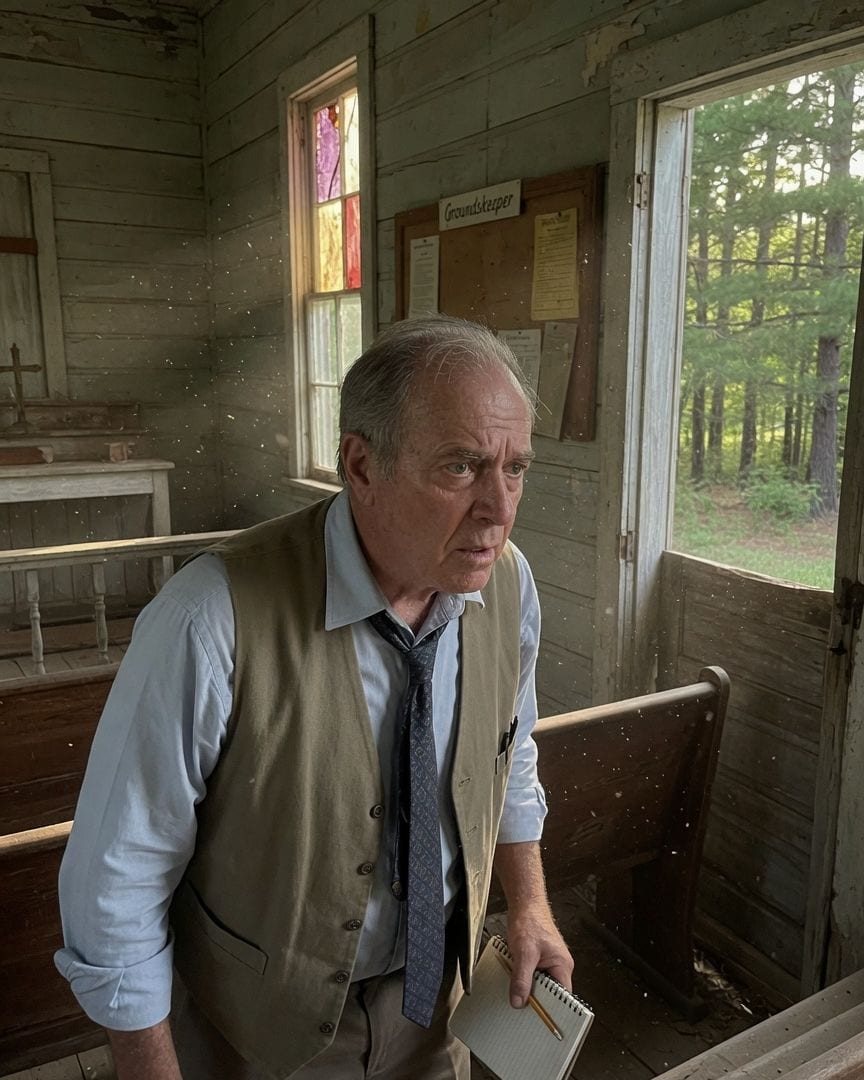
On his final project before retirement, a lineage historian found 41 soldiers buried in 1955 with no death dates. He then found their Cold War transfer order, dated *after* the burial.
Owen Sarkis, a lineage historian nearing retirement, sought to close his career with one final, simple project: resolving the mystery of the phantom 250th Chemical Company. His search led him deep into a Carolina pine forest, to an isolated chapel with a meticulously mowed plot. Forty-one headstones stood in neat rows, each bearing a name and regimental number, but beneath every name, the dates of birth and death were unsettlingly blank. The local groundskeeper hinted the men "just… left," and Owen found their names on no military lists after 1955; their lives seemed erased. But the true shock came with a "TOP SECRET" military transfer order, listing all 41 men from the chapel, ordered to a non-existent facility *two weeks after* their supposed burial. What really happened to the 250th Chemical Company?
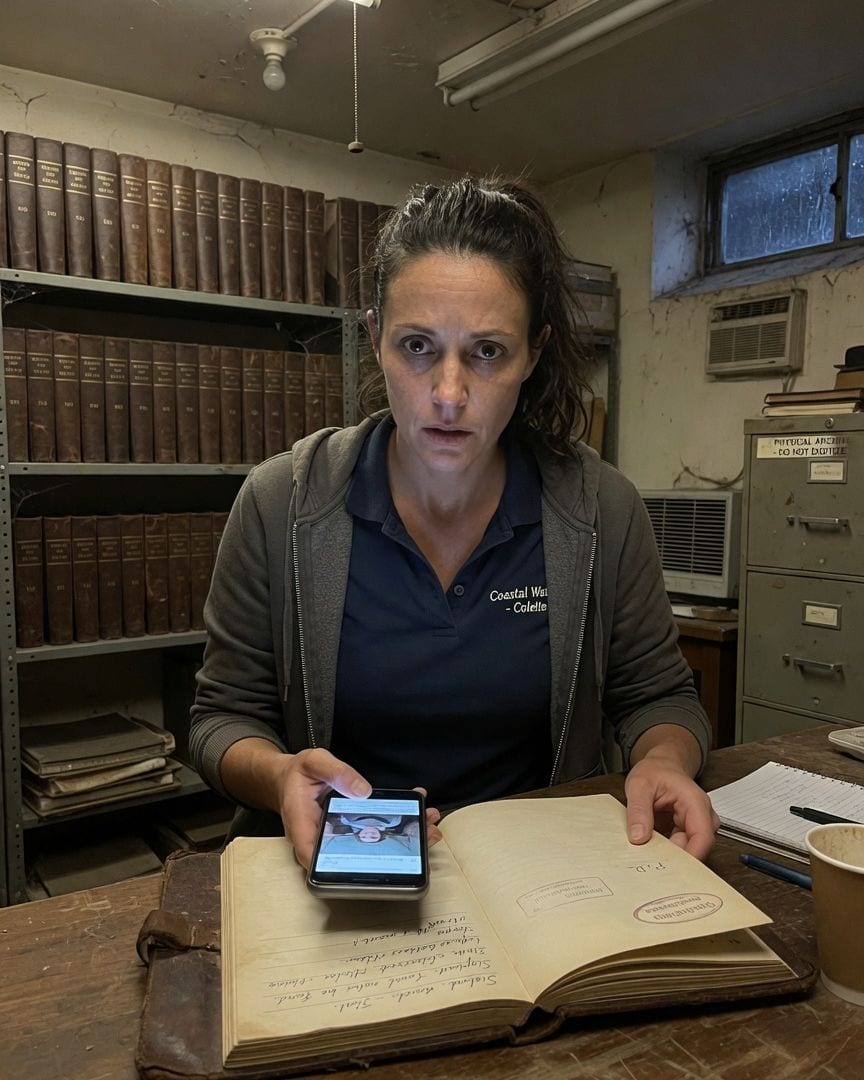
My coastguard log noted Sighting 9 again tonight, a light where no vessel showed. The old logs carry Sighting 9 off Skerry Point at 3:14am every tenth year since 1954, always 'nothing found,' always 'send no boat.'
On my watchtower night shift, the radar screen glowed green and the ocean was quiet. Then, a familiar light appeared off Skerry Point, exactly on cue, just as it had every tenth year for decades. But digging deeper, I found a hidden stamp in an old logbook: 'Operation Skerry. Status: Complete.' It left me with a chilling sense of finality.
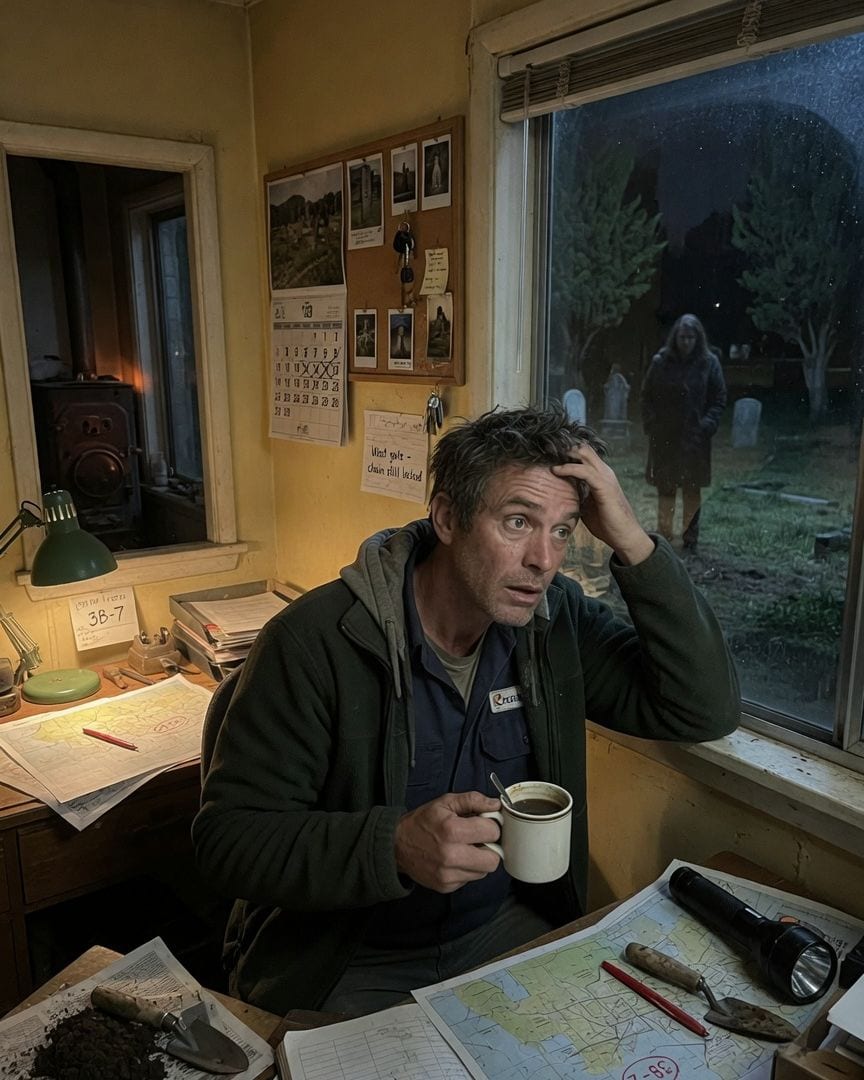
My cemetery lodge overlooks a woman visiting an empty grave near 3 AM most nights. The west gate she uses has been chained shut since autumn, its lock untouched.
As the cemetery's night caretaker, I'm used to the quiet hum of the lodge. But for three weeks, a woman has appeared nightly at plot 3B-7, a silent mourner in the deep night. What chills me is how she leaves: walking straight through the west gate that's been chained and padlocked shut for eight months.
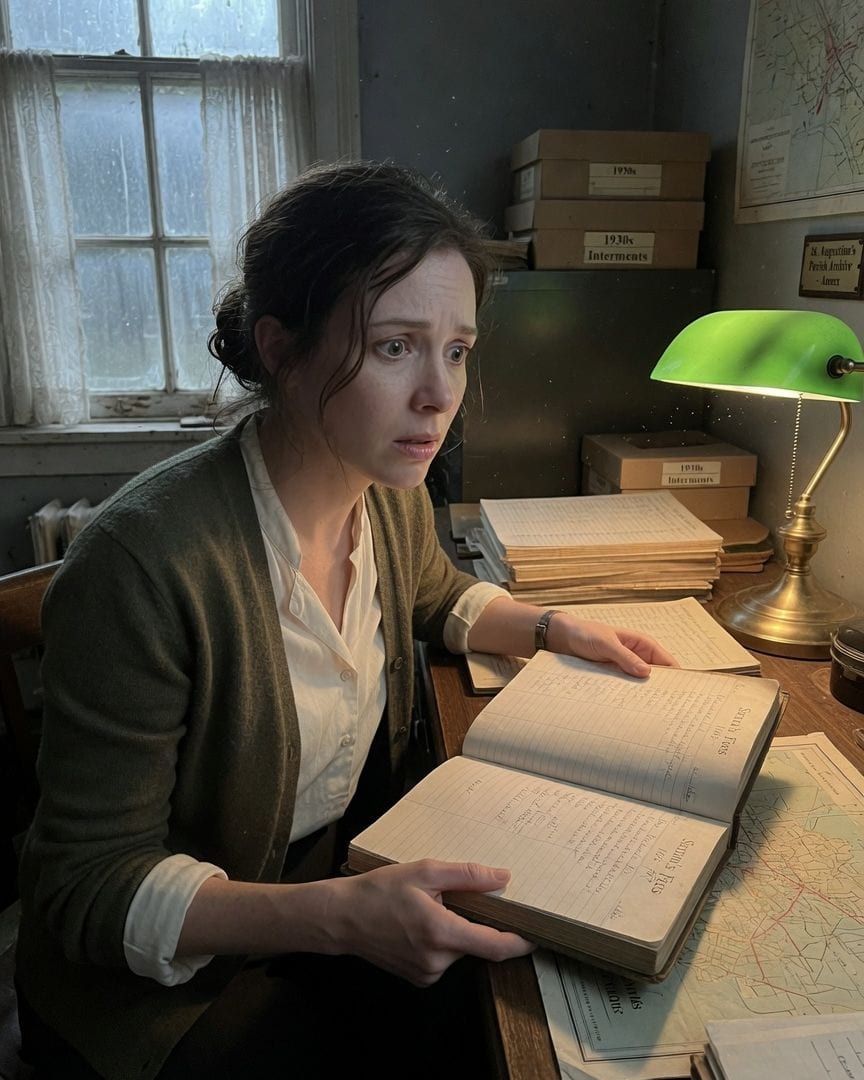
Our churchyard closed in 1974. But the sexton's book shows new graves every month, paid by families whose names are on stones from the 1930s.
As Oakhaven's new archivist, I expected a quiet life of dusty ledgers and ancient records. But a current entry in the sexton's fee book listed a "new burial plot" paid last month for Theresa Romano, who died in 1931. The town ordinance closed the churchyard to new burials in 1974.
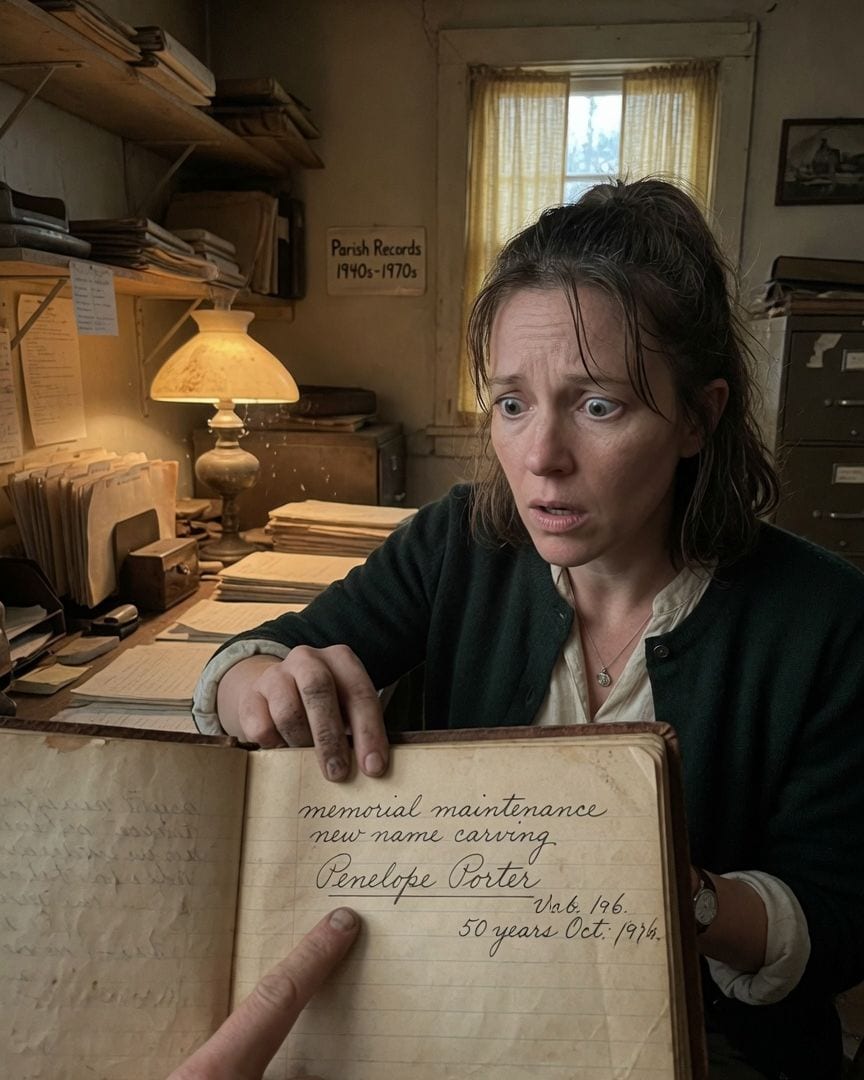
My name is carved on the war memorial with this coming Tuesday's date. The cut is fresh, but the stone inside matches fifty years of age, and a ledger says it was carved exactly fifty years ago.
On a sunny autumn Tuesday, my oldest friend, Gary, urgently called me to the village war memorial. There, carved beneath the names of the fallen, was 'PENELOPE PORTER' with a date from this coming autumn. The fresh carving of my name, dated for a Tuesday yet to arrive, felt like a cold jolt, an impossible message from the stone itself.
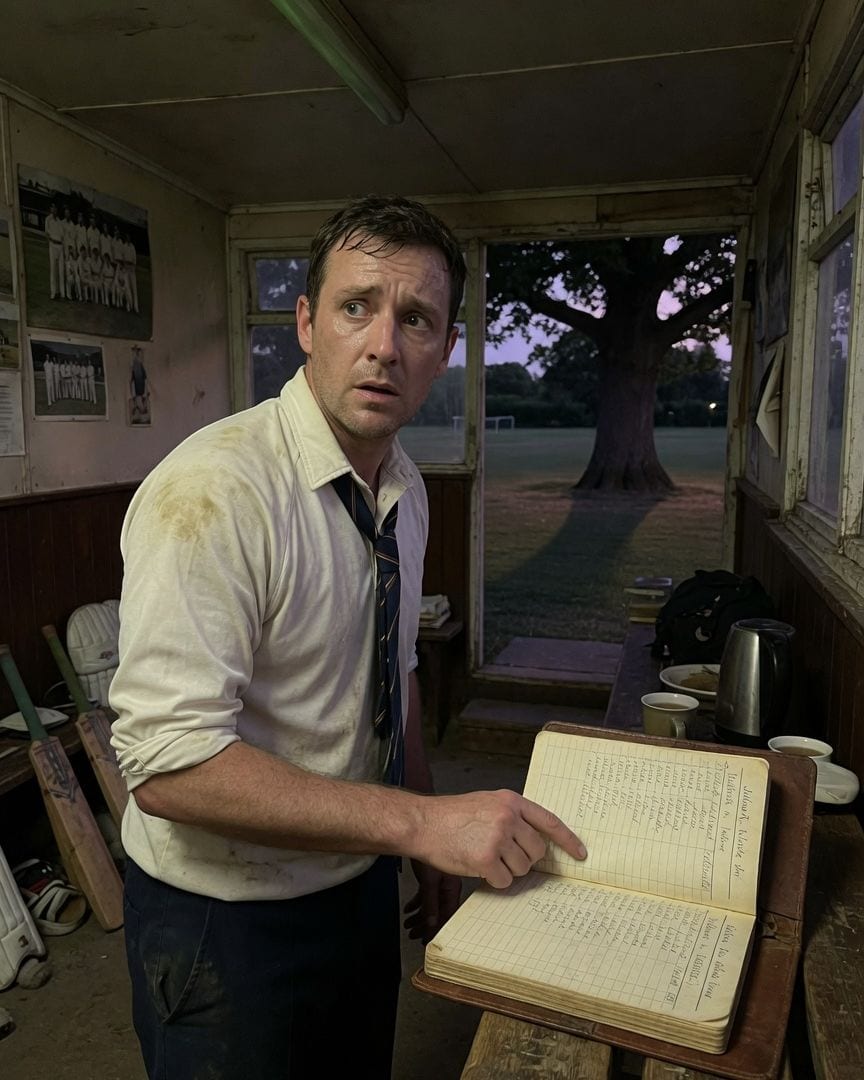
My cricket club's scorebook listed eleven players as 'retired.' One name matched a local man who vanished without a trace.
I moved to Oakhaven for a slower pace, joining the local cricket club and its quaint traditions. But in the club's old scorebook, I found a chilling entry: a full innings of eleven batsmen, each simply marked 'retired' on a specific date. When I asked about Julian Thornton, one of those names, the town fell silent, their placid smiles never quite reaching their eyes.