Sergeant Rios had three weeks until home. Then a unique boot print appeared outside her post, facing *inward*.
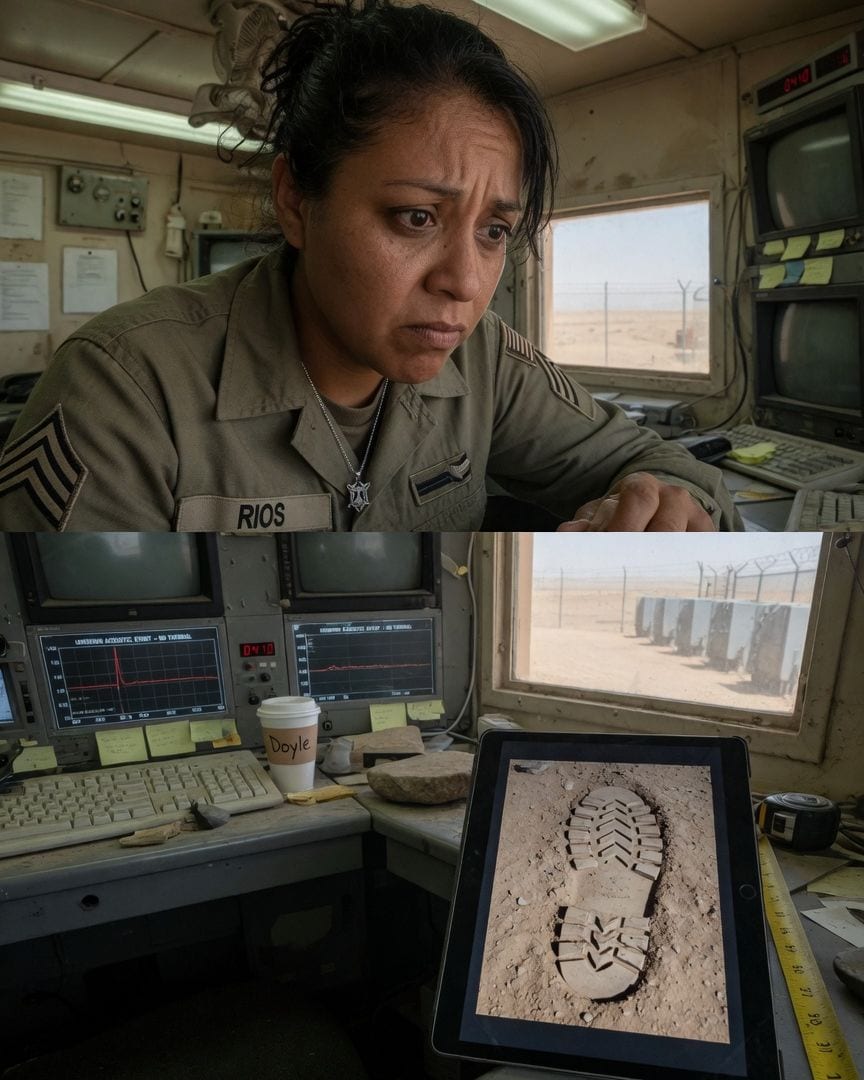
Sergeant Vivian Rios, 32, sat hunched over her console at Observation Post 7, the desert night cold against the window. Three weeks to discharge, three weeks to home. Her screen showed the usual sensor readouts: thermal, seismic, acoustic.
But for the past three months, one acoustic pattern had been a ghost. At 0410, every night, like clockwork, a single walker's gait, crossing sensor to sensor in a dead-straight track along the smuggling wash.
No thermal signature, no visual confirmation, just the rhythmic thud-thud-thud. Rios had run it against every pattern library – animal, human, vehicle, even known geological shifts. It matched nothing but itself.
The station’s heater fan hummed, a lonely counterpoint to the silence outside. Tonight, she watched the last 'thud' register on the sensor nearest her own post, then vanish.
A faint click echoed from the console, the sound of the system processing an event it couldn't fully log. The screen went blank, showing only the empty desert. The system swore nothing was there.
But the sound, she knew, had been real. It was 0410.
The next morning, fueled by a restless night, Rios decided to walk the perimeter herself. The sun beat down, baking the dirt, raising shimmering heat hazes from the dusty ground.
She checked the fencing, the ground for fresh tracks, anything out of place. The sand, undisturbed by the morning's light breeze, preserved the usual animal trails—rabbit, coyote, a desert rattler.
She followed the line of acoustic sensors, a string of dull gray boxes stretching into the distance. Near the acoustic sensor closest to OP-7, where the phantom track always vanished, she found it. A single, distinct boot print.
It was too clear, too defined, for a sensor glitch or a trick of the light. She crouched, the dry earth crumbling slightly beneath her boots. This was not standard military issue, nor civilian.
The tread was unusually deep, almost like a specialized climbing boot, but with a unique, angular pattern she'd never seen. It was stark against the fine dust. The desert itself seemed to hold its breath.
She took photos, measured it, then carefully covered it with a flat rock. The print was facing inward, towards the post, not outward towards the wash.
Back inside, Rios uploaded the photos to her secure terminal. She cross-referenced the boot print against every known military and civilian footwear database available, running searches both local and wide-net. Nothing.
Specialist Kevin Doyle, 25, the sensor tech, walked in, coffee in hand, the familiar aroma of burnt beans trailing him. 'Morning, Sarge. Everything squared away?' Rios looked up, her face tight, the fluorescent light above reflecting in her weary eyes.
'Kevin, check this.' She brought up the image of the print. Doyle leaned in, brow furrowed, taking a long sip of his coffee. He tapped the screen with a careful finger. 'Never seen that tread. Looks... custom-made?
Or something out of an old survival catalog.' Rios nodded slowly. 'It was found right where that 0410 acoustic trace always disappears.' Doyle’s eyes widened, the coffee cup freezing halfway to his lips. 'But if it's physical...
and the cameras missed it...' He trailed off, looking at the print on the screen, then slowly, his gaze drifted out the window at the empty desert beyond the wire. His voice was a strained whisper: 'And it's facing inward.'
Over the next few days, Rios dug deeper. The desert outside continued its relentless shimmer, indifferent to her growing unease. She reviewed all camera footage from 0400-0420 for the past three months, frame by frame, until her eyes ached.
Blurry heat hazes, wind-blown debris, but no figure. The thermal sensors showed nothing but the gradual cooling of the desert floor.
She had Doyle recalibrate the acoustic sensors, testing them against known footfalls—her own, Doyle’s, even a stray jackrabbit they’d chased near the perimeter. They were accurate. The print was real.
The sheer coherence of the data, the absence where something should be, was a cold dread tightening in her gut.
She started pulling old maintenance logs for OP-7, going back decades, looking for any anomalies, any record that might explain the impossible track.
She found a curious entry from 15 years prior, almost hidden between routine filter changes and generator repairs: 'Sub-level access point sealed, structural integrity compromised.' But current blueprints showed no sub-level beneath the main floor.
The detail snagged in her mind like a burr. She checked archived blueprints, dusty scans from the district headquarters’ digital vault.
There it was: a small utility sub-level, accessible from a hatch near where the boot print had been found, now marked 'abandoned' and then completely erased from more recent plans.
A sealed-off area, right beneath the point of emergence, scrubbed from history.
Rios's inquiries didn't go unnoticed. Captain Paul Montgomery, 48, her commanding officer, called her in. The captain’s office was sparse, the air conditioner blowing a thin, cold stream.
'Sergeant Rios, I'm getting reports you're spending a lot of time on 'unauthorized investigations.' Is there a problem with the sensor field I should know about?' His tone was clipped, his eyes unreadable.
Rios laid out her findings: the repeating acoustic signature, the unique boot print, the missing sub-level. She projected the old blueprint onto his wall screen. Montgomery listened, impassive, his fingers steepled.
The silence in the small office stretched, punctuated only by the hum of the AC. 'Sergeant, sensors glitch. Dust devils make strange tracks. Old blueprints are often inaccurate. Your discharge is three weeks out. Don't complicate things.'
He paused, his gaze hardening. 'Consider this a direct order to cease your current line of inquiry.' He dismissed her with a wave of his hand.
The door closed with a soft thud behind Rios, but the air in the corridor felt colder, heavier.
Later that night, as Rios worked late, reviewing the few unclassified records she still had access to, she noticed the network activity logs for her terminal.
Someone had accessed her internal investigation files, specifically the boot print images and the old blueprint scans. The access was logged under a generic maintenance account, but the timestamp was clear: it had happened minutes after her meeting with Montgomery.
Rios knew Montgomery was trying to shut her down. She needed hard proof, something undeniable. She returned to the old maintenance logs, focusing intently on the 'structural integrity compromised' entry from 15 years prior.
There was a faded, handwritten note in the margin, initialed 'G.R.' and a date: July 2009, almost to the day. The detail, small as it was, sang with a wrongness that resonated through the quiet office.
She cross-referenced 'G.R.' against personnel records from that time. Lieutenant Gordon Rutherford. His service record ended abruptly six months after that maintenance entry, marked 'transferred, details classified.' A dead end, a blank wall where a man's life should have been.
But the name stuck, a persistent echo. Rios then remembered an old desk drawer in the post's inactive storage, stiff and unyielding when she’d first tried to open it weeks ago.
She returned to it now, forcing it open with a wrench. Inside, beneath a stack of brittle, forgotten training manuals, she found it: a faded, unofficial photograph.
It showed a group of soldiers, younger, smiling, gathered in front of this very outpost, the desert stretching behind them. In the middle, a man with a familiar face, though older in the photo: Gordon Rutherford.
He was laughing, one arm slung around a man who looked like Doyle’s predecessor. Standing next to Rutherford, slightly out of focus, was another soldier. Taller, leaner than Rutherford, his face obscured by shadow.
On the back, a scribbled note, barely legible: 'OP-7 Crew - '09. Missing one.' Rios stared at the note, her mind racing. Missing one. She checked the photograph against the official '09 crew roster she’d found online.
All names present and accounted for. But the photo clearly showed one person more than the roster claimed. An extra.
The implications hit Rios like a physical blow, a cold wave washing over her. An extra person in a military photo, yet the roster was clean. 'Missing one'—but the official count was full.
This wasn't just an anomaly; it was a systemic error, a lie painted over decades of official reports. She looked closer at the soldier next to Rutherford in the photo, the one slightly out of focus.
He was tall, lean, with the same angular jawline and deep-set eyes as Rutherford, a strange mirror image. And the boots. Even blurry, obscured by shadow, the distinctive, angular tread was visible.
The same tread as the print she found near her post. The print that matched nothing in any database. The light from the desk lamp glinted off the old photo, making the extra figure seem to shift, to almost resolve.
The face in the photo, the 'extra' man, was a younger, almost identical version of Gordon Rutherford himself. But Rutherford was already in the photo, standing clear, accounted for, his arm around a smiling colleague. Two Rutherfords.
One accounted for, one not. And the 'unaccounted' one was wearing those boots.
Rios confronted Montgomery again, the photograph clutched in her hand, the original blueprints laid out on his desk, Rutherford's partial, classified record on her tablet. Montgomery’s calm façade finally cracked.
His jaw tightened, and the usual controlled placidity in his eyes gave way to a weary, haunted resignation. He confirmed that 15 years ago, a 'breach' had occurred.
Not a border breach, he clarified, his voice low, but a localized dimensional anomaly beneath OP-7. It had manifested as an individual, a 'duplicate' of Lieutenant Rutherford, who had emerged from the sealed sub-level.
The original Rutherford had disappeared during the incident, vanished without a trace, replaced by the duplicate. The duplicate was physically identical but lacked the original's memory and behavior, an empty vessel.
Command had covered it up, sealing the sub-level and quietly erasing the original Rutherford from all but the most obscure, classified records, explaining him away as a 'classified transfer.'
The duplicate was then integrated into the unit, serving out Rutherford's remaining time, an empty shell, an 'accountability that cannot be.' His voice had become a monotone, a man recounting a long-held, terrible secret.
The 0410 footfall, he explained, was the signature of a new emergence. It wasn't a walker; it was the space itself, thinning, a new one preparing to step through.
Montgomery, his career already ruined by this admission, helped Rios. They knew the next emergence was imminent; the rhythmic thud-thud-thud had subtly intensified in recent days.
The 'duplicate' Rutherford's disappearance after his 'transfer' was likely another silent integration into a different unit, another replacement somewhere else, silently stepping into another life.
Rios, armed with a heavy-duty plasma cutter and a hastily assembled sonic disruptor from Doyle's workshop, descended into the forgotten sub-level. The air was thick and cold, pressing in around her, tasting of ozone and forgotten earth.
She found the source: a shimmering, vertical tear in the bedrock, barely visible, pulsing faintly with an internal light. It looked like a tear in the very fabric of reality, a wound in space.
As she approached, a form began to solidify, slowly stepping out of the tear. It was tall, lean, with the familiar angular jawline, indistinct at first, then resolving into a human-like silhouette.
Its boots were the same unique tread, clear even in the dim light of the sub-level. It turned its head, its deep-set eyes fixing on her.
It was not Rutherford, nor any specific person, but an empty, nascent form, a template waiting for an identity. Rios aimed the sonic disruptor and fired.
A high-pitched, agonizing shriek, a sound that seemed to tear at the very air, filled the chamber as the entity recoiled, its form dissolving back into the shimmering tear.
She then used the plasma cutter, its blue-white flame roaring, to weld shut the reinforced hatch Montgomery had helped her secure, sealing the breach with thick, molten metal.
The tear pulsed one last time, then faded, the air settling back into a heavy silence.
The official report cited a structural integrity issue and a localized gas leak beneath OP-7, requiring the permanent sealing of the sub-level.
Sergeant Rios received her honorable discharge as planned, her record clean, the details of her final weeks carefully scrubbed.
Captain Montgomery was quietly transferred to a desk job in a remote, forgotten corner of the Pentagon, his face a little grayer, his eyes holding a new, permanent sorrow.
Specialist Doyle, though he never fully understood the true nature of what he’d helped with, became a meticulous keeper of old records, often found poring over obscure historical data, a nervous habit he hadn’t possessed before.
OP-7 resumed its routine, the 0410 footfall silent once more, the desert wind the only sound.
Rios was back home, the desert a fading memory, replaced by the humid air of the Pacific Northwest. She’d started a new life, a quiet one.
One evening, watching a news report about a border patrol unit in a different sector logging 'unexplained anomalies' on their thermal cameras, she felt a familiar chill.
The news anchor mentioned unusual boot prints found near a remote observation post in the New Mexico desert. Rios paused the TV. The image on screen showed a blurry still from a thermal camera, a faint, human-like shape.
Then a close-up of a boot print, scanned and digitized. It was the same angular, deep tread. Not a duplicate of Rutherford, but the same type of entity, emerging elsewhere.
The breach at OP-7 was sealed, but the border was long.
A few days later, a new post appeared on a small, obscure online forum dedicated to military legends: 'The Watch That Won't End - OP-7.' The first comment beneath it, posted anonymously, read simply: 'the border is long.'
If this one got to you
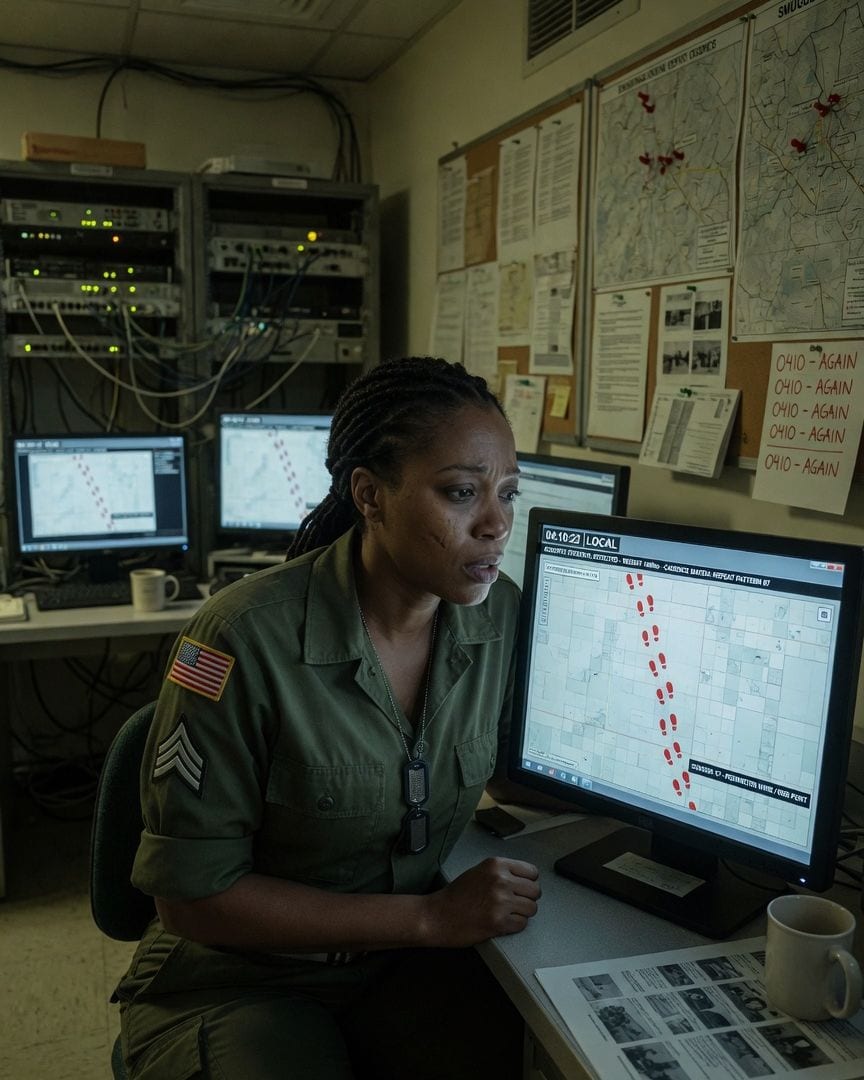
Unseen footfalls walk to Sergeant Prescott's post every 0410. For months, no one is ever seen there.
Sergeant Naomi Prescott, a border-support analyst, had grown accustomed to the quiet routine of OP Nightingale. For three months, however, her sensors have registered a single, repeating footfall signature every morning at 0410. This unseen walker's track moves with impossible precision, stopping dead at the perimeter wire just outside her post, leaving no visual or thermal trace.
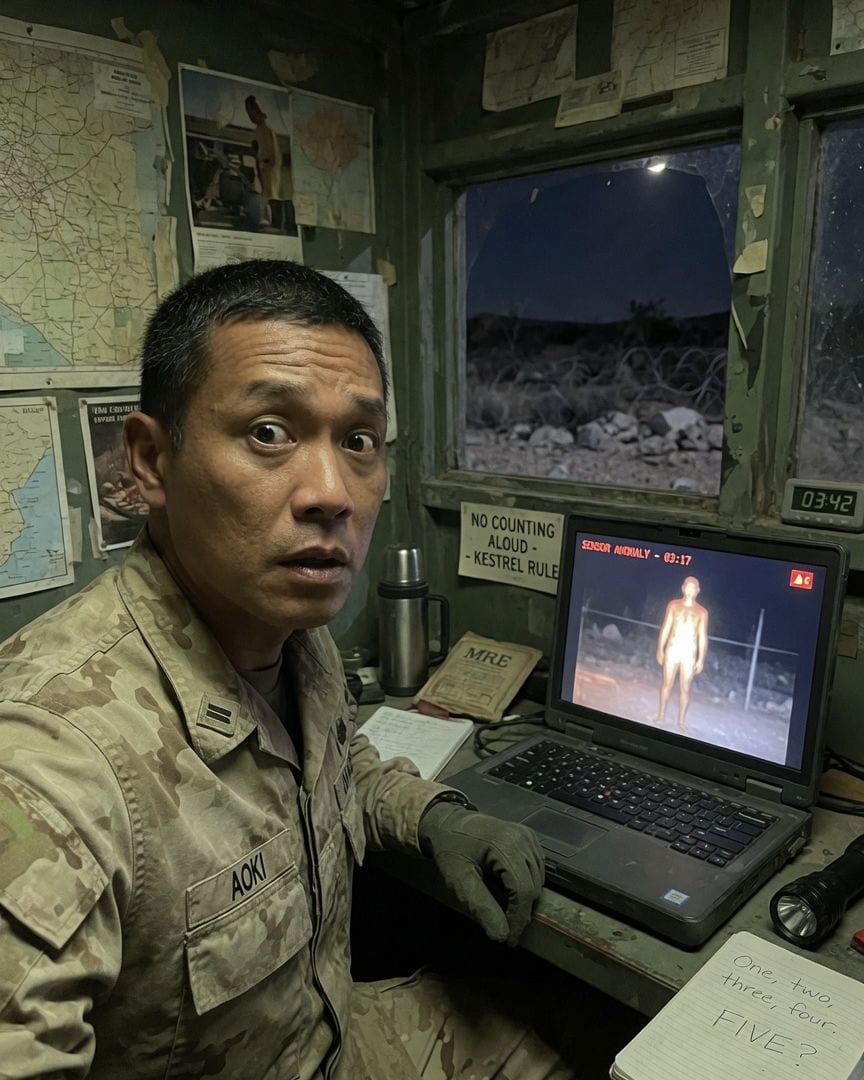
Sergeant Harold Aoki, hours from relief, counted his four-man patrol. A dry voice rasped, 'Five.'
Sergeant Harold Aoki was just hours from relief, walking the perimeter of Firebase Kestrel under a sliver of moon. A man who valued accountability, he counted his four-man patrol at the halfway mark: 'One, two, three, four.' A beat of silence, then a faint, dry voice, not one of his men, rasped, 'Five.' Later, back in the watchtower, the thermal camera feed flickered with a distinct, too-tall heat signature outside the wire, then vanished. When Aoki went to check, he found impossible boot prints just beyond the perimeter, appearing from nowhere and leaving no trail.
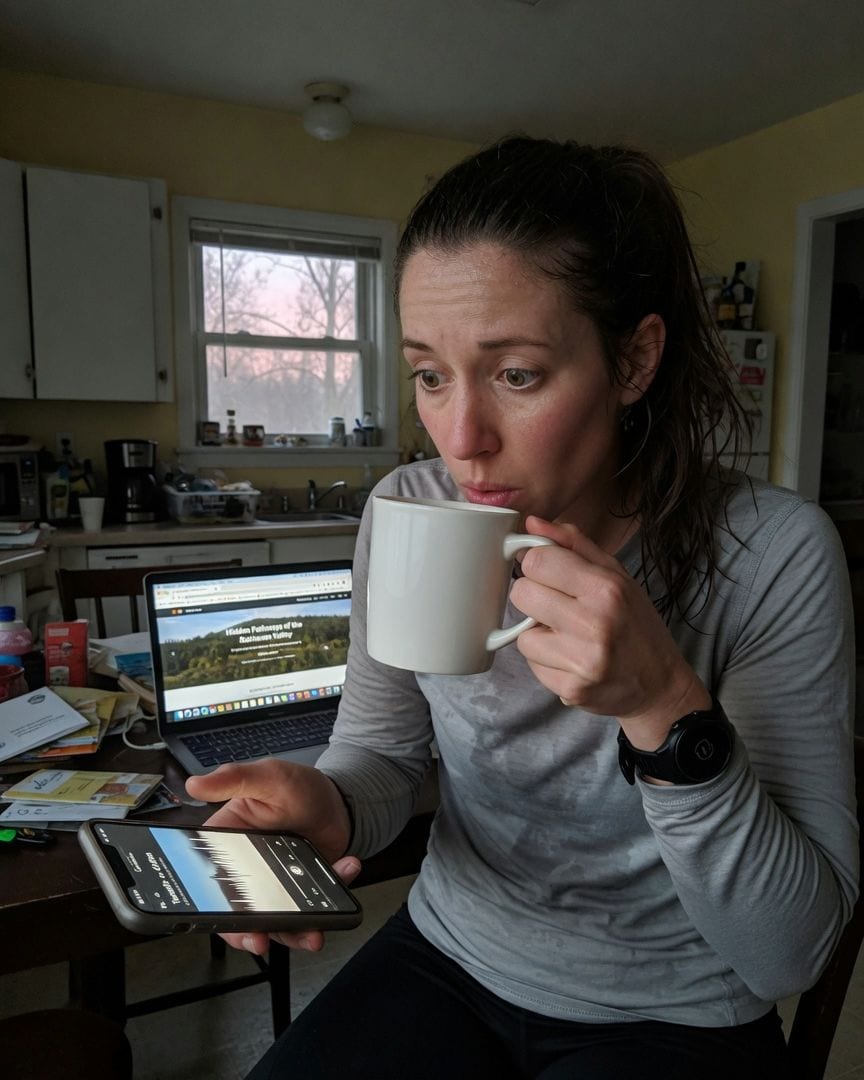
My running watch caught footsteps and a low voice right at my shoulder, saying 'keep going, don't turn around.' I was completely alone on the towpath.
My morning runs on the old canal towpath were my sanctuary, always deserted. My new running watch recorded thirty seconds of audio from that solitary path. But playing it back, I heard a second set of footsteps and a low voice, inches from my ear, saying, 'keep going, don't turn around'.
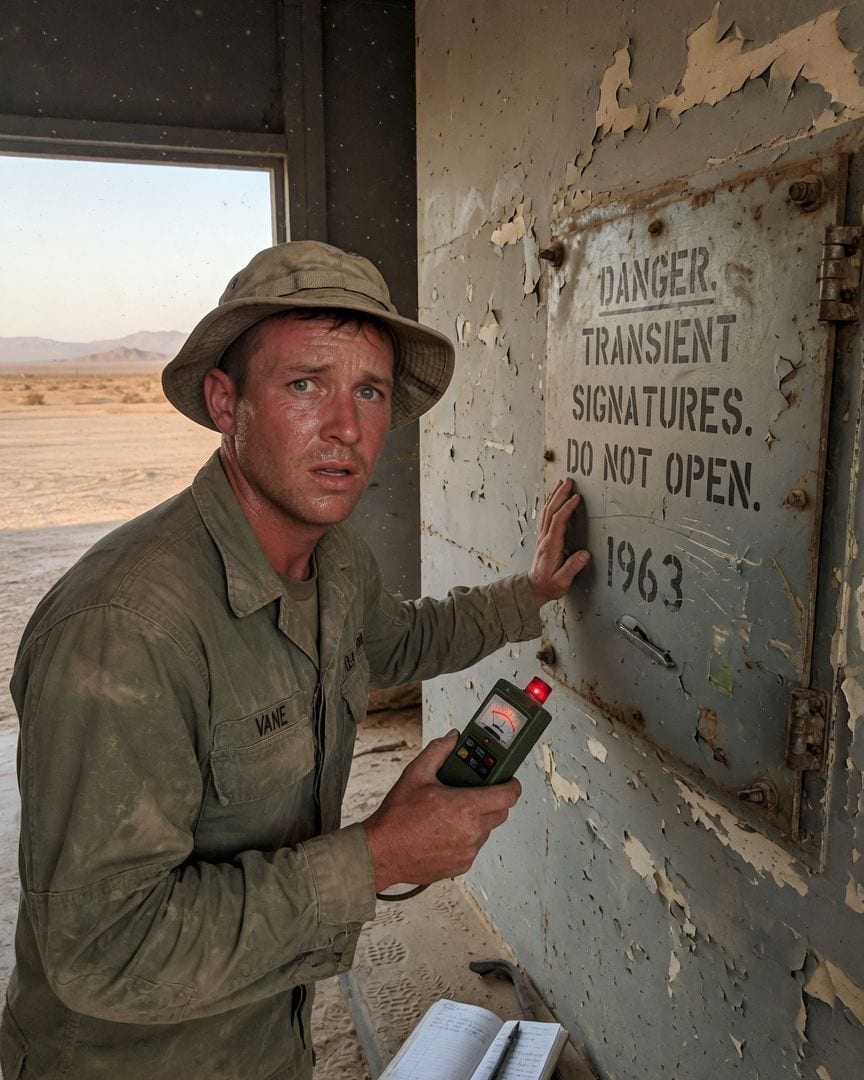
On Airman Purdy Vane's last survey of a Cold War testing range, hot footprints strode four hundred yards into a concrete wall with no door, and no prints leading out.
Airman Purdy Vane conducted his final, lonely survey of Sable Draw, a vast desert testing range slated for permanent closure. Under the relentless late summer sun, his Geiger counter, usually silent, suddenly shrieked. It led him to a perfect, four-hundred-yard track of intense radiation readings, like unhurried footprints, ending abruptly against the blank, doorless wall of a concrete instrument shed. Despite the range being officially cold for decades, Purdy later uncovered a hidden steel panel on that wall, bearing a stark, hand-painted warning: 'DANGER. TRANSIENT SIGNATURES. DO NOT OPEN. 1963.' How could something so dangerous remain hidden, decades after the desert was declared safe?
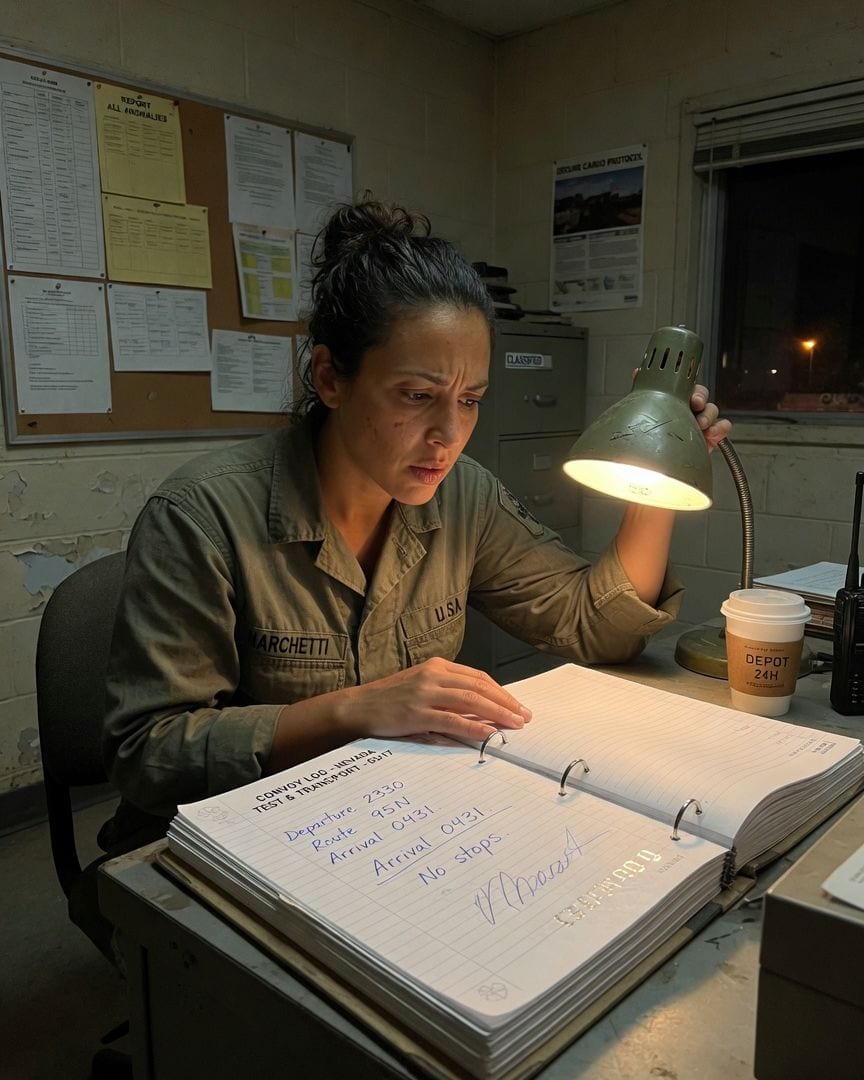
A transport driver's signed logbook claimed her four missing minutes in the desert never happened.
Specialist Cleo Marchetti followed the lead truck through the desolate Nevada desert, transporting an unidentified craft. Her only job was to keep the taillights of Senior Specialist Felix Hartley’s rig in sight. But at the halfway point, they simply vanished, leaving Cleo alone in the oppressive dark for four silent minutes. When the lights reappeared impossibly closer, Cleo knew something was terribly wrong. Yet, the official convoy log, bearing her own signature, recorded a perfect, uneventful journey with no stops. How could an entire four minutes disappear from the official record she herself confirmed?
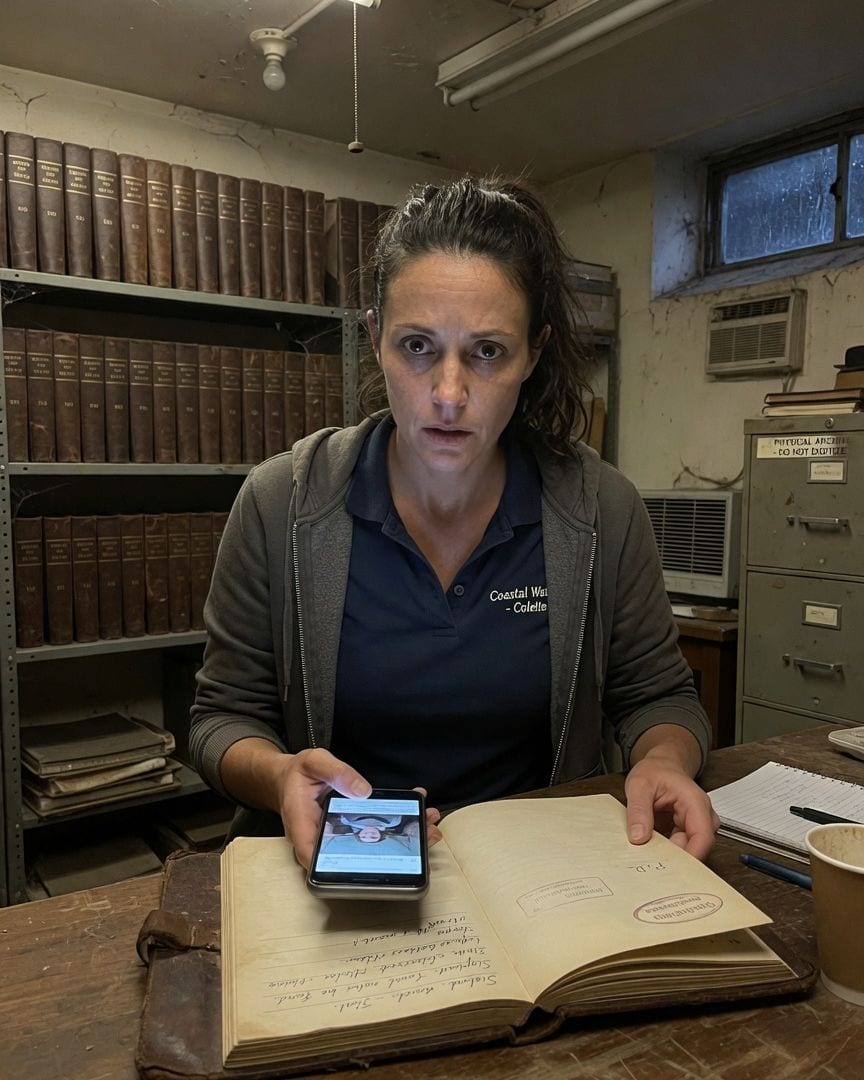
My coastguard log noted Sighting 9 again tonight, a light where no vessel showed. The old logs carry Sighting 9 off Skerry Point at 3:14am every tenth year since 1954, always 'nothing found,' always 'send no boat.'
On my watchtower night shift, the radar screen glowed green and the ocean was quiet. Then, a familiar light appeared off Skerry Point, exactly on cue, just as it had every tenth year for decades. But digging deeper, I found a hidden stamp in an old logbook: 'Operation Skerry. Status: Complete.' It left me with a chilling sense of finality.