Two weeks from retirement, Major Hollis Rake found his surname on a 1978 Cold War report for an identical anomaly, decades before he was born.
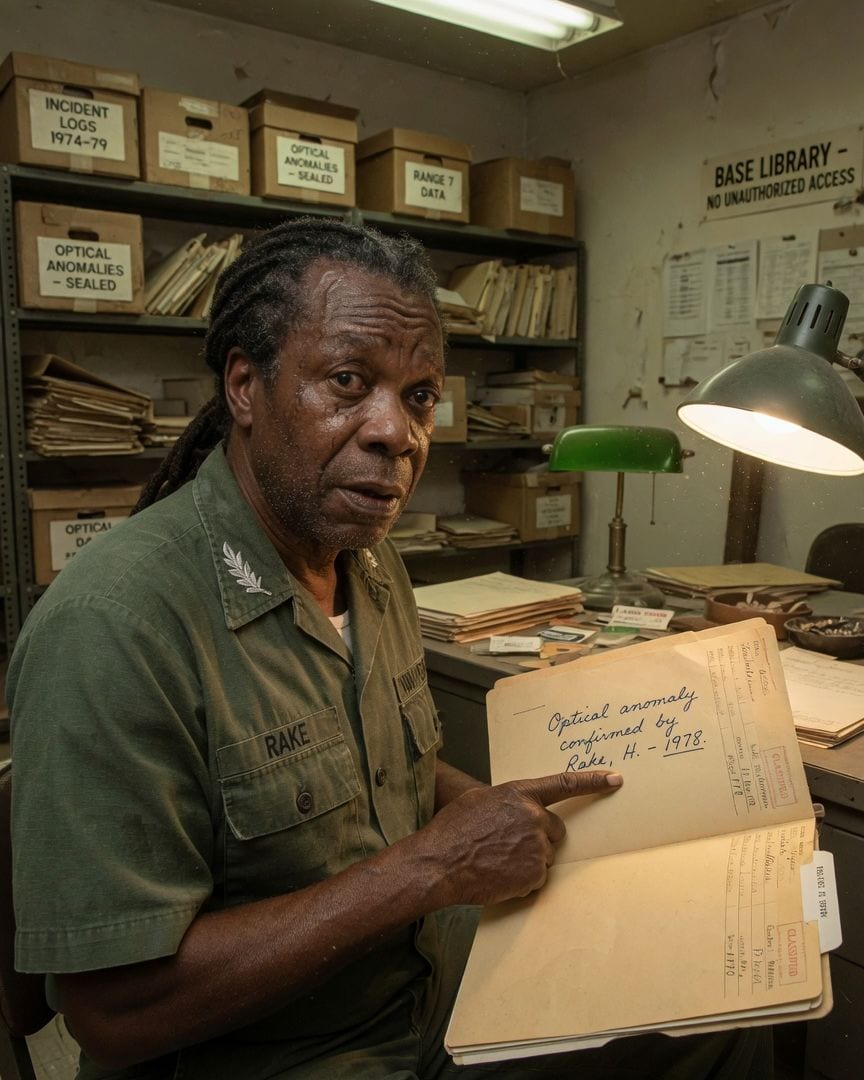
Major Hollis Rake, 58, observed the New Mexico desert shimmer in the heat, two weeks from retirement. His console, usually a steady stream of data from target sleds, now pulsed with an impossible reading.
An object, perfectly still, hung three thousand meters above the sled rail, directly in the flight path. Every optics station on the range had swung to it, their feeds converging on his main screen.
The theodolites reported an exact range, the cine cameras a precise size, the radar a velocity of zero. And all three agreed, down to the decimal point.
Hollis felt a cold dread settle in his gut, a physical chill in the air-conditioned bunker. The impossible thing wasn't that a saucer was hanging over his range.
The impossible thing was that every instrument he owned proved it, their collective testimony a silent, irrefutable lie against the laws of physics.
He wiped a bead of sweat from his brow, the steady hum of the equipment suddenly feeling like a held breath.
Hollis spent the next two days filing his incident report. Every detail, every reading, meticulously logged. The official response was swift: a 'highly unusual atmospheric inversion,' classified and sealed.
But Hollis knew what he had seen, and what his instruments had confirmed. He requested access to the range's historical incident archives, a musty, rarely visited corner of the base library where the air hung heavy with forgotten paperwork.
He was looking for anything similar, any precedent. After hours sifting through decades of mundane equipment failures and weather balloons, he found it. A thick, yellowed folder marked 'Anomaly, Optical – Range 7, 1978.'
The coordinates were identical to his own recent incident. The core readings, once deciphered from the outdated terminology, matched perfectly: zero velocity, precise size, exact range. The official conclusion? 'Atmospheric inversion.'
Hollis felt a flicker of vindication, then a deeper unease. This wasn't an isolated event. As he turned to the last page, a handwritten addendum, scrawled in faded blue ink, caught his eye.
It was initialed simply 'R.H.' and dated '1978.' Below that, a single line: 'Optical anomaly confirmed by Rake, H. – 1978.' His own surname, staring back at him from forty-six years in the past. It was a cold, impossible echo.
Hollis stared at the 1978 incident report, his finger tracing the handwritten addendum. 'Optical anomaly confirmed by Rake, H. – 1978.'
The date was impossibly wrong, decades before his birth, but the name was unmistakably his own surname, a cold and impossible echo from the past. The report was supposed to be a confirmation of a similar event, a shared anomaly.
Instead, it was a direct, personal implication, a ghost from the past reaching out to him. He felt a sudden, profound chill, far colder than the air conditioning. Someone knew.
Someone had written his name down, long before he existed, and filed it away in a sealed record. His eyes darted to the report's official classification stamp, then back to the impossible name.
The dread was not in the saucer, but in the paper itself.
The name in the 1978 file became an obsession for Hollis. He couldn't shake the feeling that he was not just observing history, but was somehow part of it.
He used his remaining access privileges, leveraging his impending retirement, to dig deeper. He discovered that 'R.H.' was Raymond Holloway, a low-level archivist who had been quietly reassigned shortly after 1978.
Hollis tracked down Pamela Holloway, 34, Raymond's granddaughter, who worked in the main government archives in Santa Fe. The archives were a labyrinth of steel shelves and dim lighting, smelling of old paper and dust.
Pamela, a junior records clerk with nervous eyes, was initially wary but softened when Hollis explained his research into 'historical range anomalies.'
He subtly guided her to search for other files cross-referenced with 'Optical Anomaly' and 'Atmospheric Inversion' across various military installations, specifically looking for reports with similar instrument readings. Pamela, intrigued by the unusual request, found several.
Each file, from a naval base in the Pacific in 1955 to an air force test range in Nevada in 1991, described an object with zero velocity, confirmed by multiple instruments, and each was officially closed with a mundane explanation.
The pattern was undeniable. As Pamela pulled up a 1963 report from a submarine tender in the Atlantic, Hollis noticed a faint, almost invisible sequence of numbers handwritten in the bottom margin, partially obscured by a coffee stain.
It looked like a classification code, but he'd never seen anything like it. He asked Pamela to check the other files for similar markings. She found them, in every single one, consistently placed, sometimes faded, sometimes clearer.
A distinct, repeating sequence, a 'filing code' that wasn't part of any standard indexing system.
Hollis's increasingly specific requests at the archives didn't go unnoticed. One afternoon, as Pamela was helping him cross-reference another batch of files, a senior archivist, Carl Hughes, 62, approached their desk.
Hughes, a man with a calm, almost unnervingly still demeanor, introduced himself. 'Major Rake,' he said, his voice flat, like a well-oiled machine, 'you're taking a keen interest in rather obscure historical records for someone about to retire.'
Hollis explained he was compiling a personal history of range incidents, a hobby. Hughes simply nodded, his eyes unblinking, then offered, 'Some records are best left undisturbed, Major. For your own peace of mind.'
The warning was polite, but the implication was clear, like a thin sheet of ice over deep water. Hollis felt a prickle on his neck.
Later that day, as he walked to his car, he saw Hughes sitting in a dark sedan across the street, watching him. The next morning, his access to the main archives was revoked, citing 'pending retirement clearance.'
Pamela, apologetic, confided that she'd been told to stop assisting him. 'They said you were looking into things that were… sensitive, Major,' she whispered, her eyes wide with a fear Hollis now shared.
Hollis knew he was being watched, knew his digging had struck a nerve. He also realized the 'filing codes' might be the key. He remembered Pamela mentioning a 'Special Records Division' where truly sensitive documents were kept.
It was a long shot, but he had to try.
Undeterred by the revoked access, Hollis knew he had to reach the Special Records Division. He pulled strings, called in favors from old friends in procurement, fabricating a story about needing access to obscure equipment schematics for a retirement project.
It took two days, but he got a limited, supervised pass. The Special Records Division was a windowless, temperature-controlled bunker beneath the main building, rows of hermetically sealed files stretching into the gloom like silent, waiting tombs.
His escort, a silent young airman with a bored expression, led him to a microfiche reader in a secluded cubicle.
Hollis bypassed the fake schematics request and, using the pattern of the 'filing codes' he’d memorized, started searching for files that contained similar numeric sequences. It was like searching for a specific melody in a library of noise.
He found a few, then more. Each one detailed an 'anomaly event' identical to his own, but with different dates, locations, and often, different types of 'lost' items or personnel.
A submarine from 1968, a flight crew from 1972, a remote research outpost in 1985. Every file had the 'filing code' in the margin, but these were cleaner, clearer.
He noticed a commonality: the last few digits of the code always correlated with a unique identifier of the vanished entity — a hull number, a flight number, a specific equipment serial.
The official explanations in these files were even more generic: 'lost at sea,' 'disappeared without trace,' 'equipment malfunction.' But the internal notes, stamped 'Eyes Only,' always referenced the 'filing event' and the 'code completion.' The dread solidified.
This wasn't about UAPs. This was about a system, an ongoing process. The files weren't records of things lost; they were records of things filed. And the institution was doing the filing. He felt a cold clarity, a horrifying coherence.
The impossible agreement of his instruments, the consistent 'zero velocity' across all reports – it was the signature of the 'doorway' opening and closing, the moment something was removed. He pulled up one more record, his hands shaking slightly.
It was his own incident report from two weeks ago, marked 'Pending Closure.' In the bottom margin, stark and unambiguous, was the 'filing code.' He knew what he would find.
He knew it with a certainty that chilled him to the bone.
Hollis scrolled through the microfiche, the screen displaying his own official incident report from two weeks prior. In the bottom margin, barely visible, was the familiar, chilling sequence of numbers.
He zoomed in on the last digits, his heart hammering against his ribs. The final portion of the code was not random. It was his own service number, followed by the precise date of his retirement, now just days away.
The record was complete, waiting. He wasn't just observing the pattern; he was the pattern.
The 'Rake, H. – 1978' wasn't a premonition of his involvement, but a pre-filing, a placeholder in a system that had been tracking him for decades.
His entire life, his career, his upcoming retirement – all of it had been leading to this date, this specific 'filing event.' The calm, bureaucratic efficiency of it was far more terrifying than any alien invasion.
He looked up from the screen, his gaze falling on the door to the cubicle. Carl Hughes stood there, unmoving, a faint, knowing smile playing on his lips. The airman escort was nowhere in sight.
Hollis was trapped, staring at the record of his own impending disappearance.
Carl Hughes stepped into the cubicle, the door closing softly behind him, the click echoing in the confined space. 'You found it, Major,' he said, his voice as calm as if discussing the weather. 'The filing code.
And your own designated entry.' Hollis felt a surge of cold fury. 'My retirement date? My service number? You've been planning this my whole life?' Hughes inclined his head slightly. 'Not 'planning,' Major. Observing. Documenting.
The 'doorways,' as you might call them, are a natural phenomenon. They open. They close. We merely manage the process. The institution's purpose is to maintain order, to prevent panic.
When an anomaly occurs, when a doorway opens, things pass through. We categorize them. We file them. It's a system of preservation, in a way. The records exist. The entities, however, do not.'
He gestured vaguely at the rows of sealed files beyond the glass. 'The 'Rake, H. – 1978' was an early flag, an indicator of a high probability for a future event. A useful predictive marker.
Your family lineage has a… particular resonance with these events.' Hollis stared, aghast. 'You just let people vanish? You classify them as 'lost'?' 'Lost for the public record, Major. Filed for ours. It's a necessary function.
The coherence of reality, as the public understands it, must be maintained. And the doorways… they select.' Hughes paused. 'And now, it has selected you. Your time is up, Major. Your file is complete.'
Hollis surged forward, but Hughes merely raised a hand. 'There's no point, Major. The process is in motion.' Hollis ignored him, his eyes scanning the cubicle for an exit, a weapon, anything. The microfiche reader was heavy, but useless.
The door was locked. He lunged for Hughes, intending to at least get answers, to force some emotion from the man. But Hughes moved with surprising speed for his age, sidestepping Hollis's clumsy attack.
'You're not the first to resist, Major. Nor will you be the last. But the system is absolute.' Hollis stumbled, hitting the wall. He looked at Hughes, seeing not a man, but an extension of the cold, impersonal institution.
'What happens when I 'pass through'?' he demanded, his voice hoarse. Hughes's expression remained neutral. 'That, Major, is beyond our purview. We only manage the entry points. The destination is not recorded. Only the fact of the filing.'
Hollis felt a profound, chilling despair. He had two weeks. Now, he had minutes. He thought of his quiet retirement, the fishing trips, the grandchildren he'd never meet. The sheer, bureaucratic evil of it all, the calm, unfeeling logic.
He saw Hughes reach into his coat pocket, pulling out a small, metallic device. It wasn't a weapon, but a small, precise instrument that seemed to hum faintly in the still air.
'It's time, Major,' Hughes said, taking a step closer. 'The coordinates are active. The doorway is opening.' Hollis backed away, hitting the far wall of the cubicle.
He could feel a faint hum in the air, a vibration in the floor. The lights in the cubicle flickered, then dimmed. Hughes held the device steady, pointing it at Hollis. Hollis closed his eyes, bracing for whatever came next.
He felt a sudden, intense pressure, a sensation of being stretched thin, then compressed. It wasn't pain, but a wrenching, an unmaking. The humming intensified, growing into a deafening roar. He opened his eyes. The cubicle was gone.
He was standing in a vast, echoing darkness, utterly alone. Above him, a faint, swirling light, like a distant galaxy, pulsed with a terrible, silent energy.
Major Hollis Rake's retirement papers were processed on schedule, two weeks after his last day of duty, without incident. His personal effects from the range office were packed and shipped to his empty home. His pension began.
Carl Hughes submitted a routine 'closure report' for 'Anomaly Incident 7-NM-2024-Rake,' noting 'subject filed as per established protocols.'
Pamela Holloway, unnerved by Hollis's disappearance and her own brief, chilling encounter with Hughes, quietly resigned from the archives a month later, citing 'personal reasons.' The Special Records Division continued its work, undisturbed.
A week after Hollis Rake's official retirement date, his next-door neighbor, Sandra Mitchell, 60, noticed the mail piling up. She called the police for a welfare check.
The house was empty, meticulously clean, as if Hollis had simply walked out the door and locked it behind him. There was no sign of struggle, no forced entry.
On the kitchen counter, next to a half-finished cup of coffee, lay a single, unopened letter from the Department of Defense. It was a formal notification, stamped and dated. His retirement was approved, effective immediately.
The envelope contained a blank form for 'next of kin notification.' His name was pre-printed at the top, followed by a series of blank lines. Sandra placed the letter back on the counter, a faint shiver running down her spine.
The house, usually so full of Hollis's quiet presence, felt utterly hollow. It was as if he had never been there at all. The last line on the form asked for 'Date of Filing.' It was left blank.
Days later, Sandra found a small, unmarked crate in Hollis’s garage, tucked behind some old tools. It wasn't on any list of his belongings. Inside, neatly stacked, were dozens of manila folders, each labeled with a name and a date.
The first one read: 'Rake, H. – 2024.' The last line on the form asked for 'Date of Filing.' It was left blank.
If this one got to you
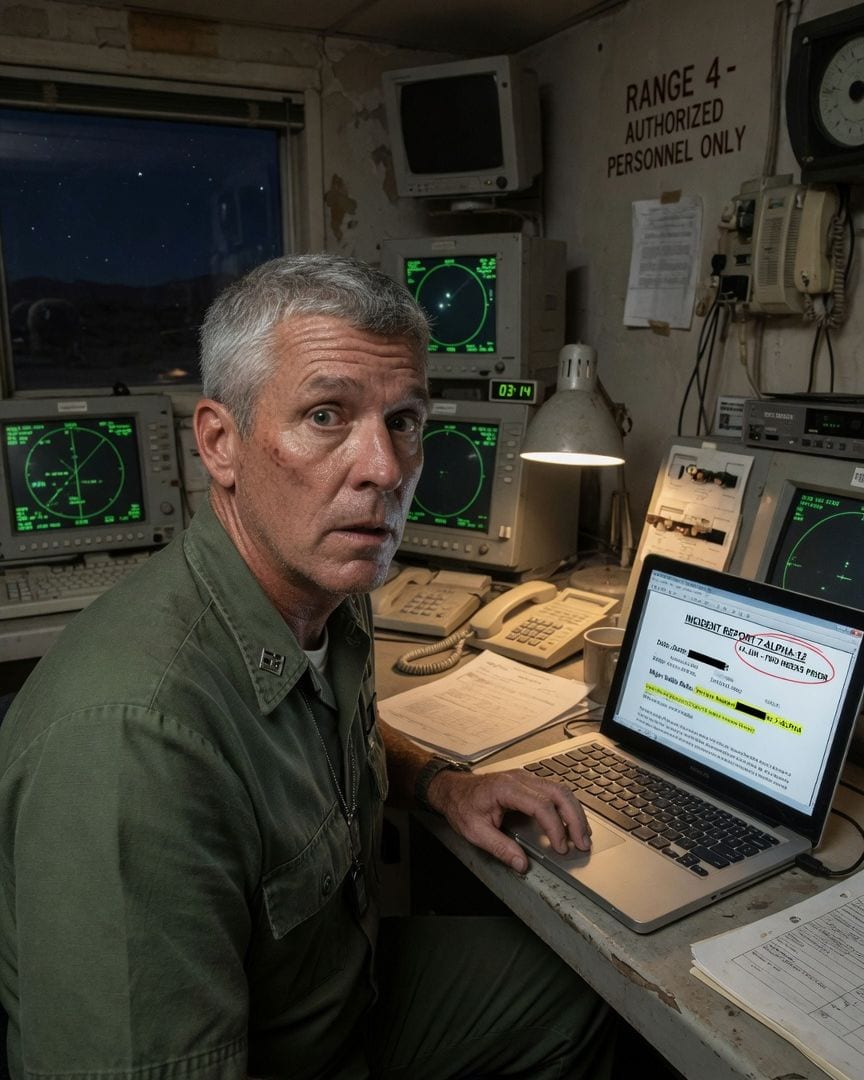
Major Hollis Rake, two weeks from retirement, reported a silent desert disc. His own report was already filed, dated two weeks before it appeared.
Major Hollis Rake, just two weeks from retirement after thirty-five years on a New Mexico desert range, found his predictable world upended. A silent, featureless disc, defying all known phenomena, appeared over the sled rail, its impossible presence confirmed by every instrument on the range. But the true unease began when Major Rake filed his meticulous incident report: it was already in the system, dated two weeks *before* the event even happened. His own name and service number were later found linked to the incident's code in his transfer disposition. Was his retirement just a clerical error, or something far more sinister?
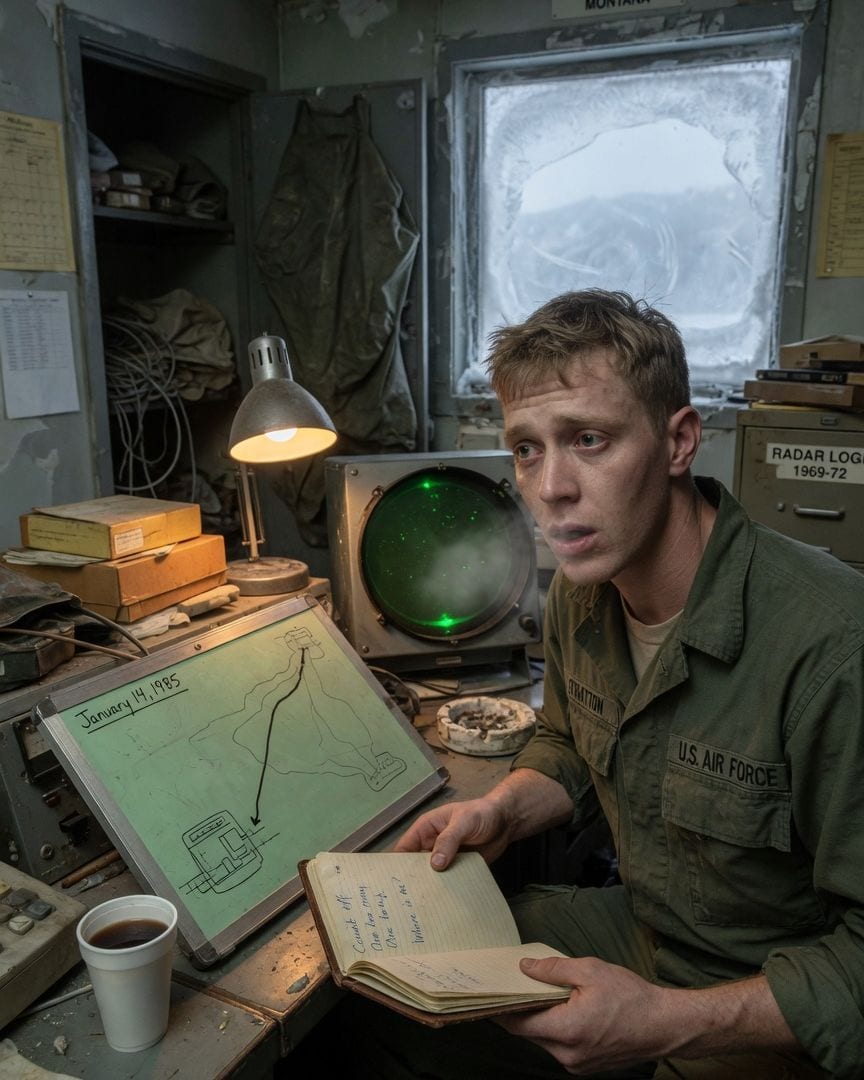
Airman Lars Stratton found an old Cold War manifest listing one name twice: 'Bernard Radcliffe' transferred and 'Bernard Radcliffe' still present.
Airman Second Class Lars Stratton was counting down his final weeks at Echo Station, a desolate Cold War outpost due for mothballing. He longed for home, far from the bitter Montana winds and the constant hum of static. Inside the dim radar shack, he logged the usual nightly ghost blip, a faint contact appearing at 2300, just as it had every winter since 1987. This night, a metallic tang like old blood lingered in the air, raising the hairs on his arms. Seeking distraction, Lars later discovered a leather-bound logbook from 1971, detailing the same 2300 contact, but with chilling notes and a manifest listing one airman's name, Bernard Radcliffe, twice—once transferred, once present. Was he truly alone in the silent, remote station?
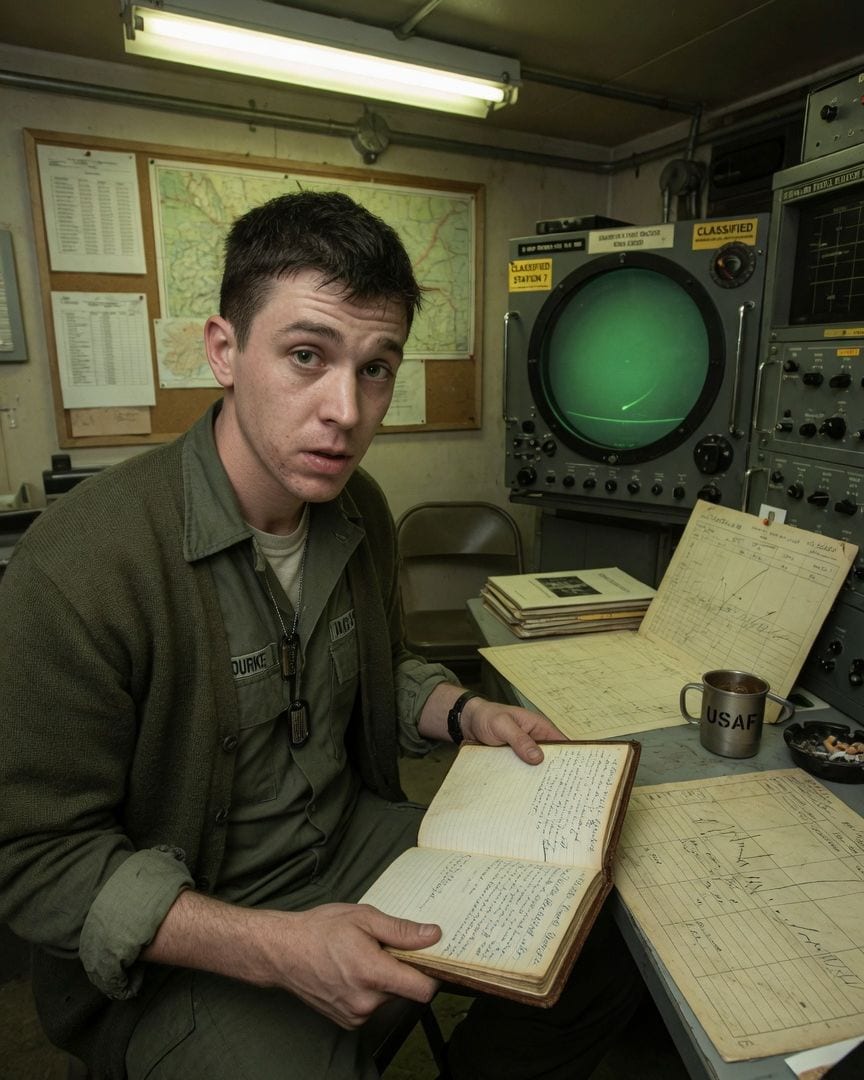
Nearing the end of his tour, Airman Rourke found an old Cold War logbook that named his nightly radar ghost: Airman Gerald Thornton.
Airman Second Class Preston Rourke was nearing the end of his two-year tour at Gap-Filler Station 7, a lonely outpost in the Montana high country. Every night, his radar screen painted a phantom contact, a slow line across the valley floor always dismissed as a temperature-inversion ghost. But while clearing a storage closet, Rourke found old plotting boards from prior winters, each showing the exact same impossible trace, drawn by different hands over successive seasons. His meticulous checks found no weather anomalies to explain the persistent radar ghost. Then, he uncovered a worn, unofficial logbook detailing more radar plots. One entry from 1968, next to an identical trace, contained a date and a name: Airman Gerald Thornton.
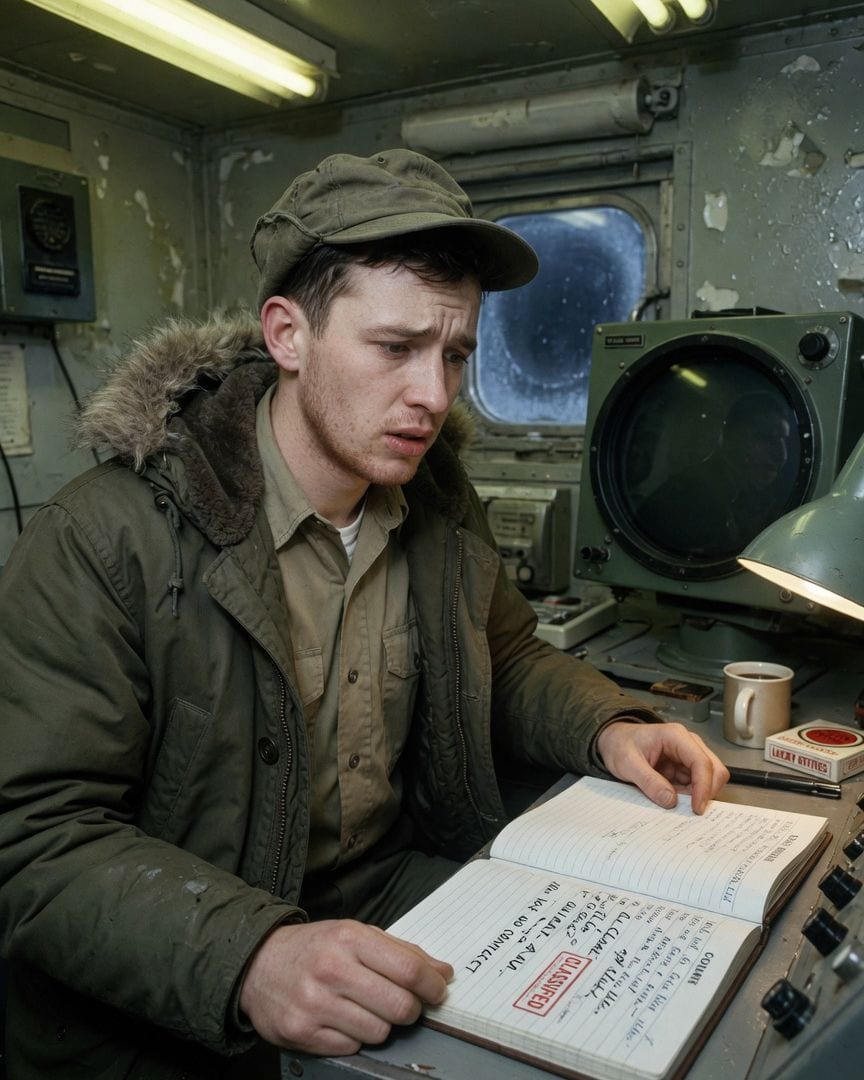
A Cold War airman logs an impossible radar contact on his last sweep. But his official logbook entry is stamped 'CLASSIFIED' and then contradicted by a hastily scrawled 'ALL CLEAR' dated moments before it.
Airman Ordway Vance, 22, manned the radar dome at Site Pellin in the biting North Atlantic dark of January 1962, running the last calibration sweep before its decommissioning. His scope picked up a faint, impossible return, growing closer with each pass, though the ocean remained empty to the eye. When Vance detailed the contact in his official logbook, a 'CLASSIFIED' stamp appeared, followed by a hastily scrawled 'ALL CLEAR' dated moments before his own entry, contradicting his every word. Commander Hartley dismissed it as equipment malfunction, but Vance sensed a chilling, official erasure behind the lie. He soon found a locked cabinet marked 'SITE PELLIN ANOMALIES,' hinting at a deeper truth buried within the base's final days.
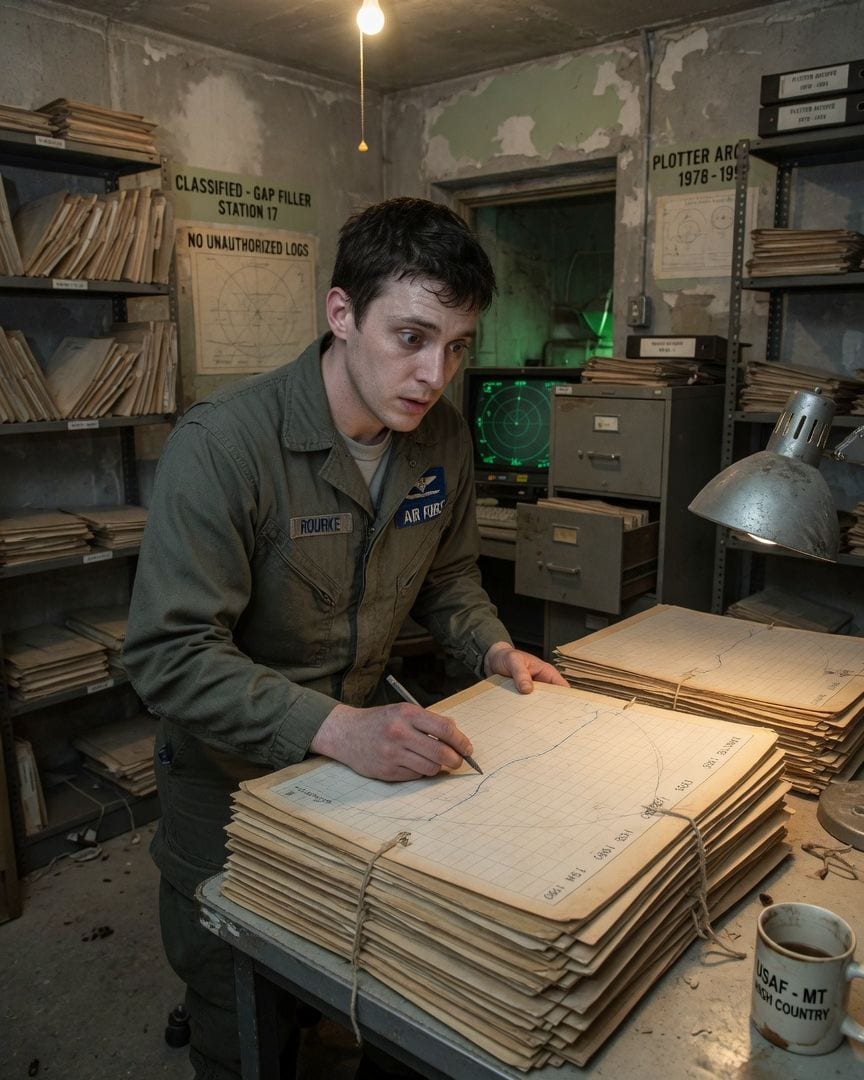
An Airman tracks a nightly radar contact. But in dusty archives, he finds old Cold War plotter boards, each showing that exact same line drawn by other airmen for three winters.
Airman Second Class Felix Rourke endured the cold, quiet nights at his isolated Cold War station, watching the perimeter radar. For three weeks, a single, slow contact appeared at 2300 hours, a precise violation of every protocol that chilled him deeply. He dismissed it as an anomaly, until a hunch led him to a forgotten closet in the dusty archives. There, he unearthed old plotter boards, each revealing the exact same impossible line drawn across the valley floor at the same hour, signed by different airmen from three consecutive winters decades ago. What impossible secret did the mountain station truly hold?
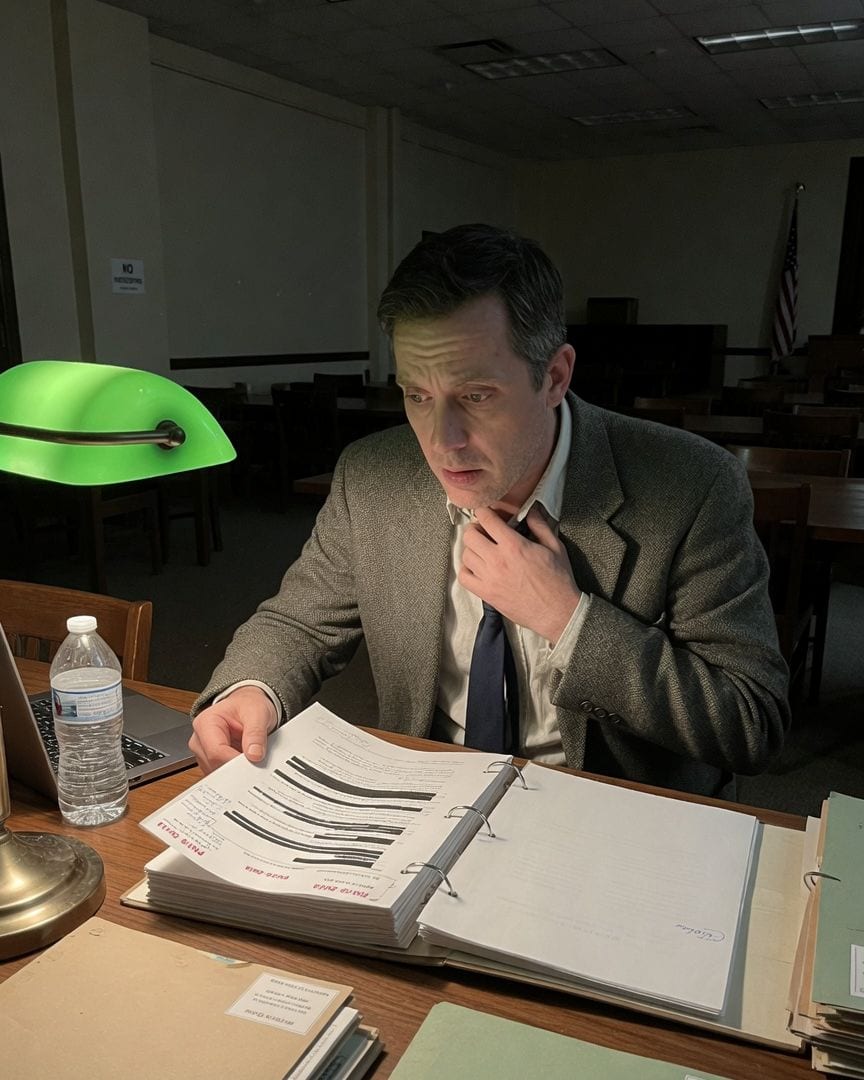
Three hours from his flight home, a researcher found his name on a Cold War project memo, dated his birth year, decades before he was there.
Marcus Threlfall, a 38-year-old researcher, hunched over declassified files in the quiet National Archives, racing against his flight home. A single green lamp on his table cast focused light as he delved into 1946 liaison documents. Deep in a folder, he discovered a debrief transcript dated eleven months in his own future, describing his exact setting and a sudden, intense thirst. Searching for an explanation, he uncovered a heavily redacted 1985 memo from 'Project Nightingale' on 'temporal resonance.' How could his own name appear on a list of potential subjects, dated his birth year, decades before he ever stepped into that room?