My X-ray shows a metal plate and screws in my jaw from a break I don't remember. My old records show a different mouth.
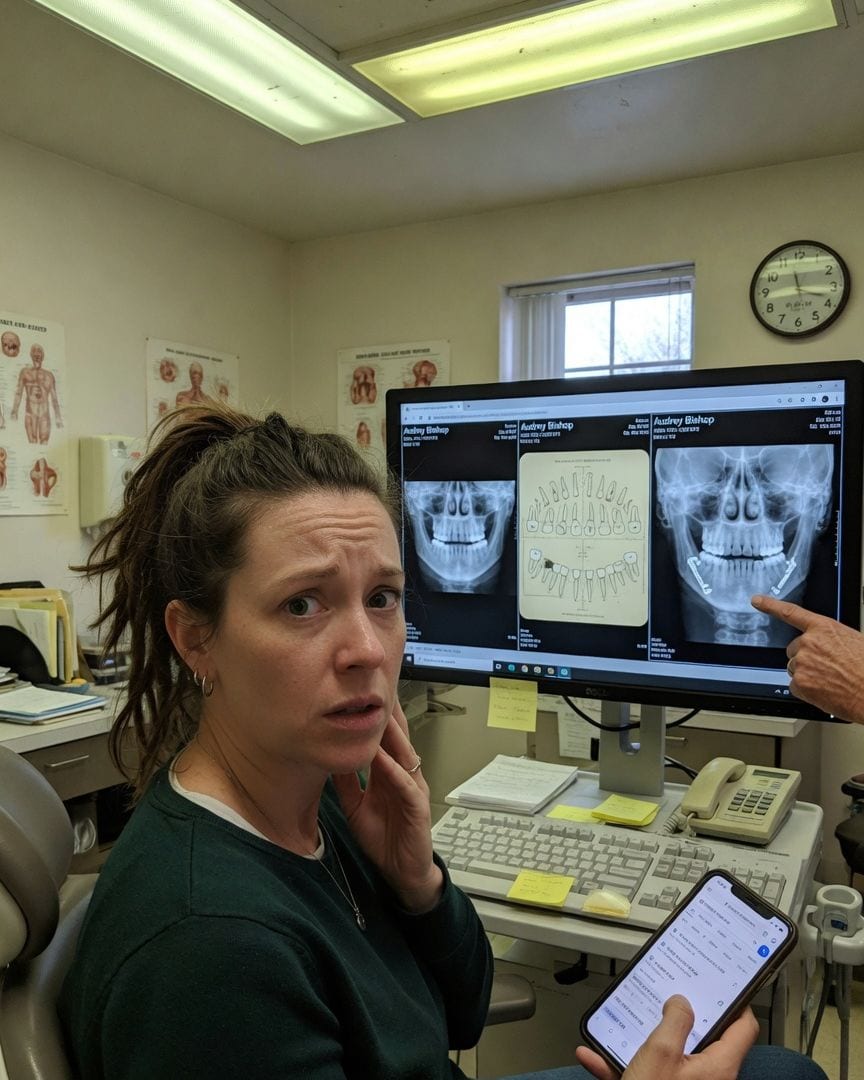
I sat in the sterile chair of Dr. Gideon Montgomery’s oral surgery office, the fluorescent lights humming with an almost imperceptible buzz. I’d come in for a routine wisdom tooth extraction, a mundane procedure I’d put off for months.
Dr. Montgomery clicked through my recent X-rays, his finger tracing a line on the glowing screen. His face, initially focused, shifted to a slight frown.
"So, which hospital wired you shut, Miss Bishop?" he asked, his tone casual, almost conversational.
I blinked, confused. "Excuse me?"
He didn't look up, instead pointing precisely at my jawline on the screen.
There, stark and undeniable, was a clear image of a healed fracture along the angle of my mandible, with a small, almost invisible metal plate and screws now completely encased in solid bone.
It looked decades old, seamlessly integrated into my skeleton.
"This," he continued, his voice now tinged with professional curiosity, "is a serious break. Looks like a clean repair, expertly done, but you must remember it. Weeks, maybe months, with your jaw wired shut. A long recovery."
I felt a sudden, profound chill. I had never broken my jaw. Not once in my thirty-five years. No childhood accident, no teenage mishap, no adult trauma.
I ran a hand along my smooth jawline, feeling nothing but skin and solid bone. The X-ray, however, offered irrefutable proof of a severe trauma I had never lived, a ghost in my own body.
Dr. Montgomery, sensing my genuine confusion, tried to find a mundane explanation. "Are you absolutely certain? Sometimes childhood accidents blur with time, or perhaps you were very young and it was never discussed?"
I shook my head, a strange, cold certainty settling over me. "I remember every major injury, Dr. Montgomery. A broken arm in fifth grade, stitches from a fall off my bike. My jaw? Never."
Dr. Montgomery, professional but clearly intrigued by the medical anomaly, offered to pull up my older dental records from the county archives, just in case a prior dentist had noted it, or an old X-ray might jog my memory.
While we waited for the files to be retrieved, I felt a growing unease twist in my gut. The image on the screen, clear and irrefutable, was a foreign body memory.
I pulled out my phone, my fingers fumbling, searching for articles on 'phantom fractures' or 'medical mix-ups,' trying desperately to find a rational anchor for this impossible reality.
But the plate, the screws, the perfect healing—it was too specific, too real to be a mere error.
Dr. Montgomery returned, a thick, digital file loaded onto his tablet.
"This is your file from when you were a kid, before you moved to the city for college," he said, tapping the screen to display a diagram of a child’s mouth. "Let's see if there's any mention."
He scanned the notes, then frowned deeply. "That's truly odd." He looked from the old chart to me, then back again, a palpable disbelief on his face. "This chart... it's yours, Audrey Bishop, birth date matches.
But the dental work listed here, the fillings, a missing molar... they don't match your current mouth at all. And there's certainly no record of a jaw fracture." The unease amplified into a cold, creeping dread.
This wasn't just a missing memory; it was a missing mouth, a childhood dental history that simply wasn't hers.
Dr. Montgomery scrolled to a different section of the archived file, a digital image of an even older X-ray, labeled unequivocally with my full name and birth date, taken when I was perhaps eight or nine years old.
He zoomed in, the pixels sharpening to reveal a child's developing jaw. "And this," he murmured, his voice barely audible, "this is even stranger."
The image showed a jaw that was pristine, utterly free of any fracture, any plate, any surgical intervention. It was perfectly, normally formed.
He placed a trembling finger on the screen, pointing first to the ghost of my childhood teeth on the old chart, then to the clean, unbroken bone in this earlier X-ray, then to my current X-ray with its undeniable metal.
"This cannot be right, Miss Bishop," he said, his voice low, almost to himself, as if witnessing a violation of fundamental laws.
I stared at the three images: my name, my birth date, three completely different realities of my own body. My heart hammered against my ribs, a frantic drum against the cage of my chest.
The wrongness wasn't just inside me; it was deeply, impossibly written into my entire past.
I left Dr. Montgomery's office in a daze, clutching a referral for a second opinion and copies of my conflicting dental records.
The second oral surgeon, a Dr. Harlow, confirmed Dr. Montgomery’s findings with a similar look of profound bafflement: the jaw fracture was real, old, and perfectly healed, and the lack of memory or corresponding childhood record was an unprecedented medical mystery.
Driven by a desperate need for a rational explanation, I began my own painstaking investigation.
I first visited my childhood dentist's office, now run by a younger practitioner, Dr. Nina Russo.
Dr. Russo, methodical and kind, meticulously searched through archived physical files and digital backups, but found nothing new—just the same conflicting chart Dr. Montgomery had.
I then turned to my parents, asking about any forgotten accidents, any mysterious hospital visits, pushing them with details about the X-ray. They were adamant: I had never broken my jaw.
My mother even produced old photo albums, flipping through pictures of a young me with a gap-toothed smile, then a full set of adolescent teeth, all seemingly normal, none showing signs of injury or recovery.
The disconnect deepened, becoming a chasm. I spent hours cross-referencing dates, hospital records, anything that might explain the disparity.
I found a faint, almost imperceptible scar, a thin line beneath my left earlobe, that I’d always dismissed as a childhood scrape. Now, I traced it, wondering if it was a faint echo of the surgery I never had.
I discovered that the original X-ray had a small, almost unreadable code, a string of letters and numbers, at the very bottom corner. It was too blurry to make out fully, but it seemed to be a unique identifier.
I felt a growing sense of dread. The ordinary world was systematically failing to explain something undeniably present within my own flesh and history.
My increasingly frantic search led me to the county archives, a dusty, quiet building filled with old ledgers and microfiche readers.
I hoped to find records of local hospitals from two decades ago, perhaps a clue about the plate's manufacturer, the specific surgical technique used, or even a news report of an accident that might explain the trauma.
I spent days poring over medical registries and birth records, feeling increasingly like I was chasing a ghost, a phantom limb of my own past.
One afternoon, while reviewing a particularly dense microfiche of hospital admissions from twenty-two years prior, I noticed a man in a tweed jacket, elderly but sharp-eyed, observing me from a table across the room.
He wasn't overtly staring, but his gaze kept returning to me, a subtle, almost imperceptible shift in his posture whenever I looked up.
When I met his eyes, he would quickly avert his own, returning to his own stack of historical newspapers with a practiced nonchalance. The third time it happened, a cold prickle ran down my spine.
I gathered my belongings, feeling exposed and vulnerable. As I left the archives, I saw him talking to Nina Russo, the archivist, their conversation low and serious, their heads close together. The next morning, I received an anonymous email.
It contained a single, grainy image: a detail from my current X-ray, zoomed in on the metal plate in my jaw, with the unreadable code from the bottom corner now digitally enhanced and highlighted.
Beneath it, a short, chilling message in plain text: 'Some things are better left buried.' The man in the tweed jacket, Bernard Hughes, was waiting outside the archives the following morning.
He approached me calmly, a faint, almost pitying smile on his face. "You're looking for answers, aren't you, Miss Bishop?" he asked, his voice soft, unthreatening. "Some answers aren't meant for the living to find."
Shaken but my resolve hardening, I confronted Bernard Hughes. "Who are you? What do you know about my jaw, about those records, and about that email?"
Bernard sighed, gesturing to a nearby park bench beneath a sprawling oak. "My family has been in this county for generations, Miss Bishop. We've seen things. Documented things that the official records can't quite hold."
He spoke with a quiet authority that was more unsettling than any overt threat. "The X-ray, the old dental chart… they’re not mistakes. They are echoes."
He explained, not in a mystical way, but clinically, almost academically, that some bodies—some specific genetic lines—were 'receptacles.' "They hold. They wait. And then, they are… re-inhabited."
He described a cycle, a transfer of consciousness, a 'spark' moving between suitable hosts, often triggered by a severe trauma to the current vessel. "The jaw fracture," he said, looking directly at me, "that was a transfer event.
The previous occupant… they didn't go quietly. There was resistance."
I felt a wave of nausea, a profound sense of unreality. "You mean... I'm not who I think I am? That I'm someone else?"
Bernard shook his head slowly. "You are Audrey Bishop. But perhaps not the first Audrey Bishop in that body. Or the second. The dental chart, the one with different teeth, different fillings—that was another iteration.
A prior self, perhaps, before the jaw trauma forced a change. The body heals, but the record of what was remains. The bone remembers."
He pulled a faded photograph from an inner pocket of his tweed jacket and held it out.
It showed a young woman, perhaps in her early twenties, with a striking resemblance to me, but with a harder, almost wary glint in her eyes. "This was the one before you," he said. "The one who sustained that fracture.
Her name was also Audrey Bishop. She died in an accident, twenty-two years ago, just after the surgery." The pieces clicked into place with horrifying precision.
The faint scar beneath my ear, the X-ray, the conflicting dental records—they were all fragments of a life I had unknowingly inherited, a self that had been simply replaced.
Reeling from Bernard's revelation, I demanded proof beyond his family's 'records' and a single photograph.
Bernard, unperturbed, led me back to the county archives, not to the public section, but to a small, dusty back room he accessed with an ancient, tarnished key.
He explained that his family had maintained a parallel, unofficial record-keeping system, specifically tracking these 'transfer events' through subtle anomalies in public records.
He pulled out a dusty, leather-bound ledger, distinct from the official county books, and flipped to a page marked with my birth year. There, among handwritten entries detailing births and deaths, was an entry for 'Audrey Bishop.'
It listed my exact birth date, but the mother's name was 'Eleanor Vance,' and the place of birth was 'Old Creek County Hospital,' a facility I knew had been defunct for decades, located in a remote, forgotten corner of the state.
Next to the entry was a small, almost imperceptible symbol, a unique glyph. "This is the true record," Bernard said, his voice quiet, almost reverent. "The one that should not exist.
The original Audrey Bishop, born and died on the same day. Her body, however, was deemed a perfect vessel, activated soon after. This particular glyph marks a 'primary activation' – the beginning of a cycle for this vessel."
He then produced a printout from his own pocket: a partial digital medical record of mine from my current general practitioner, displaying a data string I'd seen before, the one from my X-ray, now clearly matching the unique glyph in the ledger.
The implication was clear, a cold wave washing over me.
I was not just a replacement; I was part of an ancient, repeating pattern, and the cycle had begun with my very birth, a record of a life that couldn't possibly be mine, yet bore my name and my unique mark.
Bernard explained that the 'Old Creek County Hospital' was not merely defunct; it was a front, a clandestine facility where certain newborns, identified as 'prime vessels' due to specific genetic markers, were registered and then, if the original infant didn't survive, 'activated.'
Eleanor Vance was indeed the biological mother of the original Audrey Bishop, who had tragically died at birth. Her body, however, was deemed perfectly suitable for the 'spark.'
The unique glyph, Bernard revealed, was a signature, a distinct bio-marker that allowed the 'spark' to imprint itself, essentially rebooting the vessel with a new consciousness.
Each subsequent severe trauma, like my jaw fracture twenty-two years ago, represented a potential 're-activation' or a 'transfer' to a new, compatible host, if the current one was too damaged or too resistant.
In my case, the previous 'Audrey Bishop' had been a particularly strong host, and the entity had chosen to remain in the same body after the jaw trauma, simply replacing the consciousness.
"You are the latest iteration," Bernard stated, without judgment, his eyes holding an ancient weariness. "The body remembers, even if the mind doesn't.
The X-ray, the dental charts, the faint scar beneath your ear—they are all physical memories of the lives lived within this vessel, ghosts of previous selves that persist in the bone and tissue."
He showed me more entries in the ledger, similar glyphs alongside other names, spanning centuries, all linked to the same regional pattern.
It wasn't a monster; it was a process, a chillingly precise natural phenomenon that had been quietly observed and documented by his family for generations.
I was not unique; I was merely the current chapter in an ancient, biological book, a vessel sailing on an inescapable current.
The full truth settled over me, cold and heavy, a vast, crushing weight. Bernard, 'the one who knew,' offered no solace, only the implacable weight of facts.
He reiterated that his family's role was merely to observe, to ensure the records were kept, to understand, never to interfere.
"The spark will move when the vessel is compromised beyond repair, or when its time is simply done," he said, his gaze unsettlingly steady, devoid of pity. "It seeks continuity, Miss Bishop. It seeks life."
I felt a profound sense of violation, of being a mere passenger in my own skin, my very existence a borrowed one.
I demanded to know if there was a way to stop it, to escape this terrifying cycle, to reclaim my own, unique self. Bernard merely shook his head, a gesture of quiet finality. "The body is the vessel.
The spark is simply life, finding its way. You are alive now. That is all there is. There is no escape from what you are." He stood, indicating our conversation was over.
As he turned to leave the dusty room, he paused at the doorway, his silhouette framed against the dim light of the archives. "There's one more thing," he said, his voice barely a whisper, yet it cut through the silence.
"The previous Audrey, the one with the jaw fracture… she fought it. She tried to resist the transfer, to hold onto her self, to push the spark away. It was a violent struggle, hence the fracture."
I felt a sudden, sharp pain in my jaw, a phantom ache that momentarily stole my breath. I looked at Bernard, a dawning horror in my eyes. "What happens if I fight it?" I asked, my voice trembling, barely audible.
Bernard offered a small, sad smile, a flicker of something ancient in his eyes. "The vessel remains. The spark finds its way."
He then pointed to a faint, barely visible red mark on my left wrist, a small, almost perfectly circular impression, no bigger than a dime. "That mark appeared on the previous Audrey's body just before the final transfer.
A small, almost invisible sign of the spark preparing to move on, to find its next home." I looked down at my wrist, where the faint, circular mark now pulsed with a dull, almost internal heat, a silent, terrifying countdown.
I returned to my apartment, the world a blur of new, terrifying coherence. Every ache, every fleeting thought, every old photograph of myself now seemed to hold a different meaning, a different echo of lives lived through me.
I avoided mirrors, afraid of seeing a stranger in my own eyes, or worse, a composite of those who came before.
The small, circular mark on my wrist remained, a constant, low thrum against my skin, a persistent reminder of the inevitable.
I deleted my social media accounts, disconnected from friends, my vibrant life shrinking to the confines of my apartment and the cold, hard reality of my borrowed existence.
I found myself obsessively researching historical trauma, looking for patterns, for any mention of similar 'marks' or unexplained body anomalies, a desperate, futile attempt to understand what I was.
The dread was no longer an external threat; it was a quiet, internal countdown, a clock ticking within my own flesh.
The mark on my wrist began to deepen in color, a faint, reddish-brown circle, no bigger than a dime, a living brand.
I tried to ignore it, to live a normal life, but the knowledge, the absolute certainty of what resided within me, was a constant, suffocating presence. I felt myself slowly detaching, observing my own actions from a slight distance.
One morning, I woke up to find the mark had faded completely, leaving only smooth, unblemished skin. A profound, unsettling calm settled over me, a quiet peace that felt entirely foreign.
I felt strangely light, unburdened by the crushing weight of my discovery. I looked at my reflection in the bathroom mirror. Her eyes seemed clearer, sharper, her gaze holding an unfamiliar depth.
A faint, almost imperceptible smile touched her lips, a serene curve she didn't quite recognize. She picked up her phone, opened Facebook, and began to type a new post, her fingers moving with an unfamiliar confidence, a new purpose.
The final line of her post simply read: 'It's a beautiful day to begin again.'
Audrey Bishop’s friends noticed her sudden, vibrant return to social media, her posts full of an unexpected, almost unnerving energy. Her apartment was spotless, her demeanor serene, her eyes sparkling with a new, almost predatory light.
When her neighbor, Nina Russo, commented on her renewed vigor, Audrey simply smiled, a faint, almost imperceptible gleam in her eyes. "I feel like a whole new person," and I mean it.
If this one got to you
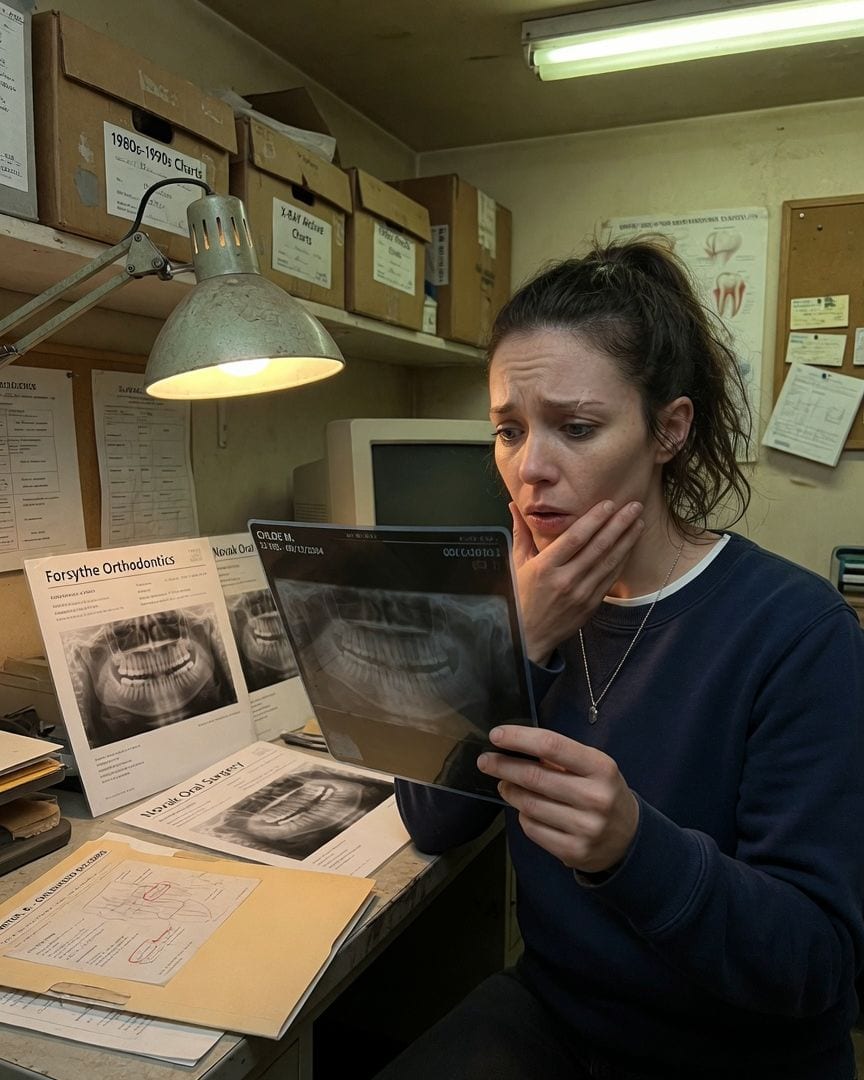
My jaw X-ray shows old surgery plates. I have no scars. I've never had jaw surgery.
My orthodontist pointed to my X-ray, revealing faint, metallic surgical plates embedded in my upper jawbone. I'm thirty-two years old and know, with chilling certainty, that I have never had jaw surgery in my life. The plates are undeniably there, deep inside my bone, but they don't belong to my memory.
My MRI scan shows metal rods fused into my neck vertebrae. I've never had spinal surgery. The clinic doctor personally called, asking which hospital placed them.
I booked a full-body MRI for my 34th birthday, expecting a clean bill of health. Instead, the scan revealed a perfectly healed surgical fusion in my neck, complete with tiny rods and screws. I have no memory of any such surgery, no scar, and nothing in my medical history.
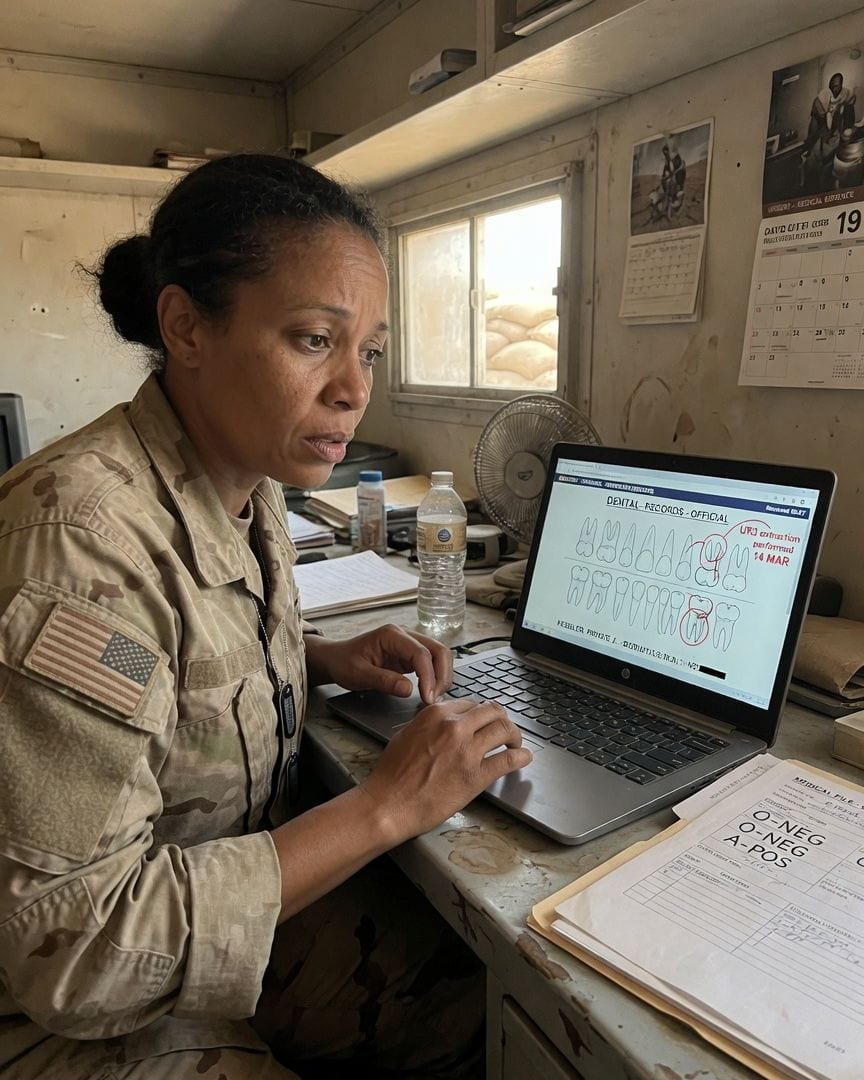
Weeks from going home, Sergeant Whitmore saw Private Kessler’s dental records show teeth he didn’t have and missing ones he did.
Sergeant First Class Iris Whitmore counted the weeks until her deployment ended, dreaming of home as the desert heat baked FOB Cerberus. But the familiar weight of Private Kessler’s dog tags soon brought a cold knot of dread: his blood type, once O-negative, suddenly read A-positive. She dismissed medical anomalies and clerical errors, only to find his official records subtly rewriting his timeline, linking old injuries to new identities. When his dental charts arrived, showing teeth he never had and missing ones he did, Sergeant Whitmore faced an impossible question: who was Private Kessler, really?
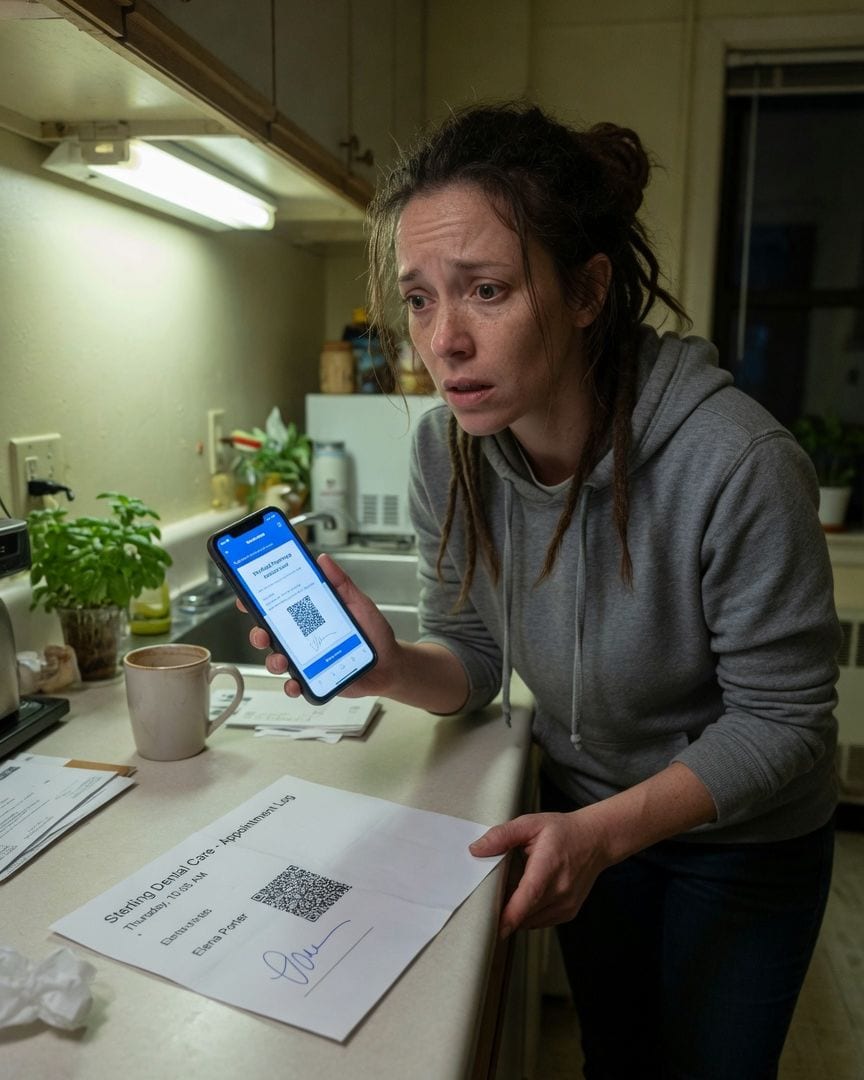
My dentist's system says I was there last Thursday. I wasn't. But the check-in tablet shows my signature, and the hygienist described my chipped tooth exactly right.
I received a call confirming a dental appointment I never made, for a day I was home. Yet, Sterling Dental had my perfect digital signature and described a chipped incisor I’d never told them about. The physical proof insisted I was there, but I wasn’t.
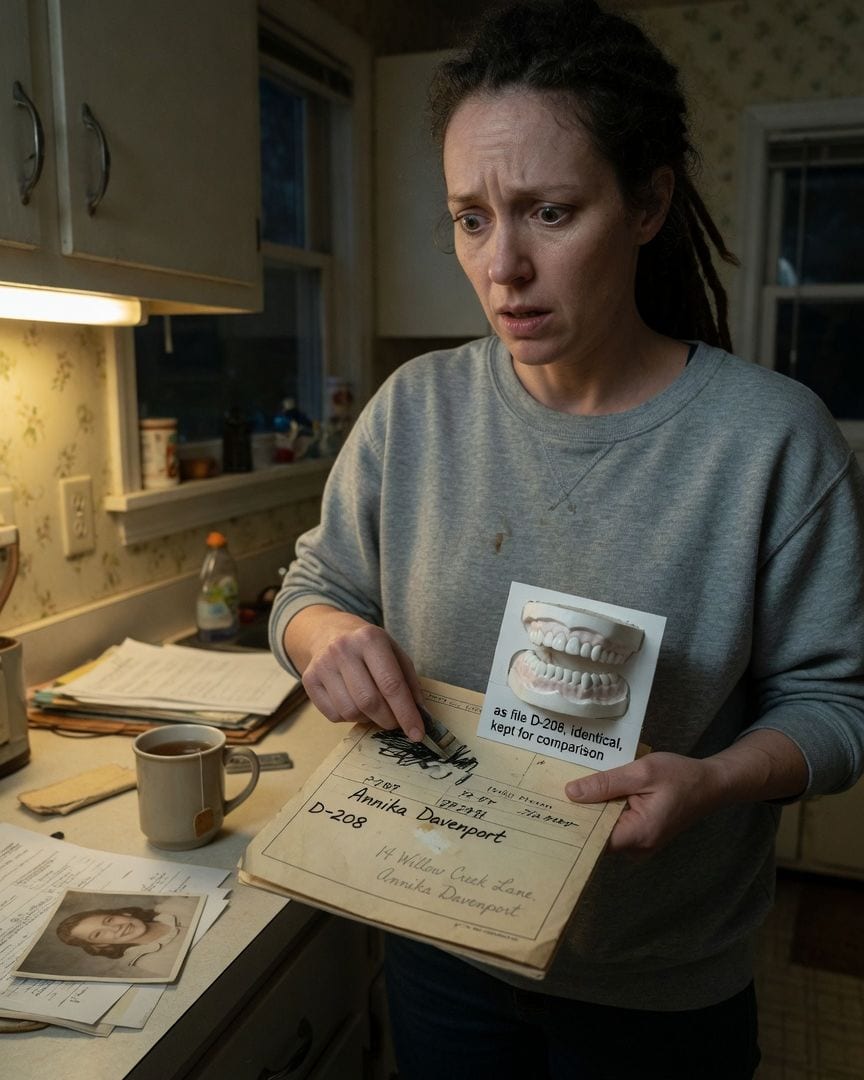
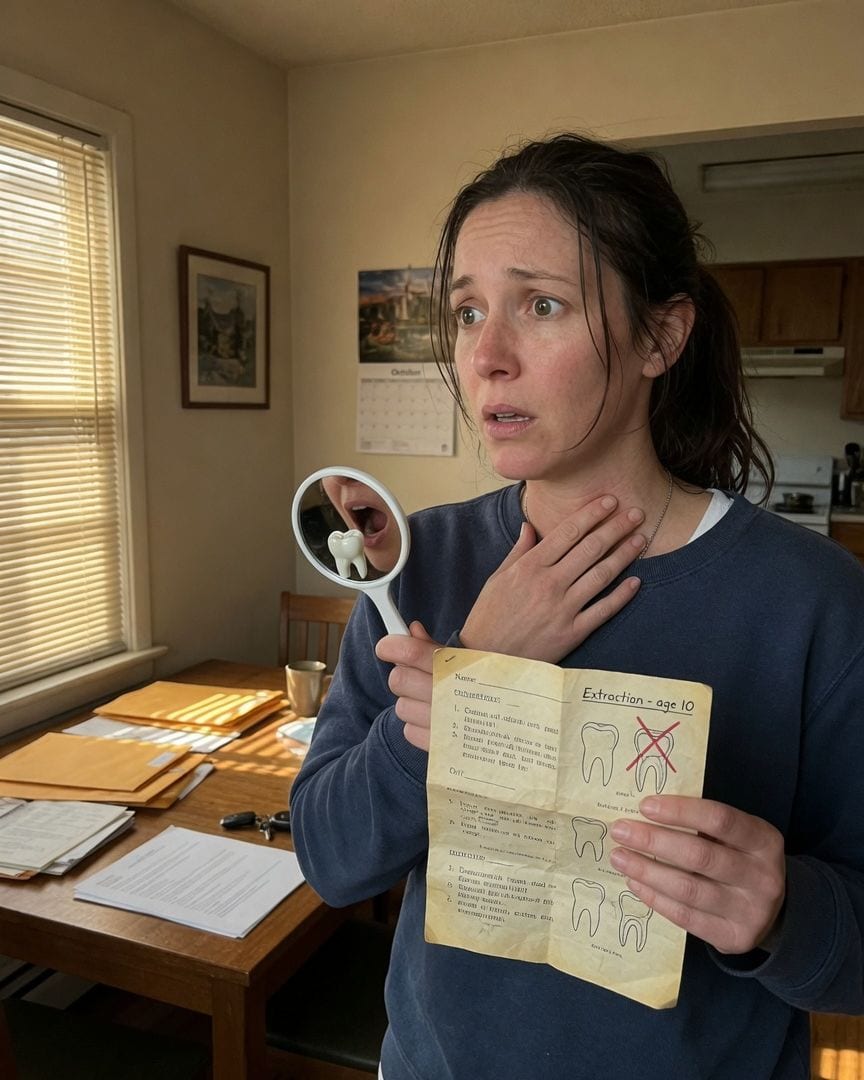
My childhood dental chart lists the house I bought last year — in my own name, years before I was born. A second set of my teeth sits filed beside it, marked 'identical.'
Sifting through old dental records, I found my chart, D-208, with my 1988 birth date. But a line from 1958 was blacked out, and a clipped card with an impression of my teeth listed my name and current home address, decades before I was born. The impossible facts knotted into a cold certainty.
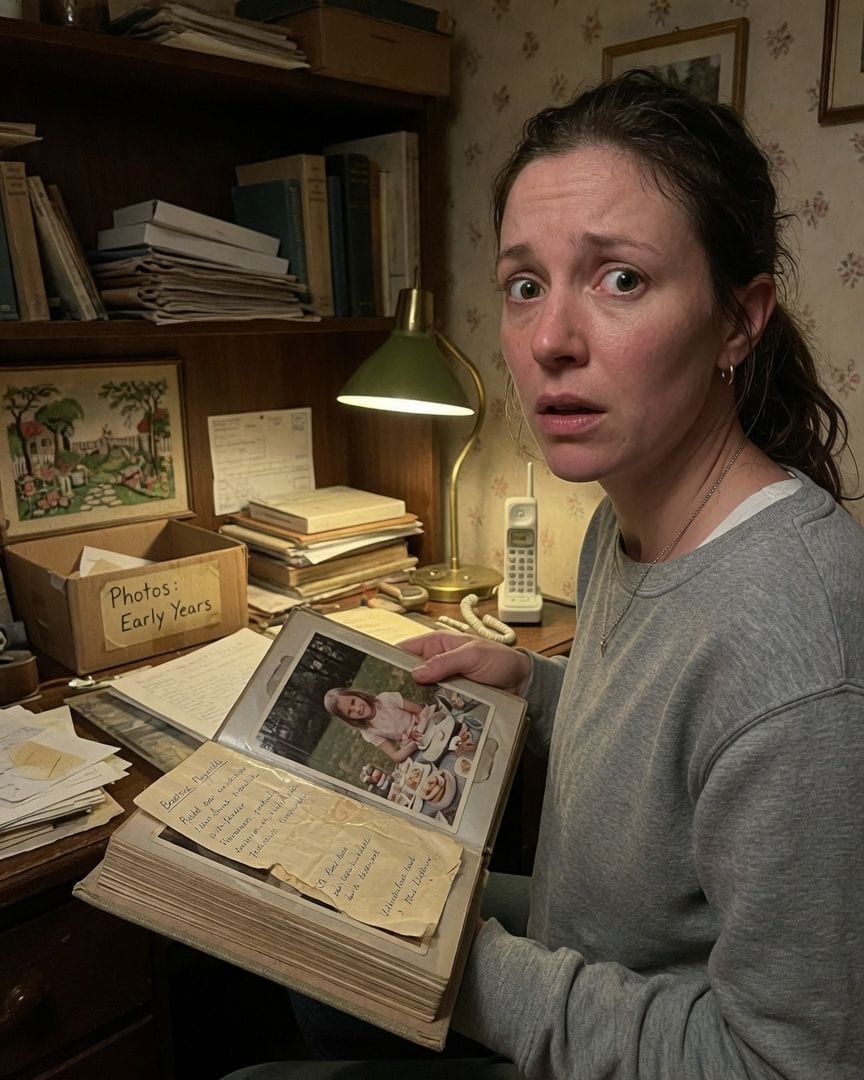
My mother's right ear has been partially deaf since she was eight. Now she's talking on the phone with it.
My mother, Beatrice, is finally back after five days, but my relief is curdling. She's using her right ear for phone calls, the one that's been partially deaf since she was eight. A new doctor confirmed her right ear was perfect, her left ear weaker, completely contradicting my lifelong memory.