My MRI scan shows metal rods fused into my neck vertebrae. I've never had spinal surgery. The clinic doctor personally called, asking which hospital placed them.
The whole thing started as a birthday gift to myself. Thirty-four felt like a good age to get serious about wellness, so I booked a full-body MRI at Ellsworth Diagnostics. A complete health scan, head to toe.
The initial report came back clean, a relief, a confirmation that I was, for all intents and purposes, a perfectly normal 34-year-old woman. I went back to work, forgot about it.
Then, Dr. Desmond Langford called me directly. He was the clinic’s senior physician, a man whose voice I remembered from the consultation as calm, reassuring. Now, it was different—subdued, almost hesitant.
He opened with an apology, then delivered the news: the scan had flagged something unusual. A perfectly healed surgical fusion of my C5 and C6 vertebrae in my neck. Complete with tiny, almost invisible rods and screws.
I remember standing in my kitchen, phone pressed to my ear, the late afternoon sun slanting through the window. My neck felt fine. It moved freely, no stiffness, no phantom ache. I’d never had spinal surgery.
No accident, no major trauma, no scar, nothing in my medical history. I told him this. There was a pause on his end, a quiet inhale.
"Ms. Porter," he said, his voice dropping slightly, "the imaging is unequivocal. The hardware is there. And it's fully integrated. We need to know which hospital performed this procedure. Can you check your records?
Perhaps there's a file from a childhood incident you've forgotten?"
His tone wasn't just a query; it was an expectation. An assumption that I should know, that this was simply a forgotten detail of my own life. But it wasn't. There was nothing.
Just the chilling image of the scan, now seared into my mind: intricate, alien metalwork embedded in my own bone, a secret architecture beneath my skin that my own memory refused to acknowledge.
A glitch, I told myself, clutching at the mundane explanation. A mix-up. My file swapped with someone else's. Dr. Langford’s insistence, though, had burrowed deep. It wasn't the kind of error a reputable clinic would make.
Not on something as definite as surgical hardware. To rule out any other impossible anomalies, to prove it was just a fluke, I requested my complete childhood medical and dental records from my pediatrician and family dentist.
It took a few days, a few phone calls, but eventually, a thick manila envelope arrived, heavy with its contents.
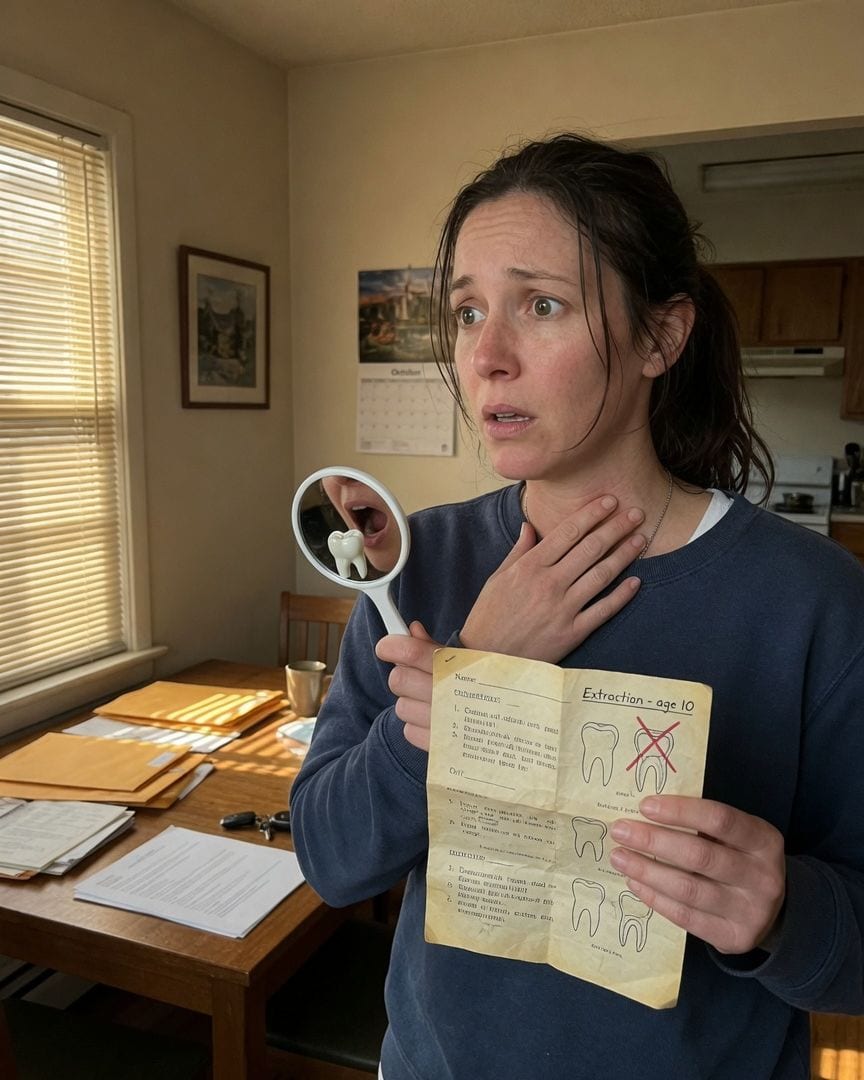
I laid the pages out on my dining table, the afternoon light illuminating the yellowed paper. My heart thudded a slow, anxious beat against my ribs.
Everything else seemed normal enough – childhood vaccinations, a scraped knee at age seven, a bout of the flu. All the boring, unremarkable history of a regular kid. Then I reached the dental chart, dated from when I was ten.
It was a standard diagram, neatly drawn, each tooth represented, some marked with tiny 'F's for fillings. My eyes fixed on the upper right quadrant, on the rows of molars. There, over one of them, was a clear, unambiguous 'X'.
Extraction. Missing tooth.
My breath hitched. I knew, with a chilling certainty that went deeper than memory, that all my molars were present. I always had a full set.
I ran my tongue over the smooth, unbroken line of my teeth, then back to the diagram, my finger tracing the stark, impossible blank space. No missing tooth. Not now, not ever that I remembered.
I got up, walked to the bathroom, and pulled out a small dental mirror I kept for hygiene checks. I angled it, shining the light, meticulously examining the spot. It was undeniably there. A natural, healthy molar.
No filling, no cap, just my own tooth. The chart was wrong. Or my mouth was. The mundane explanation – a clerical error, a misremembered tooth – felt flimsy, crumbling under the weight of my own physical reality.
My own body was betraying the story of my life.
I stood frozen in my bathroom, the fluorescent light harsh on my face. In one hand, the yellowed dental chart, the 'X' a stark, impossible pronouncement.
In the other, the small dental mirror, reflecting the solid, undeniable presence of the molar. My gaze flickered between the two, then locked onto my own wide, disbelieving eyes in the main mirror.
The smooth curve of my jaw, the familiar line of my chin, suddenly felt alien, a mask I had worn without question for 34 years.
I pressed my fingers against my neck, just above my collarbone, a phantom ache blooming where the invisible rods were supposed to be. My own body was a contradiction, a lie.
I was looking at myself, but seeing two different people.
The dental chart and the MRI. Together, they were too much to dismiss. Two impossible physical facts, each contradicting the established narrative of my life. I couldn't just brush them off as clerical errors anymore.
I needed answers, directly from Ellsworth Diagnostics, but not as a patient looking for reassurance. I needed to understand their record-keeping, how such discrepancies could arise.
I scheduled a follow-up with Dr. Langford, armed with my childhood dental chart. He met me in his office, a sterile room where the monitor glowed with a faint, almost sickly light.
I laid out the chart, pointing to the discrepancy. He listened patiently, his expression unreadable, a medical mask of professional calm.
"Ms. Porter," he said, gesturing to the 'X' on the diagram, "childhood dental records can be… imperfect. A temporary molar mistakenly marked, perhaps. Or a simple clerical error from your dentist's office. It happens."
He spoke with the easy confidence of someone who dealt with anxious patients daily.
He reiterated that his clinic stood by their MRI findings, that the fusion was undoubtedly present, but offered no further explanation for why I wouldn't know about it.
He just repeated, almost robotically, that medical history could be more complex than memory.
I left his office more frustrated than before. He’d ruled out the dental anomaly as a simple error, but the MRI remained, a solid, inexplicable fact. I needed a different angle, something that didn't rely on their internal explanations.
I ordered a comprehensive home DNA kit, ostensibly for ancestry and health predispositions. Maybe it would reveal a genetic marker for a rare skeletal condition, or even a familial history of spinal issues that I was unaware of.
It felt like a long shot, but I was grasping at any rational explanation left.
While waiting for the results, I researched Ellsworth Diagnostics itself. It was a venerable institution, founded in the 1960s.
Digging through old articles and public records, I found a mention of their extensive archives, overseen by a long-serving employee named Maureen Jennings. An archivist. Someone who might know the deep history, the quiet corners where forgotten files resided.
I called the clinic, feigning interest in an old family friend's medical history from decades past, hoping to gain access. Maureen, a woman with a surprisingly sharp memory, agreed to meet.
Her voice was calm on the phone, but with an undercurrent of something I couldn’t quite place, something almost… knowing.
I felt a thread, thin but tangible, pulling me deeper into the clinic's quiet history, away from its sterile, modern present.
Maureen Jennings, a small woman with silver hair pulled back in a neat bun, met me in the quiet, dust-mote-filled archive basement of Ellsworth Diagnostics.
The air hung heavy with the scent of old paper and disinfectant, the kind that never quite masked the underlying mustiness of decades. Fluorescent lights hummed overhead, casting a dull yellow glow on towering shelves packed with labeled boxes.
Maureen didn't look up from a faded ledger she was poring over as I explained my concocted story about a 'family friend' from the 70s.
"Some records are… complex," Maureen murmured, her voice barely audible over the hum of the lights, her finger tracing a line on the aged paper. "They tell stories the living don't always remember."
I pressed, my voice a little too loud in the silence. "I was hoping for any information on unusual procedures from back then. Patient transfers, perhaps? Things that might have been... out of the ordinary?"
Maureen finally looked up, her blue eyes, startlingly bright in her wrinkled face, piercing through me. "Curiosity can be a heavy burden, dear. Especially when it concerns the past. Some things are best left undisturbed."
She didn't look angry or even annoyed, just… resigned. She then pulled out a thick, leather-bound volume from a shelf behind her, not for me, but for herself. Its pages were filled with meticulously handwritten entries, dates from the 1980s.
She opened it carefully, the binding creaking.
Maureen traced a finger down a column of names. "We've always prided ourselves on providing… continuity," she said, her eyes still on the page. "For certain cases where a life needed a second chance, a new frame."
She closed the book with a soft thud, the sound echoing in the archives, and finally, her gaze fixed on me. "You wouldn't want to uncover something that changes everything you thought you knew about yourself, would you?"
The question hung in the silence, not a threat, but a subtle warning that chilled me more than any direct accusation. The air in the room suddenly felt cold, making my skin prickle.
Maureen knew, or suspected, what I was truly searching for.
The next day, I abandoned all pretense. I called Maureen Jennings and told her I was coming back, and that I wasn't leaving until I had real answers. She didn't argue.
When I arrived, she was waiting for me in the same basement archive, the air heavy with unspoken history. I laid out the MRI scan results, the detailed images of the fused vertebrae and tiny rods.
Then I placed my childhood dental chart next to it, the impossible ‘X’ glaring up from the page. Finally, I looked at her, my voice tight. "You know something about this, don't you? What did you mean, 'continuity'?
'A new frame'?"
Maureen didn't flinch. Her composure was unsettling, almost serene. "You're not the first to feel the echoes, dear," she said, her voice soft, almost sympathetic. "Ellsworth Diagnostics has always been at the forefront of… restorative medicine.
Decades ago, before your time, we pioneered a program. For individuals whose bodies were irreparably damaged, but whose… essence, their unique pattern of life, warranted preservation. Especially for those without family, without a trace to claim them."
My breath hitched in my throat. The room felt suddenly too small, too close. "What are you saying?" I managed to ask, my voice barely a whisper. "That my body belonged to someone else?"
Maureen nodded slowly. "Not 'belonged.' It was… re-integrated. A new vessel, a clean slate, for a life to continue. The body remembers, even when the mind is given a new narrative.
The healed spine, the dental work… those are traces of the original structure. Necessary repairs, before the new imprint."
She turned from me and walked to a locked cabinet behind her desk. She retrieved a microfiche from inside, its surface dull and grey, sliding it into an antique viewer that hummed to life.
On the screen, a blurred intake form from 1983. My eyes scanned the faded type. 'Catherine Blackwood,' I read, my throat tight. The form detailed severe spinal trauma, dental reconstructions. It listed a birthmark just below the left earlobe.
The pieces began to click into place with a horrifying precision. The MRI, the dental chart, Maureen’s cryptic words about 'continuity' – it was all suddenly, impossibly coherent.
My own body was a living archive, a second-hand vessel carrying the ghost of a prior occupant’s medical history.
I stumbled out of the archives, the image of Catherine Blackwood's intake form, the mention of her birthmark—my birthmark—seared into my mind.
The air outside felt too thin, too bright, assaulting my senses after the dim, dusty quiet of the basement.
I drove home in a daze, Maureen's words echoing in a sickening loop: 'A new vessel, a clean slate, for a life to continue.' It was a phrase meant to soothe, but it only amplified the dread.
As I fumbled with my keys, unlocking my front door, my phone pinged. It was the email I’d been dreading and anticipating with a perverse certainty: 'Your DNA results are in.'
My hands trembled so violently I almost dropped the phone. I pulled open the attachment. The report was extensive, a cascade of genetic data, but my eyes immediately found the 'Genetic Match' section.
It wasn't a distant cousin or an unexpected relative. It was a 100% match to 'Catherine Blackwood.' Not a descendant, not a relative, but the Catherine Blackwood, listed with a date of death from 1983.
The clinical certainty of the lab report, the name, the date – it slammed into me with the force of a physical blow. Her body wasn't just like Catherine's; it was Catherine's.
I stood in my living room, the report glowing on my phone, the impossible truth now undeniable. I was looking at my own name on a death certificate, decades old, in a cemetery just across town.
The DNA match to Catherine Blackwood annihilated any lingering doubt. There was no room for error, no space for a clerical mistake. My genetic identity was identical to a woman who had died over forty years ago.
I found Catherine’s obituary online, a grainy newspaper clipping from 1983. It mentioned a tragic accident, severe injuries.
A small, black-and-white photo accompanied it: a young woman, perhaps in her early twenties, with a faint, almost imperceptible birthmark just below her left earlobe—the exact same birthmark I had always taken for granted.
I saw the same high cheekbones, the same slight curve to the nose. Emily Porter wasn't just inhabiting Catherine's body; she was Catherine's body.
The spinal fusion, the dental work—all meticulously documented in Catherine’s old medical files, now manifested in Emily’s physical form. Maureen had been right; the body remembered, even when the mind was given a new narrative.
Ellsworth Diagnostics, under the guise of 'restorative medicine,' had taken an unclaimed, severely injured body, repaired it, and then, somehow, 'imprinted' a new identity onto it—Emily Porter. The realization wasn't a sudden shock, but a chilling, slow-motion unraveling.
Every scar, every ache, every physical detail I'd ever taken for granted was now recontextualized. I wasn't born Emily Porter; I was made Emily Porter, a new life built upon the foundation of another's tragedy.
The pattern snapped into place with a horrifying click: I had always been inside it, unknowingly living a borrowed existence.
I returned to Ellsworth Diagnostics, this time demanding to speak with Dr. Langford. I was beyond polite requests.
I held the DNA results in one hand, Catherine Blackwood's grainy obituary photo in the other, and my own MRI scan report tucked under my arm.
Dr. Langford met me in his office, the same sterile room where he’d first dismissed the dental anomaly. He listened, his hands clasped on his desk, his expression calm and unbothered. He didn't interrupt, didn't flinch.
When I was done, he nodded slowly.
"A rare circumstance, Ms. Porter," he said, his voice flat, devoid of emotion. "Catherine Blackwood had no next of kin. Her injuries were catastrophic, but the underlying biological framework… robust.
Our program offered a unique solution: a chance for a form of continuity, a new life, unburdened by past trauma."
He spoke of it with clinical detachment, as if discussing a successful organ transplant, or perhaps a particularly complex repair to a piece of machinery. "You were an orphan, Ms. Porter, a perfect candidate for a fresh start.
A clean slate, as Maureen put it. We ensured the new identity was complete, your memories authentic to your life. The physical remnants were… an unforeseen side effect, perhaps. But harmless."
I felt a cold rage, then a profound emptiness that threatened to swallow me whole. I wasn't a person; I was a project. A vessel. "How many others?" I demanded, my voice shaking despite myself.
"How many other 'clean slates' are walking around?"
Langford's expression remained placid. "Our protocols were always stringent. Ethical, within the parameters of the time. You are… a success, Ms. Porter." There was no escape, no fight left in me.
The truth wasn't something to be overcome; it was my cage, carefully constructed and sealed shut before I even knew I was inside.
I left the clinic, the city lights blurring around me, a profound sense of dislocation settling deep within my bones. I was alive, but the 'who' of it had been irrevocably altered.
I tried to resume my life. My job, my friends, my apartment – they were all still there, untouched by the seismic shift within me.
But I saw them through a new, fractured lens, as if viewing a familiar painting through cracked glass. I visited Catherine Blackwood's grave, a simple stone in an old, quiet cemetery just outside town.
I stood there for a long time, a stranger mourning the original inhabitant of my own body, watching the wind rustle through the autumn leaves. The world moved on, oblivious to the monstrous coherence of my existence.
Ellsworth Diagnostics continued its work, a venerable institution with a dark, quiet history hummed into its foundations. Dr. Langford and Maureen Jennings remained, guardians of secrets I now shared, and that now defined me.
The answers had come, but they offered no peace, only a profound, unsettling knowledge that settled like a permanent weight.
The dread didn't fade; it simply changed, settling into the marrow of my bones. I found myself scrutinizing faces in crowds, wondering if other 'clean slates' walked among them, carrying the echoes of forgotten lives, their own borrowed existences.
I avoided mirrors for a time, then sought them out, searching for Catherine's ghost in my own features, the subtle shifts I now perceived, the birthmark that now felt less like my own and more like a brand.
The knowledge was a constant companion, a silent, internal scream. I was Emily Porter, but I was also a living memorial to Catherine Blackwood, a vessel for a life that refused to end.
Sometimes, when I catch my reflection, I wonder which of us is truly looking back.
If this one got to you
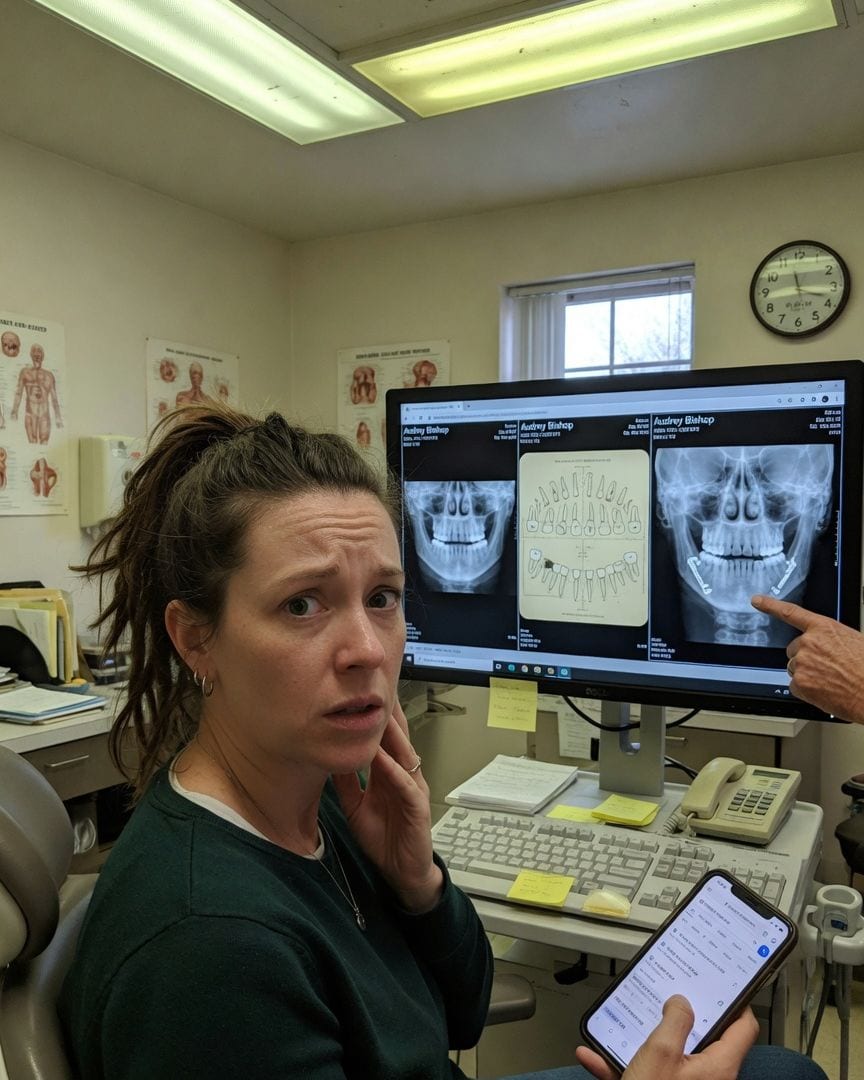
My X-ray shows a metal plate and screws in my jaw from a break I don't remember. My old records show a different mouth.
During a routine wisdom tooth extraction, my oral surgeon found a perfectly healed, decades-old jaw fracture in my X-ray. It came with a small metal plate, completely encased in bone. But I'm 35 years old, and I have no memory of ever breaking my jaw.
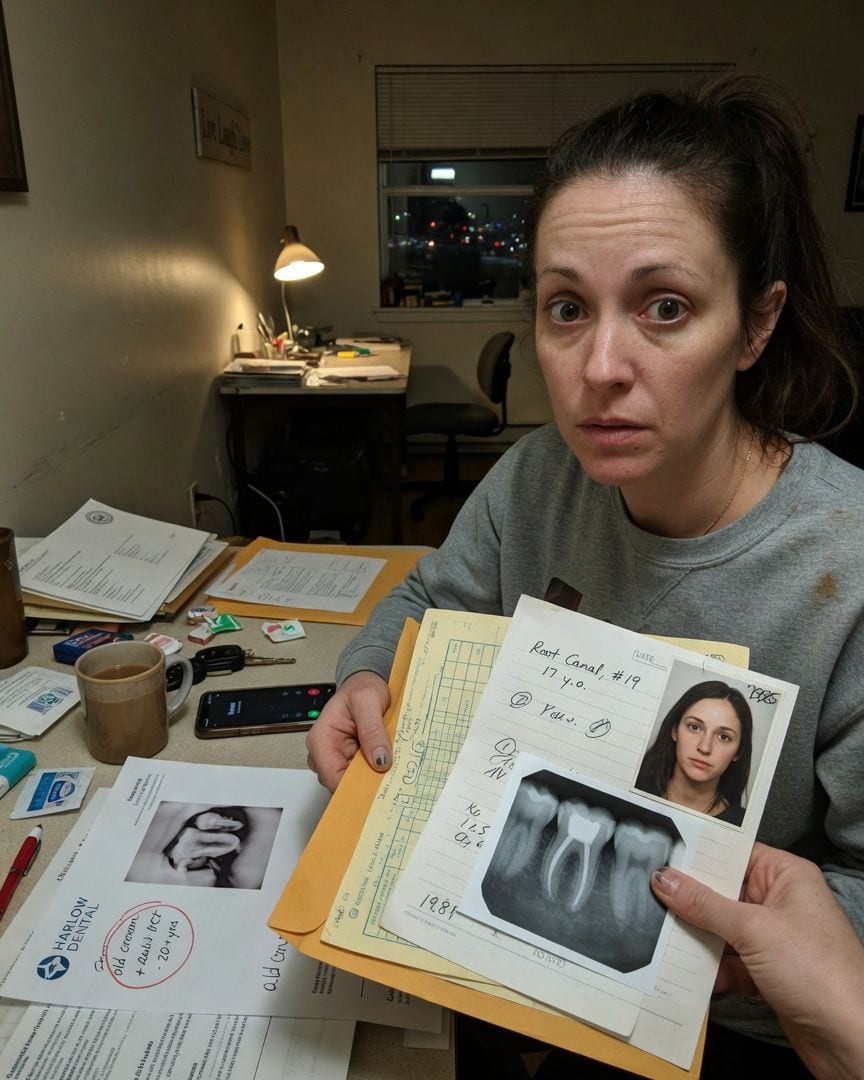
My lower molar has a twenty-year-old root canal. My new dentist showed me the scan. That tooth is whole. I can feel it.
My new dentist found a twenty-year-old root canal and crown in my mouth. The problem? I have no memory of ever having major dental work there, and my mother confirms I never did. My own body held a secret I couldn't explain.
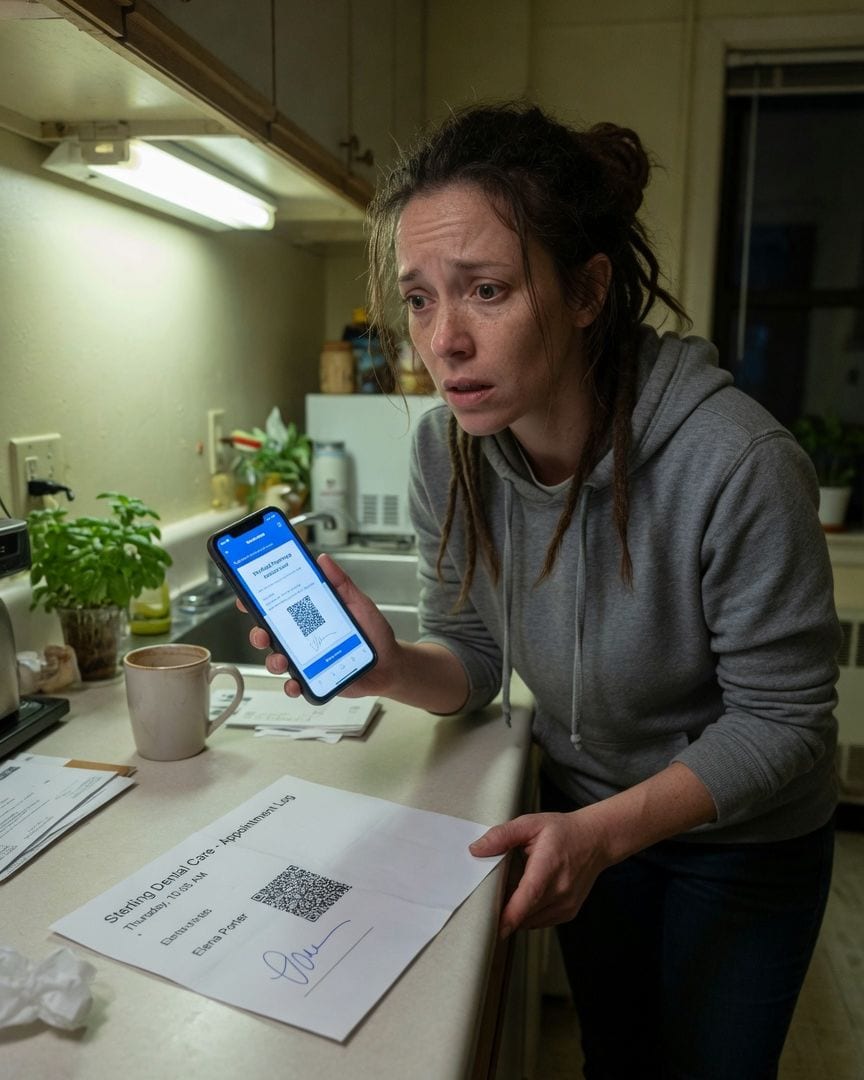
My dentist's system says I was there last Thursday. I wasn't. But the check-in tablet shows my signature, and the hygienist described my chipped tooth exactly right.
I received a call confirming a dental appointment I never made, for a day I was home. Yet, Sterling Dental had my perfect digital signature and described a chipped incisor I’d never told them about. The physical proof insisted I was there, but I wasn’t.
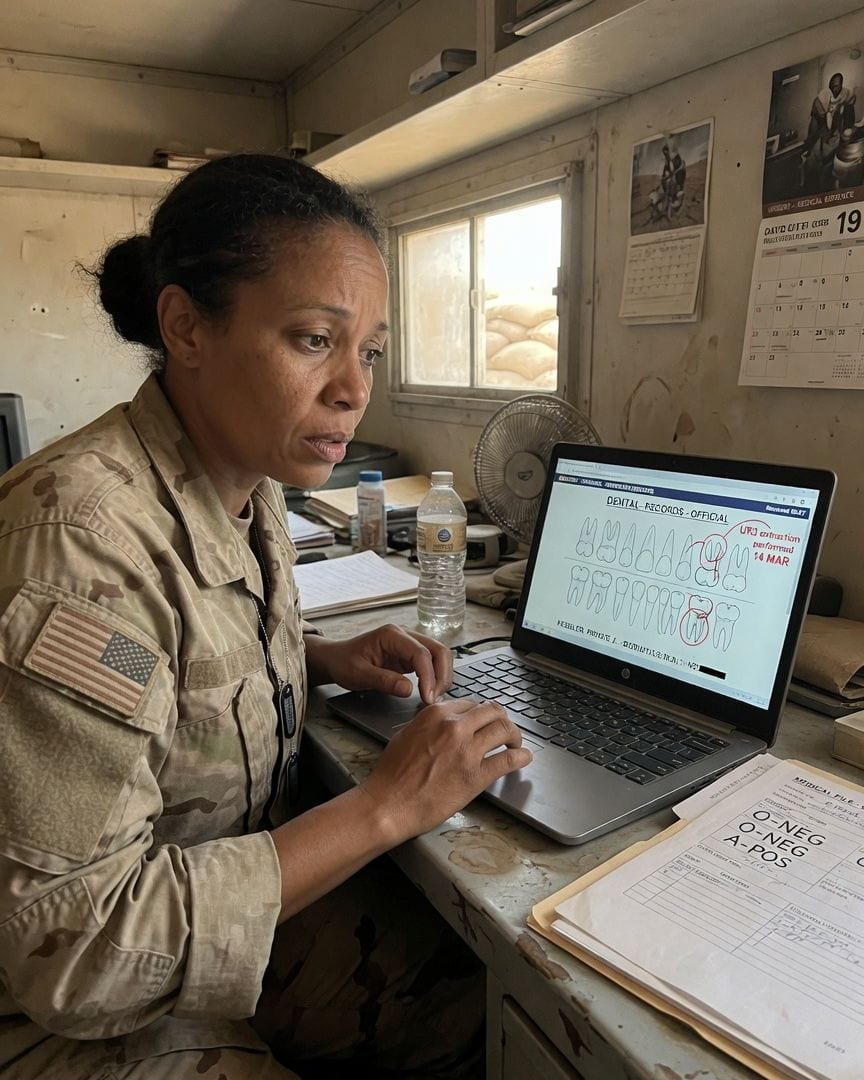
Weeks from going home, Sergeant Whitmore saw Private Kessler’s dental records show teeth he didn’t have and missing ones he did.
Sergeant First Class Iris Whitmore counted the weeks until her deployment ended, dreaming of home as the desert heat baked FOB Cerberus. But the familiar weight of Private Kessler’s dog tags soon brought a cold knot of dread: his blood type, once O-negative, suddenly read A-positive. She dismissed medical anomalies and clerical errors, only to find his official records subtly rewriting his timeline, linking old injuries to new identities. When his dental charts arrived, showing teeth he never had and missing ones he did, Sergeant Whitmore faced an impossible question: who was Private Kessler, really?
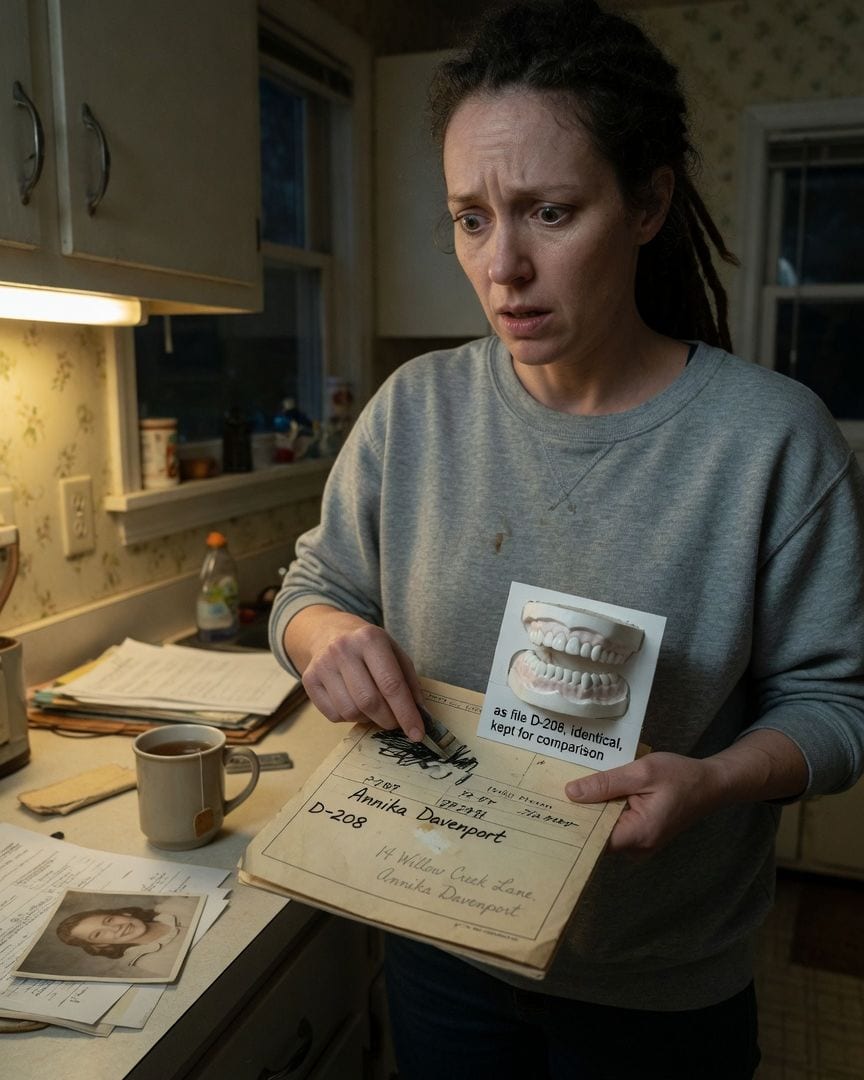
My childhood dental chart lists the house I bought last year — in my own name, years before I was born. A second set of my teeth sits filed beside it, marked 'identical.'
Sifting through old dental records, I found my chart, D-208, with my 1988 birth date. But a line from 1958 was blacked out, and a clipped card with an impression of my teeth listed my name and current home address, decades before I was born. The impossible facts knotted into a cold certainty.
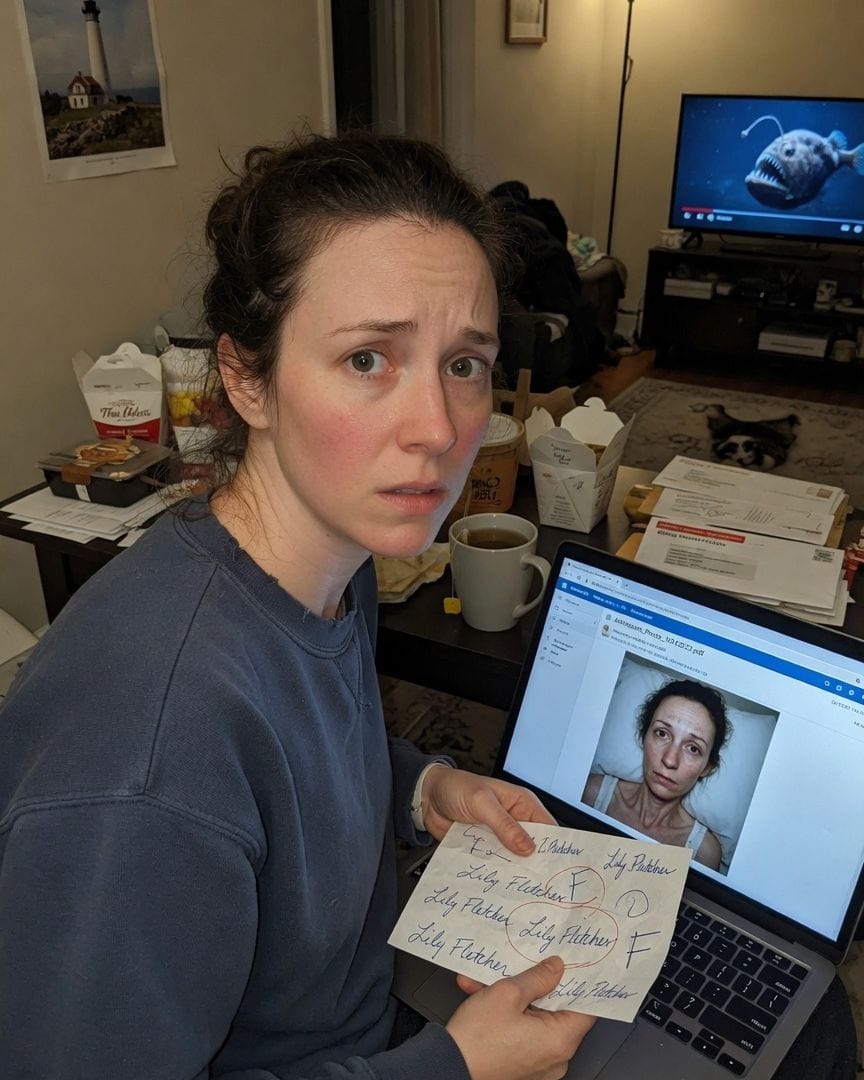
A hospital is billing me for a two-night stay in Cleveland — with my insurance, my wristband scans, and a discharge form in my own signature. I spent that whole week home alone, and I've never been admitted anywhere.
A bill arrived from Cleveland General Hospital for a two-night stay under my name, Lily Fletcher. I'd spent those dates at home, but the hospital had my accurate details and even a discharge summary. The chilling part? It was signed with my unmistakable signature, a mark I know I never made.