My adult signature is on a library card from 1968, but I only developed that style in the last decade.
The call came mid-afternoon. Mrs. Evans, Russell’s third-grade teacher, sounded harried. “Mrs. Porter? Just checking on Russell’s permission slip for the natural history museum trip. It was due yesterday.” I frowned, looking at the calendar on the fridge.
“Mrs. Evans, I haven’t seen a permission slip. Russell usually puts them on the counter.” I called out for Russell, who was playing a game in his room. He walked in, messy hair, still wearing his soccer jersey. “Museum trip?”
he asked, genuinely confused. “No slip, Mom.” I relayed this to Mrs. Evans, who sighed. “Well, we have a signed one here, faxed this morning. From you. Dated yesterday.” My stomach gave a strange lurch. “Faxed?
No, that can’t be right. I haven’t sent anything to the school.” Mrs. Evans offered to fax it back to me. “Just for your records,” she said, her voice strained, clearly thinking I was mistaken.
The fax machine in my home office whirred to life a few minutes later, spitting out the sheet. There it was: “Permission to Attend Natural History Museum Field Trip.” Russell’s name, the date of the trip, all correct.
And at the bottom, “Parent/Guardian Signature: Emily Oakley.” My maiden name.
But the signature itself, that flowing, confident curve of the 'E,' the way the 'O' connected to the 'a' – it was undeniably my signature, the one I’d developed in the last decade, long after I’d married Mark and changed my name to Porter.
I stared at the faxed slip, then at Russell, who was now beside me, peering at it. “I swear, Mom, I never saw this,” he whispered.
The ink on the page looked strange, not crisp and black like a fresh print, but a faint, dry charcoal, almost as if it had been sitting for years before being sent.
The cold certainty hit me. It wasn't just a mistake. I pulled out the heavy photo album from the bottom shelf of the bookcase, the one filled with old family photos and important documents tucked into plastic sleeves.
My original birth certificate, slightly yellowed, was there, confirming my name: Emily Oakley. Below it, my first school report card, and a library card from when I was twelve.
I pulled them out, laying them on my desk next to the faxed permission slip. My maiden name was on all of them, of course, but the signatures were different. A childish, hesitant scrawl on the report card.
A slightly more developed, but still distinctly adolescent, loop on the library card. My signature style on those documents was completely unlike the one on the fax.
Then I grabbed a utility bill, just arrived yesterday, with my current signature, Emily Porter, scrawled confidently at the bottom of the check I’d used to pay it. I placed it beside the fax. The 'E's matched.
The sweep of the 'y'. The curve of the capital 'O' on the faxed slip, even with the different letter, mirrored the 'P' on the check. It was a perfect, uncanny match for my adult ‘Porter’ style, but signed 'Oakley.'
The impossibility of it pressed down on me. I called the school again, asking specifically for Fiona Easton, the administrator who’d faxed the slip. She answered, her voice even and polite. "Mrs. Porter. How can I help you?"
I tried to keep my voice calm. "About Russell's permission slip. The one you faxed. It has my maiden name, Oakley, but the signature style is mine from after I married." A beat of silence.
"Mrs. Porter, the record is clear. It’s signed by Emily Oakley, dated yesterday, consenting to the trip." Her voice had not a trace of emotion. "But I only adopted that signature style after I became Emily Porter.
It's impossible for me to have signed 'Oakley' like that yesterday." Fiona’s tone remained perfectly level. "The record stands, Mrs. Porter. We have your consent." The polite stonewalling was like a smooth, cold wall.
The wrongness sharpened into something tangible, something that refused to be dismissed.
Driven by a cold, unsettling certainty, I started tearing through the boxes in the attic. This wasn’t some mundane error.
If that impossible signature, my signature, could exist with my maiden name and an incorrect date on a school form, where else could it be?
I sifted through forgotten yearbooks, old medical records from my twenties that still had 'Oakley' on them, college transcripts gathering dust. Each one had my older, less refined signature.
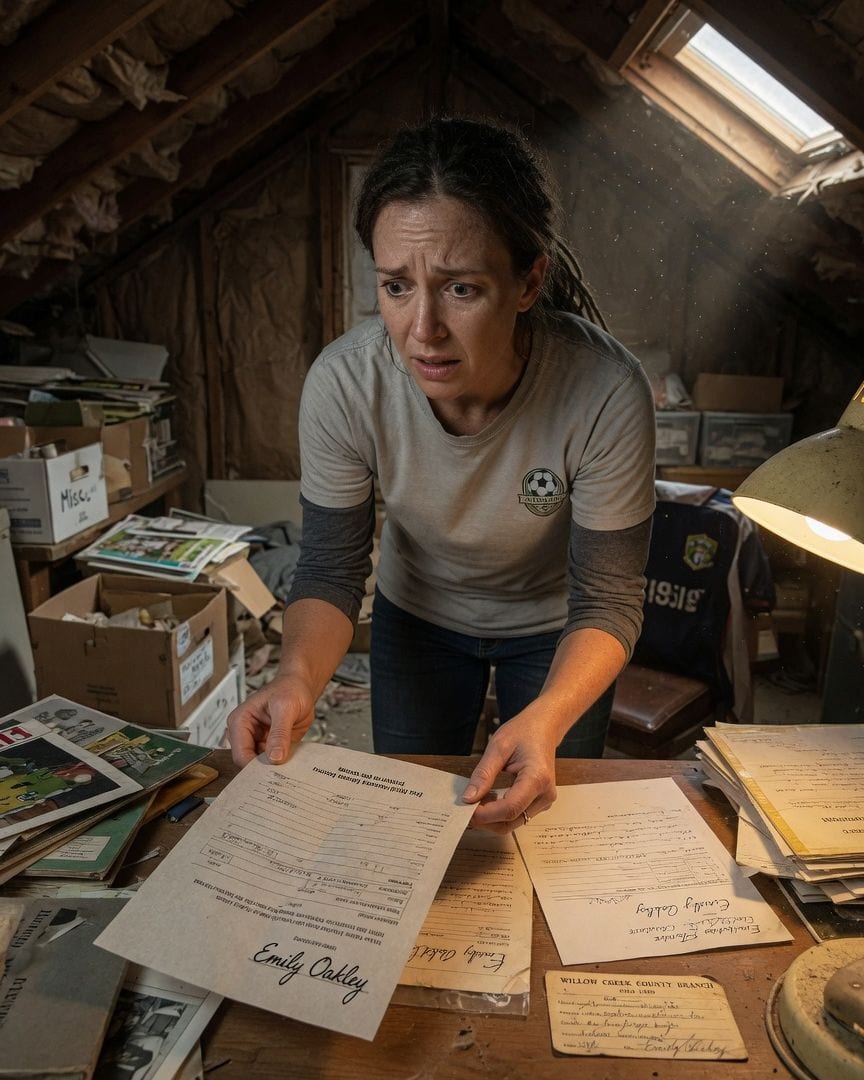
I emptied boxes, scattering old photographs and letters, the dust motes dancing in the single beam of sunlight filtering through the attic window. Hours later, my hands grimy, my throat thick with dust, I found it.
Buried beneath a stack of old gardening magazines, in a small, battered box labeled "Misc.," was a small, yellowed, dog-eared library card.
It was from the Willow Creek County Branch, a rural library I’d never even heard of, let alone visited. The name printed neatly on it was "Emily Oakley."
And there, scrawled on the signature line, a perfect, confident replica of the impossible hand from the fax, was that signature. Below it, embossed in faded black ink, the date read: 1968.
The 1968 library card rattled me in a way the school form hadn't. I was born in 1985. The card was signed, by me, seventeen years before I even existed.
My rational mind tried to find an explanation: a clerical error, a shared name, a bizarre coincidence. But the signature was too exact, too personal. It was mine.
I tried the phone number printed on the back of the card, an old seven-digit number. It rang several times, then disconnected with a digital tone announcing it was out of service.
A quick online search confirmed it: Willow Creek County Library Branch, established 1955, permanently closed 1972. The place hadn't existed for over fifty years. My next step was to find out who was behind these records.
I called the school district's central office, navigating a maze of automated menus. I asked about historical student records, specifically any 'Oakley' family files from the late 60s or early 70s.
After being transferred three times, I was eventually connected to Gerald Novak, a retired district archivist who, the receptionist informed me, "still consults on occasion for the older stuff." Gerald was gruff, his voice raspy over the phone.
He clearly didn’t appreciate being bothered. But when I mentioned the specific, anachronistic signature — my adult signature with my maiden name, appearing on old documents — a pause stretched out. "Oddities," he muttered, "yes, I've seen oddities.
Signatures that don't quite fit the timeline, you mean?" His gruffness softened, replaced by a weary tone. "You might want to look into the district's 'legacy files.' Separate, rarely accessed. Off the main grid, you could say." He paused again.
"It’s a dusty rabbit hole, Mrs. Porter. And some things are better left buried." The line clicked dead.
The very next morning, a chilling piece of paper appeared in my mailbox. No stamp, no return address, just slipped in. It was a single sheet, thick, creamy paper, with only two words typewritten in stark black ink: 'Drop it.'
The simplicity of it, the chilling, direct command, froze me. My hands trembled as I reread it. Someone knew.
Later that afternoon, while I sat hunched over my laptop, scrolling through municipal archives and obscure historical society websites, the Wi-Fi signal flickered erratically. Not a full disconnect, just a momentary stutter, like a skipped beat.
I didn’t think much of it until it happened again, and then a third time, each time coinciding with a specific search query related to old school district employees. A cold dread seeped into my bones.
I checked my router logs. There, amidst the usual connections, were a series of unusual access attempts from an unknown IP address, clustered precisely around the times I’d been researching.
The air in my office seemed to grow colder, though the window was closed.
A few days later, I drove to the district's physical archives, a drab brick building on the edge of town, hoping to find someone, anyone, who could guide me to these 'legacy files' Gerald had mentioned.
I pulled into a parking spot across the street, just watching the entrance for a moment, trying to gather my nerve. That’s when I saw her.
Fiona Easton, the school administrator, sitting in a dark sedan, parked a few cars down from me. She wasn’t looking at her phone, wasn’t reading. She was staring directly at me. Our eyes met.
A small, unreadable smile touched her lips before she slowly, deliberately, put the car in drive and pulled away, disappearing around the corner. My digging had been noticed. I was being watched.
The anonymous note and Fiona’s surveillance were enough. I called Gerald Novak again, my voice tight with fear. He agreed to meet me at a quiet coffee shop, looking even more frail and rumpled in person.
I slid the 'Drop it' note across the table. His eyes, magnified behind thick spectacles, widened. His face, already pale, seemed to drain of what little color it held. He pushed the note back, his hand trembling slightly.
"I told you, Mrs. Porter," he whispered, "some things are better left buried." I recounted seeing Fiona. Gerald let out a long, slow breath. "She's a guardian, you see. Of the protocol."
He finally admitted it, his voice barely audible above the clatter of the coffee shop. "The 'legacy files' are not just old records. They're part of a… a protocol. Established decades ago. For certain families. Certain 'lines'."
He leaned closer, his eyes darting around the room as if worried about being overheard. "These families, their descendants are identified. And then, they are 'pre-approved' for various life events." I stared at him, my mouth dry. "Pre-approved?
What does that mean?" "It means their path is… managed. Guided. To ensure a smooth transition, they said. For the betterment of the community." He tapped a gnarled finger on the table. "The impossible signature, Mrs. Porter.
That's the 'mark of approval.' A standardized placeholder. Used by the institution to create a paper trail of consent, regardless of actual individual agency. I've seen them. Files with birth records, school enrollments, even marriage applications.
All bearing that same mark. Some dating back to the 1940s." The pieces clicked into place with sickening precision. "Fiona Easton," I repeated, "she’s a 'guardian'?" "Indeed. Ensures the protocol's continuity. The school is just one node.
It's a much larger system." He finished his coffee, his gaze distant. "Your name change, Mrs. Porter... Oakley to Porter. It might have 'flagged' you. Reactivated a dormant file, so to speak. Made you visible to the system again."
Armed with Gerald’s information, I drove home in a daze, a knot of dread tightening in my stomach. 'Pre-approved.' 'Mark of approval.' The words echoed, cold and hollow.
If this protocol spanned generations, if families were 'marked' from birth, then what about me? What about Russell? A desperate, frantic need to know settled over me.
I pulled out my own childhood keepsakes, scattering them across the living room floor: a box of faded report cards, a construction paper collage from kindergarten, a small, worn box of elementary school photos, still smelling faintly of crayons and old paper.
I sifted through them, my fingers trembling. My mother’s handwriting on a note from a field trip, my father’s scrawled well wishes on a birthday card.
Then, at the very bottom of the box, tucked beneath a stack of my drawings of smiling suns and stick-figure families, I found it. A faded, laminated form, creased in the middle. My first-grade enrollment sheet.
My mother’s familiar signature was there, beside the line for 'Parent/Guardian.' But beneath it, next to the section for 'Student Acknowledgement,' was my own name, neatly printed in a child's careful hand: 'Emily Oakley.'
And next to that, in bold, dark ink, was the impossible, flowing signature I now recognized so chillingly well. The same graceful 'E', the same confident sweep. The date stamped beside it, clear as day, read: November 12, 1975.
I was born in 1985. A full three years before I had even learned to write my own name, let alone sign it. I wasn't just observing the pattern; I was always inside it. I was one of them.
The discovery of my own marked enrollment form, dated a decade before my birth, stripped away any last vestiges of doubt. There was no mistake. There was no coincidence.
There was only the chilling, undeniable truth that I had been a part of this system from the very beginning. I found Fiona Easton after hours, alone in her office, the fluorescent lights humming over her perfectly organized desk.
She looked up, her expression unperturbed as I slammed the laminated form onto the polished wood. “This is my first-grade enrollment,” I said, my voice trembling, each word an effort. “I was born in 1985. This is dated 1975.
And that is not my mother’s signature. That is the signature.” Fiona nodded slowly, her gaze calm, almost serene. “A placeholder,” she confirmed, her voice devoid of any human emotion. “For those who will contribute to our future.
Your line, Mrs. Porter, has been… significant.” She leaned back in her chair, her hands clasped. “The protocol, as we call it, is designed to identify and subtly guide certain talented individuals. To ensure their paths align with institutional goals.
The signatures are not for consent, not in the traditional sense. They are for acknowledgement within the system. A recognition of one’s destined role.” She paused, a faint, unsettling smile touching her lips.
“Your name change, Mrs. Porter, it created a temporary anomaly. Your maiden name, Oakley, has a very long history within the protocol. We simply needed to ensure continuity.”
She reached into a desk drawer, pulling out a thick, leather-bound ledger, its cover worn smooth with age. “The record,” she said, placing it on the desk between us, “goes back centuries. We knew.”
Fiona slid the ledger across the desk. Its pages were filled with meticulously inked entries, rows of names, dates, and alongside many, that distinct, impossible signature.
My own name, Emily Oakley, appeared multiple times, across different decades, each entry accompanied by the undeniable mark. And then, a new horror bloomed in my chest. There, in a section marked 'Future Enrollments,' was Russell’s name. My nine-year-old son.
And beside it, already, was the familiar, flowing signature, dated for his future high school enrollment.
The horror wasn't just that it had happened to me, but that it was still happening, and my son was next, his path already charted, his choices pre-approved.
I lunged for the ledger, my hand reaching, desperate to tear the pages, to erase the damning evidence. But Fiona’s hand shot out, surprisingly swift and strong, clamping down on my wrist. Her grip was iron.
“The record is permanent,” she stated, her voice like steel. Her eyes, usually calm, held an unnerving intensity. “You are a part of it. Your son is a part of it. You always were.”
I fought, a desperate, futile struggle against a quiet, unwavering force. My wrist throbbed. Fiona’s grip tightened, her eyes unblinking, her composure absolute. “You simply remember it differently,” she murmured, that faint, almost imperceptible smile touching her lips again.
A strange numbness began to spread through my limbs, my resistance faltering, like a current being cut. The room seemed to tilt, the humming of the fluorescent lights growing louder, ringing in my ears.
The ledger’s pages, filled with generations of marked names, blurred into an endless, terrifying scroll.
Emily Porter stopped challenging the school's records. Her son Russell continued his classes, his permission slips always perfectly signed and accounted for. Fiona Easton remained the calm, efficient school administrator.
The ledger, with its centuries of impossible signatures, remained in its hidden drawer. Life at the school, and in the quiet town, returned to its undisturbed rhythm.
The world moved on, unaware of the subtle shifts in the paper trail, or the quiet acquiescence of one once-rational mother.
I stopped asking questions. I signed all the new forms that arrived, my hand moving with a fluid, confident ease, the signature perfectly matching the old, impossible one.
I watched Russell play, my gaze distant, a faint, unreadable smile on my face. My memories of the impossible forms, the anonymous letter, Fiona’s calm, absolute words – they all seemed to recede, replaced by a quiet, settled understanding.
The world’s record was simply the correct one. I simply remembered it differently.
Russell found his mother humming softly in the kitchen, carefully filling out a form for his upcoming high school registration. 'Mom,' he asked, 'did you remember to sign that permission slip for the field trip next month?'
Emily looked up, her eyes clear, a slight, almost imperceptible tilt to her head. 'Of course, sweetie,' she replied, her voice soft. 'It’s already handled.'
If this one got to you
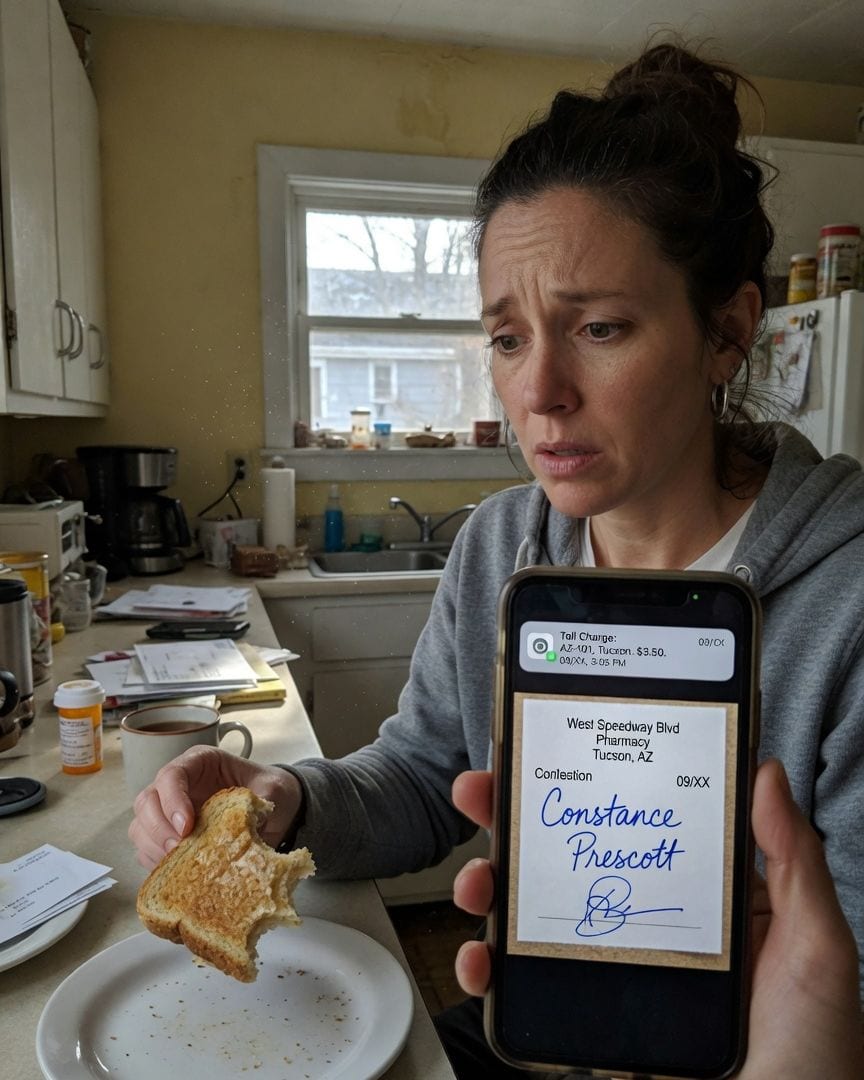
My own signature picked up my prescription in Tucson, Arizona. I live in Maine, and I've never set foot in that state.
When my pharmacy called about a refill, it felt odd — I usually get a text. But then they claimed I'd picked up a month's supply in Tucson, Arizona, yesterday, with my signed receipt. I've never been to Arizona, yet the signature was unmistakably mine, down to a distinct, childish 'P' loop.
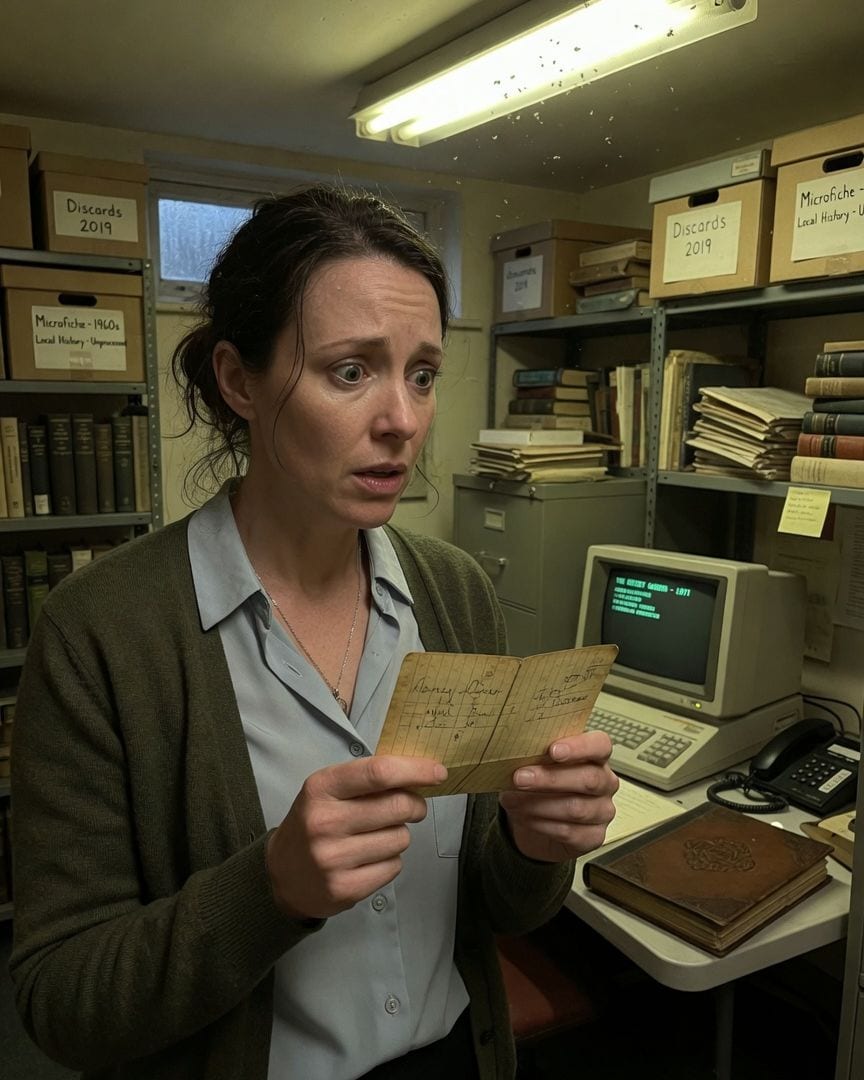
A locked library ledger from 1971 lists my name accessing 'Special Collections', marked 'Subject: Pending'.
As a county archivist, I process old library discards. Among them, I found a brittle due-card from 1971. The borrower's name was 'Nancy Lawson,' written in my own unmistakable handwriting. I wasn't born until 1985, making the card predate my existence by fourteen impossible years.
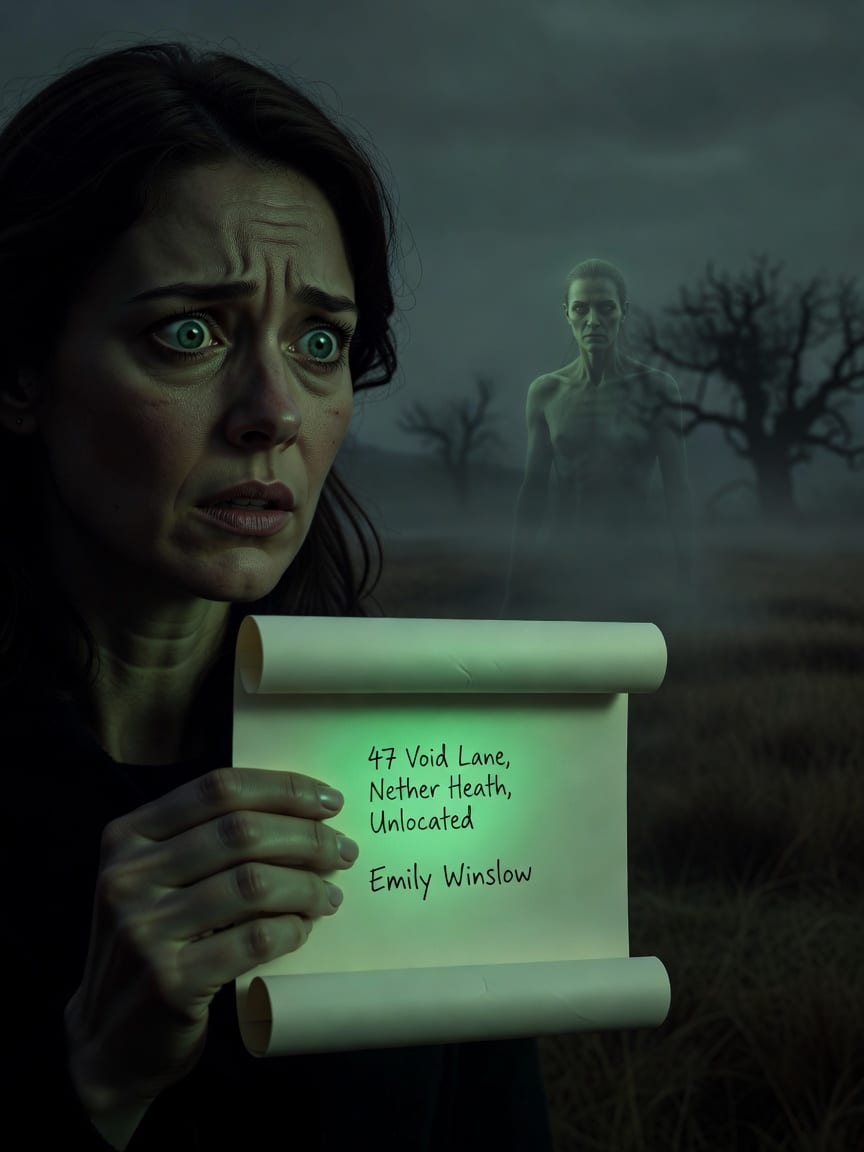
My change-of-address card arrived today. It said I'd moved to a house I'd never seen, on a street that didn't exist. And it was signed with my own hand, a month from now.
A crisp, cream-colored card on my kitchen counter informed me I'd moved to 42 Willow Creek Lane, an address that didn't exist. The signature was my name, Emily Winslow, a chillingly precise ghost of my own handwriting. But then I found an old 1947 ledger, listing 42 Willow Creek Lane and a signature identical to the one on my card.
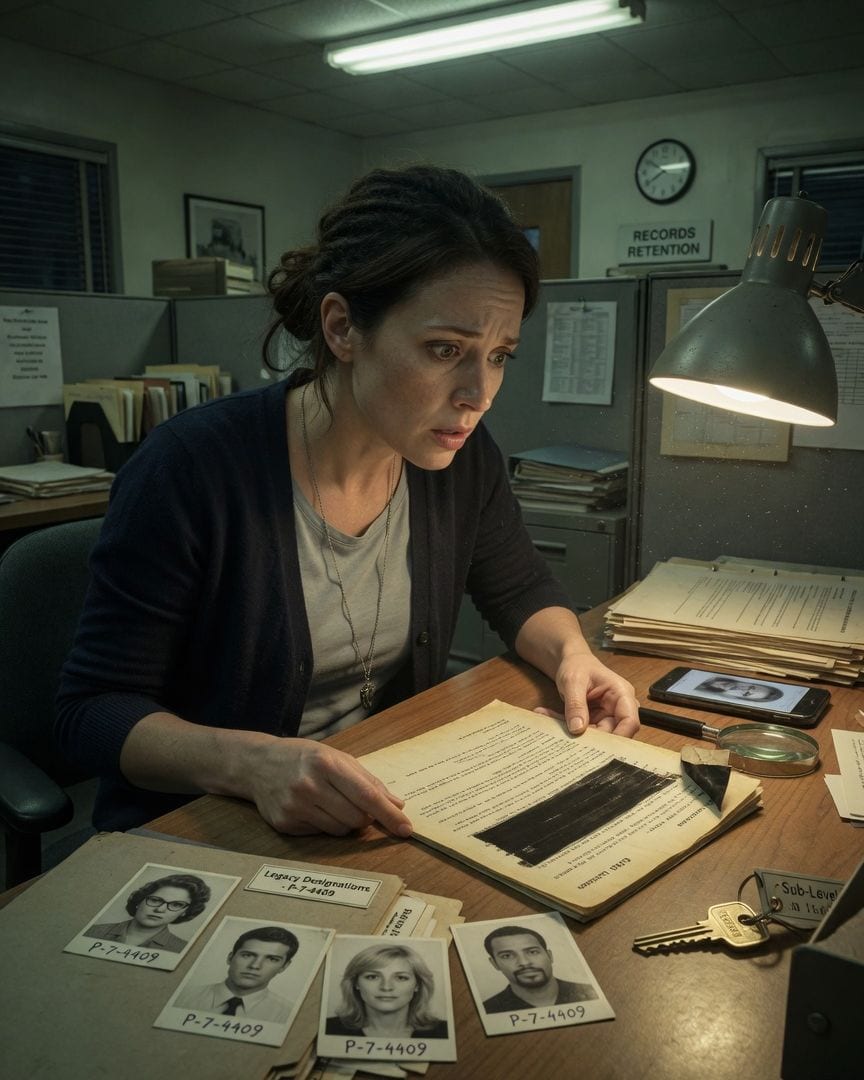
My passport file has four strangers' faces in it. They all share my number, issued since 1966, and none were ever surrendered.
I went to renew my passport, expecting a routine process. Instead, the clerk found four prior applications under my number, each with a different name and face, all 'issued and not surrendered.' Digging deeper, I uncovered a redacted memo that linked one of these mysterious designations to my own childhood street and my mother’s maiden name, years before I was even born.
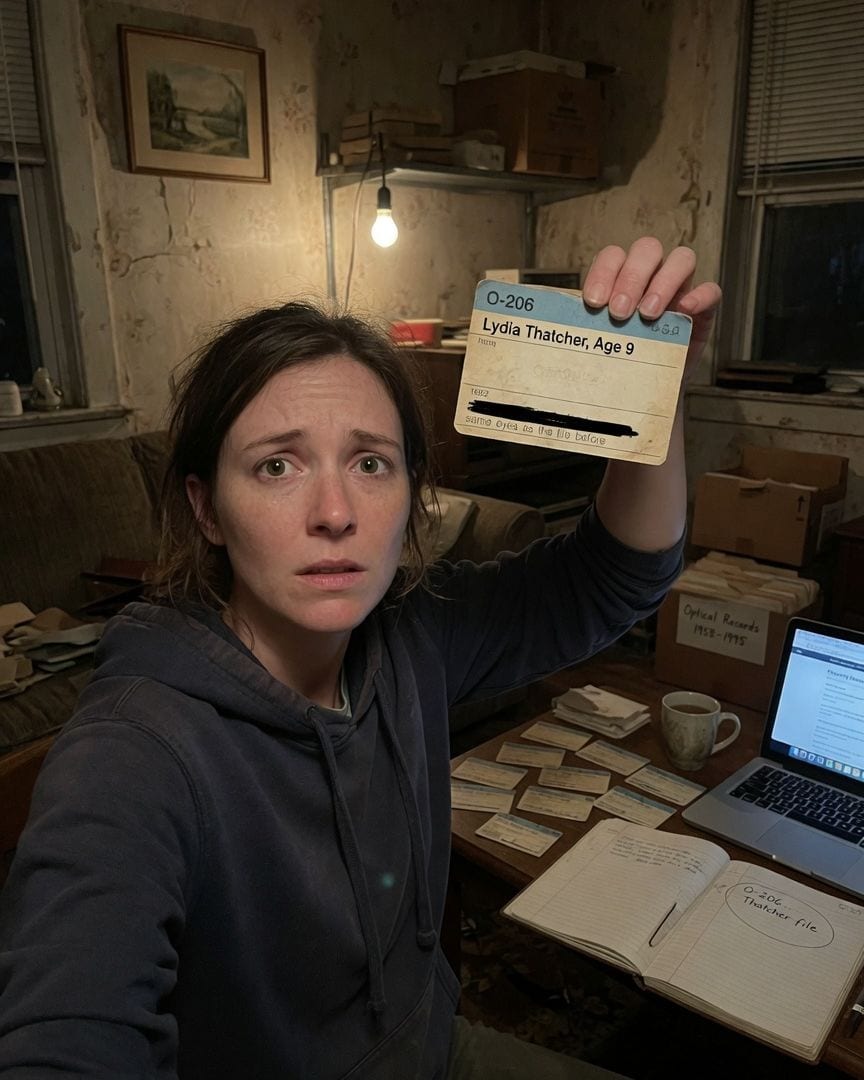
My own optical card is dated 1962, with my name on it. I wasn't born until 1993.
Sifting through old patient files from my former optical practice, I found my own O-206 card. It had my name, Lydia Thatcher, and my current home address printed on it. But the card was dated 1962, decades before I was even born, and a redacted note mentioned 'same eyes.'
My taxi driver knew my name before I spoke, then apologized for the flight I was going to miss. I was arriving. The cab's plate was scrapped four years ago.
After a strange taxi ride, I received an unsettling birthday card addressed to me. Its return address listed 'Old Mill Road Field,' an empty lot where a mill once stood, and it was postmarked locally. The card arrived four months before my actual birthday, sparking a cold dread I couldn't ignore.