My passport file has four strangers' faces in it. They all share my number, issued since 1966, and none were ever surrendered.
The fluorescent hum of the passport office felt colder than usual. It was late autumn, but the air inside held a chill that seeped into your bones, despite the heating.
I tapped my fingers on the worn plastic counter, waiting for my renewed passport. Thirty-two years old, first renewal, shouldn't have been complicated.
The clerk, a young man with tired eyes and a name tag that read 'Kevin,' finally located my file on his screen.
'P-7-4409, Ms. Lawson,' he mumbled, reading from his monitor, a slight frown already etched on his face. 'There's a slight delay.'
I frowned back. 'Any reason?' I already had my plane tickets for next month.
He typed, his fingers hovering over the keyboard as if unsure. He paused, then scrolled through something I couldn't see. 'My system shows four prior applications under P-7-4409. From 1966 to present. Four different photographs, four different names.
And each application marked 'issued and not surrendered'.' He looked up at me, his perplexity mirroring my own.
My stomach dropped, a cold, sudden weight. 'But I've only ever had one passport. The one I brought in. It's right there, waiting for renewal.'
'Yes,' he said, pushing my old passport across the counter, its cover familiar under my fingertips. 'Yours is the only physical passport we can find. The only one registered to you.'
He scrolled through the digital records again, his brow furrowing deeper, a nervous habit of his, I noted. 'Wait, the system says these previous ones were…' He trailed off, then cleared his throat, avoiding my gaze.
'It just says they were issued and not surrendered.'
The bland bureaucratic language was worse than any explicit threat. Four faces, four lives, all under my number, all simply 'issued and not surrendered.'
It felt like a chill wind had just passed through the sterile office, stirring something far more unsettling than cold air.
I spent the next week quietly digging. The official explanation I was offered by my supervisor, a weary woman named Brenda, was a 'system glitch,' a 'legacy data anomaly' from the switch to digital records.
She even suggested it was probably just a draft number that was accidentally reused. But the faces, the four distinct faces from those digital records the clerk showed me on his screen, haunted me. They weren't drafts.
They were real people. I couldn’t shake the image of those eyes, looking out from black and white photographs, then grainy color, then high-resolution. All issued. None surrendered.
I approached Marcus Coleman, the Senior Records Officer, a man with a reputation for knowing where every skeleton was buried in the archives.
He was close to retirement, his office smelling of old paper and dust, a small oasis in the clean, modern building. He listened patiently as I explained, his gaze unsettlingly calm as he peered over his half-moon spectacles.
'P-7-4409, you say? That's an old designation. Might be some physical records down in Sub-Level 3. Automated systems don't always pick up the nuances of older entries.'
He gave me a key attached to a heavy brass tag, and a cryptic smile that didn't quite reach his eyes. 'Good luck, Sylvia. Mind the spiders.'
The archives were a labyrinth of dust and silence, the air thick and still. Fluorescent tubes flickered overhead, casting long, dancing shadows.
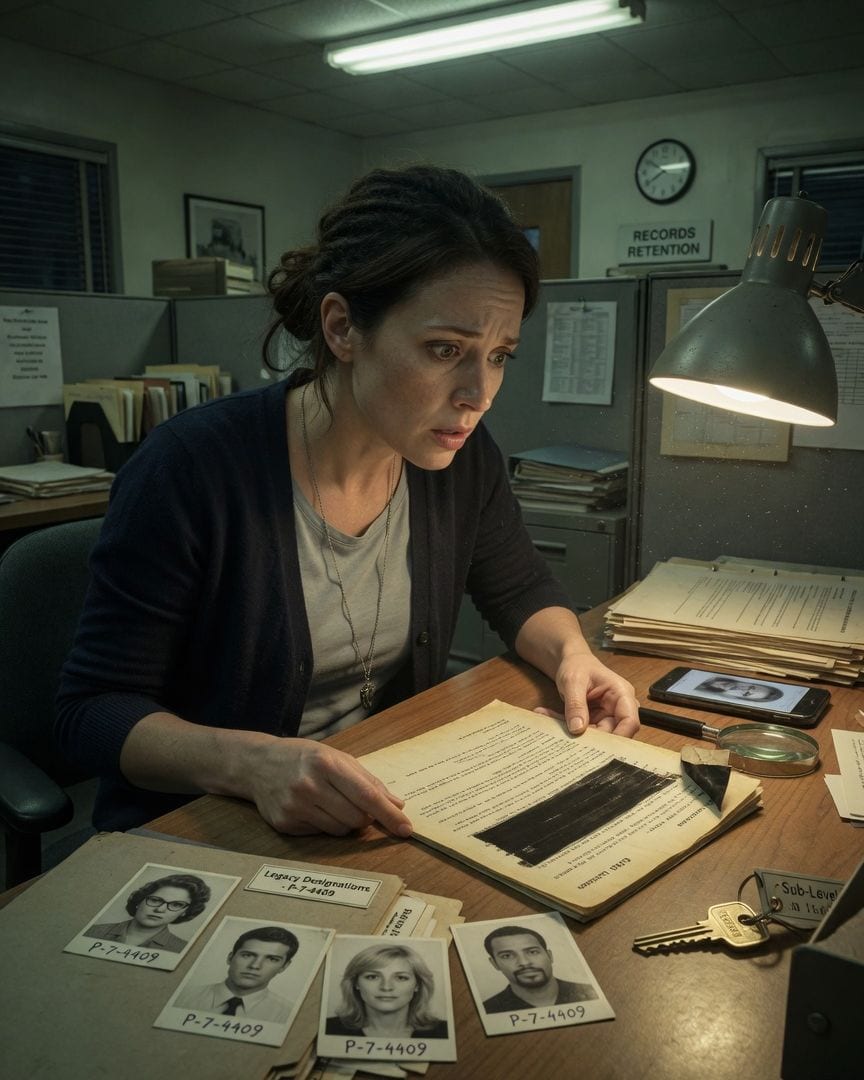
I found the section for 'Legacy Designations,' rows of heavy, metal drawers that groaned when I pulled at them. The P-7-4409 drawer was stiff, resisting my pull, as if guarding its secrets.
It took a shoulder to finally wrench it open. Inside, tucked away in the back, I found a thick, brittle file.
It contained faded copies of the four passport applications the clerk had mentioned.
Each photo showed a different person – a stern-faced woman from the 60s, Rosemary Calloway; a serious young man from the 80s, Reginald Bishop; a smiling woman from the early 2000s, Ruth Ingram; another man from a decade ago, Eric Yates.
All bore the P-7-4409 stamp, meticulously applied. The paper felt strangely cold to my touch, as if it had absorbed the years of silence. I flipped through the supporting documents: birth certificates, old utility bills, a few faded letters.
Everything seemed perfectly ordinary for each individual, except for the shared designation.
Then, tucked beneath the last application, I found a memo, dated 1988, addressed to 'The Designations Committee.' It was thin, onionskin paper, crackling slightly when I unfolded it.
One line, near the bottom, was entirely blacked out with thick, permanent marker. My heart gave an unpleasant lurch. This wasn't a glitch. This was deliberate.
Back at my desk, under the steady glow of my task lamp, I carefully examined the memo. The redacted line was dense, impenetrable.
I held it up to the light, tried different angles, even scanned it with my phone, attempting to digitally enhance the hidden text. Nothing. The black ink was too thorough.
Desperate, I remembered an old trick from a forensic documentary: carefully peeling off layers of tape or paper that had been used to obscure text. This memo was old, the ink a different consistency from the paper.
I found a loose edge where the black marker had bled slightly into the paper fibers, making it stiff, and painstakingly lifted it with the tip of my nail.
Beneath the black, faint but legible, I saw it. Words: '...resident of Oakhaven Drive, daughter of Eleanor Yates...' My breath hitched, a gasp caught in my throat. Oakhaven Drive. That was her childhood street. My childhood street. Eleanor Yates.
That was her mother's maiden name. My mother's maiden name. The date on the memo was 1988. I wasn't born until 1992.
My own street, my own family, filed years before I even existed, in a document about a 'designation' that had already claimed four other lives.
The discovery ignited a cold fire in my gut, a chilling certainty that went beyond any rational explanation. I couldn't unsee the redacted line, the impossible connection to my own life.
Using my administrative access, usually reserved for filing mundane travel claims and ordering office supplies, I started cross-referencing names from the P-7-4409 file. Rosemary Calloway (1966), the first 'designate,' had simply vanished from all public records around 1980.
No death certificate, no new address, no tax filings, just an abrupt, eerie end to all official traces. Reginald Bishop (1980s) disappeared in 1995. Ruth Ingram (early 2000s) faded out in 2015. Eric Yates (a decade ago) disappeared in 2020.
The pattern was horrifyingly consistent, a bureaucratic void where a life once stood.
I confided partially in Vanessa Bishop, a colleague a few years older than me, who handled 'legacy' digital systems – a euphemism for the convoluted mess of older databases.
Vanessa was helpful, almost too much so, guiding me through obscure database queries and old microfiche indexes.
She always had an answer, or a suggestion, leading me down paths that invariably ended in a shrug or a "looks like a corrupted file." 'Some of these old files are a mess, right?'
Vanessa would say, her smile calm, almost serene, as she pointed me toward a dead end or a subtly altered record. It was like watching someone deftly remove obstacles from a path, only to lay down new ones.
I found myself looking for Marcus Coleman, but he was suddenly elusive, always 'in a meeting' or 'out of the office.'
His desk was neat, almost bare, as if he hadn't been there in weeks, despite the lingering scent of his pipe tobacco.
The bureaucracy itself, usually a comfort of order, now felt like a vast, silent ocean, carrying me further from shore.
I learned that the 'National Identity Registry,' the overarching department that managed all citizen records, had a sub-section for 'Special Designations' but its records were classified, requiring clearance I didn't possess.
Every step I took confirmed the wrongness, but also the sheer, impenetrable scale of it. It wasn't a mistake; it was a system. And the system was very, very good at its job.
The digging was noticed. One morning, I found a small, folded note tucked under my keyboard, almost hidden by the dust that collected there despite the daily cleaning crew.
The paper was old, slightly yellowed, and the handwriting was Marcus Coleman’s precise, old-fashioned script. 'Some files are best left closed, Sylvia. For your own good. – M.C.'
It wasn't a threat, not in any overt sense, more a quiet, paternal warning, which made it far more chilling.
He wasn't telling me to stop; he was telling me to consider the consequences, in that calm, knowing way of his.
I looked up, scanning the office, but everyone was at their desks, immersed in their screens, the low murmur of conversation and keyboard clicks filling the air. No one seemed to have approached my desk.
Later that day, I noticed a file I'd been meticulously organizing, detailing the last known addresses and sparse contact information of the P-7-4409 designees, had been subtly re-filed under a different, obscure code.
It took me an hour to find it again, buried under a folder labeled 'Legacy Archival Redundancies - Batch 7, Q2 Fiscal 1998.' A code I hadn't seen before, and certainly hadn't used.
I felt eyes on me, not hostile, but observant, like an entomologist watching a specimen.
When I went for coffee, I saw Vanessa Bishop talking in hushed tones with Marcus Coleman in the breakroom, both of them glancing my way over their steaming mugs.
They stopped talking abruptly when I approached, their expressions returning to calm neutrality, almost too quickly. 'Just discussing the new printer cartridge order,' Vanessa offered, her smile as serene as ever.
The feeling of being watched intensified, settling on my skin like static electricity. This wasn't just a discovery; it was an intrusion. I was no longer just an investigator. I was a target, or perhaps, a subject under observation.
The calm, bureaucratic surveillance was a thousand times worse than any overt threat. It implied an absolute confidence in their ability to manage me, to contain whatever I might uncover.
I cornered Marcus Coleman in an empty conference room after hours, the large, polished table reflecting the last sliver of evening light. The door clicked shut behind me, the sound strangely loud.
'Mr. Coleman,' I began, my voice trembling slightly despite my best efforts to control it, 'what is P-7-4409? And why was my family's name in a memo about it years before I was born?'
Marcus sighed, a long, weary sound that seemed to carry the weight of decades, but his eyes held no surprise. He simply looked at me, as if he had been expecting this conversation for a long time.
'It's not a passport number, Sylvia. It's a designation. For a very old, very specific lineage.' He spoke without inflection, as if reciting a long-memorized policy. 'The National Identity Registry has a special department. We ensure continuity of certain... roles.'
My mind raced, connecting the dots I had seen and the pieces I had felt. 'Roles? What roles? And 'issued and not surrendered'—that means they didn't just get new passports, did they? They vanished. They were removed.'
Marcus nodded slowly, his gaze still unsettlingly calm. 'When a designate's term is up, they are retired. Their identity ceases to be. It's a necessary part of the process. Quiet, efficient.'
He gestured vaguely toward the empty room, as if the entire building was part of this unspoken process. 'The Redacted Line, as you call it, was simply a pre-emptive identification. We monitor potential candidates. You showed the right markers.'
I felt a cold wave wash over me, a physical nausea. 'Markers? What markers?' The air in the room suddenly felt thin, hard to breathe.
Marcus offered a faint, unsettling smile, one that didn't touch the knowing depths of his eyes. 'Certain... predispositions. A unique confluence of factors. We identify them early, track their development. You were always going to be P-7-4409, Sylvia.
It was simply a matter of time until your application came through.' He spoke of my life, my identity, as if it were a pre-planned schedule, a bureaucratic inevitability.
The earlier clues clicked into place: the vanished individuals, the calm acceptance of Vanessa, the pre-emptive memo. It wasn't a monster in the dark; it was a file in a drawer, managed by calm, ordinary people.
And I was the next file.
Stunned by Marcus's chilling confession, the conference room now felt less like an empty space and more like a sealed coffin. I retreated to my desk, the entire office now feeling like a cage, its walls closing in.
The sterile fluorescent lights hummed with a new, sinister energy. I knew I had to dig deeper, to confirm the 'markers' Marcus had so casually mentioned.
My hands were shaking as I navigated the secure internal HR database, a system I knew intimately from my daily work, but which now felt alien, corrupted.
I accessed my own internal HR file, a secure document that contained every detail of my life since birth – school records, medical history, emergency contacts, all the innocuous data points that now felt like pieces of a pre-ordained puzzle.
I then brought up the records of the four previous P-7-4409 designees I had found in the archive – Rosemary Calloway, Reginald Bishop, Ruth Ingram, Eric Yates.
I laid them side-by-side on my dual monitors, scrolling through their personal data. Names, addresses, educational history, employment. All different. Different lives, different paths, different times. Then, I paused.
My eyes, scanning for any anomaly, any common thread, landed on the 'Date of Birth' field. I checked Rosemary Calloway's. Then Reginald Bishop's. Then the smiling woman, Ruth Ingram. Then Eric Yates.
A chill snaked up my spine, colder and more profound than anything I had felt before. I checked my own file again, then back to theirs. No, it couldn't be. It was too precise. Too impossible.
Every single one of them. The exact same day. The exact same month. My own birthday. A cold dread settled, heavier than anything before, as I realized this wasn't an accident, or a simple replacement. This was a selection.
From birth.
I confronted Vanessa Bishop in her cubicle, the low walls offering no privacy, only a false sense of security. My voice was a tight whisper, raw with a mix of fear and desperate certainty.
I pulled up the side-by-side birthdate comparison on my monitor, pointing at the damning consistency. Vanessa didn't flinch. Her expression remained placid, untouched by the enormity of what I'd uncovered.
'Ah, you found the pattern,' she said, her voice betraying no emotion, as if discussing the weather. 'Clever girl. We call it the 'Natal Marker.'
A unique astrological alignment, a genetic predisposition, we're not entirely sure which, or perhaps a combination. But it consistently identifies ideal candidates for the P-7-4409 designation.'
Vanessa leaned back in her chair, a picture of calm competence. She explained that the 'Special Designations' department, hidden deep within the National Identity Registry, was centuries old, predating even the concept of passports. 'We ensure the continuity of certain...
essential functions. The Designates provide a vital service to the continuity of the state. When their term is complete, they are quietly retired, their identity dissolved, and a new one is brought online. It's for the greater good, Sylvia.
A smooth transition.' She pointed to my birthdate on the screen, then to the faded memo I had carefully reconstructed. 'That memo from 1988? That was your initial identification. Your Natal Marker was confirmed, your lineage traced.
You were always going to be the next P-7-4409. Your passport renewal simply activated your designation. Your 'issued and not surrendered' predecessors have all been quietly, peacefully, absorbed back into the greater anonymity. Their lives served their purpose.'
The horror wasn't a monster hiding in the shadows; it was the calm, logical, chillingly coherent system that had been managing my life, and countless others, for generations.
The 'greater good' felt like a death sentence. Vanessa's words echoed in my mind: 'Your passport renewal simply activated your designation.' That meant I was already 'online.' I was the current P-7-4409.
I had to get myself 'retired' before they did it for me, before my identity was quietly, peacefully, dissolved. My mind raced, a cold, desperate clarity guiding my shaking hands.
I returned to my desk, the familiar glow of the monitor now a malevolent eye.
My fingers trembled slightly as I logged back into the system, navigating to the 'Special Designations' database, a menu I hadn't even known existed until Marcus's 'confession.'
It was hidden behind layers of obscure codes and multi-factor authentications that Marcus or Vanessa must have overlooked, or simply considered irrelevant, in their confidence. With trembling fingers, I located my own P-7-4409 file.
There it was, my name, my photo, my current passport details. I found the 'Designation Status' field, currently set to 'Active.'
Taking a deep breath, a breath that felt like it might be my last as 'Sylvia Lawson,' I changed it to 'Retired - Immediate.'
Then, I created a new entry: 'P-7-4409 Designate Sylvia Lawson - Identity Dissolved - Effective Immediately.' It felt like signing my own death warrant, erasing myself from existence, but also my only chance at escaping their chilling 'continuity.'
I quickly printed out three documents: the redacted memo with my family's details, the list of P-7-4409 names with their shared birthdate, and my newly created 'retirement notice.' Proof. Tangible, irrefutable proof of what they were doing.
As the printer hummed, spitting out the last sheet, I heard footsteps approaching my office, slow and deliberate, not hurried. The sound was too calm, too inevitable. Marcus and Vanessa. They knew.
I grabbed the papers, still warm from the printer, shoved them into my bag, and without a second thought, slipped out the back exit of the office, through the emergency stairwell, leaving my desk light on, the hum of the printer still echoing in the silent, deserted building.
Sylvia Lawson vanished. Her apartment was found empty, her bank accounts frozen, her digital footprint meticulously scrubbed, not by her, but by an unseen hand.
The National Identity Registry quietly announced the 'early retirement' of Sylvia Lawson, citing 'unforeseen health complications.' Marcus Coleman and Vanessa Bishop continued their work in the Special Designations department, their calm demeanor unwavering, the P-7-4409 file now marked 'Closed.'
No one questioned the sudden vacancy, no one remembered Sylvia's face for long. The system simply continued, a silent, bureaucratic machine ensuring its own continuity.
Sylvia, now living under a new, fabricated identity in a small, anonymous town hundreds of miles away, started a new life. 'Sarah Miller,' an administrative assistant, a perfectly ordinary woman.
She kept the printed documents hidden, wrapped in plastic, buried deep in a lockbox beneath her floorboards—her only proof of the nightmare she'd escaped.
She was always looking over her shoulder, always waiting for the other shoe to drop, for the serene smile of Vanessa Bishop to appear in a grocery store aisle, or the knowing calm of Marcus Coleman to materialize at her door.
Every stranger was a potential watcher, every flicker of a fluorescent light a warning.
One morning, she found a letter in her P.O. box, forwarded through a complex chain of anonymous re-mailers she’d carefully set up to mask her location.
It was an official-looking envelope from the 'National Identity Registry,' addressed to her new, fabricated name: Sarah Miller. Her blood ran cold. Inside was a single, stark white card. It simply read: 'Your new designation number has been issued: P-7-4410.'
The small post office clerk noticed the woman’s sudden pallor, the way her hand trembled as she held the card. 'Everything alright, ma'am?' he asked, his voice kindly.
The woman, Sylvia, looked up, a faint, wrong little smile playing on her lips. 'Is that so?'
If this one got to you
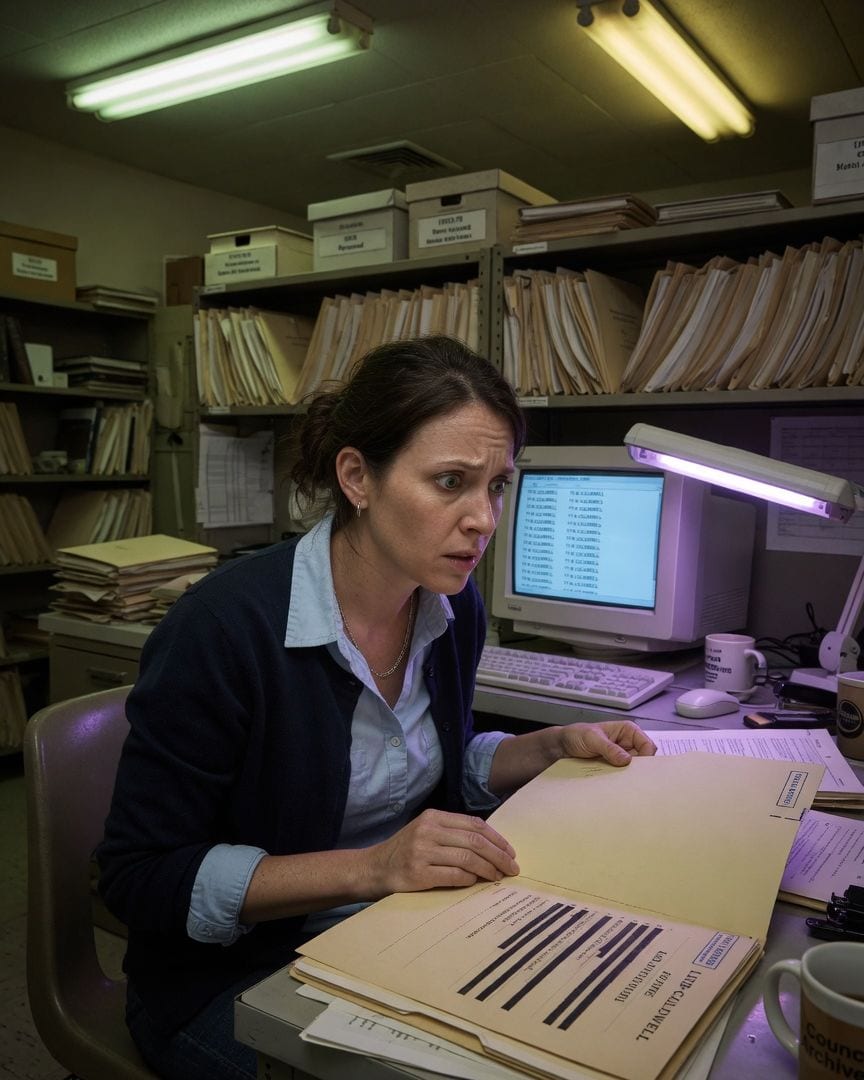
My employer's security file holds a vetting report on me dated nine years before I ever applied. It has my full name and my parents' address — with only one line, the source who referred me, blacked out.
Working a routine data audit, I pull my own security file. The issue date is nine years before I even applied for the job. Then, hidden within an old archive file, I find my current address etched under a blacked-out line.
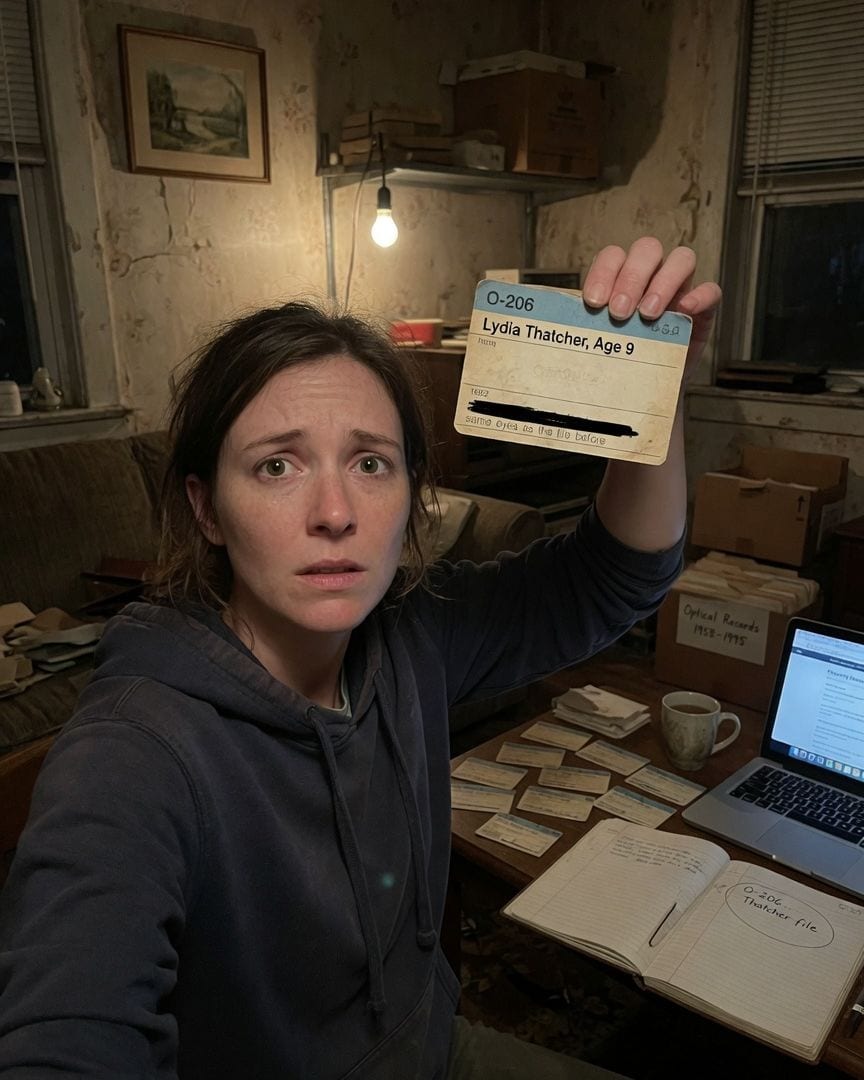
My own optical card is dated 1962, with my name on it. I wasn't born until 1993.
Sifting through old patient files from my former optical practice, I found my own O-206 card. It had my name, Lydia Thatcher, and my current home address printed on it. But the card was dated 1962, decades before I was even born, and a redacted note mentioned 'same eyes.'
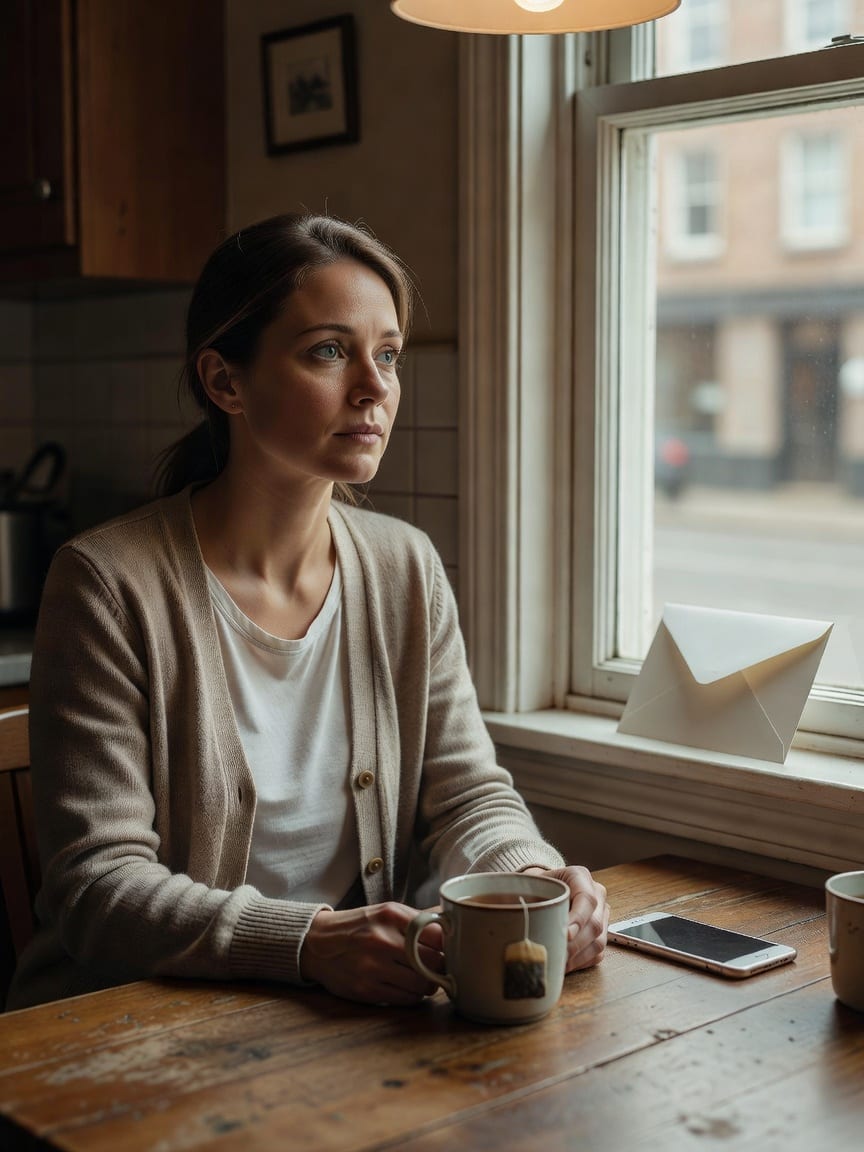
My taxi driver knew my name before I spoke, then apologized for the flight I was going to miss. I was arriving. The cab's plate was scrapped four years ago.
After a strange taxi ride, I received an unsettling birthday card addressed to me. Its return address listed 'Old Mill Road Field,' an empty lot where a mill once stood, and it was postmarked locally. The card arrived four months before my actual birthday, sparking a cold dread I couldn't ignore.
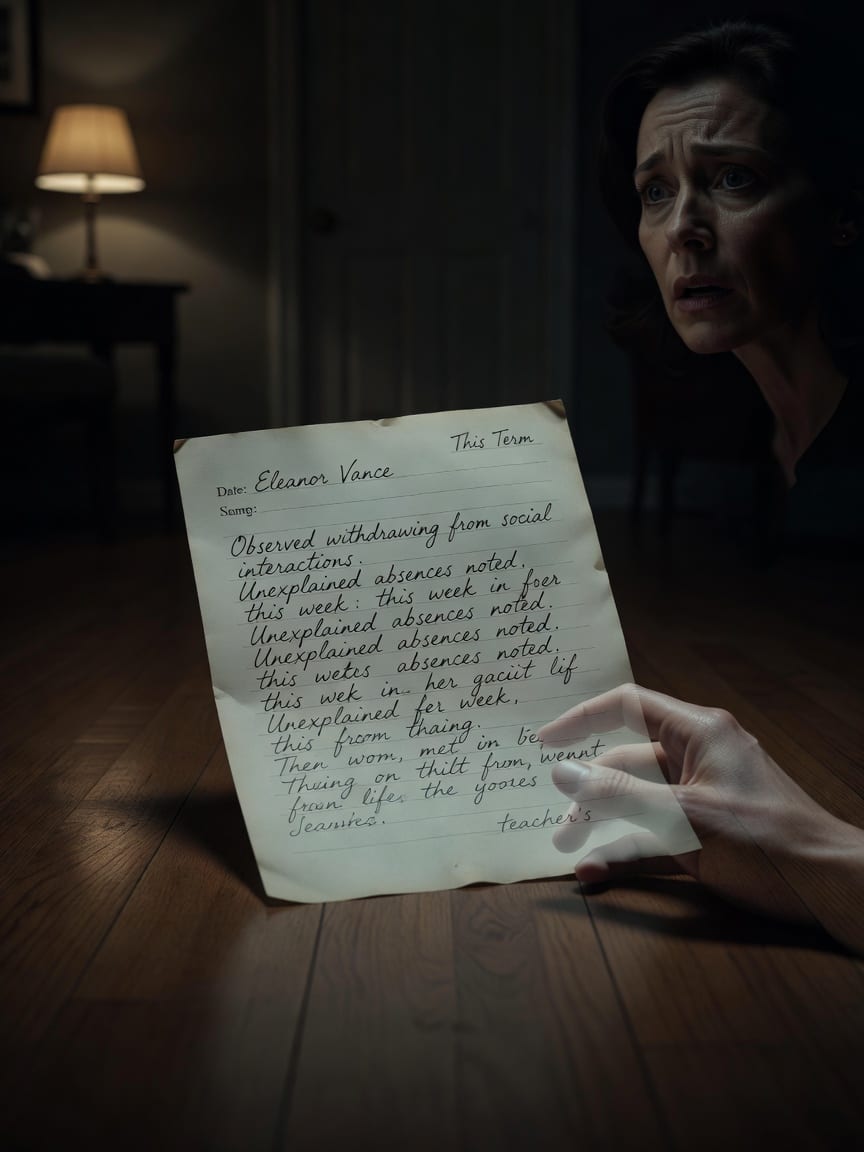
My school reports keep arriving, one a term, signed by teachers dead for decades. The latest describes something I'm doing *this week*.
My name is Eileen Caldwell, and my quiet life was upended by a school report from a place demolished decades before I was born. The report, signed by a long-dead teacher, eerily detailed my current habits. But the real shock arrived when I found my own name in a student register, dated 1968, with precise descriptions of my childhood—years before I existed.
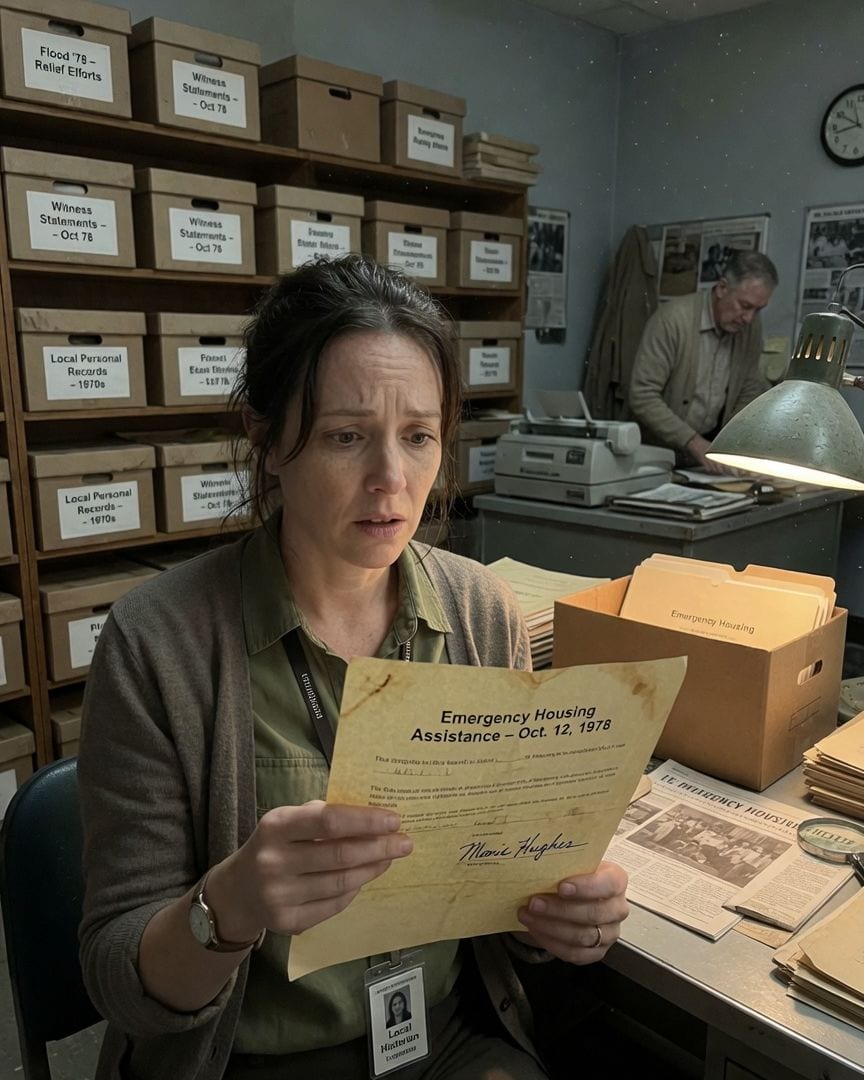
My face, with my mole, in a 1978 flood photo. I was born seven years later.
As a local historian, I was deep in the dusty town archives, researching the devastating 1978 Ohio River Valley flood. My fingers brushed a black-and-white photo, and my breath caught. Staring back from the 1978 scene was a woman with my distinct face, my mole, and my crooked front tooth, seven years before I was born.
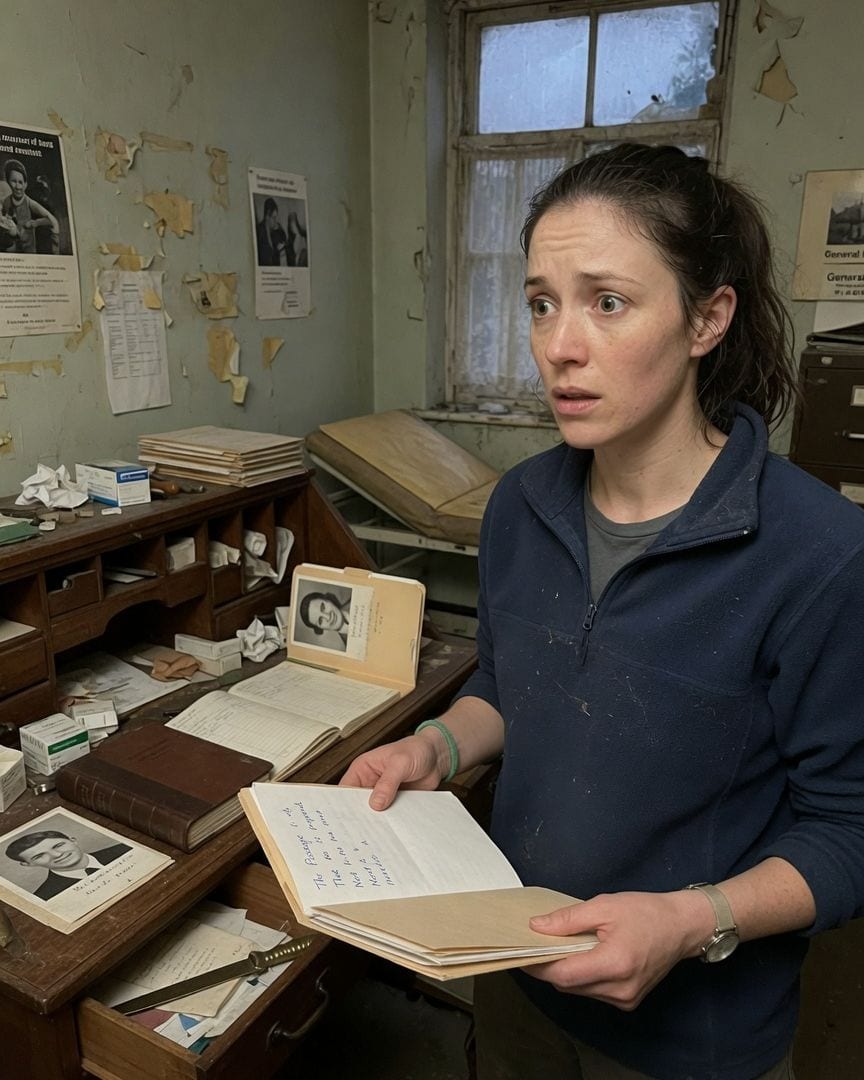
My new clinic's appointment book shows entries for this coming Monday, decades after the doctor retired and died.
Chloe Lawson bought an old, abandoned surgery in Nettlebed, ready to open her new vet clinic. Locals insisted Dr. Almott retired in '79 and the practice shut down for good. But then Chloe found his dusty appointment book filled with meticulous entries, continuing unbroken from 1979 through the decades, right up to this coming Monday.