Airman Lars Petrov finds his own name signed in a Cold War logbook from 1968, decades before he was even born.
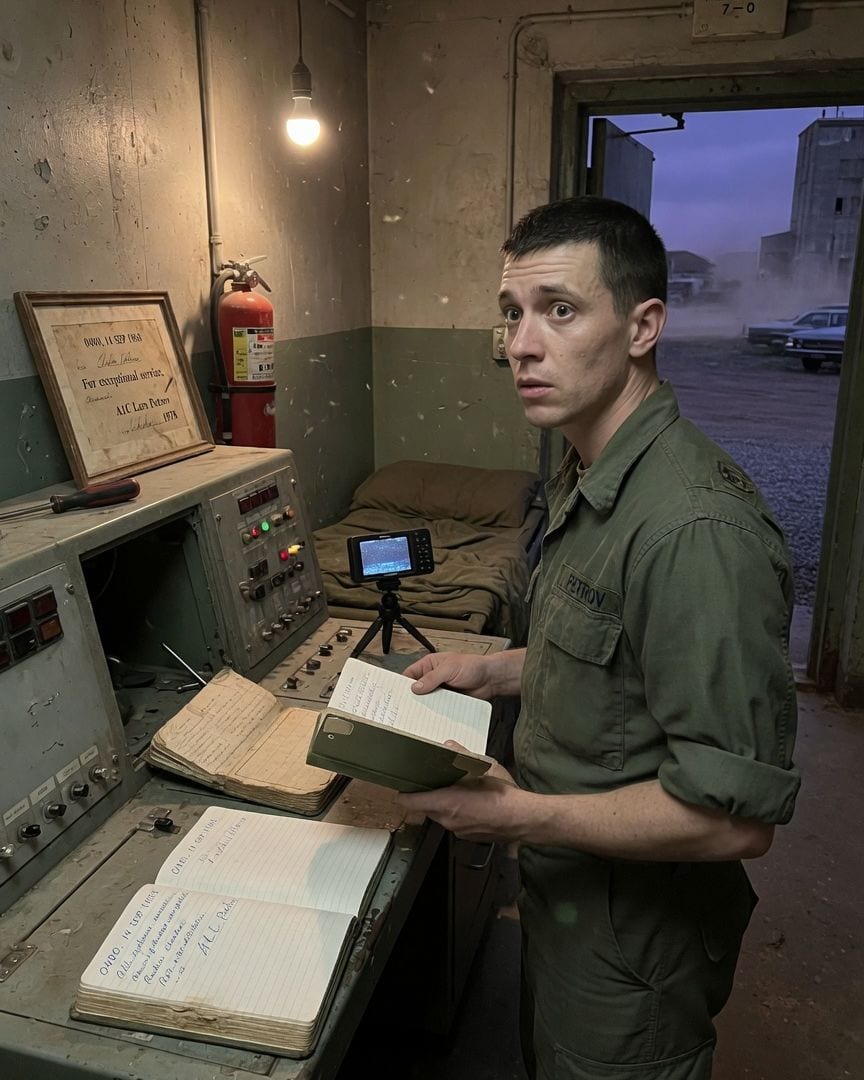
Airman Lars Petrov drove the last few miles to Missile Site 7-0, the North Dakota flatlands stretching endlessly under a bruised sky. The wind, a constant, mournful presence, scraped across the decommissioned ICBM silo, churning dust into the air.
This was his final isolated posting before discharge, a purgatory of solitude. He pulled his beat-up sedan into the gravel lot, the only vehicle for miles, and stepped out into the biting chill.
The concrete control room, squat and windowless, looked like a tomb.
Inside, the air was stale and cold. A single bare bulb illuminated the main console. On a small, scarred table beside it, Lars found a logbook.
Bound in faded green canvas, it lay open to a fresh page, the ink still crisp. He picked it up. The current date, the shift times, the radio checks – all meticulously recorded.
At the bottom of the page, a neat, looping signature read: 'A1C L. Petrov.' His name. But the handwriting was not his. He scrolled back through the days, weeks.
Every entry, every shift, every single item detailed with an unsettling precision. All signed 'A1C L. Petrov,' always in the same distinct, elegant hand. Lars, who knew his own scrawl well enough, felt a prickle of unease.
He tried to dismiss it as a forgotten training log, or maybe a crude joke left by the last guy. But the entries were current, daily, detailing activities he had not performed.
He looked at the last line: '0400, 14 SEP: All systems nominal. Radio check complete.' He had been asleep in his cot at 0400.
Lars made it a point to check the logbook before he went to bed each night.
Without fail, by the time he woke, new entries had appeared, always in that same distinct, unnerving script, detailing hours of activity he had spent in his cot. The consistency of it gnawed at him. He needed an explanation.
He set up his phone on a tripod, angling its camera to capture the control room console. His plan was simple: record the empty room overnight, catch whoever was making the entries.
The next morning, he reviewed the footage, his breath held tight. It was a frustrating, static-laced mess.
The video would run smoothly for an hour, then skip, pixelate, or freeze for critical minutes, right around the times entries would have been made. He saw nothing.
Just the flickering lights of the console, and then, a jump in time, and the logbook was updated.
He moved the phone, searching for a better angle, for some hidden corner that might reveal an intruder.
As he adjusted the tripod, his hand brushed against the dusty, framed commendation hanging on the control room wall, tucked behind a rusty fire extinguisher. He pulled it down.
The glass was clouded, but he could make out the faded script: 'For exceptional service, A1C Lars Petrov.' And beneath that, a date: '1978.' A chill, sharp as the North Dakota wind, sliced through him.
He hadn’t been born in 1978. He checked the official base manifest accessible through his terminal, punching in his codes. Only his name, Lars Petrov, was listed as assigned to Site 7-0.
No other personnel were mentioned for the remote outpost, past or present. The commendation, the logbook, the impossible date – they didn't fit.
Frustration flared, hot and sudden. Lars slammed his hand down on the main control panel, the plastic groaning in protest. A loose panel behind the console rattled, a faint, dry sound that cut through the silence. He peered closer.
The seam was barely visible, just a hairline crack. He pried at it with a screwdriver, expecting to find a nest of ancient wiring. Instead, the panel swung open, revealing a small, hidden compartment, dark and dusty.
Inside, nestled in the gloom, was another logbook. It was identical to the current one, bound in the same faded green canvas, the edges worn smooth with age.
Lars pulled it out, the old paper crumbling slightly at the edges, releasing a faint, musty scent. He opened it, his eyes immediately landing on the first entry at the top of a yellowed page: '0400, 14 SEP 1968.'
He stared at the signature beneath it: 'A1C L. Petrov.' The handwriting, the neat, looping script, was indistinguishable from the logbook he kept on the console. His own name, staring back at him from decades before he was even born.
Lars secured the older logbook, tucking it behind the main console next to the current one. He spent hours comparing the entries, line by line, page by page.
The elegant handwriting, the distinct signature, the meticulous detail of each shift report—they were indistinguishable. It was the same hand, stretched across five decades of recorded activity at Missile Site 7-0. He tried to dismiss it.
Maybe it was some kind of elaborate, decades-long prank, or a forgotten institutional quirk. But the sheer consistency, the impossibility of it, chipped away at his composure.
He finally called Staff Sergeant Franklin Easton, his immediate supervisor at the main base, the satellite phone crackling with the usual static.
Lars chose his words carefully, framing his discovery as a "discrepancy" in the logbook, a potential security breach, or an unsettling prank. Easton, sounding mildly annoyed by the interruption to his quiet desk job, dismissed it with a weary sigh.
"Petrov, sounds like you're getting a little stir-crazy out there," he’d said. "Isolation gets to everyone. Just focus on your duties, okay?"
Feeling increasingly isolated and disbelieved, Lars found another pretext. He requested his full service record, citing a need to "verify deployment history" for a future civilian job application. Easton agreed, but with a hint of suspicion in his tone.
"Everything's in order, Petrov. Don't worry about it." Lars also attempted to access the base's digital personnel archives for Site 7-0's historical staffing, but his clearance level consistently denied him access.
Each attempt yielded the same sterile message: ACCESS DENIED. CURRENT ASSIGNMENT ONLY. It showed only his own name, his current assignment, and no past records, no trace of anyone else ever having been assigned to this desolate post.
The pervasive, silent wind outside, which had once felt like a companion, now felt less like solitude and more like a constant, watchful presence, heightening his unease.
When he finally received a partial digital copy of his own service record, he found minor, almost imperceptible inconsistencies: a blank month here, a transfer date that felt slightly off there, small gaps that nagged at his memory like missing teeth.
Lars continued his investigation, the feeling of paranoia growing with each passing day. He meticulously searched the entire, sprawling missile site, from the dusty, abandoned underground bunkers to the perimeter fence that hummed faintly in the wind.
He found nothing, no sign of another person, no hidden living space, no forgotten supplies. Yet, the feeling of being observed intensified.
He began to check over his shoulder, to listen for footsteps that never came, for the click of a door that never opened.
He called Easton again, his voice tighter, more insistent. This time, he mentioned the sheer age of the logbook he’d found, the entries stretching back to the 1960s. Easton’s tone hardened instantly. "Airman Petrov, I'm warning you about unnecessary distractions.
Operational security is paramount. Your duties are simple. Perform them. End of discussion." The words were laced with an unspoken threat.
A few days later, Lars's internet access at the site was suddenly throttled to a crawl, rendering his already sluggish connection almost useless.
His personal phone, when he tried to call home, occasionally dropped calls or showed strange, static interference, as if someone were listening in.
One morning, Lars woke to a cold draft in his room. He found a note tucked under his pillow, a single, torn piece of paper.
The handwriting was the same distinct, neat script as the logbooks: 'Don't look where you don't belong.' The message was clear, direct, and unnerving. It wasn't a prank.
Someone, or something, was fully aware of his actions, and actively trying to stop him. He locked the two logbooks away in a secure locker, but the constant, chilling sensation of being watched never left him.
Every shadow, every creak of the old facility, became a potential threat, a silent confirmation that he was not alone.
Driven by the ominous note, Lars made an unscheduled, unauthorized trip to the main base, bypassing the usual protocol.
He pulled his sedan, now covered in a fine layer of dust, into the main parking lot and marched directly to the base's Archival Clerk.
Monica Calloway, a jaded woman in her mid-forties, looked up from her computer, her expression unimpressed. Lars, his voice tight with desperation, demanded to see his full, physical service record. Monica was initially guarded, citing protocol and his supervisor’s authority.
"Airman, you need to go through Staff Sergeant Easton for that. Orders are orders." But Lars was relentless, his desperation making him surprisingly forceful. "This is urgent, ma'am. It's about an anomaly. A critical one."
With a weary sigh, Monica eventually relented. She stood, pulling a heavy ring of keys from her belt, and walked to a secure cabinet. She unlocked it, revealing rows of thick, aged files. She pulled one out.
It was labeled, in faded lettering, 'Petrov, Lars, A1C.' As she opened it on her desk, Lars’s eyes immediately fell upon something sickeningly familiar: the commendation for 'A1C Lars Petrov,' dated 1978, tucked neatly inside the clear plastic sleeve.
It was identical to the one on the wall at Site 7-0. He pointed to it, his finger trembling. "That… that's impossible. I wasn't even born then."
Monica, her expression shifting from mild annoyance to a faint, dawning unease, picked up the file. "Some older files are… complicated," she murmured, almost to herself.
She carefully showed him the very first entry in the file, neatly typed: 'Assigned to Missile Site 7-0, North Dakota, 14 SEP 1968.'
Lars protested, his voice cracking with disbelief. "My birth year is 1996, ma'am. This is a mistake. A massive error." Monica slowly, methodically, flipped through the decades of entries.
Each page was filled with meticulous details of daily activities at Site 7-0, all under the name 'A1C Lars Petrov.' She produced a sample of handwriting from a 1972 entry, then from 1985, and finally from 2003.
She placed them side by side with the images of the logbook entries Lars had brought from Site 7-0. The loops, the flourishes, the distinct slant – they matched perfectly.
Monica confirmed, her voice now tinged with a growing sense of dread, that the handwriting in these official entries, spanning over fifty years, matched the logbook samples taken from the site. This wasn't just an old, forgotten logbook.
It was an official, decades-long, continuous service history for a 'Lars Petrov' at that specific site. Lars’s world tilted on its axis. The logbook entries were not a prank, not an error.
They were real, official, and the military had known about this impossible continuity for over fifty years.
Lars, reeling from the revelation that the 'Lars Petrov' in the records was a continuous, decades-long entity, demanded to see his own service record, the one he knew to be true.
Monica, now visibly disturbed, swallowed hard and pulled up his digital file on her computer. Her fingers trembled slightly on the keyboard. She showed him his current assignments, his transfers, his training history.
It all matched his memory perfectly – his enlistment date, his basic training, his initial postings. A solid, verifiable history for a 28-year-old man.
Then, with a hesitant finger, she scrolled down. The screen refreshed, and below his recent, verifiable history, there was a seamless, horrifying transition.
The dates continued backward, not to his actual enlistment, but merging directly into the decades-long 'A1C Lars Petrov' record for Site 7-0 that she had just shown him in the physical file.
His own name, his own service number, now irrevocably tied to an impossible, continuous history stretching back to 1968. His entire identity, his military existence, had been quietly subsumed by this phantom record.
He saw his own face in the ID photo at the top of the digital file, a familiar portrait from his enlistment, but beneath it, the accompanying history now claimed he’d been at Site 7-0 since before his parents met.
He was never merely assigned to Site 7-0; he is Site 7-0, the latest iteration of a role that has existed for over 50 years.
He stared at the screen, his world fracturing, the implication chilling him to the bone: he was always named in it.
Desperate for a full explanation, Lars sought out Colonel Richard Sullivan, the retired commander of the wing that oversaw Missile Site 7-0.
He found Sullivan living a quiet, unassuming life in a small, remote town nestled among the low hills, far from any military presence. Lars, his hands trembling, presented the two logbooks and his compromised service record, carefully explaining everything.
Sullivan, now an elderly man with silver hair and a sharp, knowing gaze, listened patiently to Lars's frantic recounting, a faint, almost imperceptible smile playing on his lips.
He explained, without a trace of emotion, that Site 7-0 was never just a missile silo, nor merely a radio relay station. "It was, and is," Sullivan began, his voice surprisingly soft, "a carefully designated 'containment and observation point.'
Nothing more, nothing less." The 'A1C Lars Petrov,' he continued, was an entity, an anomaly, that had been meticulously observed and managed by a hidden branch of military intelligence for decades.
Its 'service record' was the institutional mechanism by which it was officially accounted for, integrated into the system to prevent panic or wider discovery.
"New airmen are assigned to Site 7-0," Sullivan explained, his gaze steady, "not to staff it, but to become the temporary 'vessel' for the entity's current identity. Their own records are subtly merged and overwritten."
He gestured to Lars's service file. "Every 'Lars Petrov' at Site 7-0 eventually becomes indistinguishable from the entity in the official record." The logbook entries, Sullivan clarified, were the entity's own logs, its 'activity reports.'
The military had known about it since the 1960s, maintaining the illusion of a single, continuous airman.
Sullivan explained that Lars's own upcoming discharge was a calculated part of the cycle, allowing the entity to 'retire' and for a new 'Lars Petrov' to be assigned in its place, a fresh identity for the ongoing 'assignment.'
Lars was horrified, the implications settling over him like a shroud. But Sullivan remained unnervingly calm, his composure more unsettling than any threat. He offered Lars a choice, a chillingly simple one: "You can accept your fate, Airman.
Return to Site 7-0, allow your discharge to proceed as planned. Your physical self will be safe, even as your identity is partially subsumed. Or," Sullivan's voice remained even, "you can resist. And face unforeseen complications."
Lars vehemently refused to be erased, to become a mere placeholder in a forgotten system. "What is it?" he demanded, his voice raw. "What is this entity?" Sullivan simply shrugged. "It is what the system requires it to be.
An airman." Lars, desperate, tried to find a way, any way, to sever his record, to prove his individual, unique existence. He argued, pleaded, trying to appeal to Sullivan’s humanity.
Sullivan merely stood and walked to a locked, antique cabinet in the corner of his study. He retrieved a thick, leather-bound volume, its edges softened with age.
He placed it on his desk, the worn cover reading: 'Site 7-0 Personnel Ledger, 1960-Present.' He opened it to a specific page. In neat, official script, under 'Assigned Personnel,' was a single, continuous entry: 'Petrov, Lars, A1C.
Service Number: [Lars's own service number]. Date of Assignment: 14 SEP 1968. Status: Active.' And then, in a different, lighter ink, 'Projected Discharge: [Lars's projected discharge date].' The institutional record, in stark black and white, stated it plainly.
His individual existence, his entire military career, had been absorbed into a decades-long pattern. Lars realized he could not fight the system, could not prove he was not the entity the military officially recognized.
He had to leave, to escape the physical location and the records, to try and reclaim his identity outside of its suffocating grasp. He drove away from Sullivan's isolated house, the ledger’s unyielding entry burned into his mind.
He had to run from the very identity he’d been given, from a name that was no longer truly his.
Lars Petrov never returned to Missile Site 7-0. His official discharge processed as scheduled, though quietly, without the usual ceremony or fanfare.
Staff Sergeant Easton reported him AWOL for a few days before his official discharge date, but the paperwork was pushed through with unusual speed, a single, unspoken order smoothing the path.
Monica Calloway, the archival clerk, transferred to a different base shortly after, citing stress and requesting a change of scenery.
Missile Site 7-0 received a new airman a few weeks later, a young man named Victor Easton, assigned to the lonely relay station.
The logbook on the console was current, filled with meticulous daily entries, signed 'A1C V. Easton,' in a neat, steady hand.
Lars Petrov lives under a different name now, in a small town far from North Dakota, in a state with no flatlands or desolate missile silos.
He works a quiet job, something that requires no official documentation beyond the basics, something that keeps him anonymous. He still dreams of the incessant wind, the desolate flatland, and the unblinking eye of the control room.
He knows he survived, physically, but a part of him, the part that was Airman First Class Lars Petrov, was left behind, absorbed into the pages of a ledger that stretched back generations.
He sometimes wonders if the new airman at Site 7-0 ever checks the logbook, or if he's just another unwitting placeholder in the system, another name that will eventually be written into the impossible history.
He feels like a ghost, haunting the edges of a life that was almost his.
He is free, but forever marked by the knowledge that his own identity was a temporary, replaceable role in a system far older and more coherent than he could ever comprehend.
His past is a story he can never tell, his name a whisper he no longer answers to. He is a man without a record, a soldier who was never truly himself.
A small, unmarked package arrived at his new apartment a few months after his discharge. Inside, wrapped in brown paper, was a framed commendation, identical to the one he'd seen on the wall at Missile Site 7-0.
It was dated 1978, for 'A1C Lars Petrov,' and the frame was slightly dusty. He set it on his mantelpiece, a reminder of the name he no longer used.
His new neighbor, a kindly older woman, stopped by later with a pie. 'That's a nice award,' she said, nodding at the frame. 'Is that you, dear? You look so young.' He just smiled, a faint, wrong little smile.
If this one got to you
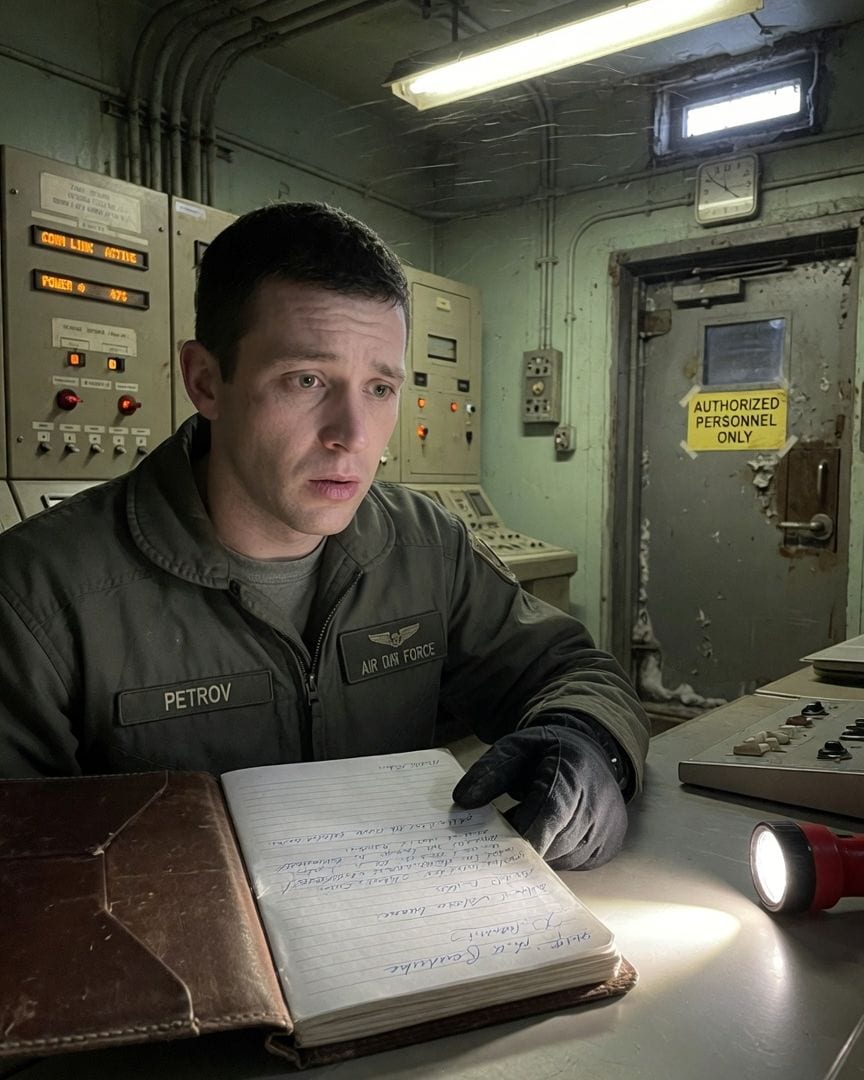
On his lonely watch at Site 73, Airman Petrov's logbook is signed by a man declared MIA forty years ago.
Airman Thomas Petrov squinted against the horizontal sleet, counting down his final two weeks at Site 73, a lonely decommissioned missile silo in North Dakota. His only job was to keep the comms humming, but a peculiar detail in the dusty control room logbook caught his eye. Open to today’s date, the meticulous entries were signed by a name he didn't recognize: A1C R. Fontaine. Petrov was the sole occupant, and official rosters confirmed no Fontaine had been assigned there for decades. As unease mounted, Petrov searched the bunker's forgotten levels, discovering a hidden locker holding a water-stained service record for Richard Fontaine, declared Missing In Action forty years ago. The faded signature in the record was identical to the fresh ink in the logbook. What chilling presence kept the logs current at Site 73?
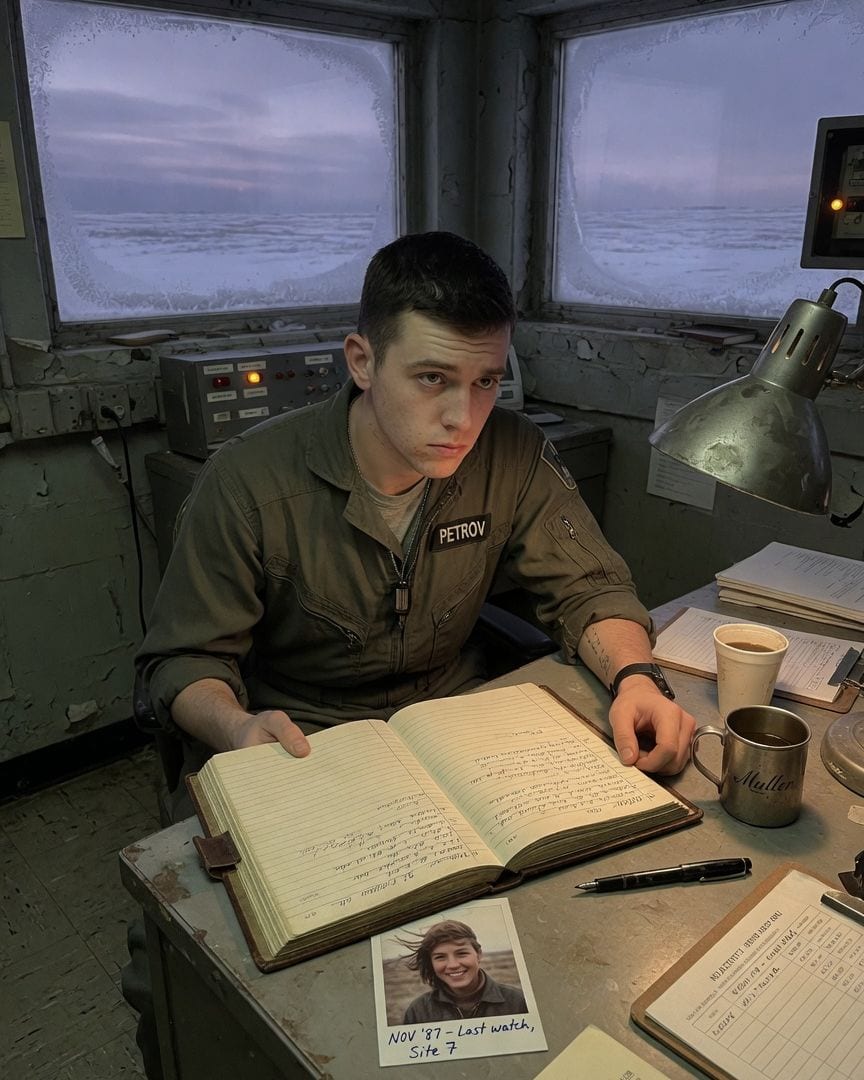
Airman Petrov found a photo dated 1987 in a base logbook, but the Cold War site was officially decommissioned in 1975.
Airman Nathaniel Petrov endured another lonely watch at Site 7, a decommissioned missile silo turned communications relay in desolate North Dakota. His six-week rotation became unsettling when he noticed the logbook on his desk, filled with daily entries detailing his watch, signed by unfamiliar names, though he had never written a word. The latest ink was fresh, and pages revealed years of similar entries from different hands, defying the fact Petrov was the only man assigned. Later, tucked within, he found a faded polaroid photo dated 'NOV '87 - Last watch, Site 7,' a full twelve years after the base was officially decommissioned in 1975.
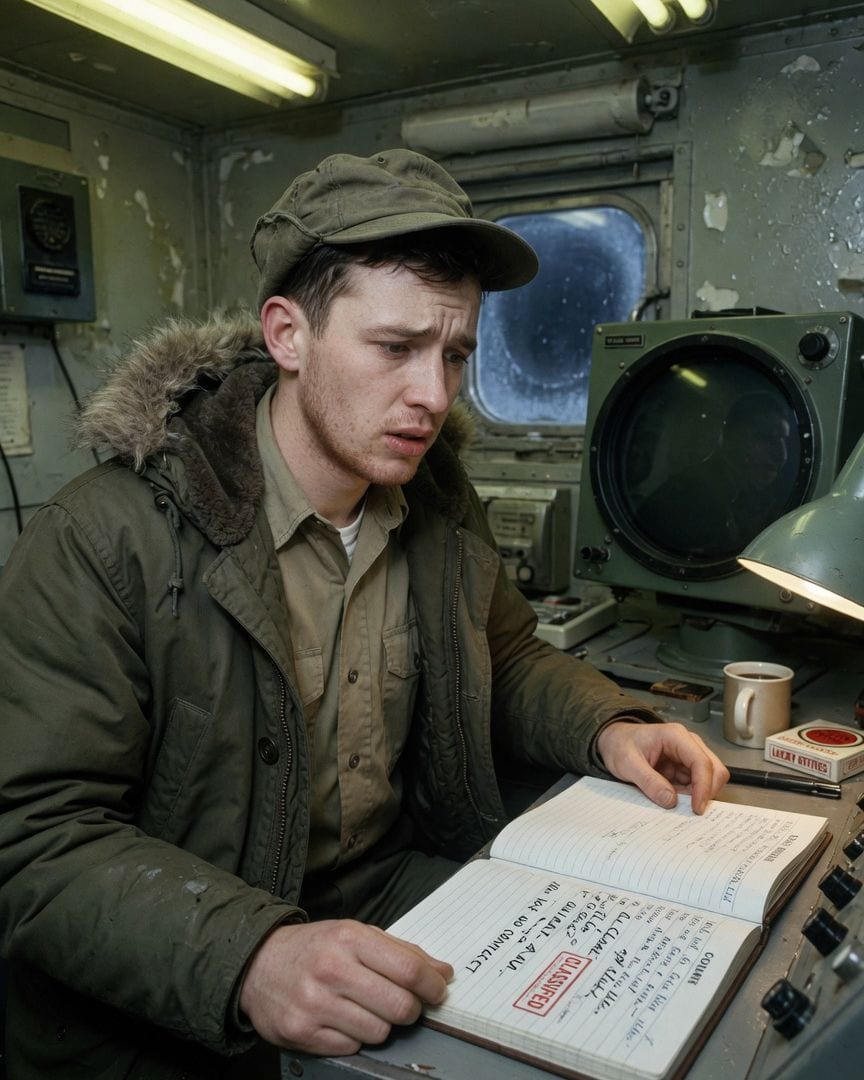
A Cold War airman logs an impossible radar contact on his last sweep. But his official logbook entry is stamped 'CLASSIFIED' and then contradicted by a hastily scrawled 'ALL CLEAR' dated moments before it.
Airman Ordway Vance, 22, manned the radar dome at Site Pellin in the biting North Atlantic dark of January 1962, running the last calibration sweep before its decommissioning. His scope picked up a faint, impossible return, growing closer with each pass, though the ocean remained empty to the eye. When Vance detailed the contact in his official logbook, a 'CLASSIFIED' stamp appeared, followed by a hastily scrawled 'ALL CLEAR' dated moments before his own entry, contradicting his every word. Commander Hartley dismissed it as equipment malfunction, but Vance sensed a chilling, official erasure behind the lie. He soon found a locked cabinet marked 'SITE PELLIN ANOMALIES,' hinting at a deeper truth buried within the base's final days.
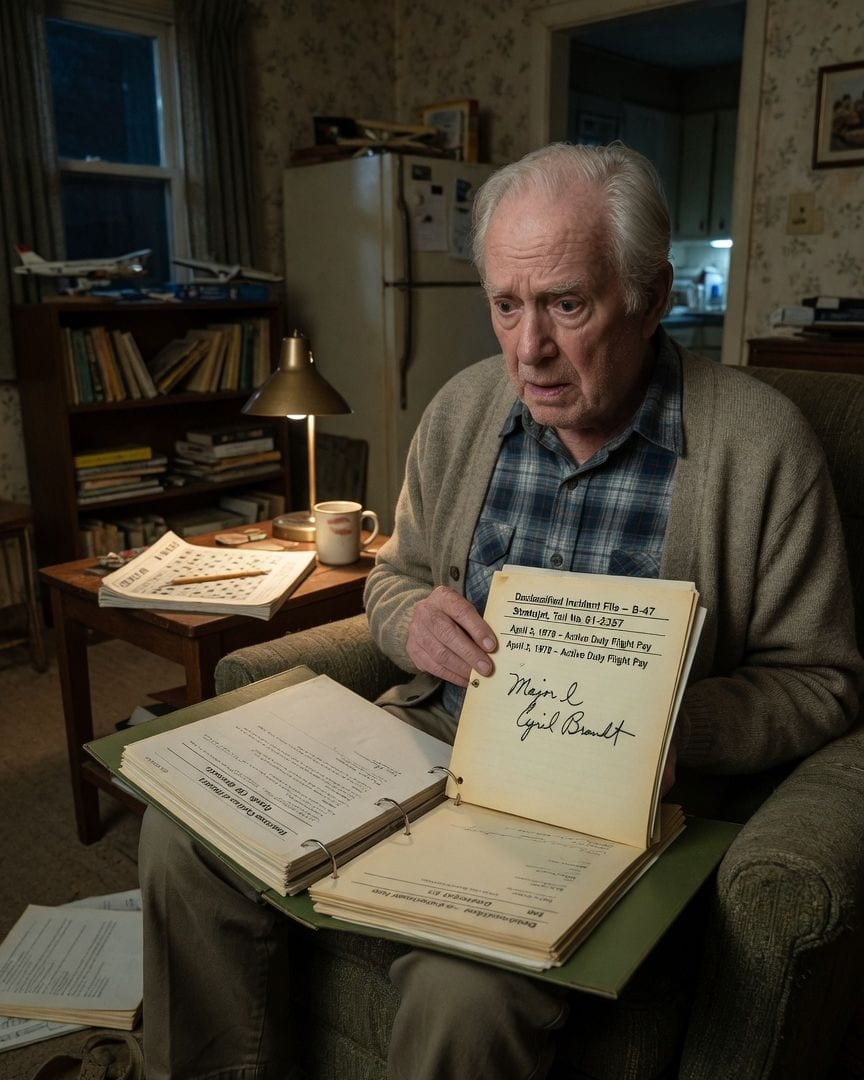
A retired Cold War pilot found his own signature on a flight pay record, dated five years after he left active duty, the ink unnervingly fresh.
Cyril Brandt, a seventy-two-year-old retired B-47 pilot, cherished his quiet Dakota retirement, his days filled with crosswords instead of combat. He expected to find long-awaited closure on a strange 1968 UFO incident when a heavy, declassified file arrived. Settling into his armchair, the weight of the olive-green binder felt familiar, but its contents quickly shattered his calm. He discovered maintenance logs for his B-47, detailing engine hours and tire rotations, dated years after the aircraft had been scrapped. Then, buried deeper, he found a payroll entry for himself, dated 1978 — five years after he left active duty — bearing his own unmistakable signature, the ink unnervingly fresh. How could his own hand have signed off on a mission that never happened, for a plane that no longer existed?
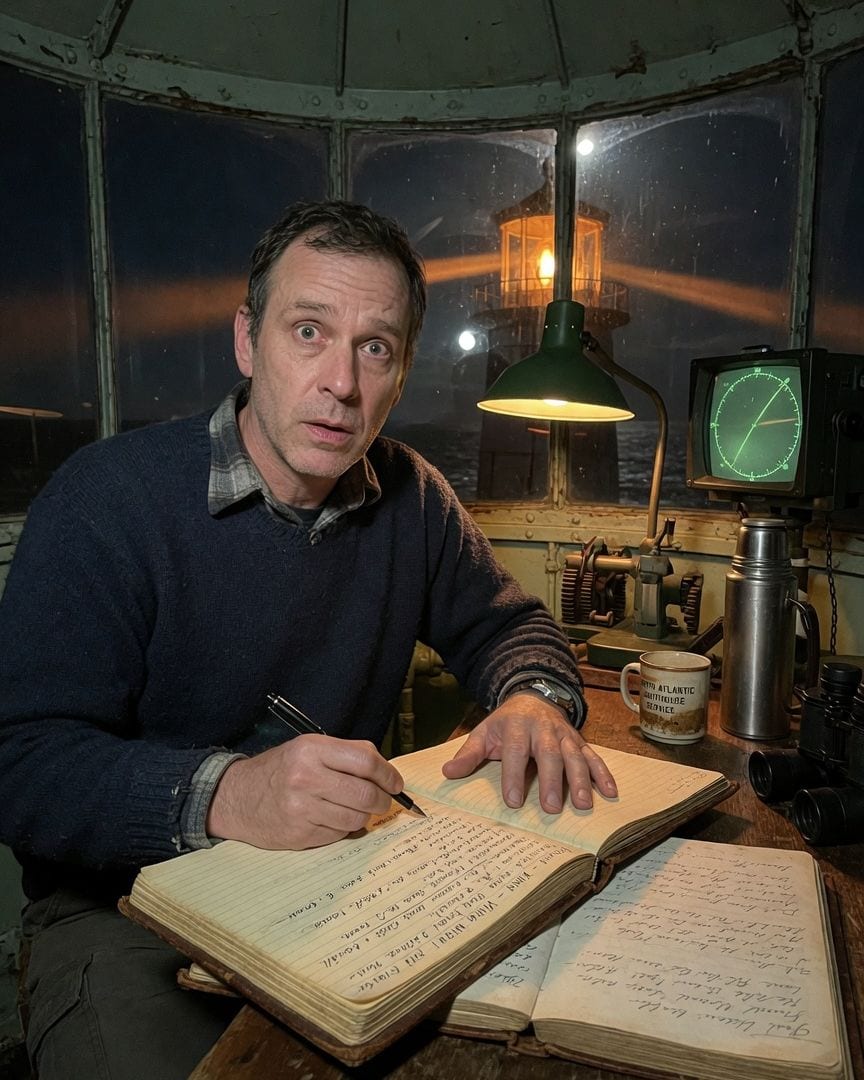
My lighthouse log has my own 3 AM entry for a phantom ship. I was alone in the tower, and I wrote no such thing.
Perched in the lantern room for my usual 2-6 AM watch, I reached for the thick logbook. But the 3:00 AM entry, under my own name, detailed a vessel I never saw. The words were in my own ink, yet I had never written them.
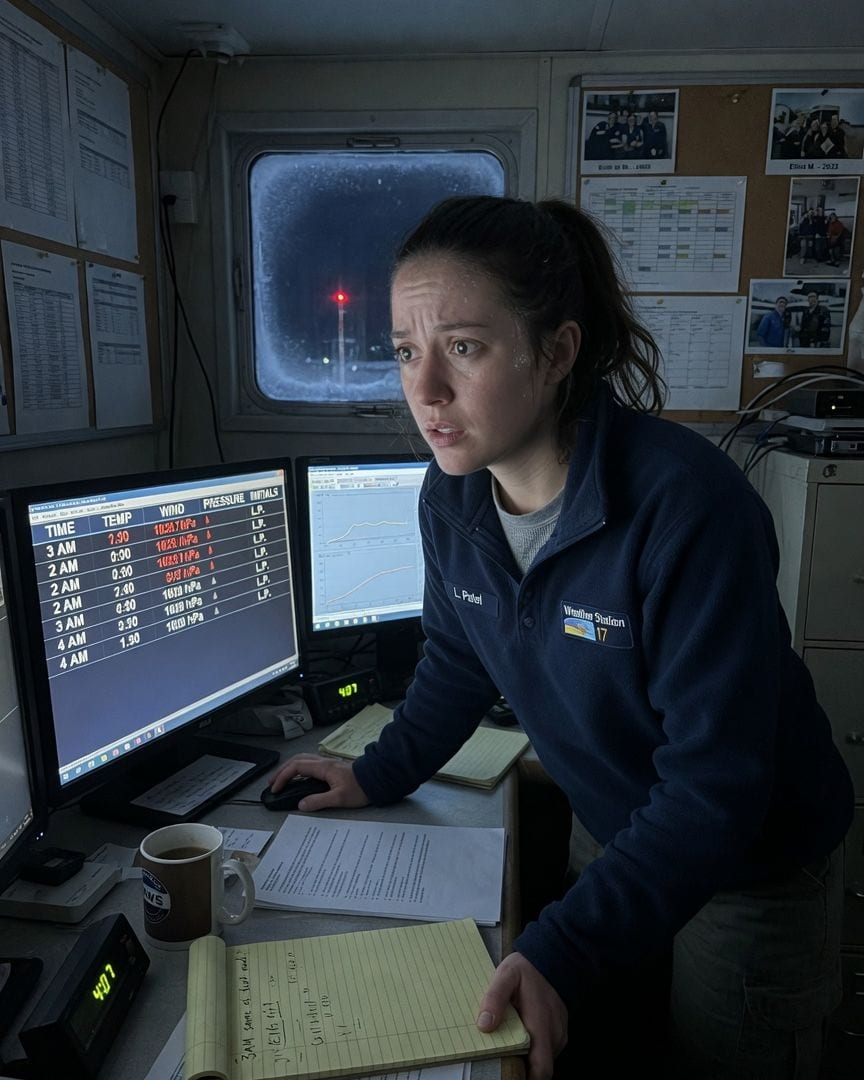
My weather station's 3 AM log shows a pressure reading I never made. My initials are on it, but the dials were dead still.
Working the overnight shift at the remote weather station, I routinely checked the digital logs. The 3 AM entry showed an impossible barometric pressure spike, a hurricane that simply hadn't happened. I distinctly remembered being outside at that time, calibrating a sensor, not making that entry. Yet, my initials, L.P., were clearly logged next to data I never made.