Airman Petrov found a photo dated 1987 in a base logbook, but the Cold War site was officially decommissioned in 1975.
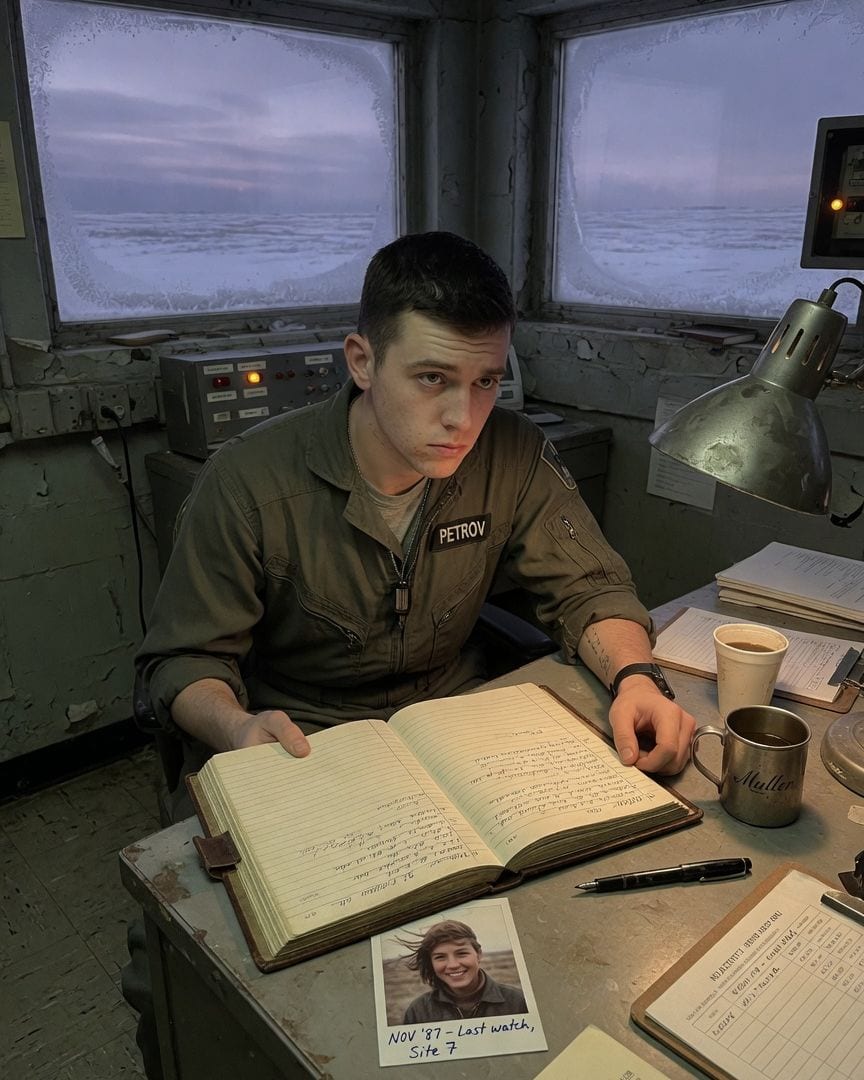
The North Dakota flatland stretched to the horizon, an unbroken quilt of white under a bruised sky.
Airman Nathaniel Petrov, 24, watched it all from the reinforced windows of Site 7’s control room, a decommissioned missile silo repurposed into a solitary communications relay.
The wind was his only company for miles, a constant, mournful howl that vibrated through the thick concrete.
His six-week rotation had started like any other lonely posting, a quiet assignment deep in the heart of nowhere, but the logbook on the desk had changed that.
It was a thick, leather-bound volume, well-worn, but open to the current day, filled with neat, consistent handwriting detailing equipment checks, weather observations, and routine maintenance.
Every entry was signed off, a crisp, looping signature at the bottom of each page.
Petrov was the only man assigned to Site 7, a fact made abundantly clear by his official orders and the absolute silence that enveloped the station. He had never written a single word in it.
Yet, the entries appeared, day after day, documenting his watch as if another hand worked alongside him in the desolate outpost.
Petrov tried to rationalize it. A prank, maybe. A former airman playing a long game, someone who had left a hidden cache of pre-written entries to mess with the next guy.
But the entries were daily, without fail, even through the nights he'd been awake, monitoring the relays, consuming stale coffee, and listening to the wind. He’d seen no one, heard no vehicle approach or leave.
The perimeter sensors were tight, reporting only the passage of phantom snow drifts or restless wildlife. He picked up the logbook, its leather cool and dry against his palm.
The paper felt old, brittle at the edges, but the ink on the last entry, dated this morning, was undeniably fresh, its sheen still faint under the fluorescent lights.
He flipped back, finding entries stretching for years, each page filled in the same steady hand, a consistency that defied multiple authors.
He saw pages signed ‘D. Muller’ for months, then abruptly, the script shifted slightly, signed ‘R. Kingsley’ for others, then back to other unfamiliar names like ‘J. Hayes’ and ‘A. Vane.’ His own name was nowhere in the meticulous record.
On the desk, beside the logbook, sat a tarnished silver coffee mug, engraved with the initial 'Muller,' and an old-fashioned fountain pen, its nib dark with dried ink.
Neither belonged to him, nor were they standard issue equipment for Air Force personnel at a remote relay site.
He tried to search the Air Force’s internal database for 'D. Muller' or 'R. Kingsley' associated with Site 7, but the system returned only 'no records found for this location' or 'personnel files restricted.'
The mundane explanation of a simple clerical error or a harmless joke began to fray, replaced by a cold, tightening knot in his stomach.
The site was supposed to be empty, a ghost in the vast flatland, yet someone, or something, had been here, meticulously documenting the days, leaving behind traces that defied logic, that spoke of a presence he could not reconcile with the vast emptiness surrounding him.
The thought of an unknown hand meticulously writing in a log he was responsible for gnawed at Petrov.
He spent the next hour poring over the logbook, page by page, trying to find a pattern, a mistake, anything to explain the impossible entries.
His fingers skimmed over the dated records, each one a stark, silent testament to a presence he could not detect.
He noticed a slight bulge between two of the older pages, near an entry signed 'R. Kingsley' – the same name as one of the former signatories.
Carefully, he pried them apart, the old paper resisting before yielding with a soft crinkle. Tucked inside was a faded polaroid photo.
It showed a young woman, beaming, her hair windswept, standing in front of what looked unmistakably like Site 7’s relay tower, years younger, the paint on the tower less weathered, but still recognizable.
Beneath the image, a scrawled, handwritten note read: 'NOV '87 - Last watch, Site 7.' Petrov stared at the photo, then at the date, then back at the pristine, current entry in the logbook.
The site had been officially decommissioned in 1975, its missile silos capped and sealed. It was supposed to be unstaffed, a skeleton crew at most, only for maintenance.
Renee Kingsley, whoever she was, should not have been here, not then, not ever.
The discovery of Renee Kingsley’s photo, dated years after the site’s official closure, shattered Petrov’s remaining attempts at rationalization. The easy answers, the comforting lies he’d told himself, crumbled under the weight of the impossible.
He spent the next several days attempting to verify the names in the logbook – Muller, Kingsley, and a dozen others – through every available military channel, official and unofficial. His inquiries went nowhere. He hit walls of administrative obfuscation.
'Personnel records unavailable for Site 7 prior to 1980,' or 'classified status, access denied,' was the consistent refrain from every contact, from every database search. The responses were too consistent, too evasive, a digital curtain drawn over inconvenient truths.
He began to notice other subtle anomalies within the station.
The control room had a faint, lingering scent of old pipe tobacco, a smell that would wax and wane with the temperature, though Petrov didn't smoke and had found no evidence of anyone else having been there.
A specific brand of coffee, 'Thunderhead Roast,' was stocked in the break room, even though he only drank instant.
These weren't just old supplies left behind; the packages seemed to rotate, always fresh, always present in quantities that suggested regular use, not forgotten stores. He started cross-referencing the logbook entries with the site’s internal network traffic.
The log often mentioned 'routine system checks' that corresponded with phantom data spikes on the network, originating from an IP address that didn't exist on the site’s manifest, a ghost in the machine.
Sometimes, an internal sensor would register a 'perimeter breach' in the dead of night, a brief, sharp blip on his monitor, only for the next scan to show nothing, not even disturbed snow or paw prints.
The instruments half-confirmed and half-denied, leaving a widening gap between what the technology swore and what Petrov’s gut screamed.
He felt a growing unease, a sense of being observed, not just by the system, but by something far more present, an unseen witness lurking in the cold steel and concrete.
Petrov’s persistent inquiries did not go unnoticed. A few days after his fruitless searches, an untraceable email landed in his inbox, sender unknown, subject line blank. The body contained only three words: 'Stop looking, Airman.'
He dismissed it as a prank, a final, desperate attempt at rationalization, but the following night, while on watch, his radio crackled to life with a burst of static that made the hairs on his neck prickle.
Amidst the white noise, a low, guttural voice, barely discernible, whispered, 'You're not the first.' The words were indistinct, almost swallowed by the hiss and pop, but the message was clear.
Petrov scrambled to trace the signal, his hands flying over the console, but it vanished as quickly as it appeared, leaving only the usual hum of the relay equipment and the thumping of his own heart.
He began to feel an invisible presence.
The faint sounds he’d dismissed as the building settling – the groaning of ancient pipes, the creak of stressed metal – now seemed deliberate: a soft scrape from the corridor outside the control room, a distant thud from the lower levels of the silo, as if something heavy had been moved.
He checked the exterior cameras, scanning the barren landscape, the swirling snow, the distant gleam of the relay tower.
For a fleeting moment, he saw it – a silhouette, too tall, too thin, standing perfectly still at the edge of the perimeter wire, barely visible against the snow.
He blinked, rubbing his eyes, and it was gone, leaving no tracks in the fresh powder, no disturbance in the pristine white expanse. The dread was no longer abstract; it was personal. Someone knew.
Something was watching, and it didn't want him digging deeper. The hair on his arms stood on end. He was no longer the hunter; he was being hunted. The control room itself felt colder, the air thick with unspoken things.
Driven by a primal fear, Petrov ignored the warning. The email and the phantom voice only intensified his resolve. He knew the site had old, physical records, likely stored in an unindexed archive, forgotten in some forgotten corner.
He spent the next day systematically searching the forgotten corners of Site 7, his flashlight beam cutting through cobweb-laden shadows, eventually discovering a locked, dusty room deep in the maintenance tunnels.
The air inside was still and heavy, smelling of mildew and old paper. Inside, amidst decaying equipment, was a single, unlabeled file cabinet, its gray paint peeling.
He forced it open, the ancient lock groaning in protest before snapping under his improvised pry tool. The top drawer contained a box labeled 'Site 7 - Historical Logbook Anomalies.'
Inside were fragmented, heavily redacted reports, yellowed with age, their typeface faded. He pulled one out, dated 1988.
It detailed 'unexplained personnel transfers' for Airman Renee Kingsley, correlating precisely with the 'NOV '87 - Last watch' note in the polaroid photo. The report spoke of her vanishing without a trace, her last recorded activity being a logbook entry.
Another report, from 1995, meticulously documented 'logbook discrepancies' for Airman Donald Muller, describing his personal items – including a tarnished silver mug – being found at the site after his 'transfer.'
The reports were vague, clinical, sanitized of any genuine horror, but the pattern was horrifyingly clear: these people didn't just disappear; they were absorbed, their presence maintained in the logbook, their personal effects left behind as a macabre trophy.
The paper trail, however fragmented, however carefully obscured, confirmed his deepest fears. These weren't just anomalies; they were a systemic failure, a process, a chillingly consistent pattern of disappearances.
At the bottom of the box, beneath a stack of old manifests, he found a yellowed business card: 'Vincent Barlow, Retired Asset - Site 7 Oversight.' A phone number was scrawled on the back, faded but legible.
Barlow was the 'one who knew,' the name that would finally provide the answers.
Petrov held the card, his hand trembling, knowing he was about to cross a line he might never return from, a line between ignorance and a truth that would surely shatter him.
With a pounding heart, Petrov dialed the number. Vincent Barlow answered on the second ring, his voice calm, almost unnervingly so, as if he had merely been waiting for the call to come.
Petrov, barely controlling his agitation, explained his findings, the impossible dates, the disappearing personnel, the classified reports. Barlow listened patiently, without interruption, then simply said, 'I've been expecting a call from Site 7.
It’s always around this time in the rotation, isn't it?' He agreed to meet, suggesting a secure line, but Petrov, desperate for a tangible answer, a real face, insisted on meeting in person.
Barlow agreed to a rendezvous point a few hours drive from Site 7, emphasizing discretion with a tone that suggested much more than mere secrecy.
As Petrov gathered his gear, preparing for the drive, a sense of profound dread settled over him, cold and heavy. He returned to the file cabinet, a nagging feeling pulling him back, a whisper of something missed, something deeper.
He ran his hand along the bottom of the 'Anomalies' box, feeling a loose panel beneath the compressed weight of the reports. He pried it open with a grunt, exposing a false bottom.
Beneath, in a hidden compartment, lay a single, much older, leather-bound ledger, its pages even more brittle than the logbook on his desk. The cover simply read: 'Site 7 Monitoring Personnel - Rotation Schedule.' He opened it.
The pages were filled with names, dates, and small, hand-drawn asterisks. He found 'D. Muller' and 'R. Kingsley,' each with an asterisk beside their last listed date, a chilling symbol of their fate.
And then, near the current date, his own name: 'N. Petrov.' A small, almost invisible asterisk already marked next to it, faint but undeniable, and a date that predated his actual assignment orders by several months.
His breath hitched, catching in his throat like a trapped bird. He wasn't just investigating; he was already part of it, and had been for longer than he knew.
He traced his own name, 'N. Petrov,' on the brittle, yellowed schedule. An asterisk next to it, just like all the others before him – Muller, Kingsley, and dozens more.
The date above his name, months before his official orders, was a gut punch.
He heard a faint, almost imperceptible hum from the concrete floor beneath his feet, a vibration that seemed to resonate with the chilling realization that he was never assigned to Site 7 by chance.
Petrov met Vincent Barlow in a quiet, anonymous diner miles from Site 7, the kind of place where hushed conversations could easily blend into the clatter of plates and the murmur of local gossip.
Barlow, a man with tired eyes and an impeccably neat, if slightly dated, Air Force uniform, listened to Petrov’s frantic recounting of his discoveries without a flicker of surprise, a chillingly calm observer.
Then, calmly, he began to speak, his voice low but clear. 'Site 7 isn't just a relay, Airman. It's a localized, self-sustaining temporal-spatial distortion. An anomaly.
It requires continuous human observation to maintain its stability, to keep it from, shall we say, expanding.'
Barlow explained that the logbook wasn't a record of human activity, but the entity's own manifest, its way of establishing a continuous, observed reality.
'The 'sign-offs' aren't signatures,' Barlow continued, his voice devoid of emotion, as if relaying a weather report, 'they're acknowledgments of the entity's presence, the moment of 'integration.' The observer becomes part of the observation.'
He revealed that the 'rotation schedule' Petrov found was a classified protocol, put in place decades ago when the true nature of Site 7 was finally understood. 'We don't 'assign' airmen to Site 7, Petrov. We select them.
You were selected. Just like Muller, Kingsley, and myself.'
Barlow explained that he was the last 'fully integrated' observer before he found a way, a very specific way, to externalize his role, becoming the 'oversight,' ensuring the cycle continued, ensuring the entity was fed.
Every planted clue, every impossible detail Petrov had stumbled upon, clicked into place with horrifying coherence.
The phantom pings on the network, the rotating supplies of Thunderhead Roast, the unexplainable traces of tobacco – all were manifestations of the entity’s continuous simulation of human presence, a lure drawing in its next 'observer.'
Petrov wasn't just a sentry; he was a component in a living system, a cog in an unseen machine.
Petrov felt a cold, paralyzing terror seize him. 'Integration? What does that mean, exactly?' His voice was barely a whisper. Barlow’s gaze was steady, unflinching. 'It means you become part of the site, Airman. You maintain the log. You observe.
Forever.' Petrov recoiled, pushing back from the diner table, his chair scraping loudly across the linoleum floor, a jarring sound in the quiet diner. 'No. I won't. I can break it. I can destroy the logbook, the equipment.
I can cut it off.' Barlow merely sighed, a sound of weary resignation. 'Many have tried, Petrov. The site resists. It needs its observer.' Petrov rushed back to Site 7, a desperate, half-formed plan solidifying in his mind.
He would cut the power, disable the relay, burn the logbook to ash, anything to break the cycle.
But as he entered the control room, the air grew heavy, thick with an almost physical pressure that made it hard to breathe.
The fluorescent lights flickered violently, strobing the room, casting dancing shadows, and the hum of the old equipment rose to a deafening drone that vibrated through the floor and up into his bones.
He grabbed the logbook, intent on shredding its pages, but his hands felt sluggish, heavy, his movements slow and clumsy as if he were wading through thick mud.
The fountain pen, the one belonging to Muller, rolled off the desk and clattered to the concrete floor, landing open on a blank page, its nib pointing accusingly upwards.
He felt an overwhelming mental intrusion, a sense of his own thoughts becoming distant, alien, like watching a film of himself from a great distance.
He reached for the emergency power cut-off, his fingers stretching for the red switch, but his hand froze, hovering inches from the switch, as if held by an invisible force.
A profound calm, utterly foreign and absolute, settled over him, silencing the panic, silencing the fear, silencing everything. He looked at the logbook, then at the pen on the floor, then back to the logbook.
The wind howled outside, a continuous, unending watch, a sound that no longer felt mournful but simply eternal.
He felt himself dissolving, his identity fraying at the edges, becoming one with the hum of the relays, the cold steel of the silo, the endless, desolate flatland. The watch would never end, not for him.
Four weeks later, the relief personnel arrived at Site 7, their transport kicking up snow on the lonely access road.
They found the station in perfect order, all systems nominal, not a single light out of place, not a single piece of equipment malfunctioning.
Airman Nathaniel Petrov was gone, his personal effects packed neatly in his locker, but his transfer orders were mysteriously missing from the official manifest, a bureaucratic anomaly in an otherwise pristine record.
The logbook on the control room desk was current, filled with daily, neat entries detailing equipment checks and weather observations, signed off every night with an unfamiliar, yet consistent hand. The last entry was dated today, signed 'N. Petrov.'
The new Airman, Alice Crane, 23, accepted her posting with a practiced calm, a quiet observer stepping into a quiet role, utterly unaware of the quiet horror that had unfolded within the concrete walls, unaware of the continuous watch.
Alice Crane settled into the routine quickly, finding a strange, almost hypnotic comfort in the solitude, in the rhythm of the checks and the hum of the relays. The cold, sterile environment of Site 7 began to feel like home.
She sat at the control room desk, completing her first official entry in the logbook, her handwriting a neat, steady script. Everything was exactly as Petrov had left it, precisely ordered, precisely maintained.
On the desk, next to the logbook, sat a tarnished silver coffee mug, gleaming faintly under the fluorescent light. She picked it up, examining the intricate engraving. On its side, in elegant script, was the name 'Petrov.'
It wasn't hers, of course, but she felt no urge to discard it, no inclination to replace it with her own. It simply felt right, a part of the station, a part of the history.
She reached for the old-fashioned fountain pen, its silver cool against her fingers, a perfect weight in her hand. She dipped the pen, and for a moment, the hand that held it felt utterly alien.
If this one got to you
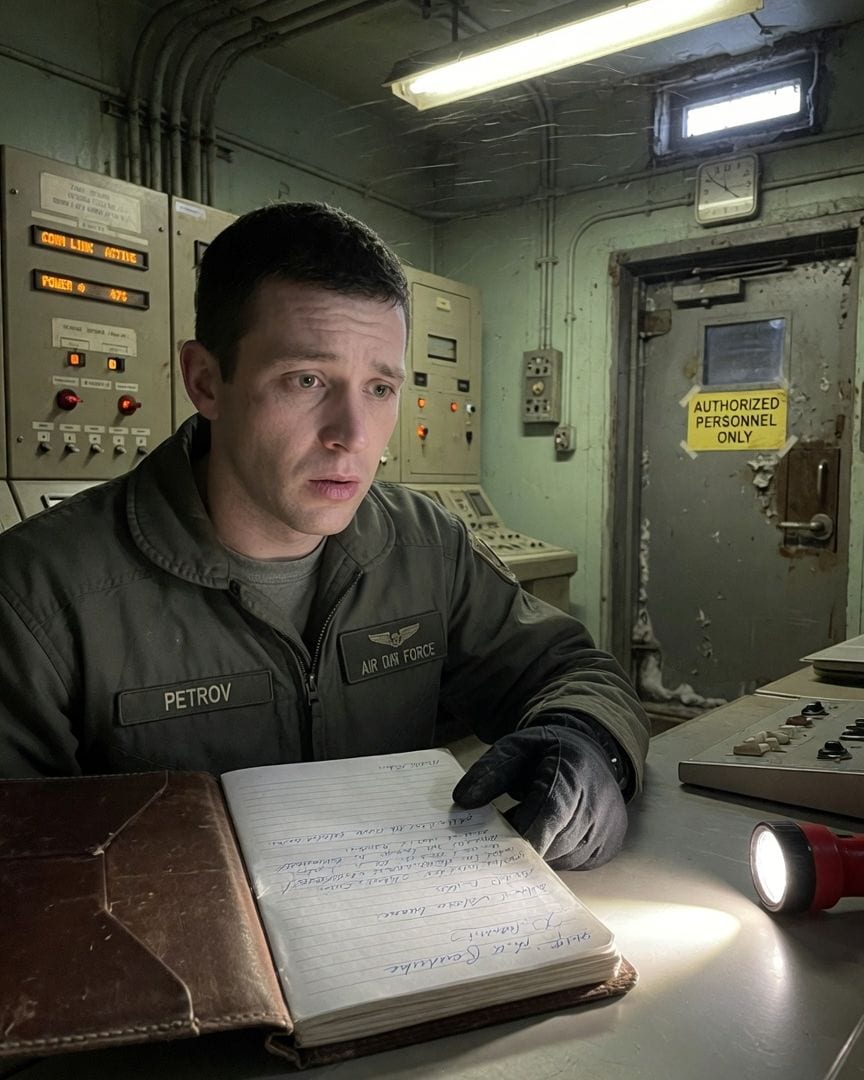
On his lonely watch at Site 73, Airman Petrov's logbook is signed by a man declared MIA forty years ago.
Airman Thomas Petrov squinted against the horizontal sleet, counting down his final two weeks at Site 73, a lonely decommissioned missile silo in North Dakota. His only job was to keep the comms humming, but a peculiar detail in the dusty control room logbook caught his eye. Open to today’s date, the meticulous entries were signed by a name he didn't recognize: A1C R. Fontaine. Petrov was the sole occupant, and official rosters confirmed no Fontaine had been assigned there for decades. As unease mounted, Petrov searched the bunker's forgotten levels, discovering a hidden locker holding a water-stained service record for Richard Fontaine, declared Missing In Action forty years ago. The faded signature in the record was identical to the fresh ink in the logbook. What chilling presence kept the logs current at Site 73?
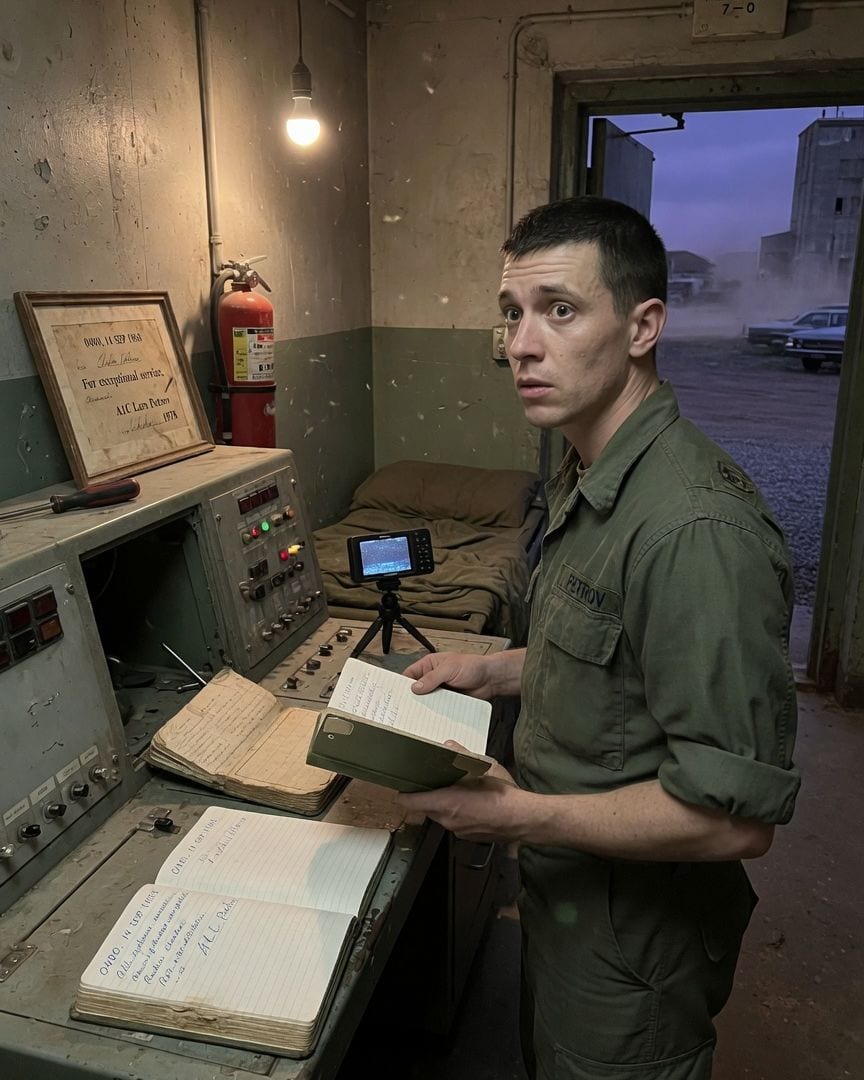
Airman Lars Petrov finds his own name signed in a Cold War logbook from 1968, decades before he was even born.
Airman Lars Petrov was counting down the days at Missile Site 7-0, his final remote posting before discharge, the North Dakota winds his only company. Inside the cold control room, he found a logbook where meticulous entries, including his name, detailed activities he hadn't performed, appearing nightly while he slept. Frustrated, he uncovered a hidden compartment holding an identical logbook, its pages yellowed with age. There, his own signature stared back at him from 1968, decades before he was born. Who was writing his name, and for how long?
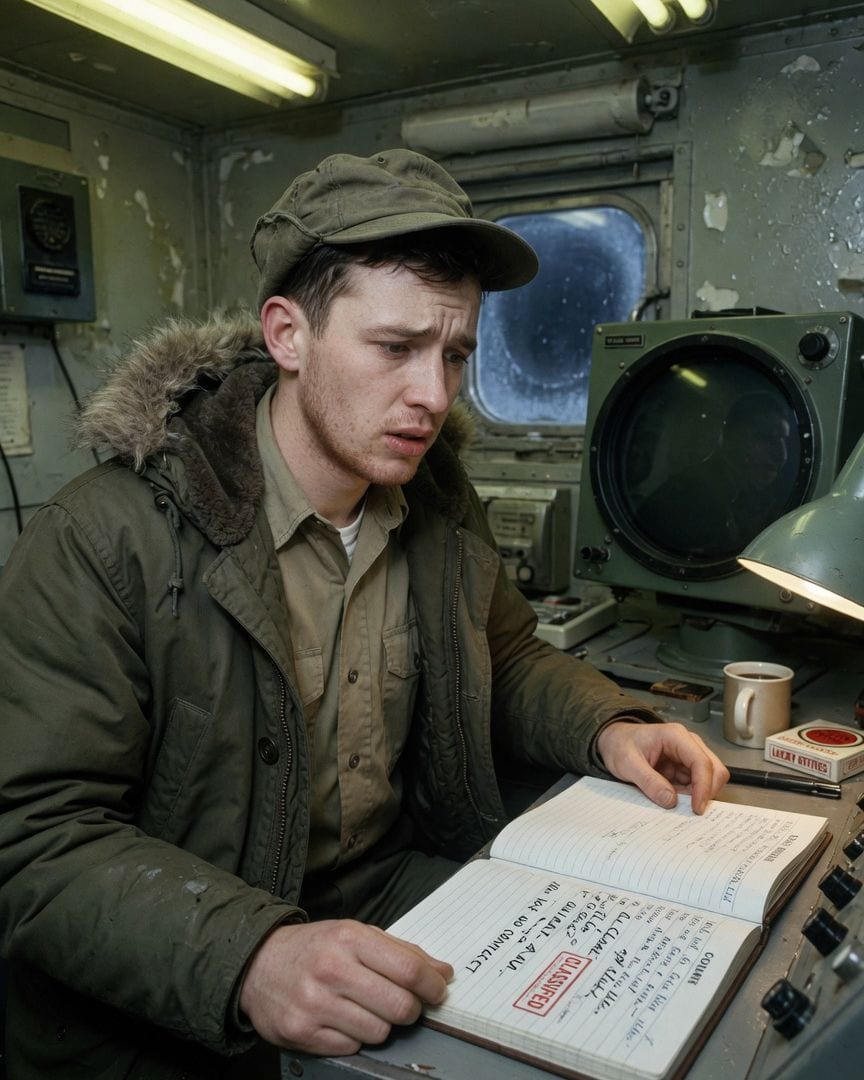
A Cold War airman logs an impossible radar contact on his last sweep. But his official logbook entry is stamped 'CLASSIFIED' and then contradicted by a hastily scrawled 'ALL CLEAR' dated moments before it.
Airman Ordway Vance, 22, manned the radar dome at Site Pellin in the biting North Atlantic dark of January 1962, running the last calibration sweep before its decommissioning. His scope picked up a faint, impossible return, growing closer with each pass, though the ocean remained empty to the eye. When Vance detailed the contact in his official logbook, a 'CLASSIFIED' stamp appeared, followed by a hastily scrawled 'ALL CLEAR' dated moments before his own entry, contradicting his every word. Commander Hartley dismissed it as equipment malfunction, but Vance sensed a chilling, official erasure behind the lie. He soon found a locked cabinet marked 'SITE PELLIN ANOMALIES,' hinting at a deeper truth buried within the base's final days.
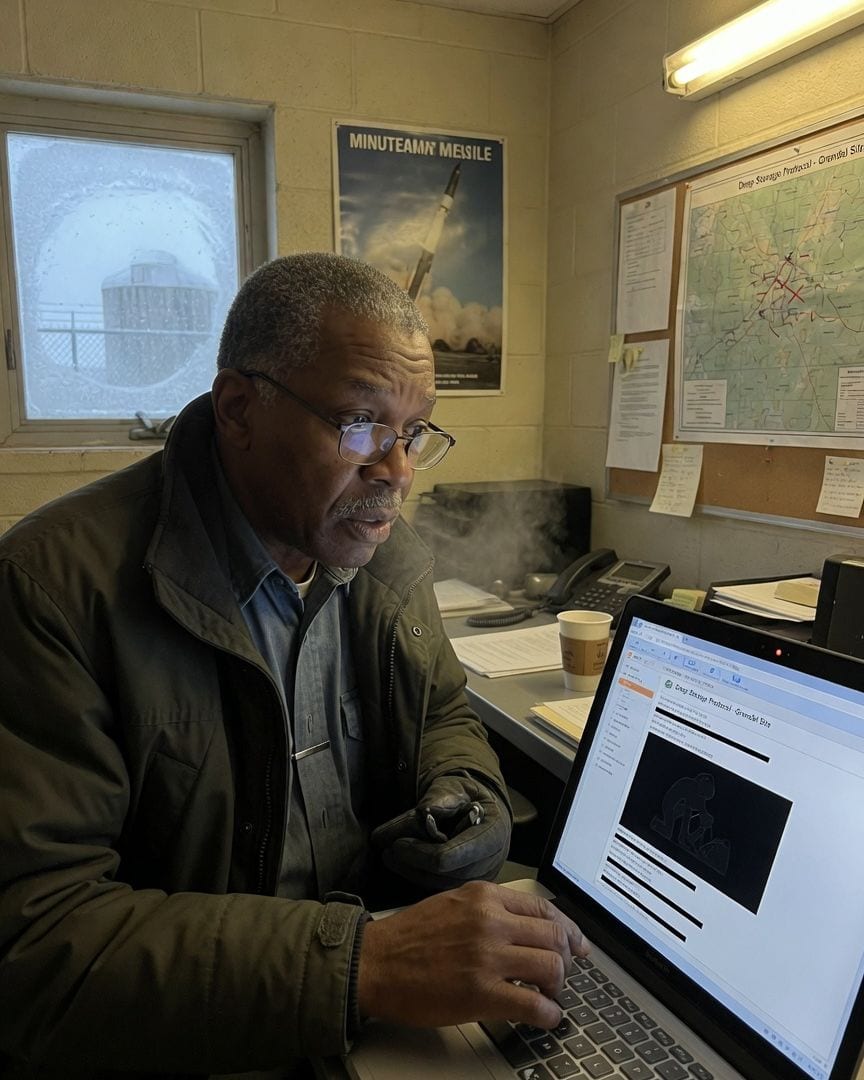
On his last cleanup before retirement, Colonel Marsalis found a dead Cold War missile silo's printer repeating: CREW STILL ON STATION.
Colonel Ren Marsalis, a career Air Force officer, faced his final administrative cleanup before retirement at the decommissioned Grendel Site in the biting North Dakota winter. He expected a sealed missile capsule, but Capsule 7's eight-ton door stood cracked open eleven impossible inches, its hydraulics removed in 1985. Inside, consoles glowed with static alerts from an unknown power source, while an old printer endlessly spooled paper repeating one chilling message: "CREW STILL ON STATION. ACKNOWLEDGE." This impossible communication, from a long-dead system, was no glitch; it hinted at a deliberate, hidden presence, a truth reinforced by a redacted document showing a hunched, humanoid shape.
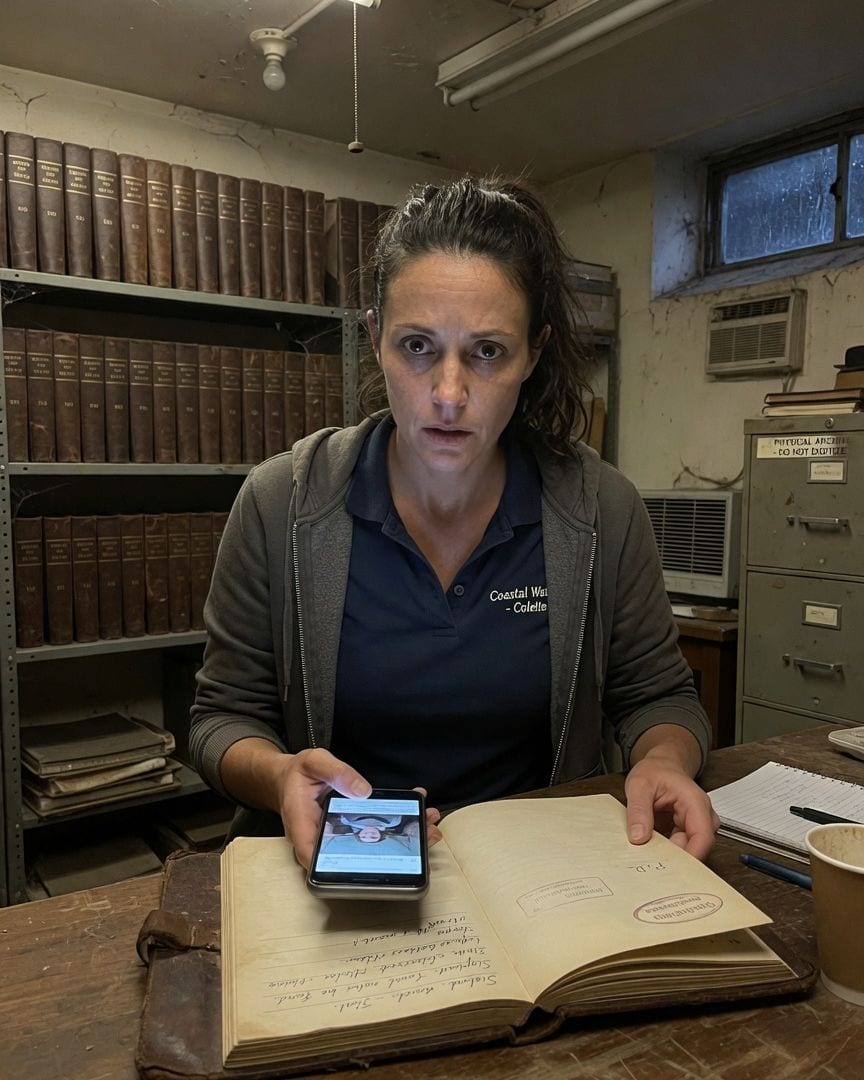
My coastguard log noted Sighting 9 again tonight, a light where no vessel showed. The old logs carry Sighting 9 off Skerry Point at 3:14am every tenth year since 1954, always 'nothing found,' always 'send no boat.'
On my watchtower night shift, the radar screen glowed green and the ocean was quiet. Then, a familiar light appeared off Skerry Point, exactly on cue, just as it had every tenth year for decades. But digging deeper, I found a hidden stamp in an old logbook: 'Operation Skerry. Status: Complete.' It left me with a chilling sense of finality.
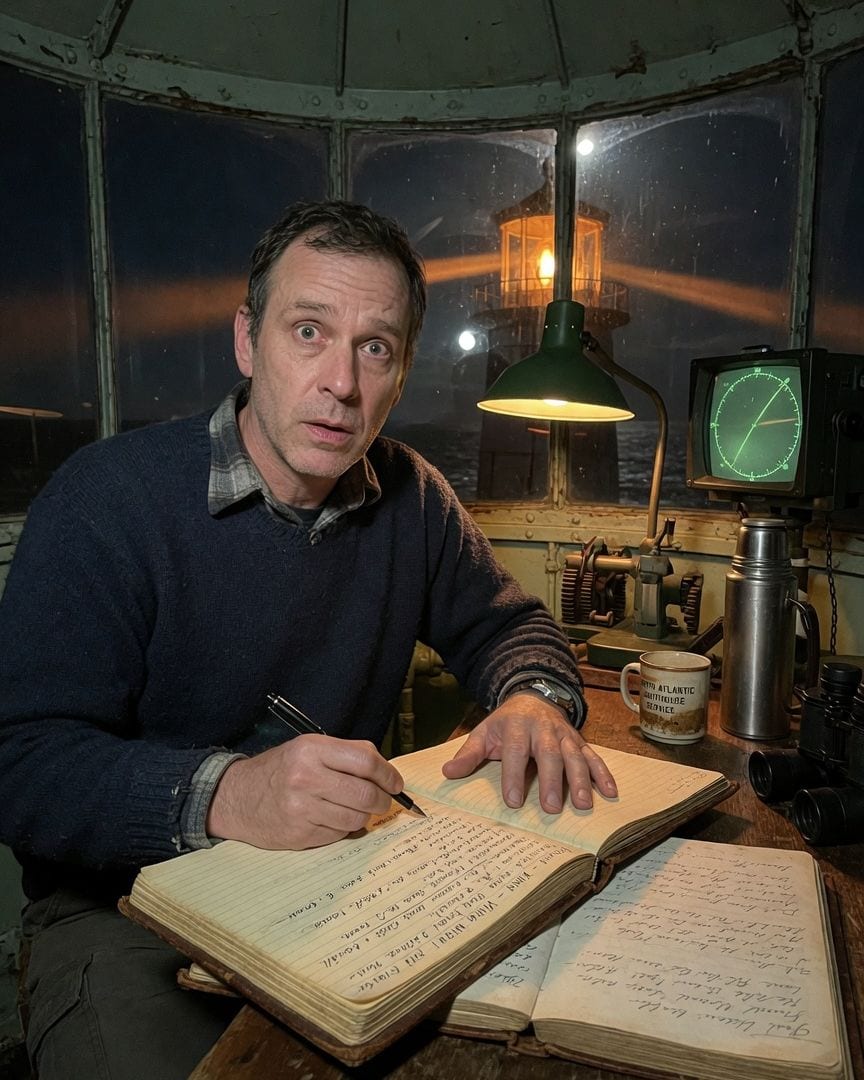
My lighthouse log has my own 3 AM entry for a phantom ship. I was alone in the tower, and I wrote no such thing.
Perched in the lantern room for my usual 2-6 AM watch, I reached for the thick logbook. But the 3:00 AM entry, under my own name, detailed a vessel I never saw. The words were in my own ink, yet I had never written them.