My bank statement shows a $900 cash deposit made in a town I've never set foot in, at 10:40 AM on a workday. I was at my desk, badged in. Two more landed since.
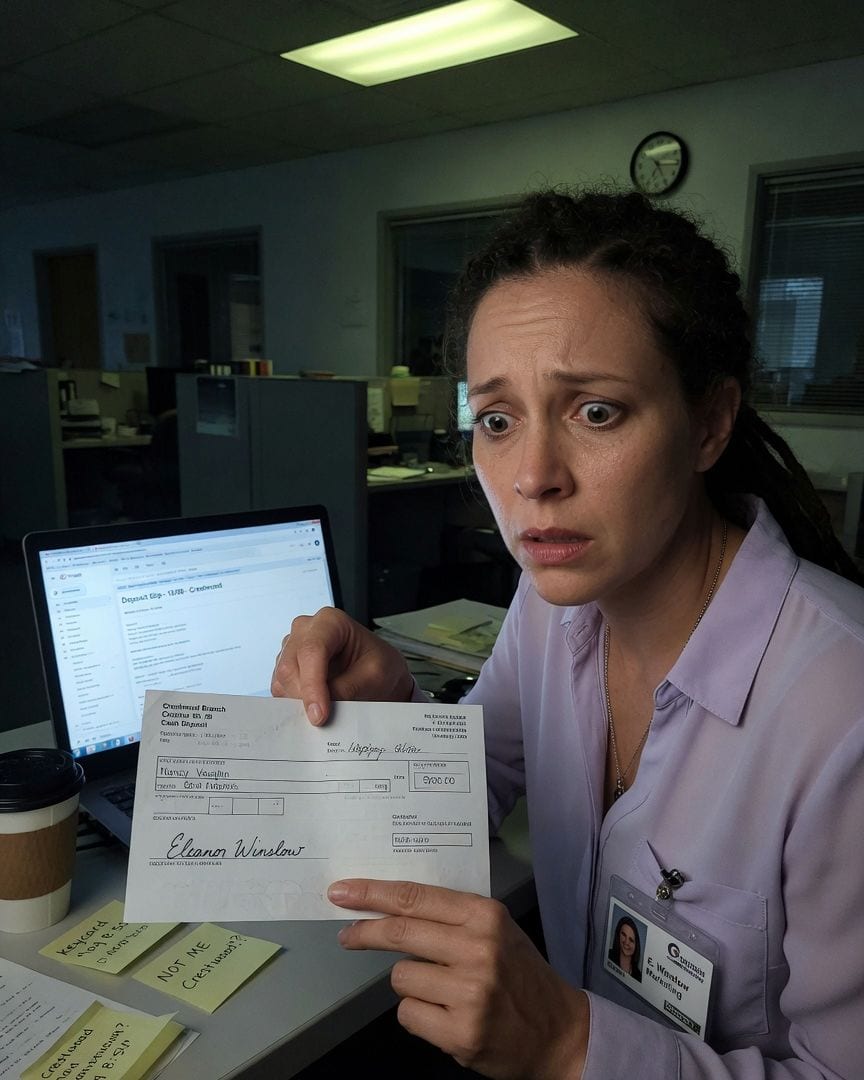
My bank statement showed it clear as day: a $900 cash deposit. Not a withdrawal, which would have been bad enough, but a deposit. Made at a teller window, 10:40 AM on October 8th.
The source location was what stopped me cold: Crestwood. A town I’d never even set foot in, 150 miles from my apartment.
I stared at the online entry, then at my work ID badge, clipped to my blouse. That morning, the 8th, I’d been at my desk, badged in, logged into my computer, running a marketing campaign review.
My work keycard logs would prove it, if anyone bothered to check.
I called the bank, speaking to Gerald Ingram, the branch manager. He was polite, almost excessively so, but firm. "Ms. Winslow, the teller's record notes an ID was shown and matched.
It's highly unlikely it was a deposit into the wrong account if an ID was presented." He paused, a beat too long. "It must be a bank error. A miskeyed account number at the point of entry.
We’ll look into it."
A miskeyed account number. I tried to believe him. It was the only explanation that made sense. But then two more deposits, identical down to the dollar, landed in my account on the following two Fridays: October 15th and 22nd.
The money sat there, untouched, a digital ghost in my balance, insisting I was in Crestwood on three separate mornings I knew, with absolute certainty, I wasn’t. The dread wasn't about the money, which I refused to touch.
It was about the impossible presence. The idea that someone, somewhere, using my name, my identity, was doing things I wasn't.
Linda, my friend and colleague, sat across from me in the office cafeteria, sipping her coffee, trying to find a mundane explanation. Her brow was furrowed with concern. "Maybe someone has a similar account number?
Or a distant relative you don't know about, trying to help you out?"
I shook my head, pushing my half-eaten sandwich away. "I have no relatives in Crestwood, Linda. None. And my account number is unique. Besides, who just deposits nine hundred bucks three times? It's a pattern. Three Fridays in a row."
I pulled up my work keycard logs on my laptop. Every entry for those dates showed me swiping into the building at 8:50 AM, leaving at 5:15 PM. Unbroken. Indisputable. I was here. I had to be.
"Okay," Linda said, pushing her glasses up her nose. "Then it’s still some kind of bank glitch. It has to be."
I ignored her. My stomach was churning. I had my bank call the Crestwood branch again, demanding to speak to the actual teller who made the deposits. This time, I got a younger woman named Nancy Vaughn.
She sounded a little flustered when I explained the situation, her voice polite but wary. "Yes, ma'am, I remember those. Cash deposits, right?"
"Yes," I said, my voice tight. "And the ID? You saw an ID?"
"Yes, ma'am. Matched perfectly. Signature, photo, everything." She even mentioned the name on the ID. My name. "She was in a bit of a hurry, but everything checked out."
"Could you… could you send me a scanned copy of the deposit slip? Just for my records?" I asked, a new, terrible thought beginning to form in my mind. "Given the...
unusual nature of these deposits, I need it for my own documentation."
There was a pause, a rustle of papers on her end. "I don't know if I can do that, ma'am. Bank policy and all."
I pushed, explaining my frustration, the 'error' disrupting my finances, the need for definitive proof for my own peace of mind. I even feigned a little exasperation. She relented, sighing. "Alright.
I'll scan it and email it to the address on file. Give me an hour or so."
The waiting felt like acid in my stomach. What would it show? A scribbled mess, clearly not mine? A forged name, badly done? Or something far worse than a simple error, something that defied logic and explanation?
The office seemed to hold its breath around me, the hum of the air conditioning suddenly too loud.
The email arrived late that night, a single attachment. My heart pounded against my ribs as I opened it. It was a clear, high-resolution scan of the deposit slip.
The date, October 8th, the amount, $900, the Crestwood branch stamp – all exactly as described.
And there, at the bottom, was the signature. My signature. Not a crude imitation, not a similar hand, but the precise, distinctive loops and angles of my own cursive, the way I'd signed a thousand documents throughout my life.
It was flawless.
My breath hitched in my throat. I traced the image on the screen with my finger, then looked at my own hand, splayed out on the keyboard.
It was undeniably mine, this hand, this signature, but I knew, with an absolute, terrifying certainty, that I had never made that mark.
My hand, holding the paper printout I’d made, felt alien, suddenly cold and heavy, as if it recognized the lie written by its ghost.
The impossible signature became my obsession. I printed the slip, comparing it to my driver's license, old credit card receipts, my passport.
They were identical, the same tell-tale flourish on the 'W' of Winslow, the exact angle of the 'A' in Abigail.
How could someone mimic my signature so perfectly, and present an ID that passed bank scrutiny, all while I was demonstrably elsewhere?
Linda, bless her, tried to suggest it was a deepfake ID, something digital, a photograph presented at the teller. "But Nancy described a physical person, Linda. Someone 'in a hurry.' Not a projection."
I started researching Crestwood. It was a quiet, unassuming town, mostly known for a small historical society and a few local festivals. Not exactly a hotbed for elaborate financial fraud.
I called a few hotels there, asking if an "Abigail Winslow" had checked in on any of the deposit dates. The first two had no record. The third, a quaint place called The Crestwood Inn, had a record.
"Yes, Ms. Winslow," the receptionist, a friendly woman named Pamela Larsen, said, her voice lilting slightly with a Southern accent. "Checked in on October 8th, checked out the 9th. Room 207."
My blood ran cold. "And the 15th? The 22nd?"
"No, just the one stay, ma'am. Just that first time."
"Could you describe the guest?" I asked, my voice barely a whisper.
Pamela hesitated. "Well, she was… average, I suppose. Brown hair, about your height. Nothing remarkable. Seemed in a hurry."
Nothing remarkable. Like me. The hair on my arms stood on end.
I drove to Crestwood the following weekend. The bank branch looked utterly normal, a red brick building on Main Street. The Crestwood Inn was quaint, with a bright yellow porch swing.
I found a small, local craft market happening in the town square. Near the Inn, on a lamppost, I saw a familiar face posterized on a flyer for a local bake sale: Nancy Vaughn, the teller I'd spoken to.
Her smile was wide, her eyes bright. It was a small town. Too small for this kind of elaborate, invisible fraud. This wasn’t a random act. Someone, or something, was deliberately building a shadow life for me.
My persistent inquiries seemed to stir something. A few days after my trip to Crestwood, I received an anonymous email. The subject line was blank. The body contained a single, grainy photo.
It was a picture of me, standing in front of The Crestwood Inn, looking at the bake sale flyer. The photo was taken from a distance, slightly out of focus, but undeniably me.
The afternoon sun in the photo matched the day I was there. There was no message, no threat, just the silent, chilling proof that my investigation had been noted.
I deleted it immediately, my hands shaking so hard I almost dropped my phone. The air in my apartment felt suddenly thin, sharp.
Then, a call from Gerald Ingram, the bank manager. His voice was different, less dismissive, more... wary, like he was speaking through a heavy blanket. "Ms. Winslow, about those deposits.
I really think it's best if you just consider them a clerical error. The funds are there, untouched. It's not hurting anyone." His tone was almost pleading.
"But Mr. Ingram," I started, trying to keep my voice even, "someone is using my identity. Someone was there. In Crestwood. On my behalf."
He sighed, a heavy, resigned sound that whistled through the phone line. "Look, I've been in banking for thirty years. I've seen... things. Oddities. Things that don't add up. Sometimes, it's safer to just let them be.
There are some records, some patterns, that are best left undisturbed." He didn't elaborate, but the implication was clear: someone knew, and they wanted me to stop. The hunter had become the hunted.
Gerald Ingram's veiled warning spurred me on. I couldn't let it go. There was an "Abigail Winslow" existing in Crestwood, and someone wanted me to ignore her. I remembered his mention of "patterns."
I called him back, pressing harder this time. "What patterns, Mr. Ingram? What have you seen?"
He resisted, citing confidentiality, his voice growing tighter. "I can't divulge anything, Ms. Winslow."
"My identity is being used!" I cut him off, my voice rising. "What if it's happened before? What if it's happening to others? Don't you think that's more important than some vague confidentiality clause?"
I appealed to his conscience, to the thirty years he’d spent in banking.
After a long silence, a crackle of static, he finally cracked. "There was an old archivist," he mumbled, as if talking to himself. "Wayne Norwood. He retired years ago. He used to keep… unusual records. He called them 'anomalies.'
When he left, they tried to 'digitize' everything, but I heard he kept his own private files."
He gave me Wayne's address, a street name and house number that felt too ordinary for the information he was imparting, with a strict warning: "Don't tell him I sent you. And don't expect him to talk."
I found Wayne Norwood living in a small, meticulously kept house outside the city. Hydrangeas bloomed by the front door, a tidy, unassuming place.
He was a quiet man, older, with kind but knowing eyes that seemed to hold generations of quiet observation.
When I showed him my bank statement, the hotel receipt, and the impossible signature slip, he didn't react with surprise, only a deep, melancholic nod. His fingers, gnarled with age, traced the precise loops of my replicated signature.
"Ah, another one," he murmured, his voice soft, like rustling paper.
He led me to a dusty study, filled with neatly organized boxes stacked floor to ceiling. The air smelled of old paper and something faintly metallic. He pulled out a small, leather-bound ledger from one of the boxes.
Its cover was worn smooth, the pages inside brittle with age. "I've been tracking them for decades. The activations."
He explained that these perfectly forged IDs and impossible records were not glitches, but a deliberate, organized process. "They create a parallel trace. A shell. For some purpose. The deposits are just maintenance."
He flipped open the ledger, revealing rows of names, dates, and small, untraceable deposits. The precise handwriting, faded but legible, filled every line. "You're not the first, Ms. Winslow. Just the latest."
The truth, delivered so calmly in that quiet, dusty room, was chilling. My bank records, the Crestwood hotel, the anonymous photo – they all clicked into place, not as random incidents, but as pieces of a vast, methodical design.
The world outside, the ordinary world, seemed to spin on, oblivious, while I had stumbled into a meticulously crafted shadow.
Wayne showed me how to decipher his personal shorthand in the ledger. Each entry was a person, a date of "activation," and a small, repeating sum, often a multiple of ninety.
He pointed to a specific page, his finger tapping a line. "This is the current sequence. The latest ones."
My finger traced down the column, past names I didn't recognize, some familiar-sounding, others completely foreign. The dates stretched back, a silent, relentless march of time. Then I saw it, halfway down the page, in bold, stark lettering: "WINSLOW, ABIGAIL."
The date beside it was "10/08." October 8th. The exact same day as the first deposit, the day "she" had checked into The Crestwood Inn.
But below my name, a faint, almost invisible pencil note, scrawled in a different, elegant hand, added a single, unsettling word. Not a name, not a date, but a chilling addition to the meticulous record. It simply read: "PREPARED."
"Prepared for what?" I whispered, my voice barely audible in Wayne’s quiet study. The single word hung in the air, heavy and cold.
Wayne sighed, closing the ledger, his gaze distant. "It means they're ready. The shadow identity isn't just a record; it's a placeholder. For when they need it."
He explained that the system wasn't about theft or fraud in the conventional sense. It was about creating a parallel, verifiable existence that could be activated, or swapped, at will. "Sometimes it's for intelligence, sometimes for... disappearance.
Someone needs to vanish, and suddenly, they have a fully documented life in another town. Or someone needs to appear, and there's a record waiting."
He described how these 'shadows' were maintained, not just with money, but with small, verifiable interactions. "A library card application. A minor traffic ticket paid. A membership to a local club, never used, but the record exists."
All perfectly legal, all untraceable to the original person, yet building a credible, tangible life. The deposits, he said, were just the financial heartbeat of this ghost.
The 'PREPARED' note meant that my shadow identity in Crestwood was fully robust, fully funded, fully established. Ready for deployment. It wasn't just a threat; it was an established fact. My original identity was now simply one of two.
I tried to fight it. I contacted lawyers, the police, even the FBI, armed with Wayne's ledger and my bank records. But the answers were always the same, delivered with varying degrees of polite dismissal.
"There's no actual crime here, Ms. Winslow." "The money is in your account; that’s not fraud." "We can't investigate a hypothetical identity, especially when you can't prove who made the deposits."
The records I had only proved that I had money in my account and that my signature was on a slip. The 'other' Abigail Winslow had committed no crime. She was just... existing.
Wayne had warned me. "They operate within the cracks, Ms. Winslow. Everything is plausible deniability. Everything is just an 'error' or a 'coincidence.' The system is designed to be undeniable, yet unprovable as malicious."
I even tried to empty the Crestwood deposits from my account, thinking if the money wasn't there, the shadow couldn't be maintained.
But my bank flagged it as suspicious activity, requiring me to visit a branch with two forms of ID to confirm such a large transfer. The system was designed to keep the money in place, a self-sustaining loop.
I was trapped in a bureaucratic nightmare that was far more sinister than any direct threat. There was no escape, no undoing.
Just the chilling knowledge that somewhere, 150 miles away, another me was ready to step into a life, fully funded, fully documented, waiting for the call.
I eventually stopped trying to fight it. The deposits continued, weekly, a constant, unsettling reminder in my online banking statement. I never touched the money. It grew, an impossible fortune tied to an impossible life.
Wayne Norwood passed away a few months later, quietly, in his sleep. His ledger, I learned, was inherited by his niece, who had no idea what it meant, likely dismissing it as an old man’s eccentric hobby.
Gerald Ingram retired early, citing 'stress.' Linda still asked about the 'bank error' from time to time, but I just shrugged, saying it was 'resolved.' How could I explain that the resolution was the acceptance of a parallel existence?
I learned to live with the knowledge, a cold, quiet dread that settled deep in my bones.
Sometimes, I found myself looking at strangers in crowds, wondering if they, too, had a shadow. Wondering if their bank statements held impossible truths. Wondering if their own ghost was out there, "prepared." I never went back to Crestwood.
I didn't need to. I knew she was there, waiting. And the world, with its neat rows of ledgers and its unquestioning records, simply accepted her existence.
Linda Kingsley, scrolling through her social media feed one evening, paused on a local news story about a small, community award given in Crestwood. The accompanying photo showed a woman accepting the plaque, smiling politely. Linda blinked.
The woman looked exactly like Abigail. Same hair, same smile. But the name under the photo read 'Abigail Winslow, local volunteer.' Linda frowned, then shook her head. Abigail never mentioned volunteering in Crestwood. It must be a coincidence.
The world kept her other name, even if she didn't.
If this one got to you
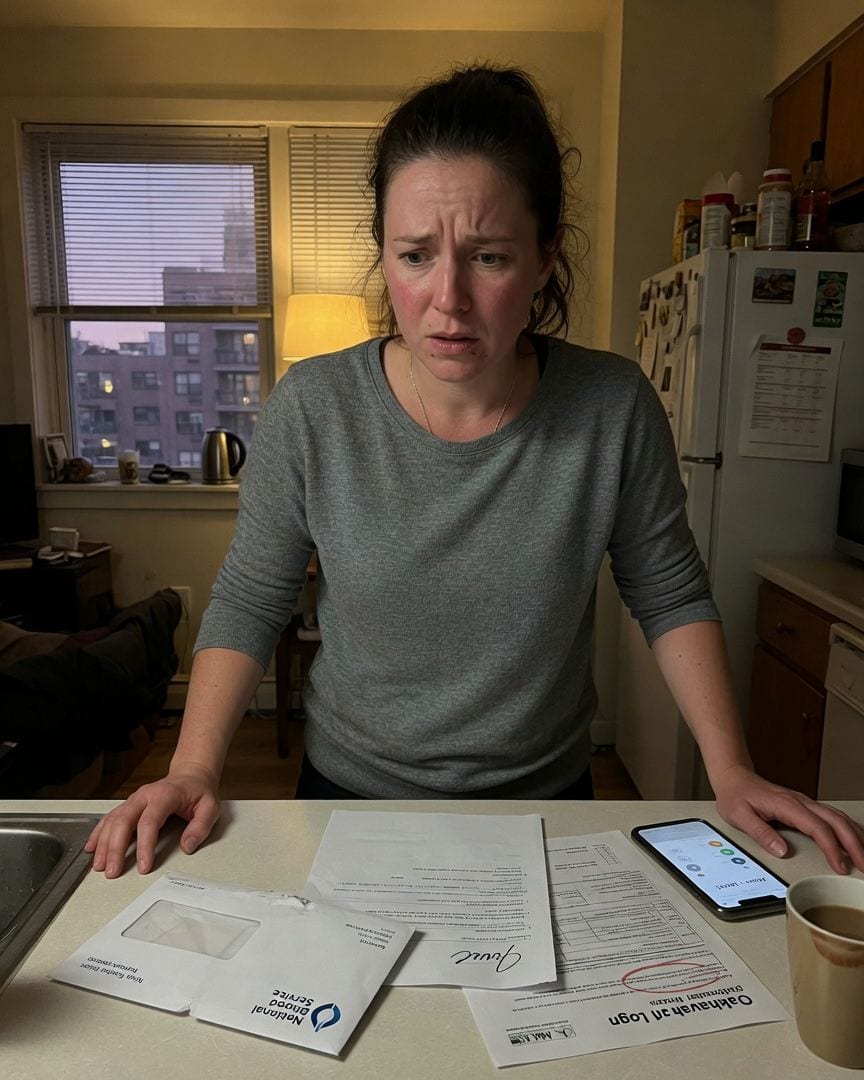
My signature appeared on a blood donation form, thanking me for my sixth. I've never set foot in that town.
An ordinary envelope arrived, but inside, a letter from the National Blood Service thanked me for a sixth blood donation. I’ve never given blood in my life, and the thought makes me queasy. But then I saw the enclosed consent form, signed unmistakably with my own hand, for a donation made in a town I’d never heard of. It was my signature, but it wasn't me.
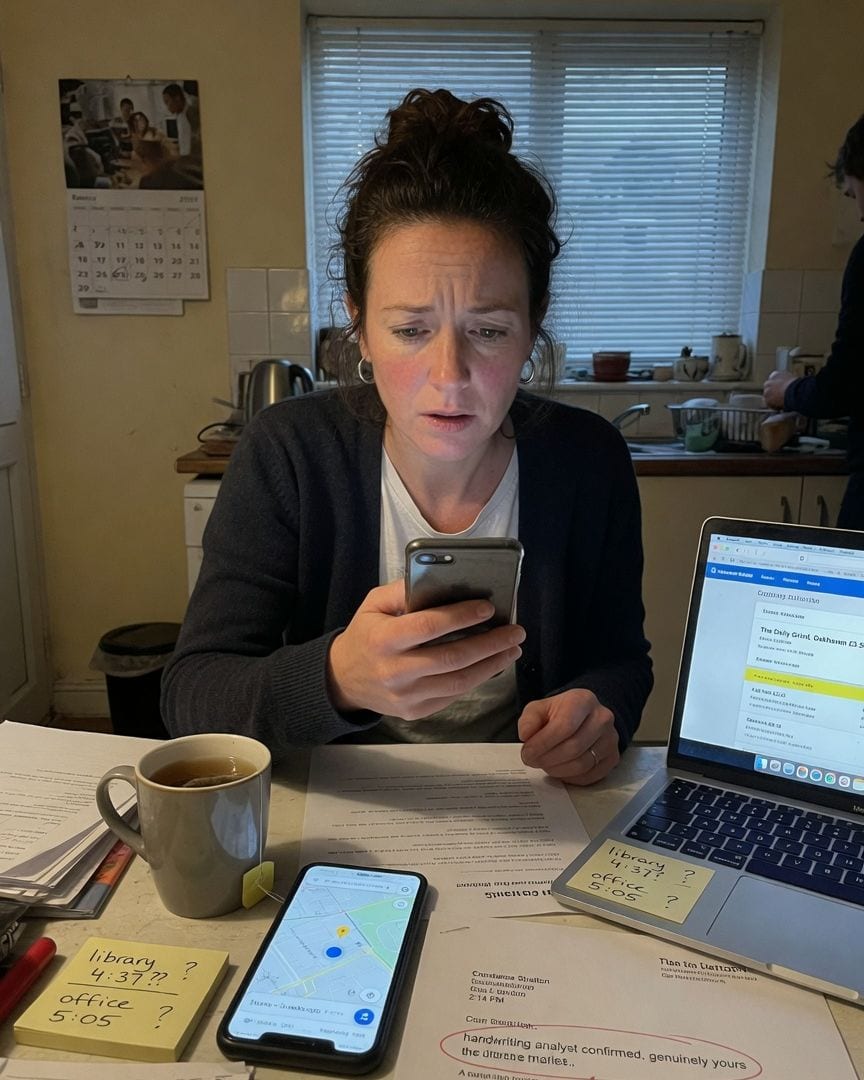
My signature covers a twelve-thousand-pound loan agreement. It's witnessed three hundred miles away, the day my phone confirms I was home.
My afternoon takes a chilling turn when the bank calls about a £12,000 loan, signed with my own handwriting in a town 300 miles away. My phone proves I was at my kitchen table at the time, yet a handwriting analyst confirms the signature is genuinely mine. The impossible truth deepens when a keycard log places me 100 miles away, just minutes before I entered my office.
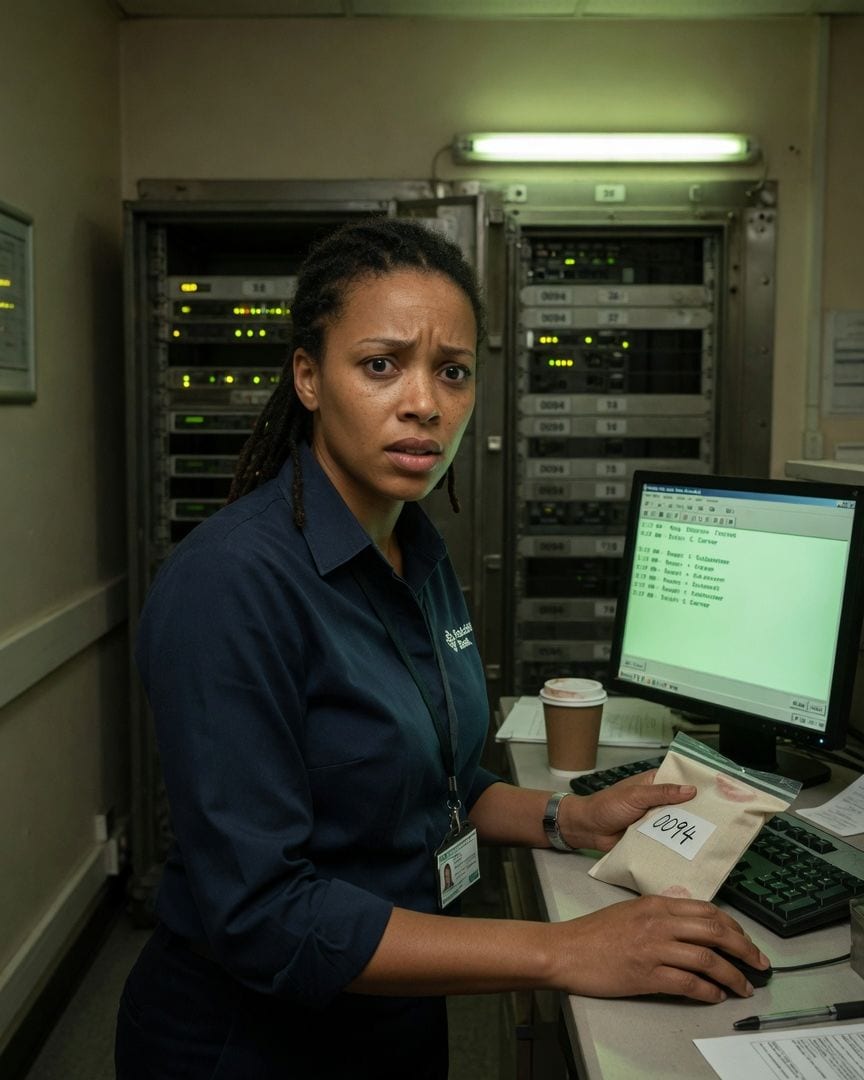
My night-deposit log shows a bag posted at 3:17 AM. My teller number, my count. Bag 0094 is still sealed in the safe, untouched.
I prided myself on precision as a night teller, logging every entry. But at 3:17 AM, a deposit appeared logged under my teller number that I never processed. Security footage then revealed a figure in my uniform, wearing my ID badge, with a blank photo slot.
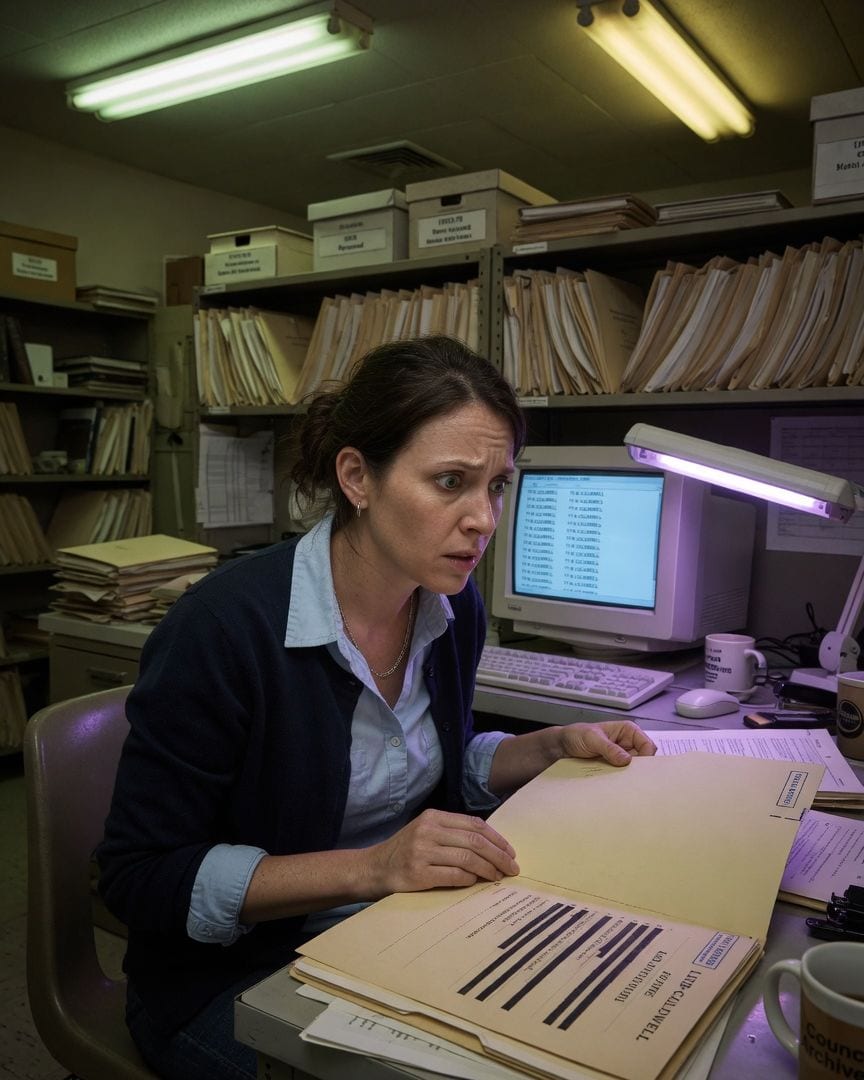
My employer's security file holds a vetting report on me dated nine years before I ever applied. It has my full name and my parents' address — with only one line, the source who referred me, blacked out.
Working a routine data audit, I pull my own security file. The issue date is nine years before I even applied for the job. Then, hidden within an old archive file, I find my current address etched under a blacked-out line.
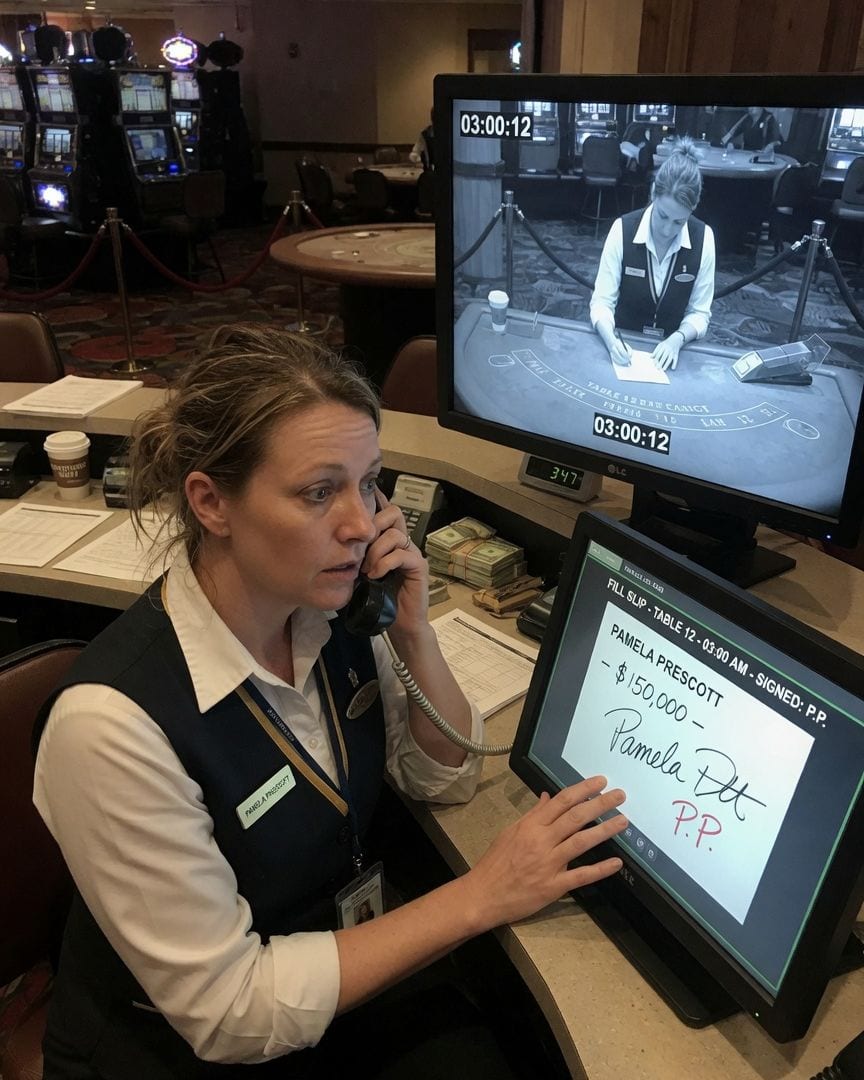
My initials are on a casino count sheet for a table I never touched. Table 12 was dark, roped off for the night.
On my graveyard shift, a routine casino inventory turned impossible. A $50,000 fill for Table 12, a table dark for years, was posted under my name and signature. The impossible part? Security footage shows me making the fill, even as the table itself remained untouched.
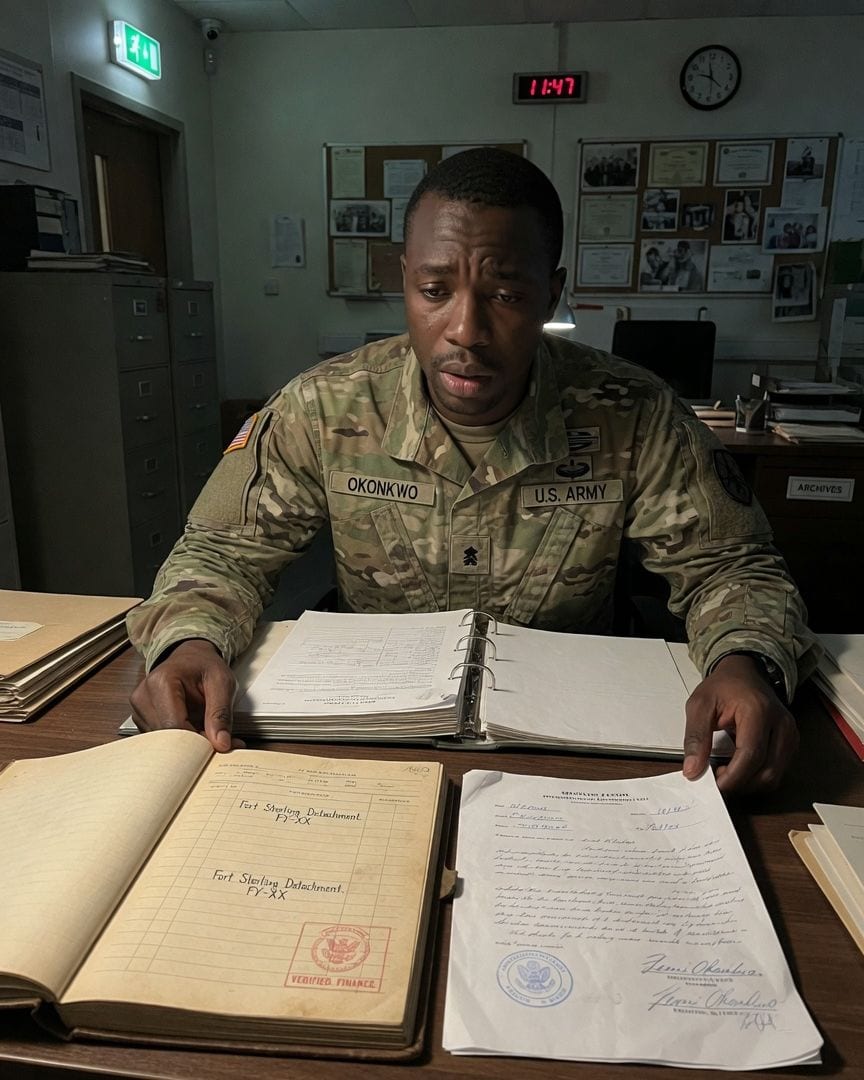
An old deployment ledger bore Specialist Femi Okonkwo's name, but the elegant signature was not his own.
Specialist Femi Okonkwo, an Air Force cargo hauler, stared at an earnings statement that contradicted his entire four-year enlistment. It listed nine months of jump pay and a mountain duty station in Colorado—places he’d never been, operations he’d never completed. Finance and HR records, seemingly impeccable, confirmed every detail of his impossible deployment. But when Femi finally retrieved the physical sign-in ledger, the faded blue ink of his supposed signature revealed the true, chilling discrepancy: the neat, elegant hand on the official document was unequivocally not his own. Who signed for Specialist Okonkwo’s impossible deployment, and why was it so meticulously verified?