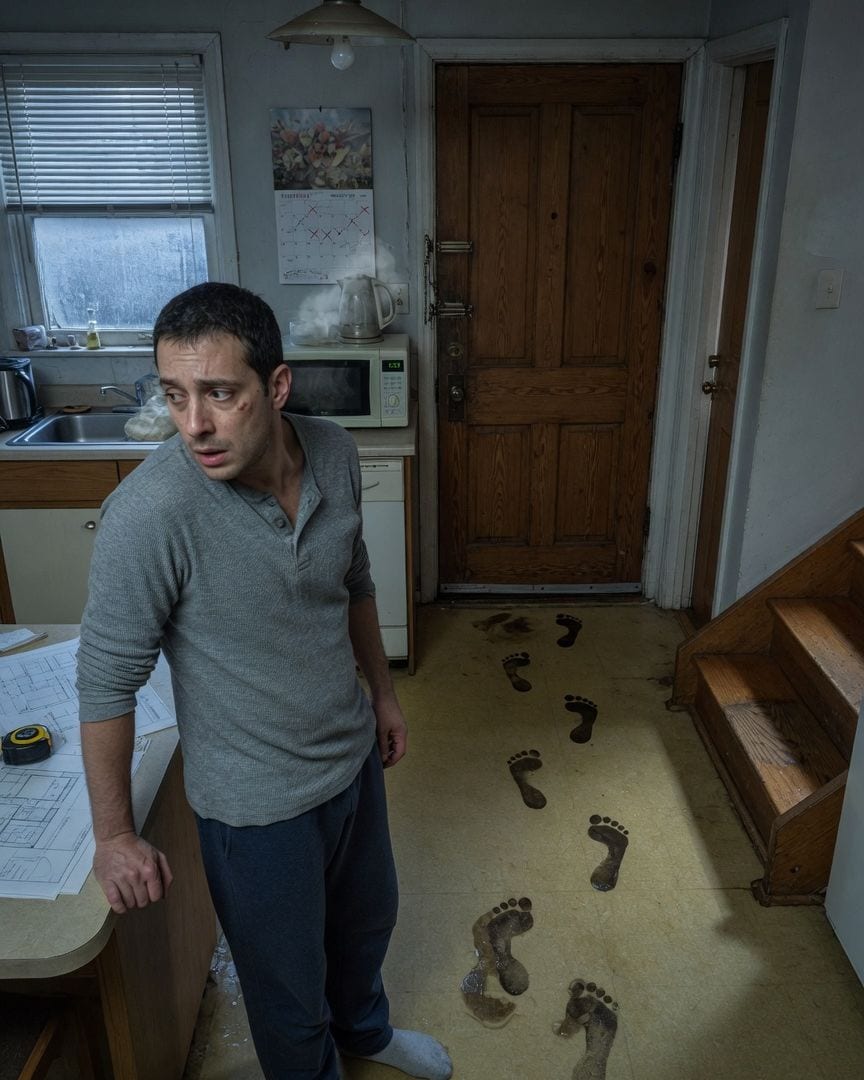
Bare wet footprints cross my locked kitchen floor every morning. Larger than mine, leading from the bolted back door to the stairs, fading from the toes as I watch.
The first time I saw them, I figured I’d forgotten to lock the back door. Or maybe a pipe had burst under the floorboards, but the moisture was wrong for that, too. I’m an architect; I notice details.
I bought this old house, inherited really, with a plan, a vision. But the plans didn't account for this.
It started a week after I moved in. I woke up, walked into the kitchen, and there they were: a series of wet, bare footprints, stretching across the linoleum from the back door to the bottom of the main staircase.
They were undeniably larger than my own, a man's size, I’d guess. The baffling part? The back door, a heavy, solid oak thing, was bolted shut, just as I’d left it. I checked the deadbolt, the chain. All secure.
I knelt, touching the prints. Cold. Not condensation from a damp morning, not residue from a mop. The edges were sharp, but the toes were already starting to evaporate, blurring slightly even as I watched. It hadn't rained overnight.
The ground outside was bone dry. No leaks from the fridge, no drips from the sink. I ran my hand over the floor, cool and smooth. Everywhere else, dry. Just these prints.
Always from the bolted door, always towards the stairs.
And I noticed something else, a recurring detail that started to prickle at the back of my mind: the impression of the right foot was consistently deeper, the heel more pronounced, as if someone favored their other leg, or had a limp.
I became meticulous. I placed tape across the bottom of the back door frame. Checked it before bed, checked it first thing in the morning. Every single time, the tape was undisturbed. Every single time, the prints were there.
I even tried setting up my phone to record a timelapse, propped on a kitchen counter, aimed at the door. I played it back: nothing. One moment, an empty floor. The next, faint, shimmering wet marks, materializing from nothing.
No door opening. No figure. Just the impossible, cold dampness.
I started to sleep with the bedroom door ajar, straining to hear any sound in the dead of night. Nothing. Just the settling groans of an old house.
But the footprints, larger than mine, colder than a winter morning, refused to be explained away. Each failed attempt to find a rational cause only cemented the unsettling, impossible fact of their existence.
Driven by the sheer impossibility of the footprints, I started noticing other patterns, other small wrongnesses in the house's rhythm. The first was the kettle.
It was an old electric model, a gift from my grandmother, a simple switch on the base. Almost every morning, precisely at 6 AM, I’d hear the distinct click of its switch and the low hum beginning to boil.
Even when I was the only one in the house, even when I hadn't touched it. I'd rush into the kitchen, and there it would be, steaming, the water bubbling.
I even replaced it with a new one, a modern model with a digital display. Same thing. 6 AM. Click. Hum. Steam. It was never set to a timer. It just… activated.
Then there was the staircase. The main one, leading to the second floor, had a lovely old oak banister and wide, creaking treads. But the third stair, specifically, had a deeper, more resonant groan.
It wasn't just a general age creak.
It was a precise spot, towards the right edge, that was noticeably more worn, polished smooth, almost as if someone had habitually avoided stepping on the center of the stair, always taking the same path to the side.
I’m tall, I take the stairs in the middle. But these marks, this distinct wear, suggested a persistent, specific gait.
And the living room. There was an old, overstuffed armchair by the fireplace, upholstered in a faded floral pattern. It looked comfortable, but I rarely sat in it.
Yet, the cushion and the right armrest had a deep, permanent depression, a shape molded into the fabric and padding as if someone spent hours there, day after day, year after year, always in the exact same position, leaning to the right.
It wasn't the general sag of an old chair; it was a specific, undeniable imprint.
I tried to dismiss these things. Phantom power draws, ancient wiring glitches, just an old house settling, perhaps. After all, the house was old. Quirks were expected.
But the regularity, the specificity, the 6 AM kettle, the distinct creak, the deep imprint – they gnawed at me. They were too consistent to be random.
I started a calendar, marking down every 6 AM kettle click, every time I noticed the worn stair. And the longer I tracked them, the more chillingly consistent they became.
It wasn't just a house settling; it was a house repeating.
The faint, earthy smell led me there, a damp, almost metallic scent that seemed strongest near the back of the house, particularly by the old pantry. It was a smell like deep, undisturbed soil, but somehow… fresh.
I followed it down the narrow, rickety steps to the basement, a space I’d largely ignored since moving in.
Cobwebbed and dark, it was mostly concrete, but at one end, near the stone foundation, there was a patch of exposed earth.
An ancient, heavy workbench, thick with dust and ancient tools, was pushed up against that section of the wall. It looked like it hadn't been moved in decades. The earthy smell was strongest right there.
I heaved, grunting, dragging the workbench a foot or two from the wall. Beneath it, the soil was disturbingly damp, much wetter than the surrounding earth. My flashlight beam cut through the gloom.
And there, imprinted in the dark, wet earth, was a single, perfect, bare right foot. It was unmistakably adult, larger than any foot I’d ever seen in my kitchen. And it was inexplicably fresh.
The arch was defined, the toes distinct, as if someone had just stepped there, lifted their foot, and then vanished. It matched the kitchen footprints exactly, the deeper press of the heel, the stronger impression of the right foot.
The impossible reality of it made my breath catch in my throat. My heart pounded, a frantic drum in my chest. The impression pointed directly to a rough, untouched section of the stone foundation wall, its stones dark and ancient.
I slowly raised my flashlight, the beam trembling, to the dark, undisturbed wall it pointed to.
Shaken to my core by the basement footprint, I knew I couldn't ignore it any longer. The rational explanations were gone, pulverized by cold, undeniable fact. I needed a different kind of explanation.
I started with the local historical society, then moved to the county archives. I spent hours poring over dusty ledgers and brittle property deeds.
My house, I learned, had been built in the late 1800s, and its last owner before my family inherited it generations ago was a man named Ronald Sheppard.
The records stated he had vanished without a trace exactly fifty years prior, leaving no forwarding address, no will, just an empty house.
Armed with his name, I started asking around. The local librarian, a kindly woman named Mrs. Henderson, suggested I talk to Joel Porter. "Old Joel knows everything about everyone who's lived here," she'd said.
I found Joel on his front porch, a man whose face was a roadmap of wrinkles, seventy-eight years old, he told me. He listened patiently as I explained, carefully, about the house, the strange routines, omitting the footprints for now.
He just grunted, initially dismissive, waving a gnarled hand. "Old houses got quirks, girl. Don't go imagining things."
But I persisted, describing the 6 AM kettle, the third stair, the armchair. Joel's eyes, faded and blue, started to sharpen. "Six AM, you say?" he murmured, leaning forward. "Ronnie was a creature of habit.
Never saw him without his morning cuppa. Kettle on precisely at six. Rain or shine. Always." He paused, his gaze drifting. "And that third stair... he had an old injury, you know. Right leg. From the war, I think.
Gave him a bit of a limp. Always stepped to the side on that stair, to avoid putting full weight on it. Wore that spot down himself, I reckon."
My blood ran cold. A right-foot limp. The deeper impression. The worn stair. It all clicked into place with horrifying precision.
"And the armchair?" I pressed, my voice barely a whisper.
Joel chuckled, a dry, papery sound. "His throne, that was. Read his paper there every morning. Smoked his pipe. Never sat anywhere else." He inhaled deeply, a phantom scent of something in the air. "Ronnie loved his pipe tobacco.
Heavy, sweet smell, always hanging around his place."
Pipe tobacco. I’d occasionally caught a faint, recurring scent, especially in the mornings, and dismissed it as a leftover from an elderly relative, or just the vague aroma of old wood. But Joel’s words made it undeniable.
Every detail, every precise, impossible routine, wasn't a quirk of the house. It was Ronald Sheppard. He hadn't just vanished. His habits, his presence, were still here.
As I delved deeper into Ronald Sheppard’s past, that sense of being watched intensified. It started subtly.
One evening, after another long, unsettling conversation with Joel, I came home to find the specific armchair in the living room, the one with the deep depression, pulled out from the wall.
I always pushed it neatly back against the wall after cleaning, but now it sat angled towards the fireplace, perfectly centered, almost inviting someone to sit.
A faint, lingering scent of pipe tobacco, unmistakable now that Joel had identified it, hung heavy in the still air. I stood there, frozen, the hairs on my arms prickling. I hadn't touched it.
No one else had been in the house.
A few days later, I was at the public library, squinting at old microfiche reels, trying to find any mention of Ronald Sheppard’s disappearance. The machine hummed, projecting grainy newspaper pages onto the screen.
I was deep in an article, when a movement in the periphery of my vision caught my attention. A reflection, in the dark glass of the machine, just behind me. Tall. Indistinct. Too close. My heart leaped into my throat.
I whipped around, expecting to see someone, another library patron perhaps, leaning over my shoulder. Nothing. Just the empty, silent stacks, stretching into the dim corners of the archives. The room was deserted.
The next morning, the footprints were back, cold and wet, just as always. But they weren't confined to the kitchen anymore. They led from the bolted back door, across the kitchen, then into the living room.
They stopped directly in front of the armchair, which was again pulled out and angled towards the fireplace. They paused there, a darker impression of the right foot, then turned sharply towards the cold, empty grate, before disappearing entirely.
The routine wasn't just playing out in the kitchen; it was following my investigation. Ronald Sheppard’s presence, his imprint, was no longer static. It was moving, shifting. It was watching.
I knew I had to go back to Joel. The routines weren't just quirks, they were Ronald. And the house wasn't just settling.
I laid it all out for him, the full, impossible scope of it: the footprints, the 6 AM kettle, the worn stair, the armchair, the pipe tobacco smell, the basement impression. The words tumbled out, desperate.
Joel listened, his expression growing grimmer with each detail. He kept shaking his head, a slow, disbelieving gesture.
"I tried to forget a lot of that, Emily," he finally said, his voice quiet, his gaze distant. "The police came, of course. Searched the whole place. Nothing. Not a trace. Just... gone. Like smoke."
He stood up, slowly, his old joints cracking, and shuffled towards a dusty cabinet in the corner of his living room. He pulled open a drawer, rummaged, and then produced a brittle, yellowed newspaper clipping.
The paper crackled as he handed it to me.
It was from the local paper, dated fifty years ago, almost to the day. The headline screamed, stark and bold: 'LOCAL MAN VANISHES FROM HOME: RONALD SHEPPARD FEARED DEAD.'
My breath hitched. Ronald. Here it was, confirmation, in black and white. The article detailed the police investigation, the lack of forced entry, the desperate search. Joel’s own name was mentioned in a small paragraph near the bottom.
He pointed a trembling finger to it. "Read that," he rasped.
I read it, my eyes scanning the faded ink: "Neighbor Joel Porter reported hearing faint, persistent scratching sounds from the Sheppard basement for several weeks after the disappearance, which authorities attributed to settling or vermin."
My stomach lurched, a sickening, cold dread spreading through me. Scratching sounds. For weeks. Dismissed. I’d almost convinced myself the house was just settling, too, when I heard those faint, scraping noises from below.
How many times had I heard them, explained them away?
The article also mentioned something else, a chilling detail. Ronald Sheppard was last seen by a delivery driver, entering his own basement, carrying a small toolbox, just hours before he was reported missing.
Joel nodded slowly. "Ronnie was always fixing something down there, near the foundation. Thought he could shore it up himself. A perfectionist, that man."
It all clicked. The footprints, leading from the bolted back door to the stairs. The basement impression. The specific routines. They were all Ronald. His disappearance wasn't a vanishing act; it was connected to that basement.
And the house hadn't just been 'settling' for weeks after he was gone. It had been something else entirely.
The newspaper clipping's grainy photo of Ronald Sheppard stared back at me, his face oddly familiar, as the article’s final paragraph described the neighbor's dismissed 'scratching sound' from the basement, a sound she realized with a sickening lurch she'd almost convinced herself was just the house settling, too.
The newspaper clipping and Joel’s memories sent me straight back to the basement, a knot of dread tightening in my gut. This time, I didn't just look at the section of the foundation wall where the foot impression pointed.
I attacked it. Running my hand along the rough, uneven stone, I felt it: a loose mortar joint, partially obscured by decades of dust and grime. It felt wrong, too new somehow against the ancient stones.
I grabbed a pry bar from the workbench, my hands clammy. With a grunt, I wedged the end into the joint and leveraged it. The old mortar crumbled, giving way with a soft spray of dust.
I pulled at a stone, then another. They came away too easily, revealing a small, dark cavity behind them, barely large enough for my arm.
Inside, nestled in damp earth, was something metallic. I reached in, my fingers trembling, brushing away the soil. My fingertips closed around a cold, heavy object. I pulled it out. A single, tarnished silver pocket watch.
It was heavier than I expected, cool against my skin.
My heart hammered against my ribs. I flipped open the cover. Engraved on the inside, in elegant script, were the initials 'R.S.' and a date. A date that stopped my breath entirely.
It was a date five months after Ronald Sheppard’s reported disappearance.
I stared at the impossible date, the ordinary explanation of a simple haunting dying a final, definitive death in my mind. Ronald Sheppard didn't just vanish. He was here, in this basement, for months after he was officially gone.
And something else, something far more terrifying, had been happening within these walls.
The dated pocket watch in my hand shattered what little rationality I had left. Ronald was here. Trapped. Alive, for months, right under the noses of the police, under the floorboards of his own house.
The house itself, I realized with sickening clarity, had acted as his tomb. Those precise routines I’d witnessed—the 6 AM kettle, the worn third stair, the deep imprint in the armchair, the pipe tobacco smell—they weren't just residual memories.
They were the desperate echoes of a man trying to maintain his sanity, his schedule, his very identity, even as he was buried alive, walled away in the earth.
The faint scratching Joel had heard, dismissed as settling, was Ronald. Trying to get out. Trying to signal.
The wet footprints, leading from the basement to the stairs—Ronald must have found a way to surface, perhaps briefly, a small gap, a desperate crawl for light and air, before being drawn back down into the earth.
The house, in its retained memory, was not just replaying a routine; it was replaying a trapped existence, a cycle of desperate attempts to live, to escape, to be heard.
The footprints weren't just showing where he was; they were showing where he went, or more accurately, where he tried to go. The third stair, the kettle, the armchair—these weren't just his habits.
They were his anchor points, his last, desperate attempts at normalcy, the physical manifestation of his will, now repeated, endlessly, by the house itself. The house wasn't haunted; it was a physical record, a replay.
And I was living inside it.
Driven by a terrible, cold certainty that solidified into conviction, I returned to the hidden cavity in the basement wall. The small opening was no longer enough. I needed more.
I widened it, scraping away earth and loose stones with frantic energy, ignoring the dust and the cold, damp smell.
The rough stone foundation gave way, not to solid earth, but to a small, cramped space – a crudely excavated alcove. It was barely wide enough for a person to stand, or perhaps, to be trapped.
And there, pushed into a corner, half-buried in the damp soil, was a brittle, leather-bound diary. Its pages were swollen, warped by the damp, the leather dry and cracking. I pulled it out, my heart hammering like a trapped bird.
I opened it, the pages stiff and reluctant. The entries, scrawled in faded ink, were Ronald Sheppard's.
They detailed his descent into madness and desperation after a cave-in during a self-initiated basement expansion had trapped him, silently, behind the newly built wall.
He wrote of his attempts to shore up the foundation, a small collapse, and then the sickening realization that he was sealed in.
He meticulously logged his daily routines, his dwindling supplies, his desperate attempts to signal through the walls, and his growing conviction that the house itself, his home, was not just holding him, but actively keeping him.
The final entry, dated precisely five months after his reported disappearance – the exact date on the pocket watch – was a frantic, almost illegible scrawl.
It spoke of the 'cold, wet touch' and 'the path that never ends,' of the 'whispers in the stone.' And at the very bottom of the page, pressing through the ink, was a deeply pressed, unmistakable bare right footprint.
The ink was smeared, as if he had pressed his actual foot, cold and wet, onto the paper as his final act.
The diary. It was a tangible, dated artifact that couldn't possibly exist. A physical record of his impossible survival within the house. It proved everything I had witnessed, every impossible routine, every cold footprint, was real.
The ordinary explanation of a simple disappearance, of a man merely vanishing, died for good in that damp, silent alcove.
I never reported my findings. The diary and the watch remained hidden, re-buried behind the wall I carefully, painstakingly, sealed up again.
I couldn’t bring myself to expose Ronald’s final, agonizing truth, nor could I begin to explain the house’s living memory, its relentless replay of a man’s last, desperate months.
I stayed in the house. I tried to leave, packed a bag, but found myself unpacking it hours later, drawn back by an invisible thread. I no longer slept soundly. The 6 AM kettle still clicked, precisely on schedule.
The third stair still creaked with that distinct, worn sound. And I found myself avoiding the center of that stair, too, stepping carefully to the side, my right foot pressing a little harder.
Sometimes, I’d catch myself sitting in Ronald’s armchair, staring into the empty fireplace, a faint, metallic taste of damp earth clinging to the back of my throat.
The mornings came, cold and damp. I found myself rising before the kettle clicked, waiting.
Watching the bare wet footprints appear, leading from the bolted back door to the foot of the stairs, fading from the toes as I watched, almost as if waiting for me to follow. I knew the path now, every step.
I knew the routine. I knew the house. I was simply the latest occupant, observing, learning, and perhaps, beginning to repeat.
Joel Porter, now frail and forgetful, still walked his small dog past Emily's house each morning. He'd wave if he saw her in the kitchen, sometimes catching a glimpse of her moving through the house.
He'd often remark to his dog, 'She's a creature of habit, that one. Always up early, always makes her tea, always steps just so on that third stair.'
The kettle clicked on, precisely at 6 AM, and the faint, familiar scent of pipe tobacco drifted from the kitchen.
If this one got to you

My great-uncle's house has footsteps at 11:10 PM, with a distinct left foot drag. I found the slipper, still warm.
Moving into my great-uncle Leonard’s old, isolated house, I expected some quirks. But the distinct crunch of footsteps on the gravel path outside, always at 11:10 PM, stopping at my front door with no one there, defied all logic. Then, I found a single, heavily worn leather slipper hidden under the porch step, its left heel deeply scuffed, radiating an undeniable, recent warmth.
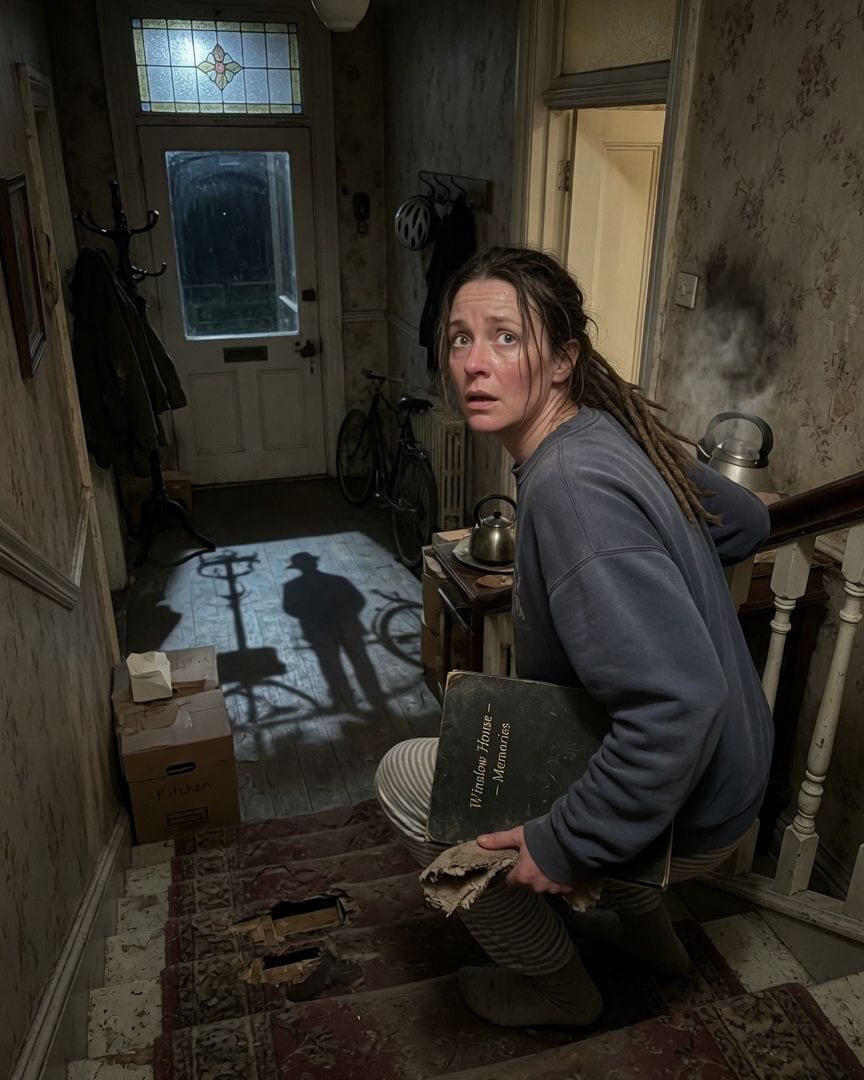
At 3am my dark porch throws grey shadows onto my hall floor — a coat-stand, a bicycle, and the outline of a man standing outside. I open the door and no one's there.
I'd just moved into Winslow House, struggling with new-house jitters and sleep. Then, at 3 AM for the second time, a stark grey light woke me, casting distorted shapes onto my hall floor. The undeniable shadow of a man stood beyond the threshold, impossibly still, even though I lived alone and the porch light was off.
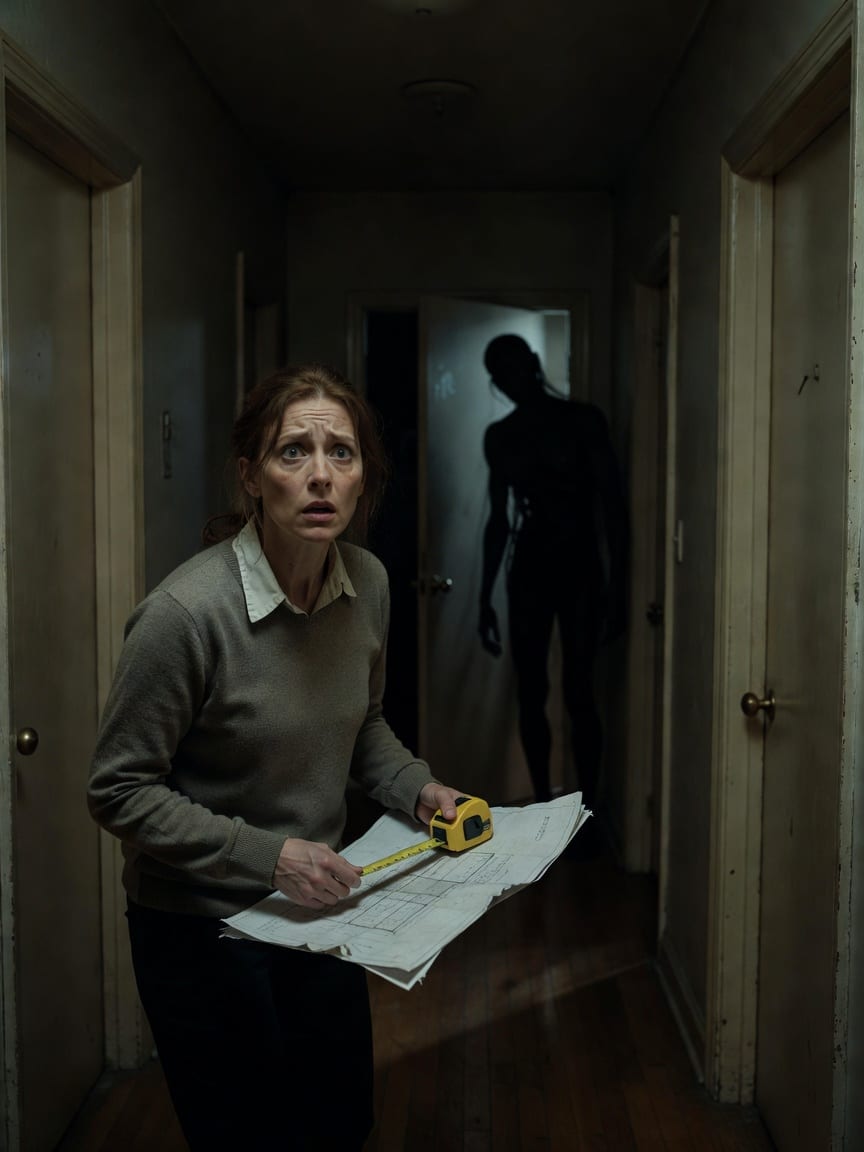
My front door has a dented gate and a dead hydrangea. I walked past it six times, trying to reach the corner shop just a hundred yards away. The pavement kept bringing me back to my own porch, and the shop's light never moved.
My morning started like any other, a quick walk to the corner shop from my home at Number 14, Elm Terrace. But after walking what felt like two minutes, I found myself back at my own front door, the shop no closer. I tried six times, faster and slower, but my street kept compressing, refusing to let me leave.
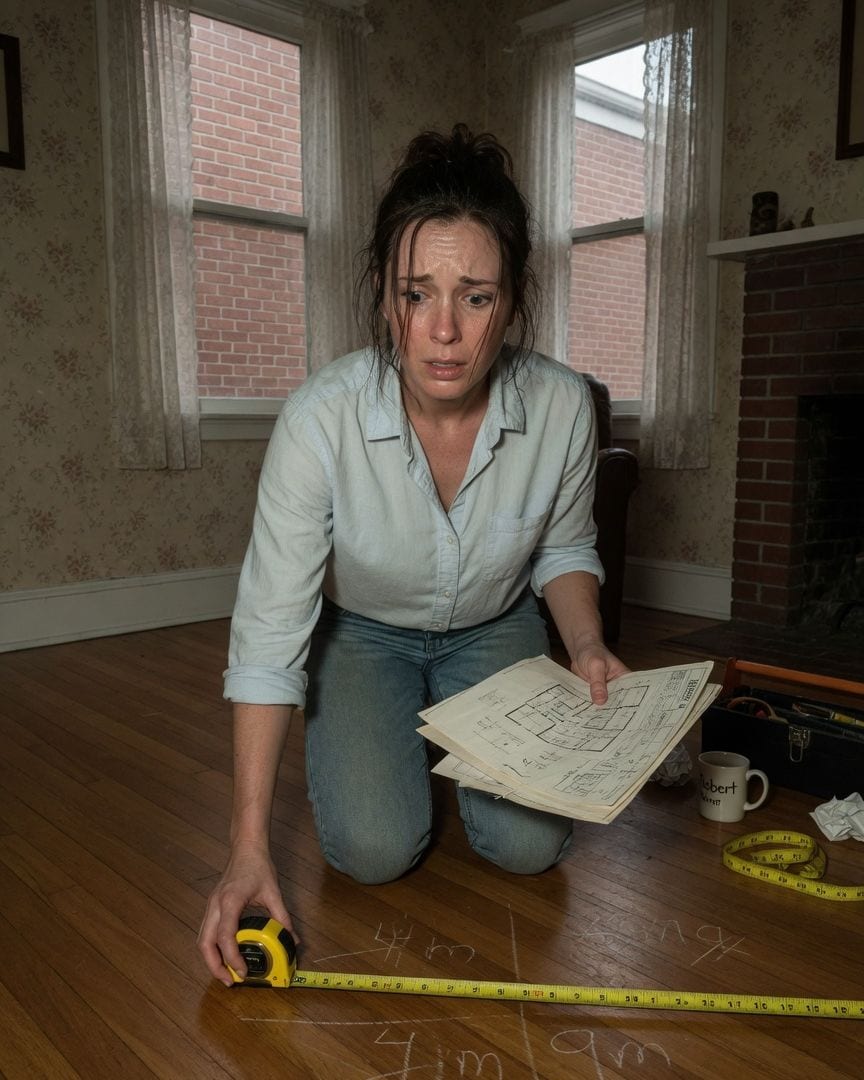
Our living room measures four by five metres. But the outside wall is nine metres long. A metre of house, gone, and I can't find it.
After moving into our charming 1920s house, I was meticulously measuring the living room when the dimensions refused to add up. My calculations of the interior space led me to discover a narrow, unpainted fifth door in the hallway, tucked almost out of sight. It wasn't on any original plans, and it opened to absolute, impenetrable darkness.
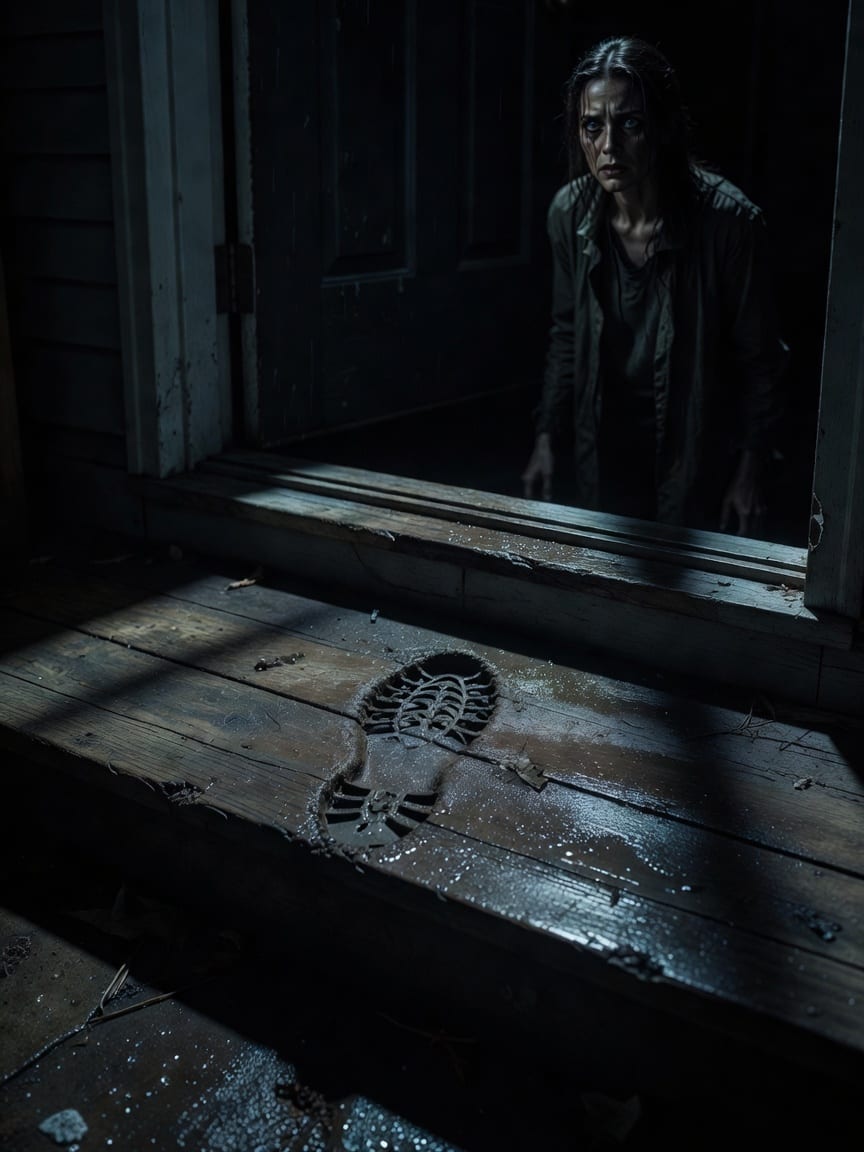
My landlord's only rule: never let the outside tap run after sundown. Last week it dripped. This morning, wet bootprints ringed the back step from the tap to my door, all the same size. The tap was off.
We'd just settled into Waterside House, with its strange landlord rule about the outside tap. After the washer broke, I found perfect, wet bootprints leading from the tap to our back door, but the tap was cranked completely off, tighter than I could manage.
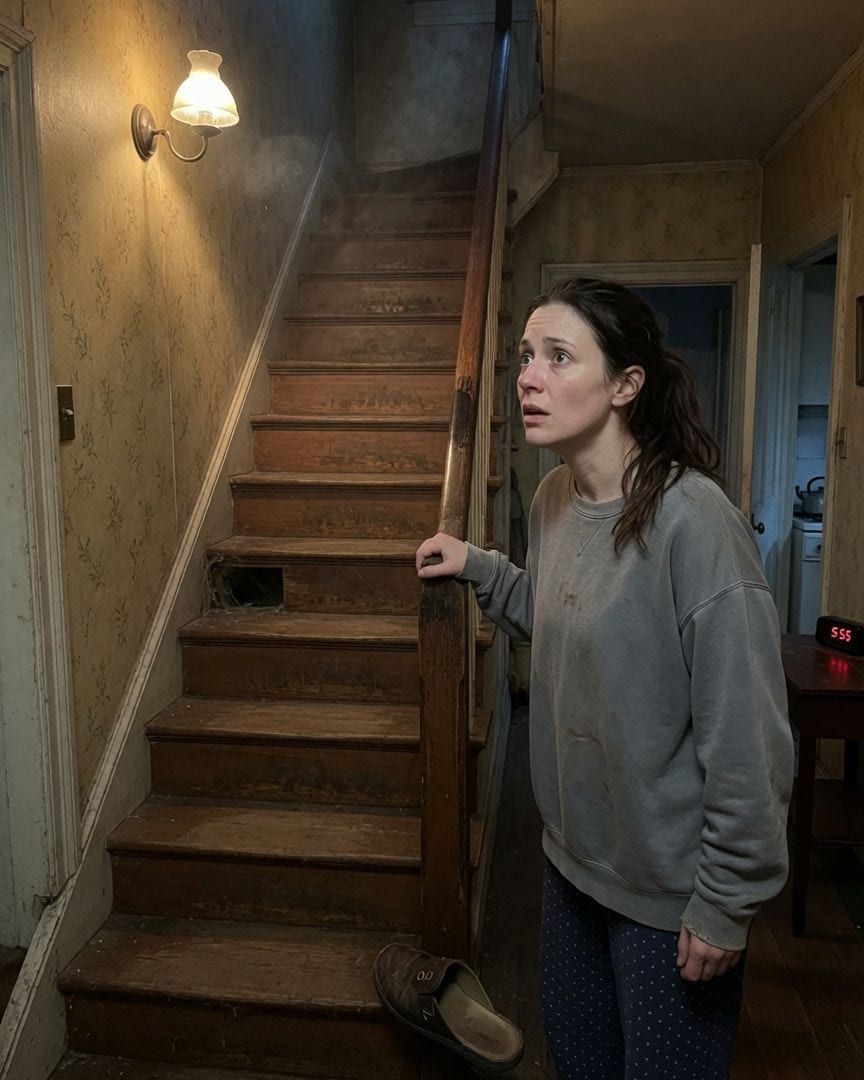
My stairs take a slow, heavy descent every 5:55 AM. I feel the banister move, the seventh step creak, then the kitchen door swings shut. Nothing reaches the bottom. I live alone.
Every morning at 5:55 AM, my house wakes with the sound of footsteps descending the stairs, favoring a left leg, yet no one is ever there. I tried to explain away the specific creak of the seventh step, until I found a heavily worn leather slipper hidden in the wall beside it, clearly for a left foot.