My great-uncle's house has footsteps at 11:10 PM, with a distinct left foot drag. I found the slipper, still warm.
The first few weeks in my great-uncle Leonard’s house, I put it down to the settling of an old place.
I’m an architect, practical by nature, so I cataloged all the usual suspects: wind in the eaves, expansion and contraction of timber, the distant hum of the power lines.
But the house is solid, isolated, a good half-mile from the main road down a long, winding gravel path. And the sounds aren't random.
It’s always at 11:10 PM. Every single night since I moved in late spring. I’d be in the living room, reading or trying to unwind, and I’d hear it. The distinct crunch of footsteps on the gravel path outside.
Not light, not hurried. Slow, even, methodical. And there's always a slight, unmistakable drag to the left foot. Crunch, crunch, draaaag… crunch, crunch, draaaag. They come steadily, from the curve of the driveway, all the way up to the porch, and then they stop.
Right at the front door.
And then… nothing. No knock. No doorbell. No shuffling, no clearing of a throat, no car door closing. Just silence.
The first time, I flicked on the porch light, peered through the sheer curtain. Nothing. Just the empty gravel, smooth as if undisturbed. The second night, I got up, walked to the window, waited. Same routine.
The third, I yanked the curtains wide, hoping to catch a glimpse of some neighborhood kid, some prankster. The path was always, utterly empty. Not a leaf out of place.
It wasn't the wind; the sound was too specific, too human. It wasn't a branch; it sounded like someone walking. And it certainly wasn’t a neighbor.
Ralph Mercer, the only one for miles, lives across the creek and rarely leaves his property.
Beyond the footsteps, other small things started to prickle at my rational mind. A persistent cold spot in the kitchen, right by the old, cast-iron sink, that defied the warm spring air.
I’d walk through it, feel a distinct chill, then it would pass. And a faint, stale smell of pipe tobacco. Leonard hadn’t smoked in decades, and I never have.
I tried to dismiss it all as the quirks of an old house, a new environment, the way your brain plays tricks when you’re alone. But the regularity of those 11:10 PM steps, precise as clockwork, was undeniable.
The footsteps became an obsession. I found myself anticipating them each night, my stomach tightening. One evening, after a particularly clear, loud iteration, I forced myself to stand by the front door, my hand on the cold brass knob, waiting.
The air felt heavy, almost buzzing. At precisely 11:10 PM, it began. Crunch, crunch, draaaag… Each step resonated through the old oak door, vibrating up my arm.
I felt a distinct, cold draft seep under the door as the steps halted directly outside. The air around me dropped several degrees. I took a breath, counted to three, and flung the door open.
The porch light flooded the gravel path. Empty. As always. But the chill lingered, a pocket of freezing air clinging to the threshold, slowly dissipating into the warmer night. No one. Nothing.
I barely slept that night. The next morning, a restless, wired energy propelled me. This wasn’t imagination anymore. It wasn't just sounds. I started a meticulous search of the porch, looking for anything, any clue.
I ran my hands along the railings, examined the floorboards, even checked the underside of the decorative planters. My gaze fell on the narrow gap beneath the lowest porch step, half-hidden by overgrown ivy.
Something dark and solid was tucked away there.
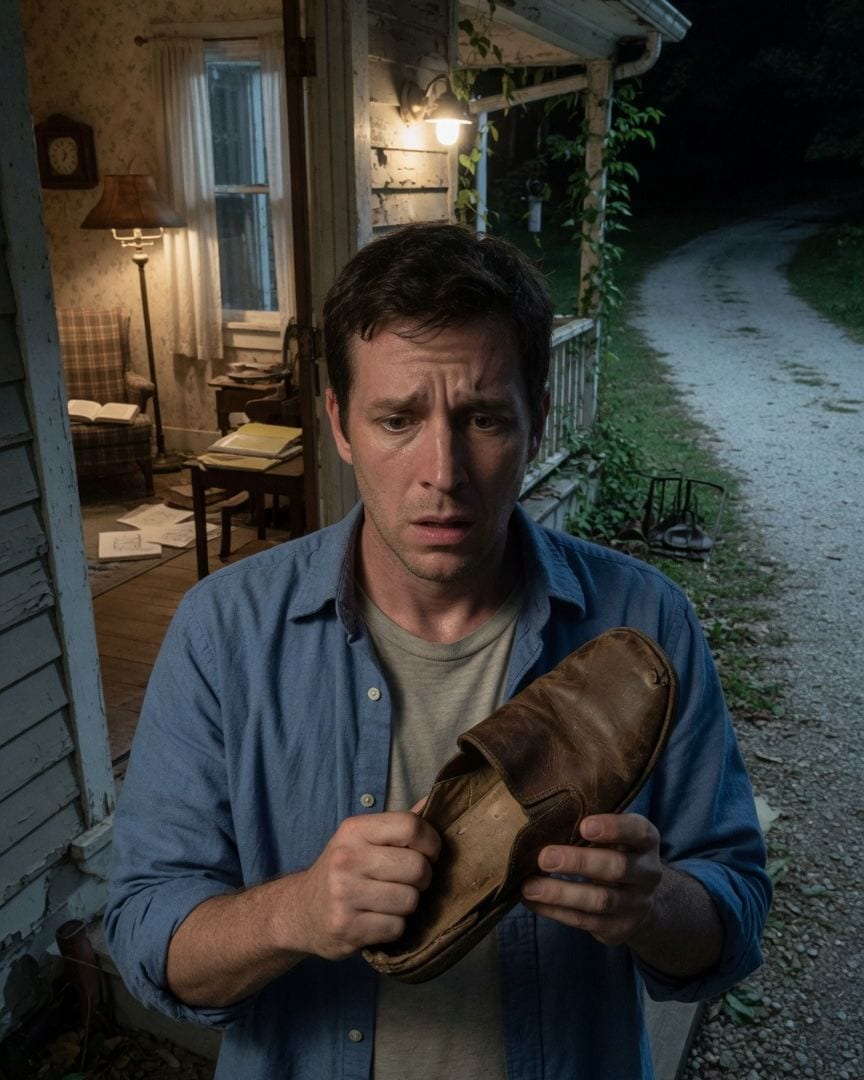
I knelt, pulling back the tenacious vines, my fingers scraping against rough stone. I reached into the damp, shadowed space and retrieved a single, heavily worn leather slipper. It was old-fashioned, a man’s slipper, clearly well-used.
Its left heel was deeply, unevenly scuffed, almost flattened, exactly where the phantom drag would be.
The leather felt strangely pliable, not stiff with disuse. As I brushed dust from it, a faint, almost imperceptible warmth radiated from its inner sole. Not the warmth of the morning sun; it was too deep, too concentrated.
It felt like… recently departed body heat.
I stood there on the porch, the worn, single slipper heavy in my hand, its left heel deeply scuffed. The faint warmth, undeniable, radiated from its inner sole, a tangible echo of a presence that should be long gone.
I stared at the empty gravel path, then back at the slipper, a chilling understanding beginning to dawn: this isn't a ghost in the conventional sense, but something far more insidious, something that leaves traces, something that continues.
My initial shock gave way to a grim determination. I needed answers, something more than a warm slipper and phantom footsteps.
I went through Leonard Ellison’s old papers, confirming what I already knew: my great-uncle, 87, had died alone in the house in late 2023, natural causes. No one had lived here since, not until me.
I drove into town, visited the small historical society, ostensibly for property records. The librarian, a kindly but vague woman with a perpetual smile, offered nothing concrete about past residents or any ‘odd occurrences.’
She mostly just talked about the annual bake sale.
Back home, the house seemed to amplify its subtle wrongnesses, as if my digging had stirred something. Leonard’s favorite, heavy-bottomed ceramic coffee mug, the one I remembered from childhood visits, wasn’t packed away with his other belongings.
I found it in the cupboard above the sink, and one morning, as I reached for it, it felt subtly warm to the touch, as if it had just been used.
A faint squeak on the third stair from the bottom, consistent and rhythmic, sounded nightly, even when I was alone in bed.
It was a soft, almost polite sound, but it felt like a presence moving through the house alongside me.
I started noticing Ralph Mercer, my neighbor across the narrow creek. An old man, probably in his seventies, he was always there, sitting in a rocking chair on his porch, watching my house.
His gaze was steady, unblinking, and utterly unbothered. He never waved, never approached, just watched. It made my skin crawl, this sense of being observed, of being part of a silent, ongoing tableau.
I felt like a new exhibit in a museum he’d visited a thousand times.
Then I found an old, faded photograph of Leonard on the mantelpiece, tucked behind a chipped ceramic cat. He was younger in the photo, maybe in his sixties, smiling faintly.
But even in the grainy image, I could see it: a slight, almost imperceptible drag in his left leg, a subtle lean in his posture as he stood by the porch railing. The slipper, the footsteps, the drag—it all aligned.
Too perfectly.
The feeling of being watched intensified. It was less about Ralph Mercer’s eyes, and more about the house itself.
One afternoon, I pulled into my driveway to find Ralph standing on my porch, his back to me, staring intently at the front door. He wasn’t knocking, just observing. His presence was unnerving, too calm.
My heart thumped against my ribs as I approached.
“Mr. Mercer?”
He turned slowly, his eyes ancient and knowing. “Just admiring the old place, Miss Ellison. Been in the family a long time.” He gestured vaguely at the house, a slow sweep of his hand.
“The house, it… it has its own schedule, you might say.” He paused, his gaze drifting to the gravel path, then back to me, a peculiar stillness about him. “Leonard was a creature of habit. Very particular. Especially at night.”
I pressed him, my voice tight. “You knew about the… footsteps?”
Ralph’s smile was faint, unreadable. “Oh, the house keeps its memories. Sometimes, they play them back. Leonard, he was always checking that door before bed. Last thing he did, every night. Had a bad leg, you know. Old war injury.
Dragged it a bit.” He offered no further explanation, just a quiet nod. Then he turned, ambled back across the creek to his own property, leaving me with a cold, hollow dread.
He knew. And he wasn’t surprised. He knew about the routines, the drag, and the house’s peculiar way of remembering. The implication, unspoken, was that I was now part of its audience. Or worse, its next memory.
I couldn’t let it go. Not after Ralph’s quiet knowing. I walked over to his house, my footsteps firm on the gravel, determined to get something concrete. He was on his porch again, rocking.
I didn’t wait for him to acknowledge me.
“Mr. Mercer,” I said, my voice carefully steady. “About Leonard… and the house. What exactly do you mean, ‘it keeps its memories’?”
Ralph sighed, a long, slow exhalation, settling deeper into his rocking chair. The wood creaked gently under his weight. “Leonard, he was my oldest friend. Known him since we were boys.
Died right there, in his armchair, one night last fall. Just… stopped breathing. No one found him for three days. He was alone, see.”
My stomach clenched. Three days. “Alone?”
Ralph nodded. “Always was, after his wife passed. Just him and his routines. That 11:10 PM walk to the door? That was his last check. Last thing he did before bed, every night, rain or shine.
He’d check the lock, maybe peek out at the stars, then come back in for his last cup of coffee.” He pointed a gnarled finger towards my house, a slight tremor in his hand.
“He had a favorite mug, heavy bottom, blue rim. Always left it out by the sink, ready for the morning.”
I remembered the mug I’d found, subtly warm to the touch. “So, the house… it’s replaying his last moments?”
Ralph’s eyes held a distant, almost mournful look. “Something like that. It’s seen a lot of lives, that house. A lot of routines.
And when someone dies alone in it, especially if their routine isn’t… finished, well, the house tends to remember. And repeat.” He leaned forward, his voice dropping, taking on a conspiratorial tone.
“There was a woman, decades ago, lived there before Leonard’s family. Greta Lockwood. Kept a journal. Thought she was going mad, hearing things. She had a theory about the house.
Said it wasn’t haunted by a ghost, but by time itself, replaying what it couldn’t let go. She hid it somewhere. Said it was the only way to prove it.”
He gestured vaguely towards my house again, a flick of his wrist. “Might still be there. If you know where to look.”
I felt a cold certainty settle deep in my bones. The footsteps, the slipper, the warm coffee mug, Leonard’s limp – it all fit. Leonard’s final, interrupted routine, eternally replayed by the house itself.
The pieces were all snapping into place, forming a picture far more terrifying than any ghost story.
Armed with Ralph’s cryptic clue, I returned to the house, now seeing every detail, every worn path, with new, terrifying eyes. The house wasn’t just a home; it was a record player, endlessly looping.
It absorbed its inhabitants, their habits, their final moments.
I spent hours searching, methodically tapping walls, examining floorboards, running my hands along the dusty undersides of built-in shelves. Ralph had said she hid it, for proof. Proof usually meant something accessible but unseen.
Finally, in the small, rarely used library, my fingers brushed against a loose floorboard beneath a dusty, built-in bookshelf. It gave slightly. With a surge of adrenaline, I pried it open with a letter opener.
Inside, nestled in the dark, was a dust-covered, leather-bound journal, its pages thick and yellowed. It was heavy, clearly old.
Greta Lockwood’s journal.
My heart pounded as I pulled it out, the air thick with the scent of aged paper and dust, mingled with the faint, persistent smell of pipe tobacco. I opened it, the binding creaking like an old door.
My eyes scanned the faded, looping script, skipping past initial entries about garden plans and local gossip. My gaze snagged on a specific date:
‘October 14, 1952.’
Beneath it, in a hand that grew increasingly frantic, I read:
‘The footsteps began again tonight. 11:10 PM. The unmistakable drag on the left. To the door. And no knock. Just like last week. Just like the week before. It’s not a neighbor. It can’t be. It’s the house. It remembers.’
I devoured Greta Lockwood’s journal through the night. Her entries detailed a descent into terror mirroring my own, but spread across years.
Greta, a keen amateur historian, meticulously documented the recurring routines: the 11:10 PM footsteps with the distinct drag, the inexplicable cold spots, the faint but persistent smell of pipe tobacco (which she’d traced back to a previous occupant in the 1890s, a recluse named Arthur Finch), and yes, the rhythmic squeaking of the third stair.
Greta had eventually stumbled onto the same horrifying truth as Ralph Mercer: the 'memories' were a composite, a looping echo of lives lived and ended within its walls.
The house didn't just remember; it replayed, especially the routines of those who died alone and suddenly, their daily patterns cut short, their final acts incomplete.
It was a terrible, indifferent mechanism, a memory made manifest, that couldn't be stopped or reasoned with. It wasn't a haunting; it was a recording, and the house was the recorder, its tape perpetually running.
But then, Greta’s entries grew increasingly desperate, describing a chilling realization: the house wasn't just replaying past lives. It was starting to replay her own routines.
She wrote about hearing the faint sound of her own coffee maker from hours earlier, the subtle creak of her own rocking chair when she wasn't in it, the distinct scent of her own lavender soap, sometimes even her own voice, a faint murmur from a conversation she’d had days before.
The house was absorbing her, too, preparing to add her incomplete routines to its endless, horrifying loop.
I read Greta’s final entry, scrawled in a shaky, frantic hand, the ink smudged as if she’d been crying:
‘The house is keeping me. It’s already started. I hear my own steps now, from yesterday. It’s not letting me leave. It wants the full pattern. The end.’
The words trailed off, unfinished.
I looked up from the journal, my gaze sweeping across my own living room. The worn path on the floorboards, leading from the armchair to the kitchen, then to the front door – my path.
The indentation on my side of the sofa, the specific way my coffee mug sat on the table. My eyes landed on the journal itself, lying open on the coffee table.
A faint, distant whisper, a sound like a page turning, drifted from it. My journal. Its pages were turning, slowly, by themselves, revealing entry after entry, pages I had already read, then pages I hadn't yet written.
The house was already building my file.
A desperate urge to flee seized me. I jumped to my feet, grabbed a small bag, stuffing a few essentials inside – my wallet, keys, phone. I rushed towards the front door.
But as I moved, I found my steps slowing, evening out. My left foot, inexplicably, began to drag, a subtle, unfamiliar hitch in my stride.
I tried to quicken my pace, but my body felt heavy, guided by an unseen force, following a familiar path, the one I’d walked a hundred times from the living room to the door.
I reached the front door, my hand reaching for the knob, but my fingers paused, hovering. I felt an overwhelming compulsion to look out, to check the gravel path one last time, to complete the routine. My own routine.
The house was not letting me go. It was already part of her, and I, part of it.
Eleanor Ellison is gone. No note, no trace beyond the hastily packed bag on the coffee table and the open journal, its final page describing a left foot beginning to drag.
The realtor, a different one this time, quickly put the house back on the market, citing 'unforeseen circumstances' with the previous owner.
Ralph Mercer sat on his porch across the creek, watching the house, a faint, unreadable smile playing on his lips. He noticed the new 'For Sale' sign at the end of the gravel path. The house stood silent, empty, waiting.
The air was still, but if one listened very closely, a faint, almost imperceptible sound of a single page turning could be heard from within its walls.
The house is empty again, but the gravel path remains, pristine under the porch light.
A new 'For Sale' sign stands at the gate, promising 'historic charm and serene isolation.' At 11:10 PM, the gravel path is empty, but faint footsteps begin, slow and even, with a new, distinct lightness to the tread.
If this one got to you
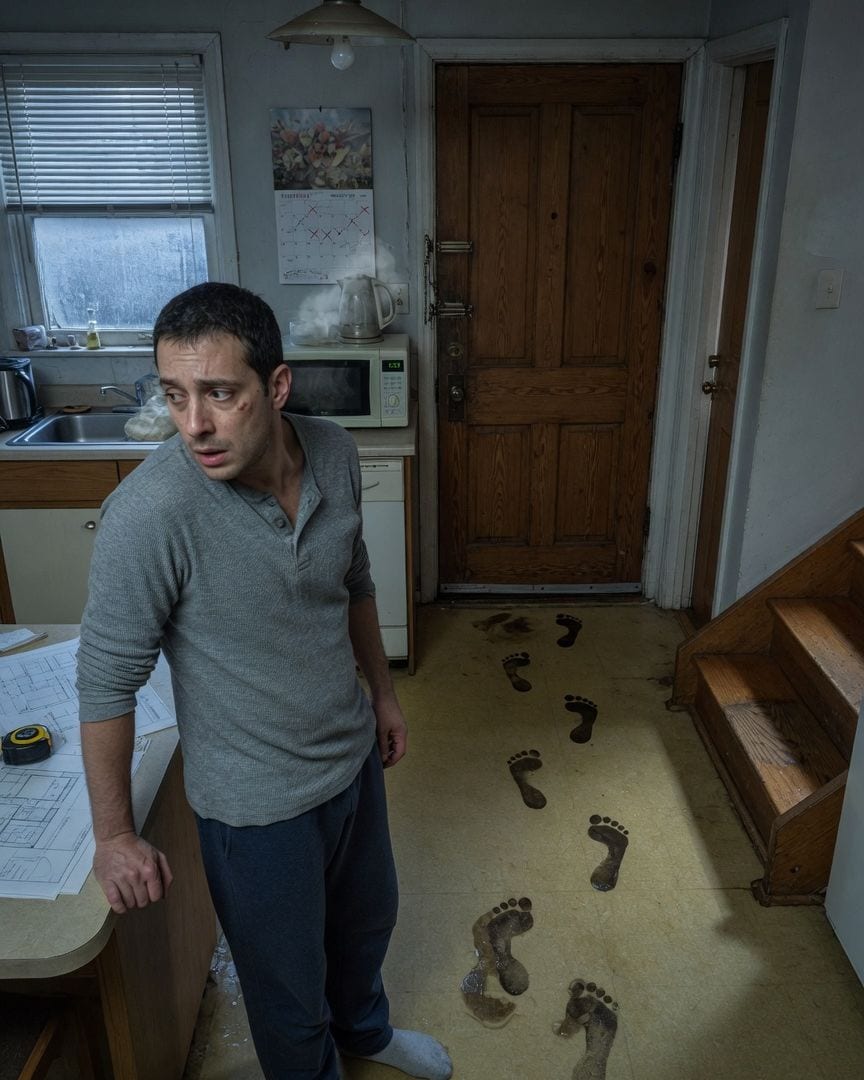
Bare wet footprints cross my locked kitchen floor every morning. Larger than mine, leading from the bolted back door to the stairs, fading from the toes as I watch.
As an architect, I notice details, but nothing in my old house's plans accounted for this. Every morning, wet, bare footprints appear across my kitchen floor, stretching from the bolted back door to the main staircase. They are larger than my own, colder than winter, and simply materialize from nothing.
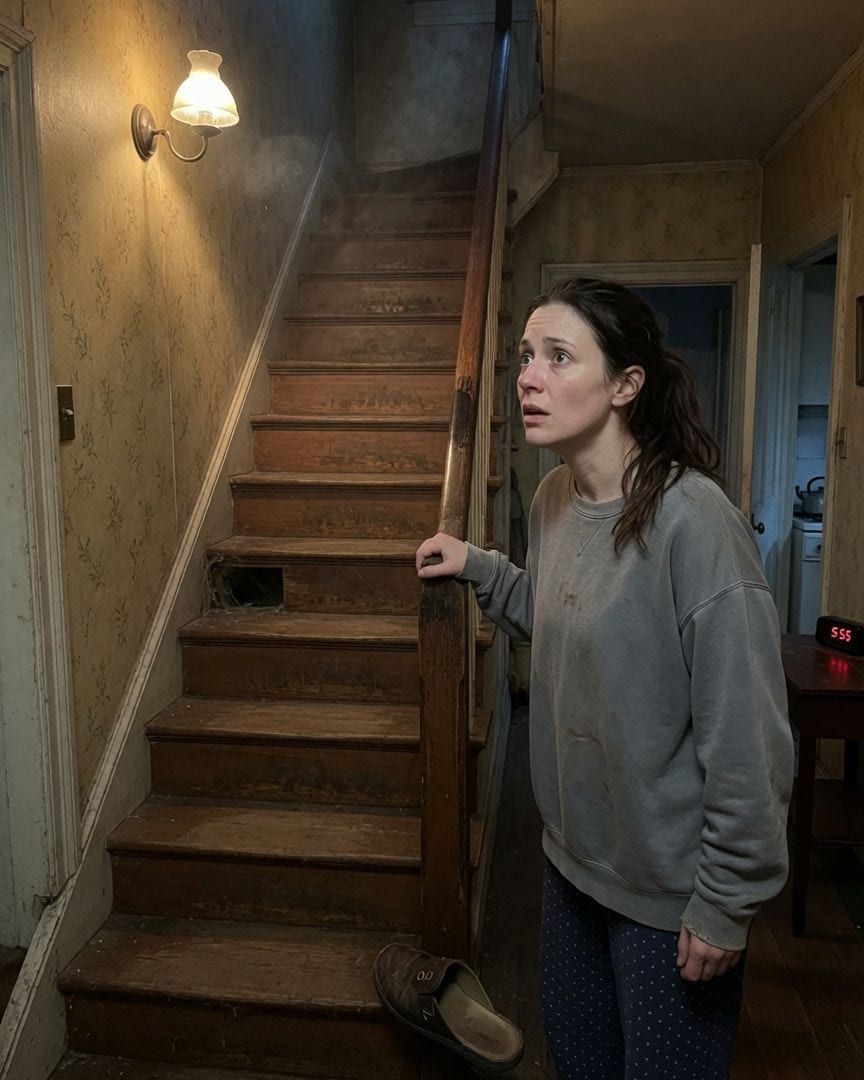
My stairs take a slow, heavy descent every 5:55 AM. I feel the banister move, the seventh step creak, then the kitchen door swings shut. Nothing reaches the bottom. I live alone.
Every morning at 5:55 AM, my house wakes with the sound of footsteps descending the stairs, favoring a left leg, yet no one is ever there. I tried to explain away the specific creak of the seventh step, until I found a heavily worn leather slipper hidden in the wall beside it, clearly for a left foot.
My front door has a dented gate and a dead hydrangea. I walked past it six times, trying to reach the corner shop just a hundred yards away. The pavement kept bringing me back to my own porch, and the shop's light never moved.
My morning started like any other, a quick walk to the corner shop from my home at Number 14, Elm Terrace. But after walking what felt like two minutes, I found myself back at my own front door, the shop no closer. I tried six times, faster and slower, but my street kept compressing, refusing to let me leave.
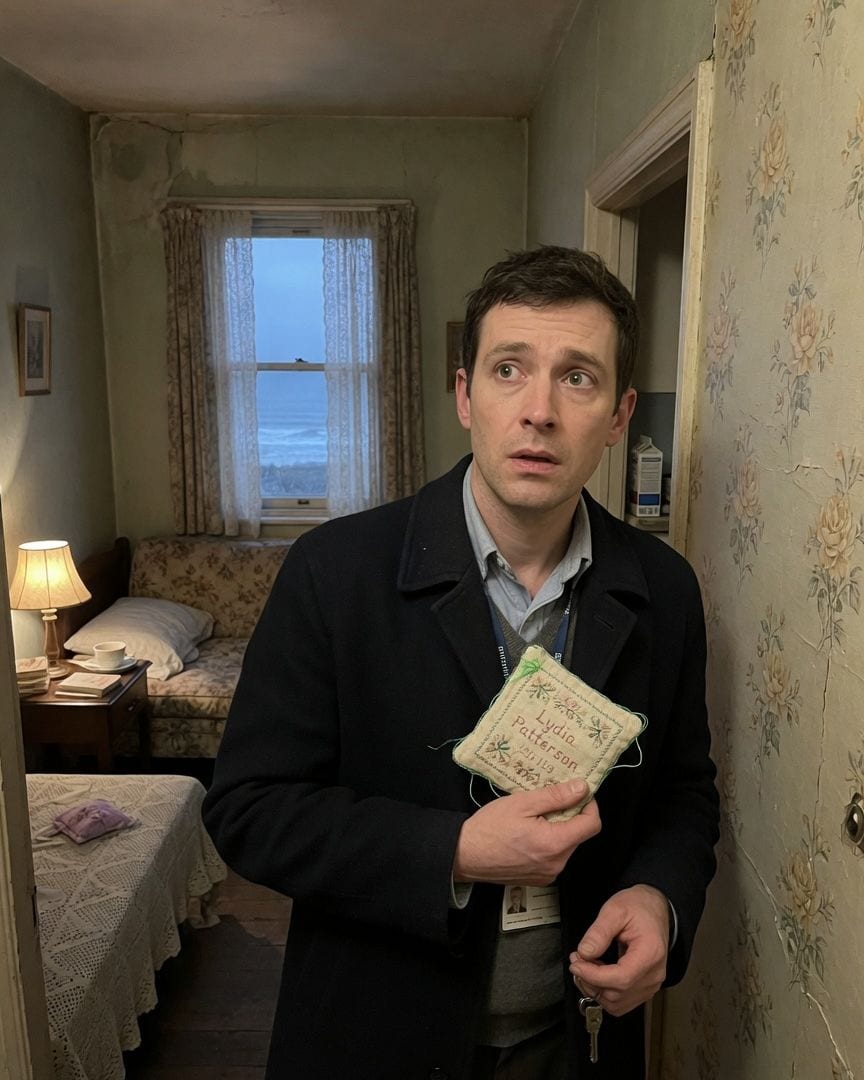
The 'empty' almshouse I was auditing wasn't empty. I heard a bare foot *thump-thump* from next door.
My new charity role involves auditing the supposedly 'empty' almshouse units. But from the unexplained activity outside to a fresh carton of milk inside, something is deeply wrong. Then, in one unit, I found a dead woman's sampler with a jarringly new thread, and heard bare feet thumping next door.

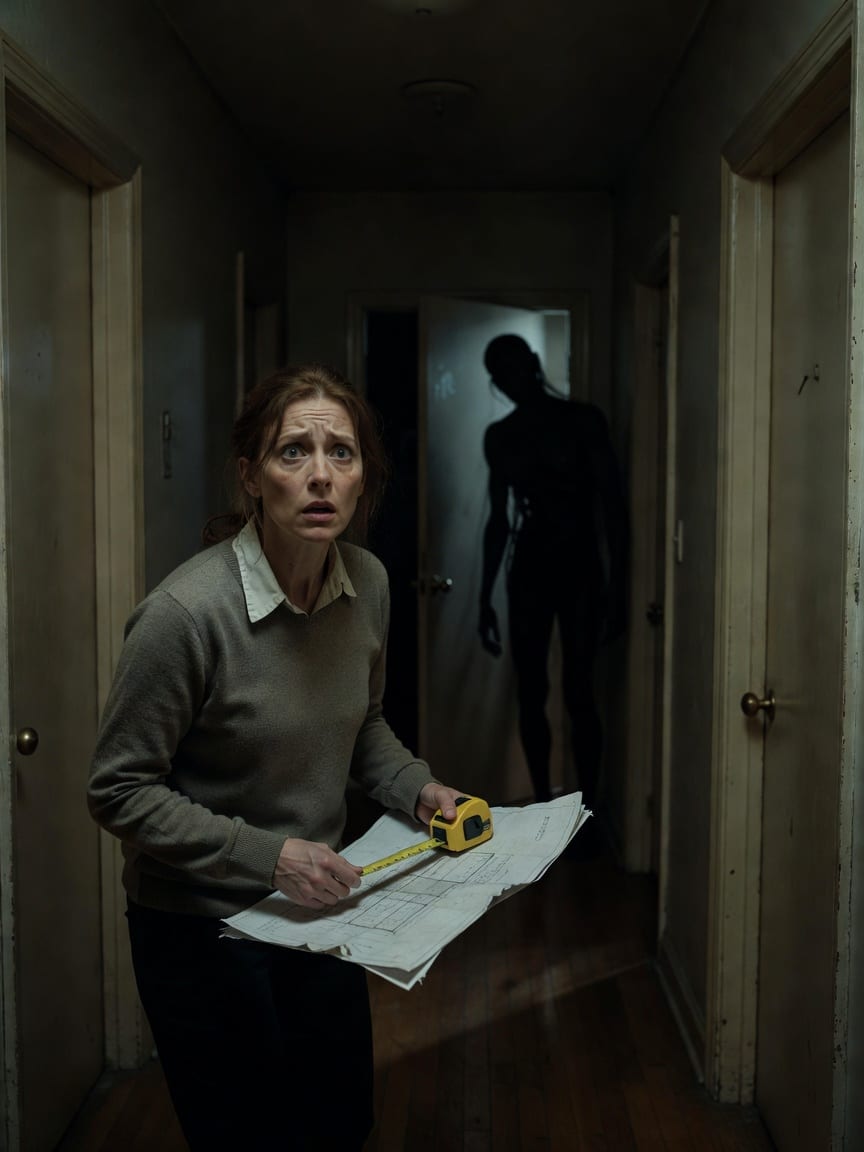
My stairlift tape measures thirteen steps, but my own feet always find a fourteenth — to a door that isn't there.
As a meticulous fitter, I measured my client's new loft stairs, confirming thirteen solid steps. But my foot found a shallow, impossible half-step, leading to a plain wooden door that shouldn't exist. Now the door is gone, leaving only a ghost outline.
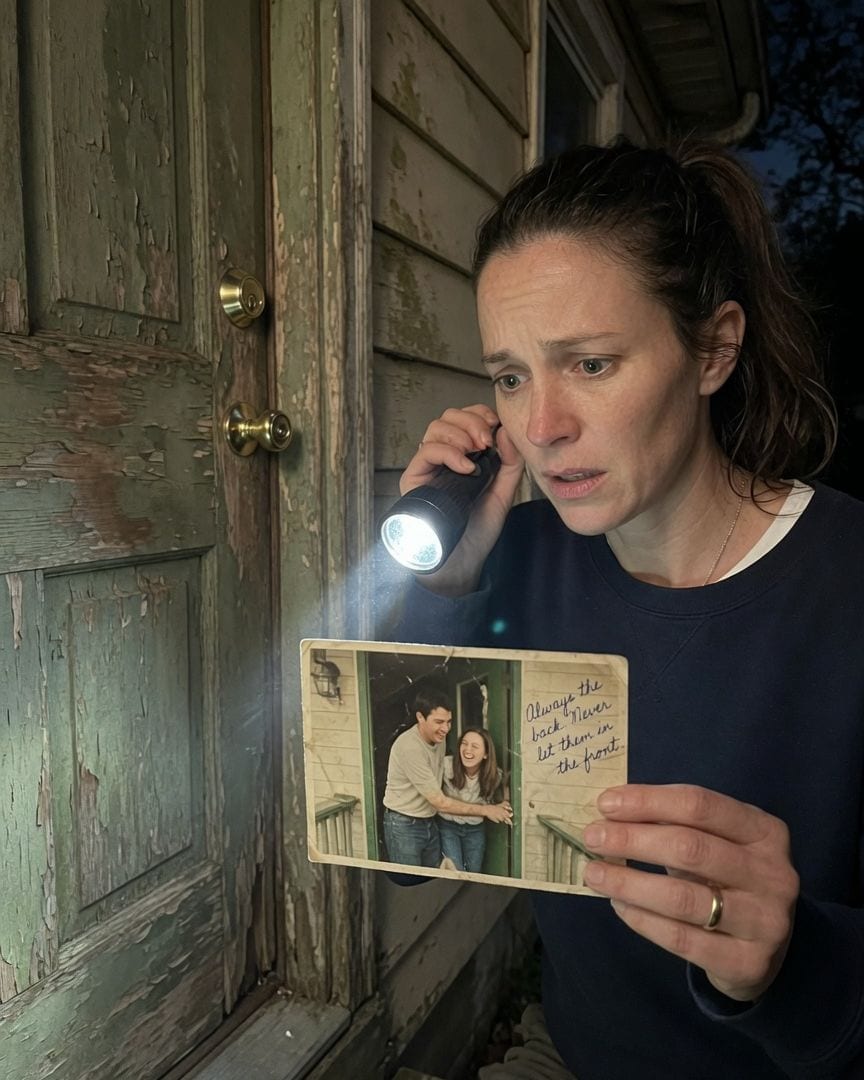
My mother waves us to the front door now. She was missing five days. She says we've always used the front, but the back door, our kitchen door for thirty years, is locked.
My mother, Janet, finally came home after five days, but her overly bright smile and insistence on using the front door felt wrong. For three decades, our family always used the back entrance, which now had a gleaming, new deadbolt. The quiet hum of unease quickly grew into a chilling dread.