My bay window shows an impossible village green. I found a sampler of it, dated 1892, inside my 1920s house.
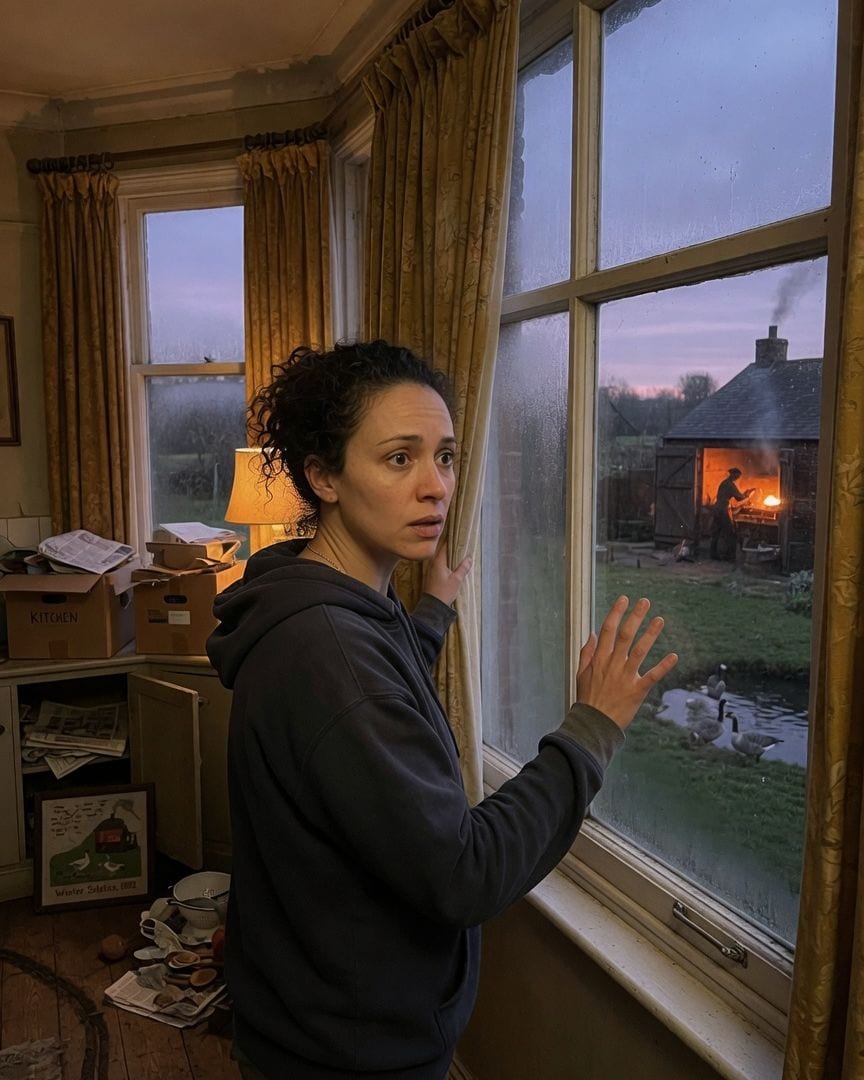
I’d just moved into the house, a pretty two-story built sometime in the 1920s, with a big bay window in the living room that I loved.
It looked out onto a quiet street, usually a few parked cars, a bus stop. I was still drowning in boxes, trying to make sense of the new space, when dusk fell on the shortest day of the year.
I remember looking up from a pile of kitchenware, feeling that sudden, sharp drop in light, and just needing a moment to breathe.
I walked into the living room, heading for that bay window. It was double-glazed, thick glass, usually quiet, but as I approached, I felt an odd chill.
A specific pane, toward the right, felt thin, almost like single glazing, and I could hear a faint, distant rattle, as if a sharp wind was trying to get in. I put my hand to it.
The glass was genuinely cold, radiating a raw, outdoor temperature that shouldn’t have been possible indoors, not with the heating on. Then I looked out.
The street was gone.
Instead of my neighbor’s minivan, there was a vast, open village green. The kind you only see in old paintings. Geese pecked at the sparse, winter-yellow grass near a small pond, their breath misting in the cold air.
To the right, exactly where the corner of my street should have been, stood a small, stout building: a smithy.
Its wide double doors were thrown open, and inside, a forge pulsed with a deep, orange glow, smoke curling lazily from a squat chimney. I could even see the silhouette of a figure, hammer raised, against the light.
And the smell—faint, but unmistakable—the rich, metallic tang of coal smoke, of wood burning, was in the air.
It felt so real, so solid, that I instinctively pressed my hand against the cold glass again, half expecting to feel the rough texture of ancient stone or damp grass.
My heart was pounding, a confused, frantic drum against my ribs. I tried to tell myself it was exhaustion, a trick of the light, maybe the reflection of something on the street I hadn't seen.
But the green was too vibrant, the smoke too real, the cold too profound.
I stumbled back, yanking the heavy curtains shut, the thick fabric muffling the impossible scene. I stood there, breathing hard, waiting for my eyes to adjust, for my mind to reset.
After what felt like minutes, I forced myself forward, pulled the curtains open again.
The modern street was back. The bus stop light glowed, a lone man waiting under it, head bowed. A dark sedan was parked where the smithy had been. Everything was normal.
But the cold still lingered on that specific pane of glass, a faint, metallic chill on my fingertips. And for a long moment, the ghost of woodsmoke, however faint, was still in the air.
Days passed, but the image of the green and the smithy kept replaying in my mind. I told myself it was just stress, moving to a new place, an overactive imagination.
I even Googled "optical illusions bay windows" and "phantom smells new house," trying to rationalize it away. But then I started noticing other things.
There was a specific draft in the living room, a whisper of icy air that seemed to come from nowhere, even with all the windows closed and sealed tight. It always came from the area around the bay window.
Sometimes, I’d catch a faint, almost imperceptible scent—not just woodsmoke now, but sometimes something like freshly baked bread, or the earthy smell of damp soil after rain, when I hadn’t cooked or opened a window in hours.
It was like the house itself was breathing, exhaling memories.
I also found myself walking a worn path on the living room floorboards.
A slight depression in the century-old wood, a path that led from the kitchen doorway, arced around where my coffee table now stood, and ended abruptly near the bay window.
It made no sense with my furniture layout, but my feet seemed to find it instinctively, a groove carved by habit that wasn't my own.
I decided to distract myself with a real project: cleaning out an old, built-in cupboard in the living room, one that had been painted shut and clearly hadn't been touched in decades.
It was stiff, stubborn, but I eventually got it open. Inside, it was musty, filled with old newspapers and cobwebs. As I cleared it out, my fingers brushed against something solid behind the back panel. It sounded hollow.
I knocked on it, then pushed. With a soft click, a section of the panel swung inward. A hidden recess.
Nestled inside, covered in a fine layer of dust, was an old, framed, hand-stitched sampler. It was about eight by ten inches, protected by antique glass. I carefully pulled it out.
The stitching was faded, the linen yellowed with age, but the image was incredibly clear: a vibrant green, geese by a small pond, and to the right, a sturdy smithy, its chimney smoking.
The details were uncanny, almost identical to the impossible scene I’d witnessed through my bay window. My hands were shaking as I turned it over, looking for a date, a name.
Stitched into the bottom-right corner, in a meticulous, faded red thread, were the words: 'Winter Solstice, 1892.'
I held the sampler, my fingers tracing the impossibly old date. Winter Solstice, 1892. My house was built in the early 1920s.
This scene, this precise moment in time, could not have been witnessed from this location, let alone stitched into an artifact from decades before the house even existed.
The sheer physicality of the object, the impossible detail it held, stole my breath, made my scalp prickle. It wasn't fatigue. It wasn't a trick of the light.
As I stared at the stitched scene, my gaze drifted, almost involuntarily, to my own bay window. Though it was broad daylight, the glass shimmered with an internal, watery distortion, like heat haze or a faint ripple in solid water.
The faint, unmistakable smell of woodsmoke, stronger now, filled the air around me, sharp and metallic.
I saw a flicker of movement—not outside, on the modern street, but within the glass itself, a shadowy figure passing by the smithy depicted in the sampler, a dark, indistinct form reflected in my modern window.
And for a terrifying instant, it seemed to pause, and look back at me.
Disturbed and resolved, I knew I couldn't just dismiss it anymore. I needed answers. My first stop was the local historical society, a small, quiet building that smelled of old paper and dust.
Walter Ellison, the elderly librarian, looked up from behind a desk piled with books, his expression weary. He was initially dismissive of my 'local curiosities,' as he put it, talking about "newcomers always getting ideas about old houses."
"Everything's just old, ma'am," he'd said, adjusting his spectacles. "Not mysterious."
But I insisted, firmly, on looking through old town maps and property records. I told him about the sampler, about the date. Something in my insistence, or perhaps the sampler itself, seemed to pique his curiosity.
He led me to a back room, stacked with fragile-looking binders and rolled-up parchments.
We spent hours poring over large, yellowed maps. I found the record of my property, confirming that my house was indeed built in the early 1920s.
But the maps clearly showed that its footprint sat directly on what was once the edge of the sprawling village green, a much larger area than the tiny patch of grass that remained today.
More unsettling, a large, rectangular block labeled 'Underwood Smithy' was marked precisely where my bay window now stood, oriented exactly as I'd seen it through the glass, with a path leading to it from the very spot where the worn floorboards in my living room lay.
Walter, now more engaged, found fragmented mentions of the Underwood family in various town ledgers and local history books.
There was a recurring local legend, a somber note in the town's early chronicles, of a devastating fire that had occurred at the smithy on a winter solstice, long ago.
The accounts were sparse, mostly oral history written down much later, but they all converged on the same tragic event.
"Funny," Walter mumbled, tracing a finger over a faded paragraph. "The previous owner of your house, Dorothy Underwood, was a distant relative of that family. Lived there for decades before... well, before she moved out a few years back.
She was quite keen on local history, too. Always coming in, looking for snippets about her ancestors." He looked at me over his spectacles, a new, almost worried glint in his eye.
"She certainly had a fascination with that old smithy."
My research shifted to Dorothy Underwood. Walter had been able to give me a few details – she'd been a quiet woman, no close family, kept to herself.
I found an old real estate listing for my house from when Dorothy moved out, just a few years prior. The description talked about 'unique architectural details' and a 'preserved, rustic atmosphere,' with mentions of 'original fixtures.'
But I knew many of the fixtures were modern, installed sometime in the late 20th century. It felt like a subtle exaggeration, almost a deliberate misdirection.
I tracked down the realtor, Simon Lambert, a slick man in his mid-forties with a too-tight suit. He was evasive when I mentioned Dorothy. "Ah, Dorothy Underwood," he said, feigning a chuckle. "A character. Liked her privacy, you know.
Had some... particular requests regarding the sale." He wouldn't elaborate, just kept waving his hand dismissively. He implied she'd moved to an assisted living facility out of state, but the details were vague, almost rehearsed.
One evening, after another long day spent poring over dusty archives at the historical society, I returned home. The sun had already dipped below the horizon, casting long, purple shadows.
As I approached my front door, I noticed it was slightly ajar, maybe a quarter-inch open. My breath hitched. I distinctly remembered locking it, rattling the handle to be sure, as I always did.
I pushed it open cautiously, my hand hovering over my phone, ready to call 911.
Nothing appeared stolen. The TV was still there, my laptop. Everything seemed in place. But on my kitchen counter, next to my keys, sat a small, dark object.
A crudely hand-forged iron hook—a functional tool, not decorative, a loop at one end, a sharp, curved point at the other. It looked ancient, heavy. I was certain it wasn't there when I left. My blood ran cold.
I walked to the bay window, the source of all this strangeness, feeling a prickle on the back of my neck, the undeniable sensation of goosebumps rising on my arms.
The street outside was empty, bathed in the orange glow of the streetlights, but I felt an undeniable sense of being observed, a quiet, lingering presence.
It was as if my investigation was no longer a private matter, no longer just a curiosity, but had attracted an unwanted, silent witness, someone who knew exactly what I was doing, and why.
I confronted Simon Lambert, the realtor, at his office the next morning. I didn't make an appointment; I just walked in.
I showed him the sampler, the impossible date, and the old maps I’d printed from the historical society, pointing to the spot where the smithy had stood. I put the iron hook I'd found on his desk.
"Tell me about Dorothy Underwood, Simon. And don't give me that 'eccentric old lady' crap."
Simon’s easy smile faltered. He picked up the hook, his brow furrowed. He tried to brush me off, muttering about 'old house quirks' and 'owners getting too attached.' His eyes darted to the sampler, then back to my face.
"Look, Mrs. Caldwell, people get weird about history, especially when it’s their own family’s. Dorothy was… intense. She liked to keep things as they were."
"Keep what things as they were?" I pressed, my voice sharper than I intended. "The smithy? The fire? And what about this?" I pushed the hook closer to him. "My door was open. This was on my counter.
Was Dorothy Underwood breaking into my house? Or was someone else?"
His composure cracked. He ran a hand through his thinning hair. "No, no, not Dorothy. She wouldn't... couldn't." He took a deep breath. "Look, I wasn't supposed to say anything, but Dorothy didn't just 'move out.' She just... vanished.
Shortly after selling the house to you, actually. Left most of her belongings. Nobody knows where she went. The police chalked it up to an elderly woman wandering off, but I always thought it was strange, leaving everything like that."
He paused, looking genuinely distressed. "She was very specific about the sale. Said she wanted someone who... ‘understood its unique heritage.’ Said it was important."
He sighed, defeated. "She stored some of her personal effects, what she couldn't take, in a unit out past the old mill. I still have the key. Maybe there's something there that will satisfy your... curiosity."
Simon reluctantly led me to a dim, dusty storage unit. Inside, it was packed with boxes, some neatly labeled, others overflowing. The air was thick with the scent of mothballs and stale fabric.
We found a sturdy, dark wooden chest in a corner, pushed almost out of sight. It was heavy, fastened with an old, rusted latch. I opened it.
Inside, beneath layers of moth-eaten linens and yellowed lace, I unearthed a faded, brittle newspaper clipping. Its edges crumbled slightly as I unfolded it.
The headline, printed in bold, archaic type, screamed: 'TRAGEDY AT UNDERWOOD SMITHY, WINTER SOLSTICE, 1892. SMITH AND CHILD PERISH IN BLAZE.' My hands trembled as I read the accompanying article.
It detailed the fire, describing the scene with chilling, uncanny accuracy: the glowing forge, the geese on the green, the very specific, 'unseasonably cold' wind, and the names of the smith, Thomas Underwood, and his young son, William, both lost in the inferno.
It mentioned the community’s shock, the loss. Every single detail I had witnessed through my bay window, every clue I’d found—the date, the green, the smithy, the cold, the smoke—snapped into horrifying, inescapable focus.
I was reeling, the newspaper clipping a cold, brittle weight in my hands. The puzzle pieces clicked into place with terrifying precision: the recurrence, the vision, was the re-enactment of the smithy fire.
My house was a stage, or a memory, and I had stumbled into its performance.
My hands, still shaking, delved deeper into Dorothy’s wooden chest. Beneath more clothes, I found a thick, leather-bound journal. Its cover was worn smooth, and the pages within were filled with cramped, looping handwriting.
The early entries were mundane, detailing daily life, garden notes, a recipe for apple pie. But as I flipped through, the handwriting became more frantic, the narrative fragmented, obsessive.
Dorothy described 'keeping the light on,' 'making sure the fire doesn't go out,' and 'waiting for them to come home.' She detailed specific routines she maintained, specific objects she placed, all aimed at 'preparing' the house.
She wrote about her "kin," her "ancestors," and the "memory that demands to be fed."
The journal became a chilling testament to Dorothy's descent, her obsessive belief that she could somehow reverse the tragedy, or at least keep the memory alive so vividly that the past would return, somehow making them real again.
The last entry, dated just days before Dorothy's disappearance, was scrawled in a shaky, almost illegible hand, pressed so hard the ink had bled through the thin page:
'They're almost here. The solstice. The fire will be ready. I must not forget the last detail. It's the only way to bring them back. I hear the bell.'
As Rachel read the final word, a faint, distant clang, like an old smithy’s bell, echoed from outside her bay window, piercing the modern silence of her living room.
I feverishly read the final pages of Dorothy’s journal, the metallic tang of woodsmoke now a constant, almost acrid presence in the air. Dorothy believed the house wasn't merely haunted, a passive echo of tragedy.
No, she described it as a kind of living receptacle for the past, capable of replaying specific moments, not just observing them, but experiencing them, if the conditions were precisely met.
She meticulously documented the foods prepared by the smith’s wife, the exact time the forge was lit, the path taken to the well, even the specific songs sung by the smith’s child—all details she had painstakingly pieced together from local lore, old records, and, terrifyingly, her own "visions."
She wrote about the immense effort, the draining energy it took to maintain these routines. She realized, too late, she wasn't bringing anyone back.
She was merely becoming a living conduit, a battery, for the house's tragic re-enactment, trapping herself within the loop.
The journal described the smithy bell, a small ornamental thing, as the final, crucial trigger, rung by the smith's child just before the fire truly took hold. The last detail.
My blood ran cold as I realized the current date: it was the winter solstice. Today. The house wasn't just remembering; it was actively trying to replay the tragedy, and Dorothy had become a crucial, living part of its engine.
The cold I'd felt on that first day, the drafts, the smells, the worn path—all of it was part of her meticulous, desperate recreation.
The house was growing colder around me, the air thinner, pressing in. The faint smell of woodsmoke was no longer faint; it was a constant, choking presence. I walked to the bay window.
Outside, even in daylight, the modern street was flickering, shimmering, translucent. Through the haze, I saw flickers of the green, the geese.
The ominous, hellish glow of the smithy, its doors open wide, was almost solid, like a wound in the fabric of the world.
It was dusk on the shortest day. The impossible view through my bay window was almost solid now, a vivid, sepia-toned tableau of the old green.
The modern street had almost entirely faded, just ghostly outlines of parked cars visible through the shifting, watery air.
I could hear faint, muffled voices from the smithy, the rhythmic clang of a hammer on metal, a child’s high-pitched laughter, quickly cut short.
My mind raced back to Dorothy’s journal, to the "last detail," the small, ornamental bell rung by the smith’s child.
I remembered Walter Ellison mentioning a small smithy bell on display at the historical society, donated by a distant Underwood relative, a century ago. It had been just another artifact then. Now, it was the key.
I had to break the cycle.
I raced back to the historical society, the winter air biting at my exposed skin. Walter was locking up. I pleaded with him, my words tumbling out in a frantic rush, showing him the journal, the newspaper clipping.
He saw the genuine terror in my eyes, the cold dread that had settled in the room, and the frantic urgency. He reluctantly, silently, retrieved the small, tarnished brass bell from its display case.
It fit perfectly in my palm, cool and heavy.
Back at the house, the recurrence was at its peak. The smithy glowed with an unnatural, hungry fire, its light pulsing through the distorted glass. Shadows danced, huge and menacing, against the back wall of the smithy.
I could almost feel the heat, the roar of the blaze, hear the desperate shouts. I knew Dorothy was ringing the bell to initiate the final, fatal phase of the re-enactment, drawing the house, and herself, into the consuming flame.
Instead of ringing it, I clutched the small, antique bell tightly in my hand and ran outside, into my overgrown garden.
Guided by the old maps I'd studied, I located the approximate spot where the smithy's foundation would have been, now just a patch of hard, cold earth beneath a dormant rose bush.
My hands were shaking, my breath coming in ragged gasps, but I forced myself to dig. The earth was cold, unyielding, but I kept at it, tearing at the soil with my bare hands until I had a shallow hole.
With desperate resolve, I placed the bell carefully into the cold earth. I covered it, pushing the soil back with a savage determination, symbolically burying the past, laying it to rest.
The house shuddered. Not like an old house settling, but a deep, violent tremor that ran through the ground, through my bones. A deafening crack echoed from the bay window. The unnatural cold dissipated instantly, like a spell breaking.
The air cleared of woodsmoke, leaving behind only the crisp, clean scent of winter. The view outside my bay window snapped back, definitively, to the modern street: parked cars, the bus stop, a man waiting under its light, looking bored.
The green was gone. The smithy was gone.
The house felt different after that night—lighter, quieter. The lingering smells of woodsmoke and old meals vanished completely. The bay window was once again just a window, double-glazed and silent, showing only the mundane street outside. I didn't stay.
I sold the house within months, moving to a modern apartment building with no history, no creaking floorboards, and certainly no bay windows.
The local historical society, prompted by my detailed account and evidence, began a more thorough investigation into the Underwood Smithy fire, but I didn't stick around for the results.
The fate of Dorothy Underwood remained a local mystery, officially listed as 'missing,' though I knew she had simply become another echo in the house's memory, forever waiting for a fire that would never fully catch.
I found a quiet peace in my new, bland apartment. I kept the framed sampler, though, a stark, beautiful reminder of the impossible thing I had witnessed and survived.
I learned to appreciate the predictable hum of city life, the constant, unchanging view from my window.
But sometimes, especially as the days grew shorter, a faint, phantom chill would touch my face, and I would find myself glancing at the glass, a cold dread tightening in my chest.
I knew I had stopped the recurrence in my house, had buried the bell that fueled its memory, but the memory of the smithy, the geese, the glowing forge, lingered.
Sometimes, on the shortest day, I still feel the cold behind the glass, and I wonder what other houses are still holding their breath.
If this one got to you
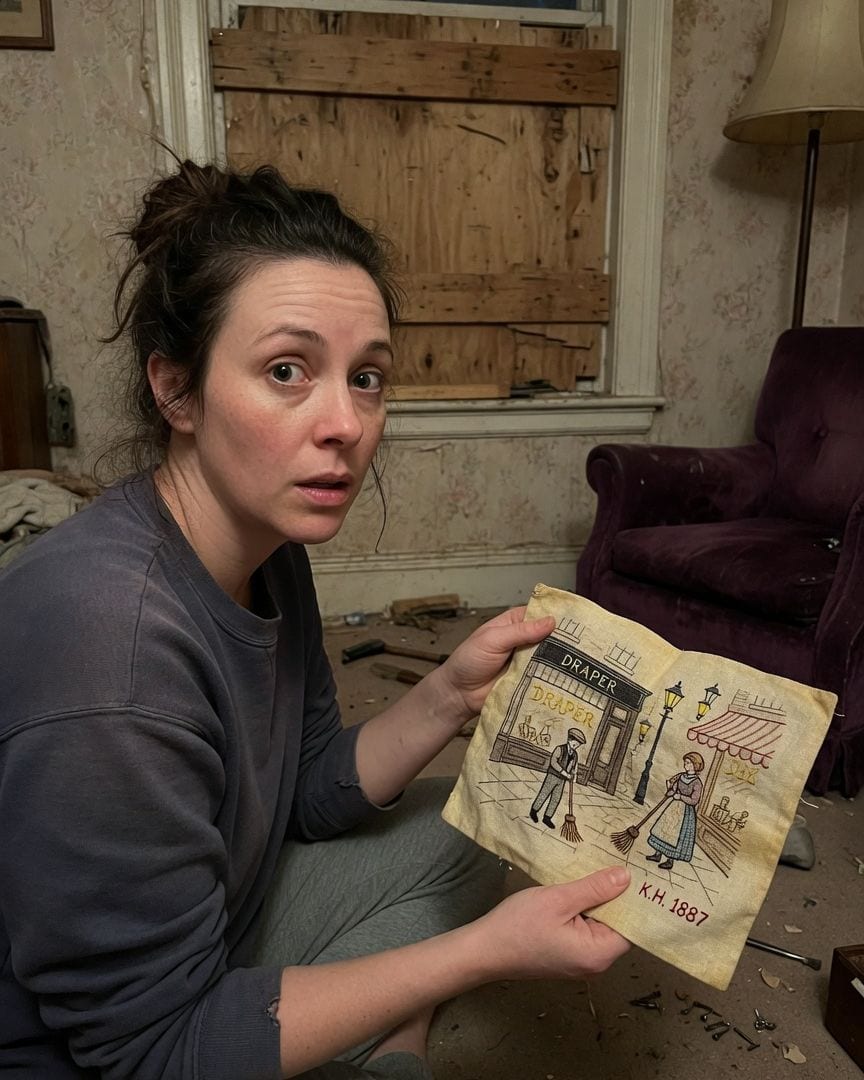
My flat's window shows a gaslit Victorian street across a brick shaft. The nails I hammered back into its frame went into wood soft and new.
My new flat came with a boarded-up window, which the agent dismissed as just an old lightwell. Driven by curiosity, I removed the boards, expecting brick or darkness. Instead, my window opened directly onto a bustling, gaslit street from 1887, a vision that defied all sense.
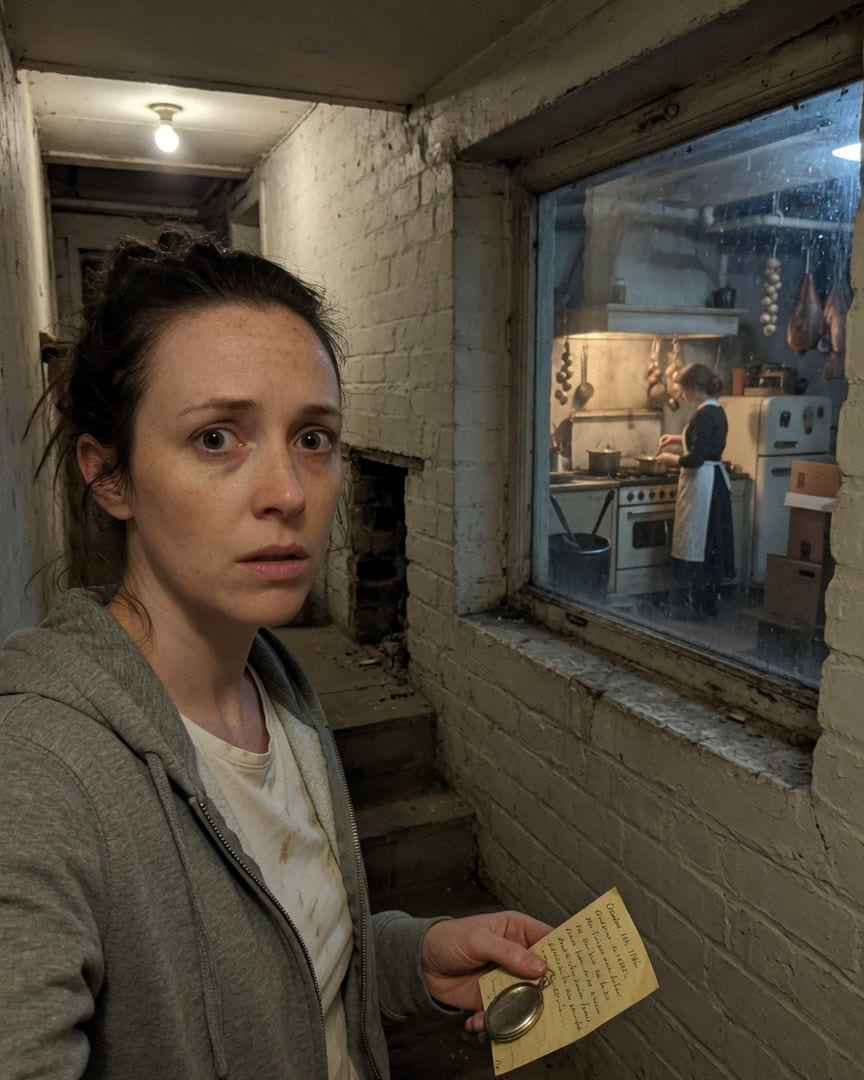
My basement window shows a 1906 kitchen, with a scullery girl and the sound of a poker stirring coals that aren't there.
I've only been in my basement flat a month, still getting used to the city's hum. But my window at pavement level now shows a gaslit kitchen, complete with a bustling scullery girl and the faint sound of coals being poked.
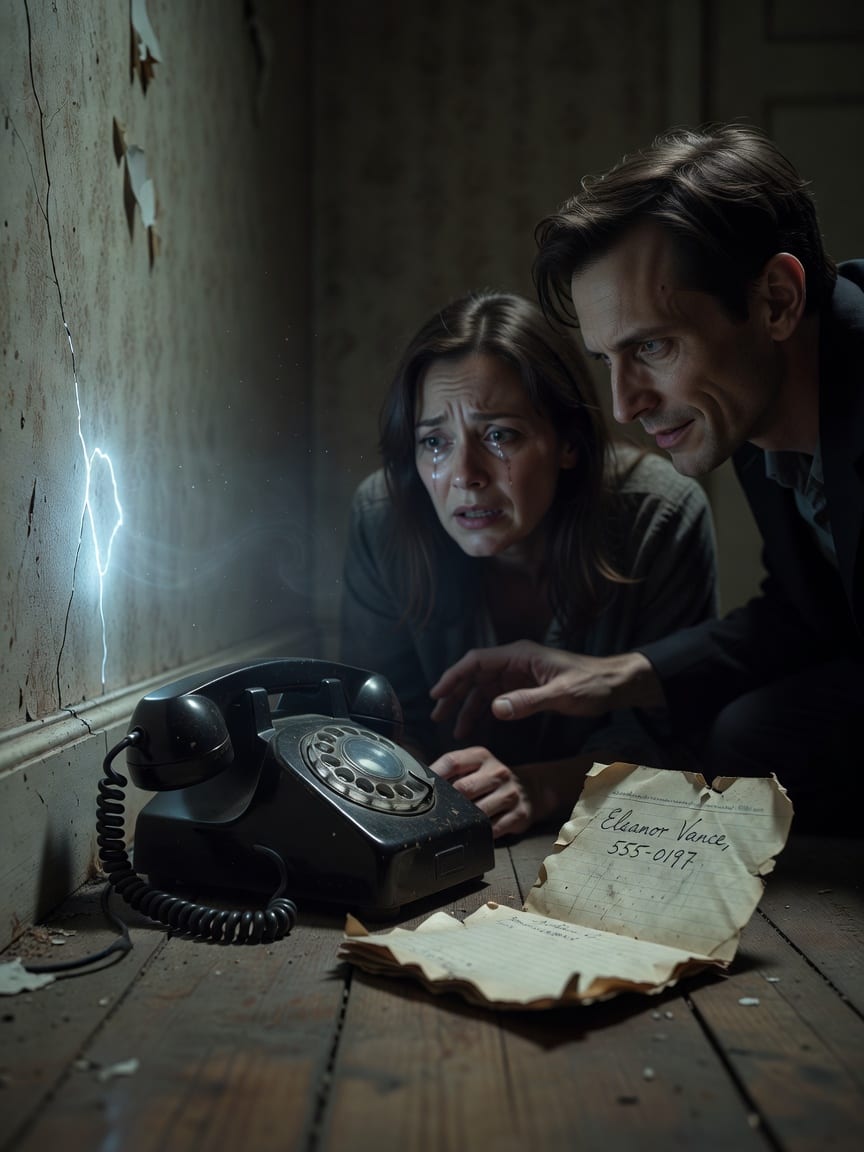
My house's walls ring when I dial a phone number from a 1974 directory. My neighbors said that directory was trash.
I was sifting boxes in my new house when I found an old 1974 telephone directory for my street. It listed my address, 12 Elm Street, under the name "Mr. & Mrs. Sheppard." On a whim, I called the faded seven-digit number. My cell phone rang, but a low, muffled sound also vibrated from the wall beside me.
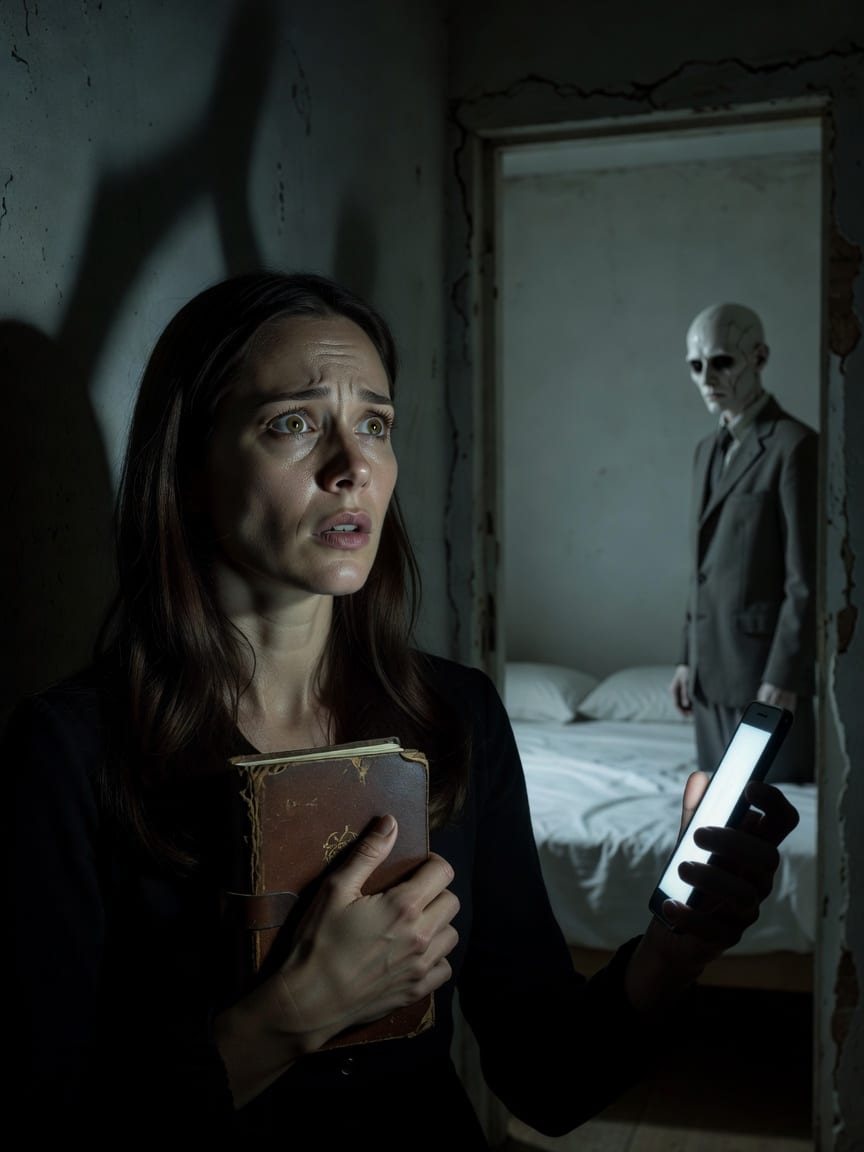
Behind a plastered-over doorway, I found a room. Papered, carpeted, and furnished with a made bed, sealed for decades. The air was dead still, but the bed wasn't dusty. My council tax bill only lists five rooms.
I'm Claire, an architect, meticulously planning my new Victorian terrace renovation. But when I uncovered a hidden room behind a wall, everything I knew about time and decay shattered. The bed was perfectly made, the air still, yet there was no dust, only an unnerving cold.
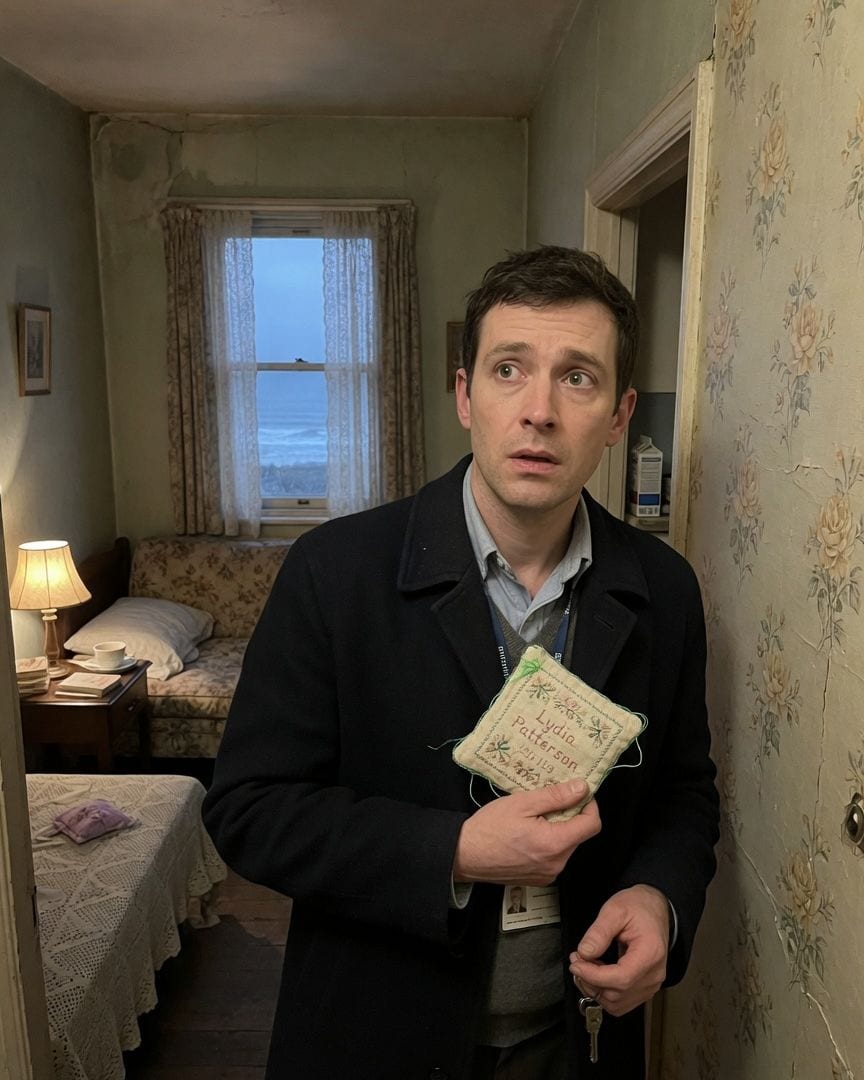
The 'empty' almshouse I was auditing wasn't empty. I heard a bare foot *thump-thump* from next door.
My new charity role involves auditing the supposedly 'empty' almshouse units. But from the unexplained activity outside to a fresh carton of milk inside, something is deeply wrong. Then, in one unit, I found a dead woman's sampler with a jarringly new thread, and heard bare feet thumping next door.
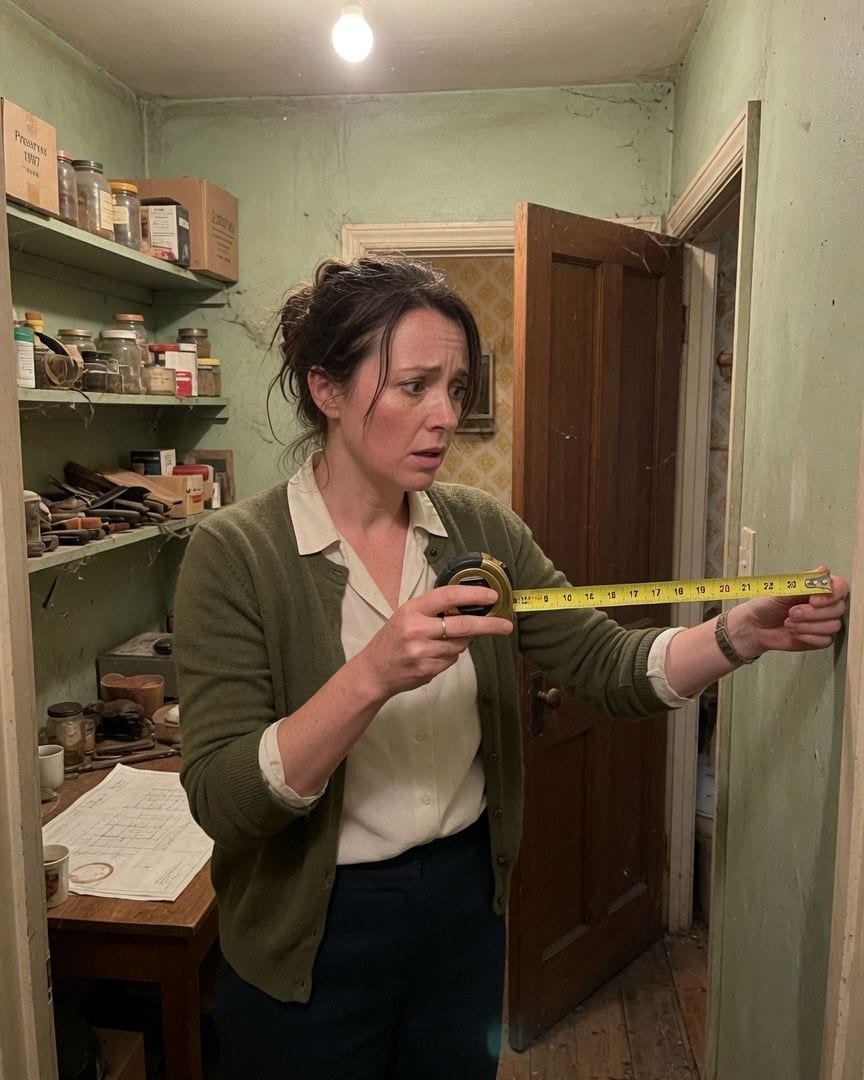
My ferry crossed the estuary three times yesterday, and each time we landed back at our own dock. The far shore simply wasn't there.
My routine ferry commute to the Oakhaven archives usually anchors my day, but yesterday, the boat inexplicably kept returning to our starting point. That unsettling feeling followed me home to my old family house, where I discovered a small, windowless annex whose internal measurements simply did not match its exterior footprint.