A Berlin researcher found a Cold War garrison's complete records for an address that's been a vacant lot for decades. Then, he found its immaculately swept doorstep open into a pulsing green light.
Ansel Vidmar, a methodical researcher of 38, worked late in a Berlin archive on the eve of its municipal transfer. Fluorescent lights hummed, casting a sterile glow on rows of dusty files.
Amidst the expected chaos of old government records, he found a steel cabinet tucked away behind a stack of disused microfiche readers. Its lock mechanism was unique, a heavy brass tumbler keyed to no index in the entire facility.
Curiosity, a driving force for Ansel, compelled him to pick the simple lock with a practiced hand.
Inside, he discovered an anomaly: the complete administrative life of a garrison company. Meticulously kept pay vouchers, sick call logs detailing bizarre ailments, a mess account, and a punishment book—all dating from the early 1980s.
The detail was exhaustive, almost obsessive. The address listed for this company, Königsallee 17, had been a vacant lot since the war, a fact Ansel knew intimately from years of local historical research.
He'd walked that lot countless times, researching its pre-war structures. The final entry in the punishment book, dated October 1983, restricted one Private First Class Robert Barlow to quarters for fourteen days.
The ink was still crisp, sharp-edged against the aged paper. Ansel’s rational mind struggled to reconcile a fully administered military unit with a patch of urban wasteland that had existed for decades.
The silence of the archive pressed in, heavy and expectant.
The discrepancy gnawed at Ansel. He couldn't dismiss it as a clerical error; the sheer volume and detail of the records were too precise, too coherent for a simple mistake. Every name had a service number, every expenditure a receipt.
The next evening, driven by an academic’s stubborn curiosity and a deepening sense of unease, he drove to the Königsallee address.
The lot was as he remembered: forty square meters of wild grass, bordered by crumbling pre-war brickwork, and a faded 'For Sale' sign that had clearly been there for years, its plastic sun-bleached to opacity.
He parked his sedan across the street, the engine ticking softly as it cooled.
Then he walked the perimeter, his eyes scanning the overgrown weeds and scattered rubble, searching for any trace, any foundation, anything to explain the impossible paperwork he'd spent the previous night poring over. There was nothing.
Just the whisper of the wind through dry grass and the distant rumble of city traffic.
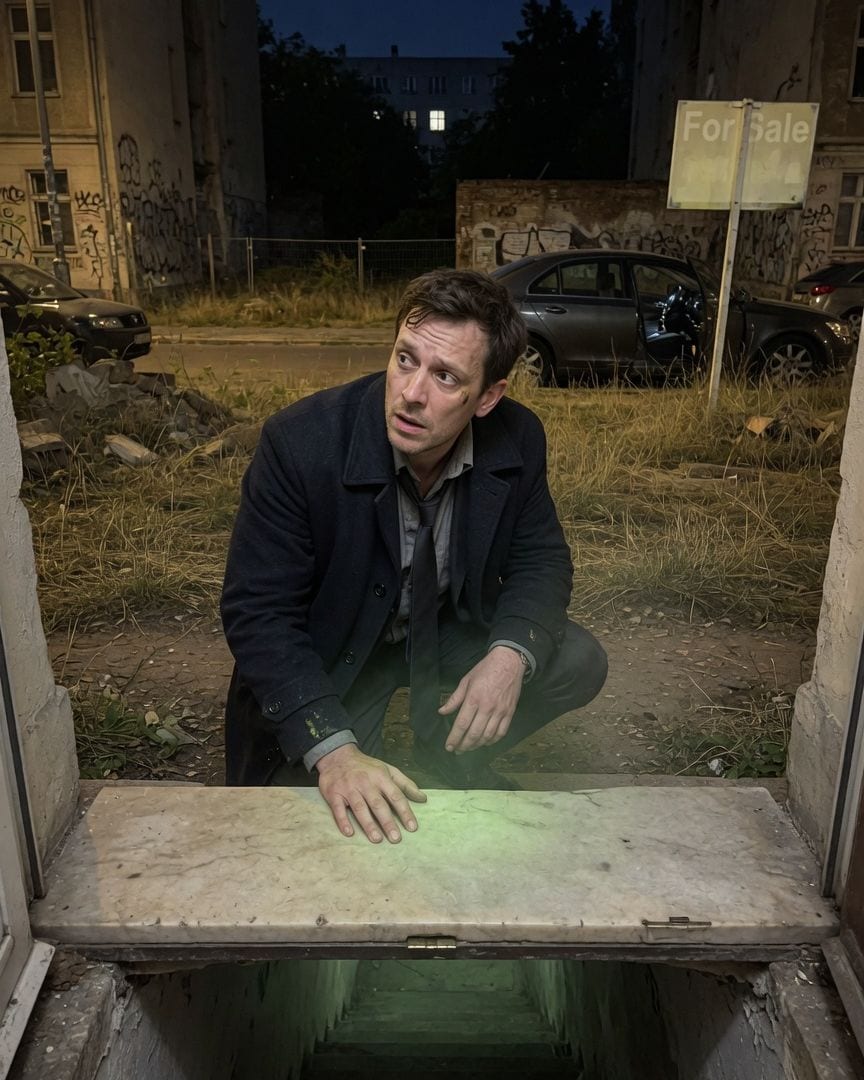
He walked to the exact center of the lot, where a main entrance might once have been, and then he saw it: a single, worn stone doorstep, sitting flush with the earth.
It was immaculately swept clean, free of the surrounding dirt and fallen leaves, as if someone had just finished tidying it. Ansel knelt, touching the cool stone.
It felt solid, ancient, yet strangely vital, humming faintly beneath his fingertips like a tuning fork. He tried to rationalize it as an old monument, a forgotten piece of local folklore, but the meticulous cleanliness defied that.
It was too recent, too deliberate. The dread began to set in, a quiet, insistent hum beneath his skin, echoing the stone’s vibration.
Ansel pushed gently on the doorstep, testing its stability. To his astonishment, it gave way silently, sinking inward with a faint, hydraulic hiss. A dark, concrete stairwell opened beneath it, descending sharply into the earth.
From the depths, a faint, anachronistic hum, like a distant, rhythmic hammering on metal, echoed upward, accompanied by an eerie, faint green light that pulsed from somewhere far below.
The air that drifted up was cool and smelled of damp earth and ozone. Ansel stared into the void, the impossible doorway to a place that shouldn't exist, his heart thudding against his ribs.
Ansel did not descend. The sheer, impossible reality of the opening was enough. He retreated, the dread a cold knot in his stomach, his researcher’s terror quickly giving way to an urgent, almost manic compulsion to understand.
Back in the archive, bathed in the same humming fluorescent light, armed with the undeniable knowledge of the physical doorway, he meticulously cross-referenced every entry in the unindexed cabinet.
The records felt different now, no longer mere paper and ink, but proof of something vast and unseen.
He found impossible supply orders for equipment that was never manufactured, personnel transfers to military units that had been dissolved decades before the entries were dated, and sick call logs detailing illnesses with symptoms that defied medical science—'melancholia of the deep earth,' 'resonant bone decay.'
He sought out Frances Bishop, 62, a senior archivist with decades of experience, discreetly asking about unindexed government anomalies.
Frances, a stoic woman with a dry wit and eyes that had seen too many strange things in too many dusty files, simply dismissed it as a relic of post-war bureaucratic chaos, a misfiled oddity from some forgotten intelligence agency.
"The Berlin archives are a graveyard of dead secrets, Mr. Vidmar. Some things are best left buried." But Ansel knew better. The records were too perfect, too coherent for a misfile.
He began to track the names in the company’s 'transfer' logs, cross-referencing them with other official records.
He found a disturbing pattern: individuals listed as 'transferred' by the Königsallee company consistently disappeared from all other public and private records shortly after, their lives simply ending, often without a death certificate or any further trace.
The unease solidified into a chilling certainty: this wasn’t an archive of the past; it was a living, active system.
Ansel's research intensified, fueled by a growing sense of dread. He spent every waking hour in the archive, poring over the anomalous records, feeling like a fly caught in a vast, unseen web.
He started to notice subtle shifts around him. His archive access logs, usually private, showed unusual queries for his previous research projects, specifically those on Berlin’s post-war infrastructure.
He found a strange satisfaction in tracing the digital footsteps, a validation of his growing paranoia.
A junior colleague, a pale young man named Stefan, casually mentioned Frances Bishop asking about Ansel’s 'unusual interest' in obscure military documents, his eyes darting away quickly. The feeling of being watched became palpable.
In the quiet aisles of the archive, he caught glimpses of movement at the edge of his vision, figures that vanished when he turned, like heat-shimmers in a desert.
He started taking circuitous routes home, varying his timing, a futile attempt to shake off an unseen shadow.
One evening, returning to his apartment, he found his door slightly ajar, though he distinctly remembered locking it, hearing the satisfying click of the deadbolt.
Nothing appeared stolen, but on his desk, centered precisely on his open laptop, lay a single, blank index card. It was identical in every detail—the heavy stock, the faint official-looking border—to the cards he'd found in the unindexed cabinet.
The card seemed to absorb the light, drawing his eye. It was a silent, undeniable message, a chilling confirmation that his digging had been noticed, and he was now being watched.
The silence in his apartment became absolute, heavy with unasked questions.
The blank index card was the final catalyst. Ansel confronted Frances Bishop the next morning, laying out his copies of the impossible records, the transfer logs, and the chilling card from his desk on her impeccably tidy workspace.
Frances’s calm facade cracked. She initially dismissed it, then grew evasive, her eyes darting to the secure cameras in the archive ceiling, a bead of sweat forming on her brow.
Ansel pressed her, detailing the pattern of disappearances, the non-existent barracks, the active doorstep in the Königsallee lot. He demanded to know the cabinet’s true origin. Her shoulders slumped, a deep sigh escaping her lips.
She finally admitted the cabinet was "always there," not officially indexed, but routinely "processed" by a specific, unnamed department that handled "anomalous acquisitions."
Her voice dropped to a near whisper, barely audible over the hum of the old server room next door.
She revealed that her predecessor, Joseph Maddox, a senior archivist in his 70s, had disappeared without a trace years ago after attempting to "clean up" the cabinet’s contents, convinced it was a misfiled historical aberration.
"He thought he could fix it," she said, a haunted look in her eyes. Frances showed Ansel a small, leather-bound journal she’d kept hidden, its pages brittle with age.
Maddox’s last entry, dated the day he vanished, spoke of "the machine" and a "doorway," a "swept path" leading to an "administrative core" that processed the "unfit." The journal abruptly ended mid-sentence, the ink dry, the final word "filed."
Frances explained, her voice flat, that the "punishments" and "transfers" were euphemisms. The company wasn't defunct; it was a system, a "secrecy machine" that processed people, absorbing them into its own bureaucratic reality.
She had learned to leave it alone, to let the machine do its work. The earlier clues snapped into focus: the endless records, the vanished individuals, the undisturbed doorstep. It wasn’t a clerical error; it was a functioning, relentless apparatus.
The true nature of the 'company' detonated in Ansel’s mind. He saw the pattern, the cold, administrative logic of it all. It wasn't about malice; it was about order.
He thought of Joseph Maddox, of Robert Barlow, of all the names listed as 'transferred' or 'restricted.' A surge of desperate energy propelled him.
He had to find something, any loophole, any way to fight back, to 'un-file' himself or those already taken.
He rushed back to the unindexed cabinet, his hands trembling as he pulled out the 'Personnel Arrived' log, hoping to find a pattern of who was taken, a weakness in the system.
His fingers traced down the page, past long-dead soldiers and forgotten officials, until they stopped. There, at the bottom of the list, was his own name, boldly written: 'Vidmar, Ansel.' Below it, a new service number, meticulously assigned.
The entry was dated for 'this morning,' and the ink, impossibly, was still-wet.
The implication hit Ansel like a physical blow, stealing the air from his lungs. He wasn't just observing the machine; he was already part of it. He was filed.
The fresh, still-wet ink on his own name solidified the terrifying coherence of it all. The 'swept doorstep' wasn't merely a portal to an underground facility; it was an entry point, a threshold into the very filing system itself.
The 'company' wasn't a military unit, nor was it truly a physical place; the company was the administrative entity, a bureaucratic construct that processed and contained individuals within its own impossible reality.
The entries in the punishment book, the transfers, the sick logs – they were all records of people being integrated, categorized, and absorbed. He remembered Frances's chilling words about the 'machine' and how Maddox simply 'vanished.'
The blank index card left in his apartment, the subtle monitoring of his archive access, the pressure he felt – it was all part of a methodical preparation.
He hadn't been investigating a buried record; he had been scouted for one.
The dread was not in a monster, but in the cold, logical inevitability of a system that simply filed away lives, making them disappear into its own meticulous paperwork.
Ansel knew he couldn’t let himself be 'filed.' He had to become un-processable. He frantically searched the cabinet’s contents for any precedent, any flaw, any way out of the system.
His fingers flew across the stiff pages, the dust motes dancing in the fluorescent light. He found a small, rarely updated section labeled 'Discharges – Irregular.'
There were only two entries, both from the 1950s, both marked 'System Error – Unprocessable.'
The brief notes indicated that these individuals had generated so many contradictory or nonsensical entries that the machine simply couldn’t categorize them, effectively spitting them out. That was his chance.
He grabbed a handful of the blank index cards, a pen, and, with trembling hands, began to fill them with deliberately contradictory data.
He listed himself as simultaneously transferred to a unit dissolved in 1945, restricted to quarters in the Königsallee barracks for a period lasting until the next decade, and on indefinite sick call for a disease that didn’t exist, all dated for impossible past and future dates.
He wrote his name, then crossed it out, then wrote it again with a different service number. He created a cascade of administrative chaos, hoping to overload the system.
As he jammed the corrupted cards into various sections of the filing cabinet, a low, rhythmic hum began to emanate from the cabinet itself, growing steadily louder.
It was the sound of a vast, slow-moving mechanism engaging, a deep, resonant thrumming that vibrated through the floor, making the old wooden shelves around him subtly shiver.
The air in the archive grew cold, and the faint green light from the opened doorstep seemed to pulse in time with the hum, a silent, internal alarm signaling a system under duress.
The hum faded as abruptly as it had begun, leaving a profound silence in its wake, broken only by the distant city sounds. Ansel Vidmar left the archive that night, leaving the cabinet overflowing with his deliberately corrupted records.
He never returned to that archive, nor to any other. He resigned his position, citing 'personal reasons,' and moved to a small, quiet town in southern Germany, far from the Königsallee.
The next morning, the Berlin archive officially transferred to municipal control. The unindexed filing cabinet, its contents a jumbled mess of contradictory entries, was subsequently marked for destruction due to 'irreconcilable administrative errors.'
The Königsallee doorstep remained, perpetually swept clean, but Ansel never looked at it again, even in passing.
Ansel Vidmar tried to resume a normal life, but the memory of the wet ink and the hum never left him. He kept a single, blank index card from the company, tucked into his wallet, a constant, chilling reminder.
Sometimes, he’d absentmindedly trace the faint, official-looking border with his thumb, a small, nervous habit.
One day, years later, he noticed a new, faint detail on the card: a tiny, almost imperceptible service number, freshly stamped in the corner, matching the one he saw in the log, but with a slight, almost imperceptible modification—a single digit altered.
He knew he was still filed.
Years later, Frances Bishop, now retired, received a forwarded letter from the municipal archive.
It was a request for information on a 'Vidmar, Ansel,' whose records had resurfaced, marked with a new service number and a transfer date to a 'Company K, Königsallee (Deactivated).'
The letter was addressed to her old office, stamped with a seal she hadn't seen in decades. She tossed it in the bin, a faint, knowing smile on her face. "Is that so?"
If this one got to you
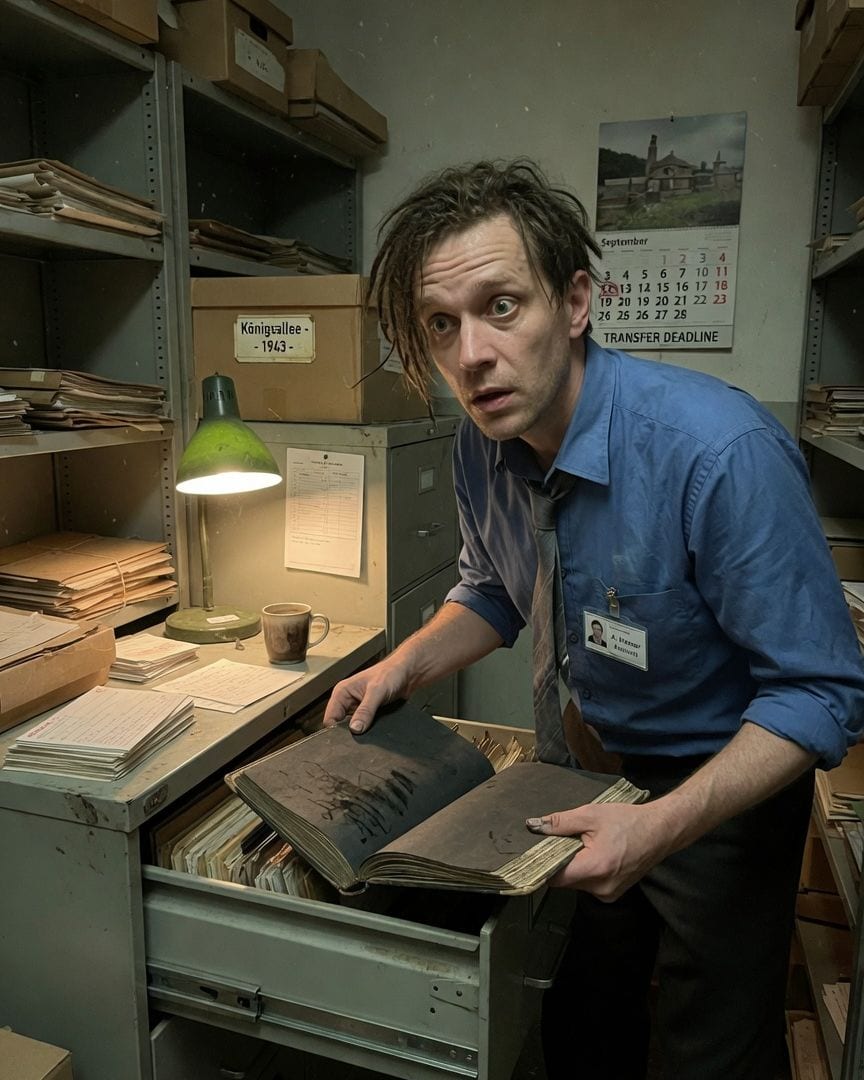
A Berlin archive researcher races a deadline. A hidden log for a Cold War barracks on a vacant lot has ink still wet from last month.
Ansel Vidmar, a methodical researcher, felt the pressure of a looming deadline. The municipal transfer of the old Berlin archive was days away, and he still had countless documents to categorize amidst towering stacks of forgotten history. His focus narrowed to an unindexed metal cabinet, revealing records for a garrison company at Königsallee – an address that had been a vacant lot since the war. A punishment log inside listed an entry from 1983, a date far too recent for a non-existent building. When Ansel visited the site, he found only overgrown grass, save for a single, eerily clean concrete doorstep emerging from the earth. His unease solidified into dread when he later uncovered a hidden Quartermaster's Log, meticulously detailing supplies for the same barracks, with entries extending to "last month," the final page's ink still faintly wet. What unseen operations were still being maintained?

Every gardener who's held allotment plot 26 gave it up after a single season, each one leaving the same note behind: never dig the ground below two feet.
Newly single at 38, I hoped Plot 26 at Weir Field Allotments would be a fresh start. But the committee’s rent book held a strange, decades-old rule: 'ground not to be dug below two feet.' Ignoring the warnings, I dug anyway, only to find a perfectly smooth concrete slab with a tiny hole—and a distinct, unnatural cold breath rising from it.
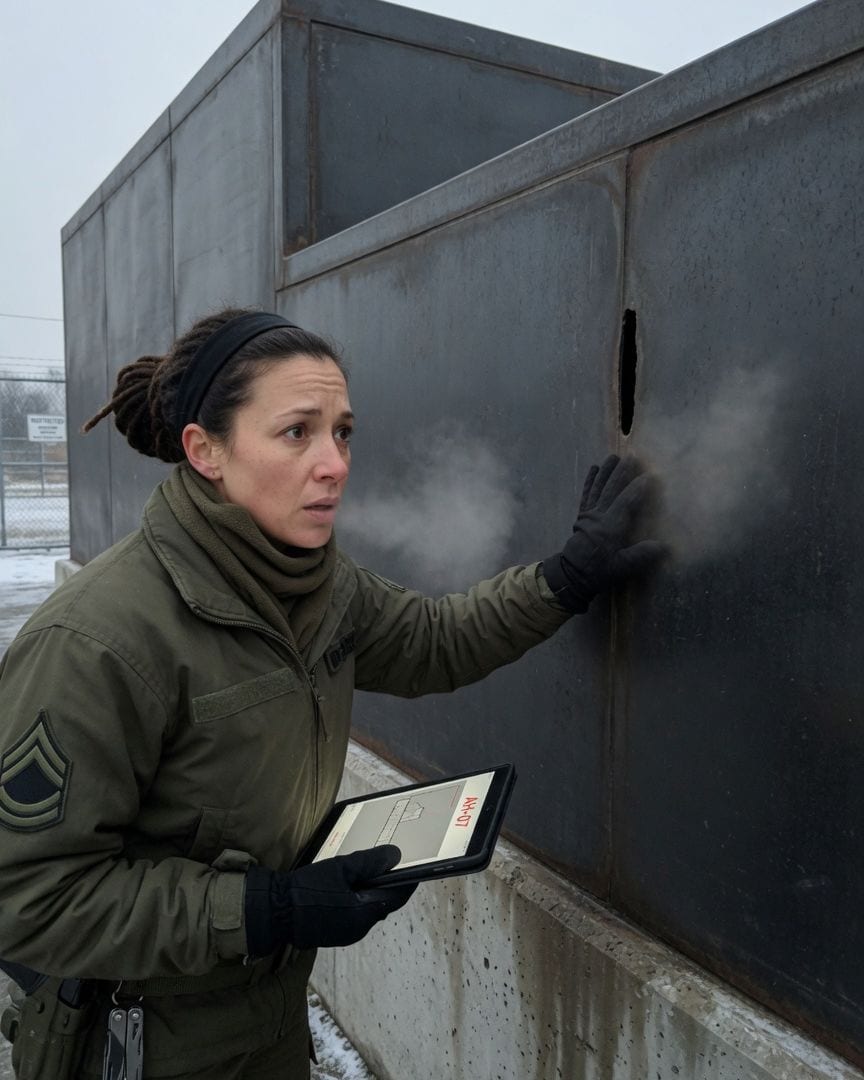
A Sergeant's audit uncovered an annex with no records. She pressed a hidden lever, and its steel wall hissed open to a sliver of impossible darkness.
Sergeant Iris Kowalczyk, a stickler for order, meticulously prepared for her transfer audit of the seventy-year-old installation. An annex behind the old post hospital defied all logic: no keyway, no maintenance record, no year built — it simply *was*. On a biting cold morning, she felt an undeniable warmth radiating from its thick, featureless steel, as if something active hummed beneath. Her fingers found a hairline seam, then a hidden, recessed pressure point that felt like a lever. When she pressed it, the steel hissed inward, revealing a sliver of impossible darkness from which a deep, electric hum and a heavy stillness pressed out. What secrets did this impossible structure conceal?
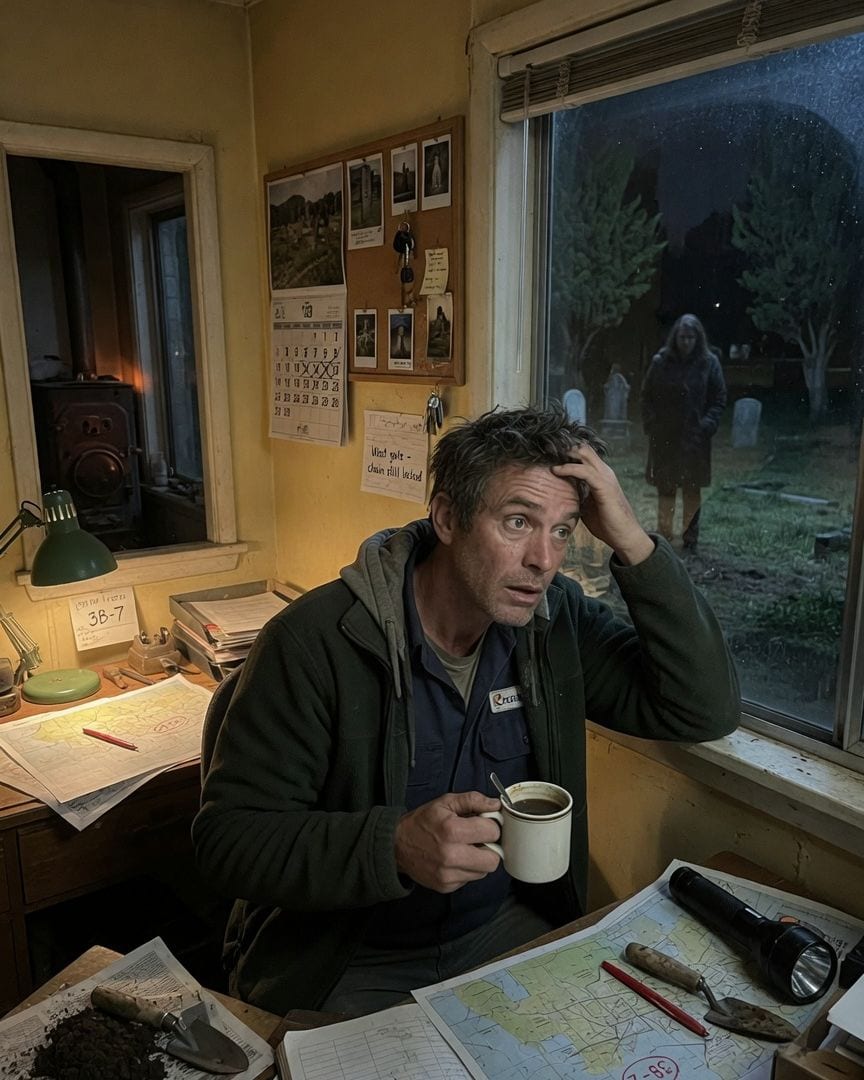
My cemetery lodge overlooks a woman visiting an empty grave near 3 AM most nights. The west gate she uses has been chained shut since autumn, its lock untouched.
As the cemetery's night caretaker, I'm used to the quiet hum of the lodge. But for three weeks, a woman has appeared nightly at plot 3B-7, a silent mourner in the deep night. What chills me is how she leaves: walking straight through the west gate that's been chained and padlocked shut for eight months.
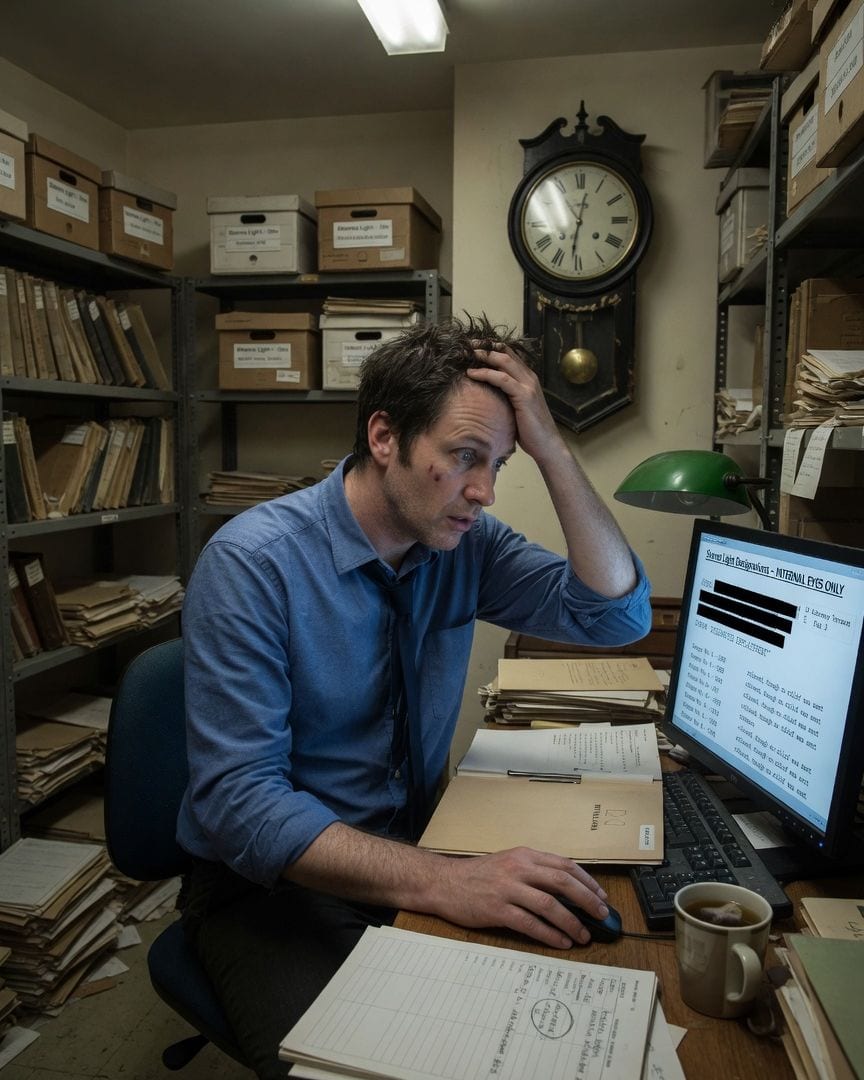
I found my street address in a century-old lighthouse file, printed decades before I lived there.
As a maritime archivist, my world revolves around forgotten lives and dusty ledgers. But the Skerne Light files broke that quiet rhythm, revealing a chilling pattern: 'Keeper number 6' relieved, though no relief was sent, repeating for decades. Now, an internal document with a strange code has led me to a redacted entry, revealing my own street address, decades before I ever lived there.
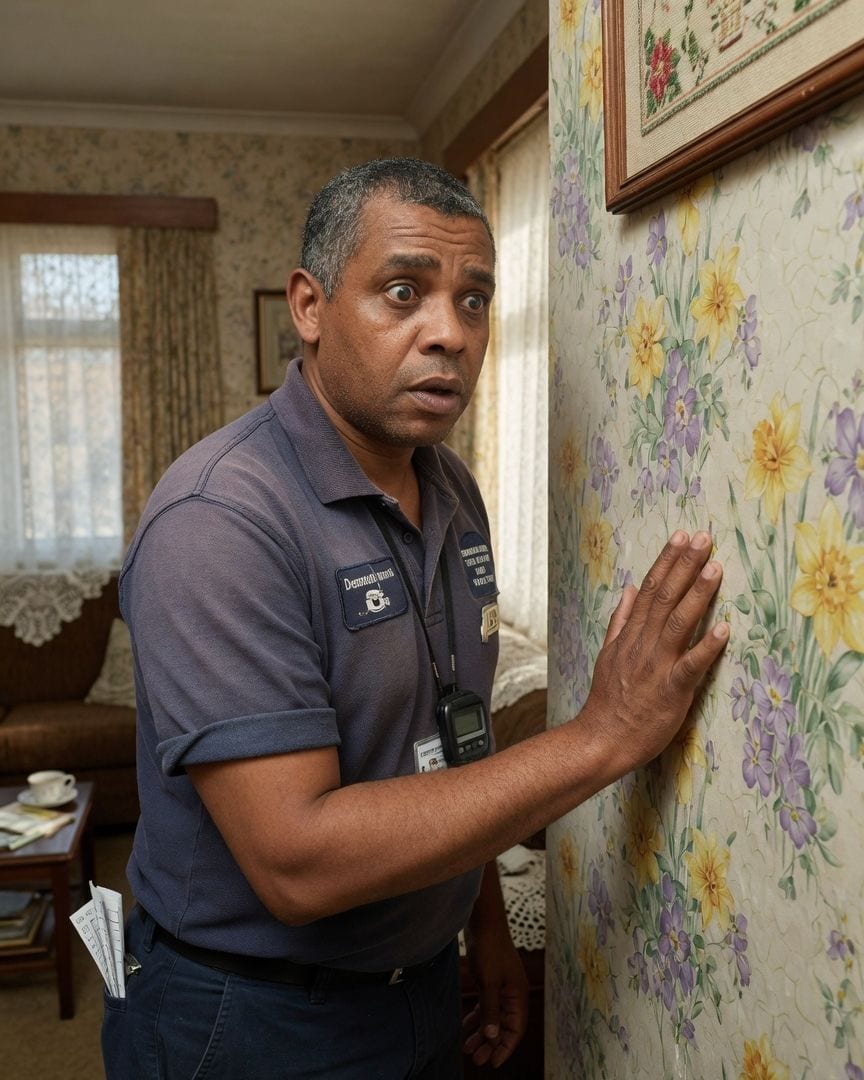
I read the water meters on this street, and this month number 30 grew a second one in pavement that was solid last month — its pipe runs back under a front door I cannot find.
I'm Desmond Drummond, a city water meter reader, used to the predictable rhythm of my fifteen-year route. But this month, Mrs. Crane's house on Elm Street showed a second meter reading. It led to a new meter pointed at a blank brick wall, and later, to a hidden door behind her living room wallpaper where no door should exist.