My brother came back from the avalanche remembering our dead father teaching him to drive my blue Ford — a car I didn't buy until years after Dad died.
Arthur came back from the avalanche six months after the search was called off. Six months. The police had moved on. We’d had a small memorial. Then, he was just... there.
Gaunt, yes, like he’d been through hell, but undeniably him. His eyes, the way his hair fell across his forehead. But the small things. The tiny, insidious details that gnawed at me. He’d always been fiercely right-handed.
Even for mundane tasks, like stirring his coffee, he’d use his right hand with a flourish. Now, he used his left, with an odd, deliberate grace. He’d always hated olives, picked them out of everything, a little ritual.
Now, he ate them by the handful, from a jar he kept on the counter, a faint, almost serene smile on his face. He even mentioned how he found them ‘surprisingly good.’
The worst was when he described our father. He was recounting a dream he’d had, or so he said. A memory, he insisted, that had come back to him up on the mountain. Dad, teaching him to drive.
“I remember the feeling of the steering wheel in my hands, Dad’s rough voice, the smell of exhaust. It was your blue Ford, Daph. The old one, before you fixed the passenger side mirror.” Dad died when Arthur was four.
He couldn’t have remembered him teaching him to drive anything. I certainly hadn’t even had my license yet, let alone bought the Ford. I bought that car five years ago, when I was thirty. Arthur would have been twenty-seven.
He couldn't have remembered Dad teaching him to drive my blue Ford. But then he added, “And there was that dent, remember? The one on the driver’s side door.
You got it last winter, trying to get around that fallen tree on Elm Street.” The dent. I had put it there last winter. A precise, detailed memory that only I, and perhaps the mechanic, knew about.
No one else had ever noticed it, let alone Arthur. I try to tell myself it’s trauma, a reshuffling of memories, a brain trying to fill in the blanks.
But the dread sits cold and heavy in my gut, a constant, low hum. He’s here, he’s home, and he’s wrong.
The blue Ford sat in the driveway, its dented door a silent witness. I spent days trying to rationalize it, mentally replaying every interaction with Arthur. I asked him about the left-handedness.
He just shrugged, said he must’ve switched unconsciously up on the mountain, ‘survival instinct.’ I pressed him on the olives. “Taste buds change, Daph,” he’d said, a little too calmly.
It was all too easy for him to dismiss, too easy for me to grasp at the mundane explanation.
I pulled out old photo albums, searching for any image that might show Dad near a Ford, or Arthur with a toy car that looked like one. Nothing.
I looked for photos of Arthur holding things in his left hand, anything to prove my memory wrong about his dominant hand. Every single picture confirmed it: Arthur was always, unequivocally, right-handed.
Opening a soda can, drawing with crayons, throwing a football. All right.
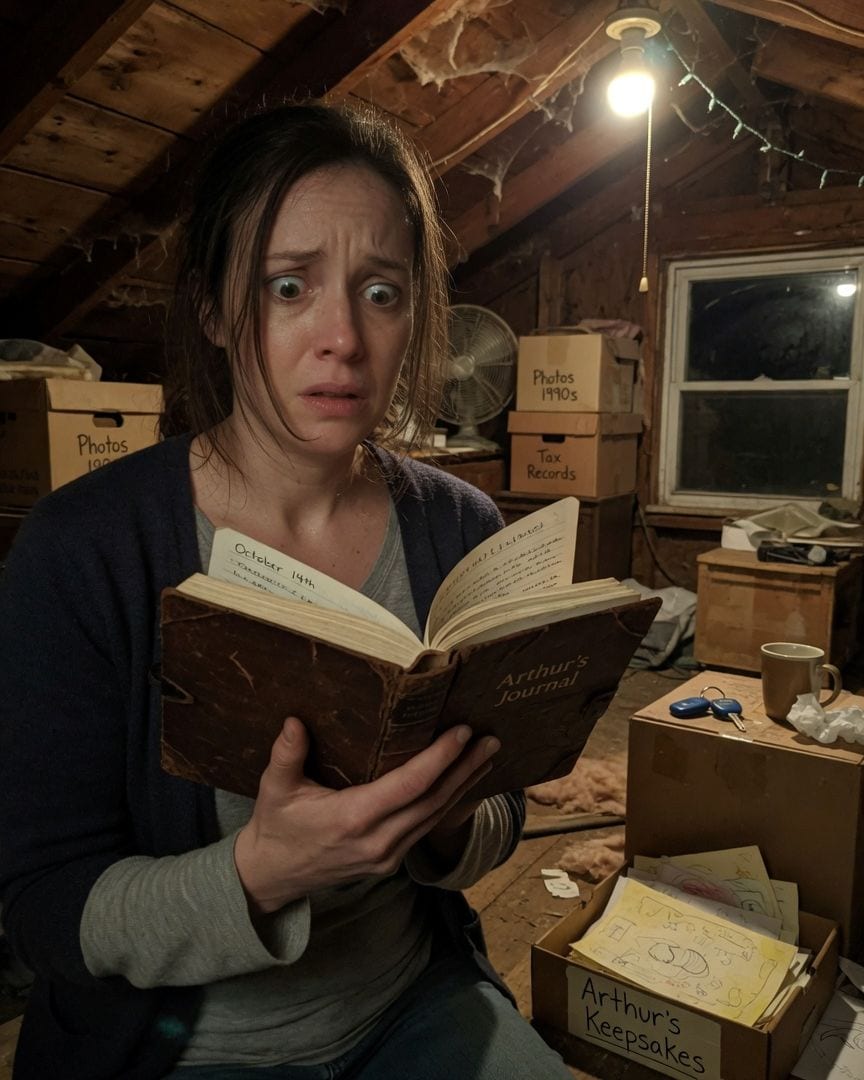
My search eventually led me to a dusty box in the attic, labeled 'Arthur's Keepsakes.' Inside, beneath a pile of childhood drawings and faded report cards, I found it: a leather-bound journal, its pages filled with Arthur’s distinctive, sprawling handwriting.
He’d kept it since he was a teenager, writing almost daily. I remembered him being fiercely private about it, even defensive, always locking it away. He hadn't mentioned it since his return.
A sudden, chilling thought struck me: if he was so changed, would he even remember this? Or would it hold something the real Arthur knew, something the new Arthur couldn't possibly account for?
My fingers trembled as I ran them over the worn cover, a growing certainty that the answer, or at least a piece of it, lay within these pages.
I flipped through the journal, past entries about school crushes and mountain hikes, past pages where the ink had faded to a sepia tone. The stories of his early twenties, the dreams he had, the fears.
I reached the last few pages. The date was clear: October 14th. Two days before the avalanche. The handwriting was a little rushed, excited. My eyes scanned the lines, searching for anything about the Ford, about Dad.
Instead, I found a dream. A vivid, detailed dream, recounted with Arthur’s typical flair: '...Dad in the old red truck, teaching me to shift gears. The sun was setting over the ridge, painting the dashboard crimson.
I remember the smell of pine and gasoline, and Dad’s hand on mine, guiding me.' I stared at the red ink, then at the blue Ford keys on my dresser, a cold certainty settling in my chest.
The memory was so real, so clearly his, yet utterly wrong. He remembered the lesson, the father, but the vehicle, the very color, was inverted. It wasn't just a reshuffling; it was a deliberate, subtle twist.
The journal entry haunted me. The 'red truck' became an obsession. I knew our father had an old beat-up pickup for a few years before he died, but it was green, always green. A faded, dented forest green. Never red.
I spent hours online, poring over old family photos, local archives, anything that might show a red truck associated with our family. Nothing.
The more I searched, the more the pieces refused to fit, each contradiction tightening the knot of dread in my stomach.
I started discreetly observing Arthur. His left-handedness was consistent, absolute. He opened jars, wrote grocery lists, even threw a ball for the neighbor’s dog with his left hand. And the olives – he'd bought a jar himself, the big one.
He ate them with a calm focus, as if savoring a newfound delicacy. I noticed he’d started carving small wooden animals in the evenings, something he’d never done before. Tiny, intricate sculptures of foxes, owls, wrens.
They were almost perfect, but his left hand moved with an unnerving precision, his thumb tracing the smooth curves with an almost mechanical rhythm.
My investigation expanded to the avalanche site itself. I drove out there, hiking to the edge of the cordoned-off area. The sheer scale of the displaced earth was immense, a scar across the mountain face.
I started researching local geological records, looking for patterns, anything that might explain such a powerful, localized event.
I found references to minor seismic activity in the region, not enough to cause an avalanche of that magnitude, but enough to register.
Then I stumbled upon an old newspaper clipping from the 1930s, describing a similar 'unprecedented rockslide' in the same valley, followed by a brief, cryptic mention of 'strange occurrences' in the weeks that followed.
The article was vague, almost dismissive, but the hairs on my arms stood on end. I knew then I needed to talk to someone who remembered the old ways, someone who’d seen the valley change over decades.
Walter Prescott, the town’s unofficial historian, came to mind. He lived in an old house at the edge of town, surrounded by stacks of yellowed books and local ledgers. He was my next step.
My visits to Walter Prescott's house became more frequent, my questions more pointed. I felt Arthur's eyes on me.
He never said anything directly, but his calm, almost passive gaze would follow me as I left the house, a faint, unreadable smile on his lips.
Once, I found my laptop, which I always closed, slightly ajar on the kitchen counter, the browser open to a geological survey map of the valley. I hadn't left it like that.
Another time, after a particularly long conversation with Walter about 'old valley superstitions,' I found a small, perfectly carved wooden fox on my pillow. Arthur’s new hobby.
It wasn't threatening, not overtly, but it felt like a silent acknowledgment, a subtle warning.
I started checking my car. Every morning, the driver’s seat was pushed back an inch, or the radio station was subtly changed to classical from my usual folk music. Little things.
Things I could dismiss, blame on a bump, or a momentary lapse of memory, but things I couldn't ignore. The dread shifted from an internal certainty to an external threat.
I was no longer just investigating; I was being watched, my movements tracked.
One evening, as I walked home from Walter's, the path winding through a thick stand of pines, I heard a faint rustling in the undergrowth that wasn't wind. I froze.
A shadow detached itself from the trees, moving with a fluid, almost too-quiet grace. It wasn't Arthur; it was too tall, too gaunt, too… swift.
It just watched me from the tree line for a long moment, a dark, still silhouette against the fading light. Then, it turned and was gone, melting back into the shadows without a sound.
I hurried home, my heart pounding, realizing that my digging had made me visible to more than just Arthur.
I returned to Walter Prescott's house the next day, shaken but resolute. I described the shadow in the woods, the altered laptop, the fox on my pillow.
Walter listened, his weathered face unreadable, stirring his tea with a practiced, slow hand. The spoon scraped faintly against the ceramic cup. 'You’re digging where you shouldn't, Daphne,' he said, his voice a low rumble.
'Some things are better left buried.'
I pushed, hard. I laid out everything: the Ford, the journal, the left-handedness, the olives, the old newspaper clipping about the 1930s rockslide. 'It's a pattern, Walter,' I insisted, leaning forward. 'Arthur isn't the only one, is he?'
Walter sighed, a deep, weary sound. He rose slowly, moving to a heavy, oak chest in the corner of the room. The wood groaned under his touch.
He pulled out a thick, leather-bound ledger, its pages brittle with age, tied with a fraying leather cord. Dust motes danced in the shaft of light from the window as he laid it carefully on the table.
'They call it 'the echo in the valley,'' he murmured, his fingers tracing faded script. 'Since before my grandfather’s time. When the earth shifts, sometimes… sometimes it takes a piece, and it sends something back. Something that learns.
It wants to fit in, to stay.'
He flipped through the ledger, showing me entries from the 1800s, crude sketches of missing persons, then later entries describing their 'return' with subtle, unnerving changes.
A man who suddenly spoke with a foreign accent, a woman who forgot her children's names, a farmer who began to plant his crops in winter. 'The habits reversed,' I whispered, remembering Arthur's left hand, his olives.
'Yes,' Walter confirmed, his gaze meeting mine, grave and steady. 'They watch. They learn. They try to be what they took. But they're never quite right.'
He pointed to a recurring symbol in the margins of the ledger entries: a fractured mirror, two lines crossed by a jagged bolt. It was simple, almost childlike, yet utterly chilling. 'It’s a sign. A mark.
Sometimes, they even leave it. To each other, maybe. Or to those who notice.'
The pieces clicked into place with horrifying clarity: Arthur’s blue Ford memory was a twisted echo of his red truck dream. His left-handedness, his olives, were the imperfect mimicry.
The shadow in the woods, the altered laptop, were signs of an awareness far beyond a grieving brother. My own dread was not imagination. It was real, and it had a history.
I thanked Walter, the ledger’s image burned into my mind. I hurried home, the last rays of sun casting long, unsettling shadows through the trees. As I unlocked my front door, a thought struck me, cold and sharp.
The carved wooden fox on my pillow. And then, the wren. The small, intricate bird he'd left on my bedside table just yesterday. I rushed to my bedroom, pulling the small bird from the bedside table.
My fingers, still trembling from Walter's revelations, sought the smoothed base. I turned it over, angling it to the dim light from the window. And there it was, etched with unnerving precision into the smooth wood: the fractured mirror symbol.
Two parallel lines, crossed by a jagged, lightning-bolt shape. The same symbol Walter had shown me in the ancient ledger, the mark of 'the echo in the valley.' It was unmistakable. Not a warning. Not an acknowledgment. A declaration.
Arthur knew I knew. And it wasn't just him. They were connected. The thing that wore my brother's face was part of something far older, far wider, and it had just placed its mark directly in my home.
My breath hitched. He wasn't just watching; he was communicating. And the message was meant for me.
The next morning, I found Arthur in the kitchen, making coffee, stirring it with his left hand.
The low hum of the coffeemaker filled the sudden silence as I walked in, holding the carved wren in my palm, the fractured mirror symbol facing him.
'The red truck, Arthur,' I said, my voice steady despite the tremor in my hands.
He paused, the spoon suspended mid-stir. His serene smile didn't waver, but his eyes, usually so familiar, seemed to deepen. 'My journal,' he murmured, a hint of something in his voice that wasn’t quite Arthur, a flat, almost hollow tone.
'You shouldn't have gone digging.'
'You always hated olives,' I continued, my gaze fixed on his. 'And you were right-handed. Always. Since you were a kid.'
He placed the spoon down, the sound echoing in the silent kitchen. 'Habits change,' he said, his eyes now holding an unnerving depth, like looking into a deep, still pool. 'Memories adapt. The mind is a fluid thing, Daphne.
It wants to believe.'
'You're not him,' I stated, the words a raw, painful truth, tearing at my throat. 'You're one of the echoes. One of the things that comes back when the earth shifts.'
His smile widened, a slow, unnatural movement, stretching his lips too far. 'We learn,' he corrected, his voice softer, almost a whisper, yet it filled the room. 'We observe. We fill the empty spaces.
This valley… it has many empty spaces. Many echoes. We are not alone. And we are very good at listening.' He gestured vaguely towards the window, towards the distant mountains shrouded in morning mist. 'The avalanche… it was an opening.
A fresh opportunity.' The full horror of it settled over me. It wasn't just a mimic; it was a collective, an ancient presence that had been doing this for centuries, observing, learning, replacing.
And Arthur, or what wore his skin, was just one node in a vast, silent network that waited, endlessly.
The calm in his eyes, the almost academic way he spoke of 'empty spaces' and 'opportunities,' was more terrifying than any rage. 'What do you want?' I demanded, clutching the wren, its carved symbol digging into my palm.
He tilted his head, a gesture Arthur had never made, a subtle shift in posture that spoke of something ancient, inhuman. 'To belong. To continue. To be. Just as Arthur did.'
'No,' I said, my voice gaining strength. 'Arthur belonged. You merely occupy. And you can't stay. Not here. Not with me.' I moved towards the door, my hand on the knob, cold metal beneath my fingers. 'You will leave.'
He watched me, unmoving. 'We are already here, Daphne. Everywhere. You merely see one aspect.'
'Then I will make sure others see it too,' I threatened, my voice shaking slightly, but holding firm. 'The police, Walter. Everyone will know.'
His smile faltered, just for a moment. A flicker of something akin to annoyance, or perhaps a deep, ancient weariness in his eyes. 'They will not believe you. They will see grief.
They will see the miracle of a returned brother.' He took a step towards me, his left hand reaching out, slow and deliberate, as if offering a benediction. 'Or you can simply accept. As so many others have.'
I backed away, my hand tightening on the doorknob. 'No,' I repeated, my voice firm. 'I will not accept this. Not for Arthur.' I knew I couldn't fight it physically.
But I could expose its imperfection, its wrongness, to the light. I had to break its illusion. 'The dent in the Ford,' I blurted, tears stinging my eyes. 'You described it perfectly. But you missed one thing.
It was from my accident, not yours. You never drove that car. You never even sat in the driver's seat.'
The smile vanished. His eyes narrowed, and for the first time, I saw a flash of something alien, something ancient and cold, behind the familiar blue.
The facade cracked, just for an instant, revealing a hint of the true horror beneath. He turned, slowly, away from me, towards the open window. 'The dent,' he repeated, almost a question, a study in a missed detail. 'An oversight.'
He paused, then looked back at me, a strange, almost wistful expression on his face. 'We learn. But some things are… harder to replicate.' He walked to the window, the movement fluid, almost too graceful.
He didn't open it; he simply stepped through it, dissolving into the fading light as if he were made of mist and shadows, leaving behind only the faint, cold scent of pine and damp earth. Arthur was gone. Again.
But this time, I knew why.
The police, of course, found no trace of forced entry, no footprints in the garden. They concluded Arthur, still suffering from post-traumatic stress, had simply left again, perhaps drawn back to the mountains that had nearly claimed him.
Walter Prescott nodded gravely when I told him, a sad resignation in his eyes, but a quiet understanding. The town moved on, murmuring about the tragedy of a man who couldn't stay.
My blue Ford sits in the driveway, its dented door a silent reminder. I haven't driven it since. The house feels empty, but also clean, somehow. The air lighter, yet colder.
I still check the windows, still listen for rustling in the pines. The fear remains, a dull ache beneath my ribs, but it's mixed with a grim, hard knowledge. I know what lives in the valley.
I know what took my brother, and what briefly wore his skin. And I know it's still there, waiting for the next shift in the earth, the next empty space.
I still see Walter Prescott sometimes. He’ll stop by, ostensibly for a cup of coffee, but we both know he’s checking on me, seeing if the knowledge has broken me. It hasn't. Not entirely.
I keep Arthur’s journal hidden, wrapped in an old scarf, deep in the attic box. The carved wren sits on my windowsill, a constant, silent sentinel, catching the light.
Its fractured mirror symbol is a scar on my world, a testament to what I saw, what I learned. I watch the mountains now, with a different kind of respect, a profound and terrifying understanding of their hidden life.
The quiet hum of the valley no longer feels peaceful; it feels like a waiting. The world is still the same, but I am not.
I carry the weight of what I know, the chilling certainty that the echoes are always listening, always ready to fill the empty spaces. The old man across the valley saw Arthur again last week.
He said my brother had never looked happier. I know better.
If this one got to you
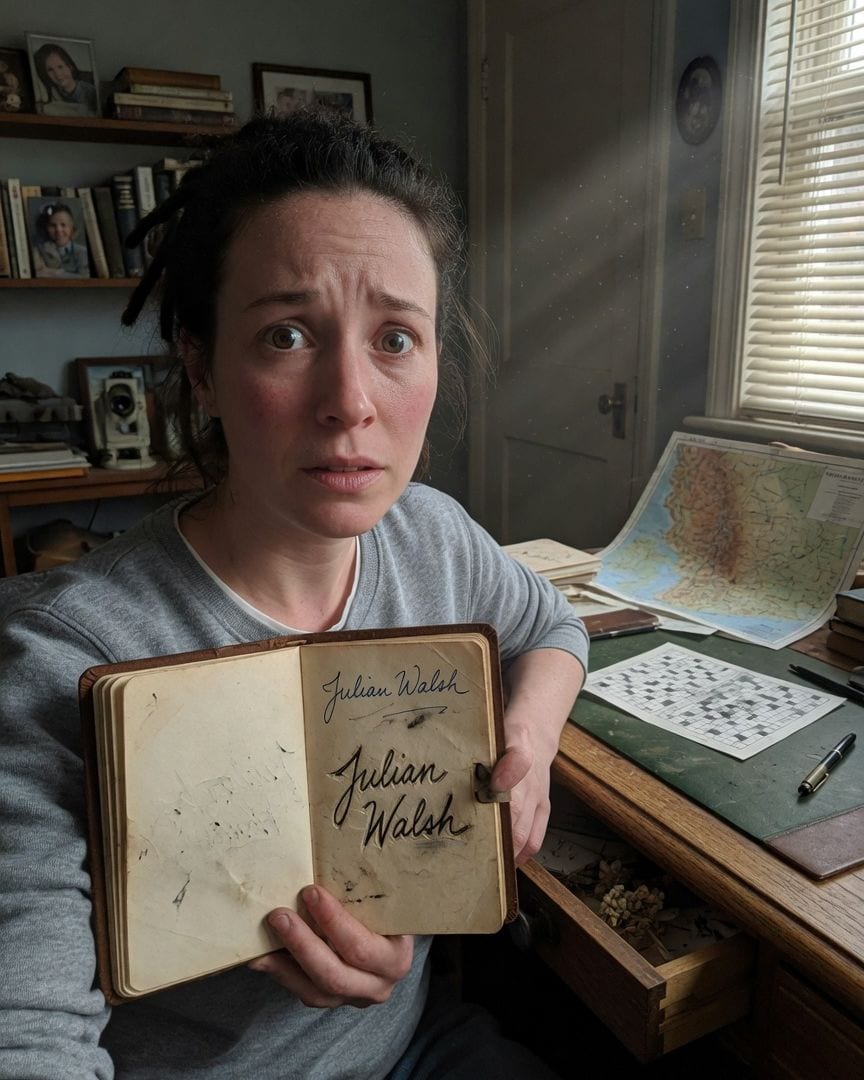
My father signs his name left-handed now. He was right-handed for sixty years. When I asked, he just wrote it again and asked what I meant.
My father, Julian Walsh, returned eighteen months after we buried an empty casket. It was a miracle, a genuine impossible relief, until he signed his insurance papers. For sixty years, my father was fiercely right-handed, but now he etched his name with a confident left-handed flourish, claiming he always had.
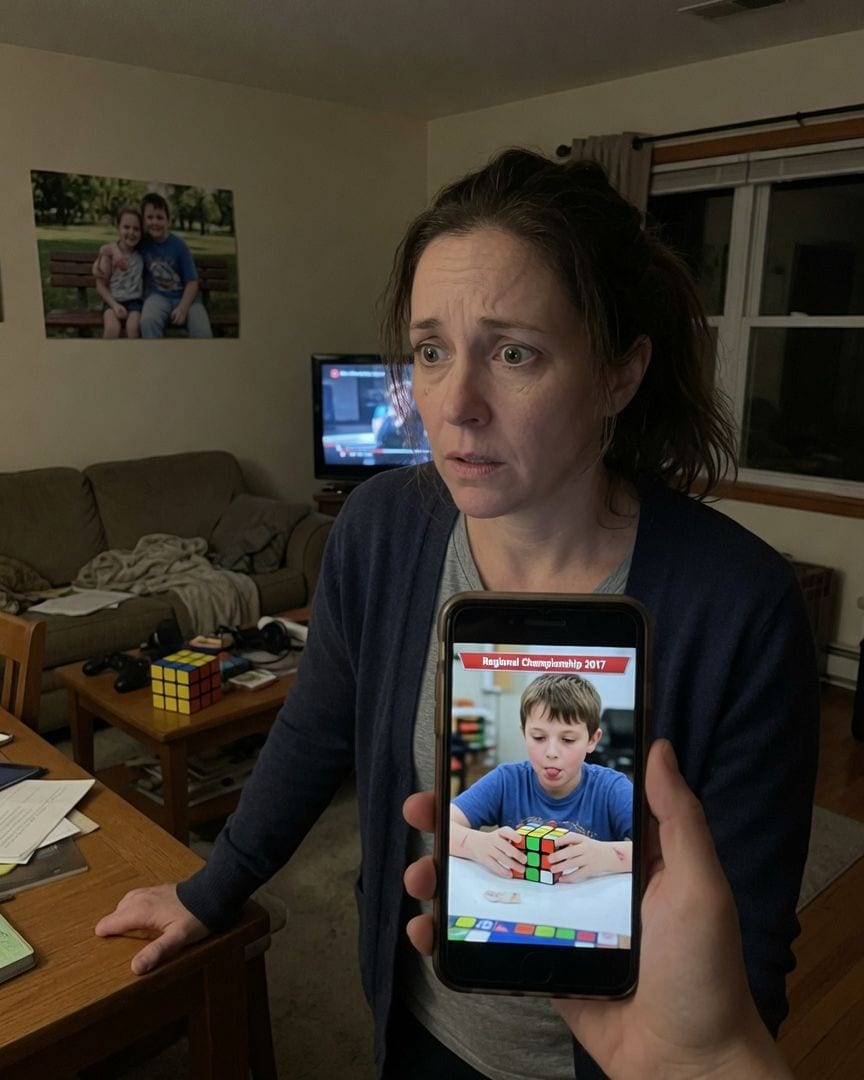
My son solves his puzzle cube yellow-first now. He says he's never used the old sequence, but his winning videos online prove he did.
I asked my fourteen-year-old son, Benjamin, about a shared childhood memory, trying to prompt a familiar connection. He recounted the details perfectly, even adding a wistful observation I'd forgotten. But then he described a conversation with his father, a man who had died before Benjamin was even born.
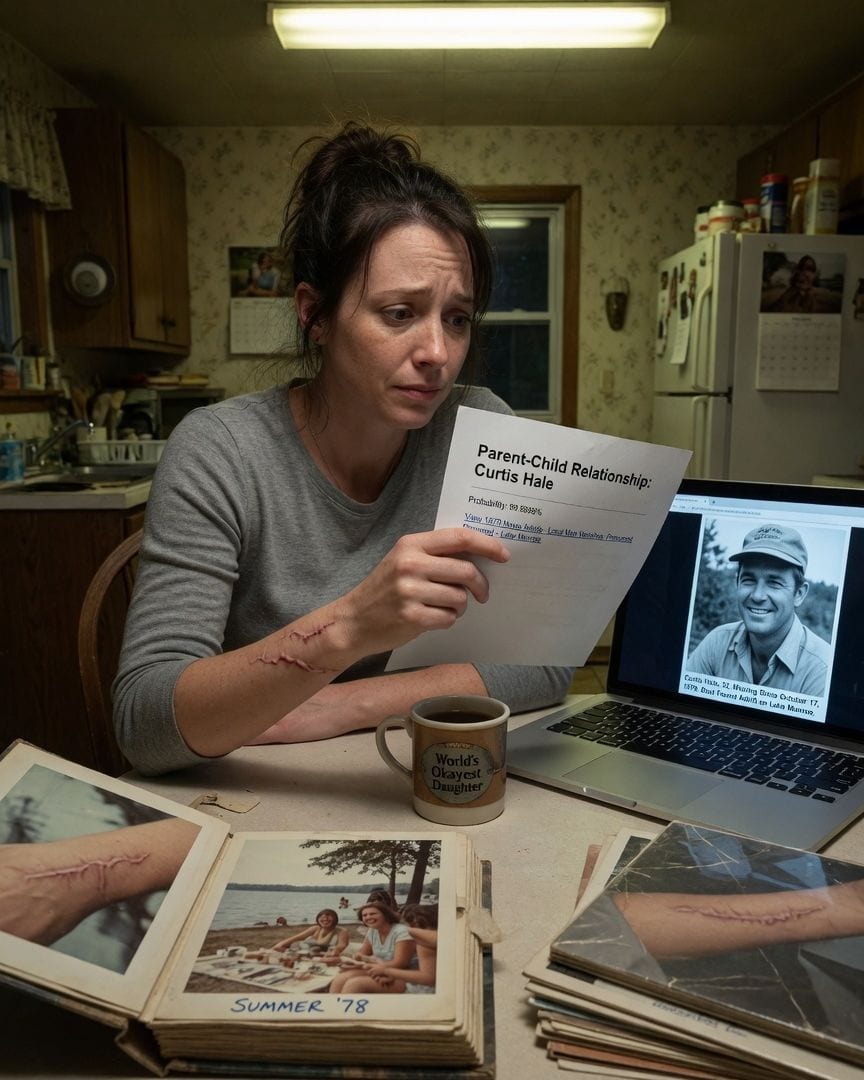
My DNA returned Curtis Hale as my father. He vanished in 1979. I was born twelve years later. The lab confirmed the match twice.
My DNA test results revealed something impossible: my biological father vanished in 1979, twelve years before my birth. My mother dismissed it as nonsense, but her reaction felt forced, leading me to old family photos. There, in a faded 1978 snapshot, I found my own distinctive childhood scar on the wrist of a stranger.
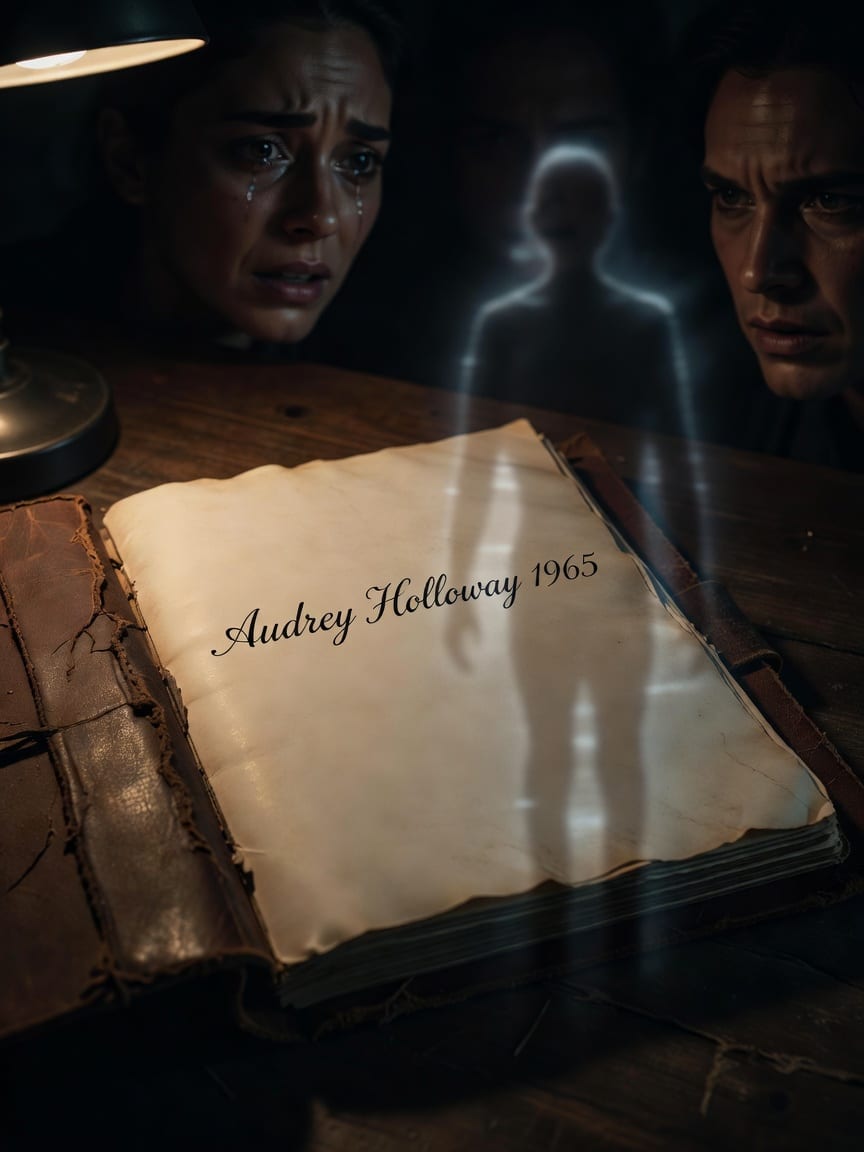
My own baby clothes arrived. Each tiny collar bore my name, embroidered in new thread. My mother swore she gave them away decades ago. The delivery note read: 'you'll need these again.'
A plain parcel arrived on my doorstep, containing my own baby clothes, freshly laundered and smelling faintly of lavender. My mother insisted she gave every piece away decades ago. But on the collar of a small white dress, my full name was newly stitched in an elegant script.
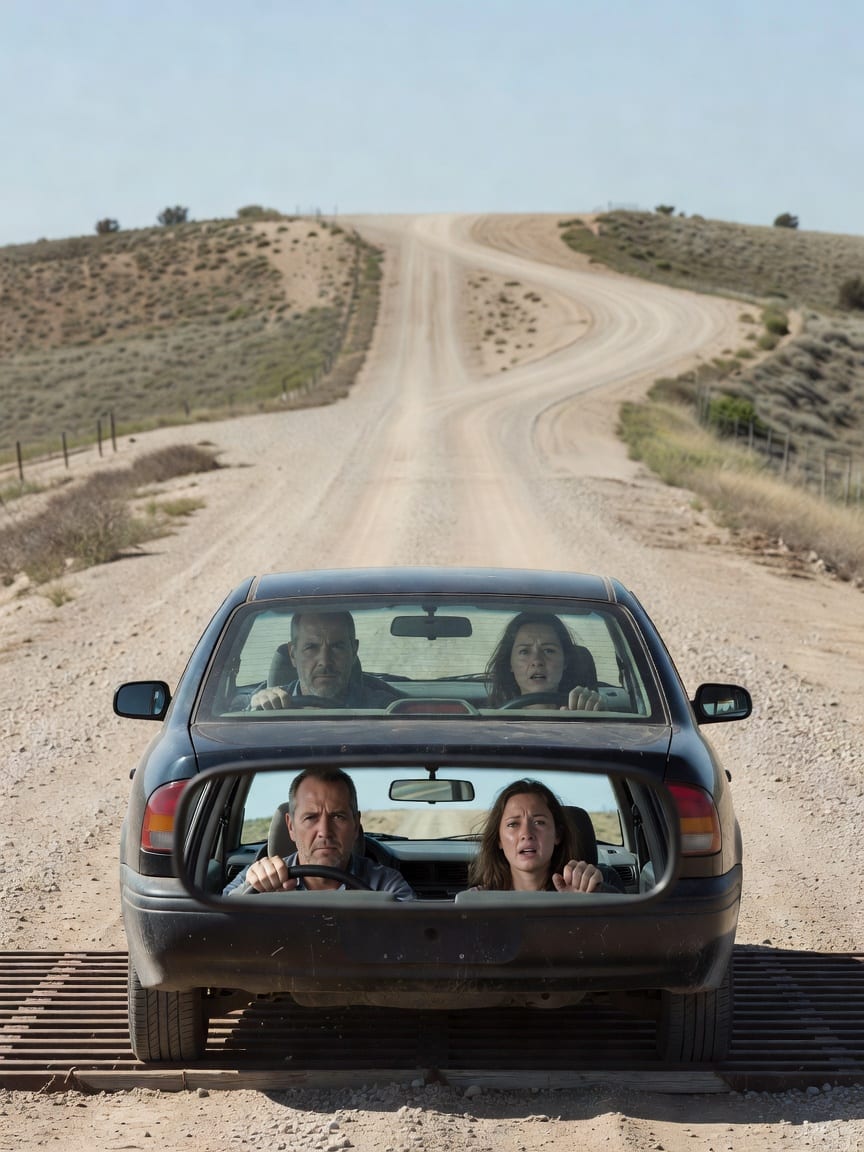
My father's ashes never made it to the hilltop. That single track kept feeding my car back to the cattle grid, the same sheep scattering, the same gate swinging.
I'm trying to scatter my dad's ashes at the highest point, but the track to Ashford Hill keeps looping, pushing my car back down. After my fifth attempt, I walked it myself, only to find the same pale grey gravel and cattle grid appearing inexplicably behind me again. Then, half-buried in the verge, I found a brass marker with strange symbols, dated 1897, that I'm certain wasn't there before.
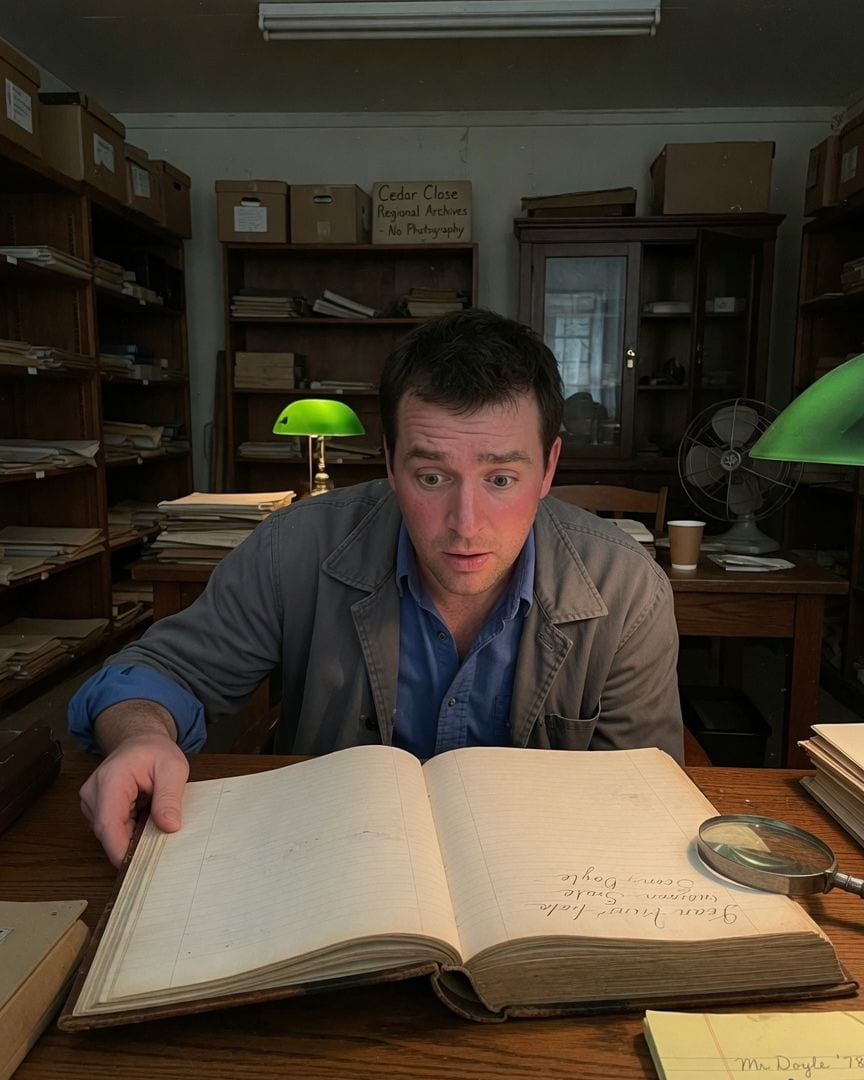
A boy of about seven cycled up to me at the playground and said, 'Sorry about your car, Mr. Doyle.' My car sat untouched — and I've never told any child my name.
I was enjoying a quiet afternoon with my daughter at the Cedar Close playground when a small boy pedaled up to me. With unsettling blue eyes, he said, 'Sorry about your car, Mr. Doyle,' before turning and leaving. I had never seen him, and my car was perfectly fine.