A Cold War Staff Sergeant watched his cargo stay perfectly level as his ship bucked a storm. Fifty-six years later, a log confirmed its impossible physics.
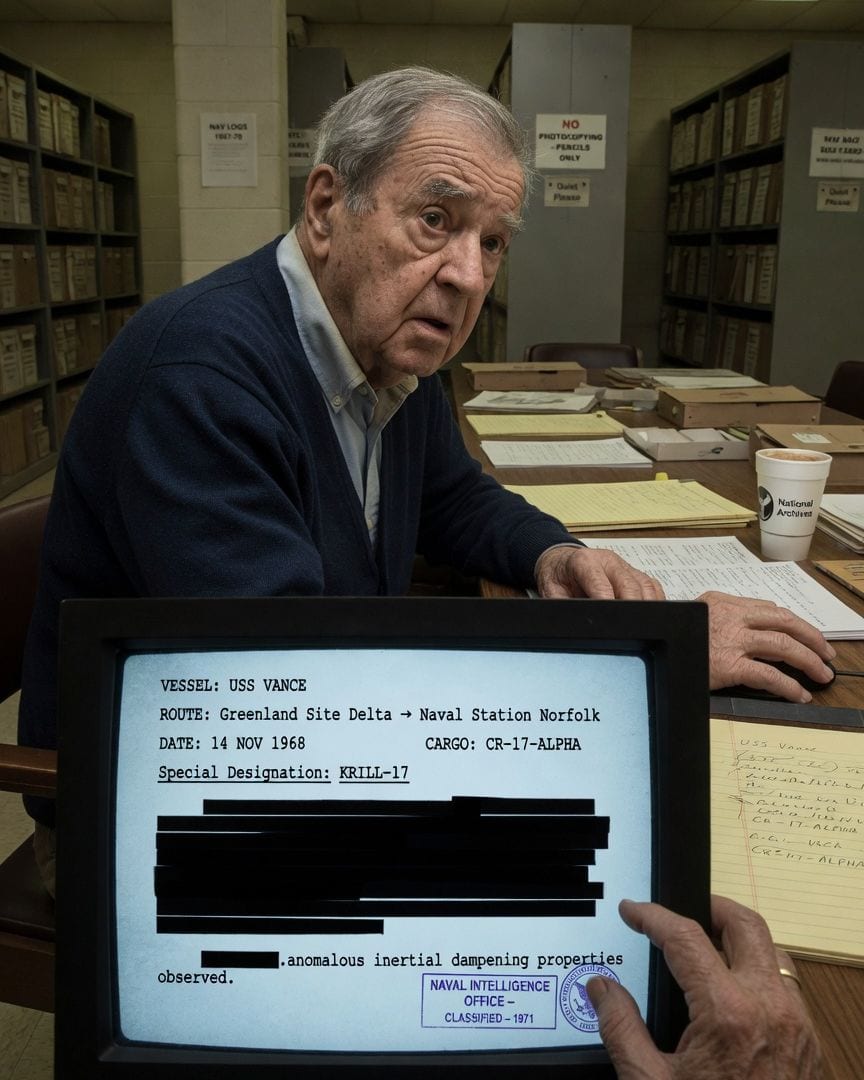
Staff Sergeant Ivo Krall, 22, gripped the frigid rail of the USS Vance. He was six feet from the sealed container, his last assignment before separation, and the North Atlantic was trying to swallow them whole.
It was 1968, a Cold War transport from a clandestine Greenland site to Naval Station Norfolk, and his only instruction for the dark, unlabeled crate was that it was not to be turned.
Not tilted, not rolled, not set down on any face but its bottom. For eleven days, four Navy men, including Krall, had no other assignment but to watch it not turn.
Off Newfoundland, the storm hit with a fury that bucked the 10,000-ton vessel like a toy. The Vance rolled hard, thirty degrees to port, then thirty to starboard, groaning as the deck canted precariously under Krall’s boots.
Waves crashed over the bow, soaking him to the bone, the wind screaming past his ears. But the container, lashed down with chains thick as his arm, did not. It stayed level.
The deck swung wildly beneath it, the horizon tilting and snapping back into view, but the featureless box remained perfectly oriented, a fixed point in a world gone mad.
Krall watched, his breath stolen by the wind and the impossible sight, as the ship shuddered around a thing that simply refused to participate in gravity.
He felt a cold dread settle deep in his gut, a wrongness that defied all explanation.
He would sign the unidentified craft over in Norfolk, collect his discharge papers, and never tell his wife why he stopped going out on boats.
Fifty-six years later, Ivo Krall, now 78, sat in the hushed reading room of the National Archives in College Park, Maryland.
The smell of old paper and dust was a comfort, a mundane anchor against the quiet, persistent unease that had shadowed his life since 1968.
He was officially researching naval logistics in the North Atlantic during the late 60s, a cover for his real quest: to find some record, any record, that might explain the impossible container.
He’d tried for decades, quietly, always hitting dead ends. The official records of the USS Vance’s manifests for that period were sparse, heavily redacted, or simply missing the specific cargo entry he remembered.
He’d almost given up, convinced it was a trick of memory, an isolated hallucination born of a violent storm and exhaustion.
But the aversion to boats, the way his stomach clenched even at the sight of a fishing trawler, was too real to ignore.
Today, however, something shifted. A newly declassified batch of Naval Intelligence transport logs, released under a recent FOIA request he’d made years ago, had just been digitized.
He scrolled through entries from '68, '69, his eyes blurring with dates and serial numbers. Then, a line jumped out. A transport from 'Greenland Site Delta' to 'Naval Station Norfolk.' The date matched his final mission. The vessel: USS Vance.
And under 'Cargo Description,' a serial number he faintly recognized from a fleeting glance at a stenciled plate: 'CR-17-ALPHA.' Beneath that, a brief, tantalizing phrase: 'Special Designation: KRILL-17.'
Krall leaned closer, his heart thudding a rhythm he hadn't felt in years. This was it. This was the container. But the 'Special Designation' was new, unsettling, and hinted at something far beyond standard military freight.
His rational mind tried to dismiss it as a code, a bureaucratic quirk, but the dread in his stomach argued otherwise.
He scrolled down further, hoping for more context, but the next line was heavily blacked out, a thick, impenetrable rectangle of censorship.
Krall stared at the declassified log entry, his thumb tracing the words 'Special Designation: KRILL-17.' The thick black redaction beneath it seemed to pulse, hiding a truth he desperately needed.
His gaze flickered to the bottom of the page, where a small, almost imperceptible line of text had escaped the censor's pen, perhaps a clerical oversight. It read: '…anomalous inertial dampening properties observed.'
Next to it, an official stamp: 'NAVAL INTELLIGENCE OFFICE – CLASSIFIED – 1971.' Three years after his incident, after his discharge, after he'd tried to forget, an official office had stamped a record confirming his impossible memory.
They hadn't just transported a container; they had observed its defiance of physics, understood it, and filed it away. The realization hit him with the force of a physical blow. He wasn't crazy. The container was real.
And the institution knew. He leaned back in his chair, the sterile silence of the archive suddenly oppressive, the weight of decades of buried knowledge pressing down on him. The file was a doorway, and he had just opened it.
The next morning, Krall returned to the archives, his research now laser-focused. He requested every document, every log, every report remotely connected to 'Greenland Site Delta' or 'KRILL-17.'
The archivist, Patricia Easton, a meticulous woman in her fifties with close-cropped graying hair and spectacles perched on her nose, regarded him with a polite but firm skepticism.
"Mr. Krall, I'm afraid most of those records are still highly classified, or simply don't exist under those exact designations." Krall, however, had learned a thing or two about government bureaucracy.
"I understand," he said, his voice calm, "but sometimes a related project, an ancillary report, or even an out-of-place accession number can lead to something.
I'm particularly interested in any materials from the 'Special Projects' division that might have been misfiled, or perhaps cross-referenced under a different code." Patricia, a stickler for process, sighed but agreed to check.
Hours later, she presented him with a dusty, unlabeled film can. "This was found in a box of old Antarctic survey footage," she explained, frowning.
"The label reads 'Operation Deep Freeze - 1962,' but the can itself has a handwritten sticker on the side: 'KRILL-17: Greenland Site - Transport Prep.' No accession number, no official date. It's not on any list." Krall's heart leaped.
The Box That Is Not on Any List. He took the can, his fingers brushing against the rough, handwritten label. "May I view this?" Patricia nodded, leading him to a small viewing room.
As the projector whirred to life, the grainy black and white footage flickered onto the screen. It showed engineers in arctic gear, not in Antarctica, but on a windswept, desolate landscape that could only be Greenland.
They were meticulously preparing the very container Krall had guarded, securing it onto a transport sled. The footage was silent, methodical, and chillingly familiar.
Then, a brief, unsettling shot: a technician in a hazmat suit carefully applying a stencil to the side of the container. The stenciled letters were unmistakable: 'CR-17-ALPHA.'
The footage then cut abruptly to static, leaving Krall with a chilling confirmation: this was the container, and its strange designation was not just a bureaucratic label, but a core part of its identity, its secret, from the very beginning.
The footage didn't explain what was inside, but it proved the meticulous, almost reverent care taken with it, hinting at something far more significant than a mere cargo item.
Over the next few days, Krall felt a subtle shift in the air around him.
He’d requested to view the 'KRILL-17' film can again, but Patricia Easton had informed him, with a slight tremor in her voice, that it had been 're-cataloged and moved to a secure off-site facility.'
Her eyes, usually direct, darted away from his. Later that afternoon, as Krall returned to his reading desk, he noticed a faint, almost imperceptible scratch on the surface of his laptop, right next to the webcam.
He was certain it hadn't been there before. He dismissed it as paranoia, the natural byproduct of chasing ghosts. But the feeling of being watched persisted. He started taking longer routes to his motel, checking his rearview mirror more frequently.
One evening, his phone, usually silent, received a text message from an unknown number: "Some files are best left buried, Mr. Krall. For your own good." No sender, no other text. Just that one, chilling line.
Krall’s hand trembled as he read it. Someone knew. Someone was watching. He deleted the message, but the words were burned into his mind. The next morning, he decided to try a different approach.
He remembered one of the other Navy men assigned to the container detail, a young petty officer named Gerald Kowalski. He’d found an old address in a declassified service record.
It was a long shot, but Krall felt an urgency he hadn’t known in decades. He drove to a quiet, tree-lined street in Maryland, finding Kowalski's modest home.
The man who answered the door was frail, his face etched with years, but his eyes held a flicker of recognition when Krall introduced himself. "Ivo Krall? My God, I haven't heard that name in ages.
You were on the Vance, with that… that thing." Kowalski's voice dropped to a whisper, glancing nervously around his own living room as if expecting unseen ears.
The casual mention of "that thing" sent a fresh wave of dread through Krall.
He wasn't alone in his memory, and Kowalski's palpable fear was a chilling confirmation that the impossible container had left its mark on more than just him.
Krall sat across from Gerald Kowalski in his dimly lit living room, the blinds drawn against the afternoon sun. Kowalski, now 76, poured them both lukewarm instant coffee, his hands shaking slightly.
"I never thought I'd talk about it again," he confessed, his voice raspy. "After we signed it over in Norfolk, we were all debriefed. Told to forget it. Classified beyond Top Secret. Said it was a 'new propulsion system prototype.'"
Krall nodded, pressing gently. "Did you believe it?" Kowalski scoffed, a dry, humorless sound. "A propulsion system that doesn't move? That defies a thirty-degree roll? No, we knew. We just didn't know what. But the way those guys handled it...
the hazmat suits on the Greenland dock, the way they never touched it directly, always with those special clamps. And the instruction: 'not to be turned.' It wasn't about stability, Krall. It was about orientation." Krall felt a chill. "Orientation?
What do you mean?" Kowalski took a long sip of coffee. "There was a rumor. From the shore crew in Greenland, before we loaded it.
They said the container had to be kept upright, on its designated 'bottom,' because if it was ever inverted, or even tilted past a certain point, it… it would activate. Or wake up." He shivered.
"One of the engineers, a civilian, he got pulled off the project after he supposedly 'accidentally' jostled it too hard. Said he saw something shift inside, a momentary ripple against the metal. He was gone the next day."
Krall remembered the impossible stillness, the deck moving beneath a fixed point. It wasn't inertia. It was deliberate. "They were containing something," Krall whispered, the pieces clicking into place. "The whole transport was a containment operation."
Kowalski nodded, his eyes wide. "And the Greenland site? It wasn't just a base. It was where they found it. Dug it out of the ice, so the story went. Something ancient, something not from here.
And they were just moving it to a more secure facility, deep underground somewhere in the desert. That's what the officers muttered, anyway."
The scope of it, the decades of secrecy, the active containment of something alien – it was overwhelming. The simple, physical wrongness Krall had witnessed on the ship was just the visible tip of an unimaginable iceberg.
The incident wasn't an anomaly; it was a carefully managed, terrifying routine.
Armed with Kowalski's fragmented testimony, Krall returned to the archives, determined to find more.
He knew the 'Greenland Site Delta' records and 'KRILL-17' files would be locked down, but he now had a new search term: 'Project KRILL-OVERWATCH,' a name Kowalski had vaguely recalled from a whispered conversation.
Patricia Easton, looking even more strained than before, initially denied its existence. But Krall, remembering the text message, pressed her, mentioning the 'misfiled' film can. Her resolve cracked.
"There's a… a restricted access terminal in the sub-basement," she admitted, her voice barely audible. "It's for files that are technically 'declassified' but require a specific clearance code, even for viewing. It's not on the public network."
She gave him a slip of paper with a six-digit code. "I shouldn't be doing this, Mr. Krall." Down in the damp, echoing sub-basement, Krall found the terminal. He entered the code, and a stark, text-only interface appeared.
He typed in 'KRILL-OVERWATCH.' The screen populated with directory after directory. He navigated through them, his heart pounding, until he found a folder titled 'Primary Exposure Subjects, Greenland-Norfolk Transport.' He clicked it open.
A list of names appeared, service numbers, ranks, and dates. He scrolled, his eyes scanning, searching for Kowalski, for Carver, for anyone else he knew. Then, his breath caught in his throat.
His own service number, his name: "KRALL, Ivo, SSgt." Below that, a series of entries, not from 1968 or 1970, but from across the decades, right up to the present.
The latest entry, dated last month: "Assessment: Subject KRALL, I. No change in psych profile. Continued aversion to maritime activity noted. Status: Active." Krall stared at the screen, the fluorescent hum of the sub-basement suddenly deafening. They had known.
They had been watching him. For fifty-six years. His separation wasn't freedom; it was merely a reassignment to a different kind of file, a living record that was still being signed.
The screen's stark text burned into Krall's mind. 'Status: Active.' The implications were staggering. His entire life since 1968, every decision, every quiet avoidance of the sea, had been part of an ongoing assessment.
He scrolled further, finding entries for Kowalski, Carver, and the other two men from the transport, all with similar 'active' statuses and recent assessment dates.
This wasn't just a record of the past; it was a live, breathing system of surveillance. The secrecy machine wasn't merely archiving; it was actively managing the fallout of its encounters.
'KRILL-17' wasn't just a designation for a container; it was the name of the entity, or the project surrounding it.
The 'anomalous inertial dampening' wasn't just a property; it was a characteristic of something that could bend reality to its will, or rather, to its own internal state, maintaining its orientation regardless of external forces.
The instruction 'not to be turned' was a critical containment protocol, not a shipping requirement. If the entity was inverted, it might 'activate' or 'wake up,' as Kowalski had heard, implying a dormant state that needed careful maintenance.
The Greenland site was indeed where it was found, an ancient, alien presence unearthed from the ice, now moved to a deeper, more secure facility.
Krall realized with chilling clarity that his 'last job' was not an end but an initiation, an unwitting exposure that had made him a lifelong subject.
The institution, nameless and faceless, continued its work, filing away not just incidents, but the lives of those touched by them.
The true horror wasn't what they'd transported, but what it had done to him, and how patiently, silently, the system had kept watch, ready to react if his 'psych profile' ever shifted in an undesirable direction.
The file was not closed; it was still being written, with his life as its ongoing subject.
Krall knew he couldn't simply walk away. He had to have proof. He fumbled for the small, obsolete USB drive he always carried, inserting it into the terminal.
He began to copy the 'KRILL-OVERWATCH' directory, the 'Primary Exposure Subjects' list, and the damning entries detailing his own surveillance. The transfer was slow, agonizingly so. He heard footsteps echoing from the main floor, approaching the sub-basement stairs.
Panic flared, cold and sharp. He yanked the drive out, only partially copied, and shoved it into his pocket. As he turned, a figure emerged from the shadows at the bottom of the stairs.
It was Patricia Easton, her face pale, her eyes wide with a mixture of fear and grim determination. Behind her, two burly men in dark suits, their expressions unreadable, started down the steps.
"Mr. Krall," Patricia said, her voice trembling, "you shouldn't have come back. They knew you would." Krall didn't wait. He bolted, not towards the stairs, but deeper into the labyrinthine sub-basement, past rows of forgotten boxes and shelves.
He heard the men's heavy footsteps behind him, growing closer. He knew this archive better than they did now.
He dodged behind a stack of century-old tax records, then through a narrow gap between shelves, his aged body surprisingly agile under the surge of adrenaline. He could hear their voices, low and urgent, calling his name.
He burst through a fire exit, the alarm blaring briefly before someone silenced it. He was outside, in the warm Maryland afternoon, blinking in the sunlight. He didn't look back.
He ran until his lungs burned, until his legs ached, until he was sure he had put enough distance between himself and the silent watchers. He had escaped. He had the partial drive, the proof. But the cost was immense.
He was now a fugitive, marked, his quiet life irrevocably shattered. The knowledge he carried was a poison, confirming decades of surveillance, confirming an alien presence, confirming that the world was not what it seemed.
He had the truth, but it was a truth no one would ever believe, a truth that had made him a target, forever isolating him in its terrifying coherence.
Krall vanished. He sold his house, emptied his bank accounts, and moved to a small, isolated cabin deep in the Appalachian Mountains, far from any major city or body of water.
He changed his name, paid in cash, and kept to himself. The USB drive, with its partial, fragmented data, was his constant companion, hidden in a waterproof pouch around his neck.
He knew it was useless, a jumble of codes and dates that would mean nothing to anyone else, easily dismissed as the ramblings of an old man. But to him, it was solid, undeniable proof. The world continued, oblivious.
The archive in College Park processed new declassification requests, the old building humming with its quiet secrets. Patricia Easton was reassigned to a remote facility in Alaska, a quiet exile.
Gerald Kowalski, without Krall's persistent inquiries, slowly faded further into his fearful silence, his memory of the "thing" now a solitary burden. Krall, alone in his cabin, lived with the knowledge.
He watched the seasons change, the mountains offering a cold, indifferent sanctuary.
He was out, he was safe, but he was also fundamentally alone, carrying a truth too heavy and too impossible to share, a truth that had taken his peace and given him only dread in return.
His life was no longer his own; it was a chapter in a file that, somewhere, was still open.
He never looked at the ocean again. He never saw the faces of his grandchildren, fearing that his presence, his knowledge, might draw the attention of those who still monitored him.
He became a ghost, living on the margins, his only companion the silent, impossible truth he carried.
The silence of the mountains was a constant reminder of the ocean's terrifying, impossible stillness, a memory that still caused his stomach to clench. His proof remained unshared, unheard, just as he knew it would.
The world kept its secrets, and some secrets kept their men. He often wondered if the container, the KRILL-17, was still somewhere, deep underground, actively maintaining its impossible orientation, waiting for its next transport. Or perhaps, for its next activation.
His file, he knew, remained open, with 'Status: Active' appended to his name. He was free, but not forgotten. He would never truly be separated. His last job had never ended.
Years later, a local forest ranger, performing a routine check, found the remote cabin empty. On the rough-hewn table, a single, worn, waterproof pouch lay open, revealing a small, unlabeled USB drive.
The ranger, curious, picked it up, then shrugged, leaving it where it was. The wind sighed through the pines, carrying no answers. His file, somewhere, remained active.
If this one got to you
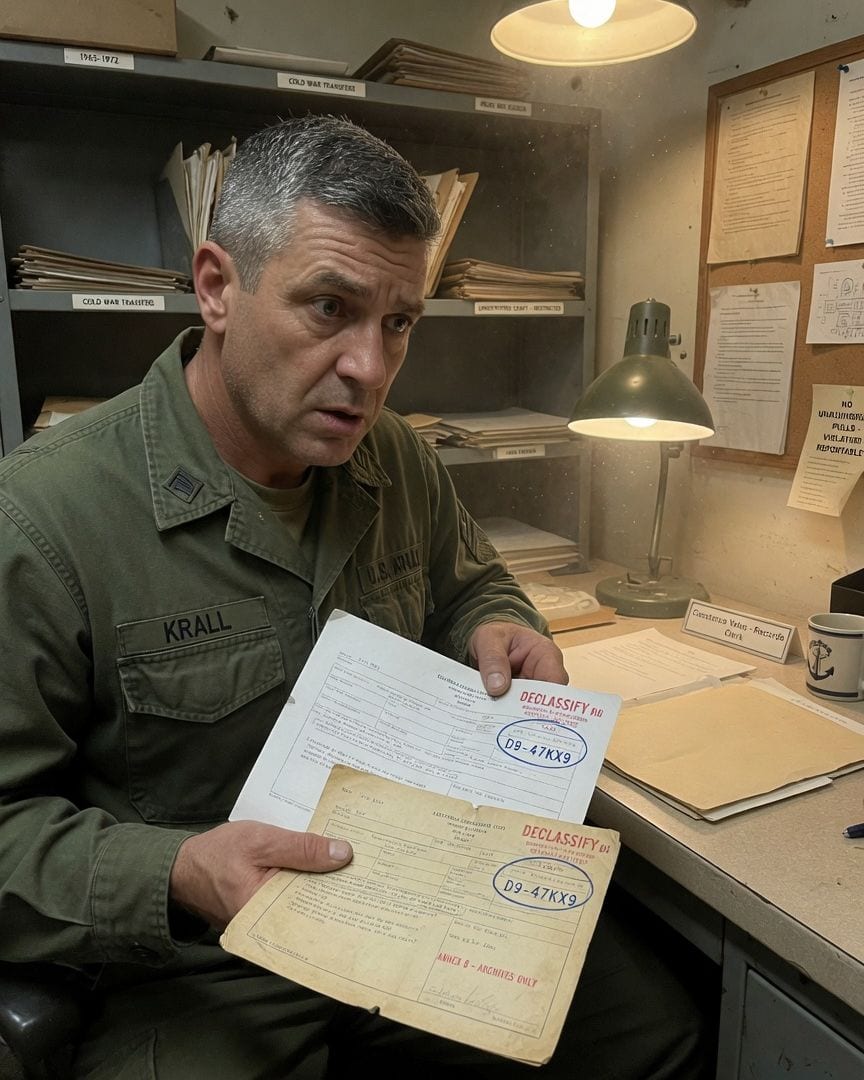
A Staff Sergeant's final mission saw a sealed container defy the ocean's roll. Later, he found its Cold War transfer log was an exact duplicate from 1967.
Staff Sergeant Ivo Krall endured his last assignment before separation, eager for a quiet life in a week. The North Atlantic pitched violently, but a sealed container he was escorting refused to move; as the ship rolled thirty degrees, the dull gray box remained unnaturally plumb, defying physics itself. Krall couldn't shake the impossible sight, and back at base, he found its control number returned "UNASSIGNED" and was stamped "DECLASSIFY NEVER." The true chill came when he discovered an identical transfer log from 1967, detailing the same impossible cargo with the exact same control number. Could the same impossible object truly appear decades apart?
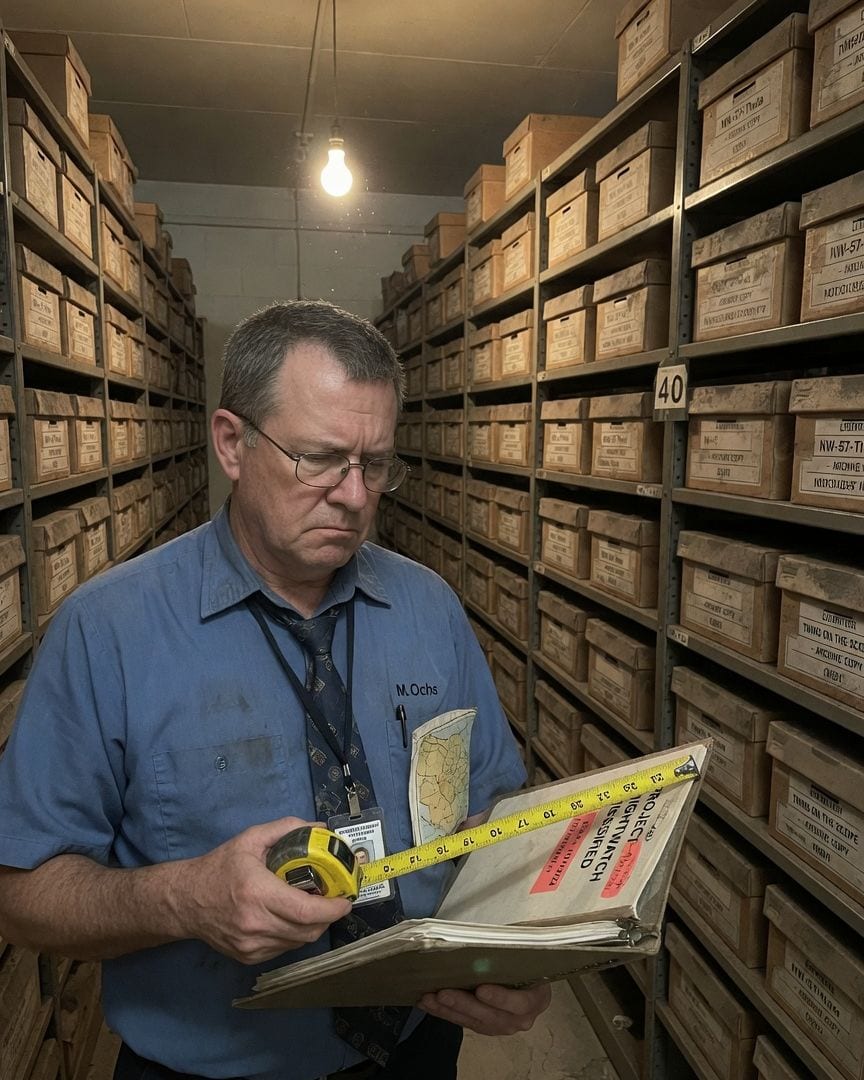
A Cold War records clerk on his final patrol found Aisle 40 stretched 61 feet longer, lined with unknown boxes. Inside one: 'PROJECT NIGHTWATCH - CLASSIFIED' with a fresh timestamp.
Marlin Ochs, a creature of habit after nineteen years at the St. Louis federal records depot, faced his final patrol through Aisle 40 before its scheduled pulping. His routine walk, usually 92 precise strides, suddenly stretched to an impossible 119, making the aisle 61 feet longer than its blueprint. The extra section felt colder, lined with dust-laden boxes bearing alien classification codes and no manifest. Inside one, he found a metal-bound file: 'PROJECT NIGHTWATCH - CLASSIFIED,' dated 1957, but with a timestamp just hours old.
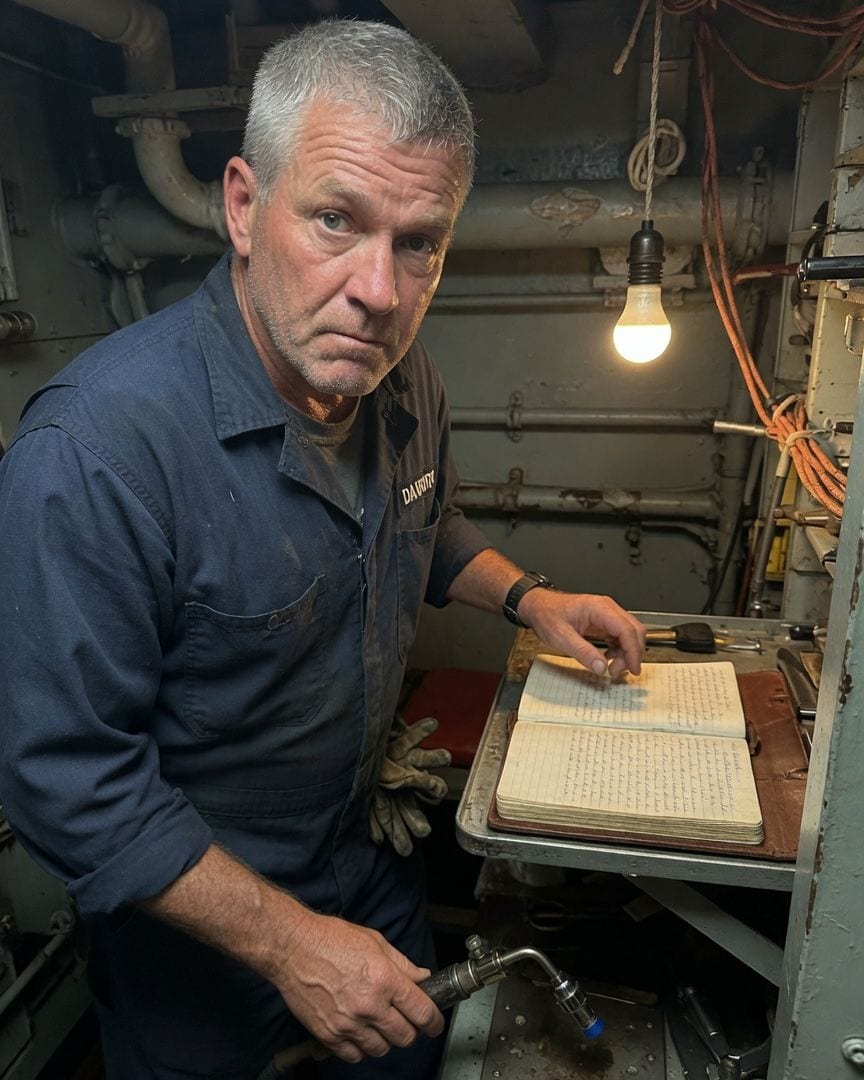
A week from shore duty, Chief Danforth cut a hatch where his ship's plans showed solid steel. An hour later, the wall was seamless, but the Cold War logbook from inside appeared under his mattress.
Chief Petty Officer Raymond Danforth, just a week from ending three decades of service, was intimately familiar with every pipe and plate of the guided-missile destroyer Weatherall. During a mid-cruise overhaul, his gloved hand found a sealed hatch where schematics promised only a solid bulkhead. He cut through the impossible seam to reveal a small, dry compartment, softly lit, containing a logbook filled with an unsettlingly familiar hand. When he returned an hour later with a witness, the hatch was gone, the wall seamless. Later that night, the same logbook appeared beneath his mattress, its pages revealing an entry: 'Petty Officer Howard Montgomery, missing, 1972.' How could a compartment vanish, yet leave its secrets behind?
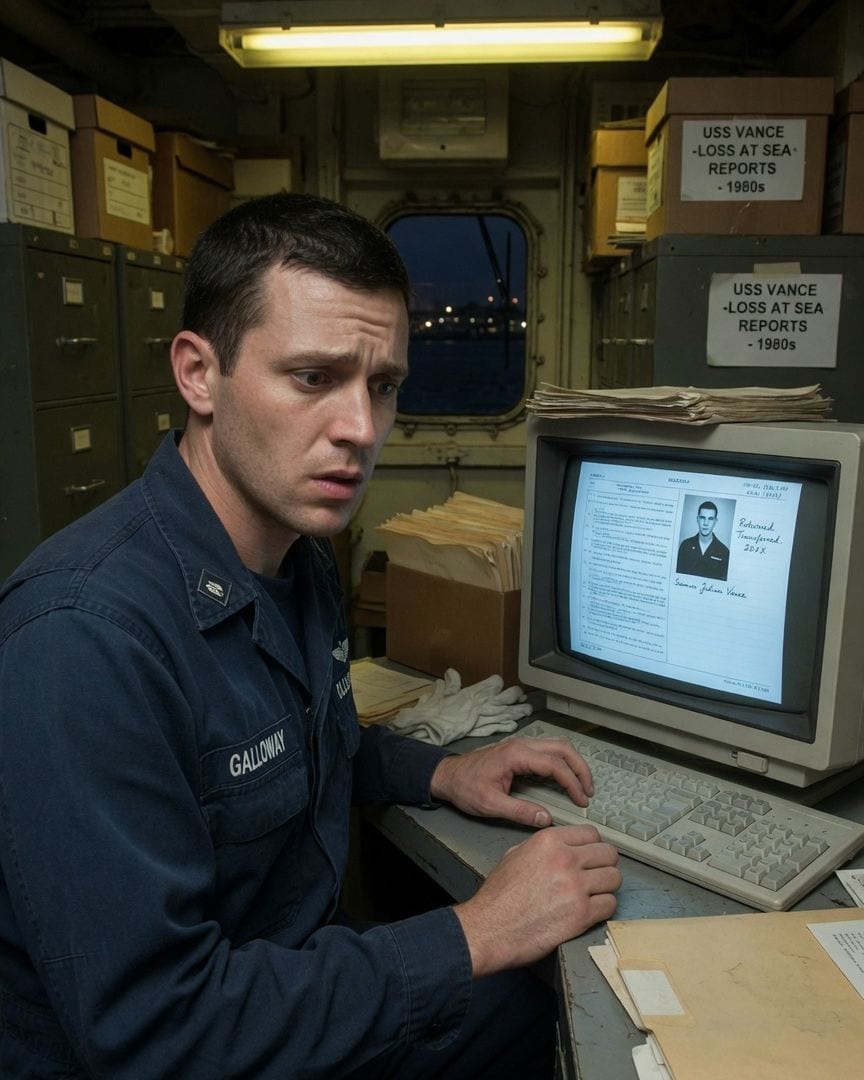
Petty Officer Galloway logged a sailor onto his ship. The man died at sea 40 years ago.
Petty Officer Joel Galloway scanned a sailor's ID on the USS Vance quarterdeck. The man's name, 'Seaman Julian Vance,' and his out-of-date uniform pricked at Galloway's memory. Later, the ship's berthing count came back one over, with an extra entry in the system but no physical body.
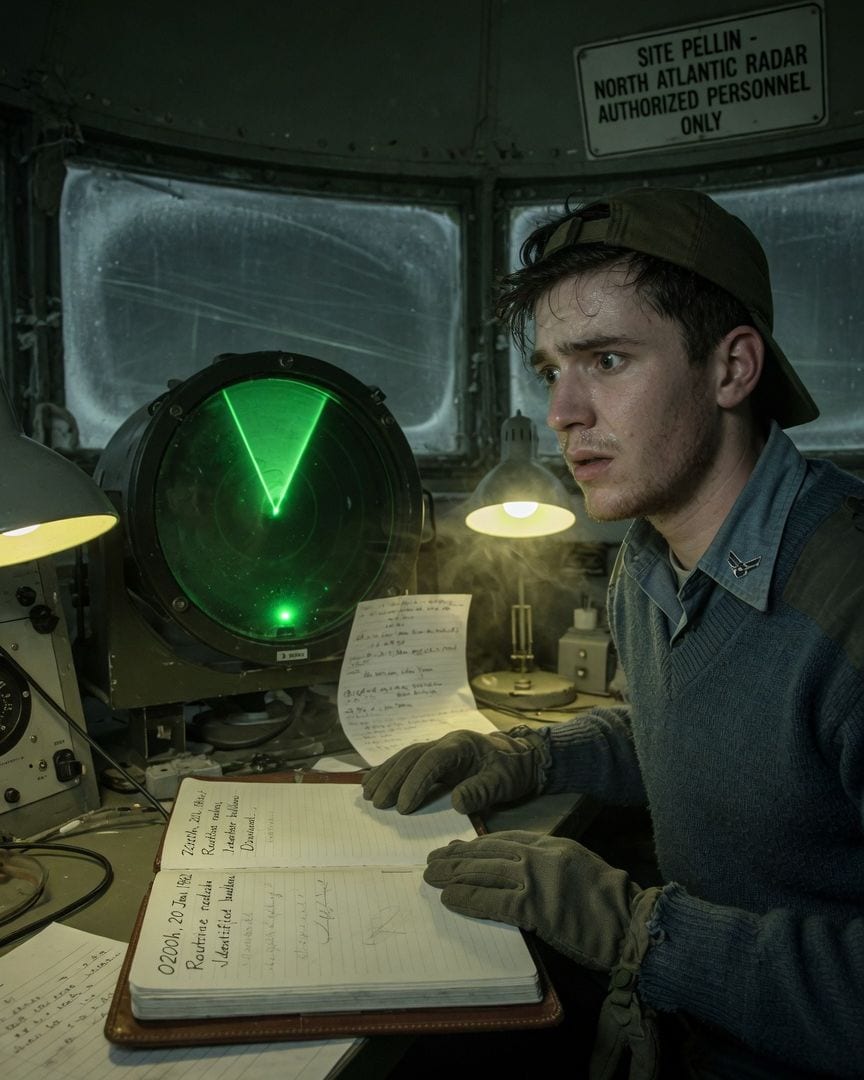
Nine days from closing, Cold War Site Pellin's Airman Vance watched his radar track a solid blip moving closer, dead in open sea where nothing could exist.
In the dimly lit dome of Site Pellin, Airman Ordway Vance, just days from discharge, ran his final radar sweeps before the base closed for good. Outside, the North Atlantic wind howled, but inside, only the hum of his console broke the silence. His last calibration had been clean, yet a single, unwavering green blip appeared on the scope, forty miles out, in open water where no vessel should be. The impossible return moved closer with each sweep, defying all logic and other sensors, until it sat static just beyond the coast fence line. What unseen presence did the radar truly hold in its unwavering green grip, contradicting the official record?
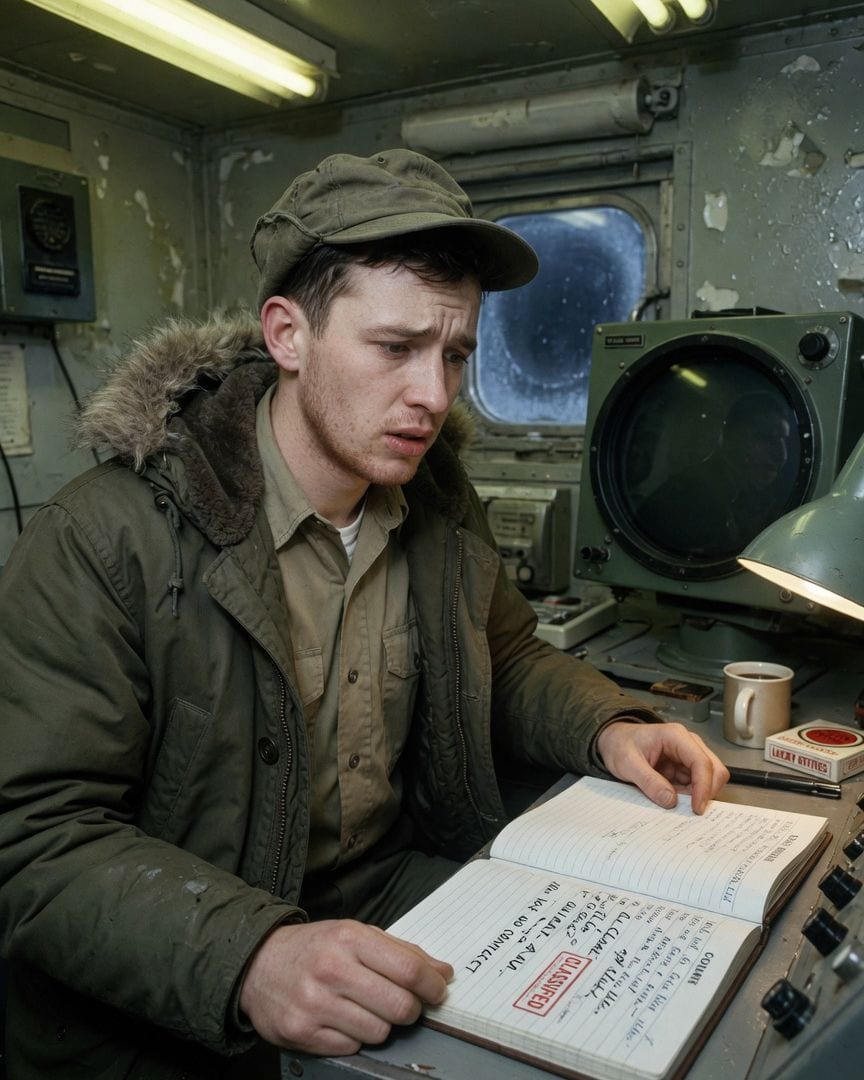
A Cold War airman logs an impossible radar contact on his last sweep. But his official logbook entry is stamped 'CLASSIFIED' and then contradicted by a hastily scrawled 'ALL CLEAR' dated moments before it.
Airman Ordway Vance, 22, manned the radar dome at Site Pellin in the biting North Atlantic dark of January 1962, running the last calibration sweep before its decommissioning. His scope picked up a faint, impossible return, growing closer with each pass, though the ocean remained empty to the eye. When Vance detailed the contact in his official logbook, a 'CLASSIFIED' stamp appeared, followed by a hastily scrawled 'ALL CLEAR' dated moments before his own entry, contradicting his every word. Commander Hartley dismissed it as equipment malfunction, but Vance sensed a chilling, official erasure behind the lie. He soon found a locked cabinet marked 'SITE PELLIN ANOMALIES,' hinting at a deeper truth buried within the base's final days.