A Staff Sergeant's final mission saw a sealed container defy the ocean's roll. Later, he found its Cold War transfer log was an exact duplicate from 1967.
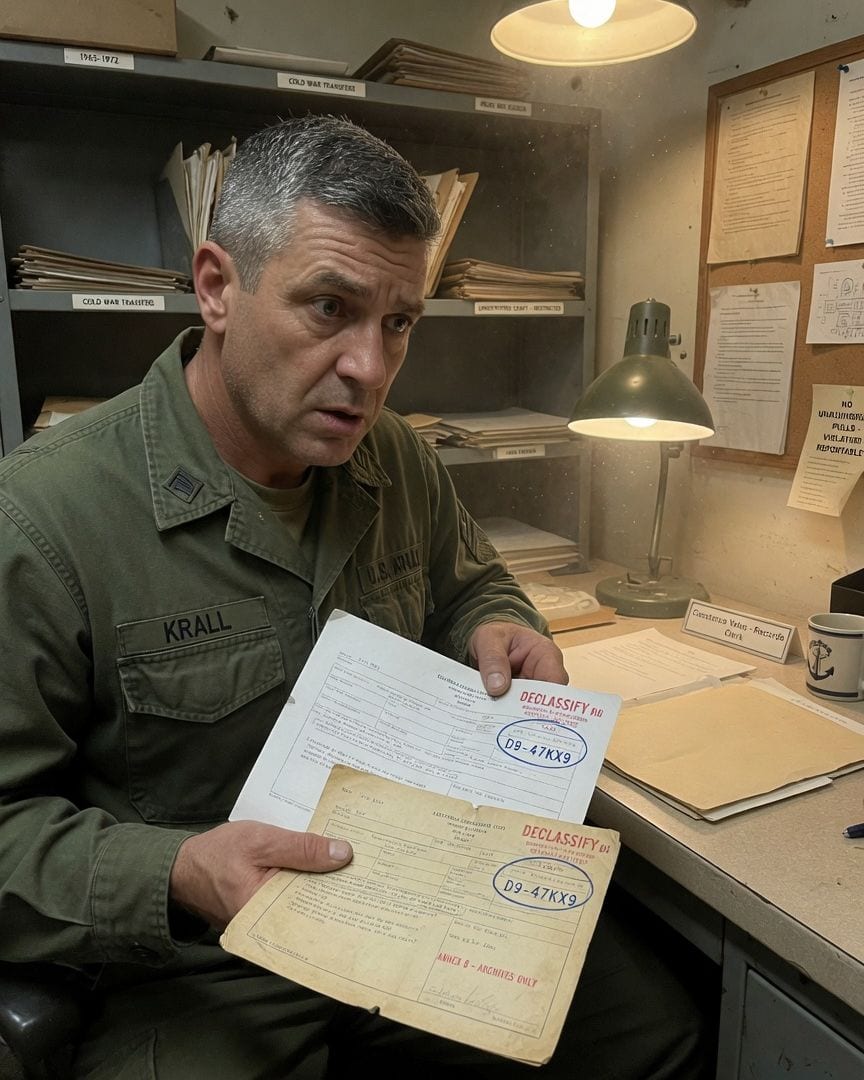
Staff Sergeant Ivo Krall, 38, gripped the freezing steel rail of the transport ship, the North Atlantic pitching violently around him.
This was his last assignment before separation, eleven days escorting a sealed container from a Greenland research site to Norfolk. His only instruction, repeated in every briefing: the container was not to be turned.
Not tilted, not rolled, not set on any face but its bottom. The ship lurched, rolling thirty degrees to port, sending a spray of icy water over the deck.
Krall braced, watching the four Navy men tethered to the container strain against the ropes. But the container itself didn’t move. It stayed perfectly level, the deck visibly sliding beneath it like a stage set.
The horizon tilted, the ship groaned, but the dull gray box, six feet from Krall, remained utterly, unnaturally plumb, as if gravity itself had redefined its center around that single object. Krall blinked, seawater stinging his eyes.
He squeezed the rail until his knuckles ached, trying to make sense of the sight. The deck shifted again, the ship heaving on a fresh wave, and the container remained a steadfast, unyielding anomaly against the chaos.
A shudder ran through him that had nothing to do with the cold.
Back in Norfolk, Krall signed off on the 'unidentified craft' transfer. He was due to separate in a week, eager for a quiet life with Pamela, his wife. But the image of the unmoving container gnawed at him.
He couldn't shake it. He requested a copy of the official transfer log, citing standard procedure for his final deployment. The log itself was boilerplate: origin, destination, cargo manifest — 'Unidentified Craft, Class Delta-9.'
What wasn't boilerplate was the control number, a seven-digit alphanumeric string that, when Krall ran it through the base's internal records system, returned 'ORIGINATING OFFICE: UNASSIGNED.' Below that, stamped in stark red ink, was 'DECLASSIFY NEVER.'
He tried a civilian contact, an old friend in federal records, but the number yielded nothing.
He even found the specific regulation for 'not to be turned' cargo, a rarely invoked protocol for hazardous materials, but it offered no explanation for how something could defy a thirty-degree roll.
His rational mind tried to dismiss it: a trick of the light, a faulty depth perception in the storm, an optical illusion caused by exhaustion. Maybe the ship hadn't rolled as far as he thought.
Maybe his sea legs were off. But the memory was too vivid, too concrete. He’d seen the deck move. He’d felt the ship roll. The container had not.
He went back to the base records office, a quiet annex tucked away behind the main admin building. Constance Yates, a meticulous clerk with glasses perched on her nose, was behind the counter.
He asked if there were any other records associated with that control number. She typed it in, frowned. 'Nothing in the primary system, Staff Sergeant. But… there’s an archaic cross-reference in the Annex B archives. Mostly old Cold War stuff.
Might take a while to pull.' A dust mote danced in a stray beam of sunlight, momentarily catching his eye. The air in the annex felt still, heavy with old paper.
Constance returned an hour later, a thick, dusty folder in her hands. 'Found something,' she said, handing him a single, brittle sheet of paper. It was a transfer log, identical in format to his own, but dated 1967.
'Unidentified Craft, Class Delta-9.' Origin: Greenland. Destination: Norfolk. Instructions: 'Cargo must not be turned. Not tilted, not rolled, not set on any face but its bottom.' And there, at the top, was the control number.
The exact same seven-digit alphanumeric string as his own. Krall stared at the two logs side-by-side: one from 2024, one from 1967. Both detailed the same impossible cargo, the same impossible instructions, and the same impossible control number.
The ink on the older log was faded, but the number was crisp, a perfect match, chilling him to the bone.
The identical logs shattered Krall’s attempts at a rational explanation. This wasn't a one-off anomaly; it was a recurring event. He thanked Constance, promising to return the older log. Back home, Pamela noticed his distraction. 'You alright, Ivo?
You’ve been quiet since you got back.' He mumbled something about separation paperwork, but he knew he couldn't tell her about the container. The words would sound unhinged, even to him.
He spent the next few days deep in the Annex B archives, with Constance's help. He learned that the 'UNASSIGNED' originating office was a dead end, a placeholder for records deemed too sensitive for standard departmental assignment.
The 'DECLASSIFY NEVER' stamp, Constance explained, often meant the information was still operationally relevant, not merely historically classified.
Krall started cross-referencing the control number with other 'Unidentified Craft' entries, finding a sparse, disjointed trail. Some entries were just a single page, others a few lines in a larger document about 'material recovery.'
He found no photos, no schematics, only vague descriptions of 'anomalous inertial properties' or 'gravitational field distortion.'
Each record was a dead end in itself, but together, they painted a picture of repeated attempts to move, contain, or analyze something beyond conventional understanding.
The oldest record he found was a brief mention in a 1958 Naval Intelligence report concerning 'unusual atmospheric phenomena' over the Greenland ice sheet, specifically 'localized gravitational anomalies' detected during a routine survey.
There were no logs of transfers from that far back, but the pattern was undeniable: Greenland, an impossible object, and a cryptic control number that seemed to follow it across decades.
He felt a growing unease, not just at the mystery, but at the sheer patience of the bureaucracy that had filed it all away, quietly, for so long.
The dusty silence of the archives seemed to mock his frantic search for answers. He noticed that some of the older files, particularly those with the 'DECLASSIFY NEVER' stamp, had strange, almost artistic blackouts.
Not just straight lines, but often curved, or even forming small, repeating shapes, like a stylized sigil. He dismissed it as sloppy redaction, but the consistency across different documents was peculiar.
The air in the room felt heavy, as if the weight of decades of secrets pressed down on him.
Krall's persistent inquiries at the Annex B archives did not go unnoticed. One afternoon, as he was reviewing a particularly dense file on 'Project Arctic Star' (a Cold War initiative with several 'unidentified craft' mentions), Constance approached his table.
Her voice was low, almost a whisper. 'Staff Sergeant Krall, a Dr. Sterling from Special Projects inquired about your research. Asked specifically about your access to Annex B.' Krall's stomach tightened. 'Special Projects?' He'd never heard of it.
'He's an… older gentleman,' Constance continued, 'very polite. Said you might be interested in some related historical data.' She handed him a small, unmarked folder. Inside was a single, heavily redacted document titled 'USS Hartley Incident Report, 1966.'
The document described the disappearance of a research vessel off the coast of Newfoundland, with references to 'anomalous energy signatures' and 'inertial dampening field.'
The redactions were extensive, but Krall immediately recognized the familiar geometric blackouts he’d seen in other files, even more pronounced here, almost forming a distinct, repeating symbol.
The symbol seemed to pulse on the page, a faint, rhythmic echo in his vision.
He felt a prickle of being watched, a sense that his digging had triggered a response, not from an adversary, but from an institution that had simply been waiting for him to find the right thread.
Later that day, as he walked to his car, he noticed a dark sedan parked further down the lot than usual. The windows were tinted, but he felt a gaze on him. He quickened his pace, the folder clutched tight.
The sedan didn't move, but the feeling of being observed persisted, a quiet, patient pressure. He knew he was no longer just an archivist; he was now part of the record he was trying to understand.
That evening, Krall opened the USS Hartley file at his kitchen table. Pamela was asleep.
He meticulously compared the redactions in the copy Constance had given him to a scan he'd made of a different, slightly less redacted copy he’d found online through a civilian forum.
The 'geometric blackouts' weren't just sloppy; they were precise, and what was blacked out in one version was sometimes visible in the other, like a broken cipher.
He pieced together fragments: '…active containment failure…' and '…operator interface…' and '…gravimetric resonance…' The words, disconnected, began to reframe the container. It wasn't just inert cargo. It was active. It had an operator interface.
The 'not to be turned' instruction wasn't about preventing damage; it was about preventing interaction, or perhaps containment breach. The 'DECLASSIFY NEVER' stamp clicked into place: it wasn't just an old secret, it was an ongoing, live situation.
He realized the 'unassigned' originating office wasn't bureaucratic incompetence, but a deliberate obfuscation for something that didn't fit into any existing department. The control number, too, wasn't just an identifier; it was a recursive marker for this specific, recurring phenomenon.
He remembered the unmoving container, the way it defied the ship's roll, and now he understood: it wasn't just a heavy object, it was doing something. It was maintaining its state.
The USS Hartley incident was clearly a catastrophic failure of this 'containment' or 'interface.' The file mentioned a lead scientist: 'Dr. M. Sterling, Project Director.' Krall felt a cold dread. The name. He'd seen it recently.
He scrambled up from the table, overturning his chair with a clatter. Pamela shifted in the bedroom. He rummaged through his own separation paperwork, his transfer files, the mundane stack of documents he'd been meant to put away.
He sorted through the pile frantically, papers scattering across the floor. And there it was, on a routing memo from 'Special Projects' approving his transfer: a faded, but unmistakable, signature. 'Dr. M. Sterling.'
The next morning, Krall returned to Annex B, heart pounding. He asked Constance about Dr. Sterling. 'Oh, him? He’s practically an institution here,' she said, pulling up a personnel file. 'Been associated with various classified projects since the late fifties.
Officially retired, but still consults.' The file showed Sterling's extensive history, a string of projects with names like 'Project Chronos' and 'Project Chimera,' all heavily redacted, all with similar control numbers and 'DECLASSIFY NEVER' stamps.
Krall's gaze fell on a grainy black and white photo in the file: a young Marcus Sterling, sharp-eyed, standing beside a much older, grim-faced general, overseeing what looked like a containment facility. The general held a small, dark object.
It was hard to make out the details, but the object looked unnervingly similar to the 'geometric symbol' formed by the redactions in the Hartley file.
The pattern across decades and classifications wasn't just about a recurring phenomenon; it was about a continuous, unbroken chain of knowledge and involvement.
Dr. Sterling hadn't merely 'consulted' on a historical file; he was the thread that connected everything, from the USS Hartley to Krall's own transfer. The implication settled over Krall like an icy shroud.
He re-read the memo in his hand, the one from his own file. He knew the signature now.
Krall found the name 'Dr. M. Sterling' on a 2024 internal memo buried deep in his own transfer file – the very same name he'd just seen on the declassified 1966 report about the USS Hartley incident and its 'inertial dampening field' anomaly.
The implications of that unbroken line of involvement, spanning nearly sixty years, hit him like a physical blow.
Krall secured a meeting with Dr. Sterling through Constance. Sterling’s office was not in the archives, but in a nondescript building off-base, unmarked.
Sterling, now 87, sat behind a sparse desk, his eyes still sharp, a faint, knowing smile playing on his lips. 'Staff Sergeant Krall. I expected you.' Sterling didn't evade. He spoke calmly, methodically, like a professor giving a lecture.
'The container, as you call it, is a containment unit. Its contents are… self-orienting. Not by mechanical means, but by influencing local gravitational fields.'
He explained that the 'artifact,' as he called it, was discovered in Greenland decades ago, impossibly old, non-terrestrial. 'It doesn't just sit there, Sergeant. It reacts. It learns. It communicates, not with words, but with patterns.
The 'geometric redactions' you observed? A resonance. A side-effect of its presence on information. It shapes the records themselves.'
Krall felt a chill as Sterling explained how the 'DECLASSIFY NEVER' stamp wasn't about protecting secrets, but about acknowledging an ongoing, active entity. The recursive control number was its unique identifier across generations of containment efforts.
'The USS Hartley,' Sterling continued, 'was one of our early attempts to understand its 'operator interface.' It didn't go well.'
He confirmed that the 'unidentified craft' in Krall's log was indeed the artifact, being moved to a more secure, purpose-built facility. 'We don't know what it is, precisely. But we know it has a preferred orientation.
And it will maintain it, regardless of external forces.' The words hung in the air, each one a nail hammered into the coffin of Krall’s former understanding of the world.
Sterling stood, gesturing for Krall to follow him. They walked down a sterile corridor, past several biometric checkpoints. 'You’re one of the few who’ve seen the pattern without being told,' Sterling said, his voice devoid of judgment.
'Most just file the incident and move on.' They entered a large, dimly lit chamber. In the center, suspended in a force-field of shimmering blue light, was a small, perfectly smooth, dark polyhedron, about the size of a human head.
It absorbed the light, reflecting nothing. It hummed faintly, a sound that seemed to resonate in Krall’s bones. 'This is it, Sergeant,' Sterling said. 'The impossible artifact. Geologically dated to over two billion years old. Its composition defies known physics.
And it is very, very real.' Krall felt the air around it shift, a subtle pressure, like standing at the bottom of a deep pool. The artifact pulsed, a slow, rhythmic beat that wasn't sound, but a feeling.
He reached out a hand, involuntarily, drawn by a primal curiosity. 'Careful,' Sterling warned, not unkindly. 'It has an… effect on those who interact with it directly.' Krall pulled his hand back, a cold sweat on his brow.
He looked at Sterling, this calm, ancient man who had dedicated his life to filing the incomprehensible. 'So, what happens now?' Krall asked, his voice hoarse. Sterling smiled, a small, sad expression. 'You’re separated, Staff Sergeant. Free to go.
But you know. And knowing changes things. The file, Krall, is still being signed.' Sterling then offered Krall a new position, a quiet, civilian role within Special Projects, analyzing historical data. He said Krall had a 'knack for pattern recognition.'
Krall looked at the artifact, then at Sterling. The choice was stark: return to the quiet life with Pamela, forever haunted by what he knew, or step further into the shadow, becoming part of the very system he had unearthed.
The artifact pulsed again, and Krall felt a strange, almost comforting pull towards it.
Krall did not go home. He accepted Sterling's offer. His separation was quietly finalized, his records scrubbed of any mention of Special Projects.
Pamela received a brief, official letter stating he had taken a 'specialized consulting role' that required extensive travel and discretion.
He moved into a small, spartan apartment near the facility, his days filled with archives, data, and the quiet hum of the artifact from deep within the building.
He saw Sterling often, learning the nuances of the 'pattern,' the way the artifact had influenced events, records, and even human minds across history. He became another signatory, another steady hand adding to the growing file.
The world outside continued, unaware of the silent, patient horror contained and studied beneath it.
He never went out on boats again, just as he'd promised himself. He didn't have to. The ocean, he now understood, was only one of its many conduits.
He learned to recognize its subtle influence in the quiet distortions of bureaucratic language, the unassigned control numbers, the geometric redactions.
He understood that the file wasn't just a record of the artifact; it was an extension of its presence, a shadow it cast on human attempts to comprehend it. He was now part of that shadow.
He kept Pamela's picture on his desk, a reminder of the life he'd chosen not to return to. He wondered if she ever looked at the sea, or if she still went out on boats. He doubted it.
The file was still being signed. He was signing it. He had become the one who knew. He traced the latest geometric redaction on a newly declassified memo, a familiar symbol now, almost comforting in its wrongness.
He knew it would never end. He was part of the machine now. He was the machine. His latest assignment: cross-referencing recent reports of 'unusual atmospheric phenomena' over the Great Lakes. The data showed localized gravitational anomalies.
He saw the familiar pattern. He saw the shape in the data. He reached for his pen.
Weeks later, Pamela Krall sat by the window, watching a freighter pass on the horizon. The phone rang. It was an automated message from the Department of Defense, thanking her for her husband's continued service in a 'classified civilian capacity.'
She hung up, a faint, wrong little smile playing on her lips. She often found herself humming a tune she couldn't quite place, a strange, rhythmic melody that seemed to answer the silent pulse of the deep water.
If this one got to you
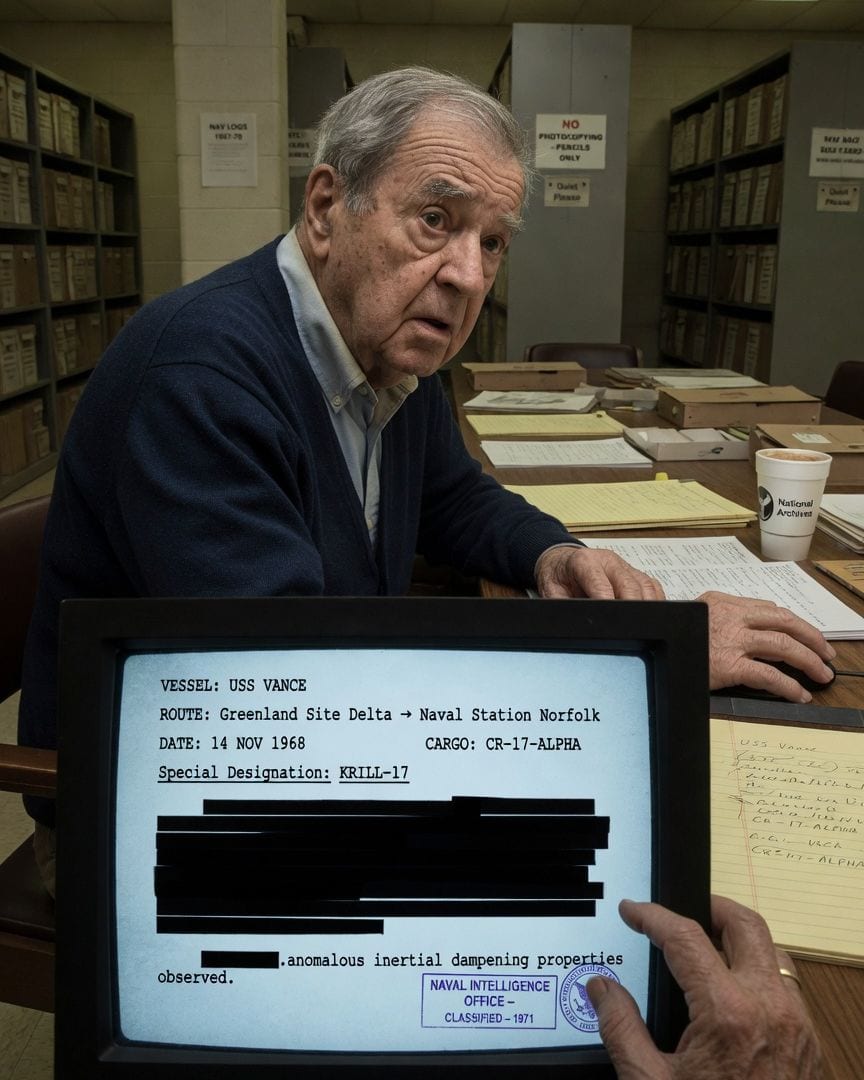
A Cold War Staff Sergeant watched his cargo stay perfectly level as his ship bucked a storm. Fifty-six years later, a log confirmed its impossible physics.
Staff Sergeant Ivo Krall, 22, gripped the rail of the USS Vance, facing his last assignment before separation. The North Atlantic raged in 1968, tossing their 10,000-ton Cold War transport vessel like a toy. His mission was simple: watch a dark, unlabeled container that must not be turned. As the storm bucked the ship violently, Krall watched, soaked to the bone, as the massive crate remained perfectly level, defying the ship's every lurch. Fifty-six years later, still haunted by the impossible sight, Krall, now 78, found a declassified log confirming the container's "anomalous inertial dampening properties." What impossible truth had Naval Intelligence hidden for decades?
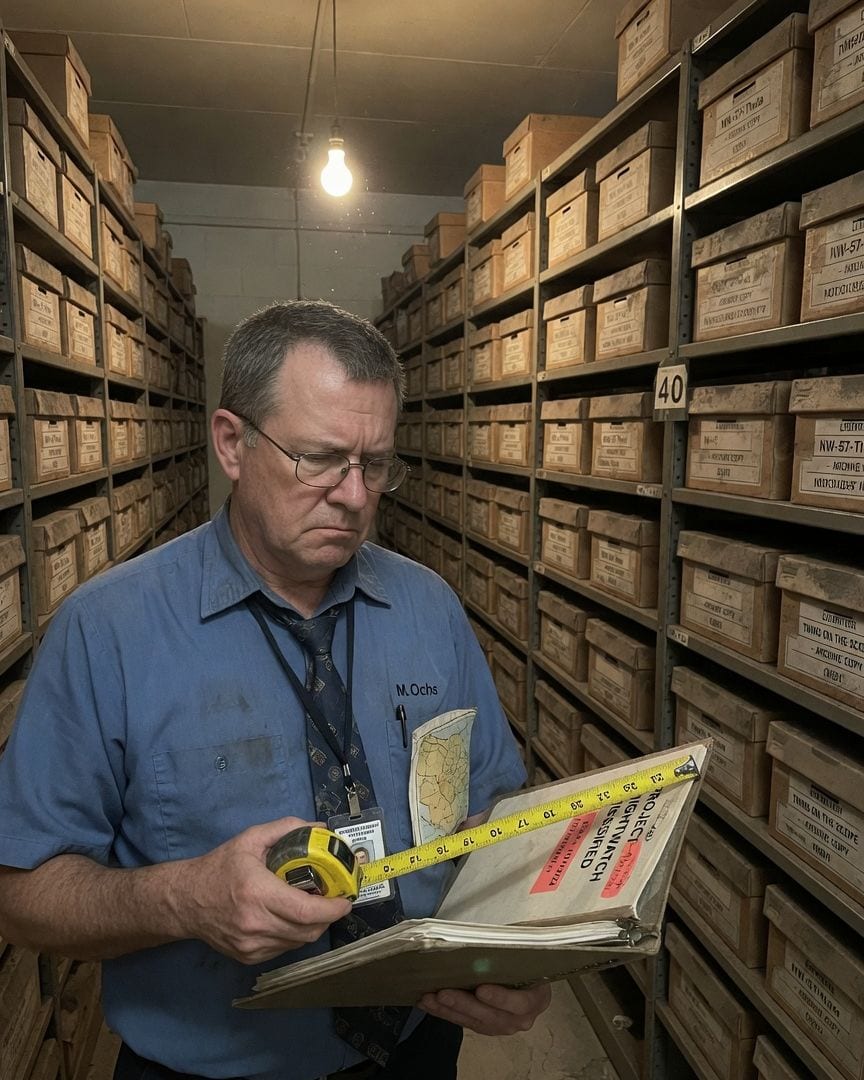
A Cold War records clerk on his final patrol found Aisle 40 stretched 61 feet longer, lined with unknown boxes. Inside one: 'PROJECT NIGHTWATCH - CLASSIFIED' with a fresh timestamp.
Marlin Ochs, a creature of habit after nineteen years at the St. Louis federal records depot, faced his final patrol through Aisle 40 before its scheduled pulping. His routine walk, usually 92 precise strides, suddenly stretched to an impossible 119, making the aisle 61 feet longer than its blueprint. The extra section felt colder, lined with dust-laden boxes bearing alien classification codes and no manifest. Inside one, he found a metal-bound file: 'PROJECT NIGHTWATCH - CLASSIFIED,' dated 1957, but with a timestamp just hours old.
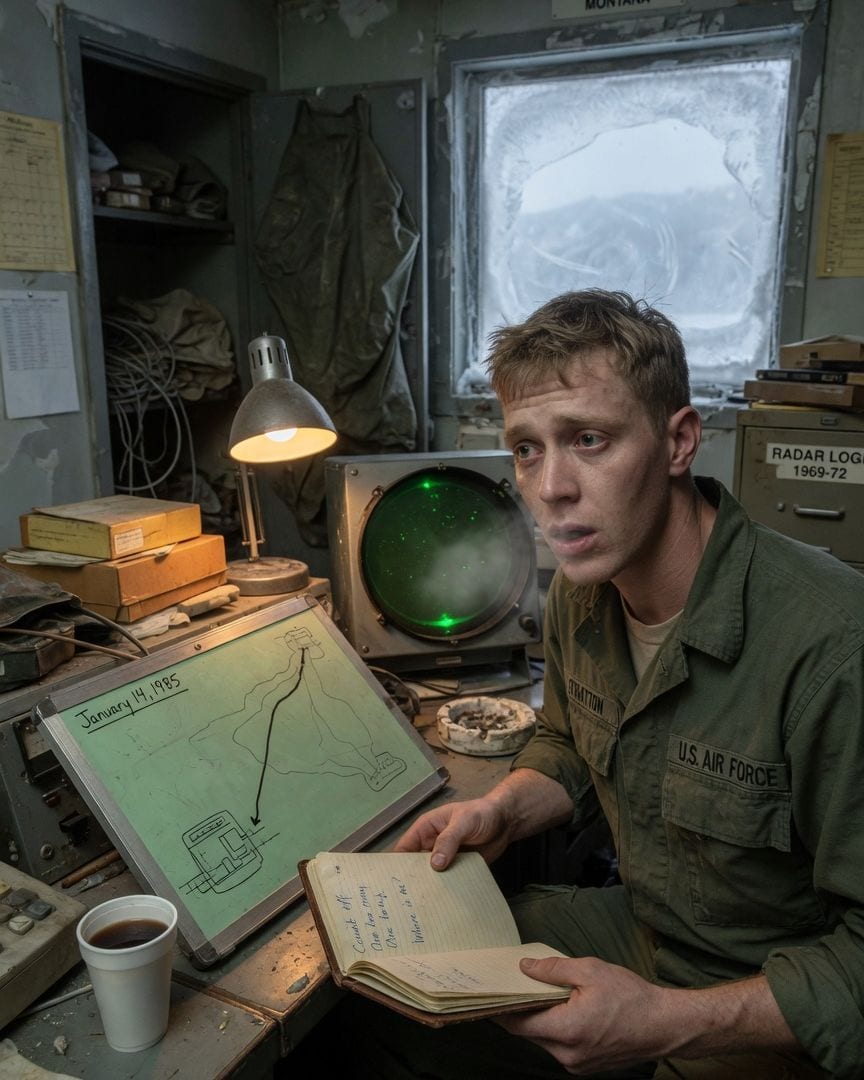
Airman Lars Stratton found an old Cold War manifest listing one name twice: 'Bernard Radcliffe' transferred and 'Bernard Radcliffe' still present.
Airman Second Class Lars Stratton was counting down his final weeks at Echo Station, a desolate Cold War outpost due for mothballing. He longed for home, far from the bitter Montana winds and the constant hum of static. Inside the dim radar shack, he logged the usual nightly ghost blip, a faint contact appearing at 2300, just as it had every winter since 1987. This night, a metallic tang like old blood lingered in the air, raising the hairs on his arms. Seeking distraction, Lars later discovered a leather-bound logbook from 1971, detailing the same 2300 contact, but with chilling notes and a manifest listing one airman's name, Bernard Radcliffe, twice—once transferred, once present. Was he truly alone in the silent, remote station?
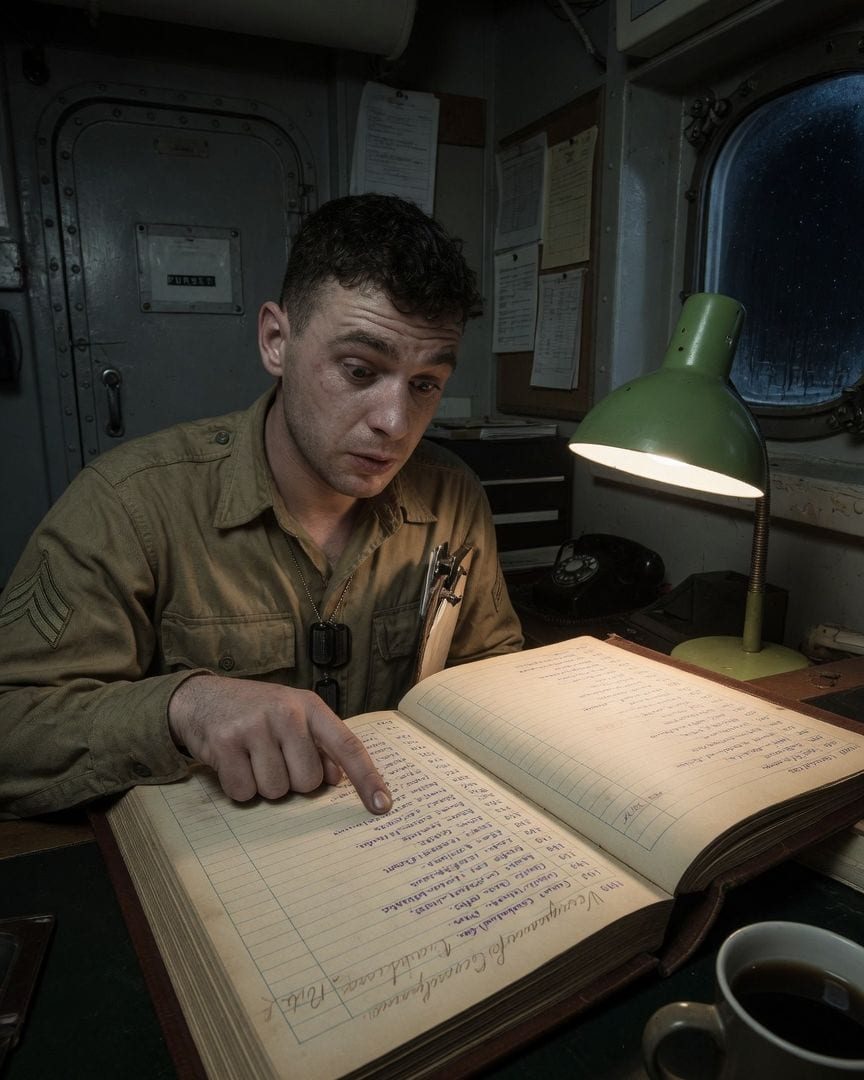
On his final crossing, Corporal Kowalski found a WWI soldier's name: 'Vestergaard, Corporal, 1918,' on his 1943 manifest.
Corporal Arthur Kowalski was on his final Atlantic crossing aboard the USS Harrington, a promised reprieve before reassignment, but the cold Atlantic air was nothing compared to the chill seeping into his bones. Despite the official roll listing 402 men, the boat drill revealed 403 soldiers lined up, an impossible discrepancy that defied every record. His discreet investigation led him to the ship's master embarkation roll, where beneath the 1943 entries, he found a faint, handwritten name: 'Vestergaard, Corporal. 1918.' A World War I soldier’s name, in archaic ink, woven into a modern manifest – how could such an impossible entry exist?
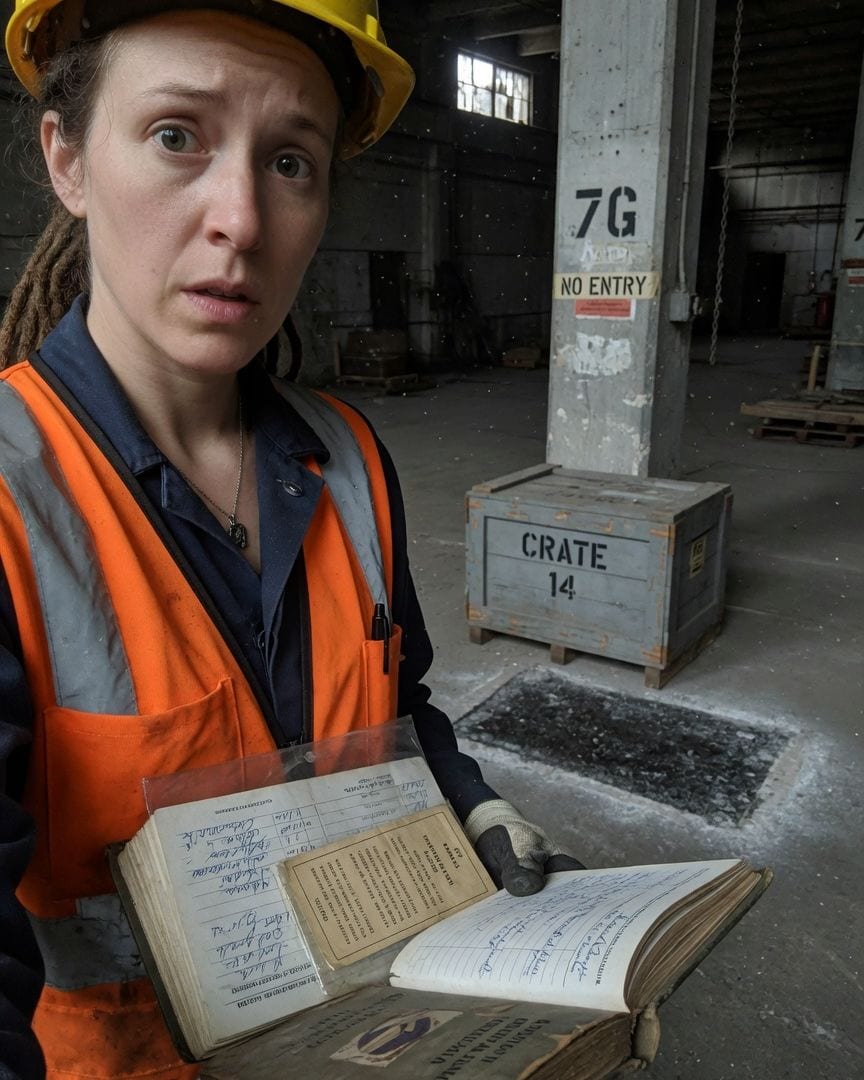
An inventory specialist's final check of a Carolina Cold War warehouse before demolition finds a crate signed for last week, years after the base closed, radiating impossible cold.
An inventory specialist, Deborah Kessling, raced a demolition deadline for a vast Carolina military warehouse, shuttered for years with its employees gone over a decade prior. Her final task was to log its forgotten contents. In a shadow-choked corner, she found Crate 14, radiating an impossible, decades-old chill. Its attached logbook showed a recent maintenance entry from 'Last week,' signed by a civilian contractor no one should have been, yet meticulous quarterly signatures stretched back sixty years, an unbroken chain of checks, even as the paper itself grew cold in her hands. What impossible secret had been so carefully maintained in this forgotten place?
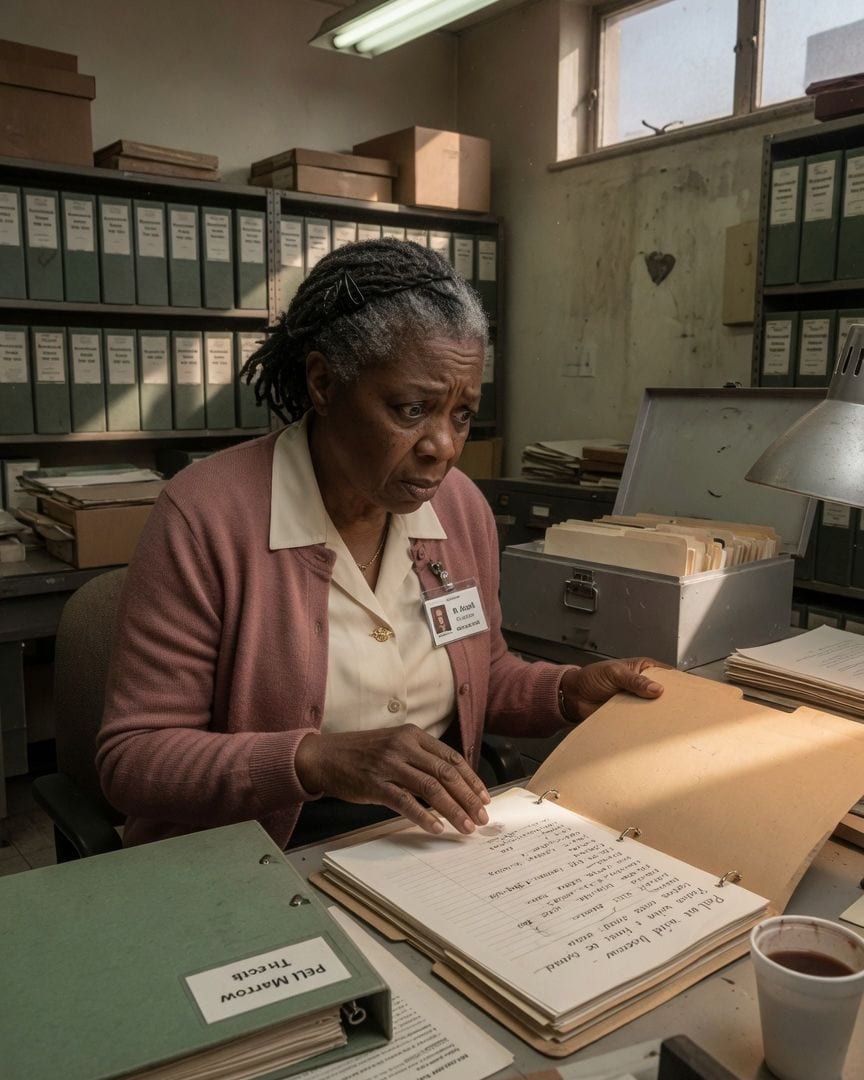
A records clerk's archive file for a Cold War reconnaissance plane lost in 1968 showed it flew yesterday to her own building.
Marguerite Ansell, a records clerk nearing her final week before retirement, meticulously audited Cold War-era files. In the cool, dusty archive, she pulled a file for an oiler declared missing in 1951. Inside, she found a fueling schedule with entries stretching into the present, the last dated just eleven days ago. Then, a second lost ship revealed a similar impossible log, and a cold certainty began to bloom in her chest. Deep in the shadows, Marguerite found an unmarked steel box containing a file for a reconnaissance plane lost in 1968. Its flight log showed a final flight yesterday, to the precise coordinates of her own archive building.