My dead colleague's badge, deactivated weeks ago, logged an entry at 1:40 AM last Tuesday. Then I found another from 1978, with the same impossible times.
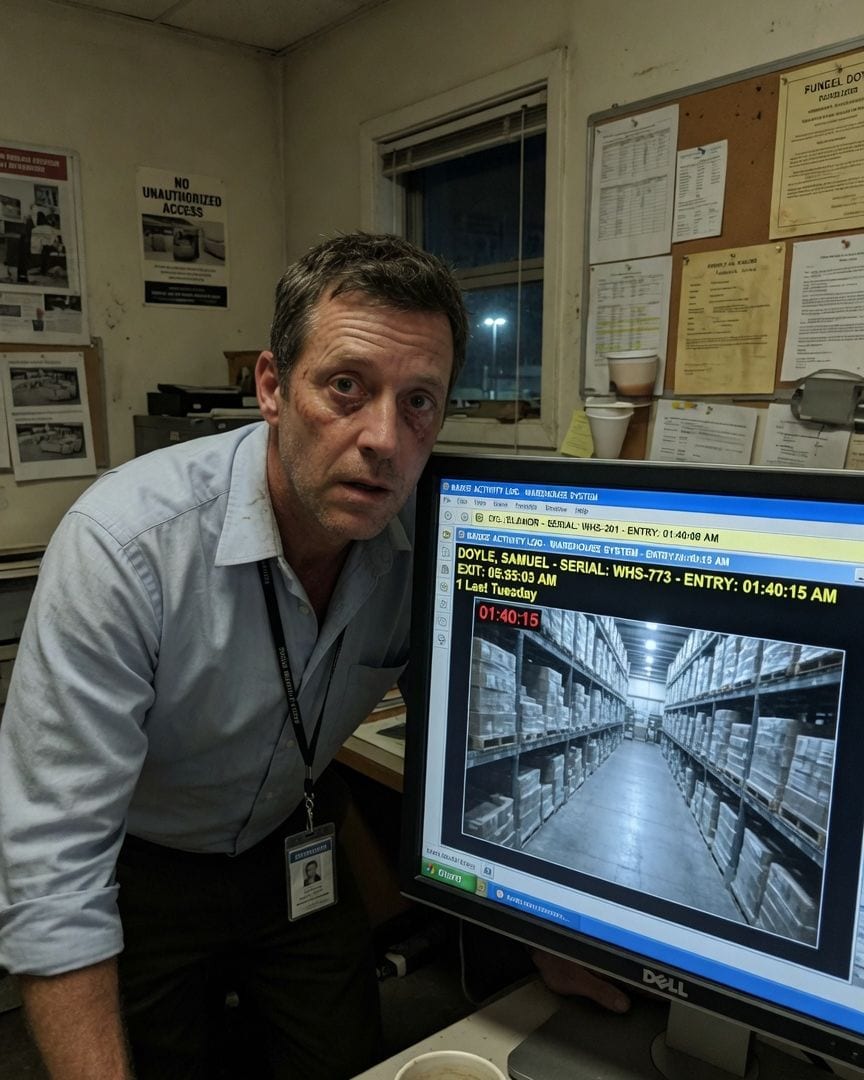
The glowing digits on my monitor felt like a punch to the gut. Samuel Doyle, age 58, night shift lead, a good man. Dead and buried three weeks ago.
And yet, there it was: "DOYLE, SAMUEL – SERIAL: WHS-773 – ENTRY: 01:40:15 AM." The warehouse card reader log, dated last Tuesday, just a few days shy of a month since his funeral. It was precise, down to the second.
My stomach churned. Samuel’s badge had been deactivated by HR the day we laid him to rest. I remembered Vivienne in HR confirming it.
I pulled up the security footage, the file already cached in my system. Expected a glitch, a phantom signal, maybe some electrical interference playing tricks. The timestamp clicked to 1:40:15 AM. Aisle 7, just past receiving.
The camera angle was perfect, sweeping the wide expanse between the towering shelves. Only, there was nothing. Just silent racks, neatly stacked pallets, and long, deep shadows stretching into the dimness. No Samuel. No one.
The aisles were utterly, perfectly empty. The clip played out, silent and still, for minutes. Then, the system registered his exit, just as impossible: "DOYLE, SAMUEL – SERIAL: WHS-773 – EXIT: 05:55:03 AM."
Five minutes before the first shift started rolling in. A clean, dated clip of nowhere, yet the digital log, which I trusted implicitly, swore Samuel had been there. I couldn't unsee it.
I called Vivienne Mitchell in HR first thing. Her office was bright, smelling of lemon polish, a contrast to the cold, cavernous warehouse. "Serial WHS-773," I told her, my voice tight. "Samuel Doyle's badge. Is it still deactivated?"
She pulled up the records on her screen. "Yep. Collected it myself the day of the funeral, Richard. Locked it right here," she patted a secure drawer beside her desk, "along with his access cards. Absolutely deactivated."
She looked at me, a slight frown forming. "Why? Is there a problem?" I mumbled something about a system check, a potential ghost in the machine, and hung up. I didn’t want to share the impossible. Not yet.
That night, I stayed late. The silence of the empty warehouse was different now, heavier. I re-watched the footage, not just Aisle 7, but every single camera angle from 1:30 AM to 6:00 AM. Frame by frame.
I zoomed in on the shadows, checked for any flicker, any movement that could have been missed at first glance. Nothing. The warehouse was a tomb, undisturbed.
Then I cross-referenced the badge log with every other system: general activity logs, motion sensor reports, light activation records. No other movement. No other badges swiped. Not a single forklift engaged. No lights coming on in Samuel’s usual work zones.
Just his badge, a digital phantom appearing and disappearing without a trace.
I tried to find any similar anomalies in the past few months. A misread badge, a system error, a duplicate entry. Anything to ground this in a technical malfunction.
I dug through months of data, filtering for 'unexplained night entries' or 'deactivated badge activity'. Nothing in the recent records. Our system was robust, designed to be foolproof, updated just last year. This wasn’t a glitch.
It was too specific, too perfectly aligned with Samuel’s old shift hours, even the precise entry and exit times. The mundane explanations were failing, one by one, leaving a cold prickle of unease spreading beneath my skin.
Driven by a growing, unsettling hunch, I expanded my search, pushing deeper into the company’s older, archived digital logs. Years, then decades. I filtered again, desperately, for ‘deactivated badge activity’ and ‘unexplained night entries.’
The system whirred, churning through what felt like endless data. Hours passed. My eyes burned.
Then, a line of glowing text flashed on the screen. It caught my breath.
‘FLETCHER, ELEANOR – SERIAL: WHS-201 – ENTRY: 01:40:08 AM – EXIT: 05:55:12 AM.’
The date listed was from 1978.
I pulled Eleanor Fletcher’s HR file from the digital archives. It was scanned from old paper, grainy and yellowed. Died: October 14, 1978. Funeral: October 17, 1978. Badge Deactivated: October 17, 1978.
The badge log entry? November 8, 1978. Three weeks after she was buried.
I stared at the glowing text on my screen: the digitized log from 1978, Eleanor Fletcher’s name, the 1:40 AM entry, the 5:55 AM exit, dated three weeks after her recorded death.
The dates were too precise, the times too exact, a pattern unfolding from the past.
I was consumed. Eleanor Fletcher’s history became my obsession. I dug deeper, finding old microfiche records in a dusty cabinet, personnel files from before the digital age. Eleanor, like Samuel, had been a night shift supervisor. And there were others.
A handful of similar entries, spaced out over decades, all following the chillingly consistent 1:40 AM entry to 5:55 AM exit pattern. All for employees officially deceased, their badges supposedly deactivated.
These specific entries weren't in the main security database, I noted, but in a separate, obscure digital archive. It was labeled 'Legacy Access' – a system I'd never even known existed, seemingly for long-term data retention rather than active security.
It was tucked away, forgotten, like an old ghost in the machine.
The warehouse itself felt different now, too. The familiar hum of distant machinery and the occasional creak of settling steel seemed to carry a new weight.
I started noticing an old, disused intercom system in a rarely-visited corner of the warehouse, its grille thick with dust and spiderwebs. I’d always assumed it was defunct, just part of the building’s antiquated bones.
But now, late at night, when I was reviewing the logs, I occasionally caught a faint, almost imperceptible hum emanating from it.
A low, thrumming sound that vibrated faintly in the air, seeming to align, unsettlingly, with those historical 1:40 AM entry times. I tried to activate it, pressing the faded 'TEST' button on its side. Nothing. It remained silent.
The hum was just background noise, I told myself, a faulty transformer or old wiring, but the hairs on my arms prickled.
I was hunched over a terminal in the archive room, a small, windowless space usually reserved for obsolete files and forgotten documents. Dust motes danced in the pale light from the screen.
I was trying to cross-reference the 'Legacy Access' entries with property deeds, looking for any historical anomalies related to the land Whitfield & Sons was built on.
I was deep in a rabbit hole of forgotten corporate history, trying to find some logical, if obscure, explanation.
Then, miles away, in the main warehouse, the old intercom system I’d been observing crackled. It was too faint to be a voice, just a sharp burst of static that vibrated through the silent building, a whisper of interference.
But immediately, my work terminal pinged. An internal message, sender 'ADMIN,' flashed on my screen. The subject line was blank.
The body of the message, however, was stark: 'RICHARD BROOKS. THIS IS NOT YOUR CHANNEL. CEASE INQUIRY.'
A cold dread spread through me, chilling me to the bone. No one else knew I was even looking at this 'Legacy Access' system, let alone that I was in the archive room.
No one should have been able to send an internal message from an untraceable 'ADMIN' account. The message was too direct, too specific.
I tried to trace the sender, but the 'ADMIN' account was a ghost, untraceable within the company network, a dead end. I glanced nervously around the empty archive room, the silence suddenly oppressive. Someone was watching.
Someone knew exactly what I'd found.
The next morning, I sought out Malcolm Thornton. Senior Warehouse Supervisor. Malcolm had been with Whitfield & Sons for over forty years, a fixture.
He was known for his quiet efficiency, his almost unnervingly calm demeanor, a man who moved through the vast warehouse like a ghost himself. I found him inspecting a shipment, his back to me.
I laid out my evidence: Samuel's log, Eleanor Fletcher's log, the 'Legacy Access' system, the intercom hum, and finally, the message on my terminal. I spoke quickly, trying to make sense of the chaos in my head.
Malcolm listened, his face unreadable, his eyes fixed on some distant point.
I pressed him, my voice barely a whisper. "What is this, Malcolm? What's going on here?"
Malcolm sighed, a slow, deliberate sound, like air escaping a very old mechanism. "The warehouse… it holds more than inventory, Richard." His voice was low, steady, without a trace of surprise or fear. "Some duties… they continue."
"Duties?" I demanded, the calm I'd tried to maintain crumbling. "Samuel is dead! Eleanor has been dead for decades! Who is sending these messages?"
Malcolm looked directly at me, his eyes ancient, as if he'd seen the passage of centuries. "The channel. It’s always been here. Since before Whitfield & Sons even existed as a name. The company… we maintain it.
We tend to it." He explained, not with fear or even concern, but with a weary, matter-of-fact acceptance. Certain individuals, he said, were chosen.
Not by HR, but by the 'channel' itself, to continue their 'work' in an unseen capacity after their official 'departure.' The badge logs were simply the system’s way of marking attendance, a digital register for a different kind of payroll.
"It’s an arrangement," Malcolm finished, his gaze unwavering, "a very old one. Your message… it means the channel has noticed your interest. It means it’s looking at you, Richard. Just as it looked at Samuel. And Eleanor."
Malcolm, having delivered his chilling explanation with the casualness of discussing a forklift repair, simply turned and walked away, leaving me stunned in the middle of the warehouse floor.
A profound sense of wrongness settled over me, the world tilting on its axis. I wanted to dismiss it. An old man's delusion, a coping mechanism for decades of working in a lonely, isolated place. A bizarre joke.
But the precise logs. The untraceable message. The cold, unwavering calm in Malcolm's eyes – it all rang with an awful truth that no rationalization could dismiss.
I returned to my office, my mind racing. I needed to confirm. I needed something, anything, to definitively refute Malcolm, to prove him wrong.
I logged back into the 'Legacy Access' system, intending to find more evidence that it was all a mistake, a relic of some forgotten, bizarre corporate experiment, a meaningless database.
I navigated to the most recent entries, hoping to see a blank slate, a sign that the pattern had, somehow, finally ended.
Instead, a new entry flashed on the screen. My breath hitched.
My own name, 'RICHARD BROOKS,' appeared in the 'Legacy Access' system. Beneath it, the chilling designation: 'ASSIGNED: LEGACY DUTY. SHIFT: 01:40 AM - 05:55 AM.'
The date for my first 'shift' was still months away, but it was there, undeniable, a future already written.
I found Malcolm again, my face pale, a tremor in my hands as I pointed at my own name on the screen. "What is this?" I whispered, the calm gone from my voice, replaced by a raw terror.
Malcolm glanced at the screen, a faint, sad smile touching his lips. "It's your assignment, Richard. The channel has chosen you."
He elaborated, his voice still unsettlingly placid. The founder of Whitfield & Sons, he said, back in the late 1800s, made a pact.
The land the warehouse stood on, a former burial ground, allowed the company to prosper, but it demanded a perpetual 'caretaker' for the 'threshold' it contained.
The 'Legacy Access' system, originally a physical ledger, then punch cards, now digital, was the 'channel' that identified those with a particular affinity or 'resonance' to the site. Samuel, Eleanor, and the others were all 'resonators.'
Their official 'deaths' were merely transitions. Their badges, even deactivated, became conduits, allowing their essence to register their continued presence in a dimension where the warehouse wasn't just a building, but a perpetual liminal space.
The empty footage was because their 'work' wasn't visible to ordinary light. "You've been here long enough, Richard," Malcolm said, his gaze settling on me. "The channel has recognized your… dedication."
Every strange log, every hum from the intercom, every warning, now clicked into place with horrifying coherence.
Desperate, I tried everything. I attempted to delete my entry from the 'Legacy Access' system, but the delete option was greyed out, unclickable. I tried to remove Eleanor's, Samuel's – same result. It was immutable.
I attempted to resign from Whitfield & Sons, typing out a formal resignation email to HR, but it bounced back with a cryptic 'Recipient unknown' error, despite Vivienne Mitchell’s email address being correct and active just yesterday.
I tried calling her, but her line was perpetually busy, ringing endlessly without going to voicemail.
I confronted Malcolm, yelling, my voice hoarse. "You can't do this! I won't!"
Malcolm simply shook his head, his calm unbreaking. "It's not a choice, Richard. It's an assignment. It's already done."
Fuelled by a terrifying resolve, a need to see the impossible with my own eyes, I demanded to see this 'threshold,' this 'unseen part' of the warehouse.
Malcolm, with a heavy sigh that seemed to carry the weight of decades, led me. We walked through rarely-used sections, past towering, silent shelves of forgotten inventory, until we reached a drab, unmarked wall.
There, I saw it: an old, metal-reinforced door, long sealed and painted over to blend with the wall, now standing almost imperceptibly ajar.
A faint, low hum, deeper and more resonant than the intercom's, emanated from the crack, vibrating in the floor beneath my feet. I pushed the door open a few inches.
The space beyond was utterly dark, a blackness that seemed to absorb light, but I felt a profound, cold stillness. I caught a fleeting glimpse of something tall, indistinct, slipping deeper into the blackness, a ripple in the absolute dark.
The hum intensified, a silent vibration that seemed to settle deep in my bones. I knew, with chilling certainty, I cannot escape.
Richard continued his work at Whitfield & Sons. Outwardly, his routine remained unchanged. He still managed operations, attended meetings, and supervised shifts. He saw Malcolm every day, and they exchanged polite, if hollow, greetings.
He stopped checking the 'Legacy Access' system; he knew his name was still there. The hum from the disused intercom system no longer bothered him.
He sometimes found himself staring at the unmarked door at the end of the aisle, feeling a strange pull towards its darkness. A profound, quiet resignation settled over him, replacing the fear. He was just waiting now.
Patricia Whitfield, the Logistics Coordinator, noticed the subtle changes first. Richard's meticulous efficiency was still there, but his eyes seemed a little too distant, a little too focused on something beyond the immediate task.
He'd started staying later, long after everyone else had left, sometimes until 1:30 AM, just standing by the main card reader, watching the digital display. His face, usually animated, had taken on a placid, almost serene quality, a quiet acceptance.
Patricia saw him by the badge reader again last night, just before closing, and when she asked if he was heading home, he gave a faint, wrong little smile. "Soon," he said.
If this one got to you
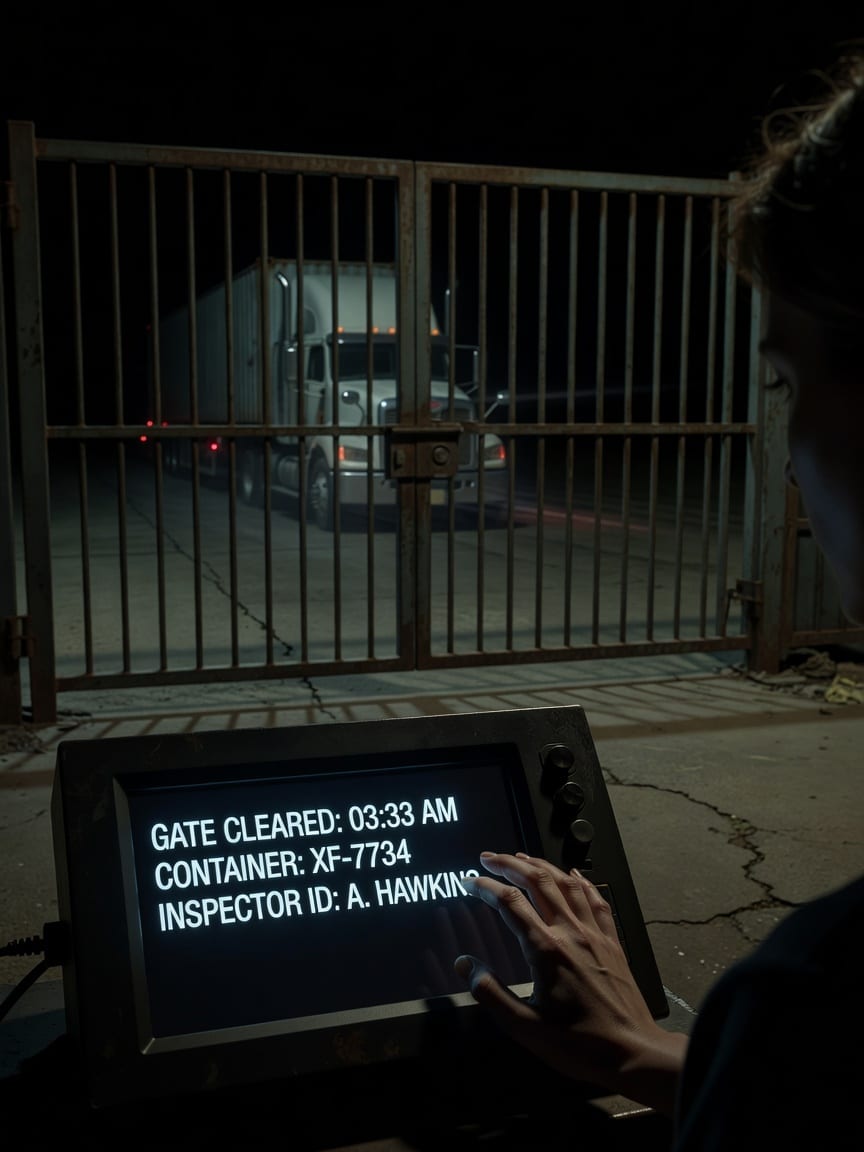
My gate log shows a container left at 3:33 AM, stamped with my ID. The yard was closed, the gate down, and I was asleep.
Audrey Hawkins' inspection log shows a container cleared at 3:33 AM, an impossible time when the gate was locked and no one was working. Her supervisor dismisses it as a glitch, but Audrey can't shake the specific details. Digging into old archives, she finds a handwritten ledger entry from 1974 for the exact same container, signed by a man who died half a century ago.
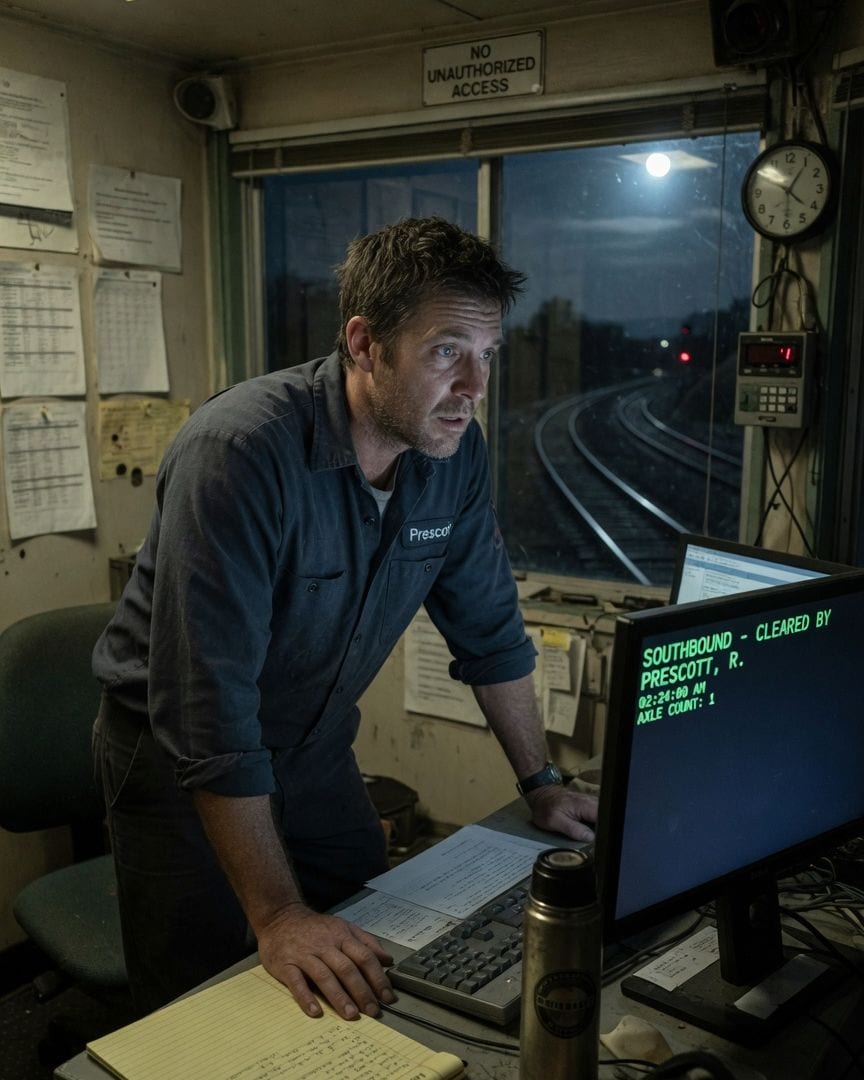
My signal box log shows I cleared a southbound train at 2:24 AM. No train was booked, but the wheel counter ticked over once.
My night shift in the signal box is usually quiet, just the hum of the panel and distant trains. But at 2:24 AM, a log entry for a southbound train appeared on screen, cleared by my name, even though I hadn't touched a thing. A cold prickle ran up my neck when the wheel counter ticked once, confirming an impossible passage on the empty tracks.
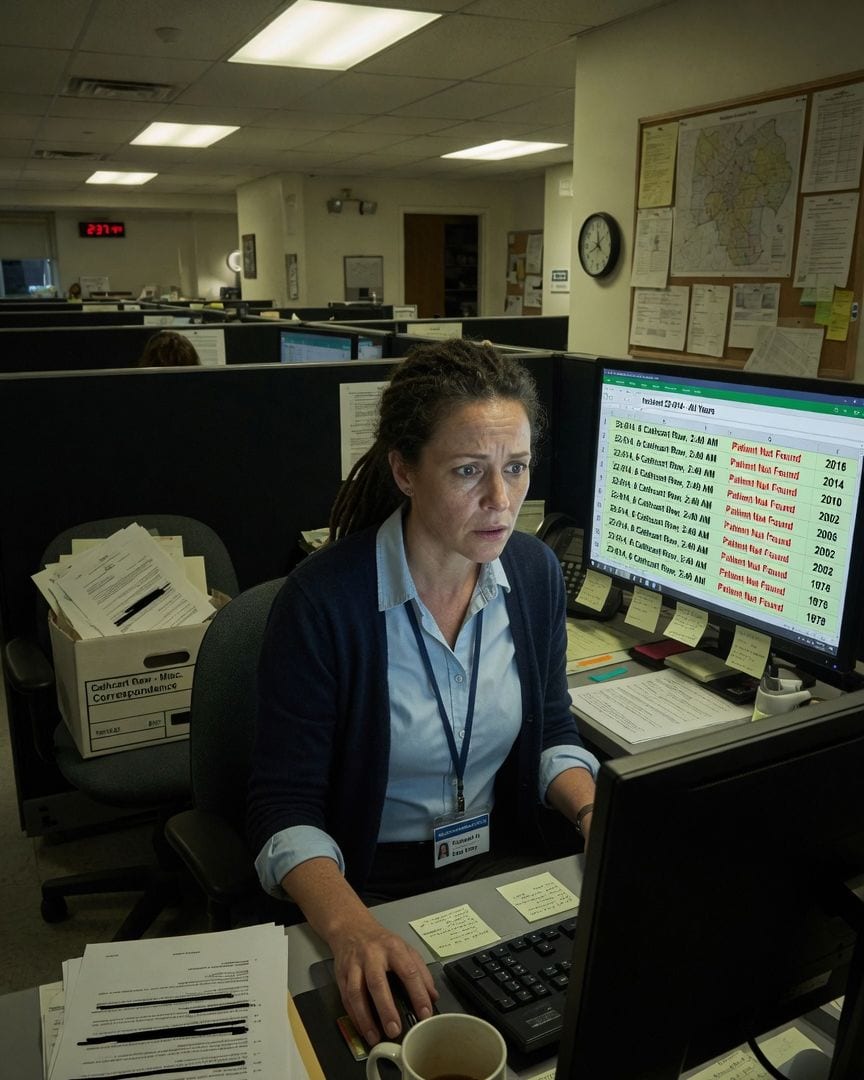
My computer log shows the same 2:40 AM call to Cathcart Row, every four years since 1978, always closed 'patient not found'.
Working data entry for the County Ambulance Trust, I found a routine incident logged as 'Patient Not Found.' But digging deeper, I discovered the exact same phantom call had repeated every four years for over forty years, always at the same address, always at 2:40 AM. Then I found a heavily redacted memo linking it to my own street.
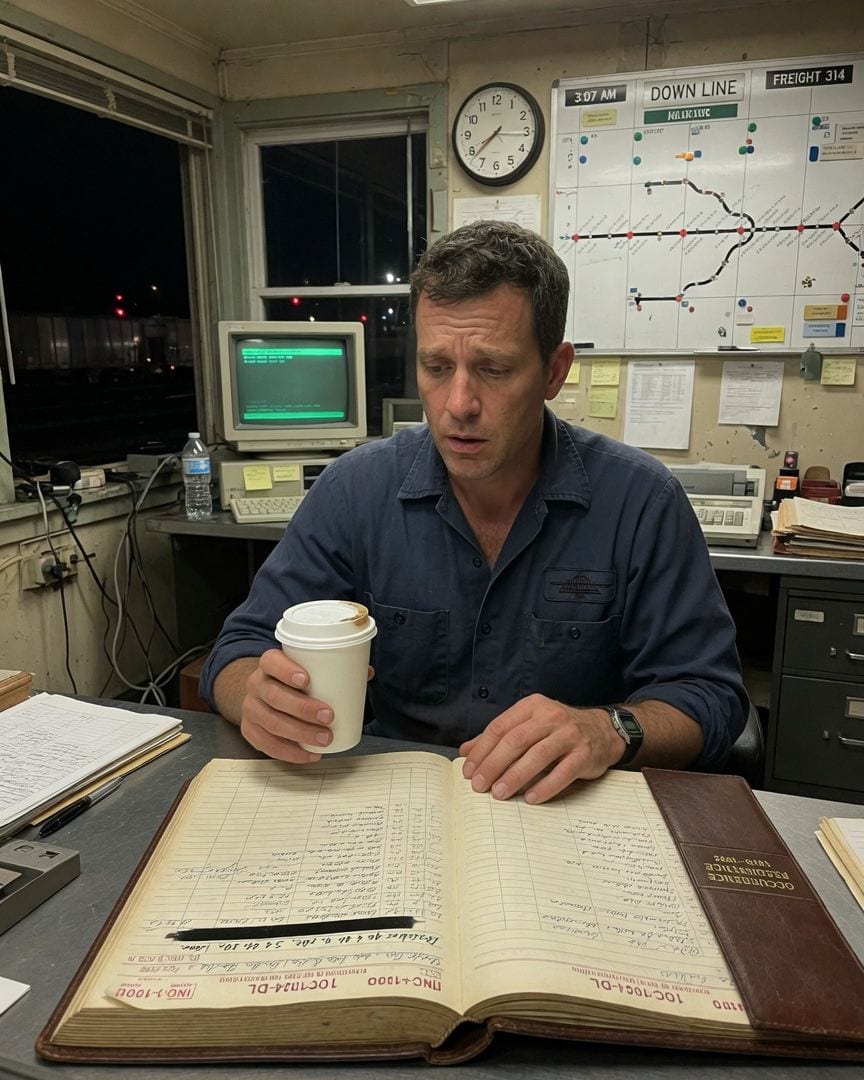
My new colleague's face is identical to a woman in a 1958 archive photo. She was declared 'the woman on the down line' for decades.
Working my solitary shift in the signal box, I found a blacked-out entry in the old occurrence register. It noted 'the woman on the down line' and the instruction 'do not stop.' This same strange entry, word-for-word, recurred every October 4th, back through the years from 1988. It felt like a chill in the routine, a silent dread in a book of transient events.
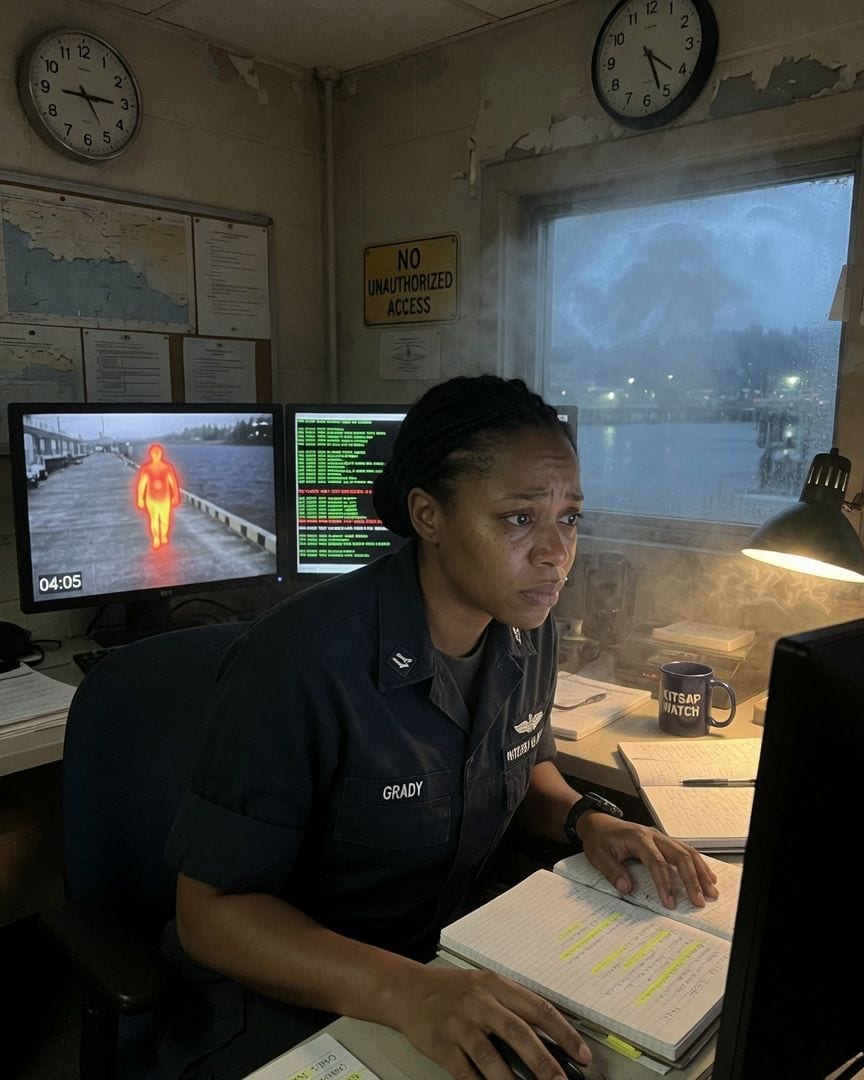
Petty Officer Olivia Grady found the base system logging impossible access at 0405. Every night for years, a blank ID walks Pier 7.
Petty Officer Olivia Grady stood her predawn watch on Pier 7, the cold mist of Puget Sound a familiar companion. Her routine scan of monitors at 0405 was shattered when an IR sensor flared with a man-sized heat bloom moving along the pier. Yet the camera feed showed only empty concrete and swirling mist. When historical logs confirmed the invisible presence had walked that exact path every night for years, Olivia dug deeper. She found a ghost "access log" entry with a unique ID but no name attached, meticulously aligned with the 0405 bloom. What impossible entity was the base system logging, night after night?
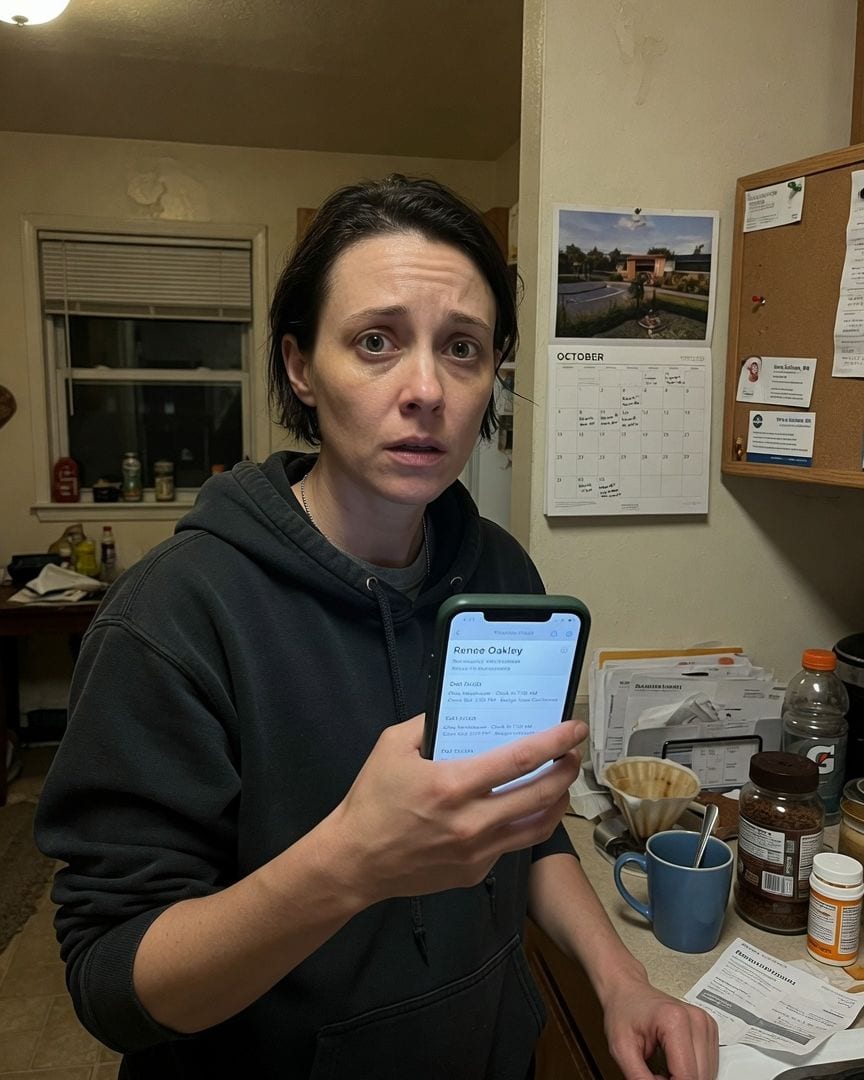
My company clock-in system says I worked full shifts in Ohio all last week. I was on medical leave in Florida, under a nurse's care.
Back home from medical leave, my payroll deposit was unexpectedly high. I checked my timesheet, only to find it logged me working full 40-hour shifts at the Ohio warehouse. But I was hundreds of miles away in Florida, confined to a sickbed under a nurse's care. Then my manager called: security footage confirmed I entered the warehouse.