A declassification reviewer listened to a Cold War pilot's final transmission. Nine minutes after impact, a second voice answered his landing checks with a perfectly modulated 'Check' – and a low hum vibrated in the room.
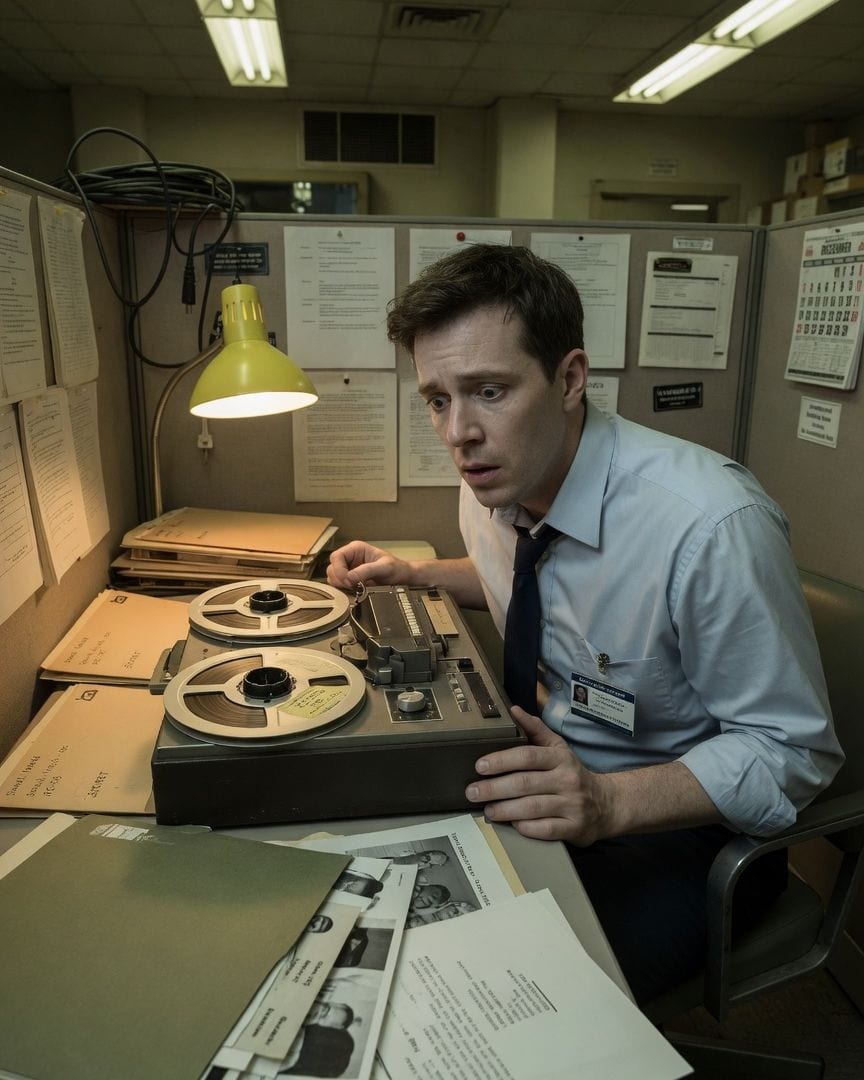
Elliot Rutherford sat in his cubicle, the stale air of the National Archives pressing down on him. A stack of Cold War-era files waited, each bound in a thick, faded jacket.
He was a declassification reviewer, and his desk was a graveyard of forgotten secrets, soon to be resurrected for public consumption. He pulled the top file: 'Sowell, Harold - KC-135 Viper 7 Incident, 1962.'
Inside, beneath a brittle cover page, lay a letter from Marguerite Sowell, age ninety-one. Her elegant, trembling script thanked the Air Force for the declassified details of her husband's disappearance, sixty-one years late.
Attached was a copy of the mission tape transcript. Captain Harold Sowell was the pilot of the KC-135 'Viper 7,' lost in the Labrador Sea on December 14, 1962.
Elliot skimmed the coordinates, the weather report, the official pronouncements of severe icing, then his eyes snagged on the final few minutes of the transcript.
Nine minutes past the estimated impact time, Captain Sowell's voice, remarkably calm, continued to read a landing checklist. 'Landing gear, checked.' 'Flaps, twenty degrees, checked.' But it wasn’t just Sowell.
A second voice, equally calm and perfectly modulated, answered each challenge with a simple, resonant 'Check.'
The official report, folded behind the transcript, dismissed it as a 'transcription error' or 'tape anomaly,' but Elliot felt a chill that had nothing to do with the archive’s conditioned air. The voices were too distinct, too consistent.
He reread the last lines, the two voices, one human, one mimicking, performing a perfect, impossible landing into the black, crushing water. The official explanation felt flimsy, a thin sheet of paper against an oceanic depth of wrongness.
The transcript clung to Elliot like a static charge. He couldn't shake the image of Captain Sowell, calmly guided by an unseen co-pilot, into the abyss. He requested the original 'Viper 7' file from the deep archives.
Vivienne Blackwood, a senior archivist whose tenure stretched back through decades of government secrets, retrieved it. Her expression remained unreadable, a practiced neutrality that gave nothing away.
The file was heavier, thicker than Elliot had expected, bound in faded olive drab, smelling of mildew and forgotten history.
He carried it back to his workstation, feeling its weight in his hands. Nestled deep within, beneath layers of redacted reports and official pronouncements of 'loss of aircraft, crew, and mission,' Elliot found a small, unmarked reel-to-reel tape.
It was labeled only with the tail number, 'Viper 7,' in block letters.
But a smaller, almost hidden sticker on the spool’s inner hub caught his eye, barely visible in the dim light: 'FOR INTERNAL EYES ONLY - DO NOT DUPLICATE.'
He tested a mundane explanation: maybe it was a duplicate, a mislabeled training tape for ground crews. But the classification, stark and absolute, was far too high for a routine administrative error.
Elliot carefully threaded the tape onto an old playback unit in a soundproofed room down the hall, a relic itself from a bygone era of classified audio. The room hummed with the quiet industry of the unit powering up.
Static crackled, then cleared, replaced by the familiar cockpit sounds: the low hum of engines, the intermittent squelch of radio chatter, Captain Sowell's voice, clear as day, perfectly matching the transcript.
Elliot leaned in, listening intently for the second voice, half-expecting a crackle, a distortion, anything to explain it away as a technical glitch, a frayed magnetic strand.
But when it came, the answering 'Check' was unnervingly clear, perfectly modulated, and carried a subtle, low-frequency hum beneath it that vibrated through the playback unit's casing. It was a sound too deliberate, too resonant, to be accidental static.
Elliot sat alone in the archives, the old reel-to-reel tape spinning, its reels turning with a quiet purpose. Captain Sowell’s voice, clear as day, broke the silence: 'Flaps, twenty degrees.'
The calm, perfectly human-like 'Check' followed, without a hint of static or distortion. Then Sowell: 'Gear, down,' and the same voice, 'Check.'
The hum beneath it was almost imperceptible, a deep, resonant thrum that vibrated through the desk, and Elliot felt it in his teeth, a strange ache.
He leaned closer, realizing the 'checks' were not just words, but carried a subtle, impossible echo, as if spoken from inside a vast, enclosed space, yet right beside the captain.
The hum and the impossible echo from the 'Viper 7' tape haunted Elliot. He tried to rationalize it, to find a technical explanation, but the sheer clarity of the anomaly defied every logical pathway.
He sent a digitized copy of the tape to an audio forensic specialist, requesting a detailed analysis of the background frequencies and vocal signatures.
The reply, when it came, was a terse email citing 'classified origins' and an inability to process the request due to 'national security protocols.' It was a bureaucratic stonewall, cold and absolute.
Undeterred, Elliot pivoted. He began cross-referencing the 'FOR INTERNAL EYES ONLY' classification with other archived files, a slow, painstaking process that consumed his days and nights. He sifted through thousands of entries, searching for that specific, hidden tag.
After weeks, he found a handful of other 'lost' incident reports from the same era, spanning different branches of service. A submarine, the USS Dolphin, that vanished in the Pacific in 1968.
A coastal patrol boat, the P-37, lost off the Carolinas in 1971. A small research vessel, the Polaris, in the Bering Strait in 1975.
Each file, initially dismissed as a tragic accident or equipment failure, had a similar 'internal eyes only' tag.
More disturbingly, each contained a cryptic, often heavily redacted, addendum. The Dolphin file mentioned 'anomalous sonar readings during final contact.' The P-37 report noted 'unexplained procedural compliance during radio silence.'
The Polaris log cited 'unusual atmospheric pressure fluctuations consistent with controlled descent.' Elliot also noticed a recurring, faint outline of a project code, partially obscured, but consistent across these disparate files.
The letters were faint, almost erased, but they appeared to spell 'ORACLE.'
Elliot brought his printouts and findings to Vivienne Blackwood. She listened patiently, her hands folded on her desk, her face betraying nothing, a perfect mask of professional indifference.
She confirmed that 'ORACLE' was a real, highly compartmentalized project from the Cold War era, but claimed its records were 'destroyed in a fire in '83.'
Her eyes, however, lingered on a printout of the 'Viper 7' transcript lying on Elliot's desk a moment too long, a flicker of something unreadable in their depths. The office air felt thick with unspoken history.
Elliot felt a subtle, unnerving shift in the archive’s atmosphere after his conversation with Vivienne. His requests for certain 'ORACLE'-tagged files, which had previously been met with standard delays, now faced unusual, almost intentional, roadblocks.
System errors, missing documents, 'files currently in transit.' He found his workstation logged out more often than not, even after he was certain he had locked it down for the night.
The small, petty annoyances began to coalesce into a pattern of deliberate obstruction.
One evening, working late, he saw Vivienne Blackwood in the restricted records section, a vast labyrinth of floor-to-ceiling shelves.
She wasn't processing new files; instead, she was sifting through old, dusty boxes, her back to him, illuminated by the single swing-arm lamp on her cart.
When she finally turned, she was holding a small, unmarked gray folder, its edges softened by age. Their eyes met across the dim rows of shelves. She offered a tight, unconvincing smile.
'Just tidying up, Elliot,' she said, her voice a little too light. 'Some of these old boxes can be quite a mess.' The folder remained clutched in her hand.
The next morning, a sealed, unmarked envelope lay on his desk. Inside was a single, typewritten note: 'Some things are better left filed.' No signature, no sender.
The message was unnerving, a cold breath on his neck, but it also confirmed his growing suspicions: someone knew what he was looking for, and they wanted him to stop.
He realized he needed to seek out someone outside the archives, someone who might have been involved in the early 'ORACLE' projects before the alleged 'fire.'
He found a listing for Colonel Kenneth Merritt, retired Air Force, who had been a liaison officer to a joint-service 'special projects' unit in the late 60s.
After several attempts—a polite letter, a phone message, an email—Merritt, surprisingly, agreed to a brief, off-the-record meeting at a quiet diner on the outskirts of the city.
Merritt arrived precisely at the agreed time, a man in his late seventies, impeccably dressed. He was wary, his posture stiff, but his gaze was sharp, missing nothing.
Elliot slid the 'Viper 7' transcript across the table and began to speak of 'ORACLE.' Merritt’s jaw tightened almost imperceptibly as he picked up the paper, his eyes scanning the final, impossible lines.
'Some things,' he said, his voice a low rumble, 'aren't meant to be declassified. The cost is too high.' The air in the diner, thick with the smell of old coffee, seemed to grow heavy.
At the diner, Elliot pushed. 'What cost, Colonel? What exactly was Project ORACLE?'
Merritt took a long sip of his cooling coffee, his eyes scanning the sparse diner, as if checking for unseen listeners. 'It wasn't a project, not in the way you think,' he finally said, his voice barely above a whisper.
'It was a protocol. A way to... process. When something didn't fit the known world.' He placed the 'Viper 7' transcript back on the table, pushing it slightly towards Elliot. 'Captain Sowell was reading a checklist. Someone was answering him.
That's what you found, isn't it?'
'Yes,' Elliot confirmed, a knot tightening in his stomach. 'Perfectly calm. Perfectly coordinated. Nine minutes after they should have hit the water.'
Merritt nodded slowly, a deep weariness etched into the lines around his eyes. 'Yes. They always did. They mimicked us. Our procedures. Made it coherent, in their own way.' He explained that 'They' were never identified, never explained.
They just… took. 'Aircraft, ships, even small units. They'd vanish, but not like a crash. More like... a transfer. And the last thing we'd get was always a sequence. A checklist, a roll call, a set of instructions.
Followed perfectly, by both sides.'
The implications slammed into Elliot. Merritt wasn't describing a series of accidents. He was describing a systematic collection. Merritt continued, his voice devoid of emotion, a detached recounting of impossible facts.
'ORACLE' was established to handle these incidents, to classify them as 'lost' while archiving the anomalous data separately. 'The internal eyes only tag?' Merritt looked directly at Elliot. 'That meant 'ORACLE asset.' Not lost, not found. Filed.'
Elliot’s mind raced, connecting the dots. The low-frequency hum on the tape, the impossible echo – it wasn’t a glitch, but the entity's signature.
The other 'lost' files he had found, the 'unexplained procedural compliance,' the 'anomalous sonar readings' – it all snapped into chilling focus. These weren't accidents; they were collections. Deliberate. Organized.
'And the institution,' Elliot asked, the words feeling foreign in his mouth, 'the Air Force, the Navy… they just… allowed it?'
Merritt looked at him, his gaze heavy with decades of unspoken truths. 'We recorded it. We tried to understand. We learned to file it. What else could we do? They don't want anything else. Just the assets. And the paperwork.'
He took another sip of coffee, the cup rattling slightly against the saucer. 'You found a file that's still being written, didn't you, Mr. Rutherford?'
Elliot returned to the archives, the weight of Merritt’s words pressing down on him, turning the familiar, quiet space into something profoundly sinister. He knew he'd exposed a decades-long secret, a horrifying pattern of systematic disappearances.
He found the 'ORACLE' folder Vivienne had been holding the previous night, now mysteriously back in its proper, albeit still uncatalogued, location amidst a row of generic 'Miscellaneous Records' boxes.
It was thin, containing only a few pages. One was a directive, signed by multiple high-ranking officers, outlining the 'ORACLE' protocol for 'anomalous asset relocation,' detailing steps for incident reports, data capture, and classification.
Another was a list of 'processed assets,' spanning from the 1950s to the late 1980s. The entries were chillingly brief: 'USS Triton, 1968, Pacific - Protocol 7-Beta. Delta Force Recon, 1979, Laos - Protocol 3-Alpha.'
Each entry had an associated 'internal eyes only' file number, precisely as Merritt had described.
Elliot felt a prickle of cold along his spine. He found a hand-written addendum at the bottom of the list, dated just last week, concerning a recently reported 'lost at sea' incident in the Pacific.
It was a new file, a new disappearance, but the handwriting on the addendum, a neat, looping script, instantly familiar, matched Kenneth Merritt’s notes from a 1960s document he’d seen earlier. Merritt was still involved, still filing.
Below the new entry, a single line was scrawled, stark and terrifying: 'Rutherford, E. - file initiated.' A cold dread, sharp and absolute, washed over him. He realized the 'file that is still being written' now included him.
Elliot clutched the 'ORACLE' file, his own name a brand on its last page. He raced out of the archives, the silence of the building now a palpable threat, to Merritt’s diner, but the Colonel wasn't there.
He called his home; no answer, only a distant, impersonal ring. He tried Vivienne Blackwood, but her phone went straight to voicemail.
The archive, he realized, wasn't just a building; it was a labyrinth of complicity, an active component of the system.
He reviewed the 'ORACLE' file again, his eyes fixed on the new entry. It detailed a modern cargo ship, the 'MV Laura Prescott,' reported missing in the Pacific just days ago.
The 'protocol' was 7-Beta, the exact same designation as the USS Triton. Elliot remembered the faint echo on the 'Viper 7' tape, the sense of a vast, enclosed space.
He cross-referenced the Triton file – it explicitly mentioned anomalous sonar pings during its final communication.
He found a digitized copy of the Prescott's last known telemetry, a hastily compiled annex to the new 'ORACLE' entry. It included a brief, distorted audio burst from the ship's bridge.
He isolated it, running it through the same audio forensic software that had stonewalled him earlier, but this time, he knew exactly what to look for.
The software, initially reluctant, now highlighted a series of deep, resonant pings within the distorted audio, a precise, rhythmic pattern.
It was a rhythm that perfectly matched the 'checks' on Captain Sowell's tape, and the cadence of the 'extra voice' from the Delta Force roll call he’d found in another 'ORACLE' file. It was a signature, unmistakable.
The entity wasn't just taking planes and ships; it was communicating with them, guiding them, using their own procedures, into what must be an underwater 'filing system.'
The institution, he realized, wasn't just passively archiving these disappearances; they were acting as a quiet, terrified liaison, facilitating the collections, ensuring the 'paperwork' was in order for these silent, impossible transfers.
The horror was in the sheer, bureaucratic coherence of it all. It wasn’t chaos; it was an operation.
Elliot knew he had to escape, to expose this. He tried to download the 'ORACLE' file and all associated evidence onto a secure drive, but the network connection suddenly dropped, dead. A cold wave of dread washed over him.
He heard footsteps approaching his cubicle, slow and deliberate, echoing in the suddenly silent archive. It was Vivienne Blackwood, her face a mask of calm, devoid of any surprise or anger.
'Elliot,' she said, her voice soft, barely a whisper in the vast, quiet space, 'you shouldn't have dug so deep. Some files aren't meant to be opened.'
He tried to bluff, to act ignorant, to deny, but she simply gestured to the 'ORACLE' folder lying open on his desk, his name glaring up from its last page.
'The new entry,' she continued, her gaze unwavering, 'it's quite clear. Your name, your file. The protocol has been initiated.'
Elliot felt a cold dread solidify in his stomach, a physical weight. He realized he wasn't just a witness; he was the next 'asset.'
He made a desperate lunge for the file, intending to at least destroy the evidence of his own 'filing,' to somehow disrupt the pattern, but Vivienne moved with an unexpected speed, blocking his access to the desk.
Her grip on his arm was surprisingly strong, not the grip of an older woman, but something far more powerful. 'It's no use,' she murmured, her voice still unnervingly calm. 'The system is comprehensive. And very patient.'
He saw a faint, almost imperceptible shift in her eyes, a depth that wasn't there before, a knowing calm that mirrored the voice on Captain Sowell's tape. He struggled against her, but her strength was overwhelming, unnatural.
He felt a strange numbness begin to spread from her touch, creeping up his arm. The hum, the same low frequency from the 'Viper 7' tape, seemed to emanate from her, filling the silent archive, vibrating through his very bones.
He realized, with dawning horror, that Vivienne wasn't just a part of the institution; she was part of the filing machine itself, an extension of the entity, ensuring the paperwork, and the assets, were processed.
His vision blurred, the hum intensifying, and he felt himself being pulled, not physically, but as if his very essence was being carefully, methodically, extracted and cataloged.
He reached for his desk, for the file, for anything solid, but his hand passed through a faint shimmer, a boundary he could not cross.
The last thing he saw before the archive faded to black was Vivienne Blackwood's calm, knowing smile, the hum now a resonant chord within his very being, a sound that promised an eternal, silent filing.
Days later, Elliot Rutherford's apartment was cleaned out, his lease terminated. His former colleagues received a terse internal memo about his 'transfer' to a highly specialized, off-site project, to be handled remotely.
At the National Archives, Vivienne Blackwood was observed by a new junior archivist, patiently demonstrating the proper procedure for updating a specific, unmarked gray folder. She carefully added a new, handwritten entry to a list within: 'Rutherford, E. - Processed.'
The junior archivist nodded, meticulously copying her movements, learning the system. Vivienne Blackwood then closes the folder, a faint, almost imperceptible hum emanating from the old paper, and places it back on a shelf, where it waits.
If this one got to you
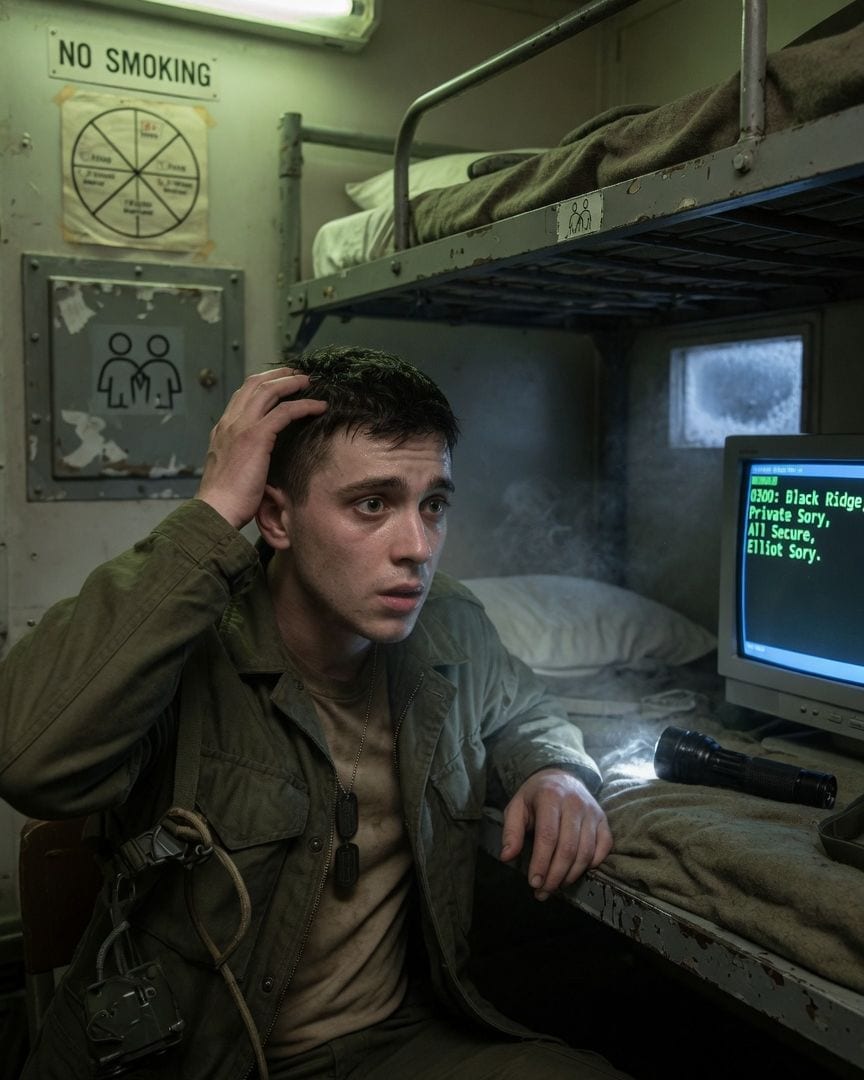
Private Sory's own voice answered his radio check, speaking his name before he could. Then the official log swore he had said it.
Private Elliot Sory shivered in the cold comms shack, three weeks into his first remote posting at Black Ridge. He knew the outpost's strange, strict rule: never say your name on the net after dark. But during his solitary 0300 radio check, a voice undeniably his own filled his headset, stating 'All secure, Elliot Sory,' before he'd even finished keying the mic. The official log later confirmed the transmission, showing no sign of his attempt to speak, only the seamless record of his name being broadcast. What force in the desolate outpost had spoken for him?
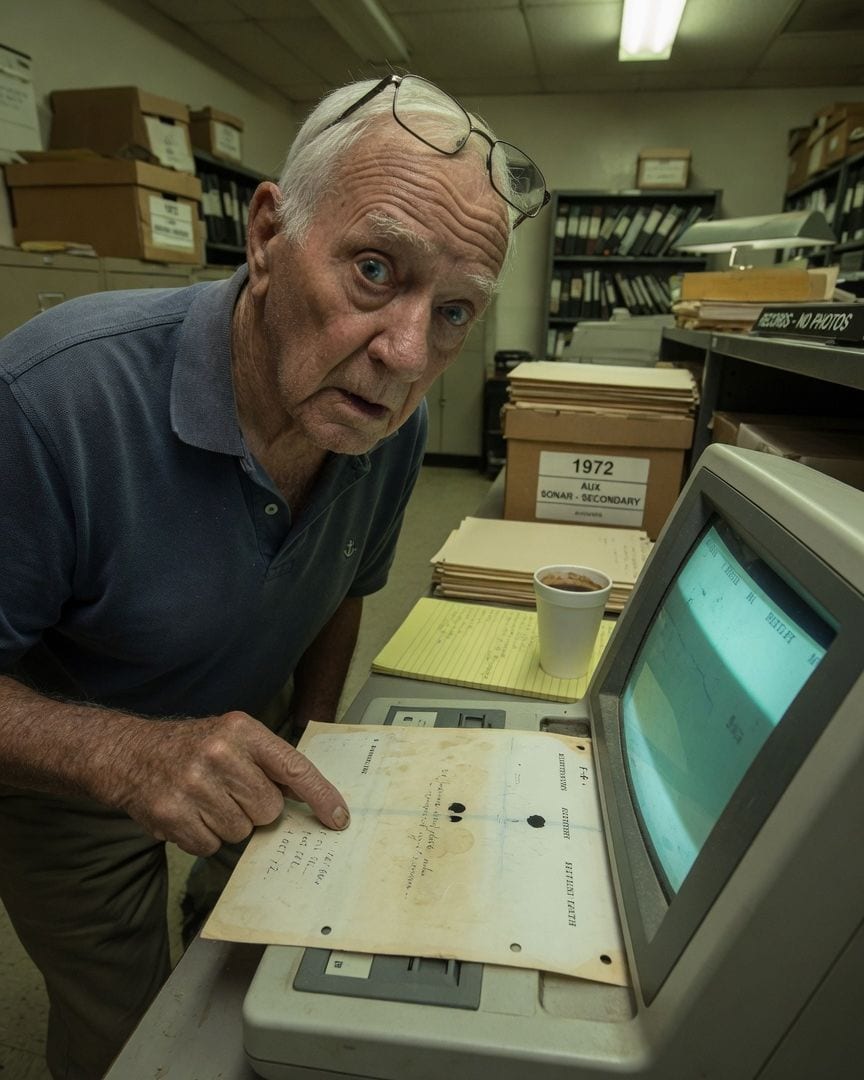
A Chief Petty Officer's salvage career ends when a Cold War fighter jet surfaces at sixty tons, perfectly intact.
Chief Petty Officer Walter Mabey, then 45, expected a routine salvage operation for a lost F-4 fighter jet off the Carolina coast in 1972. His long career was built on such lifts, but as the crane gauge climbed past twenty, then thirty, then an impossible sixty tons, a profound unease settled in. The object surfaced, not a mangled wreck, but a dark, seamless shape, perfectly intact. Mabey's salvage career abruptly ended soon after, replaced by a desk job, but the memory festered for forty years. Now 78, he dedicates his remaining time to finding the truth, uncovering a faint, rhythmic pulse on an old sonar log—a ghost beneath the official lie.
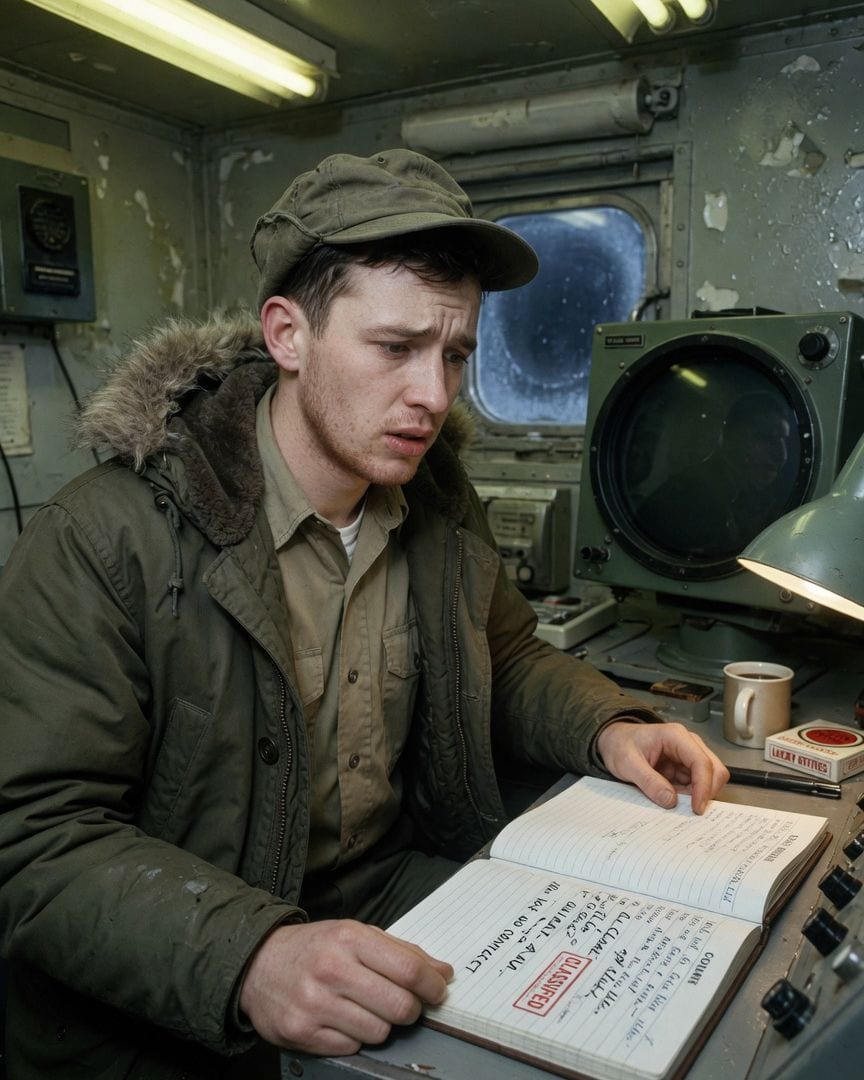
A Cold War airman logs an impossible radar contact on his last sweep. But his official logbook entry is stamped 'CLASSIFIED' and then contradicted by a hastily scrawled 'ALL CLEAR' dated moments before it.
Airman Ordway Vance, 22, manned the radar dome at Site Pellin in the biting North Atlantic dark of January 1962, running the last calibration sweep before its decommissioning. His scope picked up a faint, impossible return, growing closer with each pass, though the ocean remained empty to the eye. When Vance detailed the contact in his official logbook, a 'CLASSIFIED' stamp appeared, followed by a hastily scrawled 'ALL CLEAR' dated moments before his own entry, contradicting his every word. Commander Hartley dismissed it as equipment malfunction, but Vance sensed a chilling, official erasure behind the lie. He soon found a locked cabinet marked 'SITE PELLIN ANOMALIES,' hinting at a deeper truth buried within the base's final days.
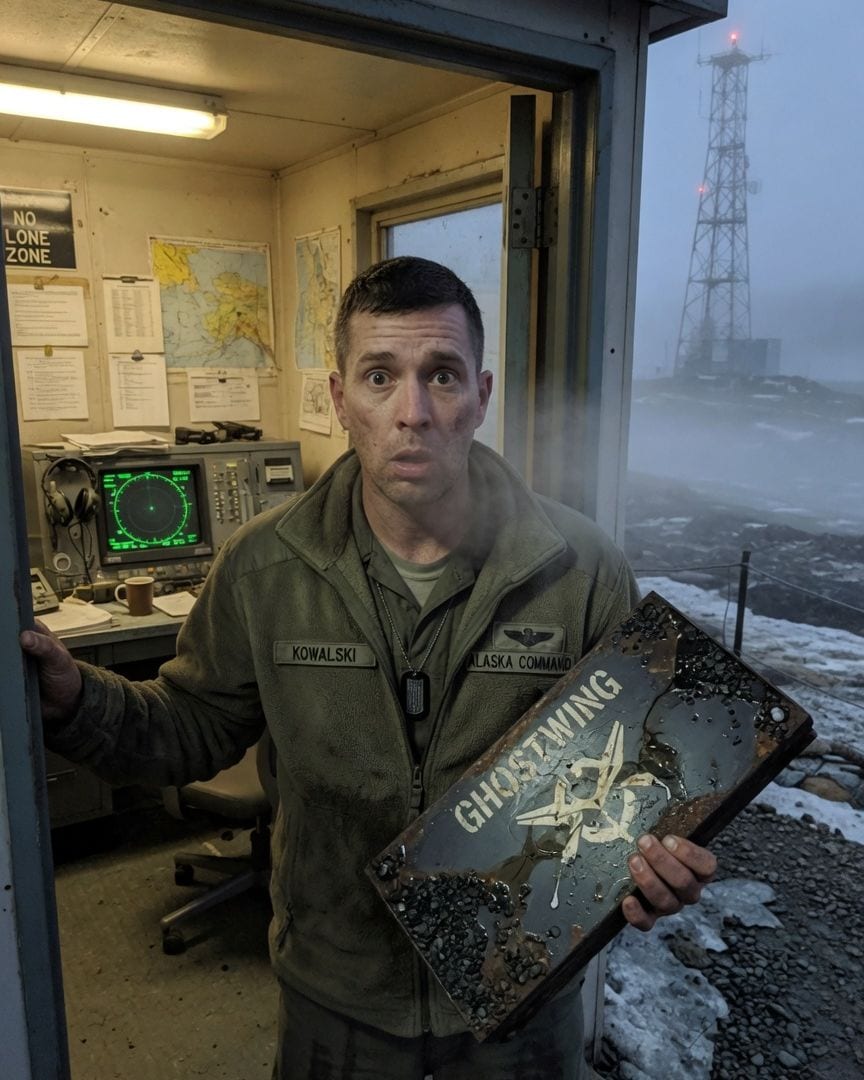
On his last rotation, Airman Kowalski heard a pilot cleared for landing by a tower that had vanished decades ago.
High atop Mount Chugach, Airman Eric Kowalski was counting down his last lonely rotation before transfer, the silence of the Aleutian airwaves his only companion. But then, his headset crackled with an urgent emergency call: a pilot in distress, cleared for landing by a controller whose facility had been decommissioned decades ago. As the phantom voices faded, a third, calm voice cut through the static, addressing him by a name that wasn't his. What impossible signal had broken through the silence, and who was Sowell?
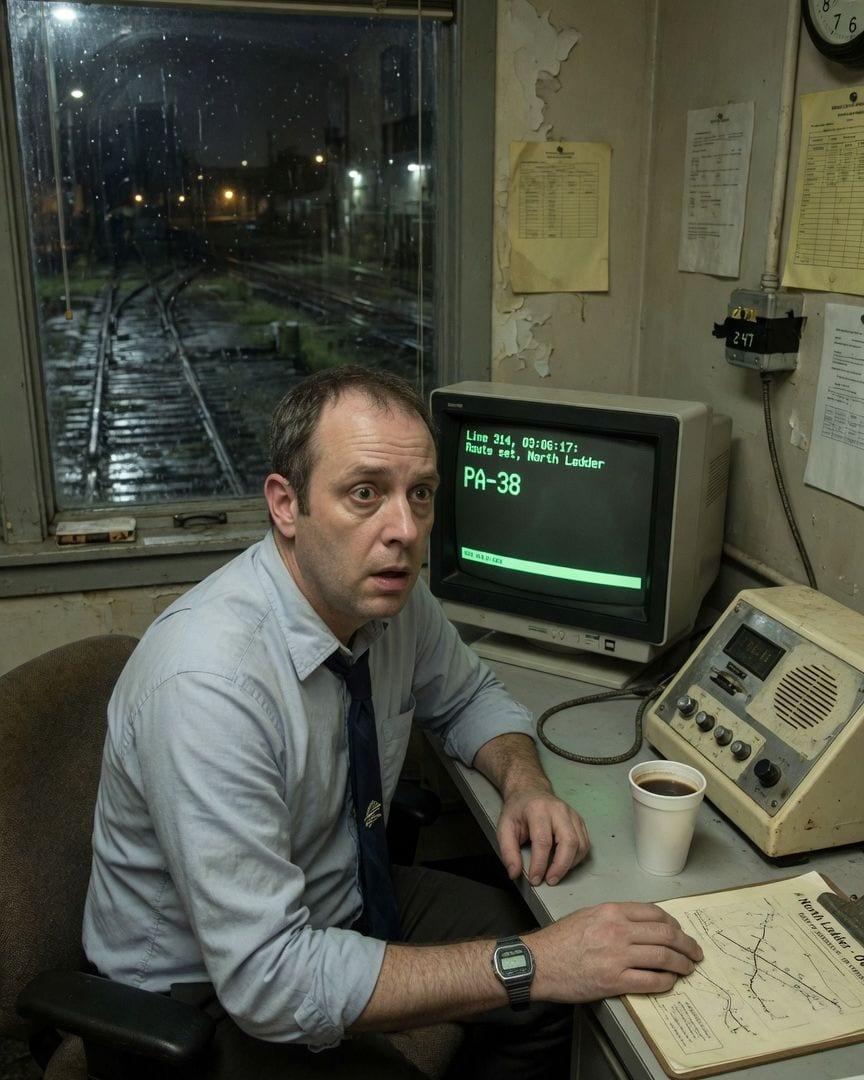
The log says my lever set a route at 3:06 AM through a track that's been shut for repair work — and the circuits show something moved down it. I never touched that lever; I sat there still.
I, Preston Abbott, a night dispatcher, was running a routine signal log check when I saw my code had set a route. It was for the North Ladder, a track decommissioned twenty years ago and physically impassable. Then, the yard's old, physically severed intercom system crackled to life, whispering a specific routing instruction for that very track.
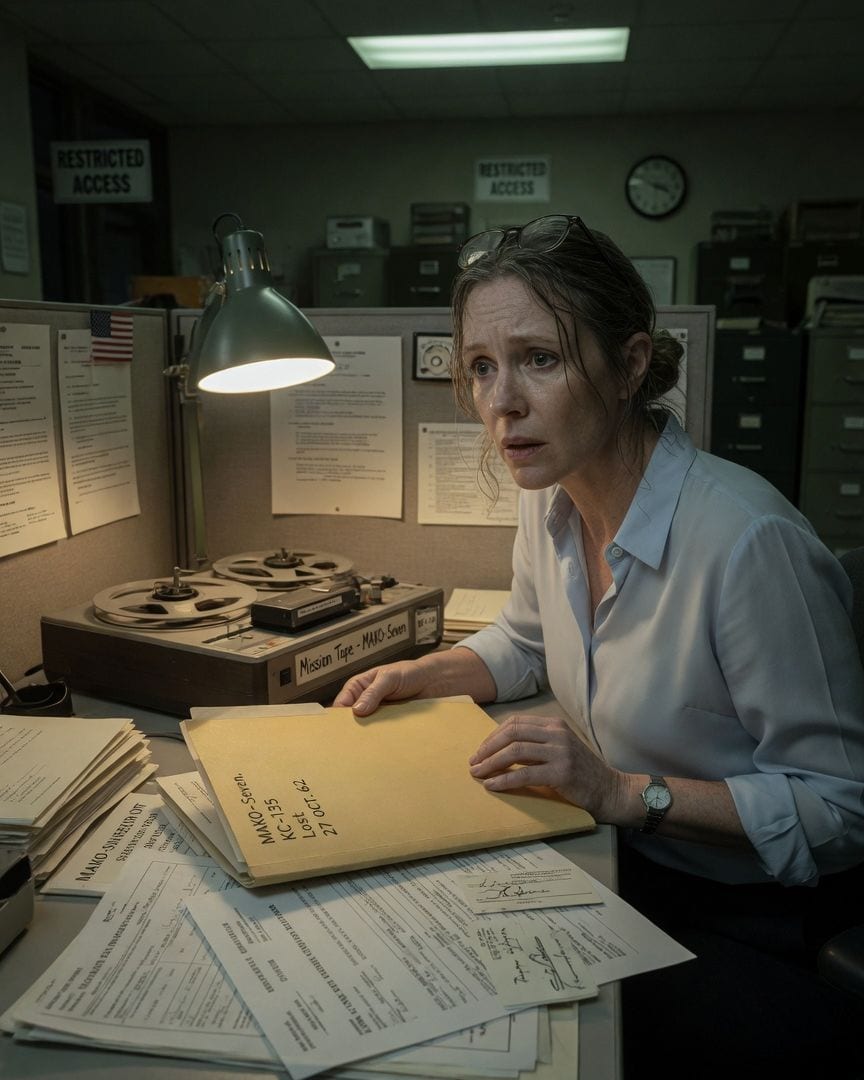
A declassification reviewer found Captain Sowell's signature authorizing parts for his lost Cold War aircraft, sixteen years after its official crash.
Janet Kingsley, a declassification reviewer, was processing a routine request for a lost Cold War mission when she made a chilling discovery. The official report stated the KC-135 MAKO-Seven impacted the Labrador Sea in 1962, but its mission tape continued for nine minutes after the official crash, with the pilot calmly landing. As Janet dug deeper into the yellowed file, she found official documents for the aircraft and pilot dated years after its disappearance. The final discovery was a requisition for replacement parts, signed by Captain Thomas Sowell himself, a full sixteen years after his plane was officially lost and he was declared dead.